 |
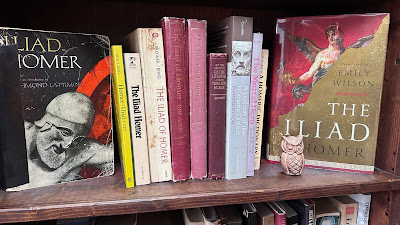
| Erechtheum the Owl says, This is important stuff. Get obsessed! |
from The Iliad
(Bk. XV, ll. 82 ff)
Let Hector turn the Greeks around again
and make them panic, lose their will to fight,
and run away until at last they fall
amid the mighty galleys of Achilles,
the son of Peleus. He will send forth
his friend Patroclus, who will slaughter many,
including my own noble son, Sarpedon.
Then glorious Hector, out in front of Troy,
will kill Patroclus with his spear, and then,
enraged at this, Achilles will kill Hector.
And after that has happened, I shall cause
the Greeks to drive the Trojans from the ships,
and force them to retreat continuously
until, through great Athena's strategies,
the Greeks have seized the lofty town of Troy.
Until that time, my anger will not cease.
-Homer (tr. Emily Wilson)
That's Zeus announcing the program of the second half of the Iliad. Hector eventually foresees his death:
(Bk. XXII, 398ff)
Then Hector understood inside his heart,
and said, "The gods have called me to my death,
I thought Deiphobus was at my side.
But he is on the wall. Athena tricked me.
The horror of my death is near me now,
not far away, and there is no way out."
-Homer (tr. Emily Wilson)
And does eventually die:
(Bk. XXIV, ll. 997ff, the very end of the poem)
After the mound was built, they went back home,
then came together for a glorious banquet
inside divine King Priam's house. And so
they held the funeral for horse-lord Hector.
-Homer (tr. Emily Wilson)
Line numbers are those of Emily Wilson's translation, and not those of the Greek. She's translating it into blank verse in English, a nice choice, but you can't get as much into a line, so it's a bit longer. Though comparisons of this sort are a little suspect, an English blank verse line has ten or eleven syllables; a line of Greek dactylic hexameter, the original meter, has twelve to seventeen syllables. (And lines of twelve syllables are very rare.)
The Iliad is a major poem, a foundational work of Western literature, a classic. If you haven't read it recently, or know it only by repute, it might surprise: it's more cleverly structured than you might think, and 'Homer' left out many of the most famous episodes (there's no Trojan horse, no death of Achilles, no several other things) in order to produce a tighter story and poem. But I'm not going to say anything about the greatness of the Iliad. It just is. I want to think about Emily Wilson's new translation, out a month or so ago.
I was very much looking forward to this. I
loved her translation of the Odyssey. Ever since I read that earlier translation, I assumed, I hoped! she would carry on and translate the Iliad. Maybe that enthusiasm was too much. Sadly I don't think this is as good.
What should a translation of Homer look like? Let's go to the most famous commentator on the subject, Matthew Arnold in his On Translating Homer:
"...the translator of Homer should above all be penetrated by a sense of four qualities of his author;--that he is eminently rapid; that he is eminently plain and direct, both in the evolution of his thought and in the expression of it, that is both in his syntax and his words; that he is plain and direct in the substance of his thought, that is, in his matter and ideas; and, finally, that he is eminently noble;..."
Arnold goes on to say, "I probably seem to be saying what is too general to be of much service to anybody." 😉 But in fact Arnold is considered kind of an expert.
My favorite of the passages I quoted above is the middle one. If one is judging for 'plain and direct', I think Wilson succeeds pretty well on both counts, that is in syntax and in ideas. Here's Richard Lattimore (1951) for comparison:
And Hektor knew the truth inside his heart, and spoke aloud:
"No use. Here at last the gods have summoned me deathward.
I thought Deiphobus the hero was here close beside me,
but he is behind the wall and it was Athena cheating me,
and now evil death is close to me, and no longer far away,
and there is no way out.
Lattimore is pretty good himself here on plain and direct, but Wilson feels to me more rapid. And her use of blank verse adds a nobility that feels lacking in Lattimore's free verse. (Lattimore's line is loosely six beat, like Homer, but not rigorous in its versification.)
But I wouldn't always say that. Here's Lattimore's final line to the whole poem:
Such was their burial of Hektor, breaker of horses.
I prefer Lattimore here; the double alliteration on B and H, which correspond across the caesura (that break, the breath you take in pronouncing the line, at the comma). It reminds me of that other great verse form for English epic, that of Beowulf.
There are places where Wilson is just flat (this is part of the description of the newly-forged shield of Achilles, Bk. XVIII, ll. 681-2):
The earth grew black behind them as if plowed,
though it was made of gold. It was amazing.
Homer does not sound like a breathless teenager. I feel we have fallen short of nobility here.
Or, this (Bk. XVI, ll.23-4):
Speak up! Do not
conceal your thoughts. We ought to share our knowledge.
Lattimore:
Tell me, do not hide it in your mind, and so we shall both know.
Now this is not Homer at his rapidest either, but Homer is swifter than either, and Lattimore is swifter than Wilson. 'So we shall both know' in Lattimore is 'ἵνα εἶδομεν ἄμφω' in Greek, a mere three words in Homer, and is a much more ordinary expression than either translation in English.
Now why did I like her Odyssey so much better than her Iliad? My library remains messed up, so I can't get a copy of her Odyssey to tell you exactly.
But here's one thing that occurred to me.You probably know that the first word in each epic is important. It's 'wrath' (Μῆνιν) in the Iliad, and 'man' (Ἄνδρα) in the Odyssey. Vergil announces his intention to combine both epics by beginning his Aeneid, 'Arma virumque', which Shaw turns into English as 'Arms and the Man'. But almost as important is the adjective that describes that initial noun. The wrath is described as ούλομένην and the man is πολύτροπον. In her translation, Wilson makes Odysseus, the man, 'complicated', and I loved that. To call a person complicated, well, we can all think of a bunch of things that might suggest, and of Odysseus, they're all true. The very word implies a new and interesting interpretation. The Greek means something more like 'of many turns', which is what it usually gets translated as. That's suggestive, but not as interesting here as 'complicated.' (The Latin root of 'complicated' suggests 'with folds', which isn't a bad change.)
She translates the adjective describing wrath as cataclysmic, not for me as interesting a word, one that suggests a flood, which isn't really quite right. (The Greek word means something closer to accursed.) So:
Tell me about a complicated man
hooked me from the start. But:
Goddess, sing of the cataclysmic wrath
put me off a bit.
I don't know. It might also just be the case I like the Odyssey better. You might, too. Wilson says in her introduction she's always been more drawn to the Iliad, and this is a common enough opinion. The Iliad is men and war and tragedy, while the Odyssey is mixed company and romance and adventure, and so the Iliad has historically been considered the greater poem. But is it? That's not really an argument I want to get into. (The Oscars are the same. Should Julia Roberts have won her Oscar for Erin Brokovich or for one of her great romantic comedies? Or think about best picture Oscars.) I've read both poems multiple times and in Greek. But I do mention that as it might have colored my interpretation.
Anyway, it's a fine translation, should you want to read the Iliad. (And you should!) But after reading her Odyssey, I was ready to throw out all my other translations and get hers in its place. (I didn't quite do that.) I did not have that reaction after reading her Iliad.


