Showing posts with label #CCSpinResult. Show all posts

Saturday, April 4, 2026

George Gissing's New Grub Street (#CCSpin)

"Best or worst, novels are all the same. Nothing but love, love, love. What silly nonsense it is."

Gissing's novel of 1891 New Grub Street isn't that kind of novel. Or not exactly.

It's not that there isn't talk about love: that's Amy Reardon above and she has just been discussing with her friend Edith why it is divorce is so difficult in England at the time. She had loved her husband Edwin at one point, but that point is probably past, beaten down by the couple's unbearable poverty.

So what it is, is a novel of money, or more, the lack of it. Balzac is referenced several times as a novelist writing on the right kind of subject.

Edwin Reardon is a novelist, maybe aspiring to be what we would now call midlist. And as in Balzac, we learn about the finances; in this case what it takes--and what you can make--as a novelist. Reardon's biggest success brought him £100, an amount that is the barest minimum for a respectable existence in London for a year. That was for a so-called triple-decker, a novel of 200,000 words or 600-800 pages. Think Middlemarch in size. He needs to write one of those a year, and with no guarantee he'll meet the demands of the moment. He can't. Book reviewing? Articles for the magazines? These pay, but not well. Reardon writes a shorter novel with a sensationalist plot; he hopes to get £75 for it, but nobody is willing to buy.

Reardon is not the only writer; the novel is set among a circle of writers. There's Whelpdale: 

"And what's more, he made six guineas in the first fortnight; so he says, at all events. Now that's one of the finest jokes I ever heard. A man who can't get anyone to publish his own books makes a living by telling other people how to write!"

There's the nearly heroic Biffen, who lives in utter poverty in a garret, has (almost) no hope of marrying, toiling away on his novel: Mr. Bailey, Grocer. Nobody expects it to be read when he does finish it. Biffen himself says of it, "The result will be something unutterably tedious...If it were anything but tedious, it would be untrue." A nod to the naturalism still mostly in the future in English?

Amy Reardon's uncle Alfred Yule writes for the magazines with the aid of his talented daughter Marian. Someday he hopes to edit his own magazine. But until then:

"Seeing him in the title-lists of a periodical most people knew what to expect, but not a few forbore cutting open the pages he occupied." 

Dora and Maud Milvain (and mostly it's Dora) write religious stories for magazines; once their mother dies, and her annuity with her, that's what they will have to live on. Dora finds the work beneath her, but she is good at it. Her brother Jasper tells her: "Oh, if you can be a George Eliot, begin at the earliest opportunity."

The other main character is Jasper Milvain. He can't write 'stories' he says, but he sees making his way in the writing trade, via magazine articles, then an editorship:

"First of all, my qualities are not of the kind which demand the recognition of posterity. My writing is for to-day, most distinctly hodiernal. It has no value except in reference to to-day."

And he knows how to go about it: 

"Art must be practiced as a trade, at all events in our time. This is the age of trade."

Milvain is a goer, and it's he who largely makes the plot go. At the beginning of the novel Milvain and Reardon are friends, with the impractical, somewhat older Reardon, having had some success.  Milvain tries to get him to capitalize on it, but to no avail, with little effect other than increasing Amy Reardon's dissatisfaction. They don't become enemies, but their differening trajectories pull them apart.

Milvain meets Marian Yule (Amy Reardon's cousin) and falls in love with her. He certainly can't afford to marry when he first sees her, but if one or the other of them should ever come into enough money? But until then Milvain cannot acknowledge his love to anyone, scarcely even to himself. And maybe he could marry an heiress?

"You have to become famous before you can secure the attention which would give fame."

How to get around that conundrum? That's Milvain's problem and he intends to solve it. There's an inheritance to be sorted out, and there are marriages--though are any of them for love? (I'd say maybe one. If you've read it, what did you think?) Milvain's a bit of a monster, but not entirely. Milvain's advice to Reardon is sound, if unhelpful. When Mr. Bailey, Grocer finally does appear in print, Milvain does what he can to puff it.


The book was my Classics Club spin book, and I finished it last month, but I've only now gotten around to the post. (We went on vacation--though since I'm mostly retired, what exactly was I vacationing from? Blog posting, perhaps.) The novel is dark, but funny, complex, and engaging. It portrays a believable segment of society in interesting detail, different from today, but maybe not so different: even today midlist authors today scramble to publish articles, get grants, teach writing, all in order to achieve a bare middle-class existence, if that.

It's one of those novels I've known of for a long time, more read about than actually read, and I pulled off the shelf a couple of things I'd previously read to remind myself what they had to say.


Woolf's essay from the second volume of The Common Reader is a little harsh on Gissing, I thought, even though she remains positive. Her complaint is Gissing is a novelist who can only write about himself, unable to create other characters. Despite the current fashion for auto-fiction, I would agree if this were true it would be a valid complaint. Give me Middlemarch over Leaving the Atocha Station. But I don't feel it applies to New Grub Street. Edwin Reardon is no doubt a roughly accurate self-portrait of Gissing. But Jasper Milvain, Amy Reardon, Marian Yule, Dora Milvain are also rounded characters. Even a comic type like Whelpdale has some substance to him. (Woolf's may be a more fair charge for something like Gissing's The Private Papers of Henry Ryecroft.)

But she also writes, "Gissing is one of the extremely rare novelists who believes in the power of the mind, who makes his people think," and this is quite true. He's not Dostoevsky, but his characters do think, do have ideas, those ideas come into conflict, and nobody is tendentiously given the right answer ahead of time. Milvain is perhaps shallow, but Reardon is unable to function.

As for Orwell, I feel Gissing is all over him, and the index of my four-volume Collected Essays, Letters, and Journalism backs me up. Well, one would expect the author of Down and Out in Paris and London and The Road to Wigan Pier to be deeply interested in a novelist of poverty. But in 1948 Orwell was requested to write an essay on Gissing for the magazine Politics and Letters on the occasion of the reissuing of two lesser-known Gissing novels. The magazine went bankrupt before the article appeared, and Orwell had difficulty recouping his manuscript from the empty offices. The article only appeared in 1960, so it was Orwell's heirs who got paid, an ironic outcome Gissing would have darkly appreciated, I'm sure.

Orwell separates out what Gissing does from picaresque novels and other earlier types of narrative. 

"A true novel...will also contain at least two characters, probably more, who are described from the inside and on the same level of probability..."

The very criteria for which Woolf faulted Gissing. But Orwell writes:

"But merely on the strength of New Grub Street, Demos, and The Odd Women I am ready to maintain England has produced very few better novelists."

I think Orwell has the better of this argument.

From the last page of New Grub Street

"'Ha! Isn't the world a glorious place?'
'For rich people.'
'Yes, for rich people. How I pity the poor devils.'"
Maybe the world hasn't changed so much?  

Sunday, December 21, 2025

Dawn Powell's A Time To Be Born (#CCSpin)

"What's good about it?, Vicky thought. He's in love with you and you're in love with somebody who's in love with somebody else--oh, splendid. Perfectly ducky, in fact."

It's that sort of comedy where one generally expects all of those mismatched loves to be resolved in the end. Is that true of this one? Hmm, maybe. The novel a bit leaves us hanging. If you've read it, did you think things were going to work out?

Ethel Carey, Amanda Keeler, and Vicky Havens were three friends at a private girls' school in Ohio. Vicky was the youngest and the pet of the older two. Now Vicky's heart has been broken when her fiancé runs off with her business partner in their small real-estate firm. Can Vicky bear to continue working with the actual Mrs. Turner when she'd hoped to be Mrs. Turner? Everybody in Lakeville is sniggering behind Vicky's back.

So Ethel, born the wealthiest of the three, goes off to New York City to see her friend Amanda, who's made good. Can Amanda do something for Vicky? 

Since school, Amanda wrote a novel, which got boosted into success when she married Julius Evans, a very wealthy New York publisher. Now she's working on the sequel, writing for Julius' magazines, and since the year is 1941, helping with refugees. Amanda's run far away from Ohio; she'd prefer to forget it. But if Amanda sets up Vicky with a studio apartment, she can use it during the day as a love-nest. She's bored with her husband and thinking about her used-to-be.

Will the US get into the war? Seems likely. It's a serious time.

But the novel is funny: 

"But Lakeville was not hometown to Amanda, it was childhood, and childhood was something to be forgotten, like a long sentence in prison."

"She was so accustomed to only go to those places she was known that this anonymity was a new experience for her. She didn't like it."

[After a family squabble.] "Yet their public manners were charming, even to each other, and probably kept in all the finer condition by not being wasted in private."

[Vicky has been crying.] "...she blew her nose so many times you would have thought she had test the instrument thoroughly before permitting it to leave the factory."

Powell says in her diary she started the novel in January of 1941; on May 18th of 1942, she writes:

"Finished novel at 4:30--p. 402."

She sends it off the next day. But a couple of weeks before on April 25th, she wrote:

"I grow dissatisfied with novel--which is not like me. But it is the longest, most expansive book I've ever attempted and I'm afraid I'll not have the actual capacity for handling this big a theme. I still like it and feel cheated that I can't linger more over it and make it richer, which is what it needs. The title ought to be changed to a more provocative one--'Almond Tree Shall Blossom'--not so bad."

I suspect all writers go through such a phase with whatever they're working on and it doesn't necessarily mean much. It doesn't in this case. It's the third Powell novel I've read, and while I liked the other two well enough, this one amazed me.


Wikipedia tells me Amanda is loosely based on Claire Boothe Luce (Luce-ly?) which would make Julius Evans a stand in for Henry Luce, publisher of Time and Life.

My Classics Club spin novel this time, and a rousing success.


Wednesday, September 18, 2024

Anna Seghers' The Seventh Cross (#ccspin)

"The National Socialist state relentlessly prosecutes anyone who commits an offense against the national community; it protects that which is worth protecting; it punishes those who deserve punishment; it destroys that which should be destroyed."

Or so says Commandant Fahrenberg of the Westhofen concentration camp. But he's just had a breakout of seven prisoners from his camp, and it's a big black eye to his leadership. Will he recapture them all? Is the National Socialist state that powerful?

No. We already know from the prologue that one (but only one) will make it to freedom. It's a novel with thrills and narrative drive. But not just that.

We spend most of our time with George Heisler, the one who makes it safely to Holland, but we see all seven as they attempt to escape the Nazis. One is killed just outside the camp boundaries, another is betrayed, a third despairs and turns himself in, the next to last to be found can think of nothing but revenge against the fellow politician who framed him.

But it's not only the escapees who feature in the novel: it's also the people who help him and hinder him, family, friends, strangers. Also the SS and the SA troopers who pursue him. He escapes one checkpoint because he's so beaten down by his years in the concentration camp he no longer matches the picture that's distributed. George steals a gardener's prized jacket to cover up his prison clothes; the gardener  at first wants George caught, but then starts to think of George as 'his' escapee and lies about the jacket when it's found, sending the searchers astray. In a letter of 1938, cited in the afterword, Seghers writes of her novel that it's 'a tale, then, that makes it possible to get to know the many layers of fascist Germany through the fortunes of a single man.'

That one man escaped gives the resistance, both inside the prison and out of it, hope. It only seems that that the state is all-powerful whatever Fahrenberg may say in that opening quote. It's not true. A childhood friend Paul Roeder, one of the key figures in helping George to escape says, "But they are not the slightest bit all-knowing. They only know what you tell them." And you don't have to tell them anything.

Anna Seghers herself was arrested in 1933 after Hitler came to power. She'd married a Hungarian Communist and was involved in Communist organizations. Once the Nazis felt solidified in their power, she was released, but she was of Jewish extraction and felt it safer to leave the country, first for France and then later for Mexico. Her mother was killed in a concentration camp in 1942.

This novel was written in 1938-9, and is set in 1937 or early '38. [Heisler while on the run picks up a discarded newspaper which discusses the battle of Teruel in the Spanish Civil War.] The novel came out with a German emigré press in Mexico in 1942, but was quickly translated into English and became a Book-of-the-Month Club main selection. In 1944 it was made into a movie with Spencer Tracy as George, and Hume Cronyn earned a Best Supporting Oscar nod for his role as that friend. 

A couple of years ago I read Seghers' subsequent novel Transit and thought it also was very good. Both novels turn around a suspenseful plot of escape from the Nazis, but both novels also have ambitions larger than simple suspense.

Seghers was nominated several times for the Nobel Prize, though she didn't win, and based on the now two novels I've read of hers, I'd have to say she would have been a good choice. After World War II, she returned to Germany, eventually pitching up in East Germany, where she died in 1983.

It was my spin book, and while I thought I might read it last month for Women in Translation month, I didn't get around to it. But it was pretty great whenever I read it. Did you join in the Classics Club spin this time? Did you have a good read?


Sunday, March 3, 2024

Konstantin Stanislavski's My Life In Art (#CCSpin)

"...we donned all sorts of costumes, footgear, stuffing, to feel the image of the body; we glued on noses, beards, moustaches, we put on wigs, hoping to strike accidentally on the things that we did not as yet know and for which we were painfully searching."

Konstantin Stanislavski (1863-1938) was a Russian actor, stage director, and teacher of acting. My Life in Art is his autobiography of 1924.

Stanislavski was born Konstantin Andreyev to a wealthy family with an estate near Moscow. He was one of many children in a happy family; his parents were interested in the arts and indulged the children's enthusiasms. Young Konstantin quickly caught the theater bug, playing in masquerades, watching a visiting puppet theater troupe, engaging in amateur theatricals with his cousins. 

But his father's supportiveness only went so far; he was expected to have a more respectable career. In his twenties Konstantin takes a part in a racy French comedy and adopts Stanislavski--Polish-sounding so it should fool people, right?--as his stage name, but nevertheless his parents come to see the production, and are appalled to see their son in such a thing. His father tells him to set up an amateur society and limit their productions to 'decent' scripts. So that's what he does.

Until he's thirty-three. Then with Vladimir Nemirovich-Danchenko. In 1897, after an epic luncheon--it began at ten AM on one day and ends at 3 AM the next--he founds the Moscow Art Theater. They sell shares in their new corporation and decide to open their season with Tsar Feodor, a play by A. N. Tolstoy (cousin to Leo).

But Nemirovich really wants to bring in Anton Chekhov. Chekhov's first play was The Seagull. Nemirovich and Chekhov had shared a prize for the best play of the year in 1896, but Nemirovich refused his half of the prize and insisted it be given to Chekhov, as author of the far superior play. Still the first production of The Seagull in St. Petersburg was not a success--Chekhov famously fled town after opening night--and had refused to write anything else for the stage or to allow The Seagull to be played again. That is, until 1898, when it became the fourth play in Moscow Art Theater's opening season. It was such a hit, the Moscow Art Theater adopted the seagull as their emblem.


That's Chekhov reading in the center, Stanislavski seated at his right, and Olga Knipper, Chekhov's future wife in profile next to Stanislavski. 

Stanislavski directed all four plays of Chekhov, jointly in the case of The Seagull with Nemirovich, and acted in them as well, as Trigorin (The Seagull), then originating the roles of Astrov (Uncle Vanya), Vershinin (The Three Sisters), and Gaev (The Cherry Orchard). Chekhov's sister told Stanislavski his production of Uncle Vanya had better be a success, because Chekhov had had an attack of tuberculosis, and a failure would kill him. Yikes! Pressure. By the time of The Cherry Orchard it was clear Chekhov was dying and they hastened the production so he could see it.

Apparently the group reading was a standard feature of Moscow Art Theater productions. I was amused that for The Three Sisters, none of the troupe's member understood it was meant to be a comedy. I read Chekhov before I saw him played, and I certainly didn't understand he could be hilarious.

Moscow Art Theater also originated productions of Gorky, as well as reviving classic plays, particularly Ibsen and Shakespeare. This is Stanislavski and his future wife Maria Lilina in Schiller's Love and Villainy (more commonly translated now as Intrigue and Love).


The company made their first tour abroad in 1906, starting in Berlin. 1906 was a troubled year in Russia, and they couldn't play at home. It was a success, but their real international reputation started with the production of Hamlet of 1911-12, which Stanislavski discusses in detail.

Now the book is called My Life in Art, not My Life in Business or My Life in History or My Married Life, so I guess it shouldn't be a surprise...but though he lived in interesting times, there's almost no discussion of it. There's no discussion of what the family business was or what his part was in his 20s while he was still involved. We learn about 1906 because the company has to go abroad. The Russian Revolution features largely as free tickets handed out to workers. The Russian Civil War is important because half their crew (including Olga Knipper, Chekhov's widow) are trapped on the other side of the white Russian general Denikin's lines. Even his wife and kids--theirs seems to have been a happy marriage--we learn about mostly in relationship to the theater. Maria Lilina is pregnant? Oh, no, she can't act!

Is this because he feels he shouldn't say anything about Soviet politics, or because he's genuinely apolitical? A bit of both, I suspect, but probably more the latter. Lenin was supposed to be a fan. 

The book was came out in 1924 after a successful U.S. tour and had been commissioned by a U.S. publisher. Wikipedia tells me Stanislavski would have preferred to have written about his teaching methods, but there was no interest in such a book at that time, so he smuggled in his ideas about how to become an actor in this autobiography. He later went on to write the books more directly discussing his ideas. In English, they're: An Actor Prepares, Building a Character, and Creating a Role, the last from his notes. They were all first published in English.

After the book: in 1926, he directs Bulgakov's The Day of the Turbins, a success and a play that Stalin was supposed to be fond of. When I read Bulgakov a while back, something suggested that it was The Day of the Turbins that kept Stalin from executing Bulgakov. Maybe that good feeling extended to Stanislavski. 
 
In 1928 Stanislavski had a heart attack--on stage, but kept playing until the curtain fell. But that's the end of his acting career.  He still directs, but now mostly works on his teaching system. Maybe he's too famous for Stalin to kill, but Stanislavski is also living quietly at this point. Stanislavski announces his true heir in the theater is Vsevolod Meyerhold, who had played Treplev in that production of The Seagull, and gone on to direct, but Meyerhold is executed by Stalin in 1939, shortly after Stanislavski's death. His widow Maria Lilina dies in 1943 at the age of 77.

All in all a pretty fascinating book and a successful spin choice!

Thursday, December 28, 2023

Boccaccio's The Decameron (Classics Club Spin)

"...if what young people do in the name of love should be called a sin..." [435]
...then this is is not the book for you.

Giovanni Boccaccio started writing his The Decameron some time shortly after the Black Death of 1348, and finished it in 1352. Ten young people (Fiammetta, Lauretta, Panfilo, etc.)
are left rootless by the plague and decide to leave Florence and live in the countryside to escape. There they spend their time in dancing, singing, eating well, and most importantly telling stories, quite often about what young people do in the name of love. These ten (seven girls and three boys) each tell a story a day for ten days (over a period of two weeks) making a hundred stories.  Dioneo claims the privilege of telling the last story on each day, and his are pretty reliably the extra-bawdy ones.

Eight of the ten days have a theme assigned--magnanimity, trickery, or tragedy, for example. Most of my favorite stories came on the day where the theme was love, dogged by troubles, comes a happy end, (Day 5) but maybe that was just the mood I was in.  '...where he lived with her in peace and prosperity for a great many years to come.' [429] There were a bunch of stories that day ending like that and I liked 'em. 😉
"Now, since the reason we are here is to enjoy ourselves and have some fun,..." [715]
Lauretta-by-jules-joseph-lefebvre
Lauretta, as imagined by Jules Lefebvre
Boccaccio gathered his stories from earlier collections in Latin or other languages; though influenced by Dante's Divine Comedy, he also tells stories of real people. Maybe he's telling those for the first time? Though it's also possible he's slotting historical people into traditional stories. Generally characters are new in each story, though some reappear. Calandrino, a not very bright painter, who is a historical figure, appears in several stories, together with his (?) friends Bruno and Buffalmacco, always suckering poor Calandrino into some gaffe. You can go see the paintings of all three even today (albeit in lesser-known Italian churches).

Did I mention the sex? One of the most famous stories is where a priest teaches a naive young woman how he's going to put the devil in hell. Do I need to explain? Probably not and anyway, I'm not going to. 

Boccaccio is mostly OK with religion, but he's pretty anti-clerical:
"a friar who was, without doubt, some gluttonous soup-swilling pie muncher" [259]
A bit ahead of the curve, but I kept thinking he'd made a fine Protestant. 

The stories went on to be reused by others. Chaucer is clearly swiping from Boccaccio in several places. I hadn't realized (and anyway it may not be true) but some consider that Chaucer met Boccaccio (and Petrarch) on one of Chaucer's trips to Italy on royal diplomatic business. Two of Shakespeare's plays have a story from the Decameron as a clear antecedent, though the the line of influence may not be direct, even in the form of translation. (Shakespeare had little Latin, less Greek, and even less Italian.) But the ninth story of Day 2 is the Cymbeline, and the ninth story of Day 3 is All's Well That Ends Well. Another of Boccaccio's stories suggested to me The Winter's Tale, though neither the notes in this volume, nor the Internets in general seemed to see what I saw. 

After I finished it I reread Poe's Masque of the Red Death, whose connection to the  Decameron in the end is pretty slight, I thought, but also Keats' long poem 'Isabella, or the Pot of Basil', which was based on a fairly Gothic story from that day of tragedies. I don't think it was Keats at his finest, and it was the day of tragic stories, my least favorite day, but another example of Boccaccio's influence.

Anyway, a substantial tome...
"Nothing will seem long to those who read in order to pass the time." [858]
...off my Classics Club list that I've been hemming and hawing over for a while. I'd started it once years ago in the Penguin translation before I even started blogging, but didn't finish it; for this reading I used the Wayne Rebhorn translation in a Norton paperback (shown above) that first came out in 2013. (The page numbers are to that version.) It won some awards and is pretty readable, I thought, though the Other Reader (who read it before I did) was put off by the use of Amurrican to represent what must have been a regional dialect in Italian. Well, translating dialect is always tricky.

However, the Decameron is a work that can usefully have notes, and the notes didn't strike me as very good in this, which was too bad. Oh, well. I did finish this version, even if I started skipping the notes after a while, which is more than I can say of the Penguin.

It was my Classics Club spin book, and I finished it a while ago (though not quite on time) but there have been things to do, movies to see, parties to attend or host, cookies to bake, etc., so it's only gotten its blog post now... 😉


Tuesday, June 13, 2023

Balzac's Cousin Bette

"I am a man of my time; I respect money."

Balzac doesn't necessarily approve. 

Lisbeth Fischer (Cousin Bette) is in the title of the novel, and is in some ways the catalyst for events, but she may not even be the main character, and Balzac's picture of society is quite broad.

Hector Hulot, later Baron d'Ervy, was a military quartermaster in Alsace during the Napoleonic years. He was good at his job, and his older brother was a Marshal favoured by Napoleon. Hulot was a rising man and married Adeline, a beautiful peasant from the region. Adeline's father and uncles supplied forage and wood to Hulot and succeeded as he did.

It's Adeline, whose cousin Bette is.

By 1838, Hulot's a respectable upper civil servant, with what ought to be income enough, except he will spend it all on kept mistresses. At the beginning of the novel he's about to lose Josépha, a celebrated actress, to someone even richer. But Hulot had earlier stolen her from Crevel--it's Crevel I quote above, but the sentiment would be true of many--and Crevel is plotting revenge for that 'theft.' Crevel, much richer than Hulot, though a tradesman, is also the father-in-law of Hulot's son Victorin. Crevel's idea of revenge is to seduce someone attached to Hulot, and his first target is Adeline, who's unapproachably virtuous. Or is she?

Got all that? But that's only the start. Hulot can't do without a mistress, so quickly finds another: the grasping Madame Marneffe, who lives in the same cheap apartment block as Bette, and is married to a dissolute rake, with whom she does nothing except plot how to get rich. (I think Marneffe codes as having syphilis, but my translation isn't explicit, and probably Balzac isn't either.)

Meanwhile Bette is looking after a Polish refugee with a budding talent for sculpture. She's fifteen years older than him, and can't quite decide in her own mind whether Wenceslas Steinbock, her adoptee, is her son or her lover. But when Hortense, Hulot's daughter, falls in love with Steinbock, at first without even seeing him, Bette is quite sure that is another 'theft' and she, too, is plotting revenge against all the Hulots, Hector, Adeline, and Hortense. (She's already resented Adeline's beauty and success for years.)

Who gets revenge? Who doesn't? There are a couple of other people out for revenge, too, by the end, all of which results in two murders. The novel has several references to Shakespeare's Othello, in particular Iago. '...all these Iagos', says a Brazilian, just before he's about to be compared to Othello. Bette is a sort of Iago, her need for revenge is her everything. (Crevel less so, though in fact he's more successful in his revenge, just not how he thinks at first.) "The joys of gratified hatred are the fiercest and strongest the heart can know." We're in Bette's consciousness when that line is delivered, but it could apply to more than one character.

It's a dark story, but not all is dark. Balzac strikes me as capable of anger, and if you can get angry, it's because you think things could be better. Hulot does a lot of damage in his quest for money for his mistresses, but that ugly quest for money is representative of his time. At one point, needing two hundred thousand francs, here's Hulot, sending Adeline's uncle to Algeria as quartermaster for the French occupation there, describing a plan to cheat both suppliers and consumers enough to acquire the needed amount:

"There is a great deal of fighting over the corn, and no one ever knows exactly how much each party has stolen from the other. There is not time in the open field to measure the corn as we do in the Paris market, or the hay as it sold in the Rue d'Enfer. The Arab chiefs, like our Spahis, prefer hard cash, and sell the plunder at a very low price. The Commissariat needs a fixed quantity, and must have it. It winks at exorbitant prices calculated on the difficulty of procuring food, and the dangers to which every form of transport is exposed. That is Algiers from the army contractor's point of view.
    "It is a muddle tempered by the ink-bottle, like every incipient government. We shall not see our through it for another ten years [Ed. note: it took a little longer than that]--we who have to do the governing, but private enterprise has sharp eyes. -- So I am sending you there to make a fortune..."
Cynical, but not exactly an endorsement of empire on Balzac's part.

But then I was amused (though maybe horrified?) by the near-tenderness with which Balzac treats Hulot. This is Josépha, long after she's thrown him over for her richer lover:
"Is there a man among you who ever loved a woman--a woman beneath him--enough to squander his fortune and his children's, to sacrifice his future and blight his past, to risk going to the hulks for robbing the Government, to kill an uncle and a brother, to let his eyes be so effectively blinded that he did not even perceive that it was done to hinder his seeing the abyss into which, as a crowning jest, he was being driven?...I never but once even saw the phenomenon I have described. It was...that poor Baron Hulot."
Now this is a bit undercut by the context in which Josépha says it, but at the same time, at the end of the novel, it's only Baron Hulot who gets to carry on with his (low-down) ways.

Jealousy and revenge; greed and corruption. There's one other theme, which I will only mention: the fact that an artist needs to work at it. (Balzac had a famous work ethic.) We're told Steinbock has real talent, and we see it, but after he joins in the general dissipation of pursuing adulterous affairs, he has no time for work and his talent is lost. "Perpetual work is the law of art." Artists make interesting appearances in other Balzac tales as well.

But I'm no expert in Balzac. I've read two other novels (Pére Goriot, The Chouans), and some of the stories. I now think this might have been the one to start with. I read it in the Modern Library edition, translated by James Waring, who translated the entire Comedie Humaine in the late 1800s. It read pretty well, I thought, but I do wish the edition had notes.  Here's one I wanted somebody to explain:
"Dessert was on the table, the odious dessert of April."

It was such a weird thing that I went and looked up the French (the Other Reader's copy shown above--I did NOT read it in French). Here's the French:

"Le dessert, cet affreux dessert du mois d'Avril."

Waring's translation seems reasonable. (Awful or atrocious says WordReference.com for affreux) What the heck is an odious dessert? It's probably early for berries in Paris in April, but, hey, who'd object to a nice gateau? I'm personally of the opinion that no dessert is odious. 😉

This was my spin book, and here I am blogging about it on the day the next spin is announced. Ouch! I was doing pretty well, but then Covid stopped me from reading anything serious for a bit, then I had some library books I wanted to read so I could return them, and by then I thought I'd better start over again. So here we are a month and a bit late...still it's another book off my Classics Club list, and a good one at that.


Wednesday, February 1, 2023

Henry James' The Wings of the Dove (#ccspin)

"We shall never be again as we were!"

Four young people and their watchful elders, first in London, briefly in Switzerland, and for most of the last third of the book, in Venice, where there's a death.

Kate Croy, the 'handsome girl', starts us off. She's maybe 25, has £200 a year from her late mother's estate, though she gives half of that to help her widowed (and impoverished and ungrateful) elder sister with four kids. Our first scene shows her hunting up her scoundrelly father and proposing to move in with him. Her father's a bankrupt and has done something (?) that makes him unpresentable in society. Still, she prefers him to her controlling aunt. But he refuses her, because if she can squeeze money out of the rich aunt maybe some of it will drift on to Pops. Why does she not want to live with Aunt Maud? Is it because Kate's in love with somebody inappropriate? Well, yes, she is.

Merton Densher, a 'bland Hermes' according to Henry James himself in The Art of the Novel, seems like a nice enough guy. He has a respectable job as a journalist, but does not come from money, does not have money, and, then as now, as a journalist, does not have much prospect of acquiring money. But he's definitely in love with Kate, and though the coy Croy generally hides it, she's in love with him. £200 a year, even £100 a year, plus the income of a steady job, oughtn't be so difficult, but Kate wants more, and then Aunt Maud does have money. But will Aunt Maud fork over or does she have other plans? Ah, she has other plans.

Meet Lord Mark. ("...he was, oh, yes, adequately human.") Mark's a pretty minor lord, and doesn't have any money himself, but he is a Lord, and Aunt Maud has more than enough money, and Maud's determined to propel Kate (and presumably herself, by connection) into aristocratic circles. If Kate wants to live with adult protection, and not in her sister's Chelsea hovel. she's going to have to entertain and encourage any overtures Lord Mark might make.

(I've been to Chelsea. Not hovels no more.) It is amusing that Chelsea means hovels to the Londoner Kate, but for our next character, the American, it means Carlyle. (Well, I'm an American, of sorts, too.)

Introduce into this circle Milly Theale, in her early 20s, an American orphan from New York, rich beyond any European's furthest imaginings. She's traveling about Europe (Switzerland at first) with her older companion, Susan Stringham, a writer from Burlington, Vermont, 'which she boldly upheld as the real heart of New England, Boston being "too far south"'. We learn almost right away that Milly had been sick in the States before she started traveling, and it's not giving too much away--it's the one thing I was sure of before I read the novel--that it's her death (in Venice) that provides the climax.

(Boston is not too far south to be the heart of New England.)

Milly decides to go to London where Susan's old school friend Maud lives.

In Lord Mark's family estates there's a Bronzino portrait of a young woman, whom everyone says looks exactly like Milly Theale. And maybe the woman looks rather ill? Anyway, Milly has a fainting fit when she sees the portrait. The internets agree the portrait James intends is that of Lucrezia Panciatichi, so you can imagine that's our American heroine above on the left. 

Sir Luke Strett, a noted London doctor and surgeon, shows up to look after Milly, though everyone pretends he's just a great friend.

You can see the outlines of a plot taking shape and I don't want to give away too much; as I said, I didn't know how it would go exactly myself--I have not (yet) seen any movie version--and while this is one of those novels much discussed--it's a major example in Sontag's Illness as Metaphor--it may be possible to come to it naively, as original readers did. And as I mostly did. There is suspense, surprising perhaps... 😉 in late James, and I'll leave it there. Though I can say, as a good friend of mine frequently does, it's all about the money. Well, almost all.

It is late James, and I have occasionally snarked about that prose style before. Here's an example from around halfway through the novel. Merton Densher is back in London; he's been away in New York, working, where he had met Milly. (From Book VI, Chapter 5, near the beginning)
"She [Milly] had been interesting enough without them [Kate and Aunt Maud]--that appeared to-day to come back to him; and, admirable and beautiful as was the charitable zeal of the two ladies, it might easily have nipped in the bud the germs of a friendship inevitably limited but still perfectly open to him."
This is Merton thinking, but yet it isn't Merton. We'll set aside that nobody thinks in such rounded phrases because everybody does that in James. One of those 'two ladies' is Kate, with whom Merton is more or less secretly engaged. Would he think of her as just one of 'two ladies'? And 'admirable and beautiful' and 'full of charitable zeal', Aunt Maud is not, and Merton knows it perfectly well, since she's the reason he and Kate are keeping their engagement secret. As well as the fact that Aunt Maud's zeal is about pimping Milly on the social circuit for societal advantage. (We'll come to have our doubts about Kate, too.) As for that 'friendship inevitably limited but still perfectly open', well, it's limited by that secret engagement, but Milly's already half in love with Merton (though it's not clear how well Merton understands that at this point) and 'friendship' and 'perfectly open' mean very different things to Milly and to Merton. 

So James is ironically complicating our relationship with the characters in ways we have to work out to get there, while at the same time sounding like 'Everything is Awesome.' (Cue that Lego movie song here...)

It must be said that James knows:
"'Then what,' he demanded, frankly mystified now, "are we talking about?"
That's Merton Densher. 

I don't know if Thom Gunn was thinking of The Wings of the Dove when he wrote this couplet/quip, but he very well could have been. (Though it would apply to other late books as well.)

Jamesian

Their relationship consisted
In discussing if it existed.

It also struck me how close in theme this was to The Ambassadors, James' novel of the next year (1903). It's Lambert Strether from that novel who advises, "Live all you can, it's a mistake not to," a statement also deeply ironic. It could have fit into this one. Sir Luke Strett to Milly:

"My dear young lady, isn't 'to live' exactly what I'm trying to persuade you to do?"

I reread Susan Sontag's Illness as Metaphor now that I've read The Wings of the Dove, (well, the Sontag at least is short) and I do think she's a little hard on James, whose irony complicates everything, but, of course, Sontag's basic point is correct: a will to live might help Milly, but what she really needs is antibiotics, and putting too much emphasis on her will feels like blaming the victim. (Way oversimplifying Sontag here.)


I'll leave you with a picture of the Palazzo Barbaro in Venice, which becomes the Palazzo Leporelli in the novel, rented by Milly as her (modest) domicile when she was there. I understand it's used as the set for scenes in the movie version with Helena Bonham Carter. James used a writing desk still there to compose The Aspern Papers.

It was my spin book. (I somehow had it in my head the spin ran to the 31st. Oh, well.) It is late James, with all the noodliness that implies, but I quite liked it, after having dreaded it a bit, and I think it's replaced The Ambassadors as my favorite of that period. 

If you've read it, what did you think? Are our couple actually redeemed? What, in fact, do you think was their final decision? (Because, of course, it ends without entirely telling you, as I, too, am now doing...)

Tuesday, May 17, 2022

Memoirs of Mme. Vigée-Le Brun (#ccspin)

"I will begin by speaking of my childhood, which is the symbol, so to say, of my whole life, since my love for painting declared itself in my earliest youth."

Elisabeth Vigée was born in Paris in 1755 to Louis Vigée, a provincial portrait painter who encouraged her love of painting. "I made a picture by lamplight of a man with a beard...When my father saw it he went into transports of joy, exclaiming, 'You will be a painter, child, if ever there was one!" 

Unfortunately he died when she was twelve, and her mother remarried a jeweller, who did not encourage her, but did take any money she made as a painter. "I detested the man."

To get out of her hated stepfather's house, she married the art dealer, Jean-Baptiste-Pierre Le Brun, in 1776. Le Brun encouraged her painting, but now her husband took all of her money instead of her stepfather. He was a successful enough dealer--later he was instrumental in making the Louvre into a public museum--but he was also a compulsive gambler, and no amount of money could do much to keep him afloat.

She was, however, starting to succeed in a big way. She painted Marie Antoinette, and the queen liked the portrait, so there were several more, also the king, with or without the children. 

In a few years though, being Marie Antoinette's preferred portrait painter was not particularly a recommendation with the public. She threw a toga party, and there was a rumor going round that it had been financed by the state to the tune of twenty-thousand francs. (She claims she spent fifteen and used a few old bedsheets. Since my idea of a toga party is more Animal House than Trianon, I guess I believe her...)

Self portrait
As the Revolution began to get hot, she decided to leave France. In 1789, the royal family was arrested, and she fled with her daughter (but not her husband) to Italy. It was the beginning of thirteen years of exile. She was abroad ostensibly to study the great masters of painting--and she did--but it was also safer. After Italy, she went to Vienna, to Saint Petersburg, to Moscow, to Berlin. She was commissioned to paint Catherine the Great (and did paint her granddaughters) but Catherine herself died before the portrait was begun. Only in 1802 was she able to safely return to France. She made later trips to England (which she didn't much like) and to Switzerland.

She wrote these memoirs in the later 1830s, when she was in her early 80s, her husband and daughter both dead by then. They're pretty fascinating, though it's true (and occasionally exasperating) that she never met an aristocrat she didn't like. I've seen her paintings in various museums.

The memoir is available on Project Gutenberg, translated by Lionel Strachey, the brother of Lytton. I first learned of its existence from Mudpuddlesoup

Wednesday, December 15, 2021

Willa Cather's The Song of the Lark

"She would live for it, work for it, die for it; but she was going to have it; time after time, height after height. She could hear the crash of the orchestra again, and she rose on the brasses. She would have it, what the trumpets were singing! She would have it, have it--it!"

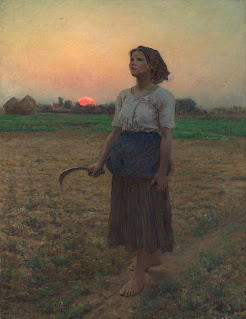
Jules Breton's Song of the Lark
Thea Kronborg, the heroine of Willa Cather's novel The Song of the Lark, is in Chicago and has just heard an orchestral program beginning with Dvorak's New World Symphony and concluding with music from Wagner's Ring Cycle.

And well, what then? She gets it.

Thea grows up in a small town in rural Colorado in the late 1800s. The big city is Denver--not that big at the time--and the bigger is Chicago. The family background is Swedish. Her father is a minister, rival to the Baptists across town, and she's in the middle of a mess of children. Her parents are good people and are good with her, but she needs to get out, to get to the big city, and even they recognize it. She takes piano lessons from the washed-up Wunsch, a drunkard, but once a solid German musician, who knows she has a gift; the town doctor, Howard Archie, saves her from pneumonia; Ray Kennedy, a brakeman on the railroad, plans to marry her when she gets older; the Mexican community in town--Spanish Johnny, Mrs. Tellamantez--loves to hear her sing.

Still the challenges are hard: she's a girl, in the 1800s, lower middle class at best, born in the back of beyond, 'hating a world that let her grow up so ignorant.' If she didn't have her gift--of a voice--even her intelligence, her solid grounding in music, wouldn't have been enough. And if she didn't have people looking out for her--Dr. Archie, Ray Kennedy, Wunsch, her parents--she wouldn't have made it either, she would have died on the way, either literally or figuratively. But she does, and she does.

So: it's the story of a girl becoming an artist, a Künstlerroman. (Or should it be Künstlerinroman?) What's the formula to success? (In case you wanted to know.) Early training--though her Hungarian piano teacher in Chicago tells her she didn't start the piano early enough to become a great concert pianist; support from those around her; luck; talent, naturally. Hard work, of course.  Thea's considered a bit of a grind by most everyone around her:

"A growing girl needs lots of sleep, Ray providently remarked.
Thea moved restlessly on the buggy cushions. "They need other things more," she muttered.
But she also has to be strong. Thea gets various things from the men in her childhood: her father is learned, the town doctor looks after her, her music-teacher, but from her mother she gets her 'constitution,' and that's a crucial ingredient. In Mrs. Kronborg's case, her strong constitution means that she can bear seven children, raise them, and never be sick; it plays out differently in Thea's case, but she, too, has incredible stamina.

It seems Willa Cather regretted the title. Lark-song ended up suggesting twittering small birds to most, but Cather didn't mean that: she was thinking of the painting by Breton. There's a solidity to the farm-girl in the painting and that was what Cather wanted to convey.

The last element to come to Thea was a certain self-knowledge. She goes to Panther Canyon in Arizona and lives in an Anasazi cliff-dwelling until she achieves the necessary confidence and self-awareness. Panther Canyon is Walnut Canyon (near Flagstaff) in disguise:


Walnut canyon cliff dwellings

And so she becomes not Thea, but Kronborg, a major opera singer.

I went through a bit of a Willa Cather phase twenty years ago or so, and I read the novel then. It's a great novel, and I was glad to reread it. At the time, though, I figured it was basically autobiographical, with a change of art from writing to opera for dramatic purposes. (Also the love object changed from a Frederica to a Fred because Cather would have felt she had to.) And that's not entirely wrong--there is a lot of autobiography in the book. But what I didn't know, until I read Alex Ross' Wagnerism earlier this year, is that's not all there is. Quite a lot of Thea Kronborg is drawn from the actual Swedish-American opera star Olive Fremstad. Cather wrote a fair amount of journalism, especially early in her career, reviewed several of Fremstad's performances, and later wrote an extended profile of Fremstad. The two became friends. Also Alex Ross, who would know--he's the music writer for the New Yorker--thinks that Willa Cather actually knows quite a bit about opera. I'm sure that all went past me the first time--and kind of did again this time, though I tried to think about it more--because I don't really know anything about opera. 

Anyway, a great novel, and I'm glad I put it on my Classics Club spin list

Sunday, August 15, 2021

Of the Time of Nero (#ccspin)


Here we have Hubert arbiting some elegances 

My spin book this time was Henryk Sienkiewicz' Quo Vadis, which set off a mini-reading project.

Petronius' The Satyricon

I knew Caius Petronius was a major character in Quo Vadis, and I thought I'd reread The Satyricon in advance. It's mostly accepted (though not universally) that Petronius, author of The Satyricon, is that Caius Petronius mentioned as the Elegantiae Arbiter of Nero's court in Tacitus. (Though maybe not: it's a common enough family name in Rome.)

What we have of The Satyricon is pretty fragmentary; parts, we're told, of Books XV and XVI, amounting to 164 pages in William Arrowsmith's translation. Even the exact meaning of the title is uncertain. For a Roman (as also a bit for us) it probably suggests several things: Satyrs (and thus lechery), satire, but also satura, a Roman word meaning heap or medley. The longest continuous surviving stretch is the dinner at Trimalchio's, who is a freedman working for the Imperial court, with lots of money and little taste and maudlin when drunk. It's amusing to see the sort of thing a rich Roman would have been eating at the time. It makes turducken look like an exercise in restraint.

It's not possible to say much with certainty about the work. If the note attached to the late medieval manuscript is correct about books XV and XVI,  it would be a very long work, even if there were only 16 books--and 24 would be a significant number for an ancient author.  Encolpius--the (loosely speaking) hero--of the book cons his way through life, cadging free dinners where he can, and sleeping (or trying to) with anything that moves. He hangs out with grammarians, professors of rhetoric, poets, so he seems to be an educated man, but there's something criminal in his background. Also he's managed to offend the god Priapus, with an unwelcome effect on his, umm, priapic appendage, and is on a quest to get back in good with the god, and go on sleeping around. (Probably. The book is fragmentary.) It is a severe judgment of its society. I find it funny in places, but your mileage may vary: some of the jokes are pretty insider-y Roman.

I took an undergraduate class on Petronius. We read a good chunk of the book in Latin, and as well as all of it in Arrowsmith's translation. I must have read the introduction--which is quite good--but I was amused now with how engaged Arrowsmith was with Lolita. (His translation comes out in 1959.) He calls Lolita a failure--twice. I'm sure I hadn't read Lolita at the time. It's not a comparison that would have occurred to me though. The sexual abuse of children is the meeting point, I suppose, but they're not really very much alike. Rather The Satyricon's embedded poetry, commentary thereon, and comically epic plot is more Pale Fire than Lolita. (Though The Satyricon is not either of them, of course.)

Tacitus' Annals

I enjoyed The Satyricon, but in the end I don't think rereading it brought much to Quo Vadis. Sienkiewicz accepts the attribution to Caius Petronius, but it doesn't otherwise feel like it impacts. Much more useful were the Annals, Tacitus' history of Rome from the death of Augustus to the death of Nero. (A.D. 14 - A.D. 68). Moses Hadas, in his introduction, notes that "Sienkiewicz' Quo Vadis... [has] long sections which are but adaptations of Tacitus." True that, Moze.

I thought one of the best things in Quo Vadis was the portrait of Petronius. Sienkiewicz is certainly taking off from Tacitus:

"His [Petronius'] days he passed in sleep, his nights in business and pleasures of life. Indolence had raised him to fame, as energy raises others, and he was reckoned not a debauchee and spendthrift, like most who squander their substance, but a man of refined luxury. And indeed his talk and his doings, the freer they were and the more show of carelessness they exhibited, were the better liked, for their look of natural simplicity...Then falling back into vice or affecting vice, he was chosen by Nero to be on of his few intimate associates, as a critic in matters of taste, while the emperor thought nothing charming or elegant in luxury unless Petronius had expressed to him his approval of it." [Annals 16.18, tr. Church and Broadribb]

Also, the great fire of Rome during Nero's reign. (July, A.D. 64) Tacitus would have been somewhere around six years old at time, but he doesn't use his own memories of the event (assuming he had some); instead he draws on earlier histories. It's a vivid moment in the book. Tacitus doubts Nero was responsible for the fire, but notes the rumors of Nero's guilt spring up almost immediately. The persecution of the Christians after the fire--Tacitus is our earliest source for this--he attributes to Nero's need to find a scapegoat to stifle those rumors.

The other thing that struck me (though irrelevant to Quo Vadis) was how important Armenia was in Roman thinking at the time. It was an ally, practically a client state, stuck on Rome's eastern border, wedged between Rome and the Arsacid-ruled empire of Parthia (corresponding roughly to modern Iran) who were a major rival to Rome at the time. Quite a lot of energy is devoted to keeping a friendly king in Armenia.

Tacitus is a famously difficult author in Latin. The (small) amount of his Latin I read in grad school impressed me; his tricky sentences frequently end with a sharp ironic sting in their tail. He reminded me of George Eliot, though of course the lines of influence run the other way, and I'm quite sure George Eliot knew her Tacitus perfectly well. The Church and Broadribb translation is fine, but it doesn't capture what I remember of the magic of Tacitus' prose.

Henryk Sienkiewicz' Quo Vadis

And on to the main event...

The handsome soldier Marcus Vinicius meets Callina (also called Lygia) and his knees tremble such as they never did in battle; the beautiful Lygia blushes bright pink and scampers off without a word out of Marcus' presence. "Ah, ha!" says the trained literary mind. "What we have here is Romantic Comedy!"

In romantic comedy the Question is what keeps our lovers apart and what it takes to get them together again in the end. Well, in Nero's Rome, there are plenty of things to keep them apart, maybe, just possibly, too many...

Not least is the fact that Lygia is a secret Christian. Years before she had been handed over to the Romans as a hostage and guarantee of a treaty between the Lygii and the Iazyges. The Romans were a neutral party in that conflict. But Lygia's father dies in battle and her mother dies as well, so Lygia, though an official state hostage, is more or less forgotten, raised by a nice Roman couple of the senatorial class.

Lygia is dark-haired with blue eyes and is so good-looking everyone is worried when she's in a room with Nero for a couple of hours he will fall into uncontrollable lust. Ah, but Petronius has a plan for that. (I suspected, and later verified, that the Lygii inhabited what is now Poland. A little Polish boosterism on the part of our author.) What Petronius didn't take into account was that the equally good-looking Marcus would attract the eye of Poppaea, the empress. Complications ensue.

This lightness doesn't last, though. (Well, the subtitle does say it's a narrative of the time of Nero.) The great fire and the persecution of the Christians are yet to come. For the purposes of the novel Sienkiewicz always assumes of the worst of Nero. Every time when Tacitus says some historians say this and some say that, Sienkiewicz always chooses the darker that, even when Tacitus says the milder this is likely true. For instance, the fire is started at the instigation of Nero, and, according to Sienkiewicz, he really does fiddle (or at least play a lyre) while Rome burns.

If it's not already clear, I preferred the earlier, lighter part of the novel. There were even some of those insider-y Roman jokes. When Petronius says of something it involves more fish than even Apicius ate in his life, I laughed. But it helps to know Apicius was the author of a cookbook. Petronius also snarks about Lucan's skill as a poet.

Later I felt it descended a bit into religious tract. The Christians (which include Peter and Paul) are all annoyingly noble, with the partial exception of Crispus, a fire and brimstone type who gets the occasional reprimand. Saint Paul asks Petronius (and we're reminded of it a second time), "If Caesar [Nero] were a Christian, would ye not all feel safer?" I'm afraid I wouldn't, and, alas, I don't think the question was meant ironically. The torture scenes began to feel a little voyeuristic. I was also a bit alarmed by Sienkiewicz' handling of Poppaea's purported Judaism. Josephus, the Jewish historian, is the source for this, and he meant it as a compliment. It doesn't come across that way in the novel.

Still, the later part has more portraits of well-known people and more big events. Not just Peter and Paul and Petronius. Nero and Poppaea do make good villains, even if their villainy is a bit played up. Seneca and Lucan have small roles. The danger and drama do pick up.

And as for our lovers? Well, you'll just have to read it and see... (if you haven't already.)

Antonine Propaganda

There's an exhibit on currently about Nero at the British Museum. I won't get to see it, but I did read the recent New Yorker article... It reminds us it's the winners who get to write the history. Tacitus, the most balanced of the surviving historians covering the period still clearly hates the Julio-Claudian emperors (that sequence of emperors who were descended somehow from Julius Caesar. Nero was the last.) Suetonius makes no pretence of balance. Both Tacitus and Suetonius flourished under the Flavian and then even more under the Antonine emperors, dynasties that were happy to have the previous guys slandered. It's just possible Nero wasn't quite *so* bad. Augustus had Maecenas, his PR guy, and consequently got pretty good press. The rest of the Julio-Claudians not so much. It doesn't necessarily matter for a novel, but it's worth keeping in mind.

Bit of a rainy week at the Internet-Free Zone so lots of reading. But there was a moment of sun when we caught this guy catching some rays...


Monday, May 31, 2021

Travels With A Donkey in the Cévennes (#CCSpin)

 "I travel not to go anywhere, but to go."

These days: if only!

R. L. Stevenson's Travels with a Donkey in the Cévennes is about a twelve-day trip he took through the mountains of southern France in September and October of 1878. 

That's already late in the year for the mountains, and Stevenson is told to expect cold weather, if not wolves and bandits. He takes a revolver. He designs a sleeping bag that will double as a sack to carry what he needs. And he acquires a donkey, Modestine, "a diminutive she-ass, not much bigger than a dog, the color of a mouse, with a kindly eye and a determined under-jaw."

The book is early in Stevenson's career, but not his first; he had previously written a book of travels The Inland Voyage and he identifies himself as a writer to people he meets. But he's more generally assumed to be a pedlar, though maybe of the higher sort: at one point he's taken for a dealer in brandy.

"In a little place called Le Monastier, in a pleasant highland valley fifteen miles from Le Puy, I spent about a month of fine days. Monastier is notable for the making of lace, for drunkenness, for freedom of language, and for unparalleled political dissension." The four factions of French politics in the 1800s are Bourbonists, Orleanists, partisans of the Napoleons, and Republicans. Le Monastier had them all. This is the start of his trip, where he commissions the sleeping bag of his own design and purchases Modestine. "At length she passed into my service for sixty-five francs and a glass of brandy."

Stevenson is raised a Scots Presbyterian of a moderately severe stripe, but has by this time lost his faith. He's discreet but honest about this loss with the people he meets and even with us readers in the text, but clear enough. Still religion interests him. Though he camps out as needed, he doesn't every night. One of his stops (the 26th of September) is the Trappist monastery Lady of the Snows: "I have rarely approached anything with more unaffected terror than the monastery of our Lady of the Snows. This it is to have a Protestant education." Nevertheless he quickly makes friends. "I was troubled besides in my mind as to etiquette. Durst I address a person who was under a vow of silence? Clearly not. But drawing near, I doffed my cap to him with a faraway superstitious reverence. He nodded back, and cheerfully addressed me. Was I going to the monastery?" An Irish deacon living at the monastery is thrilled to be delegated as Stevenson's guide: he's released from his vow of silence to play host and had had no occasion to speak English. (Though it would seem Stevenson's French is quite good.) 

But a couple of retreatants at the monastery try to convert him until he's finally forced to say they're being impolite, a little too pushy, when they immediately back off. 

Stevenson has done some reading in preparation for traveling the area. There's a legendary wolf of the area whose stories he's learned; of even more interest to him, the second half of his journey is in an area that's quite Protestant, and he's studied up on the history. The Camisards were French Huguenots whom Louis the XIVth tried to suppress in the early 1700s, and who took up armed rebellion with some success. Stevenson is full of their stories. (One of them involved a group of Protestants all stabbing a murderous Catholic Inquisitor, such that no one of them was responsible for the death, which reminded me of a certain Agatha Christie novel.) 

Phylloxera is destroying the grapevines of southern France at this time:
    "I could not at first make out what they were after, and asked one of the fellows to explain.
    'Making cider,' he said. 'Oui, c'est comme ça. Comme dans le nord!'"
The book has considerable charm; he's mildly ironic but forgiving about the people he meets. (Except for one man in Fouzilhac, who won't even give him directions; but that's OK, because these bad manners appal the people he meets in Fouzilhic. These would appear to be actual village names, now spelled slightly differently.) He's mildly ironic but forgiving as well about himself, about his inability to manage a donkey, or to load Modestine with the sleeping sack he commissioned.

I should say, I suppose, that while he's not cruel to Modestine by the standards of the time, he's certainly not enlightened by ours. In the end he sells her for thirty-five francs: "The pecuniary gain is not obvious, but I had bought freedom into the bargain." And even though he remembers her liking to eat out of his hand, Modestine's fate is no further to be thought of.
"The journey which this little book is to describe was very agreeable and fortunate for me. After an uncouth beginning, I had the best of luck to the end. But we are all travellers in what John Bunyan calls the wilderness of the world,--all, too, travellers with a donkey;..."
A French hiking club now maintains the route for walkers. 

The book is also available from Gutenberg.

Saturday, January 30, 2021

The Autobiography of John Stuart Mill (#ccspin)


John Stuart Mill's Autobiography only appeared after he had passed away, in 1873. It was written in stages; the first and largest part in the 1850s, later parts in a couple of goes in the 1860s. Mill married Harriet Taylor in 1851, and she edited that first portion, but she herself died in 1858, probably of tuberculosis. The later sections reflect on her importance to his life and thinking after her death and also on his brief parliamentary career.

It's the earlier sections, though, on his earlier life, that are the most comprehensive, and the most interesting. His youthful education is the wackiest part. Mill always insisted he was not by nature a genius; that it was only his unusual education that enabled him to achieve anything. That education was definitely unusual. 

His father was James Mill, a fairly important British intellectual in his own right, and the author of an important work on the governance of India, but perhaps more notably, a close friend of David Ricardo, the economist, and of Jeremy Bentham, the inventor of Utilitarianism. Both of those august gentlemen were around the house while young Mill was growing up. 

Mill, Sr., had some definite views on education and did the homeschooling himself.

It's hard to imagine them being implemented now. Should you be in possession of three-year-old whom you're planning to educate, you might find some hints, though more likely you'll find counter-examples you'll want to flee like the wind. Young Mill in the book insists his childhood was happy, though one might wonder. It did involve learning classical Greek from the age of three and Latin from the age of eight. Since Liddell and Scott had not yet written their dictionary, and the only Greek dictionaries that existed were Greek to Latin, when young John wanted to know the meaning of a word in Greek, he had to ask his father. It seems to his father's credit, he had no objection to being interrupted from whatever he might be trying to do to explain the meaning of Άνθρωπος.

It also involved separation from other children his age, because of their potentially corrupting influence. Again Mill says he didn't mind this and enjoyed long walks by himself. (He did have a bunch of younger siblings so there might have been somebody to play with.) It also seems young Mill got to spend a great deal of time with his father.

As for his mother, presumably he had one, but you wouldn't know it from this book. According to another biography I got from the library, by the 1850s, he was somewhat estranged from his mother, and some of his siblings, because of the way they treated Harriet Taylor, who had become his wife by then.

Perhaps unsurprisingly, this upbringing led to a psychological crisis at age twenty. He contemplated suicide: "I frequently asked myself if I could, or if I was bound to go on living, when life must be passed in this manner." You'll be glad to hear he came out of it by reading a book. (Jean-Francois Marmontel's Memoires. I'd never heard of it. Must be powerful stuff.) He rethought--a bit--the idea of happiness he'd received during his Benthamite upbringing.

It may also have helped that he met a girl. Harriet Taylor was a year younger than him and considered a great beauty. (As you can see, Mill himself was not.) Even more importantly, though, was she was his intellectual equal, even, as he says in the autobiography, his superior. The only downside was that she was already married. They began an intimate (but innocent, Mill assures us) friendship and intellectual partnership that lasted until her death in 1858 and was only regularized, as it were, by their marriage in 1851 after Harriet Taylor's first husband died. 

As we get into the period of Mill's own intellectual productions, the autobiography becomes swifter. Mill served one term in parliament. Not all that much is said about it. (He dismisses his maiden speech.) He was a strong supporter of increased home rule for Ireland, and, I was amused to discover, claims some credit for the origins of 'responsible government' (or home rule) in Canada: after the Upper Canada Rebellion, Lord Durham came to Canada to investigate and issued a fairly liberal report that led to the first bits of self-government in Canada. Mill was a strong supporter of Durham.

Mill was also friends with Carlyle which Mill admits was a bit of an odd couple pairing. Mill's maid was the one responsible for burning the first draft of Carlyle's French Revolution.

It's pretty readable. A slightly orotund prose style, but for a philosopher or a political economist, it's downright snappy.

Some quotes:

"It was in the same year, 1819, that he [my father] took me through a complete course of political economy." Mill was then thirteen.

"I am thus one of the very few examples, in this country, of who has not thrown off religious belief, but never had it."

"They [my books] were always written out at least twice over; a first draft of the entire work was completed to the very end of the subject, then the whole begun de novo, but incorporating in the second writing, all sentences and parts of sentences of the old draft, which appeared as suitable to my purpose as anything I could write in lieu of them."

[Summarizing the creed held by Bentham and his father.] "In psychology, the fundamental doctrine was the formation of all human character by circumstances, through the universal Principal of Association, and the consequent unlimited possibility of improving the moral and intellectual condition of mankind by education."

"Aiming thus at something else, they find happiness by the way."