Showing posts with label Willa Cather. Show all posts

Thursday, October 6, 2022

Willa Cather's A Lost Lady

"The Old West had been settled by dreamers, great-hearted adventurers who were unpractical to the point of magnificence; a courteous brotherhood, strong in attack but weak in defence, who could conquer but could not hold." [58]

Willa Cather's A Lost Lady came out in 1923. It had previously been serialized in Century Magazine, and when the novel was issued by Knopf in book form, it was Knopf's largest print run to that date. Which then sold out, and required two more printings within weeks. It was a hit.

The lady is Marian Forrester. She married an older man, Captain Daniel Forrester, a successful railway contractor in the Western United States. They settle in Sweet Water, Colorado, a town on the railroad where Captain Forrester has built his dream house. The story of their courtship is told near the end of the novel.

Marian is mostly seen through the eyes of Niel Herbert, who grows up as a boy in the town. He's nephew to Judge Pommeroy, the town's lawyer, and as a young man goes east to study architecture. He's fascinated/half in love with Marian Forrester already from his boyhood.
"But we will begin this story with a summer morning long ago, when Mrs. Forrester was still a young woman, and Sweet Water was a town of which great things were expected." [6]

Niel Herbert is just a boy, off fishing--or horsing around and only pretending to fish--with his friends. That first scene includes a bit of horrifying cruelty to animals, the sort of thing boys are reputed to do, but much worse than pulling the wings off flies, and our novel's villain is identified.

The novel covers a number of years, and while Cather is coy about dates, that first scene is likely around 1880. The transcontinental railroad has just been pushed through Colorado. Captain Forrester is a successful, and still vigorous, man.

Later Captain Forrester has a horse-riding accident and can only walk with a cane; a bank for which he's a principal fails; he honourably makes good on the bank's debts, but at the cost of his own fortune. This must be the panic of 1893.

Later still Captain Forrester has several strokes and, with the money gone, it's up to Marian to take care of him. She does it, she probably even still loves the Captain, but she tells Niel, "I feel such a power to live in me, Niel." [70] She drinks too much, she has an affair with Frank Ellinger, a man she knew before her marriage, ends up drunk-dialling Ellinger, in Niel's presence, when she learns Ellinger has married. Is she lost?

Great things may have been expected of Sweet Water but they don't come off. Judge Pommeroy's business stalls, and he's not the only lawyer in town anymore: that villain mentioned above has become a lawyer:

"'...rascality isn't the only thing that succeeds in business.'
'It succeeds faster than anything else, though.'" [69]

Eventually Captain Forrester dies. Marian returns to California, and Sweet Water's lady is lost. The last Niel hears of her, the last we hear as well, is that she's remarried and living in Argentina.

"Long, long afterward, when Niel did not know where Mrs. Forrester was living or dead, if her image flashed into his mind, it came with a brightness of dark eyes, her pale triangular cheeks with long earrings, and her many-coloured laugh. When he was dull, dull and tired of everything, he used to think that if he hear that long-lost lady laugh again, he could be gay." [39] 

But who or what is it that's lost? Maybe she did laugh in Buenos Aires.

It's a pretty great novel, I think.

It seems F. Scott Fitzgerald thought so, too. He read it while he was working on The Great Gatsby, and after Gatbsy came out (1925) he wrote a letter to Cather saying how much he admired A Lost Lady, and hoped she wouldn't think he'd plagiarized it to produce Daisy Buchanan. Cather wrote back to say she admired Gatsby in return, and no, she wasn't worried about it. (Frankly, while Gatsby is amazing as a whole, I find Daisy Buchanan thin beer in comparison to Marian Forrester.)

Page numbers come from the Library of America edition of Willa Cather's Later Novels. 

If you've read it, what did you make of the 'lost' of the title?  

Wednesday, December 15, 2021

Willa Cather's The Song of the Lark

"She would live for it, work for it, die for it; but she was going to have it; time after time, height after height. She could hear the crash of the orchestra again, and she rose on the brasses. She would have it, what the trumpets were singing! She would have it, have it--it!"

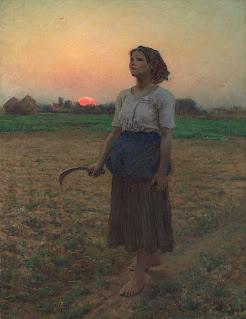
Jules Breton's Song of the Lark
Thea Kronborg, the heroine of Willa Cather's novel The Song of the Lark, is in Chicago and has just heard an orchestral program beginning with Dvorak's New World Symphony and concluding with music from Wagner's Ring Cycle.

And well, what then? She gets it.

Thea grows up in a small town in rural Colorado in the late 1800s. The big city is Denver--not that big at the time--and the bigger is Chicago. The family background is Swedish. Her father is a minister, rival to the Baptists across town, and she's in the middle of a mess of children. Her parents are good people and are good with her, but she needs to get out, to get to the big city, and even they recognize it. She takes piano lessons from the washed-up Wunsch, a drunkard, but once a solid German musician, who knows she has a gift; the town doctor, Howard Archie, saves her from pneumonia; Ray Kennedy, a brakeman on the railroad, plans to marry her when she gets older; the Mexican community in town--Spanish Johnny, Mrs. Tellamantez--loves to hear her sing.

Still the challenges are hard: she's a girl, in the 1800s, lower middle class at best, born in the back of beyond, 'hating a world that let her grow up so ignorant.' If she didn't have her gift--of a voice--even her intelligence, her solid grounding in music, wouldn't have been enough. And if she didn't have people looking out for her--Dr. Archie, Ray Kennedy, Wunsch, her parents--she wouldn't have made it either, she would have died on the way, either literally or figuratively. But she does, and she does.

So: it's the story of a girl becoming an artist, a Künstlerroman. (Or should it be Künstlerinroman?) What's the formula to success? (In case you wanted to know.) Early training--though her Hungarian piano teacher in Chicago tells her she didn't start the piano early enough to become a great concert pianist; support from those around her; luck; talent, naturally. Hard work, of course.  Thea's considered a bit of a grind by most everyone around her:

"A growing girl needs lots of sleep, Ray providently remarked.
Thea moved restlessly on the buggy cushions. "They need other things more," she muttered.
But she also has to be strong. Thea gets various things from the men in her childhood: her father is learned, the town doctor looks after her, her music-teacher, but from her mother she gets her 'constitution,' and that's a crucial ingredient. In Mrs. Kronborg's case, her strong constitution means that she can bear seven children, raise them, and never be sick; it plays out differently in Thea's case, but she, too, has incredible stamina.

It seems Willa Cather regretted the title. Lark-song ended up suggesting twittering small birds to most, but Cather didn't mean that: she was thinking of the painting by Breton. There's a solidity to the farm-girl in the painting and that was what Cather wanted to convey.

The last element to come to Thea was a certain self-knowledge. She goes to Panther Canyon in Arizona and lives in an Anasazi cliff-dwelling until she achieves the necessary confidence and self-awareness. Panther Canyon is Walnut Canyon (near Flagstaff) in disguise:


Walnut canyon cliff dwellings

And so she becomes not Thea, but Kronborg, a major opera singer.

I went through a bit of a Willa Cather phase twenty years ago or so, and I read the novel then. It's a great novel, and I was glad to reread it. At the time, though, I figured it was basically autobiographical, with a change of art from writing to opera for dramatic purposes. (Also the love object changed from a Frederica to a Fred because Cather would have felt she had to.) And that's not entirely wrong--there is a lot of autobiography in the book. But what I didn't know, until I read Alex Ross' Wagnerism earlier this year, is that's not all there is. Quite a lot of Thea Kronborg is drawn from the actual Swedish-American opera star Olive Fremstad. Cather wrote a fair amount of journalism, especially early in her career, reviewed several of Fremstad's performances, and later wrote an extended profile of Fremstad. The two became friends. Also Alex Ross, who would know--he's the music writer for the New Yorker--thinks that Willa Cather actually knows quite a bit about opera. I'm sure that all went past me the first time--and kind of did again this time, though I tried to think about it more--because I don't really know anything about opera. 

Anyway, a great novel, and I'm glad I put it on my Classics Club spin list! 

Wednesday, November 10, 2021

Willa Cather's One of Ours

 "Why was everything so mysteriously hard?...The world was too rough a place to get about in."

That's Claude Wheeler, the protagonist of Willa Cather's One of Ours, her novel of 1922. Claude is the middle child of three boys raised on a Nebraska farm. Sometimes his name is pronounced 'Clod', but he isn't: he's good on the farm, handier than his older brother Bayliss who now keeps a shop in town, more responsible than his flighty younger brother Ralph, who's always futzing with cars. But Claude is intelligent and sensitive, qualities that don't do him much good on the Nebraska plains. 

He yearns for something more. He goes to Lincoln for college, but to a religious school. He finds the instructors second-rate and would prefer to go to the state university, but his mother, who's pretty churchy, won't approve. His father doesn't much see the point of college at all.

His father buys a cattle-ranch in Colorado and takes the younger brother off to run that, so Claude has to give up university and look after the home farm. He undertakes successful innovations, marries the miller's daughter Enid Royce, builds his dream house for the two of them, but none of those things turn out to be what he was yearning for.

The WASPs in Nebraska are full of feeling but unable to express it; this includes Claude, but isn't limited to him. His future father-in-law Mr. Royce tells Claude, "Enid is a vegetarian, you know," and Claude dismisses that as irrelevant, and so maybe it is, but, while Mr. Royce likes both parties, he worries that the marriage won't work:
"He [Mr. Royce] found himself unable to touch upon the vast body of experience he wished to communicate to Claude."
The German-Americans are more open and expressive and Claude is drawn to them, but can't quite be comfortable as part of their circle.

Prohibition comes to Nebraska over the course of the novel, and ahead of the rest of the country. Claude doesn't himself seem to drink, but since he's friends with various German immigrants, he doesn't object when they do. His wife Enid canvasses for the Prohibition cause. Theirs is not the only mixed marriage: generally it's the men who don't mind drinking, and the wives who object, but Bayliss is a staunch Prohibitionist. At Claude's wedding, his father and his father-in-law go off for a quick bourbon together, and when they come back,
"...the preacher smelled the tang of spirits and felt slighted. He looked disconsolately into his ruddy goblet and thought about the marriage at Cana. He tried to apply his Bible literally to life and, though he didn't dare breathe it aloud in these days, he could never see why he was better than his Lord."

The other great political event is the approach of World War I:

"The German army was in Luxembourg; he didn't know where Luxembourg was, whether it was a city or a country; he seemed to have some vague idea it was a palace!"

(Of course, it is actually all three, though the Palais is in Paris.) 

It will be World War I that provides the something more that Claude is yearning for.

When the novel came out, it had good sales and won Cather the Pulitzer Prize, but the reviews were fairly mixed. (I'm mostly getting this information from the Wikipedia article, though I also read Edmund Wilson's negative, but not very well-informed, review from The Shores of Light.) The general poop seemed to be that the war scenes weren't very good, and my feeling is the general poop was kind of right. (Though what do I know of war?) Sinclair Lewis' remarks seem accurate to me, "truth does guide the first part of the book," the Nebraska part, but in the second part Cather used "all the commonplaces of ordinary war novels."

Pretty true. But I would add that the Nebraska part is about 2/3rds of the novel, and is easily the equal of Cather at her best. That part shouldn't be missed.  Then comes the troop ship over, which is afflicted by an early appearance of the Spanish flu, making it--unexpectedly to me at least--a pandemic novel, and was quite convincing. It's only when the novel reaches France--and is close to done--that it gets weaker.

By 1922, when this came out, American opinion had turned pretty strongly against the war. Cather acknowledges this in the person of David Gerhardt, a professional violinist turned soldier. Was this war going make the world safe for Democracy? 

"You don't believe we are going to get out of this war what we went in for, do you?"

Claude asks David. David replies,

"Absolutely not."

But Claude does go on believing, and he's the protagonist; that may have been a bit intolerable to elite opinion by 1922.

Cather's primary source material for the war parts were letters home written by her cousin Grosvenor Cather. I suspect this may also have colored her approach. A soldier writing home can admit fear, can admit (though maybe downplay) danger, but it's much harder to admit despair and purposelessness. Maybe he should have. But Claude doesn't. 

In a fascinating letter about the book, Cather writes to her friend, Dorothy Canfield Fisher, the educator and novelist, "Yes, it will be classed as a 'war story',...and God knows I never wanted to write a war story...It's a misfortune for me and my publisher that anything so cruelly personal, so subjective, as this story, should be mixed up with journalism and public events with which the world is weary and of which I know so little." To call it a 'misfortune' is considerably overstating the case, but it is best thought of as the story of Grosvenor Cather/Claude and not a war story.

She goes on, "I tried to keep the French part vague, seen from a distance, and only what he sees." 

Anyway, a very good novel, I thought, even if not Cather's best.

My spin book this month is The Song of the Lark by Cather, and this was just a warmup! 😉

Wednesday, May 19, 2021

Alex Ross' Wagnerism

 "The philosopher is not free to dispense with Wagner."

-Friedrich Nietzsche, The Case of Wagner 

Wagnerism is the history of the reception of Richard Wagner and his music, and of the uses made of Wagner's music after his death. And, well, some of those uses weren't very nice. 

When the book was good, I thought it was very good, but it wasn't at all times. It's more encyclopedic than analytic, at times even gossipy. Did you know that Virginia Woolf went to a benefit costume ball as a Valkyrie in 1909? Me neither. Not sure that tells me much about Woolf, though it might say something about how ubiquitous Wagner was.

Years ago I read Ross' The Rest Is Noise, his history of twentieth century classical music, around when it came out in paperback. I really liked it, even though most of it went over my head. (And I'm pretty tall.) I don't know that much about serious music. A diminished seventh, you say--is that music, baseball, or planetary science? I wouldn't know one if it bit me on the ear. Still, sometimes I like a book that's too hard for me, it leaves me wanting to know more.

Because Wagnerism addresses Wagner's presence in literature and film--and politics--more than in music, this book worked differently for me. 

Ross' organization is a mix of chronological and by topic. The first figure Ross covers is Nietzsche, an early Wagner disciple, at least until he wasn't, and the most prominent. Ross gives himself 60 or so pages on Nietzsche, and is lucid and helpful. Nietzsche and Wagner is a topic on which books could be written--and have, with more than one of them by Nietzsche himself. Subsequent chapters are on French Wagnerians (Baudelaire was an early booster), British, American, Austrian, Russian, black (W.E.B. DuBois was a fan), gay, Jewish, feminist. Right-wing, but also left-wing. Well, everyone actually was listening to Wagner for a while.

When Ross gives himself space he's at his best. This includes his writing about Nietzsche and Baudelaire. There was interesting stuff on Joyce. Wagner is important to Thomas Mann, (less so to Heinrich) and Thomas Mann's attitude toward Wagner changes over the years. I was particularly interested in Ross' take on Mann's Joseph saga, which he reads as a direct challenge to Wagner's Ring Cycle: both tetralogies, both investigations of myth, but Mann dealt with Old Testament--that is, Jewish--subjects, which Wagner himself wouldn't touch. There was some good stuff there.

On the other hand Ross speculates that Wagner is behind Adrian Leverkühn, the hero of Mann's Doctor Faustus. But how can that be when *everyone* knows that Leverkühn is Nietzsche + Schönberg? 😉  There needed to be either more or less to that argument.

Ross is at his tip-top best on Willa Cather. He devotes an entire chapter to her, largely on The Song of the Lark, and she shows up in some of those other categories listed above as well. Very well worth reading if you care about Cather.

Wagner in World War II is the emotional heart of the book. Ross is at some pains to remind us that lots of people who did not like Naziism, were never going to like it, still liked Wagner. 

Wagner's politics were complicated and probably not well-thought-out. He got himself in serious trouble supporting the anti-monarchical revolutions of 1848 and it took him years to get out of that trouble. He was pretty seriously pacifist. He meant his anti-Semitism though, publishing a vile article first anonymously, and later doubling down by re-publishing it under his own name. One of the main reasons Nietzsche, not exactly known for his compassion, broke with Wagner was his abhorrence of Wagner's anti-Semitism.

Hitler's Wagner--and Hitler really did love Wagner--was not all of Wagner. But how big a chunk of the total Wagner was Hitler's Wagner? The jury's still out on that, even I would say, in Ross' mind.

There was trivia and some of the trivia was fun. I did not know that Laughing Cow cheese (La Vache Qui Rit) is actually a pun on the Valkyries of Wagner; some Frenchman in World War I making fun of the German propensity for Wagnerian code names. (The Siegfried Line, anyone?) Thomas Mann and Willa Cather played records and drank champagne at the Knopf's in 1943. What's Opera, Doc? makes an appearance, as well as other cartoons of the era. Though, for that matter, I read Broom Hilda at GoComics this morning; and Now I'm Very Angry Broom Hilda did not get a mention...are the cartoonist Russell Myers' backdrops influenced by Wagnerian set design? Think of those remote, fantastical geological outposts. (Though, of course, they have more to do with the Coconino County backdrops of Herriman's Krazy Kat.) Some of Ross' arguments/speculations are about on that level...
"Perhaps [George Bernard] Shaw hung back from direct engagement with Wagner because he wished to avoid placing himself in competition with the Meister." [439]
Is this that same Shaw who cheerfully bashed on Shakespeare?
"Cy Twombly listened intermittently to Wagner while working on his ten-painting cycle Fifty Days at Iliam..." [631]
I listen to Wagner intermittently, too, though in my case, the inters are pretty danged mittent. Are my posts therefore Wagnerian? Well, maybe they go on too long...

Ross ends with a brief history of his own listening to Wagner. He was not initially a fan, it seems, but then in his twenties got excited about Wagner. But wondered, should he?

Anyway, good when it was good, and very good when it was very good, as we say in the Department of Tautology. If anything in the subject interests you, it's quite readable and often astute. It didn't blow me away like his first book, though.

It's one of those pan-European books that might do for a lot of countries, but I'll stick to the basics and count it for Germany: