Showing posts with label Trixie Belden. Show all posts

Tuesday, April 20, 2021

March Wrapup

My reading month in March:

Koren Shadmi's Graphical Biographies

The Twilight Man: Rod Serling and the Birth of Television

I saw this reviewed in the New York Review of Books--yes, yes, I'm running behind--and ordered it from the library. I was never particularly a fan of The Twilight Zone--too black and white for me at the age I would have watched the show in reruns--but I liked the graphical style of the clips in the review and the book looked interesting. It was. In fact, really quite good--it got me interested and I might try to see some Twilight Zone episodes. It recapitulates Serling's life story in a narrative frame you might find in a Twilight Zone plot.


Gary Gygax and the Creation of D&D (text by David Kushner)

Looking up Shadmi in my library's catalog, I also came across this. I was a fan of Dungeons and Dragons and so I got this one, too. Though it's Gary Gygax in the title, don't worry: Dave Arneson gets equal time. It was enjoyable, and even though it spoke to me more, I do think it was a less successful work than The Twilight Zone volume. The text is written as if by a dungeon master, or even more, as if it were from that early computer game Colossal Cave/Adventure. (That game's author Will Crowther gets a couple of pages.) "You are in a maze of twisty passages all alike." "You are likely to be eaten by a grue."


The Mystery Department

Michael Innes' Hare Sitting Up

An Inspector Appleby story from 1959. Take identical twin brothers, one a schoolmaster, the other a biowarfare scientist, add a rural lord half(?)-crazed with bird-watching, throw in a blackmailer and a pretty girl with a Ph.D., and you've got a story. It's mostly Innes in his silly mode, which I actually prefer, though Innes does want to say one or two serious things about the morality of WMDs. Not his best by any means, but fun.

Julie Campbell's The Gatehouse Mystery

Trixie and Honey find a diamond in the old gate house on the Wheeler property. Are they going to turn it into the proper authorities? Of course not!

This book has the first appearance of Trixie's older brothers, Brian--and Mart, the snarky one with a propensity toward Brobdingnagian vocables. Always my favorite character. I'm sure I don't know why.

The next in the series is waiting at the library for me to pick it up.

Chester Himes' Blind Man With A Pistol

The last of the Coffin Ed Johnson and Grave Digger Jones mysteries Himes completed, from 1969. This is a very ambitious book, bursting the bounds of Himes' already capacious sense of what a mystery can be. All in 191 pages. Several plots; several time frames. Pretty great & at some risk of sending me down a Himes rabbit hole--I've ordered up the recent biography of Himes from the library. But if you're interested in Himes as a mystery writer, you should probably start with something earlier in the series.

"'There ain't going to be any facts,' Grave Digger informed Anderson."

#BrianMooreAt100

Cathy at 746Books has organized a year long read of Brian Moore's books in honor of what would have been his hundredth birthday. 

Brian Moore's The Color of Blood

Political tensions in an unnamed East European country just before the fall of the Iron Curtain. I thought it was very good. More here.

Brian Moore's Fergus

That I enjoyed The Color of Blood so much led me on to read Fergus. Not as good, I said, though still good.

This month's Brian Moore is the great, but grim, The Lonely Passion of Judith Hearne. Will I reread it? Maybe, but I haven't yet.


The Poetry Section

George Bradley's Of the Knowledge of Good and Evil

This collection came out with Knopf in 1991. A living American poet (b. 1953). The first volume of his I've read--though a couple of these poems appeared in The New Republic in the 80s, so it's possible I read those before. I thought it was very good. Expect something to appear in a poem post in the future. Bradley's poem 'The Lives of the Chinese Poets' begins 'About suffering they were reticent,...' O my Auden! 

Georgi Gospodinov

Natural Novel, And Other Stories, The Physics of Sorrow

Contemporary Bulgarian novelist, poet, story writer. That's most of what of his is available in English. I think he's pretty good. More thoughts here, mostly on The Physics of Sorrow.

Hilary Mantel's Cromwell

Wolf Hall

I reread this for Brona's readalong, but I'm *still* organizing my thoughts on this one. Not very organized thoughts, eh? I should have finished rereading Bring Up The Bodies to be on schedule, but I haven't...

Shakespeare's Henry VIII

That sent me off to this. Not necessarily one of the better plays, but there are some great speeches--Buckingham's (Act II, Sc 1) on his sentence of death:

The law I bear no malice for my death
'T has done upon the premises but justice
But those that sought it I could wish more Christians

or Wolsey's farewell to greatness.

Andre Alexis

Contemporary Canadian writer. He's four books into a series of five he's termed a quincunx. I read the first, Pastoral (2014). I thought it was very good. A newly minted priest takes up a parish in a small town near Sarnia, Ontario. The second one in the series--Fifteen Dogs--is the celebrated one; it won the Giller, one of Canada's two major novel prizes, as well as various other prizes. I might have more to say when I finish the sequence, at least as it stands now. I have the others on hand.

Euripides

Rex Warner (no relation?--though that first name could so easily slip into...) translated three Euripidean plays with strong female characters in the 40s & 50s: Medea, Hippolytus, Helen. I was interested in the Helen, but then I carried on. Medea, Phaedra, & Helen are all women who do bad or tricksy things and suffer at the hands of men. These are quite often read now as feminist or proto-feminist; would an Athenian of the time have thought so? Mmm. Certainly as Aristophanes presents it (Women at the Thesmophoria) Euripides wasn't popular with the ladies...but then, that's Aristophanes.

No longer the standard translations, but I thought they were quite good. I especially liked Warner's handling of the choruses. He's an interesting novelist (The Aerodrome) and poet, but best known now, I'm guessing, as the translator of Thucydides.

The books that were still around the house (at least when I took the picture):
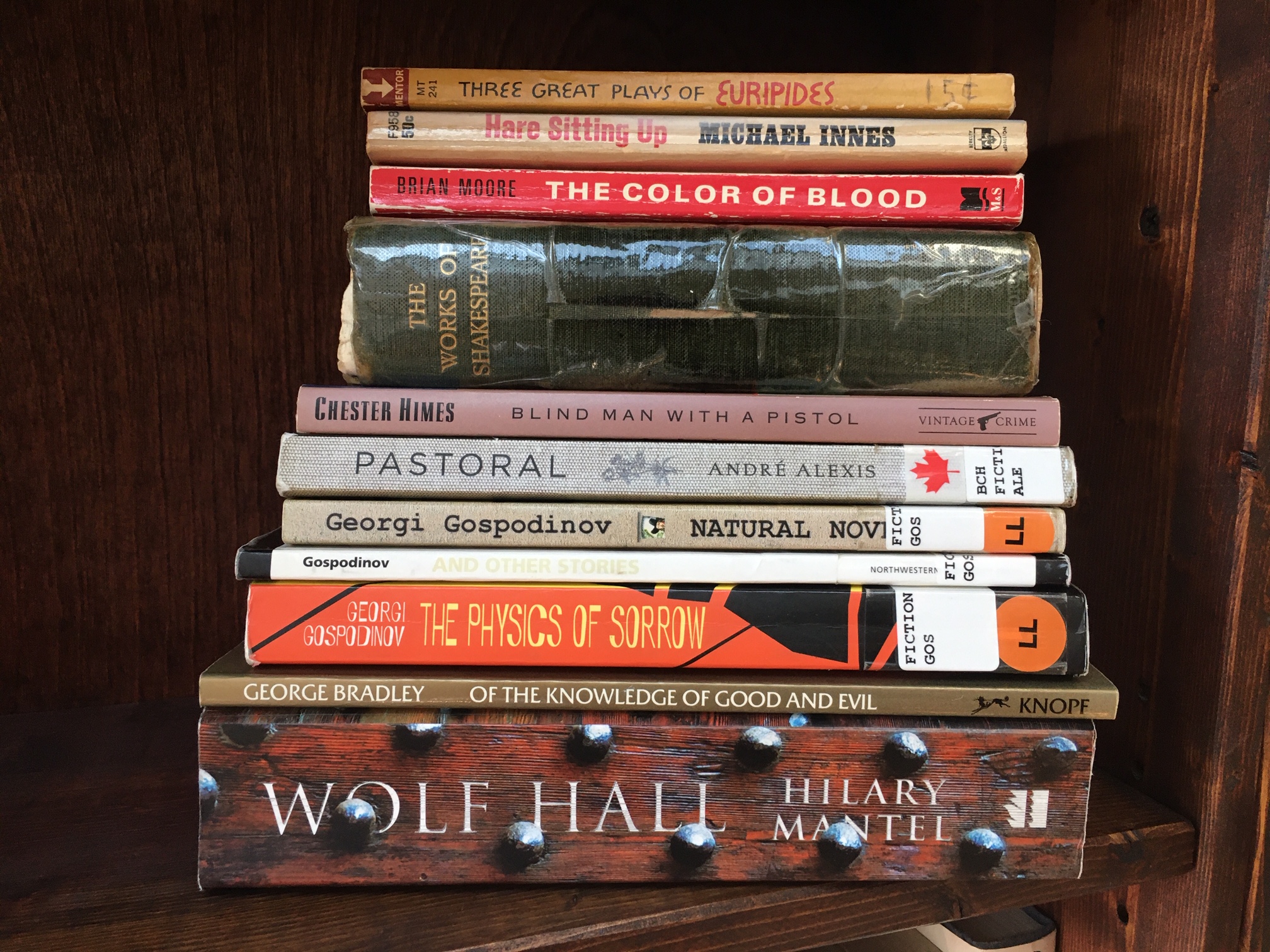
I wrote most of this post a while ago. It was long past time to either delete it or publish it. Yet another month of much, but muddled, reading--I sometimes get embarrassed by the desultoriness of my reading. Oh, well. Any of these strike thoughts in you?


Friday, March 5, 2021

February Wrapup

Hmm. Am I going to be a person who now writes monthly wrapup posts? I doubt it, but I'm trying it on for size.

Drugs

Michael Pollan's How To Change Your Mind

About recent research into, and experimentation with, psychedelics. A friend's been recommending this for a while. (Who has acted on it.) It was also, through the weird channels in which my brain works, related to a project I was reading on. When I got it from the library, I wasn't actually sure I would read it, but then the first chapter was full of people I knew, and so I was hooked. I worked, as a computer programmer, for the pharmacology department at the University of Chicago in the mid to late 80s. All those people were no longer researching psychedelics by then, for reasons expounded by Pollan, but they had been.

Pollan strikes me as a pretty good writer of non-fiction, and while LSD and mushrooms aren't really my thing, I'm now inclined to read The Omnivore's Dilemma. Eating meat, while maybe feeling you shouldn't, is my thing, and now I'm curious to see what Pollan has to say.

Aldous Huxley's The Doors of Perception and Heaven and Hell

Unsurprisingly this is an important book in Pollan. It didn't do much for me when I first read it thirty years ago, and it still didn't. I have loved Brave New World on each of several readings, and I keep thinking that some other Huxley book will mean as much. None has yet. I was surprised how much art criticism was in this; that probably all went over my head the first time.

Venice

Cees Nooteboom's Venice

Visiting Venice. Important living Dutch writer and this was really very good. More here.

Donna Leon's Death at La Fenice

That sent me off to Donna Leon. The first Commissario Brunetti story. The mystery was so-so, but the characters and setting are fun. I might also read/reread some Michael Dibdins at some point.

Interlude

Megha Majdumar's A Burning

I really ought to have written about this one at length, but it arrived from the library after a long wait and I wasn't going to be able to renew it. Molotov cocktails are thrown into a commuter train in India, and what happens to various characters peripherally associated with this terror attack. Her debut novel, there's been some buzz, and I definitely enjoyed it. I read somewhere that it has done better in North America than in India. That makes sense to me. Her politics are well-intentioned, but I wouldn't be surprised to learn that an Indian found them shallow while a North American thought them insightful. It's the voice that interested me. It's possible the same criticism could be made (felt shallow there, but impressive here) but I was impressed. I'd read another of hers.

Susanna M. Smith (#ReadIndies)

Susanna M. Smith's How The Blessed Live

It was #ReadIndies month hosted by Kaggsy and I really should have blogged about these on time. I already had the idea of digging into a couple of small Canadian publishers and had these when I saw her announcement. How The Blessed Live is about two fraternal twins and their father. The daughter goes to Vancouver and hangs out with artists; the son goes to Montreal to university. The mother died at their birth, and the father lives in lamentation on an island in Lake Ontario. Isis and Osiris are mentioned. There may have been brother/sister incest.

I mention that mostly because I tend to dislike it in a novel and still I liked this novel. Brother/sister incest goes back to Egypt, to Greece; anything after about Malory starts to feel derivative. I was willing to forgive it here, so that means it must have been pretty well done. A fairly poetic style. This came out with Coach House books in 2002. If I'd written that Coach House books post (this one came from the public library, but I have several other of their books here already) I would also have mentioned how I love, love, love the paper stock they use.

Susanna M. Smith's The Fairy Tale Museum

This book (her second and only other book I believe) came out with Invisible Publishing in 2018, the press I was more interested in (and knew less about) when I ordered them up from the library. A collection of stories on similar somewhat magical themes: a fairy tale museum. (Truth in advertising.) I liked this even better. She retells various fairy tales with a twist and in different contexts. Think, I suppose, Angela Carter.

More stuff related only in my own mind to Propertius

Shakespeare's Henry V

I started it looking for that speech about tennis balls and mockery--and found I had misremembered the line I was looking for. That speech is in Act I and I could have stopped there, but it is Henry V. The second act is weird, but otherwise such a great play. I carried on. We few, we happy few. We are the makers of manners.

Robert Herrick's Poems

Herrick has a more obvious connection to Propertius, maybe not just in my mind. ("Come, I will drink a tun/To my Propertius.") My edition is not complete, a compact thing from Blackie and Son that I probably bought in the U.K. years ago. But it does have a good couple hundred of his (mostly short) poems. Reading it this time, though I was supposed to be thinking about Propertius, the pandemic kept coming to mind:

Stay then at home, and do not go,
Or fly abroad, and seek for woe.

I ask you: could I help it? And, Ted Cruz, were you listening?

Tabucchi

Antonio Tabucchi's Indian Nocturne

Another book I should have blogged about. Novella length. Pretty great. A character much like Tabucchi himself travels to India, both for academic reasons, but also to hunt up an old friend who may be in trouble. We learn about the back story with the friend; we learn about the writing of books. Does he find the friend? Well. Tabucchi was a professor of Portuguese and the story ends in Goa. It's not the equal of his Sostiene Pereira, but then, so very few things are.

Trixie Belden

Julie Campbell's The Secret of the Mansion

I found this in a Little Free Library a few months ago, and thought, wow, I could recapture my childhood. It hung around my reading chair for those few months and then, one night, when nothing else was working, I reread it. I was surprised how well it held up.

I had not yet read Little Women when I read these as a child--I only read that as an adult--and I was surprised at how much this owes to Little Women. Julie Campbell likes the poor little rich kid next door motif so much she uses it twice. It's Honey Wheeler in this one; Diana Lynch is only mentioned in the second book and joins the gang still later. Oh, the chores! And is that Moms? Or Marmee?

Just who is it living in the old Frayne mansion next door? And is there treasure hidden in there? Sleepyside-on-Hudson...not so sleepy any more!

Julie Campbell's The Red Trailer Mystery

I enjoyed that one so much, I ordered up the next several from the library. The Red Trailer Mystery is practically one novel with the The Secret of the Mansion. Jim Frayne disappears at the end of the first; Trixie and Honey and the ever-competent Miss Trask hunt him down--in order to tell him he's inherited a million bucks--in the second. And find some trailer thieves. And help a poor family, who aren't yet dying of tuberculosis, but could be.

More of these to come!

Hazzard

Shirley Hazzard's The Transit of Venus

Let us continue the I-should-have-blogged-about theme. Maybe I even did so, though pretty danged obliquely.

Two Australian orphan sisters, Grace and Caroline, move to England. Their lives. Grace, the sweeter and blonder one, marries the son of an astronomer. Caro leads a life with more detours. This is a novel one needs to read several times before saying anything, but it is a novel one wants to read several times, so maybe that's OK.

Gloom

E. M. Cioran's On The Heights of Despair

Cioran's first book, (1934, tr. Ilinca Zarifopol-Johnston, 1992) originally written in Romanian.

Ha. My heading is probably not entirely fair. Oh, wait, of course it is. I mean, look at the title. "On the heights of despair," the introduction suggests, was a stock phrase from Romanian suicide notices of the time. 

Cioran is an essayist/aphorist in the Nietzschean/Schopenhauerian pessimist tradition.

By no means his best. It felt a little windy. While it's his themes, his later writing in French forced him to pare down. (I suppose. Or maybe he just learned to.) This is also more clearly derivative. Nietzsche is never very far from Cioran, but this reeks of it. Though, correspondingly, there is more appreciation of the Dionysiac in this, it's not all gloom and doom, more than in later Cioran. Nevertheless Cioran strikes me as standing more on his own feet afterwards. It wasn't bad--if you like Cioran--but The Trouble With Being Born remains my favorite. If favorite is quite the right word to use...

That's a month's worth of reading. Actually, for me, probably more than a month's worth under normal circumstances, but what else can you do these days? I'm also in the middle of rereading Wolf Hall and The Adventures of Nicholas Nickleby. Well, when I say middle, that's appropriate enough to Wolf Hall, somewhat less so to Nickleby.

The books that are still around the house

How was your February reading?