Showing posts with label Keating 100. Show all posts

Wednesday, March 4, 2026

Peter Dickinson's The Glass-Sided Ants' Nest

     "We've got a lovely little set-up here, all airy-fairy. Just the thing for Pibble, I said, the moment I'd seen the Kus."
    "Coos?"
    "Every single member of the household, my dear, is called Ku. They're a tribe from New Guinea, somewhere. Deceased's a Ku, suspects all Kus, witnesses all Kus. Except there aren't any."
 
This was totally bats. But I really mean that in the best possible way...
 
During World War II, the Ku tribe sheltered a downed Australian airman. The Japanese found out and killed everyone they could lay their hands on, and this included the British anthropologist studying the tribe. The anthropologist's daughter Elizabeth has brought the remains of the tribe to London, where they live in a house, attempting to keep up their tribal customs in an alien environment. They all take the last name Ku.
 
Then the chief of the tribe, Aaron Ku, is bashed over the head by a lefty at the top of the stairs.
 
Elizabeth has gotten her own Ph.D. in anthropology after the war, and this arrangement will enable her to keep up her father's work more comfortably, with the tribe arranged for viewing like ants tunnelling in a kid's glass terrarium. And one of the things she tells Pibble is that, while the Kus don't approve of murder, of course, if they were to murder someone, they would naturally use the left hand, because that's the hand of evil deeds.
 
Most of the clues kind of go like that. This is the first case (out of six) with Chief Inspector Jimmy Pibble by Dickinson, but in his world he's already got a reputation. We're told he's the one who gets these kind of cases. He interviews an old lag at one point:
    "Hope you don't mind me asking, but are you Pibble?"
    "Yes," said Pibble. "But how did you know?"
    "Kinky little case like vis. Vey wouldn't send one of the ver big boys out on it--too much to lose, nuffing to gain. Good luck, ven."

There is a lot of slang and dialect. Pibble himself uses "Crippen" as an oath amusingly enough, but a fair amount of it might be easier for a Brit...

A second murder is in progress when it's thwarted by Pibble discovering the culprit.

Pretty entertaining. I'd read another from the series. Do you know it? Is this representative? 

Vintage Mystery Scavenger Hunt

Silver Age (1968). Staircase. 


Tuesday, June 20, 2023

Josephine Tey's The Daughter of Time

"Truth is the daughter of time."
-Old proverb

Inspector Alan Grant is stuck in hospital after he fell through a trap door in pursuit of a criminal. For now, he can do nothing but lie on his back and look at the ceiling. Nurses, friends, acquaintances bring him flowers, sweets, books to pass the time. None of them particularly engage.

One friend, more astute than the rest, brings him portraits of historical criminals. These portraits include King Richard III, famous for supposedly murdering his nephews, the 'Princes in the Tower.' Grant thinks, that doesn't look like a murderer's face, and becomes interested in the evidence for King Richard's guilt. He gets his friends to bring him a bunch of history books, and eventually Brent Carradine, a researcher. Grant applies his Scotland Yard techniques to working out a solution, while Carradine gathers the evidence.

Now all I know about the case comes from Shakespeare's Richard III: there Richard's a thorough-going villain, and the ghosts of all of the people he'd unjustly killed gather round his bed the night before Bosworth Field and chant, "Tomorrow in the battle think on me." I was prepared to believe he didn't kill his nephews. It turns out Shakespeare got his information from Sir Thomas More, still a child at the time of the supposed murders, and later a partisan of the Tudors, at least until he wasn't. If you've read Hilary Mantel, you'll have no problem imagining More as untrustworthy, but in Tey he's the 'sainted' Thomas More, and Grant has some convincing to do.

Would it be a spoiler to reveal Grant's solution? Well, I won't. Tey, in the person of Grant, makes a pretty good case, but not perfectly convincing. Her evidence amounts to cui bono, who benefits--that was the best part for me--but also she makes considerable use of the absence of evidence. (If X happened, Y should have happened, but there's no record of Y. But the events were in the 1400s. There may just be no record any more.) Still very enjoyable. It would have helped if I'd known more about the period.

It's a celebrated novel--and justly so. Though the British Crime Writer's Association voted it the best mystery of all time in 1990 and that seems a little excessive. (Not The Maltese Falcon, The Murder on the Orient Express, The Hound of the Baskervilles!?!) But it is certainly a classic mystery...


For the challenge I'll go with:

Vintage Mystery, Gold, Castle or Ruin. The Tower of London is about as classic a castle as you can find.

Tuesday, April 20, 2021

March Wrapup

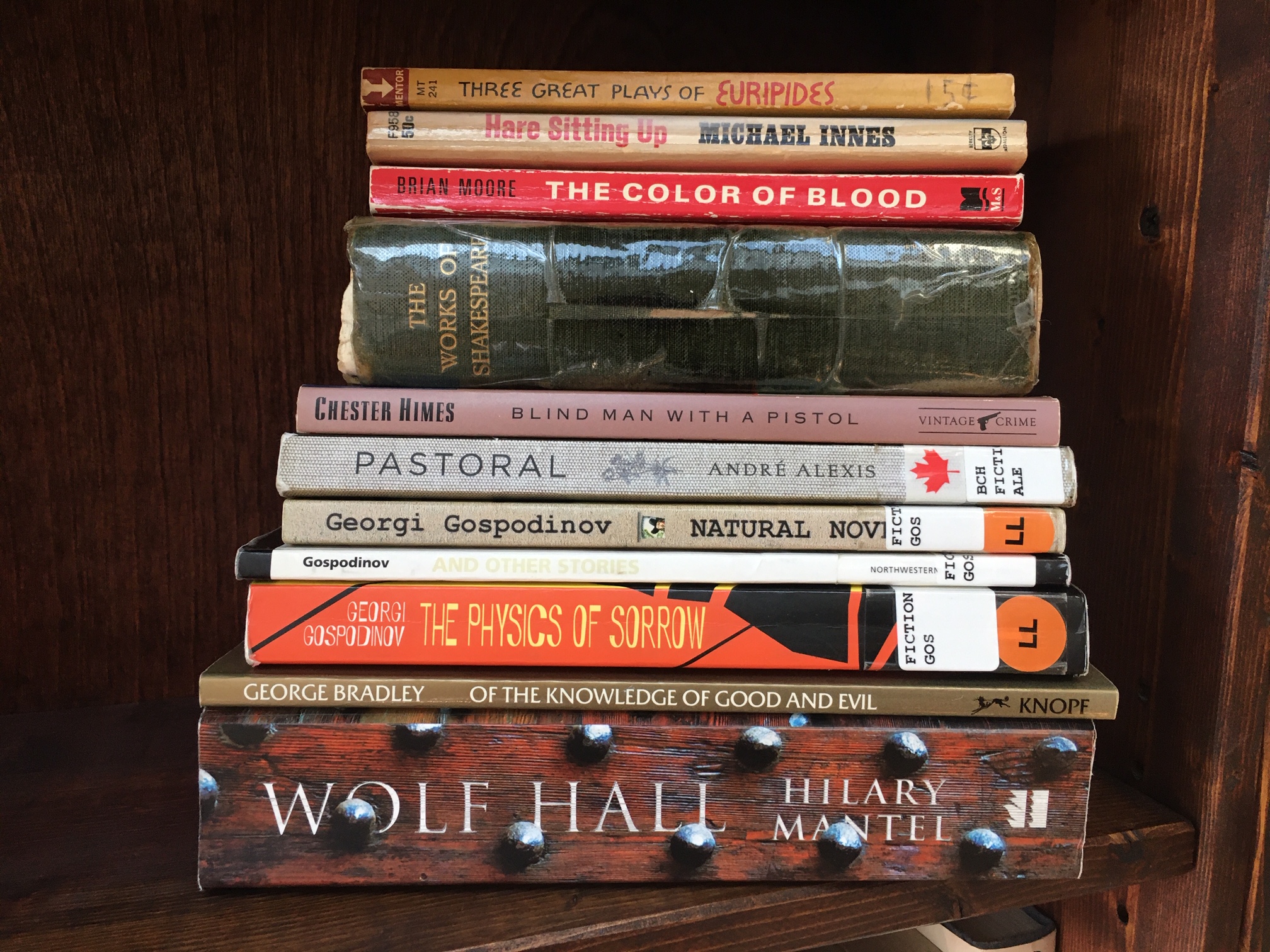
My reading month in March:

Koren Shadmi's Graphical Biographies

The Twilight Man: Rod Serling and the Birth of Television

I saw this reviewed in the New York Review of Books--yes, yes, I'm running behind--and ordered it from the library. I was never particularly a fan of The Twilight Zone--too black and white for me at the age I would have watched the show in reruns--but I liked the graphical style of the clips in the review and the book looked interesting. It was. In fact, really quite good--it got me interested and I might try to see some Twilight Zone episodes. It recapitulates Serling's life story in a narrative frame you might find in a Twilight Zone plot.


Gary Gygax and the Creation of D&D (text by David Kushner)

Looking up Shadmi in my library's catalog, I also came across this. I was a fan of Dungeons and Dragons and so I got this one, too. Though it's Gary Gygax in the title, don't worry: Dave Arneson gets equal time. It was enjoyable, and even though it spoke to me more, I do think it was a less successful work than The Twilight Zone volume. The text is written as if by a dungeon master, or even more, as if it were from that early computer game Colossal Cave/Adventure. (That game's author Will Crowther gets a couple of pages.) "You are in a maze of twisty passages all alike." "You are likely to be eaten by a grue."


The Mystery Department

Michael Innes' Hare Sitting Up

An Inspector Appleby story from 1959. Take identical twin brothers, one a schoolmaster, the other a biowarfare scientist, add a rural lord half(?)-crazed with bird-watching, throw in a blackmailer and a pretty girl with a Ph.D., and you've got a story. It's mostly Innes in his silly mode, which I actually prefer, though Innes does want to say one or two serious things about the morality of WMDs. Not his best by any means, but fun.

Julie Campbell's The Gatehouse Mystery

Trixie and Honey find a diamond in the old gate house on the Wheeler property. Are they going to turn it into the proper authorities? Of course not!

This book has the first appearance of Trixie's older brothers, Brian--and Mart, the snarky one with a propensity toward Brobdingnagian vocables. Always my favorite character. I'm sure I don't know why.

The next in the series is waiting at the library for me to pick it up.

Chester Himes' Blind Man With A Pistol

The last of the Coffin Ed Johnson and Grave Digger Jones mysteries Himes completed, from 1969. This is a very ambitious book, bursting the bounds of Himes' already capacious sense of what a mystery can be. All in 191 pages. Several plots; several time frames. Pretty great & at some risk of sending me down a Himes rabbit hole--I've ordered up the recent biography of Himes from the library. But if you're interested in Himes as a mystery writer, you should probably start with something earlier in the series.

"'There ain't going to be any facts,' Grave Digger informed Anderson."

#BrianMooreAt100

Cathy at 746Books has organized a year long read of Brian Moore's books in honor of what would have been his hundredth birthday. 

Brian Moore's The Color of Blood

Political tensions in an unnamed East European country just before the fall of the Iron Curtain. I thought it was very good. More here.

Brian Moore's Fergus

That I enjoyed The Color of Blood so much led me on to read Fergus. Not as good, I said, though still good.

This month's Brian Moore is the great, but grim, The Lonely Passion of Judith Hearne. Will I reread it? Maybe, but I haven't yet.


The Poetry Section

George Bradley's Of the Knowledge of Good and Evil

This collection came out with Knopf in 1991. A living American poet (b. 1953). The first volume of his I've read--though a couple of these poems appeared in The New Republic in the 80s, so it's possible I read those before. I thought it was very good. Expect something to appear in a poem post in the future. Bradley's poem 'The Lives of the Chinese Poets' begins 'About suffering they were reticent,...' O my Auden

Georgi Gospodinov

Natural Novel, And Other Stories, The Physics of Sorrow

Contemporary Bulgarian novelist, poet, story writer. That's most of what of his is available in English. I think he's pretty good. More thoughts here, mostly on The Physics of Sorrow.

Hilary Mantel's Cromwell

Wolf Hall

I reread this for Brona's readalong, but I'm *still* organizing my thoughts on this one. Not very organized thoughts, eh? I should have finished rereading Bring Up The Bodies to be on schedule, but I haven't...

Shakespeare's Henry VIII

That sent me off to this. Not necessarily one of the better plays, but there are some great speeches--Buckingham's (Act II, Sc 1) on his sentence of death:

The law I bear no malice for my death
'T has done upon the premises but justice
But those that sought it I could wish more Christians

or Wolsey's farewell to greatness.

Andre Alexis

Contemporary Canadian writer. He's four books into a series of five he's termed a quincunx. I read the first, Pastoral (2014). I thought it was very good. A newly minted priest takes up a parish in a small town near Sarnia, Ontario. The second one in the series--Fifteen Dogs--is the celebrated one; it won the Giller, one of Canada's two major novel prizes, as well as various other prizes. I might have more to say when I finish the sequence, at least as it stands now. I have the others on hand.

Euripides

Rex Warner (no relation?--though that first name could so easily slip into...) translated three Euripidean plays with strong female characters in the 40s & 50s: Medea, Hippolytus, Helen. I was interested in the Helen, but then I carried on. Medea, Phaedra, & Helen are all women who do bad or tricksy things and suffer at the hands of men. These are quite often read now as feminist or proto-feminist; would an Athenian of the time have thought so? Mmm. Certainly as Aristophanes presents it (Women at the Thesmophoria) Euripides wasn't popular with the ladies...but then, that's Aristophanes.

No longer the standard translations, but I thought they were quite good. I especially liked Warner's handling of the choruses. He's an interesting novelist (The Aerodrome) and poet, but best known now, I'm guessing, as the translator of Thucydides.

The books that were still around the house (at least when I took the picture):

I wrote most of this post a while ago. It was long past time to either delete it or publish it. Yet another month of much, but muddled, reading--I sometimes get embarrassed by the desultoriness of my reading. Oh, well. Any of these strike thoughts in you?


Thursday, August 23, 2018

Charles Dickens' The Mystery Of Edwin Drood

Hmm. I just read and blogged about this novel less than a year ago, and that was already a reread. Maybe I'm just a bit obsessed by what happened to Edwin Drood? We'll never know, of course, and realistically it could very well be that Dickens himself hadn't made up his mind. He radically changed the ending of Great Expectations after finishing it. So then, the question is, what was Dickens likely to have decided should have happened? Or the more answerable question might be, what do I think should have happened?

In case you're not as obsessed with Edwin Drood as I am: it was Dickens' last novel and he died with it half-finished in 1870. Edwin Drood, a young orphan of some means, disappears about halfway through the pages we have. He had been engaged to be married to Rosa Bud, but just before his disappearance they broke it off. His watch and tie pin are found by the side of a river near the last place he was seen. Accident? Murder? Wilful disappearance? All are possible.

The two main suspects, if it's murder, are Neville Landless, a young half-Indian man, also an orphan, and in love with Rosa Bud; The other is John Jasper, Edwin's uncle, addicted to opium, and also in love with Rosa. Everyone is in love with Rosa in the novel.

Well, I speculated about the possible resolutions in that previous post, so no need to repeat myself here.

What particularly struck me about it on this rereading is the modern feeling of the politics. Neville is dogged by assumptions of guilt simply because of his race. Mr. Sapsea, the mayor of the town, and Mr. Honeythunder, a 'philanthropist'--it's the word used, but Dickens would completely approve of thinking of them as scare quotes--retail condemnations publicly because of his skin color and nothing else. I'm reminded of so many cases, but let's say particularly the Central Park Five.

The extent of Jasper's overall villainy remains obscure to me, but he's definitely at his most villainous in a #metoo moment of teacher-student politics and emotional blackmail. In the chapter 'Shadow on the Sun-dial', he corners the frightened Rosa; she's perfectly aware of his obsession with her; she was his student but has already fled from that. But now she will entertain his declarations of love or he'll arrange that Neville is convicted for murder, guilty or no. Rosa had to give up her music lessons earlier; now she feels she has to flee her home as well.

Maybe I'm just seeing contemporary political concerns in everything these days and reading Dickens anachronistically. That's possible. But it really doesn't feel like it.

Vintage Mystery Challenge. Why. It's an author you've read and loved before. (And obsessed over?)

Back To The Classics. Reread A Favorite Classic.

Sunday, August 5, 2018

Michael Innes' The New Sonia Wayward

Oh, what a tangled web we weave
When first we practice to deceive.
Michael Innes' The New Sonia Wayward (1960) could be read as demonstrating that old saw as being completely true.

Colonel Ffoliot Petticate (what a handle!) is sailing off the coast of England with his wife who is generally not known as Mrs. Ffoliot Petticate. No, she's Sonia Wayward, author of intellectually unsatisfying (at least to Petticate) but lucrative romances. And then she dies.

Her death is innocent enough. Colonel Petticate is an ex-Army doctor, and while he's no longer practicing, he's quite sure she's dead. An aneurysm or an embolism, he doesn't have the instruments and he's not sure about the cause. Oh, well. Their marriage was no longer anything more than friendly, and he hadn't really forgiven her for referring to him as 'quaint' when talking to one of her girlfriends.

But for reasons that are not particularly justified, he tips her body into the ocean and proceeds to try to appear as if his wife has just gone away. It will be convenient: he can write the next Sonia Wayward novel (the 'new Sonia Wayward') and keep cashing the checks.

Umm. Complications ensue...

Did his wife abandon him? (Embarrassing.) Did he kill his wife? (Criminal.) Who wrote the new Sonia Wayward? (Fraudulent.) There are some funny bits and Innes can be a successful farceur.

However, I just don't like it when, in a novel, suspense is generated because an otherwise smart person does something stupid, and this one is full of it. We're meant to like Petticate and think him of above average intelligence. Except he keeps failing to show it.

This one is helped along at the end with a couple of amusing, if improbable, coincidences, but the final solution was visible a mile away, I'm afraid. So, for me at least, not one of the better Michael Innes mysteries.

Vintage Mystery Challenge. Silver. Who. In/Retired From The Armed Services.

Which completes the Silver Age part of my challenge. I've got a couple to go on the Gold Age card.

The old saw, which I thought of when I'd barely started the novel, is actually Sir Walter Scott. I didn't know that...

Saturday, October 28, 2017

Agatha Christie's Murder On The Orient Express

I pulled this one off the shelf because I wanted to see how Christie introduced a large number (twelve) of suspects, a victim, and a few other sundry characters. They're all in place, though a few somewhat sketchily, by page 20 in my edition. I could have stopped there. I didn't.

This is, of course, one of Christie's absolute best, and I say that as one of the large class that prefer Miss Marple to M. Hercule Poirot as her detective.

The novel starts with Poirot in Aleppo about to board the train to Istanbul. He's just completed a successful case in French Syria and he's talking with a junior officer delegated to see him to the train. The officer is unimportant. In case we haven't seen Poirot before, we come away with three traits, I'd say: he can be smug, but he's kind and thoughtful about what others think, and he's insightful.

He's told about and then sees the first two suspects: a colonel from India, and a young English lady from Baghdad. They're described by the conductor as exactly that, and for quite a while at least, that's exactly who they are. Colonel Arbuthnot and Mary Debenham. (Played by Sean Connery and Vanessa Redgrave in the 1971 movie of my tie-in edition.) They seem like they might be falling in love, and Poirot overhears a few snippets of their conversation; their conversation has a strangeness not entirely accounted for by the general awkwardness of falling in love. Page 7.

In Istanbul, Arbuthnot and Debenham intend to proceed immediately on to the Orient Express; Poirot has promised himself a holiday for a few days but when he reaches his hotel, there's a telegram requesting his immediate return to London. The concierge goes to book him a sleeper and Poirot sits down to a quick meal in the restaurant. There he meets M. Bouc, an old friend, now in charge of the Wagon-Lits company whose train Poirot will catch. This gives us another quick view of Poirot's interior:
"Ah!" sighed M. Bouc. "Les affaires--les affaires! But you, you are at the top of the tree nowadays, mon vieux!"
"Some little success I have had, perhaps." Hercule Poirot tried to look modest but failed signally.
This conversation was presumably conducted in French, since both participants are French Belgian. You'll have to decide what you think of the odd inversions and the French inserted into a French conversation. I admit to being of two minds about this sort of thing.

Our next two individuals of interest are also dining at the restaurant. These are two Americans, one rich and the other his secretary. We get the most extended description so far of the rich American: his (old) age, his (receding) hairline, his (false) teeth, his eyes. Of the young man, we learn his name is Hector and he "seemed agreeable." Of the elder, that he was Mr. Ratchett, and that when he went by, "evil had passed very close." This is page 12 in my edition.

It is Mr. Ratchett who will be killed.

The sleeper car is in fact full and it takes some fiddling between M. Bouc and an as yet unnamed conductor to find Poirot a cabin.  We see the conductor in action; he will be an important character because when he's not answering a call, his seat enables him to see the entire length of the car and see access to all the sleeper-room doors. Poirot ends up for the night in a second class cabin bunking with the nice young American who is at first irritated that he won't have the cabin to himself after all. We learn his full name is Hector MacQueen. Page 15-16.

It is at lunch in the dining car the next day that the remaining characters are swiftly introduced. M. Bouc and Poirot discuss their fellow diners. M. Bouc knows some of then; otherwise they just speculate on the basis of appearance and quick snippets of conversation. They are: "a big swarthy Italian," "a spare neat Englishman [with the] disapproving face of the well-trained servant," "a big American in a loud suit--possibly a commercial traveler," Princess Dragomiroff "one of the ugliest old ladies [Poirot] had ever seen," a woman "tall and middle-aged [with] a long mild amiable face rather like a sheep," "the third woman, [at the table with Mary Debenham] a stout, pleasant-faced, elderly person," then a woman "possibly German or Scandinavian," and a couple--"Hungarian Embassy, I believe"--according to M. Bouc. This is in addition to MacQueen, Ratchett, and Arbuthnot, also all in the dining car. And here we are at page 20. I condensed two pages into this paragraph, but the remaining suspects are done very swiftly, and about a couple of them we know next to nothing. They are a bit of a blur.

And we, the story, and the train are off! At least until the train hits a snowdrift and is stuck. The story, of course, carries on. [Odd coincidence. To look at this I interrupted my current reading of Dr. Zhivago. There Zhivago and family are stuck on a train in a snowdrift, until the whole train gets out and clears the way with shovels.]

This post is now probably overlong, and anyway, I've already thought about what I wanted to think about. I also, of course, don't want to give anything away. Agatha Christie is famously the queen of misdirection and this one's a doozy. But I will add I find this one more fun even on rereading than reading it the first time. The fact that I know the solution adds extra nuance, a little extra fun, to a number of things that occur early in the novel. It's not hard to guess which will be clues: Poirot frequently points them out. But knowing exactly how they will come to fruition is fun.

And this is the perfect novel for:

Train. Golden Age. My Reader's Block Vintage Mystery Hunt Challenge.


Thursday, October 12, 2017

Charles Dickens' The Mystery of Edwin Drood

Can we talk about the mystery of The Mystery of Edwin Drood?

The Mystery of Edwin Drood was Charles Dickens' last novel and it was approximately half-finished when he died in 1870. Had he completed it, it probably wouldn't have been his best novel, but, hey, it's Dickens. It's still pretty good.

But the fun for mystery readers is precisely that it is unfinished. Dickens was influenced by his friend Wilkie Collins' hit The Moonstone and he thought he'd try his hand at a mystery plot. He's used crime and even murder elements before, but in Edwin Drood he seems to be constructing a plot with fair play cluing. And over the years, there have been plenty of attempts to say where those clues were going. But spoilers are impossible because nobody knows how it would have ended.

Edwin Drood is about to take a position in an engineering firm, a share of which he has inherited from his father. The job will take him to Egypt. He's also about to marry Rosa Bud as soon as she leaves school; they've been pledged to each other forever; their marriage was a favorite plan between their fathers, both dead now. But Rosa and Edwin can't seem to do anything but quarrel when they actually meet. And before Edwin's disappearance, Rosa tells him it's not a good idea they get married.

It's Edwin who is dead or missing when the book breaks off.

His best friend and closest relative is his uncle John Jasper, only six years older than Edwin, a church musician, and an opium addict. Edwin doesn't see it, but Jasper is also in love with Rosa.

Two other orphans, Neville and Helena Landless arrive in Cloisterham, the town where Rosa goes to school and Jasper leads the church choir. They're taken in by Mr. Crisparkle, a minor canon of the Cloisterham cathedral. They're from Ceylon (Sri Lanka) and are half of Indian ancestry. As Eurasians they're immediately subject to local prejudice. Neville immediately finds Rosa attractive and Edwin thinks the same of Helena, but this is intolerable, and Neville and Edwin end up in a brawl practically as soon as they meet. Boys.

Edwin's watch and tie pin are found at the edge of a weir, but there's no sign of him.

So the question is: is Edwin Drood dead? Or did he just disappear of his own free will? And if he's dead, who killed him?

I think it's pretty clear Neville is the first red herring. He's simply too obvious, and Dickens is too sympathetic to the downtrodden to make him actually the perpetrator.

In John Forster's biography, quoted in the introduction to my Penguin edition, Dickens muses about about a plot where an uncle kills his nephew, and is given a big scene in his condemned cell at the end of the book. Angus Wilson, author of the introduction is inclined to accept that as the plot outline. It is true that Dickens has used the prison cell scene before to great effect: think Fagin at the end of Oliver Twist.

This is a perfectly possible outcome, but I don't like it, for two reasons: 1.) the way Jasper behaves when he learns that Edwin and Rosa have called it off. He's clearly shocked, but is he shocked in the way he would be if he'd just learned he committed a murder that was unneeded? I don't think so. It's an idea that occurred to Dickens according to Forster, but I don't think he'd handle it this way if that was where he was going.

And 2.) Dickens typically shows sympathy for the addicted. He might, of course, feel differently about opium addiction than alcohol addiction, but I keep thinking of the alcoholic Sydney Carton (of Tale of Two Cities.) I think he would have allowed Jasper to redeem himself, though it would likely be at the cost of his life. Mr. Wickfield (in David Copperfield) is another example. Dickens' world view became darker as he aged, but he still seems to me to sympathize with Jasper, and I don't think he'd make him the murderer.

So if I don't think Neville Landless killed Edwin Drood, and I don't think John Jasper did so either, what was Edwin Drood's fate? I think he's still alive. In the notes reproduced in the back of the Penguin, Dickens writes, after trying out various name possibilities for Edwin, "Dead? or alive?" I think Edwin left the country to discover what he thought about Rosa, and wanted to be anonymous when he left.

I suspect Edwin would need to be returned to England at the end of the novel, possibly to save Neville from a false charge of murder, and it will have to be Jasper that does it, probably at the expense of his life somehow.

But who knows? Your guess is as good as mine.

Golden Age. Moon. That's a moon on the cover. It's a detail from A Moonlight Scene by Atkinson Grimshaw according to the back cover of my Penguin. My Reader's Block Vintage Mystery Scavenger Hunt.

Sunday, January 22, 2017

Edmund Crispin's The Moving Toyshop

It's dark days, both literally--it's overcast and rainy here in Toronto this week--and metaphorically, in the world at large. What better time for a comic mystery?

The Moving Toyshop, as far as I'm concerned, is one of the best.

I've read it, oh, a few times before, but the cover shown is the copy I got from the library. All the rest of Crispin is safe here on the shelf, but The Moving Toyshop has gone AWOL. No doubt I'm the guilty party who pressed it on somebody somewhen as a novel sure to please. If you don't already know it, let me press it on you.

The novel starts with poet Richard Cadogan in a funk and needing adventure, or at least a vacation; he wheedles an advance from his publisher to fund a brief getaway (from London) to Oxford. Train schedules fail him; he hitchhikes and finally walking into Oxford, where he arrives after midnight. He finds a toyshop where not everything seems right: it's unlocked, and he enters, hoping to find the owner and tell him his awning was untied and the shop was open. Instead, he finds the body of a woman, apparently strangled. He's knocked unconscious and locked in a closet. In the morning when he wakes up, the only exit is the window. He uses it.

"'Well, I'm going to the police,' said Cadogan. "If there's anything I hate, it's the sort of book in which characters don't go to the police when they've no earthly reason for not doing so."

Cadogan actually says that later, but he acts on his strongly felt sentiment. The police take him round, but the toyshop has moved, and there's no sign of a body, and rather pityingly, the police suggest he have that bump on his head looked at.

Half-convinced he is losing his mind, Cadogan goes to see his old friend, Professor Gervase Fen of Oxford. Enter the hero detective of the novel:

"He was a tall, lanky man, about forty years of age, with a cheerful, lean, ruddy, clean-shaven face. His dark hair, sedulously plashed down with water, stuck up in spikes at the crown. He had an enormous raincoat and a carried an extraordinary hat."

That must be Fen on the cover, I guess; there's the spikes in the hair and the hat.

This is the sort of novel that involves a crazy will, a lorry driver who reads Lawrence, a schoolteacher who defends Jane Austen in a bar, suspects with nicknames derived from Lear limericks, and more than one chase scene involving bicycles and drunk undergraduates.

The solution is improbable in the extreme, and perhaps not entirely convincing, but that isn't why one enters The Moving Toyshop. Come for the toys.

And an extraordinary hat.

Golden Age. Hat. My Reader's Block Vintage Mystery Scavenger Hunt.