"He knew with all his heart the human situation was a frightful botch, but it was such a logical, intelligently arrived-at botch, that he couldn't see how history could have possibly led anywhere else."
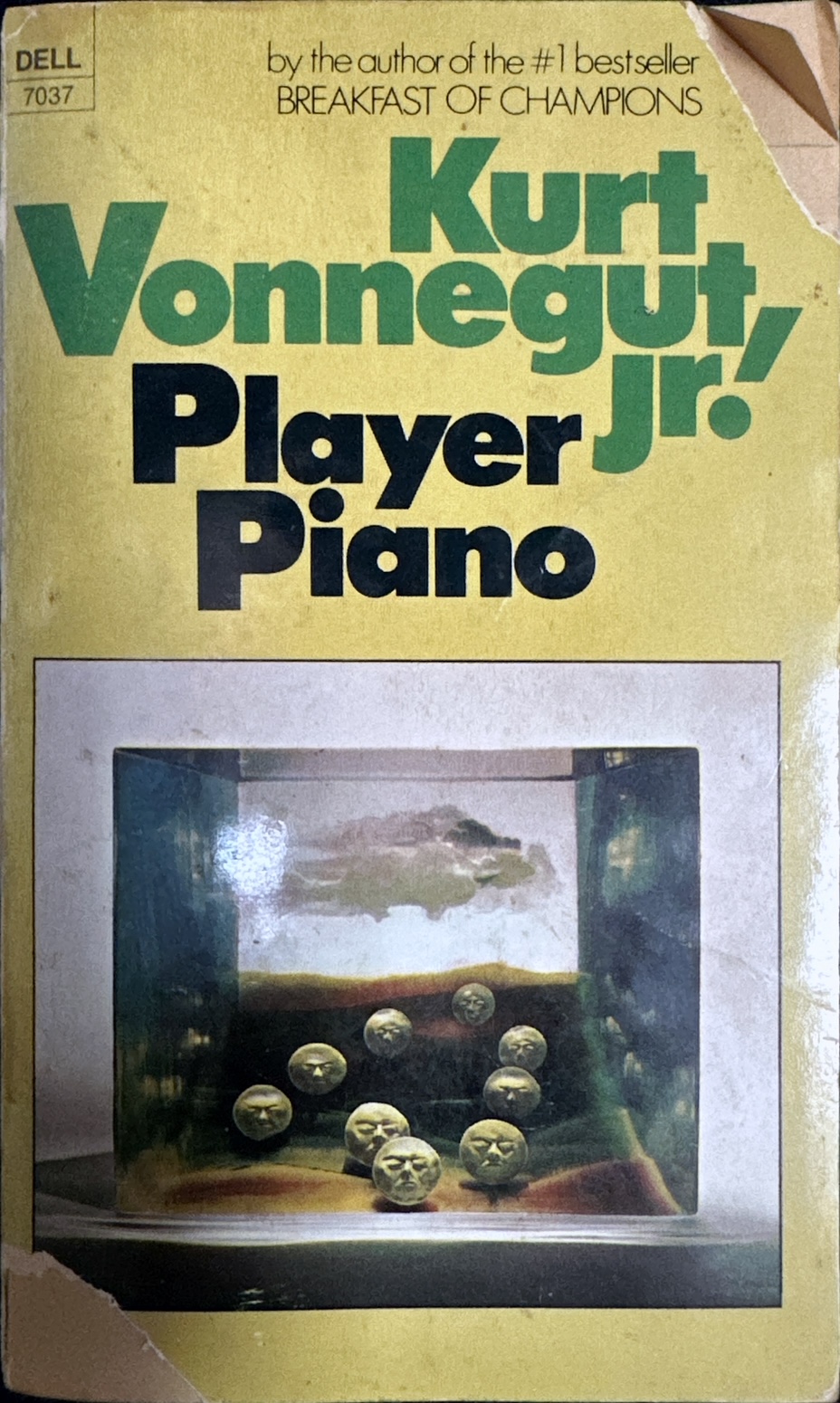
The time is after the third world war; industrial planning and robotics were so important and successful in enabling the U.S. to win those wars, that now everything is given over to managers and engineers--and the machines that replace most people's jobs.
It's a meritocratic society--examinations determine each individual's capabilities--and your punch card determines the sort of job you can have. If you're not qualified for any of the jobs, you're not tossed aside--exactly. You're offered a position in the Army--though there are no more wars after that last one--or the Reconstruction and Reclamation Corps, the 'Reeks and Wrecks'. It'll keep you from starving. But everybody knows both are just make-work.
The quote above is Proteus thinking about the current state of the U.S. Something's not right.
There's a rebel organization, the Ghost Shirt Society, that aims to do something about it. From their manifesto:
"Men, by their nature, seemingly, cannot be happy unless engaged in enterprises that make them feel useful. They must, therefore, be returned to participation is such enterprises."
Proteus is drawn to the ideas of the Ghost Shirt Society, but he's also an engineer and finds it hard to approve inefficiency for its own sake. But then his superiors want him to infiltrate the Society, and publicly fire him to ease his infiltration. What does he decide to do?
Player Piano is Vonnegut's first novel and it's definitely 1952. Processes that improve to such a degree there won't be enough work for all the workers is probably more a risk now than in 1952, but in the novel it happens with punch cards and tape, and the majority of the jobs replaced are assembly line-style work. (No LLMs or general AI.) There are a few women that work, but mostly their opportunities are limited to marriage. (Vonnegut is sympathetic to women not having anything to do, but he doesn't really see around the problem in this; their usefulness is ruined by automatic washers.) But the novel does examine real issues with a human setting, and is unpredictable in its outcome.
Still, while it's not the equal of Vonnegut's later greater novels--the prose is flatter, the construction isn't as tight, it doesn't have those flights of inspired absurdism--it is pretty solid, and better than I expected it to be. (It's usually dismissed.) It does have the Shah of Bratpuhr, the 'spiritual leader of 6,000,000 members of the Kolhouri sect,' an amusingly ridiculous character who could show up in Cat's Cradle. There's humor:
"I think I can say without fear of contradiction that I earned that degree. My thesis was the third longest in any field in the country that year."
A different character has all his academic degrees revoked because it's discovered he never passed gym. (Noooooo!)
A contribution to the 1952 Club. Thanks to Kaggsy and Simon for hosting!

WordPress has been sending my comments to the spam folder again, it seems.
