Showing posts with label YearClubReads. Show all posts

Sunday, April 19, 2026

Nicholas Blake's The Worm of Death (#1961Club)


Dr. Piers Loudron is a successful and well-to-do doctor living in Greenwich, the eastern end of London. 

Nigel Strageways (our series detective) and his partner Clare Massinger have just moved to Greenwich. They're invited over to meet their new neighbours the Loudrons. Dr. Piers' wife has passed, but there are also his adult children, three sons (one adopted) and a daughter.

Dr. Piers disappears on a foggy night. The Loudron children approach Strangeways for advice. A week later his body is found floating in the Thames. Both wrists have been slashed.

Suicide? But the wrists are slashed in such a way that suicide is unlikely, and if it was suicide how did the body get into the river? (As the cover suggests, a slashed-wrist suicide often takes place in the bath.) And just in case you were inclined to the suicide theory, Dr. Piers' daughter-in-law is strangled halfway through the book.

All four of the children have plausible motives to murder their father as does as the daughter's boyfriend, whom Dr. Piers didn't approve of. Strangeways hints he knows who did it pretty early (and I kind of did, too) but Blake does a pretty successful job of keeping us on our toes. I've had mixed results with the Strangeways series, but I thought this one a pretty good entry.

It was fun as a 1961 book because it makes good use of the old East End of London, which, of course is all changed now:

     "When he [Strangeways] got home, Clare kissed him, 'My goodness you've been drinking port.'
     'Yes, with an old tart in the Isle of Dogs." 
The Isle of Dogs isn't the sort of place old tarts live anymore I think.
 
My original list of 1961 candidates is here

Nicholas Blake is a pen name for the poet Cecil Day-Lewis, probably better known now as the father of the actor Daniel Day-Lewis. 

Vintage Mystery Scavenger Hunt

Silver Age (1961). Dead body. 

Saturday, April 18, 2026

Some Previous 1961 Reads

Two books from 1961 have made it on to the blog before, both by Erle Stanley Gardner. One was a Perry Mason story, The Case of the Spurious Spinster:


The other was a Cool and Lam tale, Shills Can't Cash Chips:

It being Gardner, those two weren't even all the books he wrote in 1961, but I thought both were pretty good entries in their series.

Also in the mystery department, but not on my blog, The Wycherly Woman is one of the best of Ross Macdonald's Lew Archer series. 

I've seen lots of people remark how many great choices there were for 1961 and so, of course, some things will be neglected. But there were two I read before I started blogging that I felt were kind of masterpieces when I read them and they didn't seem to be on anybody's radar, so I thought I'd drag them in:

Riders in the Chariot

Patrick White (1912-1990) was the Australian novelist who won the Nobel in 1973. In his Riders in the Chariot--in spirit the chariot is that of Elijah--four otherwise unrelated individuals in suburban Sydney are marked by mystical experience as hidden saints in a world of prejudice and contempt. Can an Aboriginal artist, an evangelical washerwoman, a childlike heiress, and an Auschwitz survivor redeem this world? 

A clue: in the epigraph to the novel, White quotes William Blake's idea of Isaiah speaking, "...the voice of honest indignation is the voice of God, I cared not for the consequences, but wrote..."

The Death and Life of Great American Cities 

Jane Jacobs (1916-2006) was a writer and activist on urban issues. The Death and Life of Great American Cities is her major work. It's full of surprising and brilliant insights: she's a theorist of urban planning who quite often thinks too much planning is bad for cities. I have a couple of pages from an old New Yorker tucked in my copy and in it she says of the city, "...a place full of hope and expectation, and this is has nothing to do with architecture. Those are the emotions that draw us to cities, and they depend on things being a bit messy." Her book isn't Theory with a capital T. It's often said she had a novelist's eye, and it's true: the book is wonderfully readable.

Jacobs cut her teeth as an activist saving Washington Square in New York City from an expressway. She moved to Toronto in 1968, and did the same for us here by helping to squelch the Spadina expressway. The last thirty-five years of her life she lived in a house shown on her Wikipedia page:

Jane Jacobs home Toronto  

And the last four years of her life, she was my neighbour. (We live on the opposite side of the street about eight houses up.) In any halfway decent sort of weather I used to see her sitting on the porch--"Eyes on the street" was an important concept for her--but I never had the nerve to introduce myself.

What other 1961 books would you have liked to see?


 Thanks to Simon and Kaggsy for hosting!

Thursday, April 16, 2026

Symptoms of Love (#1961Club)


Symptoms of Love

Love is a universal migraine.
A bright stain on the vision
Blotting out reason.
 
Symptoms of true love
Are leanness, jealousy,
Laggard dawns;
 
Are omens and nightmares--
Listening for a knock,
Waiting for a sign:
 
For a touch of her fingers
In a darkened room,
For a searching look.
 
Take courage, lover!
Could you endure such grief
At any hand but hers?
 
-Robert Graves
 
Robert Graves (1895-1985) was an English poet who conveniently wrote a short book called More Poems 1961. What could be better for a year club poetry post, I ask you?  😉
 
 
Thanks to Kaggsy and Simon for hosting.
 
I don't actually have that first edition shown above, of course. Allow Gumby to introduce the beat-up paperback I do have:


Wednesday, April 15, 2026

John Hawkes' The Lime Twig (#1961Club)

 "And in gloom, with the bells stroking and the wipers establishing the uncomfortable rhythm of the hour, the two wet men withdrew to the cars and in slow procession quit the sooty stables in Highland Green, drove separately through vacant city streets to uncover the particulars of this crime."

In Aldington, there's a horse race, the Golden Bowl. William Hencher lures his landlords, Michael and Margaret Banks, into a scheme to run a dodgy horse. It doesn't work out. Two detectives have just been led to Hencher's body in a stable, seemingly kicked to death by the horse. Things ended no better for Michael and Margaret Banks. 

It's a crime story, but what I've quoted above is the very end of the novel. We have no particular reason to believe that the detectives will solve the crime.

The novel is divided into eight sections plus a prologue; each is prefaced by excerpts from the column of (fictional) sports writer Sidney Slyter. The prologue takes place during World War II when Hencher's house in London is bombed and his mother killed; later after the Banks have bought the restored house, Hencher takes one of the flats and starts the scheme.

The American John Hawkes (1925-1998) is usually labeled an experimental novelist. But as you can see from above the prose isn't Joycean-level difficult. It's not plotless. There are characters that feel real enough, even if they're generally objectionable--half of them gangsters, and the other half would-be crooks. The Lime Twig was his fourth novel, and was his breakout.

It's a violent story, though if you read Andrew Vachss or the Jack Reacher novels of today, it may not seem all that violent. But sometimes that's the way: something that seemed outrageous in 1961 comes to seem middle of the road later on. But I'd read another Hawkes before another Vachss or Child.

Hawkes seems to have been the anti-Hemingway: he wrote his rather violent novels, but in this interview aired on PBS, he says, "I like the idea of the author as an ordinary person." No need to hunt lions or go to war for him.


He taught writing at Brown for most of his professional career. He and his wife and kids would go every three years or so to the South of France where he'd write a new novel. He seems rather a nice guy for such a violent story... 😉

It's 1961 Club week! Thanks to Kaggsy and Simon for hosting. 

My original list of candidates is here.
 

Monday, April 13, 2026

Peter de Vries' The Blood of the Lamb (#1961Club)

"as I saw myself, a sort of reverse Pilgrim trying to make some progress away from the City of God."

Don Wanderhope is born to a Calvinist Dutch Reformed family in Chicago before World War I. Both his parents were born in Holland. His uncle is a minister, but his father Ben's faith in God is shaky. Ben Wanderhope delivers ice; later when that's no longer a viable job, he switches to picking up garbage. Don Wanderhope intends to achieve a different sort of life.

Don's beloved older brother Louie is a student at the University of Chicago. Though the UofC was founded as a Baptist institution, it's already a hotbed of free-thinking, and Louie's faith has gone well beyond shaky to outright disbelief. But then Louie gets a severe flu, and the family gathers round to pray. His mother asks:

"You have no doubts, have you, Louie?"
"No doubts on my part."
Those were Louie's last words. You will see the ambiguity in that statement. Mrs. Wanderhope takes it one way; young Don Wanderhope in exactly the opposite way. Even dying, wise-cracking Louie probably meant the ambiguity.
 
It's the first of several out of sequence deaths, often having to do with lungs, in Don Wanderhope's life. The last is that of his daughter Carol from leukemia. What is faith in the presence of such blows? How can one accept God or even this world?

Peter De Vries, (1910-1993) like Don Westerhope, was born in Chicago to family of Dutch Reformed immigrants. He went on to become editor of Poetry magazine for a stretch and then after World War II, a staff writer at The New Yorker. He wrote twenty-plus comic novels, a couple of which were made into Hollywood movies. This novel, too, is funny--one chapter is a parody of Thomas Mann's The Magic Mountain:

"Thus were banished my visions of a sanitarium as a place were one sat on benches philosophizing in the sun in the manner of The Magic Mountain, or contracted imprudent passions in the music room."

But then the sanatarium does have two old men philosophizing, and a notorious libertine, who unlike Mynheer Peeperkorn, isn't Dutch. And Wanderhope does contract an imprudent passion.

So the novel is funny--just not in a guffawing way. I've read other novels by de Vries, though a long time ago, and I remember them funnier. But this is a dark subject, and it was inspired by the death from leukemia of de Vries' own daughter in 1960. So: moving and thoughtful, and not without humour.

It's the week of the 1961 Club, hosted by Simon and Kaggsy. Thanks to them for hosting!


 My original list of candidates is here.


Tuesday, October 21, 2025

Earl Derr Biggers' The House Without A Key (#1925Club)

"Amos!" cried Miss Minerva, "That man--why he--"
"Charlie Chan," Amos explained. "I'm glad they brought him. He's the best detective on the force."
 
1925 saw the first of the six Charlie Chan mystery novels. (And I don't know how many movies, etc...)

John Quincy Winterslip has left Boston to come to Honolulu to see what his Aunt Minerva is still doing there. Proper Bostonians don't go gallivanting off to the tropics and even though she's there to see her  cousins Dan and Amos Winterslip, it's time she come home.

But when John Quincy gets off the ship he learns Dan was murdered the night before. He also discovers that while Dan has been living an upright life for a while, he was a black sheep back in the 1880s, and there's still more than one person who would be happy to see him dead.

John Quincy's initial instinct is to pack up his Aunt Minerva and head back to Boston at once, but the Winterslip honour is at stake.

And anyway there's a girl, actually two girls, his distant cousin and Dan's daughter Barbara Winterslip, but more importantly Carlota Maria Egan, beautiful and also the daughter of a suspect.

It's a fun one in the Golden Age mystery tradition, more American than British, not an amateur detective, a few more chase scenes and a bit more violence. (A fist fight! An abduction with an escape!) John Quincy hangs out with Charlie Chan and comes to the correct solution, just a bit later than Chan and Chan has to rescue him. The romance is completely satisfactory.

In fact, really the only downside is that, though I last read it twenty-five years ago, I remembered the murderer and the solution. But I'm quite sure I didn't guess it the first time.

Biggers, already a professional writer, created Charlie Chan because he was impressed by an actual detective of Chinese ancestry on the Honolulu police force Chang Apana and disliked the whole idea of the Yellow Peril.


It's the 1925 Club week! Thanks to Kaggsy and Simon for hosting.
 
I see Fanda also read the novel and enjoyed it this week. 


Monday, October 20, 2025

Ford Madox Ford's Parade's End (#1925Club)

"And Christopher was as obstinate as a hog. For that Mark did not blame him. It was a Tietjens job to be obstinate as a hog." [800]

The protagonist of Parade's End is Christopher Tietjens and indeed he's pretty obstinate. That's Mark, his older brother, musing above, and maybe it takes one to know one, both as a Tietjens and as an obstinate hog... 

Parade's End is a series of four novels that takes place from 1912 until some point after the end of World War I. Christopher Tietjens comes from a wealthy family from the North of England--he's one of the Tietjens of Groby--and in 1912 he's a highly valued analyst in a department of statistics. But he's married Sylvia Tietjens (neé Satterthwaite) and she's a bad 'un.

She'd set her cap at him because she thought she might be pregnant by Colonel Drake and needed a father; she's beautiful; Tietjens falls; he's never quite sure the son she bears is his. (Nor is anyone else: Sylvia herself, various other Tietjens, the reader.) At the beginning of the first novel Some Do Not Sylvia is on the continent, and has just left a subsequent lover Perowne, and intends to ask Tietjens to take her back, which he does.

In the meantime, though, Tietjens, in a meet-cute episode, has discovered Valentine Wannop, a suffragette. He's golfing; she's disrupting the golf course as a protest, and Tietjens rescues her from arrest. He ends up driving her home in the middle of the night and they start to fall in love. Nothing happens at that time.

And nothing happens for quite a while. Tietjens gets himself into the army; we next see Tietjens in 1917 and he's back in England; a shell had exploded near him in France and he'd woken up in hospital not even knowing his name. He meets Valentine again in London, but nevertheless he's determined to get back to France.

"The gods to each describe a different lot:
Some enter at the portal. Some do not!" [24]
This couplet is first quoted in the context of the landed Tietjens' relation to his poor Scottish friend MacMaster. But just before Tietjens' return to France, which both he and Valentine assume is a death sentence, he asks her to sleep with him, and she thinks, that while she's not that sort of girl, "Some do!"
 
But, in fact, they do not. 
 
The second novel No More Parades is set in France. Tietjens is a very capable officer in Transport. New levies appear and need to be moved to the front; there's a grimly comic bit about trying to move Canadian troops into position to go over the top, presumably largely to be killed. Tietjens' position isn't on the very front, but it's dangerous enough; his messenger Morgan dies in his arms, killed by a German shell. 
 
At the same time Sylvia (and aspirants to Sylvia's favours) are out to drag down Tietjens. It's widely believed that Valentine is Tietjens' mistress, and Sylvia contributes to the rumours which get back to, and are believed, by Tietjens' commanding officer General Campion, his older brother Mark, even by his father, so much so that his father commits suicide. (Or does he?) One of those aspirants, working for a bank, delays deposits to his account and hastens check processing so Tietjens' checks bounce, a court-martialable offence at the time.
 
What makes Sylvia so miserable to her husband? She perceives that Tietjens has fallen out of love with her, though he's too honourable to ask for a divorce, or even to sleep with the girl he loves (at least for a long while), and she's still half in love with him. She also just craves excitement:
"And then there is the boredom. I know it; one is bored...bored...bored!" [41]
A sentiment she repeats several times.  She gets to the battle lines in France, where she's not suppose to be and gets Tietjens to spend the night with her in a hotel, but leaves the door open so Perowne can come in.
"If what's distressing you is having to tell me that you believe Major Perowne came with my wife's permission I know it's true. It's also true my wife expected me to be there. She wanted some fun; not adultery." [498]

Not my idea of fun, but that's who Sylvia is. Tietjens not unreasonably attacks this intruder, but it's Tietjens who gets in trouble for it.

Tietjens, on the other hand, is often irritating in a priggish way:

"His private ambition had always been for saintliness...a saint of the Anglican variety..." [200] 

Tietjens' reputation is so compromised by the end of the second novel that Campion can do nothing but promote him into a position that actually is the front lines.

The third novel A Man Could Stand Up-- starts with Valentine on Armistice Day 1918. Noisy celebrations are starting; Valentine, who's teaching at a girls' school, can't control her students, when she learns (along with a lot of misinformation) that Tietjens has survived the war and is in London. She goes to see him, but does he want to see her? 

In fact he does, and once again they think about sleeping together, but rescuing Valentine's drunk brother gets in the way. 

The novel then moves back in time to early 1918 on the Western front; the British army is close to collapse and nobody quite recognizes that the German army is equally close to collapse. (The Russians have collapsed, which just might give a second wind to the Germans.) 

Tietjens on the front is more concerned with his personal issues: what to do about his family? His son (if the son is his)? Valentine? His brother Mark and his father were too ready to believe the slanders about Tietjens and he can't forgive them (see the quote at the top) and Tietjens who would inherit the family estate because Mark has no children decides to refuse it and make his own way.

The fourth novel The Last Post resolves most of the issues but I won't tell you how they're resolved... When Graham Greene caused the series to be reprinted as one volume in 1963, he said The Last Post was a 'disaster' and simply left it out. That's a little strong, but I did think it was the weakest.

The novel is often quite funny, despite the darkness of its themes, both political and personal. It's also stylistically interesting, with a lot of it in stream of consciousness, an early, though hardly the first, example of the technique. There was a BBC adaptation with Benedict Cumberbatch as Tietjens, which I haven't seen but now want to. Cumberbatch could do a good Tietjens, I think, both pompous and appealing; after all he was Sherlock Holmes.

It's the 1925 Club! 


Actually only the second novel No More Parades is from 1925; the whole was issued from 1924-1928. Thanks to Kaggsy and Simon for hosting!


Thursday, April 24, 2025

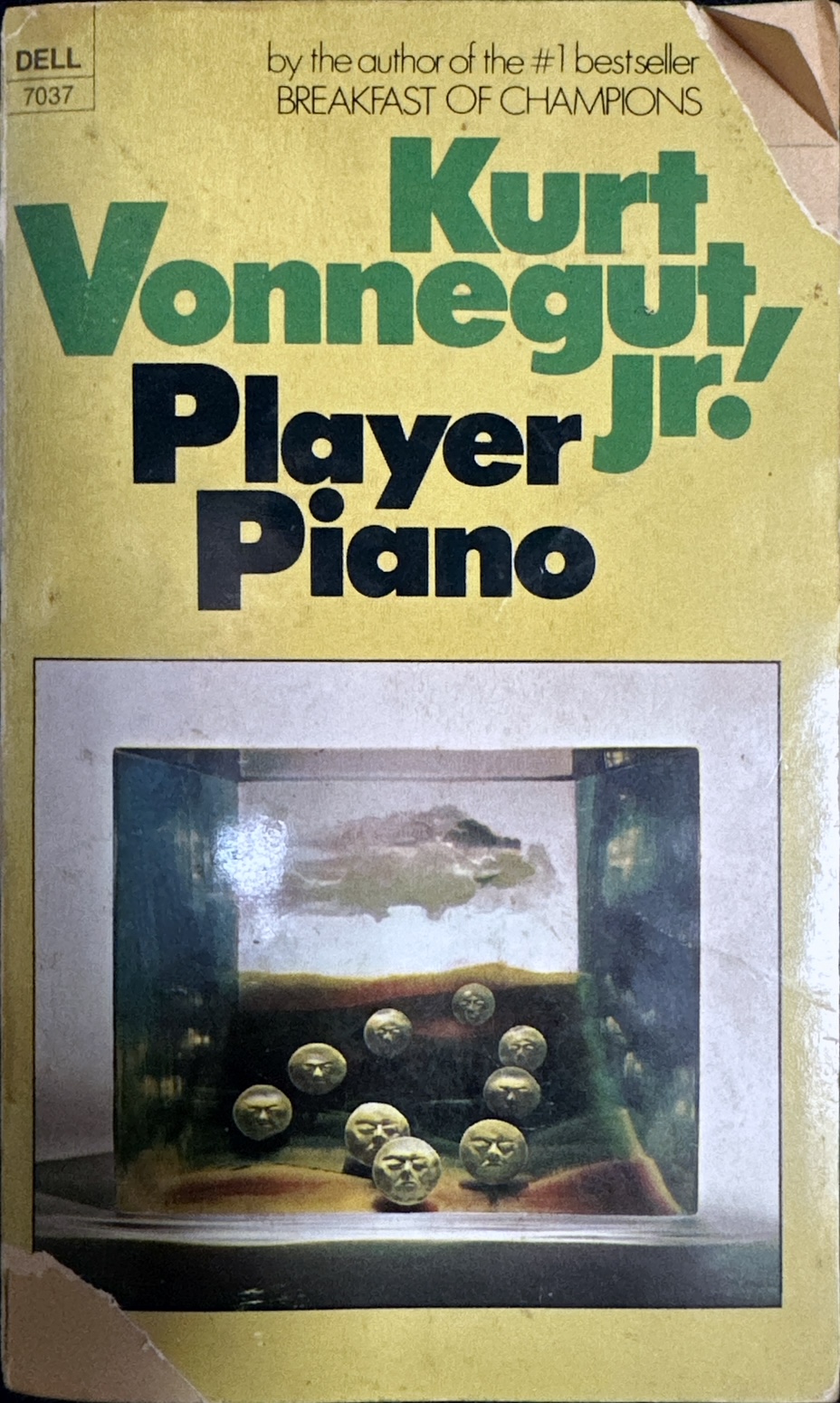
Kurt Vonnegut's Player Piano (#1952Club)

"He knew with all his heart the human situation was a frightful botch, but it was such a logical, intelligently arrived-at botch, that he couldn't see how history could have possibly led anywhere else."

Doctor Paul Proteus is the manager of the Ilium Works, "the most important, brilliant person in Ilium." He's only thirty-five, and he's expected to only move up from that triumph. After all his father was Doctor George Proteus, a man second in importance only to the president of the United States.

The time is after the third world war; industrial planning and robotics were so important and successful in enabling the U.S. to win those wars, that now everything is given over to managers and engineers--and the machines that replace most people's jobs. 

It's a meritocratic society--examinations determine each individual's capabilities--and your punch card determines the sort of job you can have. If you're not qualified for any of the jobs, you're not tossed aside--exactly. You're offered a position in the Army--though there are no more wars after that last one--or the Reconstruction and Reclamation Corps, the 'Reeks and Wrecks'. It'll keep you from starving. But everybody knows both are just make-work.

The quote above is Proteus thinking about the current state of the U.S. Something's not right.

There's a rebel organization, the Ghost Shirt Society, that aims to do something about it. From their manifesto:

"Men, by their nature, seemingly, cannot be happy unless engaged in enterprises that make them feel useful. They must, therefore, be returned to participation is such enterprises."

Proteus is drawn to the ideas of the Ghost Shirt Society, but he's also an engineer and finds it hard to approve inefficiency for its own sake. But then his superiors want him to infiltrate the Society, and publicly fire him to ease his infiltration. What does he decide to do?

Player Piano is Vonnegut's first novel and it's definitely 1952. Processes that improve to such a degree there won't be enough work for all the workers is probably more a risk now than in 1952, but in the novel it happens with punch cards and tape, and the majority of the jobs replaced are assembly line-style work. (No LLMs or general AI.) There are a few women that work, but mostly their opportunities are limited to marriage. (Vonnegut is sympathetic to women not having anything to do, but he doesn't really see around the problem in this; their usefulness is ruined by automatic washers.) But the novel does examine real issues with a human setting, and is unpredictable in its outcome.

Still, while it's not the equal of Vonnegut's later greater novels--the prose is flatter, the construction isn't as tight, it doesn't have those flights of inspired absurdism--it is pretty solid, and better than I expected it to be. (It's usually dismissed.) It does have the Shah of Bratpuhr, the 'spiritual leader of 6,000,000 members of the Kolhouri sect,'  an amusingly ridiculous character who could show up in Cat's Cradle. There's humor:

"I think I can say without fear of contradiction that I earned that degree. My thesis was the third longest in any field in the country that year."

A different character has all his academic degrees revoked because it's discovered he never passed gym. (Noooooo!)

A contribution to the 1952 Club. Thanks to Kaggsy and Simon for hosting!

 WordPress has been sending my comments to the spam folder again, it seems.


Monday, April 21, 2025

Angus Wilson's Hemlock and After (#1952Club)

"Dear Sands, I am pleased to be able to tell you that official agreement has been given to the grant for Vardon Hall."

Bernard Sands is a 'Grand Old Man of Letters', perhaps even a 'Grand Enfant Terrible'.  He's in his late 50s and has written a number of successful novels. The old manor house in his English village of Vardon was on the market; it wasn't good enough for the National Trust, and Sands has decided it should become a retreat for young writers. As the novel starts he's just gotten word of his success.

Sands is married with two children he's somewhat estranged from. His son James aspires to a Conservative political career; Sands is a bit closer to his daughter Elizabeth, a journalist.

The reason for the estrangement is that Sands has decided he's homosexual. His wife Ella has had a nervous breakdown, though she's gradually recovering. His son James is worried about the scandal; his daughter feels her mother's injury.

His first affair was with a graphic artist Terence Lambert who aspires to do stage design. That affair is over though they remain on good terms, and Sands is now interested in Eric Craddock who works in a bookshop. Is this grants scheme for young writers just a procurement mechanism? It's not, but the rumours do fly. (And somebody else is running a procurement scheme.) Mr. Greenlees, the first young writer for Vardon Hall, would definitely appear not to be a sex object.

The first high point of the novel, Sands is waiting in Leicester Square for Terence Lambert, when he's approached by a young man who asks him for a light. The young man has clearly got something more on his mind, but Sands isn't interested in cruising. But moments later, the still nameless young man is arrested 'for importuning', and the detective asks Sands if he would like to offer evidence. Sands says, "Certainly not," but he's torn between helping, as if there was anything he could do, and throwing the young man to the dogs to save himself. The stress of it all leads to a heart attack, just as Terence Lambert is arriving.

The second high point of the novel is the speech Sands gives at the opening of Vardon Hall. James and his wife have been inviting Conservative grandees, hoping to make connections, various London homosexuals show up, and, from the neighbourhood, the odious Mrs. Curry--Sands' original rival for Vardon Hall--and her circle appear. The hall is jammed; the weather is an uncharacteristic broiling, and a mad imbroglio breaks out.

The novel is funny and sad both. Those with good intentions act, but mostly don't succeed, though the worst do fall.

Sands may have been a grand old man of letters, but this is Angus Wilson's first novel. It was a success from the start; its open discussion of homosexuality, though not unknown in the English novel--Brideshead Revisited came out in 1945, for instance--was still pretty shocking. I do think from what I've read, his later novels are better. His Anglo-Saxon Attitudes made it to the blog here.

It's the week of Simon and Kaggsy's 1952 Club! My organizing post is here. There's one other 1952 book on the blog, Edmund Wilson's The Shores of Light.

Thanks to Kaggsy and Simon for hosting! I hope to get one or two more books this week.

Saturday, April 19, 2025

#1952Club Candidates

Once again it's time for Kaggsy & Simon's year club and this spring its 1952:


I've heaped up a pile of books, not all of which I'll read:

Left, then top to bottom:

A. J. Liebling/Chicago

Liebling wrote several articles about Chicago for The New Yorker in early 1952; the book came out later that year. I've read this one before, but something I read recently about the Mob in Chicago referenced it and I've been thinking about rereading it. When I first read it, my thought at the time was, enh, a New Yorker writing about Chicago--what did he know? But we can see if that's true! (Liebling at his best is amazing.)

Angus Wilson/Hemlock & After

Bernard Sands is a 50-something novelist who wants to start an arts centre. Wilson's first novel.

Kurt Vonnegut/Player Piano

Also Vonnegut's first novel. I've never read it but I think it's harder sci-fi than a lot of his later novels.

Henry Green/Doting

Henry Green's last novel. Witty and dialog-heavy? I suspect. I've read a couple of Greens, but not this one.

Yasunari Kawabata/Thousand Cranes

Hopeless love and the Japanese tea ceremony says the cover. I've also read a couple of Kawabata's and not this one--the Other Reader is a fan and we have a stack, which I haven't made my way through.

Vassily Grossman/Stalingrad

Well, this one is here, but I'd have to have started it already to actually read it in time for this week. But I've been thinking about it since I recently read Edwin Frank's Stranger Than Fiction and one of his chapters is devoted to this and the amazing Life and Fate. So I could be reading it soon.

Van Wyck Brooks/The Confident Years

Brooks' history of the American literary scene in the years 1885-1915. Late Henry James, Edith Wharton, Lafcadio Hearn, early Theodore Dreiser. Brooks' whole Makers and Finders series on the history of American literature is pretty great.

I've already read one and a half of the books on that pile (in addition to the Liebling which I read some years ago). First post on Monday!

But of course I won't read all of them this week, alas...

There's one book I've read from 1952 since I've started the blog:

Edmund Wilson's The Shores of Light. It's a pretty great collection of Wilson's criticism, bookended by two essays he wrote in 1952, on Christian Gauss, the literary critic and his (and F. Scott Fitzgerald's) professor at Princeton, and on Edna St. Vincent Millay, with whom Wilson had been in love at one point.

Some other '52 books I've read and enjoyed in the past: Invisible Man, Martha Quest, East of Eden, The Old Man and the Sea, Wise Blood, The Cloven Viscount, Men at Arms (from Evelyn Waugh's Swords of Honour trilogy).

And if I want to sneak in a mystery toward the end of the week, some possible rereads:

I remember the Queen pretty well--well, it is one of his most striking solutions--so I probably won't reread that. The Lew Archer and the Perry Mason I scarcely remember and so they'd practically be like new mysteries. One of those is likeliest.

I'm pretty sure I've also read the two Christies from that year, but I don't have them and would have to hunt them up. Though the Poirot from that year seems vague to me and it's possible I've never read it.

Are you joining in? Which look good to you? Which should I be sure not to miss?

Thanks to Simon and Kaggsy for hosting!


Thursday, October 17, 2024

Gwendolyn Brooks' Family Pictures (#1970Club)


Speech to the Young

Say to them,
say to the down-keepers,
the sun-slappers,
the self-soilers,
the harmony-hushers,
"Even if you are not ready for day,
it cannot always be night."
You will be right.
For that is the hard home-run.

Live not for battles won.
Live not for the end-of-the-song.
Live in the along.
-Gwendolyn Brooks

Paul Robeson

That time,
we all heard it,
cool and clear,
cutting across the hot grit of the day.
The major Voice,
the adult Voice,
forgoing Rolling River,
forgoing tearful tale of bale and barge
and other symptoms of an old despond.
Warning, in music words
devout and large,
that we are each other's
harvest:
we are each other's
business:
we are each other's
magnitude and bond.

-Gwendolyn Brooks

Gwendolyn Brooks' short volume of poetry Family Pictures came out in 1970. Two years earlier she had been appointed Poet Laureate of Illinois, a title she held until her death in 2000. She was also the Poet Laureate of the U.S. for the 1985-6 term. She was a lifelong resident of Chicago. Gwendolyn Brooks has always been a favorite of mine.

I'm not sure exactly which song of Paul Robeson's she's thinking of--by 1970 Paul Robeson's health was poor and he wasn't performing anymore. The poem suggests he's moved on from Ol' Man River, and it's true that Paul Robeson became much more political. (Not always in admirable ways.) So here's Paul Robeson singing "I Dreamed I Saw Joe Hill," the union organizing song:


Tuesday, October 15, 2024

Philip K. Dick's Our Friends From Frolix 8 (#1970Club)

    "You're married, too, you have a wife, and you have two children. Is your respon--" Again his tongue failed to function properly. "Where's your first loyalty? To them? Or to political action?"
    "Toward men in general."

In the year 2135, Nick Appleton works at a lower class job, as a tire-regroover. On this future earth, your status is set by a supposedly meritocratic exam you take as a young teen. But when his boy Bobby, whom Nick knows is bright, fails the exam, Nick begins to question the whole system.

What is the system? There's a world dictator, picked from one of two parties, the New Men and the Unusuals. Willis Gram, an Unusual, is the current world dictator. New Men are those that have tested brilliant; Unusuals have uncommon powers: they're precogs, telepaths, telekinetic. (Gram is a telepath.) Ordinary people are known as Old Men. There's a rebel movement, known as the Undermen. And we learn, on the fifth page of our story, that yes indeed, those supposedly meritocratic tests are rigged.

Some years ago, Thors Provoni flew off into space to find a powerful alien to help him overthrow this corrupt system and now he's on his way back. With an alien? So he claims. Should your loyalty be to your wife, child, that pretty girl you just met, your party, the corrupt but functioning system, the oppressed, the human race (maybe) under attack by aliens?

Now this novel isn't, as far as I can see, on anybody's list of best Philip K. Dick novels, and well, it shouldn't be... 😉 But I was surprised how good it was. It does come from the middle of a major period for Dick. The flawed or corrupt characters represent most of those choices about loyalty, and even the worst choices are somehow given space to feel true for a moment. It's true, though, that Dick's prose rarely rises above functional, and in this one, maybe not at all. The ending is a little rushed. Still, a pretty fun read.

Yesterday's Macanudo strip. Timely!

Sure it may all take place in 2135, but in its heart of hearts, it's a 1970 novel. Drug dealers, souped-up cars, and is that Bob Dylan guy really any good?


Monday, October 14, 2024

J. G. Farrell's Troubles (#1970Club)

"In those days the Majestic was still standing in Kilnalough at the very end of a slim peninsula covered with dead pines leaning here and there at odd angles." [5]

The opening of J. G. Farrell's Troubles. Those days are 1919, and the Majestic is a grand old hotel in Ireland, by then fairly dilapidated. The hotel was bought by the Protestant widower Edward Spencer some years before; the vendor told him the hotel attracted a regular clientele, but what he didn't tell Edward was that very few of that clientele had money to pay their bills.

Edward has four children, the oldest Angela, a son Ripon, and teenage twin terrors, Faith and Charity. Angela has her Major, who arrives in Kilnalough at the start of the novel.

"In the summer of 1919, not long before the great Victory Parade marched up Whitehall, the Major left hostpital and went to Ireland to claim his bride, Angela Spencer. At least he fancied that the claiming of a bride might come into it. But nothing definite had been settled." [7]

Major Brendan Archer had met Angela in Brighton when on health leave in 1916. They'd kissed once, he'd returned to the trenches, and ever after he was receiving letters from "your loving fiancée, Angela."

Brendan is particularly hapless at the business of romance:

"Until now, incredible though it may seem, the Major had never considered that love, like war, is best conducted with experience of tactics." [253]

When the Major gets to Kilnalough, Angela avoids him. She was tubercular the whole time. ("I thought you knew.") 

There was another prospect, but the Major hadn't even realized: she writes that he hoped he didn't mind, but after waiting, she eventually married someone else. "She oppressed him, though, by the intensity of her feeling for him, and that was the principal thing he now remembered about her. She had had a tendency to hug him violently, squeezing the air out of his lungs--it's distressing to be squeezed very hard if you are not trying to squeeze the other person back. One feels trapped." [255]

And there's a third girl he's attracted to: Sarah, but she's Catholic. After Angela dies he allows himself to fall completely in love, but just like with Angela, the Major barely talks to Sarah. After a year of aimless loitering, he bumbles out a proposal: 

    "Look here, I want you to be my wife."  He could say no more. He could not move. He stood there waiting like a pillar of salt. He could see, though, that it was no go...
    She said crossly, "Oh, I know you do, Brendan." [349]

Hapless!

All the while Brendan Archer is loitering in Ireland, and not getting married, the Majestic continues to fall down or is pulled down by desperate or angry Catholics; its owner, Edward Spencer is going mad in his attempt to hold up some sort of Protestant Irish standard. Major Archer, Edward Spencer, the Majestic hotel--almost a character in itself--are all of a piece: decaying, under attack, committed to vanishing and misguided standards, Anglo-Irish, ineffectual. If you're a symbol-spotting kind of person, the Majestic hotel is definitely a stand-in for the last years of the Protestant Irish Ascendancy.

The book ends with the arrival of the Irish Free State in 1922; the Protestants flee and the Majestic burns to the ground.

The book has a blurb on the back from The Guardian: "Sad, tragic, also very funny." Sad and very funny both are abundantly true; the tragic, though, is a bit more of question: it depends on whether you think they're so hapless, they deserve what's coming to them. And they might! 😉

J. G. Farrell wrote three novels in the 70s--this was the first--called the Empire trilogy, The remaining two are The Siege of Krishnapur (1973) and The Singapore Grip (1978). Troubles won the Lost Booker for those novels that came out in 1970 and due to a rules change weren't eligible for any Booker Prize. The Siege of Krishnapur won the Booker for its year as well. All three are great. All three focus entirely on representative members of the Empire; the subject populations--Irish, Indian, Malay or Chinese, respectively--are anonymous, nearly invisible. Did Farrell not want to appropriate the stories of the oppressed? Did he simply not know those people as well? (Farrell was born in Liverpool, but came from a Protestant Irish family of colonial administrators.) Or did the stories of hapless English in colonial settings just seem funnier? I suspect the last myself.

John Banville in a well-done introduction calls this Farrell's masterpiece. Could be, though I'd plump for The Siege of Krishnapur myself. Funny as this is, Siege is even funnier. It's also shorter and would make a better introduction if you haven't read any of them. But they're all three great and I suspect I'm going on to reread the other two as well.


It's the week of the 1970 Club, hosted by Simon & Kaggsy! Isn't that a cool logo?

My organizing post for this fall's club is here, with links to a few books from 1970 already on the blog. (Tony Hillerman, Brian Moore, Shirley Hazzard.)

Also:

"...how incrediby Irish it all is..." [24]

This is my trip to Ireland for this year's European Reading Challenge.


Page numbers are from the New York Review of Books edition shown above.

I'm hoping to get a couple more in this week. Are you reading something for the 1970 Club? Any favorites from that year?


Tuesday, October 1, 2024

Upcoming! #1970Club Prospects

The beginning of October means it's time to start on Simon and Kaggsy's 1970 Club.

I've piled up some candidates:


Will I manage to read them all? Of course not! That's (from right to left):

Studs Terkel's Hard Times

My copy of Terkel's interview history of the Great Depression dates from 1970. As with most of his books, it's a series of short interviews with people both famous and not. I will have read some of it before, but not, I think, all of it.

Philip K. Dick's Our Friends from Frolix 8

One of the lesser-read from Philip Dick that I've never read. It could be time!

Robertson Davies' Fifth Business

The first in Davies' Deptford Trilogy, which is definitely his masterpiece.  It's set in the fictional small town of Deptford somewhere in southwest Ontario.

Ngaio Marsh's When In Rome

A late Roderick Alleyn entry from Marsh, which I haven't read. It's actually set in Italy.

Mary Stewart's The Crystal Cave

The first of Mary Stewart's books about Merlin and Arthur. I will have read this some time in the 70s, but not since. But it was pretty fun as I remember.

J. G. Farrell's Troubles

Troubles is Farrell's great novel about Ireland in the immediate aftermath of WWI, (1919 and following). I read it twenty years ago, but I've lately been thinking it's time to reread Farrell's whole Empire trilogy about British imperialism. (This, The Siege of Krishnapur, and The Singapore Grip--all great). It won the Lost Booker for 1970.

and... 

John D. MacDonald's The Long Lavender Look

Another book I haven't read since the 1970s. Despite the Pink Panther's enthusiasm, this one is probably the least likely. It's from the middle of MacDonald's Travis McGee series--I've been idly thinking I should reread the series from the start...

There's three books already on the blog from 1970:

The Blessing Way. Tony Hillerman's first detective novel, set in the Four Corners area and featuring his Navajo detective Joe Leaphorn. It's a great start to the series.


Fergus. Brian Moore's novel of 1970 about a scriptwriter in LA who sees ghosts. Or something. I read it in 2021 for Brian Moore at 100 readalong. Not my favorite Moore, but a good one.


The Bay of Noon. Shirley Hazzard's novel is set in Naples in the post-World War II period. Jenny, needing to get away from home, takes a job as a secretary for the United Nations. A romantic quadrangle among diplomats and artists. It was short-listed for the Lost Booker that year.


Which look good to you? As of today, I think Troubles is likely candidate number 1, but the club runs from the 14th to the 20th. That's almost two weeks away yet! I can't think that far in advance...😉

Sunday, October 8, 2023

Sunday Salon


Book-ish

Bit of a lazy week on the blog. Posted a Sir John Suckling poem I've always thought amusing.

Reread Cyrano de Bergerac, the play by Edmond Rostand, plus some other things relating to Cyrano. Post on Cyrano soon? Maybe!

A couple of mysteries that will remain mysterious until they get their own post.

#1962Club

Kaggsy and Simon host a reading week devoted to a particular year; this year is 1962, and it starts in a week:


As usual, I've piled up a stack of books, not all of which I'll read...


The volume of Baldwin is for Another Country.

The two mysteries at the back--The Mirror Crack'd From Side to Side and The Zebra-Striped Hearse--are ones I've read before, multiple times, and for the Christie in particular, I remember the solution quite well. Still for each of them, that book is one of my favorites by the author, and they could very well get reread one more time.

Are you planning on taking part? 

And...

Happy Thanksgiving! (to those for whom it's appropriate... 😉) There's turkey sausage pasta on the menu for tomorrow night, which isn't quite roasting a bird, but will have to do...

Thursday, April 13, 2023

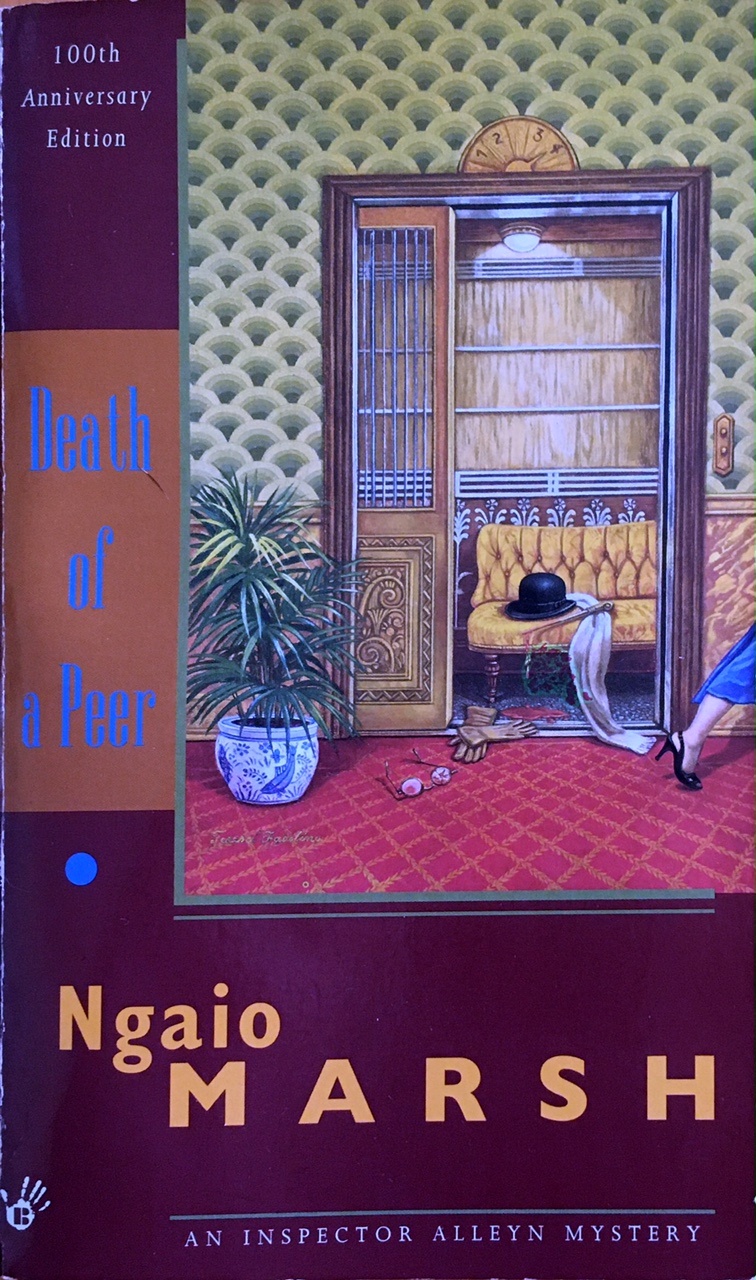
Ngaio Marsh's Death of a Peer (AKA A Surfeit of Lampreys) #1940Club

"It was some good-for-nothing out in the street. One of these Nazzys. The police will soon have him locked up."

[Spoiler alert! 😉] It wasn't one of those Nazis.

There are one or two quick allusions to events of the era, but mostly this feels like a interwar book. "The whole thing's lousy with lords and ladies," says Inspector Fox.

There have been ennobled Lampreys ever since one did 'some fishy bit of hanky-panky for Good Queen Anne or one of her ministers.' Lord Charles Lamprey is the second son, improvident, and head of a large family. It's his older brother that's murdered, in the lift at Lord Charles' London apartment. Since Lord Charles was hoping to get cash from his older brother and had not, he's clearly a prime suspect.

The novel starts in New Zealand, though, where Roberta (Robin) Grey becomes friends with the family. In New Zealand Robin's already half in love with Henry, Lord Charles' oldest son and when her parents die and she's sent off to live with an aunt in England, she's not entirely sad. We get a few amusing pages of a provincial's first arrival in London before the main event (together with Superintendant Roderick Alleyn and Inspector Fox and the whole crew) arrives.

The puzzle in this one is pretty successful, and I got to the end without realizing who had done it. Still the best thing in the novel has to be the Micawber-ish Lampreys; they're charming, witty, hapless, and (unlike the Micawbers) compulsively given to fudging the truth. You'd think that last quality might detract from the charm, but they do it to save each other, and it *is* useful in a mystery novel. Not that Alleyn or Fox is ever be-fudged.

A strong entry in the Marsh canon, I thought, though I preferred her other 1940 book, Death at the Bar, that I read earlier this year.


Good for My Reader's Block Vintage Mystery challenge.

Vintage Mystery, Gold, Glove. The gloves are a crucial clue.

And it's the week of the 1940 Club!

Marsh dated the book December, 1939 in New Zealand, at the end. My copy is copyrighted 1940. The Internets are a bit uncertain: some calling it a 1940 book and some a 1941. Publishing was becoming restricted by then and it may very well have different release dates in different countries. But I'm just going to stick my fingers in my ears, and unlike Roderick Alleyn, ignore any facts that contradict what I want to believe. La, la, la. It's a 1940 book!


E. E. Cummings (#1940Club)


love is more thicker than forget
more thinner than recall
more seldom than a wave is wet
more frequent than to fail

it is most mad and moonly
and less it shall unbe
than all the sea which only
is deeper than the sea

love is less always than to win
less never than alive
less bigger than the least begin
less littler than forgive

it is most sane and sunly
and more it cannot die
than all the sky which only
is higher than the sky

-e. e. cummings

This is from e. e. cummings' book 50 Poems, which came out in 1940. None of what I think of as his best-known and most-anthologized poems appear in it: 'i sing of Olaf glad and big' is earlier and 'pity this busy monster, manunkind,' and 'what if a much of a which of a wind' appear in the next book 1x1, which came out in 1944. The balloonMan whistles in spring, far and wee, in the first book, Tulips and Chimneys, of 1923. (Which would have been a good mud-licious sort of poem for the season.) But the 1940 club is on, and so, 50 Poems,  a sort of lost middle-child among his books, is it. 😉

But it does have some lovely poems: 'it is most sane and sunly/and more it cannot die'. There are those poems in cummings that just make me happy.


I hadn't really twigged to it, but it turned out 1940 was a good year for poetry, at least as represented on my blog... What I tend to think of as Auden's best book, Another Time, came out in 1940. There's two poems already on the blog from it: 'The Unknown Citizen' and 'Roman Wall Blues'. But I can't be doing Auden all the time. And Ogden Nash had a book in 1940, The Face is Familiar, which included the incomparable 'Portrait of the Artist as a Prematurely Old Man'. 

Monday, April 10, 2023

Leslie Charteris' The Saint in Miami (#1940Club)

"The name is Simon Templar--usually known as the Saint."

A friend of the Saint's girlfriend writes and says there's trouble brewing, and so the Saint heads for Miami.

But when they get to the Gilbecks' house, they're gone. The servants let them in, but are clearly puzzled why these foreigners have come to stay when the owners of the house just sailed away.

That same day a U.S. freighter is blown up off the Florida coast; the Saint spots a submarine; and a body washes up by the Gilbecks' house, a body half-dressed in a British Navy uniform. 

Are these things all connected? Of course they are!

It makes a pretty good 1940 novel (though see Below...) Who exactly would be attempting to drive a wedge between the Americans and the British in 1940? It's not giving much away to say that's exactly who villains are. But just who it is that's the big boss Nazi in Miami and what the Saint is going to do about it are still pretty good questions for a novel.

The Saint's first action is to hide that body, because he (rightly) suspects the British Navy has nothing to do with it.

Leslie Charteris' series is pretty well established by this point. The first Saint novel, Meet the Tiger, came out in 1928 and his crew are present: the Saint's sometime girlfriend, Patricia Holm, doesn't do much in this one except provide the tie-in to the Gilbecks; Peter Quentin does some of the early legwork, but is mostly there to be captured; however, the Saint's Brooklyn-born muscle-man, Hoppy Uniatz, is in fine form: "Welcome him with liquor, and he'll drink out of your hand," Saint tells the Greek, and it's true.

The Saint's a key figure in the long line of guys on the wrong side of the law who still fight for the good: Robin Hood to contemporaries like Andrew Vachss' Burke and Jack Reacher. The Saint hits a sweet spot for me. I find his successors too dark, and their stories too grisly for my taste. He kills one of the 'ungodly', his term for the bad guys, in this, but it isn't dwelt on, and even then it's unusual; mostly the Saint arranges for the ungodly to do themselves in, and that's the way this one ends.

The Saint was once better known than he is now: not only are there the novels, but also stage plays, radio plays, television shows, and movies.

He's also a precursor for James Bond, and Roger Moore played the Saint on TV in the 60s before Moore became (a rather wooden) James Bond. The Saint knows his champagnes and his cars; his suits are good; the ladies (inevitably stunning) are inexplicably drawn to him.

But he does have his troubles with the law; less in this than some others, but there's an FBI agent, a British secret service agent, and an amusing local sheriff. He doesn't want to fight them, but he isn't going to co-operate either: "They had provided the one vital clue, but they still couldn't have his adventures."

Pretty fun stuff. 

[Below] It was such a good 1940 novel, but then, as they're about to slog their way through the Everglades to the ungodly's hideaway, the Greek says, "The quickest way is overland through the swamps. But the only guy who could walk on that stuff died nineteen hundred and forty years ago." Ouch, you'd think a Greek would know better...I believe that gentleman had been *born* nineteen hundred and forty years earlier.

A couple of other Charteris' Saint books on the blog: The Last Hero and Enter the Saint.

Good for the 1940 Club, hosted by Kaggsy and Simon. Thanks to them!


And good for My Reader's Block Vintage Mystery Scavenger Hunt. 1940 makes it Golden Age, and we'll go with:

Vintage Mystery, Gold, Hand Holding Gun. Just whose side is the redhead on? (Because the girl in the bikini has to be the redhead...)