Dawn's wind, bristling scents of mint, thyme, clover...
All the rest is nothing more than writing.
-Paul Verlaine (tr. Norman R. Shapiro)
I've been reading Richard Hell's novel Godlike, which retells the romance of Paul Verlaine and Arthur Rimbaud, but setting the story in New York City in the 1970s instead of Paris of the 1870s. Pick your drug of choice: absinthe or something more modern. The novel is told from the point of view of the Verlaine character after the death of Rimbaud, with flashbacks to when the affair was at its hottest.
I didn't really know the poetry of Paul Verlaine at all, so I looked up some poems on-line to see what they were like.
Richard Hell is coming to the main Toronto library to discuss the book. Will he sing a few bars from Blank Generation? Probably not, alas, he's supposed to be retired from performing music.
This is from Jean Toomer's novel Cane of 1923; it's written in a mix of poetry and prose. This poem is in heroic couplets, but it is fourteen lines and can be viewed as a sonnet, though the turn comes after the ninth line. Brown eyes, as with Chuck Berry's 'Brown Eyed Handsome Man', stand in for brown skin, and loving without a trace of fear would probably be considered a rare enough moment for Blacks in rural Georgia (where the novel is set) at the time.
Poking around for pictures of cotton fields, I discovered that Marion Brown, the alto saxophonist, titled his album of 1979 'November Cotton Flower' and I have to assume he was thinking of this Jean Toomer poem. The title track from the album:
Ooh. That awful Mrs. Roebuck. One wonders what she's actually done.
Fortunately I'm not often forced into proximity with high society--and this week, when this post appears, least of all. We're off to the Internet-free zone and it's more likely Mrs. Beaver than Mrs. Roebuck. Should we see any species of deer, it will be white-tailed rather than red.
I do like Hilaire Belloc's light verse as well as the ballade form.
Pretty off-topic, but thoughts of High Society always remind me of:
Rivier-eh and Missour-eh is such a great rhyme. The original Tammy Wynette and George Jones version is pretty good, too, but since I've seen both John Prine and Iris DeMent live...
Gwendolyn Brooks' short volume of poetry Family Pictures came out in 1970. Two years earlier she had been appointed Poet Laureate of Illinois, a title she held until her death in 2000. She was also the Poet Laureate of the U.S. for the 1985-6 term. She was a lifelong resident of Chicago. Gwendolyn Brooks has always been a favorite of mine.
I'm not sure exactly which song of Paul Robeson's she's thinking of--by 1970 Paul Robeson's health was poor and he wasn't performing anymore. The poem suggests he's moved on from Ol' Man River, and it's true that Paul Robeson became much more political. (Not always in admirable ways.) So here's Paul Robeson singing "I Dreamed I Saw Joe Hill," the union organizing song:
I belong to those convicts and prostitutes myself--
And henceforth I will not deny them--
For how can I deny myself?
-Walt Whitman
That quote from Leaves of Grass serves as the epigraph to Nelson Algren's second novel Never Comes Morning. But it could also very well be Algren talking about himself.
Mary Wisniewski's biography of Algren came out in 2016 with Chicago Review Press. She's a fan, but not starry-eyed: she can see where he goes wrong, both personally (more often) but also in his writing. I read a bunch of Algren in the 80s when I was on a Chicago novelist kick, and I was explaining to the Other Reader what his stories were like: people in a miserable degraded situation manage to end up in an even worse plight by the end. Now you may not very often be--maybe not ever be...😉--in a mood to read such a book, but Wisniewski does an excellent job of why you might still want to.
Nelson Algren was born in 1909 as Nelson Abraham to a mostly Jewish, though not practising, family. His middle name is Ahlgren and comes from his Swedish grandfather; it gets simplified to serve as his pen name.
How miserable are his characters? The Man With The Golden Arm is the best-known novel; it won the inaugural National Book Award in 1950. Its protagonist,Frankie 'Machine' Majcinek, is a skilled poker dealer, where skilled means he can gull the rubes and not be detected. Poker is of course illegal in Chicago, and so he's working for a hoodlum. He's also a morphine addict, something he picked up as a soldier when he served in WWII. So he's a man with a golden arm in two senses. We first see him in a police lineup. His final appearance is a more serious encounter with the law...
Otto Preminger made a movie of the book with Frank Sinatra in Frankie Machine role. Preminger wanted to use the movie to blow up the Hays Code, and he kind of did, but still the movie is far more upbeat than the book.
Algren lived most of his adult life on the northwest side of Chicago in the heart of Polonia, the Polish neighborhood, and it's the underclass of that area he writes about. His characterizations didn't win him many friends among his neighbors. Wisniewski quotes her father at one point: "I didn't know any people like that. Those people were bums." (Though Mike Royko, of Polish-Ukrainian stock was a big fan.)
Wisniewski's own style makes this a pretty sharp read: [Jack Lait and Lee Mortimer] "claimed that the Poles were like the Irish of Chicago,... But this was silly. The Irish were the Irish of Chicago--controlling city politics and dominating the police force."
On Never Come Morning, Algren's first novel about Polonia: "Nelson presented an exceedingly narrow view of Polish-American life...This claustrophobia was the effect Nelson wanted--but it is so complete it can feel like a distortion." This is astute and could be said of a lot of Algren's fiction.
Algren wrote four novels, the last a ground-up rewrite of the first, two volumes of short stories, and a fair amount of non-fiction. Not a bad career, but also not tremendously prolific, which was the result of a lot of personal troubles--mostly self-inflicted--and insecurities. He died in 1981.
But wait! What sort of bait and switch is this? I put #ParisInJuly up there in the header. But this is a biography of a grim, naturalistic, Chicago novelist. Well, that brings us to...
The Crazy Frog and the Crocodile
"The romance of Nelson Algren and the French writer, philosopher, and feminist Simone de Beauvoir was the most ridiculous, exotic, corny, impossible, unreasonable, and amazing thing to come into both their lives."
They first met in Chicago in 1947. De Beauvoir was in Chicago and she'd been given Algren's phone number as somebody she might want to look up. Algren had been warned this French philosopher was going to call, but he still managed to hang up on her twice, either because he couldn't understand her accent, or out of cussedness. Nevertheless they managed to meet that February, and pretty soon they were both hopelessly in love. De Beauvoir at one point says it's the best sex she's ever had.
Crazy Frog and Crocodile were their nicknames for each other.
Theirs was mostly a long-distance romance, though. Both were writers who felt they had to be in 'their' city to write, Chicago for him, Paris for her. De Beauvoir also wouldn't leave Sartre, though she told Algren she was no longer sleeping with him. Algren found this hard to understand (and for going on three-quarters of a century now, that's true of a lot of people). Algren wanted to be married, though Wisniewski at one point dryly remarks he wasn't very good at it. (There were three marriages, though only two wives.)
Algren gets to Paris to visit her, hang out at the Café de Flore, meet Sartre and the crowd. "By this time in my life I was ready to vote existentialist," he writes in a letter, and it's not Sartre he's thinking about. When the romance is in its first flush, they're both writing their major books: Golden Arm for him, The Second Sex for her.
Later it gets more difficult. Algren, who had a bunch of communist friends, and who may have been a communist himself in the 30s, (though he denied it, and was willing to do so on oath) can't get a passport in the 50s. Both have affairs with others, and eventually Algren remarries his first wife, though it's even less of a success the second time than the first. He's portrayed as Lewis in de Beauvoir's The Mandarins, and Algren wasn't fond of his portrait. But de Beauvoir is buried with Algren's ring on her finger.
And I was amused to see in that first flush they enjoyed watching Kukla, Fran, and Ollie, a Chicago program whose reruns still showed up mixed in with Saturday morning cartoons when I was a kid:
So innocent.
The photo Wisniewski uses for the cover of her book shows Algren was rather a good-looking guy--so maybe de Beauvoir had taste?--but why are his pants so grease-spotted? But I think that's rather representatively Algren: he probably chose to wear grease-spotted pants for his formal portrait.
Anyway, Wisniewski's bio made me want me to read (reread) Algren, and is there a better recommendation for a literary biography than that? I'm currently in the middle of Never Come Morning.
And while de Beauvoir's imprimatur is probably of more use to Algren these days--she thought his novels were great, and was instrumental in seeing they were translated into French--I can't resist quoting Hemingway's pretty famous blurb. It's Hemingway being so much his clichéd Hemingway self it's kind of hilarious. [He's writing of The Man With The Golden Arm]:
"This is a man writing and you should not read it if you cannot take a punch. Mr. Algren can hit with both hands and move around and he will kill you if you are not awfully careful."
Though it has to be said Algren was thrilled with the blurb, and posted the letter from Hemingway containing it on his refrigerator, that new refrigerator the success of The Man With the Golden Arm enabled him to buy.
Full Disclosure: Mary Wisniewski is the friend of a friend, though I've never met her. (I think.) If I thought the book was poor, I simply wouldn't have mentioned it. But instead, I thought it was quite good.
For some strange reason I haven't been able to comment on any WordPress-based blogs lately. Argh. Has anybody else seen this?
"In the few works of fiction written so far by Czech authors about the events of the year 1968 and their consequences, the heroes have inevitably been intellectuals. In this collection of crime stories, however, I have tried to look at some of the causes and results of that bust-up of Marxism through the eyes of a simple man."
The End of Lieutenant Boruvka is the third of Škvorecky's four books about Boruvka, the Prague homicide detective. It came out in 1975 in Czech, and was translated into English by Paul Wilson in 1989. That quote is from Škvorecky's introduction.
The book contains five stories set in the years 1967-1969. Lieutenant Boruvka is melancholic as a rule, and never more sad than when he solves a case. The earlier books were nevertheless pretty funny. This one, set around the years of the Russian invasion of Czechoslovakia, is not without humour, but distinctly darker.
In the first story, 'Miss Peskova Regrets', a club dancer, who may occasionally engage in a little light prostitution, is found dead in her apartment, asphyxiated when the gas on her stove is no longer lit. Accident? Suicide? Of course not.
'Strange Archaeology': Years before Boruvka was a homicide lieutenant, he was a lowly investigator in the Missing Persons department. His first case was the disappearance of Kvetuse Rerichova. Rerichova had taken all her money out of her account, packed up all her clothing, and told her mother she was going away for the weekend. She never came back.
Rerechova's father and brother had escaped to New York earlier, and Boruvka wraps the case up as a successful escape to the West. His work is so clean he's promoted for it. Then years later a body's found while excavating for new construction. Rerechova? Yes.
In 'Ornaments in the Grass' two sixteen-year-old girls are found gunned down in a meadow by a sub-machine gun. Various military units had been engaged in maneuvers in the area and the girls had been flirting with the soldiers. Surely one of them had to do it, right?
The invasion (August 20-21 of 1968) occurs between the third and fourth stories. There's personnel changes in the office. Major Kautsky, Boruvka's boss's boss, who serves the usual function in such stories of obstruction and illogical requests, turns out to be a hero in the aftermath, and is now in jail himself. Boruvka is saddled with a new sergeant, Pudil, a zealous communist and an anti-semite.
In the fourth story 'Humbug', a delivery driver Krasa for a candy company is banged over the head with a wrench. It turns out Krasa's last name had once been Schoenfeld and he'd served time for thinking about fleeing the country. Pudil is happy to label the victim as a bourgeois Jew and not look very deep.
The final story is 'Pirates'. A spy for the secret police is living in an apartment and clearly spying on one of his neighbours. Then he's murdered. Which of the neighbours was he actually spying on and which one did it?
In the first four cases, Boruvka has pretty clearly determined the murderer, but is not allowed to bring the case to a conclusion for political reasons. In the fifth, he takes matters into his own hands. (Consider the title. Though I will note there is yet another book, which I haven't read.)
Many of the recurring characters reappear. Sergeant Malek, Boruvka's impulsive but wrongheaded underling, performs the same role here, though in the last two stories he's outclassed in his wrongheadedness by Pudil. Eve Adams, the lounge singer, who pretty much served as the protagonist/detective in the previous one, also appears here. And Lieutenant Boruvka's wife and daughter also reappear. There's a plotline through all five stories about Zuzanna, the daughter. It turns out she's pregnant, by somebody she's not married to and won't be getting married to.
The title of the first story is an allusion to the Cole Porter song 'Miss Otis Regrets' and at the beginning Zuzanna is listening to the song. Lieutenant Boruvka doesn't yet understand what's up with his daughter, but when he hears the song, he gets worried.
We're not told which version Zuzanna is listening to, and I suppose Ella Fitzgerald is more likely, but I figure you can't go wrong with Fred Astaire, even if, by 1960, his voice (and his dancing) were no longer what they'd once been:
I may very well now think this is the best of three I've read, though I reserve the right to change my mind back to the first one. 😉 All three are a lot of fun.
Covering the Czech Republic for this year's European Reading Challenge.
Goethe's second novel Wilhelm Meister's Years of Apprenticeship came out in 1795. It's a Bildungsroman, a novel of education, maybe the very first. Young Wilhelm is the son of a successful upper-middle-class merchant; his father expects him to join the family business. But Wilhelm has caught the theater bug, from a traveling puppet show that played at his house when he was a kid.
When the novel starts Wilhelm is having an affair with the actress Mariane. He's maybe twenty. (We learn about the puppets when Wilhelm bores Mariane with his backstory, when all she wants is to hop in the sack. Our man Goethe is capable of irony, as it turns out.) Mariane is genuinely fond of Wilhelm, but she's got somebody else, somebody richer, on a string, too. What will Mariane do? Will it be Wilhelm or Norberg?
Mariane doesn't entirely get to decide. She's guided by her maid/procuress Barbara; Wilhelm is led by his friend Werner, who's sure all actresses are unfaithful; the lovers' relationship wasn't meant to be. Mariane flees and the heartbroken Wilhelm takes to his bed. Eventually Wilhelm rouses himself and decides to renounce all artistic aspirations. Those poems he'd written for Mariane? Burned.
Really, renunciation? Ha! Wilhelm sets off on a commercial trip pursuing his father's interests with the intent of putting art behind him. He manages to complete a few business visits, but soon falls in with actors, decides to act himself, writes plays and adaptations of plays. He pays little attention to the business he was supposed to be transacting. (Somewhat improbably it seemed to me, but that's the way it was.) He takes the money he has, and finances an acting troupe, but the sets and costumes are destroyed when they are attacked by bandits. Wilhelm manages to wangle them jobs with another impresario.
What should be the nature of a German national theater? Wilhelm knows the French classics, Molière and Racine, but then one of the characters introduces him to Shakespeare. In real life much of Shakespeare had just appeared for the first time in German in a prose translation by Christoph Martin Wieland; Wilhelm and crew decide to do Hamlet, with Wilhelm playing the title role. There's much discussion of what's a proper production. (The manager Serlo suggests that the audience would like the play much better if Hamlet didn't die at the end...Wilhelm vetoes that.)
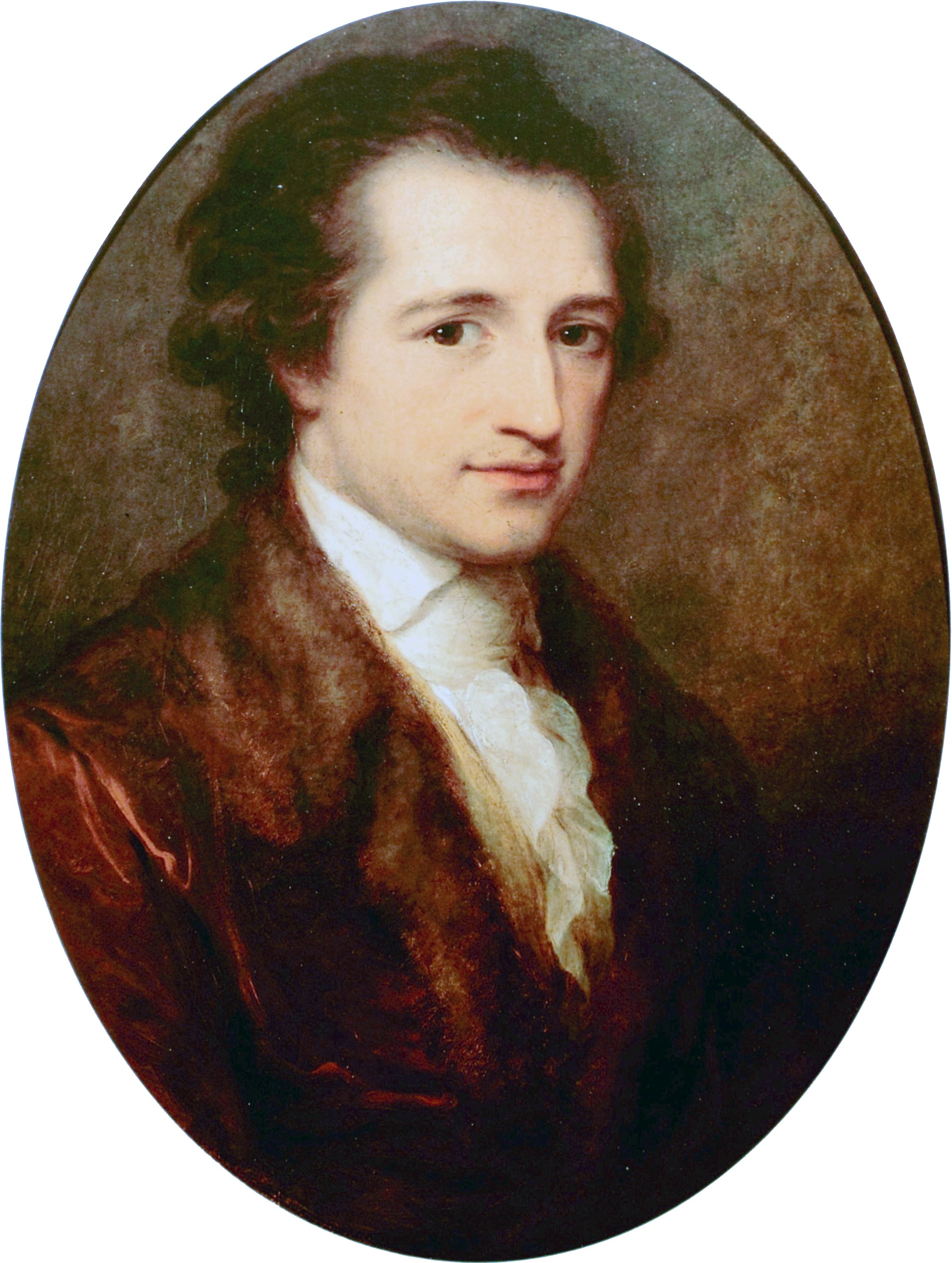
Wilhelm has a habit of falling in love repeatedly; that's OK, because the girls fall in love with him in return. (That's a young Goethe painted by Angelica Kaufman to the left. Rather dashing, don't you think? Maybe a little autobiography here?) Should he stay with that second actress, lively and fun? The practical housekeeper? The Countess? (Already married, though.) Natalie the Amazon? (As he thinks of her.) At least some of these relationships aren't chaste because by the end of the novel Wilhelm learns he has two children by different women. Somebody slips into his bed the night of a cast party and he's not sure who.
That's most of the novel, but then there are some very odd twists. We get a couple of embedded stories, one the story of a woman who becomes a pietistic Moravian Brethren; this story provides comfort to the dying sister of an actor. The other embedded story involves characters in the present whom we've met in other contexts, an incest plot, and more Moravian Brethren. Wilhelm feels bad when he learns he may have unintentionally driven some of the characters into this rather ascetic religious practice.
And then! We get a secret society, which has been guiding Wilhelm's actions all along. Which I'm not sure I really comprehended at all.
I read most of the novel in Thomas Carlyle's translation from the 1800s, available at Project Gutenberg, then started over and read the whole thing in H. M. Waidson's translation from the late 1970s. (Waidson was a British professor of German at Swansea University.) I can't say that either translation amazed me. Carlyle is Carlyle, perhaps overly rhetorical. The Waidson felt flat in places, though my reprint at least was marred by typos. (For example, 'natter' where 'flatter' was meant; I had to look up the German, also available on Gutenberg, to figure out what was meant. The German word was schmeicheln.)
Goethe wrote a sequel, Wilhelm Meister's Years of Wandering, which came out in installments in the 1820s.
The book--it is Goethe, after all--includes poetry, verse from plays or songs sung by various characters. Some of them are famous: 'Nur wer die Sehnsucht kennt' has been set to music by Beethoven, by Tchaikovsky, by Schubert (multiple times) and that's not the whole list. Here's one of the Schubert versions, one of a collection of songs that all come from Wilhelm Meister:
Here are the gates of Babylon, the walls of Jericho cast down.
Might die in Chicago, Kansas City's where I was born.
Snowflake in a blizzard, purple rose before the thorn.
Stone by stone, note by note, atom by atom, noun by noun,
Bird is building a metropolis with his horn.
Uptown, downtown, following the river to its source,
Savoy, Three Deuces, Cotton Club, Lenox Lounge.
Might just die in Harlem, Kansas City's were I was born.
Bird is an abacus of possibility, Bird is riding the horse
of habit and augmented sevenths. King without a crown,
Bird is building a metropolis with his horn.
Bred to the labor of it, built to claw an eye from the storm,
made for the lowdown, the countdown, the breakdown.
Might die in Los Angeles, Kansas City's where I was born.
Bridge by bridge, solo by solo, set by set, chord by chord,
woodshed to penthouse, blue to black to brown,
Charlie Parker is building a metropolis with his horn.
Might just die in Birdland, Kansas City's where I was born.
-Campbell McGrath
XX: Poems for the Twentieth Century is a collection of poems by contemporary American poet Campbell McGrath (b.1962). There's one poem for each year about either a person or an event associated with that year, a sort of snapshot history of the 20th century in verse. Though Charlie ("Bird") Parker only appears once, some of the people are the subject of several poems (Picasso, Frida Kahlo, Zora Neale Hurston, Mao, others). Events include Guernica, Hiroshima, the Apollo moon landing.
This poem is a villanelle. (Well, perhaps -ish, depending on rigorous you like your villanelles.) McGrath uses a number of different forms. Here's another example (short and suitable to its subject... 😉):
Gertrude Stein (1909)
I arose.
I arouse. Eye arroz. I arrows.
I, a rose!
-Campbell McGrath
Anyway, all sorts of types of poems...
I've been meaning to do a McGrath for a while, but haven't. But it's now part of my series of poems using the Amurrican vernacular by poets associated with Florida universities. McGrath is at Florida International University.
Charlie Parker died in 1955 at the age of 34, in Manhattan, just over two miles from the jazz club Birdland. He had various health and personal problems that could done him in, and just one of them was heroin ('the horse/of habit') or maybe the habit of horse.
This is the song 'Summertime', and if I have it right, should be the version from his album of 1950, Charlie Parker with Strings:
I find this quite tender. As far as I know it's not any actress in particular, but it's utterly convincing of somebody who went to Hollywood, had higher aspirations, but who only had the one moment.
Boris Dralyuk was born in Odesa (I guess I'm transliterating the Ukrainian these days instead of the Russian) in 1982, but emigrated with his family to L.A. in 1991. He's mostly known as a translator from the Russian (Tolstoy, Babel, Pushkin, Kurkov) but his first book of poetry My Hollywood and Other Poems came out last year. I found it very good.
In fact so good that I thought I'd type out some poems before I need to return the book to the library and then I'd have them available for memorization. So I was typing it anyway. But it's also Thursday. It's a poem. Does that have any implications for the future? I don't know. Maybe.
as befits you who were deemed worthy of such a city,
move with steady steps toward the window
and listen with deepest feeling, yet not
with a coward's entreaties and complaints,
listen as an ultimate delight to the sounds,
to the exquisite instruments of the mystical company,
and bid farewell to the Alexandria you are losing.
-Constantin P. Cavafy (tr. Evangelos Sachperoglu)
One of the most famous of Cavafy's poems. I should have picked something less well-known, but in the end, I didn't. 😉 The final version of the poem is from 1911. Cavafy is, of course, a native of Alexandria.
It alludes to Plutarch's Life of Antony (ch. 75, here from the 'Dryden' translation). Dionysus, Antony's patron god, leaves him to his fate. Antony is bottled up by Octavian's forces in Alexandria:
'That night, it is related, about the middle of it, when the whole city was was in a deep silence and general sadness, expecting the event of the next day, on a sudden was heard the sound of all sorts of instruments, and voices singing in tune, and the cry of a crowd of people shouting and dancing, like a troop of bacchanals on its way. This tumultuous procession seemed to take its course right through the middle of the city to the gate nearest the enemy; here it became the loudest, and suddenly passed out. People who reflected considered this to signify that Bacchus, the god whom Antony had always made it his study to copy and imitate, had now forsaken him."
Antony commits suicide the next day rather than be taken by Octavian, shortly to be followed by Cleopatra.
I was spouting off about Cavafy translations recently, and have been wanting to look them up. I generally prefer the Sachperoglu versions (in Oxford World Classics) except I prefer the alternative title 'The God Abandons Antony', more commonly used. The first few lines from the Keeley and Sherrard version:
At midnight, when suddenly you hear
an invisible procession going by
with exquisite music, voices,
don't mourn your luck that's failing now,
work gone wrong, your plans
all proving deceptive--don't mourn them uselessly:
as one long prepared, and full of courage,
say goodbye to her, to Alexandria who is leaving.
And the opening of the Daniel Mendelsohn version:
When suddenly at midnight, there comes the sound
of an invisible procession passing by
with exquisite music playing, with voices raised--
your good fortune, which now gives way; all your efforts'
ill-starred outcome; the plans you made for life,
which turned out wrong: don't mourn them uselessly
Like one who's long prepared, like someone brave,
bid farewell to her, to Alexandria, who is leaving.
Your preference?
The Sachperoglu is bilingual; the Mendelsohn has more poems and more notes. Keeley & Sherrard is probably the best-known.
I started to type in the Greek, but doing that on my English keyboard began to feel like a chore...
I believe there is also a version by Rae Dalven, who was the first to translate a volume of Cavafy into English, in 1961, but I couldn't conveniently find it. But in looking for it on line, I discovered Leonard Cohen set a version to music on his album Ten New Songs of 2001. He sings it as a duet with Sharon Robinson. Alexandria gets changed to Alexandra, so it can pass as a breakup song if you like.
I thought it was pretty good.
Cavafy is important in the Durrell Alexandria Quartet series.
For the world's more full of weeping than you can understand.
Where the wave of moonlight glosses
The dim grey sands with light,
Far off by furthest Rosses
We foot it all the night,
Weaving olden dances,
Mingling hands and mingling glances
Till the moon has taken flight;
To and fro we leap
And chase the frothy bubbles,
While the world is full of troubles
And is anxious in its sleep.
Come away, etc.
Where the wandering water gushes
From the hills above Glen-Car,
In pools among the rushes
That scarce could bathe a star,
We seek for slumbering trout
And whispering in their ears
Give them unquiet dreams;
Leaning softly out
From ferns that drop their tears
Over the young streams.
Come away, etc.
Away with us he's going,
The solemn-eyed:
He'll hear no more the lowing
Of the calves on the warm hillside
Or the kettle on the hob
Sing peace into his breast,
Or see the brown mice bob
Round and round the oatmeal-chest.
For he comes, the human child,
To the waters and the wild
With a faery, hand in hand,
From a world more full of weeping than he can understand.
-W. B. Yeats
Wilson discussed the poem in Axel's Castleas representative of Yeats' early verse. (Yeats wrote it in 1886.) It's been a bit of an ear-worm for me since then, especially the chorus.
It's been set to music several times. I know the Waterboys' version pretty well (from Fishermen's Blues), but in looking for it, I came across this lovely version by Loreena McKennitt:
Reading Longus' Daphnis and Chloethe other day sent me off to read Theocritus' Idylls. Virtually all the names in Longus are first found in Theocritus (about 400 years earlier). It may be I'll show up with some Theocritus one of these days, but today we have something else in the pastoral tradition from, oh, a few years later...
In Daphnis and Chloe, Philetas is the elder herder whom everyone considers the best singer, and who passes on his panpipes to Daphnis; Philetas' beloved in Longus is Amarillis (spelling may vary) who becomes his wife. (And is his wife at the time of the story.)
And then once I started thinking about Amarillises, (Amarilli?) there was Thomas Campion (1567-1620) and his beloved. Campion, of course, also wrote music:
"She gives me fruit and flowers," but in Longus, it's cheeses! In Daphnis and Chloe, somebody is always giving away a cheese.
"I shall have a fine book of travels, I feel sure; and will tell you more of the South Seas than any writer has done--except Herman Melville, perhaps, who is a howling cheese."
-R. L. Stevenson, in a letter to Charles Baxter
I came across that quote (via Holbrook Jackson's The Anatomy of Bibliomania) and it sent me down a Google rabbit hole in order to decide what the heck Stevenson really thought of Melville. (A howling cheese? If somebody called me a howling cheese, I think my first instinct would be to slug them.) But it seems Stevenson only meant good things about Stevenson by that quote.
At least that's what Kevin Hayes says in The Cambridge Introduction to Herman Melville. ("It means something similar to the proverbial phrase, 'to take the cake.'") Also Stevenson compares the Master of Ballantrae in that novel to Captain Ahab--The Master of Ballantrae comes out in 1889, when Melville's reputation is probably at its lowest, yet Stevenson knows his works well.
Overall I can't say I particularly found the Hayes book helpful, though; on Moby-Dick itself Hayes seemed too taken with the idea of the double or Doppelgänger. Old Ishmael telling the story of course has a relation to young Ishmael living the story, but it doesn't strike me as useful to refer to them as doubles. When Hayes calls Ahab and the whale doubles he has a better, though still not entirely convincing to me, argument. Your mileage may vary.
Still there were a few fun things. One of the contemporary reviews said this of the chapter 'The Whiteness of the Whale':
It 'should be read at midnight, alone, with nothing heard but the sounds of the wind moaning without, and the embers falling into the grate within.'
I'm sure I didn't succeed in doing that, but it sounds good. The next time I read the book. Also 'The Whiteness of the Whale' was Sergei Eisenstein's favorite chapter in the book.
I also learned about Giorgio Federico Ghedini, an Italian composer who died in 1965. His best-known work is the Concerto dell'Albatro, which includes spoken text from Moby-Dick. For classical music fans, here it is from Youtube: (the spoken word part is in the third movement beginning around the 17th minute.)
I previously shared elsewhere in a slightly abbreviated form, this quote from Hayes:
"Moby-Dick demands readers who are unafraid to confront the strange and the unusual, those willing to use their minds, if not their palates, to face the mysteries of existence as reflected through an epic whaling quest."
Aw, shucks. You shouldn't have. You really think so?
And Hayes' final words on Moby-Dick?
"Moby-Dick is the greatest book in the history of the English language."
I'm not really sure how to say anything about graphic novels, so I'm mostly just going to "quote" from Jason Lutes' wonderful Berlin, a graphic novel about the last years of the Weimar Republic, before Hitler's rise to power. He completed it last year after starting in 1996, and it consists of 24 issues, gathered subsequently into three books, before being released in a single volume last year. I came across it in this review by Jeet Heer from earlier this year.
The two main characters are Kurt Severing, a reporter whose editor is the historical figure Carl von Ossietzky. Here Severing is being berated by a communist friend for his hope that a non-violent solution can still be found:
The other major character is Marthe Müller, who comes from Köln to Berlin to be an art student, but also to experience the life of the city:
It was easier for me to get the three individual volumes than the one omnibus from my library, and though I was interested from that first review, I only put the hold on the first one initially, and I've had to return it. But I was convinced by the series from a moment in the first volume when Severing walks into his editor's office: there's a desk with a full ashtray on it, and then a number of smaller panels where we see full ashtrays also on his bookcase, the window sill, etc. That was a man under stress. But I can't show you the picture anymore.
There are numerous other characters as well, representing both the political right and the left, Jews, Lesbians and gays, the spectrum of what we think of as Weimar period Berlin.
I know a little but not a lot about the period, but it fits with one's sense from things like Goodbye to Berlin. I was chuffed to see this panel:
because I knew that song from the Ute Lemper album of twenty years ago:
Highly recommended. Interesting, fun, and in these times, just a little bit scary.
Falstaff: "My honest lads, I will tell you what I am about." Pistol: "Two yards, and more." Falstaff: "No quips now, Pistol! Indeed, I am in the waist two yards about; but I am now about no waste; I am in thrift."
A 72" waist! Even the large (and admirable) Ambrogio Maestri above on the far right probably doesn't have that for his belt size.
It's been a long time since I read this, which is a little odd, since Falstaff has been in my life lately. I'm not much of an opera person--I would like to be better, but it tends to put me to sleep, while the Other Reader stays awake--but I really enjoyed watching a simulcast of the Met production of Verdi's Falstaff. That's the final scene of the production I saw in the video. I actually walked out whistling "Everyone is Fooled." I hadn't really realized until I just reread the play how closely Verdi followed Shakespeare.
And not too long ago I saw Orson Welles' Chimes at Midnight, which includes a bit of Merry Wives, thought not too much, but is basically the tragedy of Falstaff. (Which Merry Wives of Windsor is not. A tragedy, that is.)
Anywho, I'm not an expert. I enjoyed rereading it. A couple of things I noticed: I was pretty surprised how much of the play was prose, especially in the early part. Once the scene changes to elves and fairies (even pretend fairies and elves) in the fifth act, there's more verse.
Also I was a little shocked how difficult the language was, especially in the first act. I mean it's Shakespeare, it's 1600, it's never easy. Still, I've read enough and seen enough plays at this point, I can generally get by. I don't know about you, but I find Shakespeare's quipping much more difficult to follow than his tragic-monologuing, and despite Falstaff's admonition above, there's plenty of quipping in the play. A good actor can make that easier, but I'm quite sure half the first act went right past me. There's a Welsh accent and a French accent, too, just to complicate things.
The Wikipedia article was pretty insistent this is one of Shakespeare's worst plays. Yowch! And the story I'd always heard, that Queen Elizabeth I commissioned the play because she thought Falstaff was such a great character, may not actually be true.
Doesn't matter. I still thought it was pretty funny.
Slender: "...for though I cannot remember what I did when you made me drunk, yet I am not altogether an ass."
Oh, yes you are, Slender! But that's OK, you didn't get the girl. (Or more importantly, the girl didn't have to put up with you.)
We see Toni Goldblatt, the hero of Gabriella Goliger's Girl Unwrapped, at eight, at thirteen, at eighteen, at twenty, and finally at twenty-one, living in her own apartment in Montreal, and having acknowledged, both internally and externally to her mother, that she's a lesbian. It took some doing to get there.
That outline clearly marks it as a Bildungsroman and it's a well-done example of the form.
Toni is the only child of Jewish parents in Montreal; her Austrian parents survived the Holocaust; her father, barely, in a camp and her mother hiding in a remote Italian village. Neither much wants to talk about what happened, but they will (especially her mother) use their tragedy to emotionally blackmail their daughter. Toni is born in the late 1940s, and the events of her life are correlated to world events, though she's not an especially political person
At eight, she's a tomboy living in an apartment on the far side of Montreal's namesake mountain. She goes and plays with the rough boys in the woods. Then her parents buy a place in the suburbs.
At thirteen, she goes to a Jewish camp near Montreal and falls in love with the camp music instructor Janet. She steals and drinks a bottle of alcohol, makes a declaration of love for her camp counsellor, which we're not sure anybody understands, and gets kicked out.
At eighteen, she's studying in Jerusalem. Is she a Zionist? Well, Janet is there, but she's in an unhappy relationship with David, a druggy spiritualist. She loses her virginity to an Arab boy. She's called back to Montreal by the death of her father.
At twenty she discovers a lesbian bar. But neither the working class butch/femme couples nor the newly arrived feminist University girls are quite her. But this scene is closer to who she is than anything yet. And it's there she meets Robin, the first real love of her life.
Well, first loves often don't work out. But she's now on the road to who she is.
Goliger is a sharp observer and Toni's life is convincingly portrayed. This is her debut novel after a book of short stories; her new novel (from 2018) is Eva Solomon's War and is historical fiction set in the late 30s. I haven't read either of her other books, but might!
Girl Unwrapped came out in 2010 with Arsenal Pulp Press. It's good.
-- o --
Ahem, completely off-topic. I find I was completely unable to write the words 'lesbian bar' without going off to listen to the Jonathan Richman song. Just in case you have the same sensation: