Showing posts with label Europe2024. Show all posts

Wednesday, December 11, 2024

Rosmersholm by Henrik Ibsen (#Norway)

MRS. HELSETH: But children don't cry at Rosmersholm, Miss.
REBEKKA  (Looks at her): Don't cry?
MRS. HELSETH: No. As long as people can remember, children have never been known to cry in this house.
REBEKKA: How very strange.
MRS. HELSETH: Yes, isn't it? It runs in the family. And then there's another strange thing. When they grow up, they never laugh. Never--as long as they live.
REBEKKA: Why, how queer--
MRS. HELSETH: Do you ever remember hearing or seeing Pastor Rosmer laugh, Miss?
REBEKKA: No, I don't believe I ever have,...

Rosmersholm is Henrik Ibsen's play of 1886. Rosmersholm is the ancestral family home of the well-to-do Rosmer family, whose current head is Johannes Rosmer, a pastor 45 years old. But he's a pastor who has lost his faith and has just given up his pastoral role, not least because his wife committed suicide and he's still in grief. Was her death the result of mental illness, or was he in some way responsible? He can't decide.

In addition to Johannes Rosmer, living in the house are Rebekka West, who'd arrived as a companion for Beata Rosmer, but stayed on after Beata's death, and Mrs. Hesketh, the long-standing family maid. Over the course of the play three visitors come, each more than once. Andreas Kroll, Rosmer's brother-in-law, is the first; there are also Peder Mortensgaard, publisher of a left-wing newspaper who has a history with Rosmer, and Ulrik Brendel, Rosmer's former tutor, but now a drunk.

His three visitors all want something from Rosmer. Kroll hadn't visited since his sister's suicide; the grief he and Rosmer share meant they couldn't bring themselves to talk to each other. (The inability to express emotion is a theme.) But now the left has won the last election in Norway and Kroll, a staunch conservative, expects Rosmer to stand up for the forces of good, as he sees them, church and crown and all that. Kroll is organizing a new newspaper advocating conservatism and wants Rosmer to be the editor. But Rosmer thinks the left might have some arguments on its side.

Mortensgaard wants Rosmer to stand up for the left in his paper, but only if he's still a proper Christian: he's got plenty of atheists already in his stable. But when Rosmer's unwilling to lie about his new (lack of) faith, Mortensgaard says he has no use for him, and will be forced to consider him an enemy.

Brendel wants a clean shirt, a jacket--and money--so he can throw it away at a local bar. He's a bit the comic relief, but we also learn some of Johannes Rosmer's back story from their conversations.

Why did Beata Rosmer commit suicide? Though modern diagnoses are perhaps suspect, everyone does assume she was depressed, without quite using the word. But also she had learned she was not able to bear children; so, unless she died, she would mark the end of the Rosmer line and Rosmersholm would no longer have a Rosmer. And, before she dies, she sends a letter to Mortensgaard claiming her husband is in love with Rebekka West.

Was he? Maybe a little. It was in conversation with Rebekka West that Rosmer moved to the left politically; now, during the course of the play, do we see their interactions as perhaps a bit too friendly for an unmarried man and woman? Certainly Kroll does. Can a man and a woman just be friends? It's not always an easy question now, and it was much more loaded in 1886. Kroll at first assumes there's nothing between them, but then begins to wonder; he's the first to suggest that maybe the two of them should get married. He also rather rudely (and inaccurately) suggests to Rebekka West she's a gold-digger.
 
The idea really hadn't occurred to Rosmer before (did I mention repressed?) but once it's suggested, he decides it's a good one and proposes to Rebekka; she turns him down. 

How does all of this get resolved? Ibsen did write one or two comedies, it seems; I've never read or seen any of them, and this isn't one either...

A local troupe (Crow's Theatre) did the play in October and we went to see it. I hadn't read or seen the play before, and I decided to be surprised. (Other than my general sense that Ibsen's prose plays are mostly tragedies.) Then I read it afterwards in a different translation. The stage version said it was an adaptation, by Duncan Macmillan; the translation I just read (quoted above) was by Eva La Gallienne. There was one bit in particular I wondered if it was in the original.

Rebekka West won't marry Rosmer because she says she can't bring the purity to the marriage he deserves. That almost certainly implied she was not a virgin and was being fastidious. For a play set in Victorian times that's not improbable and I think that's what Ibsen intends us to think. Rebekka West believed herself an orphan with a father she'd never met; she was raised by a foster father, Dr. West, after her mother died; it's from Dr. West she gets her education and intellectual interests. She clearly worshipped him. Kroll believes, and goes on to 'prove', though his evidence is mostly circumstantial, that Dr. West was Rebekka West's biological father. She's shocked by the suggestion, says it can't be true, she's not illegitimate, but she begins to believe it.

In the production I saw, the actress curled up in a corner of the stage and half-whimpered her lines; it was a very powerful moment, and the clear implication was that the person she'd lost her 'purity' with was, in fact, Dr. West, her foster father, and she hadn't known he was her biological father. And that's what I wondered about. Ibsen was famously frank about sex for his time, but was he really willing to put even a mention of father-daughter incest on stage in 1886? The Macmillan version did say it was an adaptation.

But as far as I can tell without both texts in front of me, the 'adaptation' was pretty close to a translation, and La Gallienne in the introduction to her translation (from the 1950s; her father, a journalist, had interviewed Ibsen at one time) thinks the incest is implied. So the answer may be, yes, Ibsen was willing. But I do think the text sufficiently ambiguous the play could be staged without suggesting incest, if the director wanted to.
 
Rebecca West, the writer, author of Black Lamb and Gray Falcon, was born Cecily Isabel Fairfield, and took her name from the character in this play. That was a bit shocking. Rebekka West was a pretty admirable figure in the play, but I might prefer a pen name from somebody who had more luck in life myself...


Tuesday, October 29, 2024

Kurban Said, Lev Nussimbaum, and Tom Reiss

A while back I read the first novel Ali and Nino by Kurban Said and found it delightful. Time for a book bender! My library delivered.

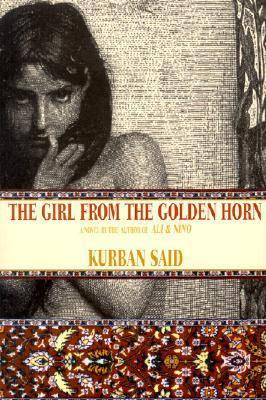
The Girl From The Golden Horn

The second (and last completed) novel by Kurban Said is The Girl from the Golden Horn. It came out in German in 1938 and was translated into English by Jenia Gramm in 2001. 

Achmed-Pasha Anbari with his daughter Asiadeh have left Constantinople for Berlin. He was a higher-up in the Ottoman administration and with the fall of the Ottoman monarchy at the end of World War I, he no longer feels welcome in Atatürk's Turkey. He does what he can in Berlin to scrape up enough money so his daughter can get an education; she's studying Comparative Turkish philology at university. She's the Girl from the Golden Horn.

While there still was an Ottoman empire, Asiadeh was promised to an Ottoman prince before she was of age. But what are the Ottomans now? Where even is her prince? She sends a letter to the Turkish consulate to forward on to the prince, asking him to either claim her or relinquish her. He chooses to relinquish.

That's fine because in the meantime she had a cold and met the university's doctor, Alex Hassa. She's in love, and Hassa, an unhappy divorcé, loves her back and needs her. They marry, go on a honeymoon, and settle in Vienna where Dr. Hassa starts a practice.

Then the prince shows up and now he wants to marry her. 

In Ali and Nino before politics intervened, the difficulties between the two were cultural: he was Muslim and she was Christian. This novel turns on similar lines except she's the Muslim and he's Christian. She doesn't wear the veil now. Does she miss it? Do girls really need to be educated? Hassa as it turns out is short for Hassanovič, that is the son of Hussein, and Dr. Hassa's family before they converted were Muslim. Does that help?

I don't think the novel was quite as wonderful as Ali and Nino, but still it was good. Asiadeh has to figure out what she wants and how to get there with her dignity intact. She does.

The Orientalist

In that post on Ali and Nino  I discussed the mystery of Kurban Said a bit. It's a pseudonym, but for whom? The likeliest candidate was Lev Nussimbaum, born in 1905. He was a Jew, and grew up in Baku, Azerbaijan. Tom Reiss wrote an article for The New Yorker on Nussimbaum, and then expanded it into a book in 2005.

Lev's father was Abraham, a well-to-do oilman in Baku; his mother died when Lev was 6, likely a suicide because she'd been detected in revolutionary politics. During World War I, Lev and his father fled to Persia when there was violence in Baku; later they return to the short-lived Republic of Azerbaijan, but are forced to flee again when the Bolsheviks arrive, this time through Georgia and then Constantinople. They finally pitch up in Berlin, where Lev attends a high school for Russian emigres. (With the sisters of Boris Pasternak and Vladimir Nabokov! Lydia and Elena, respectively. Elena is considered quite the beauty. This is a bit of a shock given what Vladimir looked like.)

And somewhere along the way, Lev Nussimbaum converts to Islam and changes his name to Essad Bey. 

As Essad Bey he becomes a best-selling writer of non-fiction in the 20s and the first half of the 30s, writing close to a book a year as well as becoming the Eastern Europe and Middle East expert for the magazine Die Literarische Welt, which also published Bertolt Brecht, Walter Benjamin, and Alfred Döblin. (Think New York Review of Books, Reiss says.) Busy, but they needed the money, especially after it became clear that the Bolsheviks weren't going away, and any claims Abraham had still in Azerbaijan were going to be valueless.

Nussimbaum got married, to a Bata shoe heiress, and divorced. The divorce was covered by gossip papers on both sides of the Atlantic.

He was a controversial figure: Was he Jewish, was he Muslim, where was he really from? Nussimbaum claimed he was born on a train between Zurich and Baku, but he was given to romanticizing, so who knows? With a background like that it's unsurprising he was a staunch anti-Bolshevik. His anti-Communism and his conversion to Islam helped after the Nazis came to power for a while; his books still could be published in Germany until 1935. But he was on a lecture tour in 1933 and doesn't return to Germany, but stays in Austria. When Anschluss looks likely he wangles a contract to write a biography of Mussolini and moves there. (That biography never materialized.) By then his health is poor; he has a severe case of Reynaud's syndrome, which leads to gangrene and the amputation of his toes. To deal with the pain he's become addicted to morphine. He dies in Positano, Italy, in 1942.

And did he write those Kurban Said books? The evidence Reiss offers is pretty strong and Reiss thinks they were entirely Nussimbaum's work. But Nussimbaum was willing to co-author and I think it's impossible to rule it out. The books were copyrighted under the name of Baroness von Ehrenfels of Austria. Did she help write or did she just help by being the front person for German publication? I don't suspect we'll ever know for sure.

Nussimbaum is a fascinating figure and Reiss has got a hold of a good topic. I do think the expansion to a book shows signs of haste: Reiss writes about the Freikorps and Walter Rathenau; interesting topics, but they don't have a whole lot to do with Nussimbaum. He writes about G. S. Viereck, the American Nazi sympathizer, who was an acquaintance of Nussimbaum,  but he kind of repeats himself. Still, a good read. And now I want to find Essad Bey's Blood and Oil in the Orient. It was the story of the Nussimbaum's escape from Baku when the Bolsheviks marched in. It was marketed as non-fiction when it came out; Reiss says it's half-fiction, but it still sounds pretty thrilling.

Reiss later went on to write The Black Count, about Alexandre Dumas' military father, which got pretty good press when it came out. I was interested in it at the time, but didn't read it, but that may change.

Both these books march around Europe, so pick a country. "The ideas you have!" said Hassa. "Nobody ever goes to Belgrade on their honeymoon." Serbia's tempting, but I'll go with Bosnia, which that honeymoon also included. A crucial scene takes place in Sarajevo, where Dr. Hassa's family is from. When Dr. Hassa and Asiadeh first meet:

"There was an Anbari who was the governor of Bosnia."
"Yes," said the girl. "That was my grandfather."

For The Orientalist, I'll say Turkey, since I've already used Azerbaijan for Ali and Nino. It was Constantinople was where Lev Nussimbaum became Essad Bey.

Tuesday, September 24, 2024

Sholem Aleichem's Wandering Stars

   "See how the stars are falling," said Reizel, her voice trembling, her heart beating rapidly.
    Leibel laughed. "Don't be afraid," he comforted her like an adult, although in truth she was a year older than he. "What is there to be afraid of? Stars don't fall--stars wander."

Reizel Spivak and Leibel Rafalovitch are teenagers in the (imaginary) village of Holeneshti in the Russian province of Bessarabia. She's the daughter of the town's cantor and he's the youngest son of the richest man in town. Though Leibel goes to the cheder (Hebrew school) run by Reizel's father, in the normal course of things the two of them would never meet.

But when the Yiddish theater comes to town, it's no longer the normal course of things, and they get happily squeezed together on a bench in the theater. (Normally the Rafalovitch barn.) 

Leibel befriends Holtzmach, the troupe's main comic actor. He steals food and cigarettes for Holtzmach, is caught and punished.

Reizel spontaneously bursts into the show's tunes, is overheard by the theater's manager Shchupak, and, since she's the cantor's daughter, she's got a beautiful voice. But when Shchupak proposes that Reizel go on the stage, her mother absolutely forbids this, and she's no longer allowed to go to shows. (Her father is intrigued, but it's not him who runs the house...)

What are a couple of fifteen-year-olds to do under such oppressive provocation? Run away, of course. When the theater leaves town, they'll join up and leave, too. But they'll have each other, and though it's a little early for them to formulate the notion, they're in love.

Did I mention they're both ridiculously good-looking? No? Ah, well they are.

The troupe decides to head for the nearest border, which is Romania, but Shchupak learns his ex-wife is now in Romania and threatening to sue. So his coach, with Reizel, changes course for the Austro-Hungarian border. But the coach with Leibel and Holtzmach makes it into Romania, and eventually Bucharest, only eventually realizing they're the only ones there. But Holtzmach figures he can manage Leibel, good-looking and with a good speaking voice, and make him into a successful (and lucrative) star; he's got no need for Shchupak any more. Shchupak has come to more or less the same conclusion with Reizel. There's going to be a lot of wandering for our heroes on their way to becoming stars. Czernivitsi, Lviv, Warsaw, Vienna, Berlin, Paris, London, and eventually New York. (Reizel passes through Chicago, too!) 

She becomes Rosa Spivak and he becomes Leo Rafalesco. Various troupes grow up around our heroes, hers complete with a genius violinist (male) and his with a ravishing leading lady. Various comic managers and hangers-on try to get the two of them married but never to each other. Aleichem is a little coy about dates, but it must be at least ten years that they wander before they're both again in New York. There's letters and pastiche press releases. It's funny.

On the way they both take their art seriously, apprenticing themselves to real-ish artists of the time. Rosa studies under Marcella Embrich; there's a celebrated real-life Polish soprano, Marcella Sembrich. He studies under Sonnenthal, that's Adolf Sonnenthal, who later had a von added to his name for services to the Viennese court theater. Their art moves from vaudevillean to serious. We see a fair amount about wandering theatrical troupes--think Nicholas Nickleby but even poorer and in Yiddish.

The ending, in New York, is both surprising and satisfactory.

Wikipedia tells me the novel was originally serialized in a Warsaw Yiddish paper from 1909 to 1911. The novel's been translated into English twice, in an abridged version by Frances Butwin in 1952 and the version I read by Aliza Shevrin in 2009. (With a pretty useless forward by Tony Kushner. The best thing about it was he correctly suggested you read it after.) While this was certainly fun, I didn't think it was as good as In the Storm, which I read a couple of years ago, and certainly not as good as the most famous things, such as the Tevye stories (the basis for Fiddler on the Roof) or the stories about Motl, the cantor's son, which I read pre-blogging. Shevrin was the translator for In the Storm and a collection of the best-known stories. This came out twenty-five years later, and while I have no way to compare with the original, the translation of the earlier work felt more convincing to me. But it's also possible this novel is somewhat slack in the original.

The Russian province of Bessarabia is now the country of Moldova, which makes it my visit there for this year's European Reading Challenge:


"Ach, what can compare with our Bessarabian summer nights? One at a time the stars light up like candles in the sky."

Addendum, November 2024:

I got Jeremy Dauber's biography of Sholem Aleichem back from the library (I'd read it a couple of years before) to look up anything about Wandering Stars. It turns out there were two versions published, the New York Yiddish version, and the Warsaw Yiddish version. Sholem Aleichem preferred the Warsaw version; the New York version changed the ending to be more sentimental. (Shades of Great Expectations.) The Warsaw version started its run in 1909, but the paper (The New World) printing it was going broke and couldn't pay, so Sholem Aleichem stopped supplying pages. It was only in 1910, after some time passed, that a new paper Moment was formed and finished publication.

Also there was a film version made in Soviet Russia in 1927, Sholem Aleichem's works were popular with the Soviet film board, but this one wasn't: the subject matter was considered too bourgeois and it was withdrawn.

Sunday, August 11, 2024

Ali and Nino (#europe, #WITMonth)

"...and Nino Kipriani was still the most beautiful girl in the world."

Ali and Nino are in their late teens and finishing their schooling in Baku just before World War I. Baku (now in Azerbaijan) was then part of the Russian Empire. Ali attends an elite Russian-run school for non-Russians; he's good at languages, bad at most other subjects, but good enough at math that he can help Nino with her homework.

"Ali Khan, a train goes from the town X to the town Y, doing 50 miles an hour..."

Ali is a Shiite Muslim, and Nino is Georgian Orthodox and they're in love.

His relatives are all in Persia; hers in Georgia, but family differences are the least of the impediments to their love. His father is happy with the marriage; hers only insists that she finish school first. 

Ali doesn't drink--until he goes off to Tiflis to meet Nino's cousins. Oh, my head! Accommodating their own  different world views is the greater challenge.

The first half of the novel is light and charming and funny. It doesn't get to stay that way: world events intervene. A servant reports the news:

"Nothing special, little master. The neighbour's women have quarrelled, a donkey bolted, it ran into the well, and there it still is. The czar has deigned to declare war on several European monarchs."

It may have all seemed very far off at first, but Baku saw the armies of Tsarist Russia, the Sunni Ottoman Empire, the English, the soldiers of the briefly independent Azerbaijan, and finally the return of Russian soldiers, now Soviet.

Highly recommended.

The novel crisscrosses the Caucasus with scenes set in Georgia, Dagestan, and Iran, but is mainly in Baku: "This wonderful town, the gate of Europe." 


I learned about the novel from Major Yammerton's blog who also read it for this year's European Reading Challenge. His thoughts are here.

The novel first came out in German, in Austria, in 1937. A difficult time and it didn't have much opportunity to make an impact at first. Kurban Said is a pseudonym, and now nobody is quite sure who he or she was. Likely enough, it was more than one person working together. The candidates: Yusif Vazir Chamanziminli was an Azerbaijani statesman and author killed by Stalin's minions in 1943. Lev Nussimbaum was born a Jew in Kiev, but lived much of his younger years in Baku and converted to Islam, writing sometimes as Essad Bey. And then there's Baroness Elfriede Ehrenfels, in whose name the copyright was registered. Nussimbaum and Ehrenfels were known to be friends. There are other, less probable candidates as well.
And if one of the people hiding behind the pseudonym Kurban Said is Ehrenfels, this also counts for:

The novel was translated into English by Jenia Gramm in 1970.


Wednesday, July 3, 2024

Josef Škvorecky's The End of Lieutenant Boruvka (#mystery, #europe)

"In the few works of fiction written so far by Czech authors about the events of the year 1968 and their consequences, the heroes have inevitably been intellectuals. In this collection of crime stories, however, I have tried to look at some of the causes and results of that bust-up of Marxism through the eyes of a simple man."

The End of Lieutenant Boruvka is the third of Škvorecky's four books about Boruvka, the Prague homicide detective. It came out in 1975 in Czech, and was translated into English by Paul Wilson in 1989. That quote is from Škvorecky's introduction.

The book contains five stories set in the years 1967-1969. Lieutenant Boruvka is melancholic as a rule, and never more sad than when he solves a case. The earlier books were nevertheless pretty funny. This one, set around the years of the Russian invasion of Czechoslovakia, is not without humour, but distinctly darker.

In the first story, 'Miss Peskova Regrets', a club dancer, who may occasionally engage in a little light prostitution, is found dead in her apartment, asphyxiated when the gas on her stove is no longer lit. Accident? Suicide? Of course not.

'Strange Archaeology': Years before Boruvka was a homicide lieutenant, he was a lowly investigator in the Missing Persons department. His first case was the disappearance of Kvetuse Rerichova. Rerichova had taken all her money out of her account, packed up all her clothing, and told her mother she was going away for the weekend. She never came back.

Rerechova's father and brother had escaped to New York earlier, and Boruvka wraps the case up as a successful escape to the West. His work is so clean he's promoted for it. Then years later a body's found while excavating for new construction. Rerechova? Yes.

In 'Ornaments in the Grass' two sixteen-year-old girls are found gunned down in a meadow by a sub-machine gun. Various military units had been engaged in maneuvers in the area and the girls had been flirting with the soldiers. Surely one of them had to do it, right?

The invasion (August 20-21 of 1968) occurs between the third and fourth stories. There's personnel changes in the office. Major Kautsky, Boruvka's boss's boss, who serves the usual function in such stories of obstruction and illogical requests, turns out to be a hero in the aftermath, and is now in jail himself. Boruvka is saddled with a new sergeant, Pudil, a zealous communist and an anti-semite.

In the fourth story 'Humbug', a delivery driver Krasa for a candy company is banged over the head with a wrench. It turns out Krasa's last name had once been Schoenfeld and he'd served time for thinking about fleeing the country. Pudil is happy to label the victim as a bourgeois Jew and not look very deep.

The final story is 'Pirates'. A spy for the secret police is living in an apartment and clearly spying on one of his neighbours. Then he's murdered. Which of the neighbours was he actually spying on and which one did it?

In the first four cases, Boruvka has pretty clearly determined the murderer, but is not allowed to bring the case to a conclusion for political reasons. In the fifth, he takes matters into his own hands. (Consider the title. Though I will note there is yet another book, which I haven't read.)

Many of the recurring characters reappear. Sergeant Malek, Boruvka's impulsive but wrongheaded underling, performs the same role here, though in the last two stories he's outclassed in his wrongheadedness by Pudil. Eve Adams, the lounge singer, who pretty much served as the protagonist/detective in the previous one, also appears here. And Lieutenant Boruvka's wife and daughter also reappear. There's a plotline through all five stories about Zuzanna, the daughter. It turns out she's pregnant, by somebody she's not married to and won't be getting married to. 

The title of the first story is an allusion to the Cole Porter song 'Miss Otis Regrets' and at the beginning Zuzanna is listening to the song. Lieutenant Boruvka doesn't yet understand what's up with his daughter, but when he hears the song, he gets worried.

We're not told which version Zuzanna is listening to, and I suppose Ella Fitzgerald is more likely, but I figure you can't go wrong with Fred Astaire, even if, by 1960, his voice (and his dancing) were no longer what they'd once been:

I may very well now think this is the best of three I've read, though I reserve the right to change my mind back to the first one. 😉 All three are a lot of fun.

Covering the Czech Republic for this year's European Reading Challenge.


Thursday, June 27, 2024

Ana Blandiana (#poetry)


Dies Illa, Dies Irae

It will come,
It has to come,
That day
Postponed for ages
Will arrive,
It's going to come,
It's getting closer,
You can hear
Its beating pulse
On the horizon,
It will come,
It's in the air,
It can't be put off any longer,
Have no doubt, it will come,
That day,
Like a shining sword,
In the blinding light.

-Ana Blandiana
 
Ana Blandiana (b. 1942) is a Romanian poet. It was recently announced (a month or so ago) that she won this year's Princess of Asturias Literature Award for her lifetime's work. I'd never heard of her before (I think) but I find the Princess/Prince of Asturias Award to be a good selector. In addition to various people who went on to the Nobel Prize but won this first (Mario Vargas Llosa, Doris Lessing, others) they also selected a couple of writers I liked, but didn't win the Nobel, and wouldn't have minded seeing win, such as Álvaro Mutis, Susan Sontag, and Claudio Magris. So, with a list like that, I thought I'd better check her out... 😉 and my library came through.

'Dies Illa, Dies Irae' is, of course, the title of the poem/song/chant on the day of the Last Judgment. ('That day, the day of wrath' is what the Latin says.) This poem was printed on the front page of the newspaper the day after the fall of the Communist government in Romania in 1989 and then collected in her book of 1990, The Architecture of Waves. 
 
A couple of more examples. Several of her poems from before the fall of Communism use sleep as a metaphor for the state of the Romanian people:

Full Moon

Come, moon, and wake us from our sleep,
Cast your nets into our waters
And bring us out,
Pour us
Into the insomnia of air!
We may not survive,
Our lungs have turned to gills from so much sleep,
But,
In spite of the risk, wake us
And leave us, alone and free, at sea:
So we can slowly move,
With infinite care,
Forward across the waters,
A shifting architecture of waves,
A horizon stretched like a rope
Between two hells,
Staring into your lunatic eye, crazed with hope.

-Ana Blandiana


A number of her poems seem to use ballad meter:

Gara de Nord

Dirty platform, carefully guarded
After papers exploding in the air,
Two fists handcuffed at a back, and
Lots of uniforms, may this rare

Image be the stop-frame emblem
Of hope beneath a colourless sun! To see
Through the spectacles of handcuffs
The future of the verb to be.

-Ana Blandiana

Both those poems were also collected in The Architecture of Waves (1990). Here's one from her book of 2016, Clock Without Hours:

That Year

Small things started to grow that year
And they didn't stop. Nature's laws transcended.
Flourishing growth, perverse, was everywhere.
Birds looked like bulls and their flying ended.

Purslane, nettles, grasshoppers, mites,
Sorrel and burdock, mandrake and sedge
Grew and grew to an amazing height,
Delirious waves beneath the outsized thistles' heads.

Elephants with giant spiders entwined,
Eagles, quite sad, from claws of sparrows hung,
Lions in the desert trembled and whined,
Discordant hymns from puffed-up crickets rang.

Worms in a year to snakes had grown.
A blade of grass became a club;
A speck of dust, a boulder stone.

-Ana Blandiana

I assume that year is 1989 and that's her sense of the outcome, but I'm sure the poem can be read in more than one way. Five Books is (as you might guess...) a collection of five of Ana Blandiana's books from across her career, and was issued by Bloodaxe Books (in the U.K.) in 2021, translated by Paul Scott Derrick & Viorica Patea. All the poems I've quoted come from that volume. The Sun of Hereafter and Ebb of the Senses are two of her books, in one volume, also from Bloodaxe with the same translators; that volume came out in English in 2017. 

I've stuck with political poems just for a theme, but there are also quite a lot of love poems, some happy, some sad: she married Romulus Rusan, also a writer; he died in 2016, at the age of 81. Poems from the later books also frequently deal with mortality, whether her own or that of her husband's.

Tuesday, May 21, 2024

Serhiy Zhadan's The Orphanage (Ukraine)

"People aren't meant to keep so much fear and anger in their memories."

Pasha teaches at a school in the east of Ukraine. It's 2017 and the war in Ukraine is already in full swing in the east by then. But Pasha prefers to pay no attention to politics, speaks both Ukrainian and Russian, doesn't have a side, doesn't watch the news. 

Pasha's nephew is living in a nearby orphanage. The nephew's mother travels for her job, the kid's father's long gone, and with that background and the current situation, the kid was kind of a handful. Against the will of Pasha and the kid's grandfather, the mother had dropped him off at this orphanage. But now it's spring break, and Pasha's father browbeats Pasha into going and picking up his grandchild, Pasha's nephew.

But Pasha also doesn't watch the news. The orphanage is out in the countryside, in theory a short tram ride away. But overnight there'd been a shift in the front line Pasha hadn't heard about. He feels it, though, the moment he gets outside.

There are no trains and there are new checkpoints. Who's manning them? There are Russian-speakers with some Ukrainian; there's Ukrainian-speakers with some Russian; and then there are actual Russians, though in 2017 they're still pretending they aren't Russian, but Pasha hears Russian accents that aren't local.

The novel is structured as a three-day there and back journey. Through Hell? It occurred to me, even if the only soul who gets harrowed is one cantankerous but basically OK nephew. It is quite the hellscape he travels through.

But it's also a journey of discovery for Pasha. There's no my guys, your guys for Pasha at the beginning. (And wouldn't that be nice?) He's had a defective hand from childhood and couldn't be a soldier anyway. (Though somebody tells him at one point they've seen soldiers with worse.) But Pasha's a teacher of Ukrainian, and in the east that's already a political statement. And what he sees gradually changes him. When he gets to the orphanage at the end of the first day, there's only two adults left, the director and the gym teacher. Pasha and the gym teacher bond over their apoliticalness, but then Nina, the director, tells them both off.

Pasha sees worse in the two days it takes him to get back from the orphanage to his flat and his father, but he does make it with his thirteen-year-old nephew in tow. Pasha, who'd been passive as well as apolitical, starts to lead. He's also starting to decide.

The novel came out in 2017 in Ukrainian and was translated (ably, I think) into English in 2021 by Reilly Costigan-Humes and Isaac Stackhouse Wheeler. From the Ukrainian, it says, but I suspect there's quite a lot of subtlety where speakers shift between Russian and Ukrainian that the translators were obliged convey differently. 

A powerful portrait of a grim time and place, but one that ends with family and country and a glimmer (?) of hope. But things have only gotten worse in the Ukraine since then.


Monday, April 29, 2024

Christ Stopped At Eboli (European Reading Challenge: Italy)

 "'We're not Christians," they say. "Christ stopped short of here, at Eboli.'"

'They' are the peasants of Gagliano, superstitious and pagan and so not entirely Christian.

 In 1935, Carlo Levi was banished to a small hilltop town, Gagliano, in Basilicata, the deep south of Italy. Levi had been a member of the anti-Fascist organization Giustizia e Libertá [Justice and Liberty] and an opponent of the war against Ethiopia. Before Gagliano, he'd served a spell in solitary confinement and then an earlier period of internal exile in Grassano. The book begins as he's being transferred from Grassano to Gagliano.

Levi was born to a culturally Jewish and well-to-do family in Turin, in the north of Italy. He'd studied for a medical degree and his older sister Luisa became a famous neuropsychologist. But Levi himself, though he had qualified as a doctor, quit practising, and began to paint. He spent time in Paris in the 20s (he's born in 1902) painting, but on his return to Italy, had been caught up in the politics of the era.

The book is a pretty fascinating look at what the life of an isolated peasant culture was in the south of Italy in the 30s. Levi suggests--and it seems so--it hadn't changed all that much in centuries. Levi spends about a year there, grows to like the peasants he meets but remains unromantic about them. There's an amnesty after Italy wins its war against Ethiopia, and Levi is freed. He vows to come back to the south of Italy when he can, but doesn't, at least until his body is buried in Gagliano. The book came out in Italian in 1945, and made a stir among Italians who didn't have any clue about what was going on in the rural peasant south. Highly recommended.

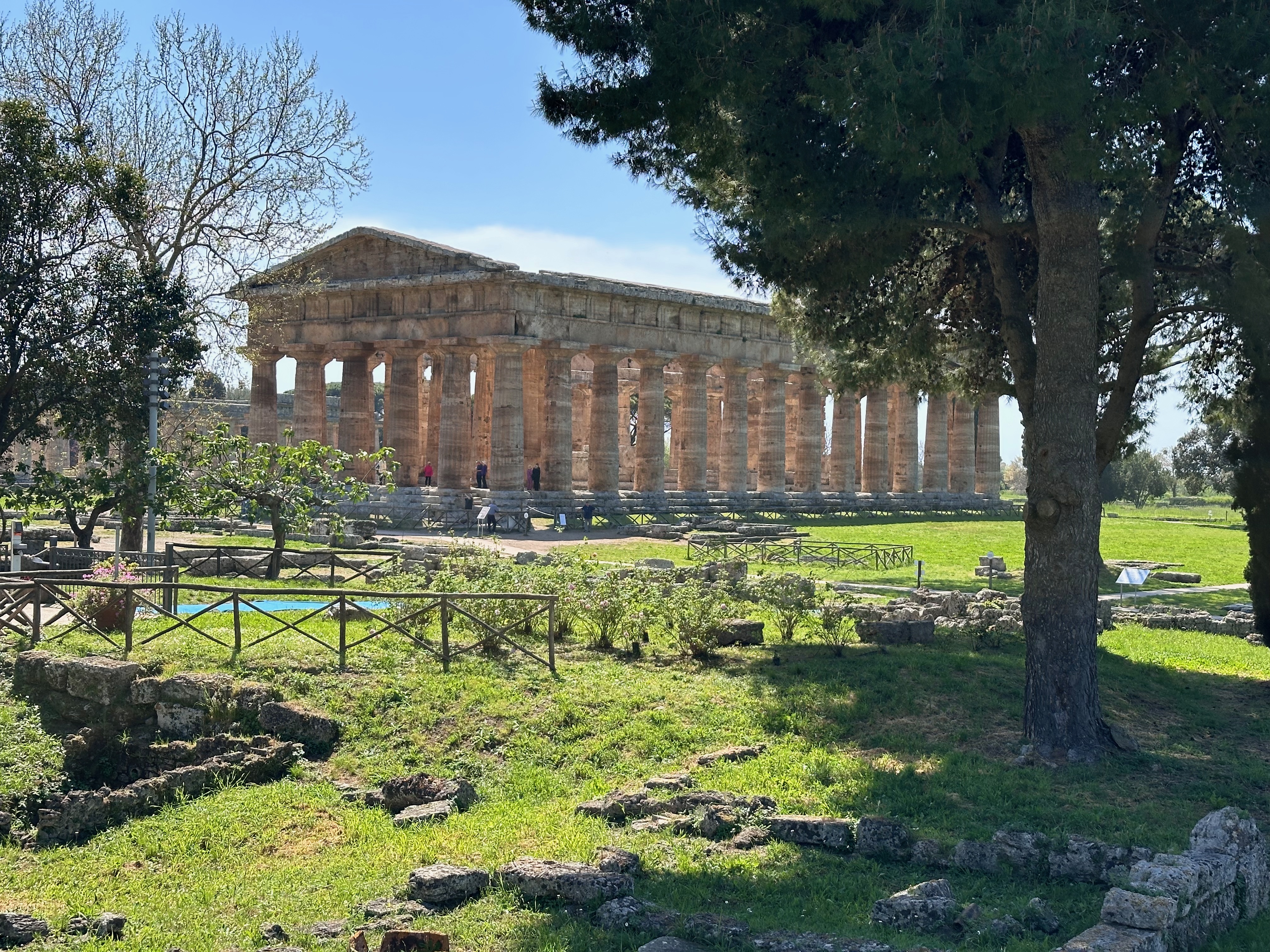
I had a few more insightful things I meant to say, but, oh well, it's been three weeks since I finished it. I read it now because we were going to the south of Italy and I thought, it's time! But we didn't get to Gagliano, nor even to Eboli. (We stopped well short.) The farthest south we got was Paestum:

Temple to Hera (probably; it used to be thought Poseidon's)

Also south of Naples is the Amalfi coast. We walked to Ravello (a hill town hangout for Virginia Woolf and D. H. Lawrence and Richard Wagner) from Minori, a town on the coast. My phone registered 74 flights of stairs that day. Three-quarters of the Empire State Building!

The view from the Villa Rufalo in Ravello. The brochure said everybody takes this photo & I did, too.

I first read Virgil at a formative age. I wanted to see Phlegraean Fields, the purported entrance to Hades and Hephaestus' workshop, near Naples.

Lunch by Roman ruins in Pozzuoli, our first supposed temple of Serape, but really just a market.

We arrived at and then flew out of Rome. There are always things to see there, of course, and we didn't see them all. One of them was Hadrian's Villa, about 30 km east of Rome:

The building on the island was Hadrian's mancave.

Our second so-called temple of Serape

When you're king of the world and you've just come back with a boatload of plunder from Romania, you get to build this sort of thing. This so-called temple also wasn't, but apparently was just meant for (very) fancy picnics. We'd intended to see the villa on our visit ten years ago, but then ended up spending the entire day at the nearby (and also very cool) Villa d'Este. But now having read The Memoirs of Hadrian, I wanted to see it.

I probably ought to have read Christ Stopped at Eboli in Italian, but didn't. But look what my library was able to deliver:

It's nice to travel, but it's also good to be back!

Tuesday, April 2, 2024

Virginia Woolf's The Waves (#ClassicsClub)

"...said Bernard...said Susan...said Rhoda...said Neville...said Jinny...said Louis..."

This is the story of six friends from an age where a first kiss is possible, but still a little shocking, on to maturity and death. They're upper middle class, articulate, privileged, a sort of Bloomsbury set in miniature. (The Wikipedia article suggests who each of the six characters is based on, but I didn't find that very helpful, or even necessarily convincing.) 

They're given backstories: Louis is scholarly, but insecure, because his father is 'a banker in Brisbane' and he doesn't have the right accent. Bernard tells stories. It's Jinny who delivers that first kiss. Susan goes to live in the country. Neville is obsessed with Percival, a not very explicit, but pretty clearly sexual, obsession. Rhoda is insecure--well, they're all insecure in one way or another.

The story takes place at interludes over the course of their lives. At first the boys and girls are relatively equal; that changes with schooling; the boys go to some Eton-like school and the girls go to some much less demanding institution. Then there's university for the boys, but not the girls. Then jobs, marriage, etc.

The interesting thing is the structure of the novel--well, Wikipedia says Woolf didn't want to call it a novel, but a playpoem, and perhaps that is a better term, even if a neologism. Though if it's a play, it's unperformable, and while the language is evocative, I'm not sure I'd call it a poem either. It's told entirely in the spoken statements--monologues--of the six characters, all of whom always speak in well-rounded sentences. Maybe some examples?

"'A shadow falls on the path,'  said Louis, 'Like a shadow bent.'"

"'Birds are singing up and down and in and out and all around us,' said Susan."

"'I burn, I shiver,' said Jinny, out of this sun, into this shadow.'"

Those are all from the first section when they're young and the monologues are typically just one sentence. The speeches get longer as the book goes on. Here's Louis, when first in school:

"'Now we march, two by two,' said Louis, 'orderly, processional, into chapel. I like the dimness that falls as we enter the sacred building. I like the orderly progress. We file in we seat ourselves. We put off our distinctions as we enter. I like it now, when, lurching slightly, but only from his momentum, Dr. Crane mounts the pulpit and reads the lesson from a Bible spread on the back of a brass eagle.'"

Each jump in time--from childhood, to that first school, to college, to jobs--is separated by an impersonal description of the waves at the shore, beginning in the morning and ending at evening:

"Now the sun had sunk. Sky and sea were indistinguishable. The waves breaking spread their white fans out over the shore, sent white shadows into the recesses of sonorous caves and then rolled back sighing over the shingle."

That's a representative start of a waves section from later in the book.

Bernard gradually becomes the primary speaker: "'Now to sum up,' said Bernard. 'Now to explain to you the meaning of my life.'" The girls fall out first and then the other two boys. But Bernard is the teller of stories. Not entirely alone, though, but as part of a representative generation. A wave.

Anyway, something like that...it is Virginia Woolf and I'm not sure I entirely got it. 😉 Compared to the other novels of hers I've read I still think Mrs. Dalloway and To The Lighthouse are superior. (I'm not that big a fan of Orlando.) This was probably easier than those, certainly easier than To The Lighthouse. That abstract speechifying she uses gives a sense of a generation in time, but at the same she gives up a useful tool for creating believable characters, which diminishes the emotional engagement. I don't know even Bernard in the way I know Mrs. Dalloway, and that does feel like a loss in a novel.

But it is one of the last off my Classics Club list!


Sunday, March 3, 2024

Konstantin Stanislavski's My Life In Art (#CCSpin)

"...we donned all sorts of costumes, footgear, stuffing, to feel the image of the body; we glued on noses, beards, moustaches, we put on wigs, hoping to strike accidentally on the things that we did not as yet know and for which we were painfully searching."

Konstantin Stanislavski (1863-1938) was a Russian actor, stage director, and teacher of acting. My Life in Art is his autobiography of 1924.

Stanislavski was born Konstantin Andreyev to a wealthy family with an estate near Moscow. He was one of many children in a happy family; his parents were interested in the arts and indulged the children's enthusiasms. Young Konstantin quickly caught the theater bug, playing in masquerades, watching a visiting puppet theater troupe, engaging in amateur theatricals with his cousins. 

But his father's supportiveness only went so far; he was expected to have a more respectable career. In his twenties Konstantin takes a part in a racy French comedy and adopts Stanislavski--Polish-sounding so it should fool people, right?--as his stage name, but nevertheless his parents come to see the production, and are appalled to see their son in such a thing. His father tells him to set up an amateur society and limit their productions to 'decent' scripts. So that's what he does.

Until he's thirty-three. Then with Vladimir Nemirovich-Danchenko. In 1897, after an epic luncheon--it began at ten AM on one day and ends at 3 AM the next--he founds the Moscow Art Theater. They sell shares in their new corporation and decide to open their season with Tsar Feodor, a play by A. N. Tolstoy (cousin to Leo).

But Nemirovich really wants to bring in Anton Chekhov. Chekhov's first play was The Seagull. Nemirovich and Chekhov had shared a prize for the best play of the year in 1896, but Nemirovich refused his half of the prize and insisted it be given to Chekhov, as author of the far superior play. Still the first production of The Seagull in St. Petersburg was not a success--Chekhov famously fled town after opening night--and had refused to write anything else for the stage or to allow The Seagull to be played again. That is, until 1898, when it became the fourth play in Moscow Art Theater's opening season. It was such a hit, the Moscow Art Theater adopted the seagull as their emblem.


That's Chekhov reading in the center, Stanislavski seated at his right, and Olga Knipper, Chekhov's future wife in profile next to Stanislavski. 

Stanislavski directed all four plays of Chekhov, jointly in the case of The Seagull with Nemirovich, and acted in them as well, as Trigorin (The Seagull), then originating the roles of Astrov (Uncle Vanya), Vershinin (The Three Sisters), and Gaev (The Cherry Orchard). Chekhov's sister told Stanislavski his production of Uncle Vanya had better be a success, because Chekhov had had an attack of tuberculosis, and a failure would kill him. Yikes! Pressure. By the time of The Cherry Orchard it was clear Chekhov was dying and they hastened the production so he could see it.

Apparently the group reading was a standard feature of Moscow Art Theater productions. I was amused that for The Three Sisters, none of the troupe's member understood it was meant to be a comedy. I read Chekhov before I saw him played, and I certainly didn't understand he could be hilarious.

Moscow Art Theater also originated productions of Gorky, as well as reviving classic plays, particularly Ibsen and Shakespeare. This is Stanislavski and his future wife Maria Lilina in Schiller's Love and Villainy (more commonly translated now as Intrigue and Love).


The company made their first tour abroad in 1906, starting in Berlin. 1906 was a troubled year in Russia, and they couldn't play at home. It was a success, but their real international reputation started with the production of Hamlet of 1911-12, which Stanislavski discusses in detail.

Now the book is called My Life in Art, not My Life in Business or My Life in History or My Married Life, so I guess it shouldn't be a surprise...but though he lived in interesting times, there's almost no discussion of it. There's no discussion of what the family business was or what his part was in his 20s while he was still involved. We learn about 1906 because the company has to go abroad. The Russian Revolution features largely as free tickets handed out to workers. The Russian Civil War is important because half their crew (including Olga Knipper, Chekhov's widow) are trapped on the other side of the white Russian general Denikin's lines. Even his wife and kids--theirs seems to have been a happy marriage--we learn about mostly in relationship to the theater. Maria Lilina is pregnant? Oh, no, she can't act!

Is this because he feels he shouldn't say anything about Soviet politics, or because he's genuinely apolitical? A bit of both, I suspect, but probably more the latter. Lenin was supposed to be a fan. 

The book was came out in 1924 after a successful U.S. tour and had been commissioned by a U.S. publisher. Wikipedia tells me Stanislavski would have preferred to have written about his teaching methods, but there was no interest in such a book at that time, so he smuggled in his ideas about how to become an actor in this autobiography. He later went on to write the books more directly discussing his ideas. In English, they're: An Actor Prepares, Building a Character, and Creating a Role, the last from his notes. They were all first published in English.

After the book: in 1926, he directs Bulgakov's The Day of the Turbins, a success and a play that Stalin was supposed to be fond of. When I read Bulgakov a while back, something suggested that it was The Day of the Turbins that kept Stalin from executing Bulgakov. Maybe that good feeling extended to Stanislavski. 
 
In 1928 Stanislavski had a heart attack--on stage, but kept playing until the curtain fell. But that's the end of his acting career.  He still directs, but now mostly works on his teaching system. Maybe he's too famous for Stalin to kill, but Stanislavski is also living quietly at this point. Stanislavski announces his true heir in the theater is Vsevolod Meyerhold, who had played Treplev in that production of The Seagull, and gone on to direct, but Meyerhold is executed by Stalin in 1939, shortly after Stanislavski's death. His widow Maria Lilina dies in 1943 at the age of 77.

All in all a pretty fascinating book and a successful spin choice!

Wednesday, February 28, 2024

Goethe's Wilhelm Meister's Apprenticeship

What an odd thing the novel was.

Goethe's second novel Wilhelm Meister's Years of Apprenticeship came out in 1795. It's a Bildungsroman, a novel of education, maybe the very first. Young Wilhelm is the son of a successful upper-middle-class merchant; his father expects him to join the family business. But Wilhelm has caught the theater bug, from a traveling puppet show that played at his house when he was a kid.

When the novel starts Wilhelm is having an affair with the actress Mariane. He's maybe twenty. (We learn about the puppets when Wilhelm bores Mariane with his backstory, when all she wants is to hop in the sack. Our man Goethe is capable of irony, as it turns out.)  Mariane is genuinely fond of Wilhelm, but she's got somebody else, somebody richer, on a string, too. What will Mariane do? Will it be Wilhelm or Norberg? 

Mariane doesn't entirely get to decide. She's guided by her maid/procuress Barbara; Wilhelm is led by his friend Werner, who's sure all actresses are unfaithful; the lovers' relationship wasn't meant to be. Mariane flees and the heartbroken Wilhelm takes to his bed. Eventually Wilhelm rouses himself and decides to renounce all artistic aspirations. Those poems he'd written for Mariane? Burned.

Really, renunciation? Ha! Wilhelm sets off on a commercial trip pursuing his father's interests with the intent of putting art behind him. He manages to complete a few business visits, but soon falls in with actors, decides to act himself, writes plays and adaptations of plays. He pays little attention to the business he was supposed to be transacting. (Somewhat improbably it seemed to me, but that's the way it was.) He takes the money he has, and finances an acting troupe, but the sets and costumes are destroyed when they are attacked by bandits.  Wilhelm manages to wangle them jobs with another impresario.

What should be the nature of a German national theater? Wilhelm knows the French classics, Molière and Racine, but then one of the characters introduces him to Shakespeare. In real life much of Shakespeare had just appeared for the first time in German in a prose translation by Christoph Martin Wieland; Wilhelm and crew decide to do Hamlet, with Wilhelm playing the title role. There's much discussion of what's a proper production. (The manager Serlo suggests that the audience would like the play much better if Hamlet didn't die at the end...Wilhelm vetoes that.)

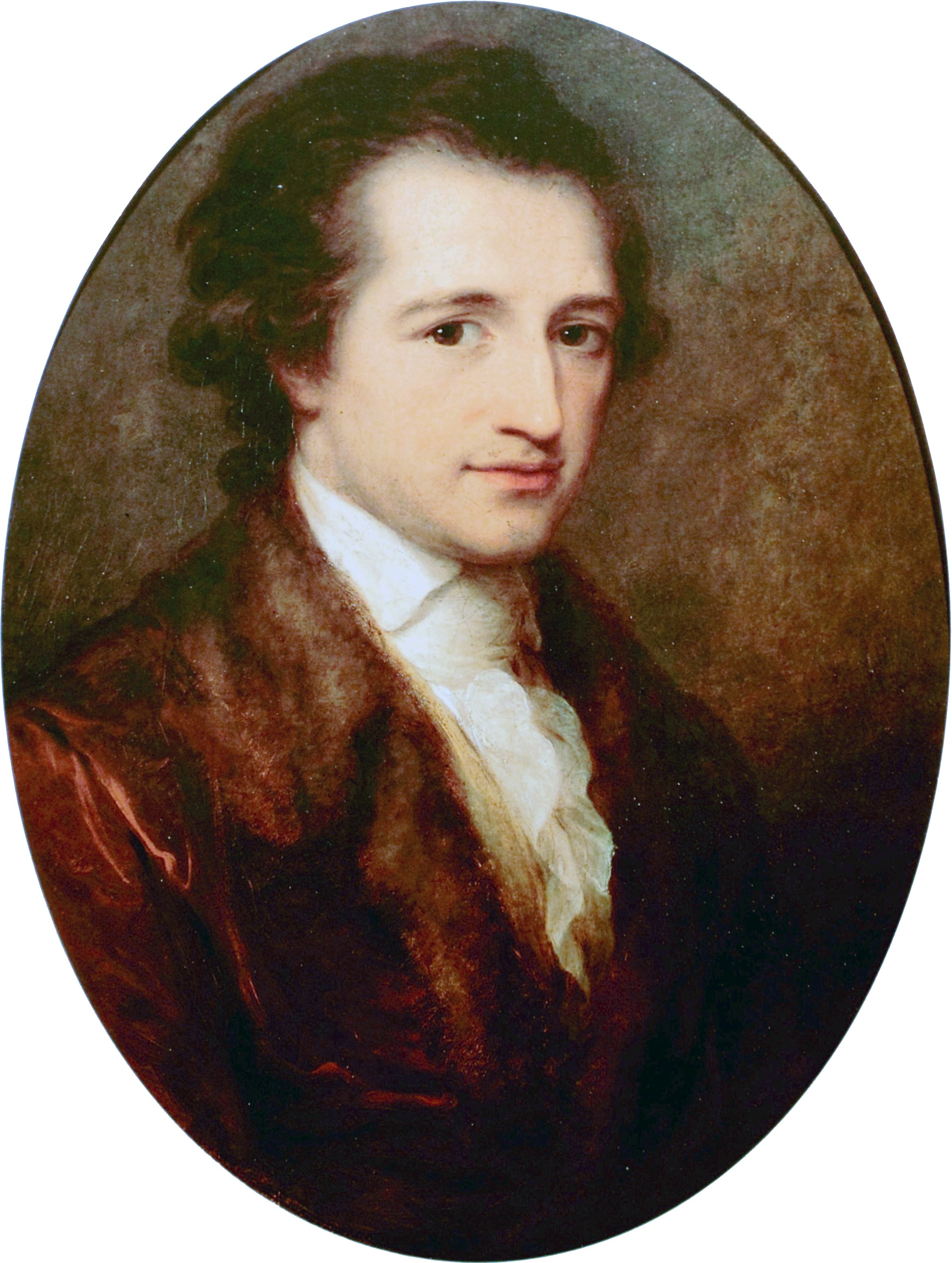
Wilhelm has a habit of falling in love repeatedly; that's OK, because the girls fall in love with him in return. (That's a young Goethe painted by Angelica Kaufman to the left. Rather dashing, don't you think? Maybe a little autobiography here?) Should he stay with that second actress, lively and fun? The practical housekeeper? The Countess? (Already married, though.) Natalie the Amazon? (As he thinks of her.) At least some of these relationships aren't chaste because by the end of the novel Wilhelm learns he has two children by different women. Somebody slips into his bed the night of a cast party and he's not sure who.

That's most of the novel, but then there are some very odd twists. We get a couple of embedded stories, one the story of a woman who becomes a pietistic Moravian Brethren; this story provides comfort to the dying sister of an actor. The other embedded story involves characters in the present whom we've met in other contexts, an incest plot, and more Moravian Brethren. Wilhelm feels bad when he learns he may have unintentionally driven some of the characters into this rather ascetic religious practice. 

And then! We get a secret society, which has been guiding Wilhelm's actions all along. Which I'm not sure I really comprehended at all.

I read most of the novel in Thomas Carlyle's translation from the 1800s, available at Project Gutenberg, then started over and read the whole thing in H. M. Waidson's translation from the late 1970s. (Waidson was a British professor of German at Swansea University.) I can't say that either translation amazed me. Carlyle is Carlyle, perhaps overly rhetorical. The Waidson felt flat in places, though my reprint at least was marred by typos. (For example, 'natter' where 'flatter' was meant; I had to look up the German, also available on Gutenberg, to figure out what was meant. The German word was schmeicheln.)

Goethe wrote a sequel, Wilhelm Meister's Years of Wandering, which came out in installments in the 1820s.

The book--it is Goethe, after all--includes poetry, verse from plays or songs sung by various characters. Some of them are famous: 'Nur wer die Sehnsucht kennt' has been set to music by Beethoven, by Tchaikovsky, by Schubert (multiple times) and that's not the whole list.  Here's one of the Schubert versions, one of a collection of songs that all come from Wilhelm Meister:


One from my Classics Club list.


Thursday, January 25, 2024

Journey to the Edge of Reason

"That he is an important man is shown again and again, but he is a little crazy."
-Oskar Morganstern

Kurt Gödel (1906-1978) is famous as the mathematician who proved that mathematics doesn't quite work. The result is known as the Incompleteness Theorem, and before Gödel's proof, mathematicians assumed anything you could say with elementary mathematics (from 2+2=4, e.g., and on up) could be proven either true or false. It might be hard, it might be impossible for me or you, but it could be done. In 1930 Gödel demonstrated it can't. 

You can create mathematical statements, using math no more complicated than addition and equality, whose truth is unprovable.

Gödel was born in Brno, now in the Czech Republic, but then the largely German-speaking town of Brünn in Austria-Hungary. His father owned a textile factory and was reasonably well off. After the breakup of Austria-Hungary at the end of World War I, financially the Gödels were better off with their money in Czechoslovakia, but when it came time for young Kurt to go to college, in 1924, he went to Vienna, the old imperial capital, which still had the best universities. (It was also becoming uncomfortable in Czechoslovakia for German speakers). 

Budiansky is clearly in love with Vienna. (Understandable.) He spends quite a lot of time on the atmosphere in Vienna, citing figures whose connection to Gödel is pretty non-existent--Joseph Roth, Robert Musil--but whose interest to readers is large. Vienna was Gödel's home for roughly fifteen years, and a large portion of his important work was done there, so it's appropriate enough.

But Vienna was becoming problematic. Gödel wasn't Jewish, but his friends were; as things got worse, the sort of mathematics that Gödel did got labeled 'Jewish mathematics' (What's that?) and after Anschluss, the university wasn't going to allow that sort of math any more. Gödel did a semester as a fellow at Princeton's Institute for Advanced Study when it opened in 1933--Einstein was one of their first hires--and though Gödel didn't much like Princeton, his friends there kept suggesting he come back.

He was subject to paranoid fantasies (though one of his mathematical colleagues was assassinated by a right-wing student, so maybe not entirely paranoid).  His girlfriend Adele was married and under Catholic Austrian law she couldn't get divorced, so the two of them couldn't leave the country as married. Also he was inclined to be apolitical, and was politically naive. 

But after Anschluss in 1938, German law applied in Austria, allowing divorce and remarriage. Kurt and Adele married. Gödel was still sluggish about the need to leave, but after much prodding he did, ultimately taking a full-time position at the Institute for Advanced Study.

And became close friends with Einstein

Through the forties, he continued to do mathematics, working with Oskar Morganstern and John von Neumann. The later years he taught (though he was a terribly shy teacher) and continued to suffer periods of paranoia.

And why was I interested in a biography of Kurt Gödel you might ask?


I read Hofstadter's Gödel, Escher, Bach around when it came out, devoured it more like. It was probably the first serious non-fiction book I read on my own. There were various essays in 2019 for the fortieth anniversary of the book, and I thought about rereading it then, but didn't, but when I saw about the new biography of Kurt Gödel, I was primed to be interested. The biography was well done. The proof of the Incompleteness Theorem is relatively (...?) easy to understand, but Budiansky saves the explanation of that for an appendix, where he does a pretty good job, and otherwise you can read the biography without math.

And am I about to reread Hofstadter? Well, if you look closely you can see a purple bookmark there...


Austria. Could be the Czech Republic, I suppose, but no, not really. Vienna is where it happens. Last year's Austria book for the challenge was another biography of an intellectual who left in the 30s and came to the U.S., Victor Gruen.


Tuesday, January 16, 2024

European Reading Challenge 2024 Signup


Time to sign up for the new year for Gilion's European Reading Challenge. The idea is to visit European countries by reading books set there. It's one of my favorite challenges and I'll again be signing up at the maximum, five-star level, which means five unique European countries, but I hope to do better than that again. No idea what countries I'll be visiting or via which books I'll be visiting them, but I do know that the first this year will be Austria because I only have a few pages left in Stephen Budiansky's biography of Kurt Gödel.

While, as an Illinois native I'm happy to see its outline everywhere, it is a little surprising to see it just to the southwest of Iceland. (Though based on today's temperatures...) Does that mean I get to count that next Chicago book as part of my European tour? 😉

Thanks to Gilion for hosting this great challenge once again. Full details (and your chance to signup!) can be found here.