So, I was putting my name on the list at my library of Kushner's new novel Creation Lake (I'm currently 256 and my library has 127 copies) but then I saw there was this book The Mayor of Leipzig that came out in 2021. Where did that come from? I never heard about it. Send me that!
They did. Conveniently, it turned out to be novella length.
An unnamed woman artist, forty-five years old, based in New York, tells her story. She goes to Germany. She meets her gallerist in Cologne and from there travels on to Leipzig, where she will have an exhibition. "After lunch I went to the exhibition space where I would have my show and that part gets technical, so I'll spare you." We're given some speculation on art, learn about her artist friends, about her analyst, whom she doesn't see any more.
We also learn that her story is being ghostwritten by Rachel Kushner, who "probably understands less about me than you will, after you read this." Amusingly the protagonist accuses Rachel Kushner of being an art groupie, though based on The Flamethrowers, maybe she is.
We also learn about Spencer Schlosnagle, the mayor of Friendsville, who's a real person. Google him, the protagonist says, and I did. A strange enough story.
There may be a ghost involved--our protagonist says she ought to talk to her analyst about it, but then she's not seeing her analyst anymore--and then there's the 'Mayor' of Leipzig, who's probably not the mayor, but is like Spencer Schlosnagle in Spencer's other famous feature.
Interesting enough, occasionally amusing. It's not The Flamethrowers and I assume it won't be the equal of Creation Lake either.
70p., but it's large print with lots of white space. It's short for a novella, maybe more long short story instead.
Nelson Algren's Chicago: City on the Make
I'd wanted to read this since I read the biography of Nelson Algren in summer. (Well, I'd probably wanted to read it before then, but had half-forgotten.) My library didn't have a copy, but I found one when I was in Chicago recently.
It comes out in 1951 and it's Algren's personal history of Chicago until that time. Or maybe it's a prose poem. "By its padlocked poolrooms and its nightshade neon, by its carbarn Christs punching transfers all night long; by its nuns studying gin-fizz ads in the Englewood Local, you shall know Chicago."
Algren is interested in the underside of Chicago life, and likes the people who also care about the downtrodden. Jane Addams and Richard Wright are heroes in the book; the first edition was dedicated to Carl Sandburg. He doesn't like the rich and the powerful and the righteous, and goes after them hard.
It's pretty fascinating, even if it's more atmosphere than actual information. You probably want to get the edition shown, and I don't just say that because I went to high school with the editor Bill Savage. 😉But the notes (by Bill Savage and David Schmittgens) are nearly essential. I grew up in Chicago, I know who Hinky Dink Kenna and Bathhouse John Coughlin were (shady Chicago politicians, are you surprised?) but even I found the notes hard to do without.
130p in this edition, with those notes, a fun introduction by Studs Terkel, and a somewhat sour afterword from the second edition by Nelson Algren himself, who'd become a bit of a grump by the sixties.
This book is the source of the famous description of Chicago:
"Yet once you've come to be part of this particular patch, you'll never love another. Like loving a woman with a broken nose, you may well find lovelier lovelies. But never a lovely so real."
A while back I read the first novel Ali and Ninoby Kurban Said and found it delightful. Time for a book bender! My library delivered.
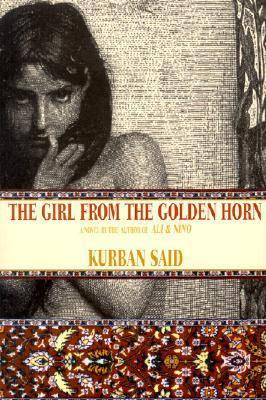
The Girl From The Golden Horn
The second (and last completed) novel by Kurban Said is The Girl from the Golden Horn. It came out in German in 1938 and was translated into English by Jenia Gramm in 2001.
Achmed-Pasha Anbari with his daughter Asiadeh have left Constantinople for Berlin. He was a higher-up in the Ottoman administration and with the fall of the Ottoman monarchy at the end of World War I, he no longer feels welcome in Atatürk's Turkey. He does what he can in Berlin to scrape up enough money so his daughter can get an education; she's studying Comparative Turkish philology at university. She's the Girl from the Golden Horn.
While there still was an Ottoman empire, Asiadeh was promised to an Ottoman prince before she was of age. But what are the Ottomans now? Where even is her prince? She sends a letter to the Turkish consulate to forward on to the prince, asking him to either claim her or relinquish her. He chooses to relinquish.
That's fine because in the meantime she had a cold and met the university's doctor, Alex Hassa. She's in love, and Hassa, an unhappy divorcé, loves her back and needs her. They marry, go on a honeymoon, and settle in Vienna where Dr. Hassa starts a practice.
Then the prince shows up and now he wants to marry her.
In Ali and Nino before politics intervened, the difficulties between the two were cultural: he was Muslim and she was Christian. This novel turns on similar lines except she's the Muslim and he's Christian. She doesn't wear the veil now. Does she miss it? Do girls really need to be educated? Hassa as it turns out is short for Hassanovič, that is the son of Hussein, and Dr. Hassa's family before they converted were Muslim. Does that help?
I don't think the novel was quite as wonderful as Ali and Nino, but still it was good. Asiadeh has to figure out what she wants and how to get there with her dignity intact. She does.
The Orientalist
In that post on Ali and Nino I discussed the mystery of Kurban Said a bit. It's a pseudonym, but for whom? The likeliest candidate was Lev Nussimbaum, born in 1905. He was a Jew, and grew up in Baku, Azerbaijan. Tom Reiss wrote an article for The New Yorker on Nussimbaum, and then expanded it into a book in 2005.
Lev's father was Abraham, a well-to-do oilman in Baku; his mother died when Lev was 6, likely a suicide because she'd been detected in revolutionary politics. During World War I, Lev and his father fled to Persia when there was violence in Baku; later they return to the short-lived Republic of Azerbaijan, but are forced to flee again when the Bolsheviks arrive, this time through Georgia and then Constantinople. They finally pitch up in Berlin, where Lev attends a high school for Russian emigres. (With the sisters of Boris Pasternak and Vladimir Nabokov! Lydia and Elena, respectively. Elena is considered quite the beauty. This is a bit of a shock given what Vladimir looked like.)
And somewhere along the way, LevNussimbaum converts to Islam and changes his name to Essad Bey.
As Essad Bey he becomes a best-selling writer of non-fiction in the 20s and the first half of the 30s, writing close to a book a year as well as becoming the Eastern Europe and Middle East expert for the magazine Die Literarische Welt, which also published Bertolt Brecht, Walter Benjamin, and Alfred Döblin. (Think New York Review of Books, Reiss says.) Busy, but they needed the money, especially after it became clear that the Bolsheviks weren't going away, and any claims Abraham had still in Azerbaijan were going to be valueless.
Nussimbaum got married, to a Bata shoe heiress, and divorced. The divorce was covered by gossip papers on both sides of the Atlantic.
He was a controversial figure: Was he Jewish, was he Muslim, where was he really from? Nussimbaum claimed he was born on a train between Zurich and Baku, but he was given to romanticizing, so who knows? With a background like that it's unsurprising he was a staunch anti-Bolshevik. His anti-Communism and his conversion to Islam helped after the Nazis came to power for a while; his books still could be published in Germany until 1935. But he was on a lecture tour in 1933 and doesn't return to Germany, but stays in Austria. When Anschluss looks likely he wangles a contract to write a biography of Mussolini and moves there. (That biography never materialized.) By then his health is poor; he has a severe case of Reynaud's syndrome, which leads to gangrene and the amputation of his toes. To deal with the pain he's become addicted to morphine. He dies in Positano, Italy, in 1942.
And did he write those Kurban Said books? The evidence Reiss offers is pretty strong and Reiss thinks they were entirely Nussimbaum's work. But Nussimbaum was willing to co-author and I think it's impossible to rule it out. The books were copyrighted under the name of Baroness von Ehrenfels of Austria. Did she help write or did she just help by being the front person for German publication? I don't suspect we'll ever know for sure.
Nussimbaum is a fascinating figure and Reiss has got a hold of a good topic. I do think the expansion to a book shows signs of haste: Reiss writes about the Freikorpsand Walter Rathenau; interesting topics, but they don't have a whole lot to do with Nussimbaum. He writes about G. S. Viereck, the American Nazi sympathizer, who was an acquaintance of Nussimbaum, but he kind of repeats himself. Still, a good read. And now I want to find Essad Bey's Blood and Oil in the Orient. It was the story of the Nussimbaum's escape from Baku when the Bolsheviks marched in. It was marketed as non-fiction when it came out; Reiss says it's half-fiction, but it still sounds pretty thrilling.
Reiss later went on to write The Black Count, about Alexandre Dumas' military father, which got pretty good press when it came out. I was interested in it at the time, but didn't read it, but that may change.
Both these books march around Europe, so pick a country. "The ideas you have!" said Hassa. "Nobody ever goes to Belgrade on their honeymoon." Serbia's tempting, but I'll go with Bosnia, which that honeymoon also included. A crucial scene takes place in Sarajevo, where Dr. Hassa's family is from. When Dr. Hassa and Asiadeh first meet:
"There was an Anbari who was the governor of Bosnia."
"Yes," said the girl. "That was my grandfather."
For The Orientalist, I'll say Turkey, since I've already used Azerbaijan for Ali and Nino. It was Constantinople was where Lev Nussimbaum became Essad Bey.
I belong to those convicts and prostitutes myself--
And henceforth I will not deny them--
For how can I deny myself?
-Walt Whitman
That quote from Leaves of Grass serves as the epigraph to Nelson Algren's second novel Never Comes Morning. But it could also very well be Algren talking about himself.
Mary Wisniewski's biography of Algren came out in 2016 with Chicago Review Press. She's a fan, but not starry-eyed: she can see where he goes wrong, both personally (more often) but also in his writing. I read a bunch of Algren in the 80s when I was on a Chicago novelist kick, and I was explaining to the Other Reader what his stories were like: people in a miserable degraded situation manage to end up in an even worse plight by the end. Now you may not very often be--maybe not ever be...😉--in a mood to read such a book, but Wisniewski does an excellent job of why you might still want to.
Nelson Algren was born in 1909 as Nelson Abraham to a mostly Jewish, though not practising, family. His middle name is Ahlgren and comes from his Swedish grandfather; it gets simplified to serve as his pen name.
How miserable are his characters? The Man With The Golden Arm is the best-known novel; it won the inaugural National Book Award in 1950. Its protagonist,Frankie 'Machine' Majcinek, is a skilled poker dealer, where skilled means he can gull the rubes and not be detected. Poker is of course illegal in Chicago, and so he's working for a hoodlum. He's also a morphine addict, something he picked up as a soldier when he served in WWII. So he's a man with a golden arm in two senses. We first see him in a police lineup. His final appearance is a more serious encounter with the law...
Otto Preminger made a movie of the book with Frank Sinatra in Frankie Machine role. Preminger wanted to use the movie to blow up the Hays Code, and he kind of did, but still the movie is far more upbeat than the book.
Algren lived most of his adult life on the northwest side of Chicago in the heart of Polonia, the Polish neighborhood, and it's the underclass of that area he writes about. His characterizations didn't win him many friends among his neighbors. Wisniewski quotes her father at one point: "I didn't know any people like that. Those people were bums." (Though Mike Royko, of Polish-Ukrainian stock was a big fan.)
Wisniewski's own style makes this a pretty sharp read: [Jack Lait and Lee Mortimer] "claimed that the Poles were like the Irish of Chicago,... But this was silly. The Irish were the Irish of Chicago--controlling city politics and dominating the police force."
On Never Come Morning, Algren's first novel about Polonia: "Nelson presented an exceedingly narrow view of Polish-American life...This claustrophobia was the effect Nelson wanted--but it is so complete it can feel like a distortion." This is astute and could be said of a lot of Algren's fiction.
Algren wrote four novels, the last a ground-up rewrite of the first, two volumes of short stories, and a fair amount of non-fiction. Not a bad career, but also not tremendously prolific, which was the result of a lot of personal troubles--mostly self-inflicted--and insecurities. He died in 1981.
But wait! What sort of bait and switch is this? I put #ParisInJuly up there in the header. But this is a biography of a grim, naturalistic, Chicago novelist. Well, that brings us to...
The Crazy Frog and the Crocodile
"The romance of Nelson Algren and the French writer, philosopher, and feminist Simone de Beauvoir was the most ridiculous, exotic, corny, impossible, unreasonable, and amazing thing to come into both their lives."
They first met in Chicago in 1947. De Beauvoir was in Chicago and she'd been given Algren's phone number as somebody she might want to look up. Algren had been warned this French philosopher was going to call, but he still managed to hang up on her twice, either because he couldn't understand her accent, or out of cussedness. Nevertheless they managed to meet that February, and pretty soon they were both hopelessly in love. De Beauvoir at one point says it's the best sex she's ever had.
Crazy Frog and Crocodile were their nicknames for each other.
Theirs was mostly a long-distance romance, though. Both were writers who felt they had to be in 'their' city to write, Chicago for him, Paris for her. De Beauvoir also wouldn't leave Sartre, though she told Algren she was no longer sleeping with him. Algren found this hard to understand (and for going on three-quarters of a century now, that's true of a lot of people). Algren wanted to be married, though Wisniewski at one point dryly remarks he wasn't very good at it. (There were three marriages, though only two wives.)
Algren gets to Paris to visit her, hang out at the Café de Flore, meet Sartre and the crowd. "By this time in my life I was ready to vote existentialist," he writes in a letter, and it's not Sartre he's thinking about. When the romance is in its first flush, they're both writing their major books: Golden Arm for him, The Second Sex for her.
Later it gets more difficult. Algren, who had a bunch of communist friends, and who may have been a communist himself in the 30s, (though he denied it, and was willing to do so on oath) can't get a passport in the 50s. Both have affairs with others, and eventually Algren remarries his first wife, though it's even less of a success the second time than the first. He's portrayed as Lewis in de Beauvoir's The Mandarins, and Algren wasn't fond of his portrait. But de Beauvoir is buried with Algren's ring on her finger.
And I was amused to see in that first flush they enjoyed watching Kukla, Fran, and Ollie, a Chicago program whose reruns still showed up mixed in with Saturday morning cartoons when I was a kid:
So innocent.
The photo Wisniewski uses for the cover of her book shows Algren was rather a good-looking guy--so maybe de Beauvoir had taste?--but why are his pants so grease-spotted? But I think that's rather representatively Algren: he probably chose to wear grease-spotted pants for his formal portrait.
Anyway, Wisniewski's bio made me want me to read (reread) Algren, and is there a better recommendation for a literary biography than that? I'm currently in the middle of Never Come Morning.
And while de Beauvoir's imprimatur is probably of more use to Algren these days--she thought his novels were great, and was instrumental in seeing they were translated into French--I can't resist quoting Hemingway's pretty famous blurb. It's Hemingway being so much his clichéd Hemingway self it's kind of hilarious. [He's writing of The Man With The Golden Arm]:
"This is a man writing and you should not read it if you cannot take a punch. Mr. Algren can hit with both hands and move around and he will kill you if you are not awfully careful."
Though it has to be said Algren was thrilled with the blurb, and posted the letter from Hemingway containing it on his refrigerator, that new refrigerator the success of The Man With the Golden Arm enabled him to buy.
Full Disclosure: Mary Wisniewski is the friend of a friend, though I've never met her. (I think.) If I thought the book was poor, I simply wouldn't have mentioned it. But instead, I thought it was quite good.
For some strange reason I haven't been able to comment on any WordPress-based blogs lately. Argh. Has anybody else seen this?
"'We're not Christians," they say. "Christ stopped short of here, at Eboli.'"
'They' are the peasants of Gagliano, superstitious and pagan and so not entirely Christian.
In 1935, Carlo Levi was banished to a small hilltop town, Gagliano, in Basilicata, the deep south of Italy. Levi had been a member of the anti-Fascist organization Giustizia e Libertá[Justice and Liberty] and an opponent of the war against Ethiopia. Before Gagliano, he'd served a spell in solitary confinement and then an earlier period of internal exile in Grassano. The book begins as he's being transferred from Grassano to Gagliano.
Levi was born to a culturally Jewish and well-to-do family in Turin, in the north of Italy. He'd studied for a medical degree and his older sister Luisa became a famous neuropsychologist. But Levi himself, though he had qualified as a doctor, quit practising, and began to paint. He spent time in Paris in the 20s (he's born in 1902) painting, but on his return to Italy, had been caught up in the politics of the era.
The book is a pretty fascinating look at what the life of an isolated peasant culture was in the south of Italy in the 30s. Levi suggests--and it seems so--it hadn't changed all that much in centuries. Levi spends about a year there, grows to like the peasants he meets but remains unromantic about them. There's an amnesty after Italy wins its war against Ethiopia, and Levi is freed. He vows to come back to the south of Italy when he can, but doesn't, at least until his body is buried in Gagliano. The book came out in Italian in 1945, and made a stir among Italians who didn't have any clue about what was going on in the rural peasant south. Highly recommended.
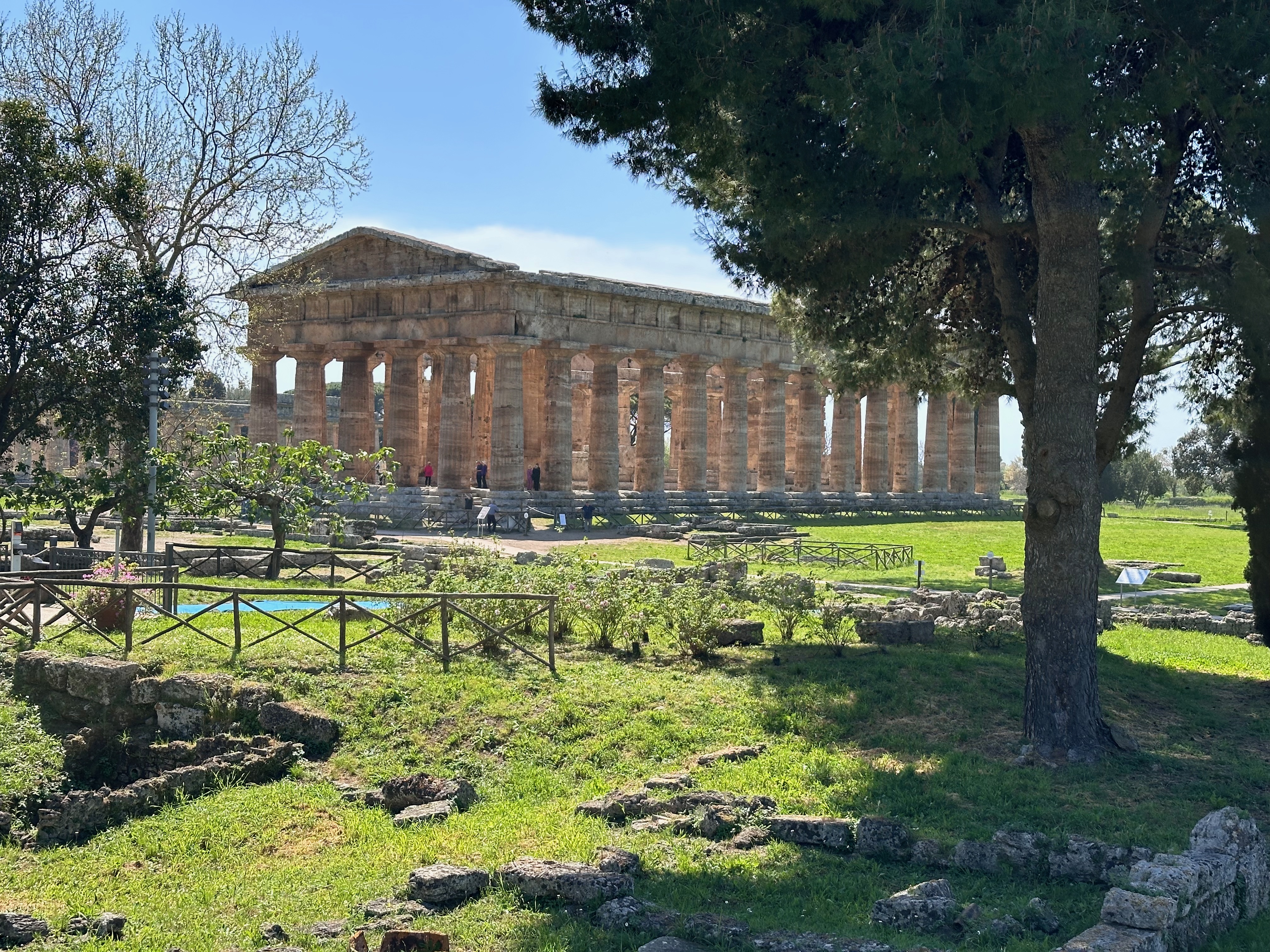
I had a few more insightful things I meant to say, but, oh well, it's been three weeks since I finished it. I read it now because we were going to the south of Italy and I thought, it's time! But we didn't get to Gagliano, nor even to Eboli. (We stopped well short.) The farthest south we got was Paestum:
Temple to Hera (probably; it used to be thought Poseidon's)
Also south of Naples is the Amalfi coast. We walked to Ravello (a hill town hangout for Virginia Woolf and D. H. Lawrence and Richard Wagner) from Minori, a town on the coast. My phone registered 74 flights of stairs that day. Three-quarters of the Empire State Building!
The view from the Villa Rufalo in Ravello. The brochure said everybody takes this photo & I did, too.
I first read Virgil at a formative age. I wanted to see Phlegraean Fields, the purported entrance to Hades and Hephaestus' workshop, near Naples.
Lunch by Roman ruins in Pozzuoli, our first supposed temple of Serape, but really just a market.
We arrived at and then flew out of Rome. There are always things to see there, of course, and we didn't see them all. One of them was Hadrian's Villa, about 30 km east of Rome:
The building on the island was Hadrian's mancave.
Our second so-called temple of Serape
When you're king of the world and you've just come back with a boatload of plunder from Romania, you get to build this sort of thing. This so-called temple also wasn't, but apparently was just meant for (very) fancy picnics. We'd intended to see the villa on our visit ten years ago, but then ended up spending the entire day at the nearby (and also very cool) Villa d'Este. But now having read The Memoirs of Hadrian, I wanted to see it.
I probably ought to have read Christ Stopped at Eboli in Italian, but didn't. But look what my library was able to deliver:
It's nice to travel, but it's also good to be back!
"...we donned all sorts of costumes, footgear, stuffing, to feel the image of the body; we glued on noses, beards, moustaches, we put on wigs, hoping to strike accidentally on the things that we did not as yet know and for which we were painfully searching."
Konstantin Stanislavski (1863-1938) was a Russian actor, stage director, and teacher of acting. My Life in Art is his autobiography of 1924.
Stanislavski was born Konstantin Andreyev to a wealthy family with an estate near Moscow. He was one of many children in a happy family; his parents were interested in the arts and indulged the children's enthusiasms. Young Konstantin quickly caught the theater bug, playing in masquerades, watching a visiting puppet theater troupe, engaging in amateur theatricals with his cousins.
But his father's supportiveness only went so far; he was expected to have a more respectable career. In his twenties Konstantin takes a part in a racy French comedy and adopts Stanislavski--Polish-sounding so it should fool people, right?--as his stage name, but nevertheless his parents come to see the production, and are appalled to see their son in such a thing. His father tells him to set up an amateur society and limit their productions to 'decent' scripts. So that's what he does.
Until he's thirty-three. Then with Vladimir Nemirovich-Danchenko. In 1897, after an epic luncheon--it began at ten AM on one day and ends at 3 AM the next--he founds the Moscow Art Theater. They sell shares in their new corporation and decide to open their season with Tsar Feodor, a play by A. N. Tolstoy (cousin to Leo).
But Nemirovich really wants to bring in Anton Chekhov. Chekhov's first play was The Seagull. Nemirovich and Chekhov had shared a prize for the best play of the year in 1896, but Nemirovich refused his half of the prize and insisted it be given to Chekhov, as author of the far superior play. Still the first production of The Seagull in St. Petersburg was not a success--Chekhov famously fled town after opening night--and had refused to write anything else for the stage or to allow The Seagull to be played again. That is, until 1898, when it became the fourth play in Moscow Art Theater's opening season. It was such a hit, the Moscow Art Theater adopted the seagull as their emblem.
That's Chekhov reading in the center, Stanislavski seated at his right, and Olga Knipper, Chekhov's future wife in profile next to Stanislavski.
Stanislavski directed all four plays of Chekhov, jointly in the case of The Seagull with Nemirovich, and acted in them as well, as Trigorin (The Seagull), then originating the roles of Astrov (Uncle Vanya), Vershinin (The Three Sisters), and Gaev (The Cherry Orchard). Chekhov's sister told Stanislavski his production of Uncle Vanya had better be a success, because Chekhov had had an attack of tuberculosis, and a failure would kill him. Yikes! Pressure. By the time of The Cherry Orchard it was clear Chekhov was dying and they hastened the production so he could see it.
Apparently the group reading was a standard feature of Moscow Art Theater productions. I was amused that for The Three Sisters, none of the troupe's member understood it was meant to be a comedy. I read Chekhov before I saw him played, and I certainly didn't understand he could be hilarious.
Moscow Art Theater also originated productions of Gorky, as well as reviving classic plays, particularly Ibsen and Shakespeare. This is Stanislavski and his future wife Maria Lilina in Schiller's Love and Villainy (more commonly translated now as Intrigue and Love).
The company made their first tour abroad in 1906, starting in Berlin. 1906 was a troubled year in Russia, and they couldn't play at home. It was a success, but their real international reputation started with the production of Hamlet of 1911-12, which Stanislavski discusses in detail.
Now the book is called My Life in Art, not My Life in Business or My Life in History or My Married Life, so I guess it shouldn't be a surprise...but though he lived in interesting times, there's almost no discussion of it. There's no discussion of what the family business was or what his part was in his 20s while he was still involved. We learn about 1906 because the company has to go abroad. The Russian Revolution features largely as free tickets handed out to workers. The Russian Civil War is important because half their crew (including Olga Knipper, Chekhov's widow) are trapped on the other side of the white Russian general Denikin's lines. Even his wife and kids--theirs seems to have been a happy marriage--we learn about mostly in relationship to the theater. Maria Lilina is pregnant? Oh, no, she can't act!
Is this because he feels he shouldn't say anything about Soviet politics, or because he's genuinely apolitical? A bit of both, I suspect, but probably more the latter. Lenin was supposed to be a fan.
The book was came out in 1924 after a successful U.S. tour and had been commissioned by a U.S. publisher. Wikipedia tells me Stanislavski would have preferred to have written about his teaching methods, but there was no interest in such a book at that time, so he smuggled in his ideas about how to become an actor in this autobiography. He later went on to write the books more directly discussing his ideas. In English, they're: An Actor Prepares, Building a Character, and Creating a Role, the last from his notes. They were all first published in English.
After the book: in 1926, he directs Bulgakov's The Day of the Turbins, a success and a play that Stalin was supposed to be fond of. When I read Bulgakov a while back, something suggested that it was The Day of the Turbins that kept Stalin from executing Bulgakov. Maybe that good feeling extended to Stanislavski.
In 1928 Stanislavski had a heart attack--on stage, but kept playing until the curtain fell. But that's the end of his acting career. He still directs, but now mostly works on his teaching system. Maybe he's too famous for Stalin to kill, but Stanislavski is also living quietly at this point. Stanislavski announces his true heir in the theater is Vsevolod Meyerhold, who had played Treplev in that production of The Seagull, and gone on to direct, but Meyerhold is executed by Stalin in 1939, shortly after Stanislavski's death. His widow Maria Lilina dies in 1943 at the age of 77.
All in all a pretty fascinating book and a successful spin choice!
"That he is an important man is shown again and again, but he is a little crazy."
-Oskar Morganstern
Kurt Gödel (1906-1978) is famous as the mathematician who proved that mathematics doesn't quite work. The result is known as the Incompleteness Theorem, and before Gödel's proof, mathematicians assumed anything you could say with elementary mathematics (from 2+2=4, e.g., and on up) could be proven either true or false. It might be hard, it might be impossible for me or you, but it could be done. In 1930 Gödel demonstrated it can't.
You can create mathematical statements, using math no more complicated than addition and equality, whose truth is unprovable.
Gödel was born in Brno, now in the Czech Republic, but then the largely German-speaking town of Brünn in Austria-Hungary. His father owned a textile factory and was reasonably well off. After the breakup of Austria-Hungary at the end of World War I, financially the Gödels were better off with their money in Czechoslovakia, but when it came time for young Kurt to go to college, in 1924, he went to Vienna, the old imperial capital, which still had the best universities. (It was also becoming uncomfortable in Czechoslovakia for German speakers).
Budiansky is clearly in love with Vienna. (Understandable.) He spends quite a lot of time on the atmosphere in Vienna, citing figures whose connection to Gödel is pretty non-existent--Joseph Roth, Robert Musil--but whose interest to readers is large. Vienna was Gödel's home for roughly fifteen years, and a large portion of his important work was done there, so it's appropriate enough.
But Vienna was becoming problematic. Gödel wasn't Jewish, but his friends were; as things got worse, the sort of mathematics that Gödel did got labeled 'Jewish mathematics' (What's that?) and after Anschluss, the university wasn't going to allow that sort of math any more. Gödel did a semester as a fellow at Princeton's Institute for Advanced Study when it opened in 1933--Einstein was one of their first hires--and though Gödel didn't much like Princeton, his friends there kept suggesting he come back.
He was subject to paranoid fantasies (though one of his mathematical colleagues was assassinated by a right-wing student, so maybe not entirely paranoid). His girlfriend Adele was married and under Catholic Austrian law she couldn't get divorced, so the two of them couldn't leave the country as married. Also he was inclined to be apolitical, and was politically naive.
But after Anschluss in 1938, German law applied in Austria, allowing divorce and remarriage. Kurt and Adele married. Gödel was still sluggish about the need to leave, but after much prodding he did, ultimately taking a full-time position at the Institute for Advanced Study.
And became close friends with Einstein
Through the forties, he continued to do mathematics, working with Oskar Morganstern and John von Neumann. The later years he taught (though he was a terribly shy teacher) and continued to suffer periods of paranoia.
And why was I interested in a biography of Kurt Gödel you might ask?
I read Hofstadter's Gödel, Escher, Bach around when it came out, devoured it more like. It was probably the first serious non-fiction book I read on my own. There were various essays in 2019 for the fortieth anniversary of the book, and I thought about rereading it then, but didn't, but when I saw about the new biography of Kurt Gödel, I was primed to be interested. The biography was well done. The proof of the Incompleteness Theorem is relatively (...?) easy to understand, but Budiansky saves the explanation of that for an appendix, where he does a pretty good job, and otherwise you can read the biography without math.
And am I about to reread Hofstadter? Well, if you look closely you can see a purple bookmark there...
Austria. Could be the Czech Republic, I suppose, but no, not really. Vienna is where it happens. Last year's Austria book for the challenge was another biography of an intellectual who left in the 30s and came to the U.S., Victor Gruen.