Showing posts with label Asturias. Show all posts

Thursday, June 27, 2024

Ana Blandiana (#poetry)


Dies Illa, Dies Irae

It will come,
It has to come,
That day
Postponed for ages
Will arrive,
It's going to come,
It's getting closer,
You can hear
Its beating pulse
On the horizon,
It will come,
It's in the air,
It can't be put off any longer,
Have no doubt, it will come,
That day,
Like a shining sword,
In the blinding light.

-Ana Blandiana
 
Ana Blandiana (b. 1942) is a Romanian poet. It was recently announced (a month or so ago) that she won this year's Princess of Asturias Literature Award for her lifetime's work. I'd never heard of her before (I think) but I find the Princess/Prince of Asturias Award to be a good selector. In addition to various people who went on to the Nobel Prize but won this first (Mario Vargas Llosa, Doris Lessing, others) they also selected a couple of writers I liked, but didn't win the Nobel, and wouldn't have minded seeing win, such as Álvaro Mutis, Susan Sontag, and Claudio Magris. So, with a list like that, I thought I'd better check her out... 😉 and my library came through.

'Dies Illa, Dies Irae' is, of course, the title of the poem/song/chant on the day of the Last Judgment. ('That day, the day of wrath' is what the Latin says.) This poem was printed on the front page of the newspaper the day after the fall of the Communist government in Romania in 1989 and then collected in her book of 1990, The Architecture of Waves. 
 
A couple of more examples. Several of her poems from before the fall of Communism use sleep as a metaphor for the state of the Romanian people:

Full Moon

Come, moon, and wake us from our sleep,
Cast your nets into our waters
And bring us out,
Pour us
Into the insomnia of air!
We may not survive,
Our lungs have turned to gills from so much sleep,
But,
In spite of the risk, wake us
And leave us, alone and free, at sea:
So we can slowly move,
With infinite care,
Forward across the waters,
A shifting architecture of waves,
A horizon stretched like a rope
Between two hells,
Staring into your lunatic eye, crazed with hope.

-Ana Blandiana


A number of her poems seem to use ballad meter:

Gara de Nord

Dirty platform, carefully guarded
After papers exploding in the air,
Two fists handcuffed at a back, and
Lots of uniforms, may this rare

Image be the stop-frame emblem
Of hope beneath a colourless sun! To see
Through the spectacles of handcuffs
The future of the verb to be.

-Ana Blandiana

Both those poems were also collected in The Architecture of Waves (1990). Here's one from her book of 2016, Clock Without Hours:

That Year

Small things started to grow that year
And they didn't stop. Nature's laws transcended.
Flourishing growth, perverse, was everywhere.
Birds looked like bulls and their flying ended.

Purslane, nettles, grasshoppers, mites,
Sorrel and burdock, mandrake and sedge
Grew and grew to an amazing height,
Delirious waves beneath the outsized thistles' heads.

Elephants with giant spiders entwined,
Eagles, quite sad, from claws of sparrows hung,
Lions in the desert trembled and whined,
Discordant hymns from puffed-up crickets rang.

Worms in a year to snakes had grown.
A blade of grass became a club;
A speck of dust, a boulder stone.

-Ana Blandiana

I assume that year is 1989 and that's her sense of the outcome, but I'm sure the poem can be read in more than one way. Five Books is (as you might guess...) a collection of five of Ana Blandiana's books from across her career, and was issued by Bloodaxe Books (in the U.K.) in 2021, translated by Paul Scott Derrick & Viorica Patea. All the poems I've quoted come from that volume. The Sun of Hereafter and Ebb of the Senses are two of her books, in one volume, also from Bloodaxe with the same translators; that volume came out in English in 2017. 

I've stuck with political poems just for a theme, but there are also quite a lot of love poems, some happy, some sad: she married Romulus Rusan, also a writer; he died in 2016, at the age of 81. Poems from the later books also frequently deal with mortality, whether her own or that of her husband's.

Sunday, October 24, 2021

I Am Alive and You Are Dead: A Journey Into the Mind of Philip K. Dick

"The book you hold in your hands is a very peculiar book. In it I have tried to depict the life of Philip K. Dick from the inside, in other words, with the same freedom and empathy--indeed with the same truth--with which he depicted his own characters."

Emmanuel Carrère's 'biography' of Philip K. Dick came out in French in 1993, thus nine years after Dick's death, and was translated into English by Timothy Bent in 2004. 

Inside the head of Philip K. Dick is a fascinating, but pretty unstable place to be.

It's not a very conventional biography, even though Carrère seems to have done a lot of the work of conventional biography--interviewing friends and lovers, visiting locations, reading letters, reading earlier biographers, and above all, reading the work of Dick himself. But Carrère doesn't footnote or cite, and except for the occasional moment where he mentions talking with one of Dick's friends, it's unclear where he has gotten information. Worse (or different) he's clearly deducing ideas--and says as much--about Dick's life and mental state from the novels. A terrible no-no, of course, but so what? It works.

The facts are there: Philip K. Dick was born in Chicago in December of 1928. He had a twin sister who died young--of hunger. It was the Depression, but the boy survives and the girl dies. It's no wonder Dick was tormented by this his whole life. The family moves to California when he's still a child, but his parents divorce and he's raised by his mother. He goes to Berkeley High School, and then to Cal-Berkeley for a year, but drops out. He works in a record store on Telegraph Avenue. He meets Anthony Boucher and starts writing science fiction stories. He marries--and marries--and marries: five times in all. 

Dick had a reputation as a druggy, which was both true and not: he took LSD once, in 1964, was terrified by it and never did it again. He smoked marijuana occasionally, but mostly socially, and not, it seems that much. But he did both Benzedrine and Valium--prescription drugs--to stimulate his writing, and wind down afterwards. A lot. But then so did W. H. Auden.

He was difficult to live with: needy and clinging, but also a know-it-all. (Well, he really did know a lot.) Bad in social situations, but with deep friendships at times. Pretty seriously agoraphobic. He wrote to (barely) pay his bills, too much and too fast, but still some of the books are pretty great. He may have had some religious experiences, or it may have been the drugs. He never said for sure, and may not have fully decided himself. The drugs (probably) did for him in the end. He died in 1984, after a series of strokes, at the age of 53.

But Carrère's handling of the facts, while seemingly fine, is not what makes the book so interesting.
"One day, a new young woman rode into his life, on the back of a Harley-Davidson driven by a guy covered in tattoos. 'Donna,' like almost everyone else who appears in this chapter, has been extrapolated from a character in A Scanner Darkly...The real Donna had another name--as did others I write of here--which she has asked not to be used in print."
"Another time, Phil became convinced that Donna was a narc. He confronted her. She replied that she understood why he would think that. In their world it was the kind of thing that was entirely possible."
"Another time, sitting down to drink a cup of coffee that someone had made for him, Phil couldn't let go of the idea of how easily it could have been laced with a potent strain of acid that would set an unstoppable film rolling in his head, a film that would last his entire life."
"Another time, Phil convinced himself that the house was under twenty-four hour surveillance. He knew the phone was tapped, and even if it wasn't, basic prudence dictated that one act as though it were."
These cuts are from one chapter and is very much the world of A Scanner Darkly. Is it fair to mix the life with the works? Maybe not entirely and maybe you would want--or want also--a different sort of biography. But this was fascinating, and it is a very phildickian thing to do.

Could you read the book if you didn't already know Philip Dick pretty well? I'm not so sure about that. As a general rule I only read author biographies for authors I've read a substantial amount of the work. That might be an especially good rule here, I suspect.

The books Carrère looks at in depth:

  • Eye in the Sky
  • Time Out Of Joint
  • The Man in the High Castle
  • Martian Time-Slip
  • Now Wait For Last Year
  • The Three Stigmata of Palmer Eldritch
  • Do Androids Dream of Electric Sheep? 
  • Ubik
  • Flow My Tears, The Policeman Said
  • A Scanner Darkly
  • Valis
  • The Transmigration Of Timothy Archer
  • The Exegesis

Of the novels in the list I've read all but Time Out of Joint, and now I want to read that one. It's a good list, and if one wanted to read that many, I might say just go with that. I haven't read the Exegesis, Dick's millions-of-words meditation on the nature of divine experience, nor am I likely to, but I have the volume of selections, and it sits next to Leopardi's Zibaldone, that shelf of things I dip into once in a while when the mood strikes.

I don't know where I first heard of the book. I got hold of it after I read Deus Irae recently, but the library didn't deliver it fast enough for me to use in writing that post. It wouldn't have mattered. Carrère mentions Deus Irae, but in passing and only slightingly, which is probably about all it deserves.

But Carrère is pretty celebrated these days. There's biographies, novels, memoirs. A few days ago it was announced he won this year's Princess of Asturias award for literature. He's been on the list for the Neustadt prize a couple of times. These things are often considered signposts for a trip to Stockholm. Could the biographer of Philip Dick actually win the Nobel prize?

Who knows? Anyway, it was the first Carrère I've read. It was pretty good. It won't be the last.

Are you a fan of Philip Dick? Or Emmanuel Carrère?


Wednesday, December 16, 2020

Moser/Sontag

Benjamin Moser's biography of Susan Sontag won the Pulitzer Prize for Biography earlier this year. If you're interested in Sontag and read literary biographies, you're going to want to read it.

It's the first full-dress biography as well. It was authorized by David Rieff, Sontag's son, and Moser had access and cooperation. It wasn't the first biography, but it easily supersedes the others. 

Sontag was born in 1933 in southern California, grew up mostly in Arizona, lived in New York, Paris, elsewhere, and died in 2004 of the cancer that had been haunting her for years. She was bisexual, probably mostly Lesbian. She wrote, you know, a bunch of pretty good books. 

The book got mostly rave reviews, but it did generate two controversies. I'm 70% sure Moser was perfectly happy with the controversy. (Sells more books, amirite?) The first, the bigger one, was around the book Freud: The Mind of a Moralist. The second was about Sontag's failure to come out in the 80s. 

Freud: The Mind of a Moralist

Sontag married Philip Rieff, one of her professors at the University of Chicago, when she was 17, after a week-long courtship. As the older (but not that old!) of the two parties, Rieff should probably take most of the blame, but both of them should have known better. The marriage was a success for a very short while and then it wasn't.

But while the marriage was still at least functional that book about Freud came out. Moser makes it out as entirely written by Susan Sontag, sort of like Glenn Close in The Wife, with Jonathan Pryce doing Philip Rieff in the next room, making breakfast and wondering what his new book is going to be about. The Scottish juror in me has to say, not proven. Now if you look up Freud: The Mind of a Moralist on Amazon (it's still in print) the only author credit is Philip Rieff. I have no doubt that's wrong. Early editions of the book listed them both, Sontag under the name of Susan Rieff. But just because while the divorce was happening, Sontag said things like, I wrote that whole damn book by myself, well, that doesn't exactly count as evidence. Rieff was the one doing work on Freud when they met.

Worse, Moser seemed to feel the need to blacken Rieff's own achievements, the better to highlight Sontag's. There's no doubt Sontag will have the greater afterlife. There was no need. For example, Moser writes:

 "'Yeah, your husband's crazy,' the family court judge said. 'You get the kid.'" 

I thought, a family court judge says anything anywhere near that? Not likely. Now Moser's honest enough to properly footnote; that quote comes from Sigrid Nunez in an interview. Nunez (author of a wonderful memoir of Sontag) was a typist for Sontag years later and then David Rieff's girlfriend for a while. However, she may not even have been born when this family court judge made that purported comment; that quote is definitely second or third-hand. But you have to read the footnotes to know that.

Moser also says that Rieff grew up in the slum of Rogers Park (a neighborhood in Chicago.) That hurt. I grew up in Rogers Park (and Edgewater, the area immediately south) and I didn't know I was a slum kid. But take it from me, no matter how poor Rieff was as a child or where exactly he grew up in Rogers Park, it was not the Lower East Side.

Anyway, I know an underdog when I see one, and Philip Rieff is the underdog in this. On this controversy Moser doesn't come off very well.

On the other hand Moser was quite interesting on the intellectual hothouse atmosphere of the University of Chicago at the time. My father went there for a year--I think it would have been the year before Sontag started--didn't much like it and transferred to Northwestern. But Moser's description certainly gibed with some of my dad's stories.

Coming Out

Susan Sontag certainly did not come out of the closet in the 80s. She slunk out in her final years, but would have preferred not to discuss it. 

There was a very strong argument to be made that coming out in the 80s would have made the lives of less well-known homosexuals easier. There was even the argument (one aspect of Silence=Death) it would save lives: a good chunk of the reason AIDS was ignored was because only *those* people got it. Would Sontag's coming out have had had a substantial impact? Hmm. Maybe. Though not like Rock Hudson's death.

And there would have been repercussions. Moser quotes Edmund White as saying if Sontag had come out then she would have lost two-thirds her sales. Her public reputation would have suffered. She might have lost publishers, friends. 

Still she could have.

Benjamin Moser gave a talk at the Appel Salon at the Toronto Public Library a bit over a year ago and we went. Back when you could do that sort of thing. I knew I was likely to want to read the book. During the question period, in person he was pretty forgiving of her decision, and understanding of the psychological difficulty someone of Sontag's generation might have in coming out. The book does come across as more condemnatory. One can always hope for and celebrate heroism. For myself I'm not particularly inclined to judge if it doesn't appear. 

I do remember some reviews beat up the book because of that condemnatory attitude, but maybe not entirely deservedly.

Overall

I do think it was pretty good. Lots of fascinating stuff about Sontag. It's neither hagiography nor hack job, though I'd probably have gone for a little more hagiography myself. Literary biographers can concentrate either on the life or on the works. Moser spent more time on the life, but not drastically so. You may or may not prefer that. On the works, I thought he was solid about On Photography, that impossible but fascinating work. It was amusing to read that Leni Riefenstahl knew exactly what Sontag had done to her in 'Fascinating Fascism' and hated her for it.

But by talking himself into thinking Sontag was solely responsible for the Freud book, I think he's skewed his sense of her intellectual direction. I've read pretty much all of Sontag at least once. (Not the first novel, the filmscripts, the play, and, of the diaries, only what's been published.) Moser, I'm sure, has read more. Still. It would be impossible for an American who comes of intellectual age when Sontag does to be free of considering Freud, but I don't think Freud is anywhere near as important to her thought as Moser does. She underwent analysis at one point. Well, was there a New York intellectual who didn't? 

Sontag's important writers are the a- or anti-Freudians. Canetti, Benjamin, Artaud. Mann. The nouveau roman doesn't have much brief with Freud. She doesn't write about Nabokov directly, but he's clearly important to her; he famously disdains Freud.  Illness as Metaphor seems very anti-Freudian to me. Sontag is much more politically engaged than a pure Freudian would be. Camp is a way around Freud; Freud was notoriously dismissive of homosexuality. Why would she be particularly engaged with Freud?

This is a question of interpretation of course, and your mileage may vary. In rereading Under The Sign of Saturn, Sontag's best book for my money, she does cite Freud in discussing Canetti, a citation I doubt Canetti approved of. 

One note: Moser says Canetti's first language was Spanish. This is either a weird political statement (Is Ladino just a dialect of Spanish?*) or more likely a simple error.

Mere Sontagisme!

*"a sprakh iz a dialekt mit an armey un flot" - A language is a dialect with an army and a navy. A classic bit of Yiddishkeit.


Monday, December 14, 2020

The Volcano Lover

 "Nothing can match the elation of the chronically melancholy when joy arrives."

I've been on a bit of a Susan Sontag kick lately; after I'd been waiting a while, my library coughed up Benjamin Moser's recent biography. When I saw it was 'in transit' I read some of Sontag's essays; before I got to Moser's description of that period in her life, I decided to read The Volcano Lover. It first came out in 1992. Sontag was 59.

The story is set in the Napoleonic era; its basis is the love triangle of Sir William Hamilton, English ambassador to the kingdom of Naples, Emma Hamilton, the most famous beauty of the day, and Lord Nelson. Sontag gives herself a good story and good characters to start with.

Moser tends to read all of Sontag's books as if they were disguised autobiography (post on his biography coming soon?) and, while I didn't mean it to, that colored my reading of this. That quote above is Sir William Hamilton in the novel, but it might very well have been about Sontag herself when this, her third novel, was a critical and commercial success. 

But even without Moser's help you might be inclined to read this as disguised autobiography. Sontag deliberately flirts with that sort of reading. Like Proust writing his book where the narrator is Marcel. The opening:
"It is the entrance to a flea market. No charge. Admittance free."

Sounds like now. It is:

"But I would be entering it here. In my jeans and silk blouse and tennis shoes: Manhattan, spring of 1992."

Call this narrator 'Susan' if you like. She portrays herself as a collector, at least potentially: postcards of movie stars, Navajo rings, World War II bomber jackets, knives, model cars, cut-glass dishes, Roman coins. The things one might find at a flea market. But notice how our collectibles are moving back in time. We then drop some space and switch to the collector that is the main character of the novel, Sir William Hamilton:

"It is the end of a picture auction. London, autumn of 1772."

And we're off. 

Most of the novel takes place in Naples; Hamilton in addition to collecting pictures and statuary, studies Vesuvius, the volcano outside of Naples. He's the volcano lover. (Ignoring metaphorical readings.) He thinks of himself at times as a new Pliny the Elder, though he doesn't plan on dying in an eruption.

Sontag never refers to Hamilton as Hamilton; he's always the Cavaliere. Emma Hamilton is the Wife, and Nelson is the Hero. Other characters from the historical record are given their actual names, but the center of the drama is shifted a bit into an archetypal space.

It's Hamilton who's Sontag's historical alter ego, and it's Hamilton who's given the most space, and who's the best portrayed character in the novel. The first section, a hundred pages or so, shows him with his first wife, unwell and eventually dying. They were in love, she more than he, but his grief is genuine.

Then Emma comes into his life. Except for small items such as her beauty and her intelligence, Emma is not exactly marriageable in 1791. She'd been the painter Romney's model, known to be the mistress of various men, born way over on the very wrong side of whatever tracks there might have been. Hamilton is independent enough to not care. He accepts he will never be able to present her at court in London, though he does eventually in Naples. Emma comes to love him. 

Then Nelson comes to Naples. And here's the hole at the center of the novel. It's a romantic triangle. Sontag has emphasized the archetypal nature of the triangle. But the three of them all get along. It's very annoying. I also wasn't really convinced. 

I've never read anything about the real persons who appear in the novel. Maybe they did all get along. But there's not much subtlety here. The Cavaliere is convincing as a character. The Wife, less so; and the Hero, not at all. There's drama and tension in the novel, real human relations: the Cavaliere and his first wife; Emma and her mother. Sontag writes fiercely about the atrocities perpetrated at the fall of the Parthenopean Republic, with Nelson taking a good chunk of the blame. But the main romance I just found dull, which seems wrong. 

Ah, well. The beginning was good. The end was good, too: it ends with retrospectives written by dead characters, including the Cavaliere's first wife, whom I was happy to see more of:

"I cannot speak of myself without speaking of him. Even when I do not mention him, he is present by omission. But I will speak of myself, too.

I was his first wife.

I was plain. I was often unwell. I was devout. I loved music. He married me for my money. I fell in love with him after we were married. My God, how I loved him! He grew to love me, more than he had expected."

Overall I quite liked it, but curiously more for what happened at the margins than at the center.

Sunday, October 6, 2019

Sunday Salon


#CCSpin

My Classics Club spin choice was Edith Wharton's The Custom of the Country. It's very good: post coming soon. But Indiana Frusk, Mabel Blitch, and Undine Spragg! I am very glad I don't come from Apex City if I was going to be saddled with a name like that.

Nobel Prize Watch

This is the week. The Swedish Academy were really trying for a while there to destroy the mystique of the Nobel Prize in Literature, but I still get excited for the Thursday announcement. When I was an undergraduate a friend told me I should try to read a living author before winning the Nobel prize. I think that was when I had a stack of Elias Canetti under my arm. But in my defense I was a classics major...

The Italians have a word -- papabile -- for somebody who could plausibly be elected pope. And I do now sometimes read those who could be considered nobelabile, instead of just laureates. The betting shops put Anne Carson on the inside track this year, who would be a very good choice, but I just read the newest (in translation) by one of my favorites, Claudio Magris.


It's a collection of very short essays or observations, from his travels or from around Trieste, and often poignant or funny or both.

Currently Reading

I piled up a stack of books for #1930club earlier this week and started one of the two long ones: Holbrook Jackson's The Anatomy of Bibliomania.

I'm also reading Erich Fromm's The Art of Loving along with Cleo.

Where I Was

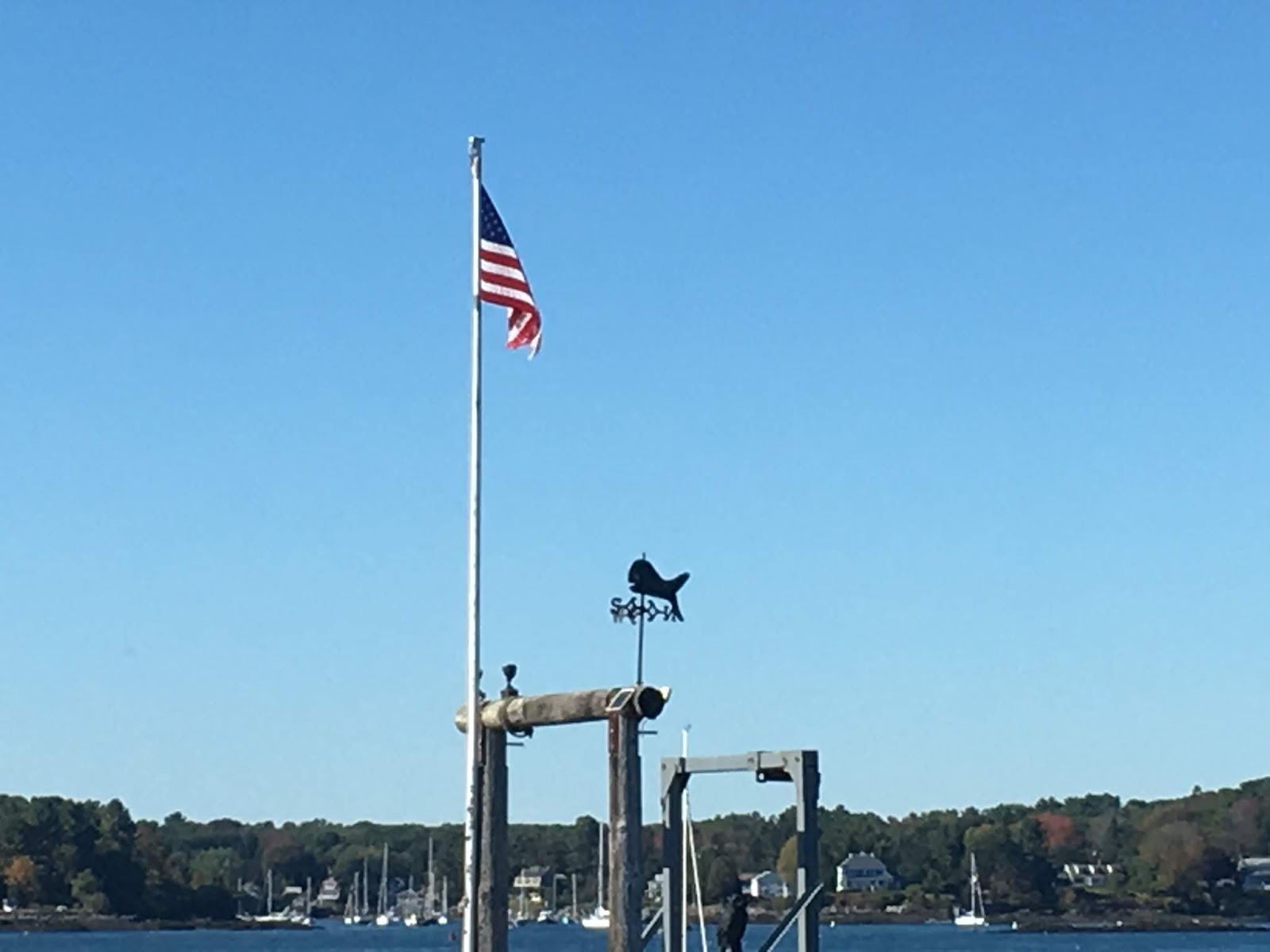
We went to New Hampshire to visit my sister-in-law and brother-in-law. The other thing I'm reading these days is Moby Dick for Brona's readalong, and while Portsmouth, NH, may not quite be the fons et origo of New England whaling, it ain't so far neither. I hadn't paid any attention to it before, but we were greeted by a whale welcome mat, and that wasn't the only opportunity for a #mobydickinthewild picture:


Hope all's well with you!


Thanks to DebNance at Readersbuzz for hosting the Sunday Salon.

Thursday, November 29, 2018

Margaret Atwood's The Handmaid's Tale

Well, I don't think I need to say what the world of The Handmaid's Tale looks like. Is there a more famous literary novel by a living author at the moment? Harry Potter is probably still better known than Offred, but not many other characters.

I came to this fresh, or as fresh as is possible these days. This is my first read of the book. I haven't seen the television show or the movie. Or the opera for that matter. (There is one, it seems.) But twenty years ago or so, I did see a play at Toronto's Fringe Festival, and I thought, hey, that's The Handmaid's Tale, even though they weren't advertising as it as such, or even as an adaptation. I wondered if they'd gotten the proper rights. (Well, it was the Fringe Festival, so probably not.)

And the play was closely related to The Handmaid's Tale. I can say that now for sure. But I can't tell you why I knew what was the world of the novel even back then, but I did and I was right.

You don't have to have read Doyle, or seen a movie or a television show, or even a mouse in a deerstalker, to know who Sherlock Holmes is. The Handmaid's Tale is getting up to that level of mythic presence.

That all may explain a bit why, though it's been on the shelves here for a while, I haven't read it, but that was a mistake. I felt I knew the book, but there's still a lot there even if you know about the dystopia.

It's also a well (and interestingly) told story. The prose is impressive. The way information is doled out is very well-handled. There's tension and suspense; this world is terrifying, and bad possibilities could occur with any action. But still Offred has to act, and try, as best she can, to live.

And the politics are a little subtler than I suspected. In the end, though some people benefit, nobody really likes this world they've constructed. Not the Commanders, not the Wives, not the Handmaids, not the Marthas, not the Jezebels or the Econowives. But some of them meant well to begin with. The road to Hell really is paved with good intentions.

Anyway, you probably don't need me to tell you, but read it. Do.

Saturday, August 18, 2018

Ismail Kadare's Broken April

"She looked out of the window and she thought that it would be hard to find a more suitable setting for a vision of the end of the world than these mountains."
Well, Ismail Kadare isn't winning any friends in the Albanian tourist bureau, I can tell you that.

Broken April (1982, English tr. 1990) is the story of a blood feud in northern Albania in the 1930s. The novel begins when Gjorg, goaded on by his father, kills the member of a rival family, Zef, who had killed Gjorg's own brother. It's the middle of March when the reluctant Gjorg succeeds in his revenge, and blood feuds have such elaborate rules that he knows he's safe for thirty days, but then his April is likely to be broken by his own death. This feud has gone on for seventy years with forty-four graves, half in the Berisha family and half in the Kryeqyqe family.

There was a pronunciation guide, but I still won't even try to pronounce the name Kryeqyqe... When I was a stamp-collecting child there was an Albanian couple living in the apartment below me; they were an important factor in my stamp-collecting prowess. They had (wisely?) changed their name to Harris when they emigrated to Chicago.

According to the Kanun, the ancient law governing the remote highlands of Albania,  Gjorg must travel to the castle to pay the fee for a successful blood feud killing. He is in some doubt whether he'll be able to reach the castle within the prescribed time limit for paying his fee, whether he'll even be able to find the castle. Aha, I said, Kafka! and I see from Wikipedia, I'm not the first to think that: the novel has that sort of grim humor. But Gjorg does reach the castle, and the novel does reach its end. It also presents other perspectives: after following Gjorg for a while, the novel shifts to a sophisticated couple from the capitol, intent on seeing the real folk Albania. Its her perspective on the scene I quote above. Then it shifts again to the steward of the castle, who specializes in all administrative matters related to blood feuds, before returning again to Gjorg at the end.

The novel satirizes the economics involved in paying blood feud fees; it also satirizes, less savagely, the romantic impulse that drives the urban couple to undertake what we might call poverty tourism. Kadare was still living in Albania, and the brutally repressive Enver Hoxha was still the leader of the country, so maybe he thought some of that was necessary. My edition has no introduction or notes beyond that pronunciation guide, so I don't know, but it may be that those things didn't help or only helped so far as they kept him alive. I believe a lot of Kadare's fiction was first published in French and didn't appear in Albania until after the fall of the Communist regime.

My edition also doesn't name the translator, which I find very bad form.

This is the second novel I've read by Kadare, one of those authors who get talked about for the Nobel Prize, should they ever award it again. The other was The File on H. I found them both good, but I liked The File on H better. Kadare sees Albania as a place where classical mythology lives on, which is bound to appeal to me as an ex-classicist. This one, with family blood feuds, alludes to Aeschylus and the Oresteia; the H of The File on H is Homer, who may or may not still exist in Albania.

European Reading Challenge. Albania.

Thursday, May 27, 2010

Susan Sontag

I've been reading the first volume of Sontag's journals. From her entry for 1/15/57. To become erudite in 1) Life and philosophy of Abelard 2) Marine biology, esp. jellyfish 3) Baron Bunsen 4) Philosophy of Spinoza 5) Book of Job I find I've become very fond of the young Sontag. This is both funny and admirable.