Showing posts with label NonFic2021. Show all posts

Monday, November 15, 2021

Edmund Wilson's The Scrolls From the Dead Sea (#NovNov)

"At some point rather early in the spring of 1947, a Bedouin boy called Muhammed the Wolf was minding some goats near a cliff on the western shore of the Dead Sea. Climbing up after one that had strayed, he noticed a cave that he had not seen before, and he idly threw a stone into it. There was an unfamiliar sound of breakage...he later came back with another boy, and together they explored the cave...[He] found long manuscripts, inscribed in parallel columns on thin sheets that had been sewn together. Though these manuscripts had faded and crumbled in places, they were in general remarkably clear."

That's the opening of Edmund Wilson's The Scrolls from the Dead Sea.

Those scrolls Muhammed the Wolf discovered were the first of the Dead Sea scrolls, ancient documents that would upend the understanding of the gospels, of Christianity and Judaism both. Though not everyone agreed at first, or even for a long while--likely there are some doubters even now--they were written in the first two centuries preceding the Christian era. 

Muhammed the Wolf and his fellow Bedouins were not scholars but they had the sense that they had gotten hold of something that might be of interest. Or at least, of value, and they let it be known they had scrolls for sale. Eventually Mor Samuel, the Metropolitan of the Syriac Orthodox church in Jerusalem purchased the scrolls then available on the market. Even he didn't entirely know what he'd just bought, but he knew they were written in Hebrew, a language he didn't know.

1947 was an 'interesting' time in the old Palestine mandate. The Brits were about to give up and run away, and Jews and Muslims were jockeying--frequently violently--for a better position in what would be the new order. (I am making a great effort to not come down on one side or the other here. 😉) Bedouin goatherders who were accustomed to roaming according to the needs of their goats were now subject to borders and armed checkpoints. 

It took a while for the manuscripts to make their way to appropriate scholars and not all of them ended up with Mor Samuel. It was a dramatic and important story and in 1954, Edmund Wilson persuaded the New Yorker to send him to Israel to report on it. He filed a series of articles for the New Yorker starting in May, and later that year a book, composed out of those articles, came out.

He discusses the discovery of the scrolls, the people involved in the discovery, the Essene order (a Jewish monastic order from the time around Christ who were responsible for the preservation of the scrolls), and historical figures, such as the Teacher of Righteousness. Ernest Renan, the 19th century French author of Vie de Jésus appears.  Wilson also went to visit the caves at Qumran and writes about his visit.

Edmund Wilson was not a scholar, but he was a literary journalist of a very high order and at this point in his career he'd acquired a little Hebrew. In the 30s he'd been a Marxist, and after he turned against communism, he decided that one of the things Marxism had done for him was to supply a religious feeling he'd been lacking. He didn't ever become a believer, but he was interested in the things believers were interested in, and in any case, the Dead Sea Scrolls were big news. 

There are probably better introductions to the subject now and discoveries have been made since--even Edmund Wilson wrote a second edition later, but I was only able to get hold of the first--but this is still a pretty good read, in the way of the New Yorker. And it's a non-fiction book of 121 pages, so it's particularly seasonal...


Sunday, October 24, 2021

I Am Alive and You Are Dead: A Journey Into the Mind of Philip K. Dick

"The book you hold in your hands is a very peculiar book. In it I have tried to depict the life of Philip K. Dick from the inside, in other words, with the same freedom and empathy--indeed with the same truth--with which he depicted his own characters."

Emmanuel Carrère's 'biography' of Philip K. Dick came out in French in 1993, thus nine years after Dick's death, and was translated into English by Timothy Bent in 2004. 

Inside the head of Philip K. Dick is a fascinating, but pretty unstable place to be.

It's not a very conventional biography, even though Carrère seems to have done a lot of the work of conventional biography--interviewing friends and lovers, visiting locations, reading letters, reading earlier biographers, and above all, reading the work of Dick himself. But Carrère doesn't footnote or cite, and except for the occasional moment where he mentions talking with one of Dick's friends, it's unclear where he has gotten information. Worse (or different) he's clearly deducing ideas--and says as much--about Dick's life and mental state from the novels. A terrible no-no, of course, but so what? It works.

The facts are there: Philip K. Dick was born in Chicago in December of 1928. He had a twin sister who died young--of hunger. It was the Depression, but the boy survives and the girl dies. It's no wonder Dick was tormented by this his whole life. The family moves to California when he's still a child, but his parents divorce and he's raised by his mother. He goes to Berkeley High School, and then to Cal-Berkeley for a year, but drops out. He works in a record store on Telegraph Avenue. He meets Anthony Boucher and starts writing science fiction stories. He marries--and marries--and marries: five times in all. 

Dick had a reputation as a druggy, which was both true and not: he took LSD once, in 1964, was terrified by it and never did it again. He smoked marijuana occasionally, but mostly socially, and not, it seems that much. But he did both Benzedrine and Valium--prescription drugs--to stimulate his writing, and wind down afterwards. A lot. But then so did W. H. Auden.

He was difficult to live with: needy and clinging, but also a know-it-all. (Well, he really did know a lot.) Bad in social situations, but with deep friendships at times. Pretty seriously agoraphobic. He wrote to (barely) pay his bills, too much and too fast, but still some of the books are pretty great. He may have had some religious experiences, or it may have been the drugs. He never said for sure, and may not have fully decided himself. The drugs (probably) did for him in the end. He died in 1984, after a series of strokes, at the age of 53.

But Carrère's handling of the facts, while seemingly fine, is not what makes the book so interesting.
"One day, a new young woman rode into his life, on the back of a Harley-Davidson driven by a guy covered in tattoos. 'Donna,' like almost everyone else who appears in this chapter, has been extrapolated from a character in A Scanner Darkly...The real Donna had another name--as did others I write of here--which she has asked not to be used in print."
"Another time, Phil became convinced that Donna was a narc. He confronted her. She replied that she understood why he would think that. In their world it was the kind of thing that was entirely possible."
"Another time, sitting down to drink a cup of coffee that someone had made for him, Phil couldn't let go of the idea of how easily it could have been laced with a potent strain of acid that would set an unstoppable film rolling in his head, a film that would last his entire life."
"Another time, Phil convinced himself that the house was under twenty-four hour surveillance. He knew the phone was tapped, and even if it wasn't, basic prudence dictated that one act as though it were."
These cuts are from one chapter and is very much the world of A Scanner Darkly. Is it fair to mix the life with the works? Maybe not entirely and maybe you would want--or want also--a different sort of biography. But this was fascinating, and it is a very phildickian thing to do.

Could you read the book if you didn't already know Philip Dick pretty well? I'm not so sure about that. As a general rule I only read author biographies for authors I've read a substantial amount of the work. That might be an especially good rule here, I suspect.

The books Carrère looks at in depth:

  • Eye in the Sky
  • Time Out Of Joint
  • The Man in the High Castle
  • Martian Time-Slip
  • Now Wait For Last Year
  • The Three Stigmata of Palmer Eldritch
  • Do Androids Dream of Electric Sheep? 
  • Ubik
  • Flow My Tears, The Policeman Said
  • A Scanner Darkly
  • Valis
  • The Transmigration Of Timothy Archer
  • The Exegesis

Of the novels in the list I've read all but Time Out of Joint, and now I want to read that one. It's a good list, and if one wanted to read that many, I might say just go with that. I haven't read the Exegesis, Dick's millions-of-words meditation on the nature of divine experience, nor am I likely to, but I have the volume of selections, and it sits next to Leopardi's Zibaldone, that shelf of things I dip into once in a while when the mood strikes.

I don't know where I first heard of the book. I got hold of it after I read Deus Irae recently, but the library didn't deliver it fast enough for me to use in writing that post. It wouldn't have mattered. Carrère mentions Deus Irae, but in passing and only slightingly, which is probably about all it deserves.

But Carrère is pretty celebrated these days. There's biographies, novels, memoirs. A few days ago it was announced he won this year's Princess of Asturias award for literature. He's been on the list for the Neustadt prize a couple of times. These things are often considered signposts for a trip to Stockholm. Could the biographer of Philip Dick actually win the Nobel prize?

Who knows? Anyway, it was the first Carrère I've read. It was pretty good. It won't be the last.

Are you a fan of Philip Dick? Or Emmanuel Carrère?


Sunday, August 15, 2021

Of the Time of Nero (#ccspin)


Here we have Hubert arbiting some elegances 

My spin book this time was Henryk Sienkiewicz' Quo Vadis, which set off a mini-reading project.

Petronius' The Satyricon

I knew Caius Petronius was a major character in Quo Vadis, and I thought I'd reread The Satyricon in advance. It's mostly accepted (though not universally) that Petronius, author of The Satyricon, is that Caius Petronius mentioned as the Elegantiae Arbiter of Nero's court in Tacitus. (Though maybe not: it's a common enough family name in Rome.)

What we have of The Satyricon is pretty fragmentary; parts, we're told, of Books XV and XVI, amounting to 164 pages in William Arrowsmith's translation. Even the exact meaning of the title is uncertain. For a Roman (as also a bit for us) it probably suggests several things: Satyrs (and thus lechery), satire, but also satura, a Roman word meaning heap or medley. The longest continuous surviving stretch is the dinner at Trimalchio's, who is a freedman working for the Imperial court, with lots of money and little taste and maudlin when drunk. It's amusing to see the sort of thing a rich Roman would have been eating at the time. It makes turducken look like an exercise in restraint.

It's not possible to say much with certainty about the work. If the note attached to the late medieval manuscript is correct about books XV and XVI,  it would be a very long work, even if there were only 16 books--and 24 would be a significant number for an ancient author.  Encolpius--the (loosely speaking) hero--of the book cons his way through life, cadging free dinners where he can, and sleeping (or trying to) with anything that moves. He hangs out with grammarians, professors of rhetoric, poets, so he seems to be an educated man, but there's something criminal in his background. Also he's managed to offend the god Priapus, with an unwelcome effect on his, umm, priapic appendage, and is on a quest to get back in good with the god, and go on sleeping around. (Probably. The book is fragmentary.) It is a severe judgment of its society. I find it funny in places, but your mileage may vary: some of the jokes are pretty insider-y Roman.

I took an undergraduate class on Petronius. We read a good chunk of the book in Latin, and as well as all of it in Arrowsmith's translation. I must have read the introduction--which is quite good--but I was amused now with how engaged Arrowsmith was with Lolita. (His translation comes out in 1959.) He calls Lolita a failure--twice. I'm sure I hadn't read Lolita at the time. It's not a comparison that would have occurred to me though. The sexual abuse of children is the meeting point, I suppose, but they're not really very much alike. Rather The Satyricon's embedded poetry, commentary thereon, and comically epic plot is more Pale Fire than Lolita. (Though The Satyricon is not either of them, of course.)

Tacitus' Annals

I enjoyed The Satyricon, but in the end I don't think rereading it brought much to Quo Vadis. Sienkiewicz accepts the attribution to Caius Petronius, but it doesn't otherwise feel like it impacts. Much more useful were the Annals, Tacitus' history of Rome from the death of Augustus to the death of Nero. (A.D. 14 - A.D. 68). Moses Hadas, in his introduction, notes that "Sienkiewicz' Quo Vadis... [has] long sections which are but adaptations of Tacitus." True that, Moze.

I thought one of the best things in Quo Vadis was the portrait of Petronius. Sienkiewicz is certainly taking off from Tacitus:

"His [Petronius'] days he passed in sleep, his nights in business and pleasures of life. Indolence had raised him to fame, as energy raises others, and he was reckoned not a debauchee and spendthrift, like most who squander their substance, but a man of refined luxury. And indeed his talk and his doings, the freer they were and the more show of carelessness they exhibited, were the better liked, for their look of natural simplicity...Then falling back into vice or affecting vice, he was chosen by Nero to be on of his few intimate associates, as a critic in matters of taste, while the emperor thought nothing charming or elegant in luxury unless Petronius had expressed to him his approval of it." [Annals 16.18, tr. Church and Broadribb]

Also, the great fire of Rome during Nero's reign. (July, A.D. 64) Tacitus would have been somewhere around six years old at time, but he doesn't use his own memories of the event (assuming he had some); instead he draws on earlier histories. It's a vivid moment in the book. Tacitus doubts Nero was responsible for the fire, but notes the rumors of Nero's guilt spring up almost immediately. The persecution of the Christians after the fire--Tacitus is our earliest source for this--he attributes to Nero's need to find a scapegoat to stifle those rumors.

The other thing that struck me (though irrelevant to Quo Vadis) was how important Armenia was in Roman thinking at the time. It was an ally, practically a client state, stuck on Rome's eastern border, wedged between Rome and the Arsacid-ruled empire of Parthia (corresponding roughly to modern Iran) who were a major rival to Rome at the time. Quite a lot of energy is devoted to keeping a friendly king in Armenia.

Tacitus is a famously difficult author in Latin. The (small) amount of his Latin I read in grad school impressed me; his tricky sentences frequently end with a sharp ironic sting in their tail. He reminded me of George Eliot, though of course the lines of influence run the other way, and I'm quite sure George Eliot knew her Tacitus perfectly well. The Church and Broadribb translation is fine, but it doesn't capture what I remember of the magic of Tacitus' prose.

Henryk Sienkiewicz' Quo Vadis

And on to the main event...

The handsome soldier Marcus Vinicius meets Callina (also called Lygia) and his knees tremble such as they never did in battle; the beautiful Lygia blushes bright pink and scampers off without a word out of Marcus' presence. "Ah, ha!" says the trained literary mind. "What we have here is Romantic Comedy!"

In romantic comedy the Question is what keeps our lovers apart and what it takes to get them together again in the end. Well, in Nero's Rome, there are plenty of things to keep them apart, maybe, just possibly, too many...

Not least is the fact that Lygia is a secret Christian. Years before she had been handed over to the Romans as a hostage and guarantee of a treaty between the Lygii and the Iazyges. The Romans were a neutral party in that conflict. But Lygia's father dies in battle and her mother dies as well, so Lygia, though an official state hostage, is more or less forgotten, raised by a nice Roman couple of the senatorial class.

Lygia is dark-haired with blue eyes and is so good-looking everyone is worried when she's in a room with Nero for a couple of hours he will fall into uncontrollable lust. Ah, but Petronius has a plan for that. (I suspected, and later verified, that the Lygii inhabited what is now Poland. A little Polish boosterism on the part of our author.) What Petronius didn't take into account was that the equally good-looking Marcus would attract the eye of Poppaea, the empress. Complications ensue.

This lightness doesn't last, though. (Well, the subtitle does say it's a narrative of the time of Nero.) The great fire and the persecution of the Christians are yet to come. For the purposes of the novel Sienkiewicz always assumes of the worst of Nero. Every time when Tacitus says some historians say this and some say that, Sienkiewicz always chooses the darker that, even when Tacitus says the milder this is likely true. For instance, the fire is started at the instigation of Nero, and, according to Sienkiewicz, he really does fiddle (or at least play a lyre) while Rome burns.

If it's not already clear, I preferred the earlier, lighter part of the novel. There were even some of those insider-y Roman jokes. When Petronius says of something it involves more fish than even Apicius ate in his life, I laughed. But it helps to know Apicius was the author of a cookbook. Petronius also snarks about Lucan's skill as a poet.

Later I felt it descended a bit into religious tract. The Christians (which include Peter and Paul) are all annoyingly noble, with the partial exception of Crispus, a fire and brimstone type who gets the occasional reprimand. Saint Paul asks Petronius (and we're reminded of it a second time), "If Caesar [Nero] were a Christian, would ye not all feel safer?" I'm afraid I wouldn't, and, alas, I don't think the question was meant ironically. The torture scenes began to feel a little voyeuristic. I was also a bit alarmed by Sienkiewicz' handling of Poppaea's purported Judaism. Josephus, the Jewish historian, is the source for this, and he meant it as a compliment. It doesn't come across that way in the novel.

Still, the later part has more portraits of well-known people and more big events. Not just Peter and Paul and Petronius. Nero and Poppaea do make good villains, even if their villainy is a bit played up. Seneca and Lucan have small roles. The danger and drama do pick up.

And as for our lovers? Well, you'll just have to read it and see... (if you haven't already.)

Antonine Propaganda

There's an exhibit on currently about Nero at the British Museum. I won't get to see it, but I did read the recent New Yorker article... It reminds us it's the winners who get to write the history. Tacitus, the most balanced of the surviving historians covering the period still clearly hates the Julio-Claudian emperors (that sequence of emperors who were descended somehow from Julius Caesar. Nero was the last.) Suetonius makes no pretence of balance. Both Tacitus and Suetonius flourished under the Flavian and then even more under the Antonine emperors, dynasties that were happy to have the previous guys slandered. It's just possible Nero wasn't quite *so* bad. Augustus had Maecenas, his PR guy, and consequently got pretty good press. The rest of the Julio-Claudians not so much. It doesn't necessarily matter for a novel, but it's worth keeping in mind.

Bit of a rainy week at the Internet-Free Zone so lots of reading. But there was a moment of sun when we caught this guy catching some rays...


Thursday, June 17, 2021

Hearing Homer's Song

"In 1934 and 1935, [Milman] Parry spent fifteen months in Yugoslavia, driving his black Ford sedan from town to town with his young assistant Albert Lord. They stopped at village coffeehouses, spread word they were looking for local singers, recorded the songs they sang while strumming their rude, raspy one-string gusles."

That field work upended Homeric studies and indeed the study of pretty much all traditional epic poetry: The Song of Roland, The Nibelungenlied, Beowulf, etc. I'd earlier read Robert Kanigel's biography of the Indian mathematician Ramanujan, The Man Who Knew Infinity, and quite enjoyed it, and when I saw his new biography was of Milman Parry, I knew I would want to read it. 

Parry was born in 1902 to a not especially successful druggist in Oakland, California, the youngest of five children. He did well in his Oakland high school, and went to the University of California, Berkeley, just a couple of miles up the street from where he grew up, where he majored in Classics, but also studied under Alfred Kroeber, the important Native American cultural anthropologist. (And father of Ursula Kroeber Le Guin.) 

From there he went on to get his doctorate at the Sorbonne, but as a Berkeley undergraduate he'd impregnated his girlfriend, Marian Thanhauser, also a student. The two married, and the young family went off to Paris and three years later he was Dr. Parry. He taught a year in Des Moines, Iowa, but then got an appointment at Harvard, taught there, and cadged up enough grant money to spend a total of eighteen months, over two trips, with a team that included Albert Lord and Nikola Vujnović, recording traditional singers in the kingdom of Yugoslavia.

And in 1935, he died, from a bullet to the heart, in a Los Angeles hotel.

There's your basic facts. Why do we care? I cared because of that upending of Classical scholarship, and Kanigel is pretty good on its importance and the history of how it came about. Parry started his investigation with the use of epithets in Homer--rosy-fingered dawn, fleet-footed Achilles, Poseidon the earth-shaker--and what that might tell us about the methods of composition. At Parry's thesis defense, one of the outside readers, a professor of Slavic literature, told him he should go listen to traditional singers in Yugoslavia and so he did, recording hundreds of hours of traditional song, until he was able to demonstrate that a Homer could compose a poem of many thousands of lines, using the technique of oral composition, on the spot, as it were. (As long as you think of that spot as a week or two's worth of recitation.) 

The standard exposition of the Parry-Lord thesis (as it's called in the Classics biz) is Albert Lord's The Singer of Tales, which is readable by a general reader. Well, pretty readable. That is, just now glancing over my copy, if you don't mind texts in Greek, both archaic and Byzantine, and Serbo-Croatian. And charts. And musical notation. And footnotes. And appendices in small print. And uh, oh well, Kanigel does actually do a nice job, possibly as good a job as can be done, explaining the Parry-Lord thesis if you're going to eschew all that. (But if you do want to read Lord, it seems you can read the 3rd edition, Harvard University Press, on-line for free. It really is quite good, and important, too.)  

The other reason, though, we're supposed to care is that rather noir-ish bullet to the heart. Was it accident (as the police determined) or was it suicide? Or was it murder! Mrs. Parry was the only other person in the hotel room at the time. There's no evidence any longer as to the death. Kanigel spends a lot of time speculating about the state of the Parry marriage; there's not a lot of evidence about that either. Was Marian Parry bored and unhappy as the wife of an impoverished grad student stuck with a child in a Paris suburb? As the neglected, frequently slighted, faculty wife in Harvard? (She was Jewish, though not practicing, and Harvard was rife with anti-Semitism in the early 30s.) Or later, raising two kids, isolated in Dubrovnik, while her husband was off on week-long collecting jaunts in that Ford through the Yugoslavian countryside? I have no doubt she was unhappy. Was she murderously unhappy? Enh. We'll never know.

There's a certain sort of book these days--I think of Erik Larson's Devil in the White City as the ur-example--that thinks the best way to palliate some quite fascinating intellectual history is to throw in a murder, or three thousand. These books clearly sell, and most readers probably do enjoy the true crime part. But as for me, I wanted more about the Burnham plan for Chicago in Larson and less about the psychopath, and here I wanted more about guslars and recording equipment and, even, more about the hephthemimeral caesura, and less idle speculation about things unknowable. Sure I read about plenty of murders, but I prefer them decorous, not too bloody, with six well-differentiated suspects, preferably isolated in a country house, with a clear resolution by the end of the book. True crime? Bleah. But I suspect I'm in the minority.

Anyway, I liked the book, but I wanted more of some things and less of others...

Hubert groovin' to some tunes


That's Avdo Međedović with a gusle on the cover of The Singer of Tales. We meet him in Kanigel's book; he'd been a butcher and a soldier and in 1935 was a farmer in the Montenegrin village of Bijelo Polje; he'd been shot in his soldiering days and was unable to raise his right arm above his shoulder; and he's the climax of that part of the book I was most interested in: he recites, composes really, at the rate of four hours a day for over a week, the thirteen-thousand-line epic Osmanbey and Pavičević, published subsequently in a translation by Albert Lord, roughly the length of the Odyssey, and thus was the key to demonstrating what Milman Parry went to Yugoslavia to demonstrate. 

And is my visit to Montenegro for 2021... 😉


Monday, May 31, 2021

Travels With A Donkey in the Cévennes (#CCSpin)

 "I travel not to go anywhere, but to go."

These days: if only!

R. L. Stevenson's Travels with a Donkey in the Cévennes is about a twelve-day trip he took through the mountains of southern France in September and October of 1878. 

That's already late in the year for the mountains, and Stevenson is told to expect cold weather, if not wolves and bandits. He takes a revolver. He designs a sleeping bag that will double as a sack to carry what he needs. And he acquires a donkey, Modestine, "a diminutive she-ass, not much bigger than a dog, the color of a mouse, with a kindly eye and a determined under-jaw."

The book is early in Stevenson's career, but not his first; he had previously written a book of travels The Inland Voyage and he identifies himself as a writer to people he meets. But he's more generally assumed to be a pedlar, though maybe of the higher sort: at one point he's taken for a dealer in brandy.

"In a little place called Le Monastier, in a pleasant highland valley fifteen miles from Le Puy, I spent about a month of fine days. Monastier is notable for the making of lace, for drunkenness, for freedom of language, and for unparalleled political dissension." The four factions of French politics in the 1800s are Bourbonists, Orleanists, partisans of the Napoleons, and Republicans. Le Monastier had them all. This is the start of his trip, where he commissions the sleeping bag of his own design and purchases Modestine. "At length she passed into my service for sixty-five francs and a glass of brandy."

Stevenson is raised a Scots Presbyterian of a moderately severe stripe, but has by this time lost his faith. He's discreet but honest about this loss with the people he meets and even with us readers in the text, but clear enough. Still religion interests him. Though he camps out as needed, he doesn't every night. One of his stops (the 26th of September) is the Trappist monastery Lady of the Snows: "I have rarely approached anything with more unaffected terror than the monastery of our Lady of the Snows. This it is to have a Protestant education." Nevertheless he quickly makes friends. "I was troubled besides in my mind as to etiquette. Durst I address a person who was under a vow of silence? Clearly not. But drawing near, I doffed my cap to him with a faraway superstitious reverence. He nodded back, and cheerfully addressed me. Was I going to the monastery?" An Irish deacon living at the monastery is thrilled to be delegated as Stevenson's guide: he's released from his vow of silence to play host and had had no occasion to speak English. (Though it would seem Stevenson's French is quite good.) 

But a couple of retreatants at the monastery try to convert him until he's finally forced to say they're being impolite, a little too pushy, when they immediately back off. 

Stevenson has done some reading in preparation for traveling the area. There's a legendary wolf of the area whose stories he's learned; of even more interest to him, the second half of his journey is in an area that's quite Protestant, and he's studied up on the history. The Camisards were French Huguenots whom Louis the XIVth tried to suppress in the early 1700s, and who took up armed rebellion with some success. Stevenson is full of their stories. (One of them involved a group of Protestants all stabbing a murderous Catholic Inquisitor, such that no one of them was responsible for the death, which reminded me of a certain Agatha Christie novel.) 

Phylloxera is destroying the grapevines of southern France at this time:
    "I could not at first make out what they were after, and asked one of the fellows to explain.
    'Making cider,' he said. 'Oui, c'est comme ça. Comme dans le nord!'"
The book has considerable charm; he's mildly ironic but forgiving about the people he meets. (Except for one man in Fouzilhac, who won't even give him directions; but that's OK, because these bad manners appal the people he meets in Fouzilhic. These would appear to be actual village names, now spelled slightly differently.) He's mildly ironic but forgiving as well about himself, about his inability to manage a donkey, or to load Modestine with the sleeping sack he commissioned.

I should say, I suppose, that while he's not cruel to Modestine by the standards of the time, he's certainly not enlightened by ours. In the end he sells her for thirty-five francs: "The pecuniary gain is not obvious, but I had bought freedom into the bargain." And even though he remembers her liking to eat out of his hand, Modestine's fate is no further to be thought of.
"The journey which this little book is to describe was very agreeable and fortunate for me. After an uncouth beginning, I had the best of luck to the end. But we are all travellers in what John Bunyan calls the wilderness of the world,--all, too, travellers with a donkey;..."
A French hiking club now maintains the route for walkers. 

The book is also available from Gutenberg.

Wednesday, May 19, 2021

Alex Ross' Wagnerism

 "The philosopher is not free to dispense with Wagner."

-Friedrich Nietzsche, The Case of Wagner 

Wagnerism is the history of the reception of Richard Wagner and his music, and of the uses made of Wagner's music after his death. And, well, some of those uses weren't very nice. 

When the book was good, I thought it was very good, but it wasn't at all times. It's more encyclopedic than analytic, at times even gossipy. Did you know that Virginia Woolf went to a benefit costume ball as a Valkyrie in 1909? Me neither. Not sure that tells me much about Woolf, though it might say something about how ubiquitous Wagner was.

Years ago I read Ross' The Rest Is Noise, his history of twentieth century classical music, around when it came out in paperback. I really liked it, even though most of it went over my head. (And I'm pretty tall.) I don't know that much about serious music. A diminished seventh, you say--is that music, baseball, or planetary science? I wouldn't know one if it bit me on the ear. Still, sometimes I like a book that's too hard for me, it leaves me wanting to know more.

Because Wagnerism addresses Wagner's presence in literature and film--and politics--more than in music, this book worked differently for me. 

Ross' organization is a mix of chronological and by topic. The first figure Ross covers is Nietzsche, an early Wagner disciple, at least until he wasn't, and the most prominent. Ross gives himself 60 or so pages on Nietzsche, and is lucid and helpful. Nietzsche and Wagner is a topic on which books could be written--and have, with more than one of them by Nietzsche himself. Subsequent chapters are on French Wagnerians (Baudelaire was an early booster), British, American, Austrian, Russian, black (W.E.B. DuBois was a fan), gay, Jewish, feminist. Right-wing, but also left-wing. Well, everyone actually was listening to Wagner for a while.

When Ross gives himself space he's at his best. This includes his writing about Nietzsche and Baudelaire. There was interesting stuff on Joyce. Wagner is important to Thomas Mann, (less so to Heinrich) and Thomas Mann's attitude toward Wagner changes over the years. I was particularly interested in Ross' take on Mann's Joseph saga, which he reads as a direct challenge to Wagner's Ring Cycle: both tetralogies, both investigations of myth, but Mann dealt with Old Testament--that is, Jewish--subjects, which Wagner himself wouldn't touch. There was some good stuff there.

On the other hand Ross speculates that Wagner is behind Adrian Leverkühn, the hero of Mann's Doctor Faustus. But how can that be when *everyone* knows that Leverkühn is Nietzsche + Schönberg? 😉  There needed to be either more or less to that argument.

Ross is at his tip-top best on Willa Cather. He devotes an entire chapter to her, largely on The Song of the Lark, and she shows up in some of those other categories listed above as well. Very well worth reading if you care about Cather.

Wagner in World War II is the emotional heart of the book. Ross is at some pains to remind us that lots of people who did not like Naziism, were never going to like it, still liked Wagner. 

Wagner's politics were complicated and probably not well-thought-out. He got himself in serious trouble supporting the anti-monarchical revolutions of 1848 and it took him years to get out of that trouble. He was pretty seriously pacifist. He meant his anti-Semitism though, publishing a vile article first anonymously, and later doubling down by re-publishing it under his own name. One of the main reasons Nietzsche, not exactly known for his compassion, broke with Wagner was his abhorrence of Wagner's anti-Semitism.

Hitler's Wagner--and Hitler really did love Wagner--was not all of Wagner. But how big a chunk of the total Wagner was Hitler's Wagner? The jury's still out on that, even I would say, in Ross' mind.

There was trivia and some of the trivia was fun. I did not know that Laughing Cow cheese (La Vache Qui Rit) is actually a pun on the Valkyries of Wagner; some Frenchman in World War I making fun of the German propensity for Wagnerian code names. (The Siegfried Line, anyone?) Thomas Mann and Willa Cather played records and drank champagne at the Knopf's in 1943. What's Opera, Doc? makes an appearance, as well as other cartoons of the era. Though, for that matter, I read Broom Hilda at GoComics this morning; and Now I'm Very Angry Broom Hilda did not get a mention...are the cartoonist Russell Myers' backdrops influenced by Wagnerian set design? Think of those remote, fantastical geological outposts. (Though, of course, they have more to do with the Coconino County backdrops of Herriman's Krazy Kat.) Some of Ross' arguments/speculations are about on that level...
"Perhaps [George Bernard] Shaw hung back from direct engagement with Wagner because he wished to avoid placing himself in competition with the Meister." [439]
Is this that same Shaw who cheerfully bashed on Shakespeare?
"Cy Twombly listened intermittently to Wagner while working on his ten-painting cycle Fifty Days at Iliam..." [631]
I listen to Wagner intermittently, too, though in my case, the inters are pretty danged mittent. Are my posts therefore Wagnerian? Well, maybe they go on too long...

Ross ends with a brief history of his own listening to Wagner. He was not initially a fan, it seems, but then in his twenties got excited about Wagner. But wondered, should he?

Anyway, good when it was good, and very good when it was very good, as we say in the Department of Tautology. If anything in the subject interests you, it's quite readable and often astute. It didn't blow me away like his first book, though.

It's one of those pan-European books that might do for a lot of countries, but I'll stick to the basics and count it for Germany:


Wednesday, May 5, 2021

Letters written in Sweden, Norway, and Denmark

 "...I adhere to my determination of giving you my observations, as I travel through new scenes, whilst warmed with the impression they have made on me."

In the summer of 1795, Mary Wollstonecraft sailed from Hull, England for Scandinavia, making her first stop Gothenberg (Göteberg) in Sweden. 

By 1795 Wollstonecraft is an established author, with several important and popular books in her past, including Vindication of the Rights of Men (a response to Burke's attack on the French Revolution) and Vindication of the Rights of Women.

She travels with her older daughter, Fanny, and a French nurse. She mentions she has business reasons, though the text doesn't offer details. But it's also clear that it's an opportunity for a new book and while the 'you' of the letters, the 'you' of the quote above, is an actual person, it is also you, the reader.

But the original you is Gilbert Imlay, Fanny's father, who was capable of claiming to be married to Wollstonecraft without having done so, and had just left her for another woman. He was engaged in some dodgy commerce, likely trading confiscated Bourbon wealth for food, and the ship on which his goods were traveling had gone missing somewhere in Scandinavia. Wollstonecraft volunteers to go look, hoping to win Imlay back.

I liked this even better than Vindication of the Rights of Women. Vindication is, whether we've read it or not, a book we know--it's been that influential. And by and large (though, alas, not entirely) the grounds for debate have moved beyond it. This was more of a surprise. 
"Talk not of bastilles! To be born here, was to be bastilled by nature..." [of Sweden]

"...the Danes are the people who have made the fewest sacrifices to the graces." 

Of the three countries Norway is her clear favorite. Since the Other Reader is a quarter Norwegian, I was pleased to be able to report this. 

But it's not all snark--much as I enjoy a good snark. There's some fine nature writing, which leads her to meditate on our relative need for nature and civilization. 

"...the line of beauty requires some curves..."

She compares government and society in the three countries: at this time Sweden is going through a conservative, anti-Jacobin phase, and its finances are problematic because of a recent war against Russia and Denmark; Denmark is led by a Crown Prince who's an enlightened despot, which is (marginally) better than a plain despot; and Norway, nominally under Danish suzerainty, is suffering benign neglect, and its sturdy yeomanry little troubled by aristocrats. Anyway, that's what she says...

A map of her travels:


I read the book in the Oxford edition shown above, which has some nice additions: an introduction, the map, contemporary reviews, and several of the Wollstonecraft's original letters to Imlay. And notes. Glad to have them, though the description of England as 'impatient at the neutrality of Denmark' struck me as rather an odd phrasing. Not how the Danes thought of English actions when I was there. The book is also available from Gutenberg.

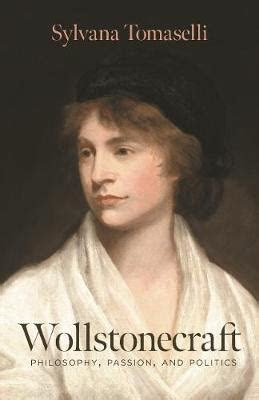
Then I read Sylvana Tomaselli's overview of Wollstonecraft, which came out from Princeton earlier this year. I think I would have preferred a more biographical approach, though this was quite good. Tomaselli organizes Wollstonecraft's thought by subject. Wollstonecraft is an important thinker, and one of the nice things about Letters is watching her think; still, for better or worse, she's a (successfully) practicing journalist, not an academic philosopher, and I'm not sure there's entirely a system there to be found. I'm suspicious of systems anyway. 

But it was fun to discover that Letters was Wollstonecraft's most successful book, rapidly translated into the Scandinavian languages. Coleridge was inspired by the book to plan a trip to Scandinavia, but like a lot of Coleridge's projects, it didn't come off. Likely he got no further than Porlock

The book works for a couple of my challenges this year:


"Adieu! I must trip up the rocks..."

Tuesday, April 20, 2021

March Wrapup

My reading month in March:

Koren Shadmi's Graphical Biographies

The Twilight Man: Rod Serling and the Birth of Television

I saw this reviewed in the New York Review of Books--yes, yes, I'm running behind--and ordered it from the library. I was never particularly a fan of The Twilight Zone--too black and white for me at the age I would have watched the show in reruns--but I liked the graphical style of the clips in the review and the book looked interesting. It was. In fact, really quite good--it got me interested and I might try to see some Twilight Zone episodes. It recapitulates Serling's life story in a narrative frame you might find in a Twilight Zone plot.


Gary Gygax and the Creation of D&D (text by David Kushner)

Looking up Shadmi in my library's catalog, I also came across this. I was a fan of Dungeons and Dragons and so I got this one, too. Though it's Gary Gygax in the title, don't worry: Dave Arneson gets equal time. It was enjoyable, and even though it spoke to me more, I do think it was a less successful work than The Twilight Zone volume. The text is written as if by a dungeon master, or even more, as if it were from that early computer game Colossal Cave/Adventure. (That game's author Will Crowther gets a couple of pages.) "You are in a maze of twisty passages all alike." "You are likely to be eaten by a grue."


The Mystery Department

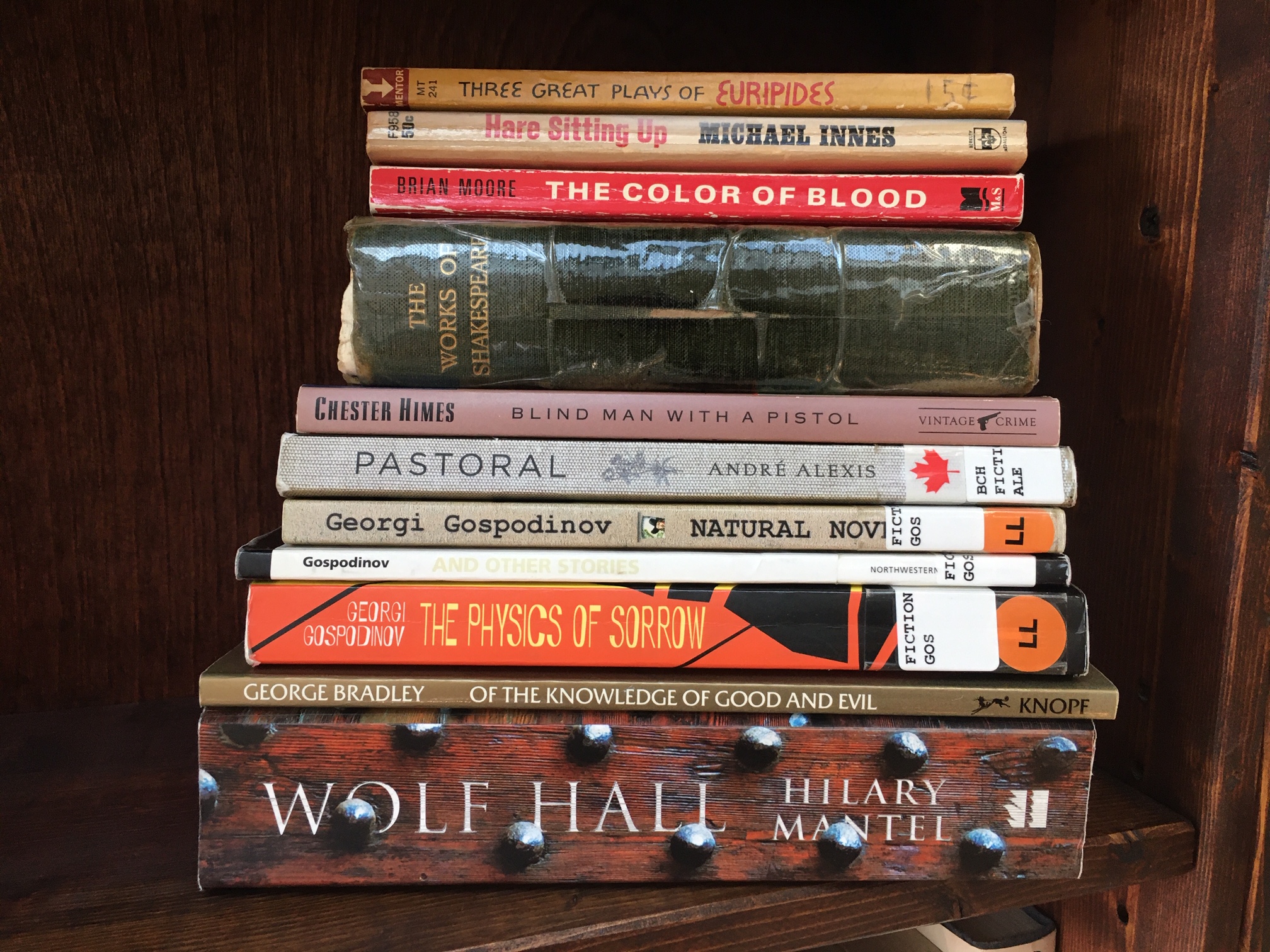
Michael Innes' Hare Sitting Up

An Inspector Appleby story from 1959. Take identical twin brothers, one a schoolmaster, the other a biowarfare scientist, add a rural lord half(?)-crazed with bird-watching, throw in a blackmailer and a pretty girl with a Ph.D., and you've got a story. It's mostly Innes in his silly mode, which I actually prefer, though Innes does want to say one or two serious things about the morality of WMDs. Not his best by any means, but fun.

Julie Campbell's The Gatehouse Mystery

Trixie and Honey find a diamond in the old gate house on the Wheeler property. Are they going to turn it into the proper authorities? Of course not!

This book has the first appearance of Trixie's older brothers, Brian--and Mart, the snarky one with a propensity toward Brobdingnagian vocables. Always my favorite character. I'm sure I don't know why.

The next in the series is waiting at the library for me to pick it up.

Chester Himes' Blind Man With A Pistol

The last of the Coffin Ed Johnson and Grave Digger Jones mysteries Himes completed, from 1969. This is a very ambitious book, bursting the bounds of Himes' already capacious sense of what a mystery can be. All in 191 pages. Several plots; several time frames. Pretty great & at some risk of sending me down a Himes rabbit hole--I've ordered up the recent biography of Himes from the library. But if you're interested in Himes as a mystery writer, you should probably start with something earlier in the series.

"'There ain't going to be any facts,' Grave Digger informed Anderson."

#BrianMooreAt100

Cathy at 746Books has organized a year long read of Brian Moore's books in honor of what would have been his hundredth birthday. 

Brian Moore's The Color of Blood

Political tensions in an unnamed East European country just before the fall of the Iron Curtain. I thought it was very good. More here.

Brian Moore's Fergus

That I enjoyed The Color of Blood so much led me on to read Fergus. Not as good, I said, though still good.

This month's Brian Moore is the great, but grim, The Lonely Passion of Judith Hearne. Will I reread it? Maybe, but I haven't yet.


The Poetry Section

George Bradley's Of the Knowledge of Good and Evil

This collection came out with Knopf in 1991. A living American poet (b. 1953). The first volume of his I've read--though a couple of these poems appeared in The New Republic in the 80s, so it's possible I read those before. I thought it was very good. Expect something to appear in a poem post in the future. Bradley's poem 'The Lives of the Chinese Poets' begins 'About suffering they were reticent,...' O my Auden

Georgi Gospodinov

Natural Novel, And Other Stories, The Physics of Sorrow

Contemporary Bulgarian novelist, poet, story writer. That's most of what of his is available in English. I think he's pretty good. More thoughts here, mostly on The Physics of Sorrow.

Hilary Mantel's Cromwell

Wolf Hall

I reread this for Brona's readalong, but I'm *still* organizing my thoughts on this one. Not very organized thoughts, eh? I should have finished rereading Bring Up The Bodies to be on schedule, but I haven't...

Shakespeare's Henry VIII

That sent me off to this. Not necessarily one of the better plays, but there are some great speeches--Buckingham's (Act II, Sc 1) on his sentence of death:

The law I bear no malice for my death
'T has done upon the premises but justice
But those that sought it I could wish more Christians

or Wolsey's farewell to greatness.

Andre Alexis

Contemporary Canadian writer. He's four books into a series of five he's termed a quincunx. I read the first, Pastoral (2014). I thought it was very good. A newly minted priest takes up a parish in a small town near Sarnia, Ontario. The second one in the series--Fifteen Dogs--is the celebrated one; it won the Giller, one of Canada's two major novel prizes, as well as various other prizes. I might have more to say when I finish the sequence, at least as it stands now. I have the others on hand.

Euripides

Rex Warner (no relation?--though that first name could so easily slip into...) translated three Euripidean plays with strong female characters in the 40s & 50s: Medea, Hippolytus, Helen. I was interested in the Helen, but then I carried on. Medea, Phaedra, & Helen are all women who do bad or tricksy things and suffer at the hands of men. These are quite often read now as feminist or proto-feminist; would an Athenian of the time have thought so? Mmm. Certainly as Aristophanes presents it (Women at the Thesmophoria) Euripides wasn't popular with the ladies...but then, that's Aristophanes.

No longer the standard translations, but I thought they were quite good. I especially liked Warner's handling of the choruses. He's an interesting novelist (The Aerodrome) and poet, but best known now, I'm guessing, as the translator of Thucydides.

The books that were still around the house (at least when I took the picture):

I wrote most of this post a while ago. It was long past time to either delete it or publish it. Yet another month of much, but muddled, reading--I sometimes get embarrassed by the desultoriness of my reading. Oh, well. Any of these strike thoughts in you?


Tuesday, February 9, 2021

Cees Nooteboom's Venice

"...in Venice, too, it is not difficult to lose your way, something to which, if I am not in a hurry, I do not actually object,..." 

Cees Nooteboom's book is not the product of a single visit to Venice, but of a lifetime of visiting: his first visit he tells us was in 1964; the book came out in Dutch in 2019, and was translated into English by Laura Watkinson. He had just been there, it would seem. It's formed of a long series of impressions, engaging, not systematic.

Nooteboom's Venice is a melancholic place, fed by ruminative recollections that circle around literary tropes and return again. What is it about Venice that brings this out? Thomas Mann's Death In Venice, Joseph Brodsky's Watermark, Valeria Luiselli's Sidewalks, Henry James, Ernest Hemingway--all of whom are mentioned by Nooteboom.

It may be that connoisseurs of Venice go in winter when it's dark, grey and cold, but there are fewer tourists. It seems that's Nooteboom's approach (as it was Brodsky's, at least on the evidence of Watermark.)

But the book isn't entirely occupied with the high-falutin'. Nooteboom is much taken with the mystery series set in Venice by Donna Leon and Michael Dibdin; at one point he goes around looking for the police office that would serve as headquarters for Commissari Aurelio Zen and Guido Brunetti. He tells us, "Those who do not believe in books have no business being here."


Commissario Aurelio Zen--I had long assumed it was just a fanciful name, but, as I learned from Nooteboom, it's not. It's a good Venetian family name--there was a doge Renieri Zen, who died in 1268. Zen in standard Italian would be Zeno, as in he with la coscienza in the novel by Svevo, but in Venetian dialect the name Zen is ordinary enough. Who knew? 

It made me want to go to Venice (go back to Venice in fact, though I haven't been there since 1984) and what more can a travel book do? 

Cees Nooteboom (pronunciation) is a Dutch writer (born 1933) of novels, poetry, books of travel. He's sometimes mentioned as a Nobel prize contender. This is the first thing I've read by him, but I will certainly be looking out for others.

The book is accompanied by lovely views of Venice taken by his wife, the photographer Simone Sassen:


And, pretty clearly, I was the first person to read this copy from the library. Nothing quite like the freshness of an unread library book!


Saturday, January 30, 2021

The Autobiography of John Stuart Mill (#ccspin)


John Stuart Mill's Autobiography only appeared after he had passed away, in 1873. It was written in stages; the first and largest part in the 1850s, later parts in a couple of goes in the 1860s. Mill married Harriet Taylor in 1851, and she edited that first portion, but she herself died in 1858, probably of tuberculosis. The later sections reflect on her importance to his life and thinking after her death and also on his brief parliamentary career.

It's the earlier sections, though, on his earlier life, that are the most comprehensive, and the most interesting. His youthful education is the wackiest part. Mill always insisted he was not by nature a genius; that it was only his unusual education that enabled him to achieve anything. That education was definitely unusual. 

His father was James Mill, a fairly important British intellectual in his own right, and the author of an important work on the governance of India, but perhaps more notably, a close friend of David Ricardo, the economist, and of Jeremy Bentham, the inventor of Utilitarianism. Both of those august gentlemen were around the house while young Mill was growing up. 

Mill, Sr., had some definite views on education and did the homeschooling himself.

It's hard to imagine them being implemented now. Should you be in possession of three-year-old whom you're planning to educate, you might find some hints, though more likely you'll find counter-examples you'll want to flee like the wind. Young Mill in the book insists his childhood was happy, though one might wonder. It did involve learning classical Greek from the age of three and Latin from the age of eight. Since Liddell and Scott had not yet written their dictionary, and the only Greek dictionaries that existed were Greek to Latin, when young John wanted to know the meaning of a word in Greek, he had to ask his father. It seems to his father's credit, he had no objection to being interrupted from whatever he might be trying to do to explain the meaning of Άνθρωπος.

It also involved separation from other children his age, because of their potentially corrupting influence. Again Mill says he didn't mind this and enjoyed long walks by himself. (He did have a bunch of younger siblings so there might have been somebody to play with.) It also seems young Mill got to spend a great deal of time with his father.

As for his mother, presumably he had one, but you wouldn't know it from this book. According to another biography I got from the library, by the 1850s, he was somewhat estranged from his mother, and some of his siblings, because of the way they treated Harriet Taylor, who had become his wife by then.

Perhaps unsurprisingly, this upbringing led to a psychological crisis at age twenty. He contemplated suicide: "I frequently asked myself if I could, or if I was bound to go on living, when life must be passed in this manner." You'll be glad to hear he came out of it by reading a book. (Jean-Francois Marmontel's Memoires. I'd never heard of it. Must be powerful stuff.) He rethought--a bit--the idea of happiness he'd received during his Benthamite upbringing.

It may also have helped that he met a girl. Harriet Taylor was a year younger than him and considered a great beauty. (As you can see, Mill himself was not.) Even more importantly, though, was she was his intellectual equal, even, as he says in the autobiography, his superior. The only downside was that she was already married. They began an intimate (but innocent, Mill assures us) friendship and intellectual partnership that lasted until her death in 1858 and was only regularized, as it were, by their marriage in 1851 after Harriet Taylor's first husband died. 

As we get into the period of Mill's own intellectual productions, the autobiography becomes swifter. Mill served one term in parliament. Not all that much is said about it. (He dismisses his maiden speech.) He was a strong supporter of increased home rule for Ireland, and, I was amused to discover, claims some credit for the origins of 'responsible government' (or home rule) in Canada: after the Upper Canada Rebellion, Lord Durham came to Canada to investigate and issued a fairly liberal report that led to the first bits of self-government in Canada. Mill was a strong supporter of Durham.

Mill was also friends with Carlyle which Mill admits was a bit of an odd couple pairing. Mill's maid was the one responsible for burning the first draft of Carlyle's French Revolution.

It's pretty readable. A slightly orotund prose style, but for a philosopher or a political economist, it's downright snappy.

Some quotes:

"It was in the same year, 1819, that he [my father] took me through a complete course of political economy." Mill was then thirteen.

"I am thus one of the very few examples, in this country, of who has not thrown off religious belief, but never had it."

"They [my books] were always written out at least twice over; a first draft of the entire work was completed to the very end of the subject, then the whole begun de novo, but incorporating in the second writing, all sentences and parts of sentences of the old draft, which appeared as suitable to my purpose as anything I could write in lieu of them."

[Summarizing the creed held by Bentham and his father.] "In psychology, the fundamental doctrine was the formation of all human character by circumstances, through the universal Principal of Association, and the consequent unlimited possibility of improving the moral and intellectual condition of mankind by education."

"Aiming thus at something else, they find happiness by the way." 


Monday, January 11, 2021

Zachary Carter's The Price of Peace (On Keynes & Keynesianism)

"Keynesian economics was formulated as a defense against fascism...But Keynesianism was also developed to prevent war, and it remains one of the great tragic ironies of intellectual history that the very catastrophe Keynes had attempted to avert for nearly two decades [in 1939] would be the event that finally demonstrated the viability of his economic ideas on the world stage."[p.309]

This book has gotten a lot of buzz--see Carter's website for a list of the accolades--and I have to say I think they're deserved. But it's better thought of as a biography of Keynesianism than of Keynes. Naturally Keynes himself would be important in such a book. It starts with a short introductory episode where he meets his wife-to-be, in 1922, but it doesn't really go back in time very much. No parents, no birth, no childhood. Not much about his youthful hound-dog homosexuality. A little bit about his Bloomsbury connections, because who doesn't like a bit of Bloomsbury gossip? (Vanessa Bell really didn't like his wife.) But there's not much at all in the book about him before 1914, and Keynes turned 31 that year. 

But you could say that's when his real intellectual life began.

He'd studied math, working on probability theory, at Cambridge, with Bertrand Russell among others. Such a thing as an economics department scarcely existed at that point in any case, but Keynes' background was in analytic philosophy more than anything else. When the First World War started, Keynes ended up in Treasury, where he was critically important to Britain's ability to finance the war. His brilliance and indispensability were recognized, he moved up, and by the time of Versailles, he was a key player. He was in the room when the Big Three--David Lloyd George, Woodrow Wilson, and Georges Clemenceau--were having 'private' discussions. He quickly realized that the terms of the Versailles treaty were likely to be poisonous and he could do nothing about it. So he quit before the terms were finalized.

And wrote The Economic Consequences of the Peace. (Which will be war again, he said. And was right.) This book turned out to be an enormous bestseller and made Keynes quite a lot of money, but its primary intellectual effect in the short term turned out to be as one of the contributing agents to the U.S. rejecting the League of Nations, not Keynes' intent at all. 

In the 1920s Keynes made money. It's like somebody said, if you're so smart, why aren't you rich? Keynes said, good question, and went about fixing that. He worked as a well-paid journalist; his writing can be delightfully witty. He invested and was enormously successful in his investments, leading him to be the financier of Bloomsbury: he funded Hogarth press until Virginia Woolf's books started to sell; he made sure that Duncan Grant had enough money to paint, etc., etc. But these are also the writings in which Keynes is beginning to work out the economics of Keynesianism, and its purposes; to stop fascism and prevent war. Forward thinking in 1925 might have achieved both; it was only later that it was one or the other. Carter struck me as both lucid and astute on Keynes' intellectual development at this point. Keynes' thinking is not the same at all points in time.

Keynes worked for a stint in Ramsay MacDonald's Labour government, but in the end with little effect; he has more intellectual impact on (and becomes friendly with) FDR and the American government, but worries that he's mostly seen as a witty journalist. He holes up Cambridge with some early disciples (Joan Robinson seemed particularly interesting to me from this period) and works out the elements of The General Theory, the main statement of his ideas. That book is still percolating through the intellectual world when the Second World War starts, and Keynes is called back once again to sort Britain's wartime finances. 

He's again crucially important to the war effort, and is a key player at the Bretton Woods conference, but Keynes had already had his first heart attack in the 1930s, and by the end of the war, he's dying, and dies in 1946. 

The book is only 2/3rds of the way through, though. I found its coverage of the next twenty-five years fascinating. Keynesianism won as an intellectual discipline; "we are all Keynesians now" wasn't first said until later, but might have been said as early as 1946. But under the pressure of McCarthyite stooges and loyalty tests, Keynesianism split into left and right factions, with some players moving from one to the other camp. Keynes recognized fiscal stimulus can be achieved by building houses, building highways, or building the machines of war; he had preferences, though, and not for the machines of war. For Carter, John Kenneth Galbraith is the key figure in this period, but also Paul Samuelson, Joan Robinson again, even Milton Friedman. Friedrich Hayek is the one arch-non-Keynesian. 

Another ongoing question is, to what extent is Keynesianism a purely mathematical project? Keynes himself was a brilliant mathematician, but didn't always depend upon it. It's not in Carter's bibliography, probably because it's too introductory, but I suspect this part is a bit under the influence of Heilbroner's Worldly Philosophers.

The book carries through to the recovery from the Great Recession. I found its coverage of the last years the weakest. Carter is a financial journalist, not an academic, and as such, writes well. His most prominent affiliation seems to be Huffington Post, and I assume he's pretty lefty. (Well, I am, too.) But he tends to gloss over those later conservative presidencies and then attacks those of Bill Clinton or Obama from the left. Sigh. A little perspective, please. 

Ah, well. It's very good and pretty fascinating on the whole. It's quite readable; no math required. Because it covers a lot of ground, it's consequently a bit thin in places. But then that's on me: one of these years I'll read Skidelsky. But until then, this was very good.

Saturday, January 9, 2021

Italy books: his and hers

His: Poets In A Landscape

In the mid-50s Gilbert Highet, then a professor in Classics at Columbia, took a trip through Italy. He seeks out places associated with the famous Roman poets: Catullus, Vergil, Propertius, Horace, Tibullus, Ovid, and Juvenal. The organizing principle is geographical, starting in the north: Catullus' birthplace is Sirmione, on the Lago di Garda; Juvenal is likely from Aquinum, the modern Aquino, southeast of Rome, also the origin of St. Thomas Aquinas. Highet and his traveling companion visit places from north to south. Some of the identifications are tenuous. Is the Villa d'Orazio Horace's actual villa? Who knows? But it doesn't really matter. Highet is a good travel writer. Italy, especially in the countryside, was still quite poor in the mid-50s, but Highet enjoys meeting people, his descriptions of the landscape are evocative, the things he sees are fun.

A second aspect of the book is the poetry. Highet gives his own translations from the poets. I think he's a sensitive and strong translator, with a real feel for the metrics. He's also an enormously civilized individual, quoting Eliot or Pound or Tennyson appropriately. For instance he cites Tennyson's witty 'Hendecasyllabics' in discussing Catullus. Highet isn't known as a translator, but based on this he could have been.

The weak link in the book is the criticism of the poetry. It's not exactly wrong, but it's terribly flat-footed. It wouldn't have been out of place in the Victorian era, but Highet was born in 1906. It's possible to read his criticism for amusement, but that's about all. Highet has the grace to quote Yeats' poem 'The Scholars' but doesn't manage to escape its mockery of 'bald heads forgetful of their sins' reading Catullus.

It would be a wonderful book to take with (or read in advance) should you be able to take a trip to Italy. ***Heavy sigh***

Highet dedicated his book to his 'Travelling Companion'. Turns out she was writing a book, too.

Hers: North From Rome

The introduction to Highet's book says if he's remembered at all, he's remembered for this, that, and the other. He was a famous enough man in his day, a great teacher, author of various books, judge at Book of the Month Club, editor at Cyril Connolly's Horizon, radio personality (you can hear him on YouTube). Still. Balderdash. If Gilbert Highet is remembered at all these days, he's remembered as Mr. Helen MacInnes.

I probably read North From Rome when I was teenager, but if so I didn't remember it, and it felt blissfully new. 

The American Bill Lammiter has written one hit play. He's there for rewrites in New York during the production; he goes to Hollywood to consult because they're going to make it into a movie. His fiancée Eleanor Halley has broken it off with him because of his unavailability and has subsequently announced she's going to marry an Italian count.

The novel starts with Bill living in a Roman hotel on the Via Vittorio Veneto, near the Pincian Gate. He's been there four months, making no progress either on his next play or in winning Eleanor back, and he's thinking about chucking it all and heading back to the U.S. 

Late that very night, smoking on his balcony, he sees a man jump out of a car and attack a pretty Italian girl. He yells, they run off, and our story is off, too. Pretty great.

It was amusing to read them together. At one point Bill visits a professor staying at the American Academy in Rome. Well, Highet in his acknowledgements gives thanks to the American Academy in Rome. I imagine Gilbert looking for signs of Propertius' farm in the countryside near Perugia, while Helen was there pacing off a possible shoot-out between Bill Lammiter and some Communist goons. 

Her dedication also reads, "To my travelling companion."

Good times.


Starting off this year's tour of Europe on a high note!


Wednesday, December 16, 2020

Moser/Sontag

Benjamin Moser's biography of Susan Sontag won the Pulitzer Prize for Biography earlier this year. If you're interested in Sontag and read literary biographies, you're going to want to read it.

It's the first full-dress biography as well. It was authorized by David Rieff, Sontag's son, and Moser had access and cooperation. It wasn't the first biography, but it easily supersedes the others. 

Sontag was born in 1933 in southern California, grew up mostly in Arizona, lived in New York, Paris, elsewhere, and died in 2004 of the cancer that had been haunting her for years. She was bisexual, probably mostly Lesbian. She wrote, you know, a bunch of pretty good books. 

The book got mostly rave reviews, but it did generate two controversies. I'm 70% sure Moser was perfectly happy with the controversy. (Sells more books, amirite?) The first, the bigger one, was around the book Freud: The Mind of a Moralist. The second was about Sontag's failure to come out in the 80s. 

Freud: The Mind of a Moralist

Sontag married Philip Rieff, one of her professors at the University of Chicago, when she was 17, after a week-long courtship. As the older (but not that old!) of the two parties, Rieff should probably take most of the blame, but both of them should have known better. The marriage was a success for a very short while and then it wasn't.

But while the marriage was still at least functional that book about Freud came out. Moser makes it out as entirely written by Susan Sontag, sort of like Glenn Close in The Wife, with Jonathan Pryce doing Philip Rieff in the next room, making breakfast and wondering what his new book is going to be about. The Scottish juror in me has to say, not proven. Now if you look up Freud: The Mind of a Moralist on Amazon (it's still in print) the only author credit is Philip Rieff. I have no doubt that's wrong. Early editions of the book listed them both, Sontag under the name of Susan Rieff. But just because while the divorce was happening, Sontag said things like, I wrote that whole damn book by myself, well, that doesn't exactly count as evidence. Rieff was the one doing work on Freud when they met.

Worse, Moser seemed to feel the need to blacken Rieff's own achievements, the better to highlight Sontag's. There's no doubt Sontag will have the greater afterlife. There was no need. For example, Moser writes:

 "'Yeah, your husband's crazy,' the family court judge said. 'You get the kid.'" 

I thought, a family court judge says anything anywhere near that? Not likely. Now Moser's honest enough to properly footnote; that quote comes from Sigrid Nunez in an interview. Nunez (author of a wonderful memoir of Sontag) was a typist for Sontag years later and then David Rieff's girlfriend for a while. However, she may not even have been born when this family court judge made that purported comment; that quote is definitely second or third-hand. But you have to read the footnotes to know that.

Moser also says that Rieff grew up in the slum of Rogers Park (a neighborhood in Chicago.) That hurt. I grew up in Rogers Park (and Edgewater, the area immediately south) and I didn't know I was a slum kid. But take it from me, no matter how poor Rieff was as a child or where exactly he grew up in Rogers Park, it was not the Lower East Side.

Anyway, I know an underdog when I see one, and Philip Rieff is the underdog in this. On this controversy Moser doesn't come off very well.

On the other hand Moser was quite interesting on the intellectual hothouse atmosphere of the University of Chicago at the time. My father went there for a year--I think it would have been the year before Sontag started--didn't much like it and transferred to Northwestern. But Moser's description certainly gibed with some of my dad's stories.

Coming Out

Susan Sontag certainly did not come out of the closet in the 80s. She slunk out in her final years, but would have preferred not to discuss it. 

There was a very strong argument to be made that coming out in the 80s would have made the lives of less well-known homosexuals easier. There was even the argument (one aspect of Silence=Death) it would save lives: a good chunk of the reason AIDS was ignored was because only *those* people got it. Would Sontag's coming out have had had a substantial impact? Hmm. Maybe. Though not like Rock Hudson's death.

And there would have been repercussions. Moser quotes Edmund White as saying if Sontag had come out then she would have lost two-thirds her sales. Her public reputation would have suffered. She might have lost publishers, friends. 

Still she could have.

Benjamin Moser gave a talk at the Appel Salon at the Toronto Public Library a bit over a year ago and we went. Back when you could do that sort of thing. I knew I was likely to want to read the book. During the question period, in person he was pretty forgiving of her decision, and understanding of the psychological difficulty someone of Sontag's generation might have in coming out. The book does come across as more condemnatory. One can always hope for and celebrate heroism. For myself I'm not particularly inclined to judge if it doesn't appear. 

I do remember some reviews beat up the book because of that condemnatory attitude, but maybe not entirely deservedly.

Overall

I do think it was pretty good. Lots of fascinating stuff about Sontag. It's neither hagiography nor hack job, though I'd probably have gone for a little more hagiography myself. Literary biographers can concentrate either on the life or on the works. Moser spent more time on the life, but not drastically so. You may or may not prefer that. On the works, I thought he was solid about On Photography, that impossible but fascinating work. It was amusing to read that Leni Riefenstahl knew exactly what Sontag had done to her in 'Fascinating Fascism' and hated her for it.

But by talking himself into thinking Sontag was solely responsible for the Freud book, I think he's skewed his sense of her intellectual direction. I've read pretty much all of Sontag at least once. (Not the first novel, the filmscripts, the play, and, of the diaries, only what's been published.) Moser, I'm sure, has read more. Still. It would be impossible for an American who comes of intellectual age when Sontag does to be free of considering Freud, but I don't think Freud is anywhere near as important to her thought as Moser does. She underwent analysis at one point. Well, was there a New York intellectual who didn't? 

Sontag's important writers are the a- or anti-Freudians. Canetti, Benjamin, Artaud. Mann. The nouveau roman doesn't have much brief with Freud. She doesn't write about Nabokov directly, but he's clearly important to her; he famously disdains Freud.  Illness as Metaphor seems very anti-Freudian to me. Sontag is much more politically engaged than a pure Freudian would be. Camp is a way around Freud; Freud was notoriously dismissive of homosexuality. Why would she be particularly engaged with Freud?

This is a question of interpretation of course, and your mileage may vary. In rereading Under The Sign of Saturn, Sontag's best book for my money, she does cite Freud in discussing Canetti, a citation I doubt Canetti approved of. 

One note: Moser says Canetti's first language was Spanish. This is either a weird political statement (Is Ladino just a dialect of Spanish?*) or more likely a simple error.

Mere Sontagisme!

*"a sprakh iz a dialekt mit an armey un flot" - A language is a dialect with an army and a navy. A classic bit of Yiddishkeit.