Avenge the patriotic gore,That flecked the streets of Baltimore.
-from Maryland, My Maryland
(former state song of Maryland)

But it's not a history of the Civil War and its aftermath like other histories. There's little discussion of military campaigns or economics--there are other books for that. Grant's memoirs, as well as Sherman's and Mosby's all feature, but Wilson discusses their prose style, not the battles. He writes about stories and myths as such, the myth (and he certainly thinks it is mostly myth) of the Southern Gentlemen or the nobility of the Lost Cause.
One of the great things about the book, though, is exactly that analysis of prose. Wilson suggests that the Civil War affected the style of American writing, that before the war, the influence of Sir Walter Scott was strong in the U.S., as everywhere in the world, but that the need to communicate quickly in wartime meant a new spareness came to the fore. Grant's dispatches feature, and Wilson makes a fascinating comparison between the speeches Edward Everett (once the most famous orator in the U.S.) gave at the dedication of the Gettysburg National Cemetery and that now better known--and much shorter--one that begins, "Four score and seven years ago,..." (which, I don't know about you, but I had to memorize in high school.) In the long run, maybe, this leads to Hemingway, however you might feel about that.
Many of the figures he writes about are obscure, and even some that aren't, were best known for something other than their writing. Sure, Grant's and Sherman's memoirs are ensconced in the Library of America now--and Grant's memoirs at least, I think, are great, and now I want to read Sherman's--but I don't think they were so celebrated as literature in 1962. If you think about who now are judged the major figures in U.S. literature in the period, you might come up with Mark Twain, Emily Dickinson, Henry and William James (those James boys), Henry Adams, Walt Whitman. They're all mentioned, but none of them get a chapter. Frederick Douglass doesn't even get a mention. Wilson might say he wanted figures who saw the effects of the war first-hand: Twain was a two-weeks cavalryman, before deciding to heck with it and going to California; the two older James brothers were discouraged from serving by their father, and didn't, though the two younger brothers did, and Wilkie James was seriously wounded; Henry Adams was in London, serving as secretary to his father, the ambassador to Britain. An important role, but away from the fighting. Only Whitman was close to the action, serving as a nurse to the Union Army.
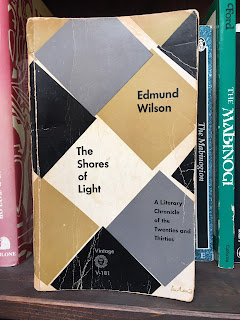
But it's also true, I think, Wilson just likes to search out lesser-known, but fascinating figures. He writes in The Shores of Light, "There are few things I enjoy so much as talking to people about books which I have read and they haven't." And I don't think he was fibbing... There's a great chapter on the diaries of Southern women, another on the philosophy of Alexander Stephens, vice-president of the Confederacy. (Stephens was anti-slavery, and initially against secession, but felt strongly the South could, that United States was a compact of states and not an indissoluble Union.) There's a chapter about the novelist John De Forest, who's known now (if at all) as the originator (more or less) of the idea of the Great American Novel. (I highly recommend Lawrence Buell's The Dream of the Great American Novel). A chapter on poetry discusses Melville (well-known, though less as a poet), Sidney Lanier (known somewhat?), and Frederick Tuckerman (scarcely known at all, but what Wilson quotes makes me want to find his work). If you're interested in reading about obscure writers (and, ahem, you *are* reading my blog at the moment 😉) I think you just might find the book to your taste...
One other thing has to be mentioned, though, and that's the introduction. It's weird. If you look at the Wikipedia article on the book, and follow up the references there, Henry Steele Commager's contemporaneous New York Times review or David Blight's article in Slate for the book's fiftieth anniversary, you'll see the introduction (of 30 pages) gets as much coverage as the rest of the book (nearly 800). Wilson was seriously pacifist at this time and got into tax trouble in the 50s--he refused to pay taxes that would support the nuclear arms race (Henry David Thoreau gets a couple of mentions in the book, though he's already dying by the start of the Civil War) and Wilson attacks Lincoln from the Left in the introduction, objecting to the suspension of habeas corpus, and considering him equally imperialist with Bismarck and Lenin. Umm. Because of the introduction, Wilson is sometimes viewed as pro-Southern, though I don't think that's true. He didn't count Reconstruction a success, but that's hardly an unusual point of view.
Now everyone reads the past in light of present events, though perhaps we shouldn't, and I myself can't help but think that seven Southern states, at least, seceded when they had no conceivable source of grievance against Lincoln--he hadn't even been inaugurated yet. They lost an election and refused to acknowledge it. (Why is that in my head these days? I'm sure I don't know.) In any case the introduction seems to have colored interpretations of the main body of the book, but I think it's best ignored. The book mostly appeared as a series of New Yorker articles in the ten years preceding their collection into a book; the introduction was written at the end when Wilson was squabbling with the IRS. The main body of the book doesn't actually seem to me to affirm the thesis stated in the introduction.
I took it along as topical reading on our recent trip to Washington, D.C. We went to see Lincoln's Cottage in northern D.C. on the grounds of the Old Soldier's Home:

The admission fee included this cool (?) bookmark, which I of course had to then use for the book...

The house just to the left of center is Lincoln's getaway cottage.
From my Classics Club list, good for November Non-Fiction, and distinctly inappropriate for Novellas in November...