Showing posts with label 2022Chunkster. Show all posts

Tuesday, November 22, 2022

Edmund Wilson's Patriotic Gore

Avenge the patriotic gore,
That flecked the streets of Baltimore.
-from Maryland, My Maryland 
(former state song of Maryland) 

Edmund Wilson's Patriotic Gore (1962) looks at U.S. literature written by authors affected by (and affecting) the Civil War. It starts with Harriet Beecher Stowe, "the little lady who brought us this big war," according to Lincoln, and her Uncle Tom's Cabin, and ends with Oliver Wendell Holmes, Jr., who died in 1935, having retired as Chief Justice of the U.S. Supreme Court, but who'd been wounded at Ball's Bluff, left for dead at Antietam, wounded again at Chancellorsville. 

But it's not a history of the Civil War and its aftermath like other histories. There's little discussion of military campaigns or economics--there are other books for that. Grant's memoirs, as well as Sherman's and Mosby's all feature, but Wilson discusses their prose style, not the battles. He writes about stories and myths as such, the myth (and he certainly thinks it is mostly myth) of the Southern Gentlemen or the nobility of the Lost Cause.

One of the great things about the book, though, is exactly that analysis of prose. Wilson suggests that the Civil War affected the style of American writing, that before the war, the influence of Sir Walter Scott was strong in the U.S., as everywhere in the world, but that the need to communicate quickly in wartime meant a new spareness came to the fore. Grant's dispatches feature, and Wilson makes a fascinating comparison between the speeches Edward Everett (once the most famous orator in the U.S.) gave at the dedication of the Gettysburg National Cemetery and that now better known--and much shorter--one that begins, "Four score and seven years ago,..." (which, I don't know about you, but I had to memorize in high school.) In the long run, maybe, this leads to Hemingway, however you might feel about that.

Many of the figures he writes about are obscure, and even some that aren't, were best known for something other than their writing. Sure, Grant's and Sherman's memoirs are ensconced in the Library of America now--and Grant's memoirs at least, I think, are great, and now I want to read Sherman's--but I don't think they were so celebrated as literature in 1962. If you think about who now are judged the major figures in U.S. literature in the period, you might come up with Mark Twain, Emily Dickinson, Henry and William James (those James boys), Henry Adams, Walt Whitman.  They're all mentioned, but none of them get a chapter. Frederick Douglass doesn't even get a mention. Wilson might say he wanted figures who saw the effects of the war first-hand: Twain was a two-weeks cavalryman, before deciding to heck with it and going to California; the two older James brothers were discouraged from serving by their father, and didn't, though the two younger brothers did, and Wilkie James was seriously wounded; Henry Adams was in London, serving as secretary to his father, the ambassador to Britain. An important role, but away from the fighting. Only Whitman was close to the action, serving as a nurse to the Union Army.

But it's also true, I think, Wilson just likes to search out lesser-known, but fascinating figures. He writes in The Shores of Light, "There are few things I enjoy so much as talking to people about books which I have read and they haven't." And I don't think he was fibbing... There's a great chapter on the diaries of Southern women, another on the philosophy of Alexander Stephens, vice-president of the Confederacy. (Stephens was anti-slavery, and initially against secession, but felt strongly the South could, that United States was a compact of states and not an indissoluble Union.) There's a chapter about the novelist John De Forest, who's known now (if at all) as the originator (more or less) of the idea of the Great American Novel. (I highly recommend Lawrence Buell's The Dream of the Great American Novel). A chapter on poetry discusses Melville (well-known, though less as a poet), Sidney Lanier (known somewhat?), and Frederick Tuckerman (scarcely known at all, but what Wilson quotes makes me want to find his work). If you're interested in reading about obscure writers (and, ahem, you *are* reading my blog at the moment 😉) I think you just might find the book to your taste...

One other thing has to be mentioned, though, and that's the introduction. It's weird. If you look at the Wikipedia article on the book, and follow up the references there, Henry Steele Commager's contemporaneous New York Times review or David Blight's article in Slate for the book's fiftieth anniversary, you'll see the introduction (of 30 pages) gets as much coverage as the rest of the book (nearly 800). Wilson was seriously pacifist at this time and got into tax trouble in the 50s--he refused to pay taxes that would support the nuclear arms race (Henry David Thoreau gets a couple of mentions in the book, though he's already dying by the start of the Civil War) and Wilson attacks Lincoln from the Left in the introduction, objecting to the suspension of habeas corpus, and considering him equally imperialist with Bismarck and Lenin. Umm. Because of the introduction, Wilson is sometimes viewed as pro-Southern, though I don't think that's true. He didn't count Reconstruction a success, but that's hardly an unusual point of view.

Now everyone reads the past in light of present events, though perhaps we shouldn't, and I myself can't help but think that seven Southern states, at least, seceded when they had no conceivable source of grievance against Lincoln--he hadn't even been inaugurated yet. They lost an election and refused to acknowledge it.  (Why is that in my head these days? I'm sure I don't know.) In any case the introduction seems to have colored interpretations of the main body of the book, but I think it's best ignored. The book mostly appeared as a series of New Yorker articles in the ten years preceding their collection into a book; the introduction was written at the end when Wilson was squabbling with the IRS. The main body of the book doesn't actually seem to me to affirm the thesis stated in the introduction.

I took it along as topical reading on our recent trip to Washington, D.C. We went to see Lincoln's Cottage in northern D.C. on the grounds of the Old Soldier's Home:


The admission fee included this cool (?) bookmark, which I of course had to then use for the book...


The house just to the left of center is Lincoln's getaway cottage.

From my Classics Club list, good for November Non-Fiction, and distinctly inappropriate for Novellas in November...

Tuesday, September 20, 2022

Short Reviews: von Doderer, Faulkner, Scholem

Three complicated chunksters all of which I started long posts for. Those posts didn't get finished. (Oh, well.) Time to clear the decks.


Heimito von Doderer's The Strudlhof Steps (850 pages)

This is a fairly new release from New York Review Books, and Vincent Kling won the most recent Wolff Prize for translation from the German for it. The novel came out in 1951 in German, and hasn't previously appeared in an English translation.

The main events take place just before and just after World War I in Vienna. I'm a sucker for the place and time. And, hey, it's shorter than The Man Without Qualities; as a bonus, von Doderer finished it, too. Four sections, each coming to a dramatic climax--who gets married, who gets dumped, who gets a leg cut off by a tram--generally on or near the Strudlhof Steps:


Lt. Melzer features in the subtitle. He likes to drink Turkish coffee on the skin of a bear he shot in Bosnia in 1912; watched his commanding officer (whom he likes) die on the Italian front in World War I; seems almost unmarriageable, but is he?

René von Stengeler is born into a wealthy Protestant family, captured by the Russians in 1916, only making it back to Vienna after the war is over. Does he marry Grete, back from Oslo where she escaped the misery of post-war Vienna by teaching piano? And why does René's sister commit suicide? Because we know she did from the first few pages.

The novel requires tolerance, but pays back. It moves back and forth in time, at first seemingly arbitrarily. You have to accept its terms, and give it space to get started. Characters have last names or first names but not necessarily both, and sometimes merely initials. For example, we never learn Lt. Melzer's (a major character) first name: on page 823, "Sorry, but we don't know Melzer's first name." The narrative voice has a curious diffidence.

Von Doderer's politics were not particularly admirable. He joined the Nazis in the mid-30s, when the party was illegal in Austria. The afterword, by Daniel Kehlmann, says he was quite anti-Semitic at that time. He later turned against the party, but never publicly, and as a WWI veteran, he was drafted into the Wehrmacht, serving in garrison duty, first in Norway, later in France, where he started writing this novel. The publication of the novel was delayed while von Doderer was de-Nazified. René von Stengeler is clearly a self-portrait, and deliberately not a flattering one. What did he think by 1950? I don't know. There are minor Jewish characters in this, and they're treated with real sympathy.

Anyway, I thought it was very good.

William Faulkner's Light in August (480 pages)

I had heard that Light in August was a murder story, the story of Joe Christmas, and, well, it is. Christmas (named for the day his infant form was dropped off at the orphanage) murders his lover. Christmas may have black blood--he doesn't know and we don't know either, but he thinks he does, and though he could pass for white, once he's accused of having a drop of black blood (by his own grandfather, no less) he assumes he does.

But Christmas' story is not the whole of the novel by any means. It's the portrait of a town called Jefferson, and not just the evils of racism, but also the ways racism distorts the life of the town. Nowadays we don't really have any problem contemplating that Jefferson the man may have been a bit racist, but the novel came out in 1932. There's a daring irony to that. Was Faulkner in his heart of hearts free of racism? Certainly not, and I doubt he would say he was. But he knew that problem for a problem, and that counts for something. Percy Grimm, the white captain of the National Guard, is a particularly (dare I say it?) grim portrait of a racist.

And am I the only one who doubted Christmas committed the murder? No, because the Wikipedia article says it's unclear who did it. I don't think that's actually sustainable, and that Christmas really did do it, but I did wonder during the middle of the novel. But maybe that's attributable to too many years of reading mysteries: the obvious suspect is never the culprit.

The town's a mess, and there's nothing to do but escape, but almost nobody does; the only ones who do are Lena Grove and Byron Bunch, running off in a folie à deux: she's looking for the man who got her pregnant and who will never marry her, and Byron's hoping she'll settle for him instead, and meanwhile he'll be there when she (which she won't) changes her mind.

One other thing to be said about this is that, of the great Faulkner novels, I thought this was the easiest read. And that's definitely something... 😉 It's easier than The Sound and the Fury, As I Lay Dying, and Absalom, Absalom. No chapters from the POV of dead people or madmen. Not the greatest of that quartet, I'd say, which for my money is Absalom, Absalom, but a better starting point. (Though if you include Sanctuary in your list of top Faulkner, I would say that one's a pretty straightforward read.)

Yeah, a classic.

Gershom Scholem's Sabbatai Sevi (929 pages, plus bibliography, notes and index)

Sabbatai Sevi (1626? - 1676) declared himself the Jewish messiah in 1665. (He may have intimated it as early as 1648 but only in limited circles.) Gershom Scholem, Jewish historian and friend of Walter Benjamin, made Sevi the subject of a major book.

Sevi (there should be a dot under the S which I can't figure out how to type, but think Tsevi or Zevi) was born in Smyrna to a middle-class merchant family, studied the Kabbala in Jerusalem, traveled on religious business to the Jewish community in Egypt and later to Constantinople. All lands under the control of the Ottomans at the time. When he began his mission in earnest, Nathan of Gaza was his prophet and explicated the theology of the new movement. Scholem, as a historian of Jewish mysticism, is rather more taken with Nathan than Sevi.

But the stories of Sevi and Nathan are just a small part of this fascinating book. What's surprising is the Europe-wide discussion of these figures, and not just in the Jewish community. Italy, Amsterdam, Morocco, Poland, Hamburg, Egypt are all discussing this new Messiah. English chiliastic Protestants write books about Sevi, who, they think, will lead 10000 Jews from the Lost Tribes across the River Sambatyon, armed with bows and arrows but still invincible. (The River Sambatyon doesn't actually exist, which is why you haven't heard of it.) Samuel Pepys writes about Sevi in his diary! Along with all the women he was shagging. He features in Venetian ambassador's reports and Jesuit Relations. One can imagine Blaise Pascal, roughly contemporary, being discussed across Europe, but it turns out not all Europe-wide discussions were so scientific.

Sevi himself always advocated a peaceful movement. Faith and the perfection of the self would lead to the kingdom of God. There were no armies in his vision.

In fact, I found the reception of Sabbatai Sevi to be more interesting than the biography of Sevi himself. Scholem is inclined to attribute Sevi's messianic proclamations to mental illness, labeling him a manic-depressive. Maybe. But diagnosing mental illness in the present is difficult enough--DSM-III, DSM-IV, DSM-V have different labels, and so will DSM-XCIII--diagnosing it in figures in the past in inherently suspect.

Why could a Messianic movement take root then? Scholem finds the main factor to be the diffusion of Kabbalistic thinking going back to Isaac Luria (1534-1572). But also the Jewish massacres by Khmelnitsky in Poland and the Ukraine take place in 1648. As for the interest in Christian circles, there was a feeling that 1666 should be an important year: the number of the beast plus 1000.

Once in Constantinople, Sevi was arrested by the Ottomans. They were relatively tolerant of Judaism, but weren't prepared to tolerate a figure who was going to lead an army of invincible Jews and put the crown of the world on his head. (If, in fact, Sevi intended these things. Probably not.) He seems to have impressed the vizier and then later the sultan, but still in September of 1666, he was told to convert to Islam or die. Sevi converted. 

Surprisingly this wasn't the end of the movement. A number of Sevi's followers also converted over the years. Sevi was ordered to leave Constantinople, first to Edirne, which was at times the Ottoman capital, then later to Albania. Sevi led his converts, the Dönmeh, also referred to as the Ma'min, or the Faithful, in a new syncretistic religious community influenced both by Judaism and Islam, particularly that of the mystical Sufi orders. Scholem's book ends in 1676, when Sevi dies, but the community survived, centred in Salonica until the Greek-Turkish population transfers of 1922. The Dönmeh were often thought to be hidden Jews, but they were Muslim enough for the time, so they had to go. The story of the Dönmeh would be fascinating, and Scholem had intended to write a book, but didn't live to do so. They do feature in Mark Mazower's book (recommended!) on Salonica, though.

I read the second edition of the book, which came out in 1973, translated by R. J. Zwi Werblowsky. Scholem says in the introduction that he had access to more material by then, and that it superseded the earlier edition.

And why did I read this book now? Well. Did I really need to read one nine-hundred page book about a failed Jewish messiah in order to prepare for another nine-hundred page book about a failed Jewish messiah? Oh, probably not, but that's what I did:


These were all August reads for me, and it's been a while now. Still I wanted to review these because they knock off a couple of challenge items. Light in August was on my original Classics Club list and works for this year's Back to the Classics challenge.


And the other two count for this year's European Reading Challenge:


The Strudlhof Steps is clearly an Austrian book, though it does have scenes in Norway and Switzerland. Sabbatai Sevi spent most of his life in what is now Turkey, but I've already done Turkey this year. Sabbatai Sevi the book ranges across Europe. Still we'll stick Sevi himself, who spent the last eight years of his life in Ulcinje, which was in the Ottoman province of Albania at the time, but is now in Montenegro.

Short reviews, did I say? Well, short-ish...


Monday, August 1, 2022

Marc David Baer's The Ottomans

Continuing this year's voyage around the Black Sea...

Marc David Baer's The Ottomans, is a history of the Ottoman empire from its founding by Osman I (dates slightly approximate, but he died close to 1324) until its demise at the end of World War I. They aren't always represented as some of history's good guys, but Baer, a professor at the London School of Economics, is pretty sympathetic. The book was short-listed for this year's Wolfson Prize, but didn't win in the end. But that wasn't revealed before I put it on my library's hold list.

Osman I (though his story seems to be at least partly mythical) led his band of Turkish herders from central Asia to a spot on the Anatolian plateau southeast of Istanbul. They elbowed out whoever was there and created a small state, but initially did not conquer a city, nor found one. They pastured their herds on the uplands in summer and in the valleys in winter.  They had already converted to Islam, but retained some of the ways of their animistic ancestors. (Relative equality between the sexes, for example.)

They had the virtues of where they came from: good horsemanship and good bowmanship. But they were too small a band and too powerless to have much impact at first. At least according to Baer, though, they were fortunate in their choice of location. The Mongols were retrenching a bit; Byzantium was weakening; the Seljuk sultanate of Rum, the main power on the Anatolian plateau, collapsed in the early 1300s. The Black Death came, and because the Ottomans had not yet founded cities, they weathered it much more readily than their city-inhabiting neighbors. 

This set them up for their period of expansion: the Balkans, the conquest of Constantinople in 1453, Mecca and Medina in 1517, the first siege of Vienna in 1529. Baer observes that at this time, the Ottomans are technological leaders: they're early adopters of gunpowder, muskets, and more famously, siege cannons. 

Baer is also impressed with their governance structures. He emphasizes their tolerance, though he's careful to distinguish this from true egalitarianism, which existed exactly nowhere at the time. (And we won't talk about now either.) You could be Jewish or Christian and advance; top positions were reserved for Muslims, but if you converted you could be from anywhere, not necessarily a Turk, and it didn't matter. When the Jews were kicked out of Spain and Portugal (1492) they were welcomed into the Ottoman empire for their skills. The grand vizier was often a Christian convert, sometimes one taken as a child and educated (though also enslaved) by the Ottoman state. This created a class loyal to the state, that advanced by merit, both in the military (the Janissaries) and in civil governance. Local aristocracies could complain, but couldn't wangle their incompetent children into positions of power.

This lasted pretty well through the reign of Suleiman I, who was in charge 1520-1566. While the maximum geographical extent of the empire came later, religious zealotry and nationalism began to cut into a system that had worked well. The other powers around them also caught up with the Ottoman expertise with gunpowder.

One of the interesting motifs for me was how much the Ottomans saw themselves as the true inheritor of the Roman empire. This is not as odd as it might seem. The Byzantines considered themselves the successor of the Roman state, called themselves not Byzantines, but Romaioi. The Ottomans now held the Byzantine capitol. Suleiman I, roughly contemporaneous with Charles V, the Holy Roman Emperor, felt equally the inheritor of Rome. (And as we know, the Holy Roman Empire "wasn't holy, wasn't Roman, and wasn't an empire"--Voltaire.) The area called Rome, or Rum, or Rumelia moves around. One interesting bit of trivia I realized is the poet Rumi, born in what is now Afghanistan, and who died in what is now Turkey, and who wrote mostly in Persian, is actually, according to his name, the 'Roman.'

Succession had always been a problem among the Ottomans. One son, generally the eldest, rushed back from the provinces where he'd been stationed to the capitol upon the death of his father, got the reins of government in his hands, and had all his male siblings killed. The army, in the form of the Janissaries, was involved, and once they'd gotten a taste for king-making, couldn't be easily dislodged. This was an unfortunate 'Roman' trait: the Praetorian Guard also didn't do the Roman empire any good in its latter days either.

Baer also feels the Ottomans failed in not making the transition from a warrior state to a peaceful trading state. They stood athwart major trade routes and could have done so. A strong faction continued to feel the true Ottoman was the warrior Ottoman. (Their term was gazi.) But the empire had gotten about as big as it could. The first siege of Vienna failed in 1529 because the supply lines were too long, but they had learned nothing from that at the time of the second (in 1683) which was a considerable disaster for the Ottomans. From here on in they're also butting up against the expanding Russian empire.

Various attempts at reform were tried and failed: concentrate on commerce not war, reduce the sultan to figurehead and let bureaucrats run things, religious zealotry, benevolent autocracy (a la the later Hapsburgs). It's Tsar Nicholas II, just before the Crimean War, who first calls the Ottoman state the 'sick man of Europe.'

The last attempted reform movement is a Turkish nationalism. The Young Turks (none of whose founders interestingly was a Turk: two Kurds, an Albanian, a Circassian) reduce the sultan to a figurehead and are more or less in charge during World War I. Baer is distinctly not sympathetic to them, but then their goal is to reduce what had been, at least at times, a successfully multi-ethnic polity to a state defined by one's race. His discussion of the Armenian genocide makes for very painful reading.

It also means Baer's not especially positive about Atatürk, though he's mostly outside the scope of the book. Atatürk (born in Thessalonica, but of Turkish parents) isn't directly implicated in the Armenian genocide, because he's busily organizing the defence at Gallipoli, but the Young Turks are his natural allies, and Atatürk, given the opportunity, refused to condemn the genocide after the war.

Anyway, a pretty fascinating history. Baer knows his stuff, provides an interesting perspective--emphasizing how European they were, especially appropriate for the European Reading Challenge 😉--and wants us to think differently about their history. (Based on the footnotes, I think there may have been a little war going on with the late Bernard Lewis.) I have to say, though, the writing was no better than adequate. There's the occasional misuse of words, but more notably a tendency to repeat. It was indeed interesting that no sultan completed the Hajj in all the years of the empire, or that it wasn't until 1520 and the conquests of Selim I that the empire was Muslim majority, but he tells us both those facts three times in different locations and in more or less the same words. Baer himself has to take the primary blame (that is, bear responsibility...?) for any sloppiness, but the book is from Basic Books, supposedly an imprint for quality books for the general reader. They ought to provide better editing. Maxwell Perkins, where did you go?

Monday, July 25, 2022

Pynchon's V.

"Stencil has stayed off Malta."

Ever since I've been signing up for the European Reading Challenge, there's been these two big historical/encyclopedic novels that turn around Malta I've been thinking about rereading. It turns out this is the year for one, V., Pynchon's debut novel. (The other is Anthony Burgess' Earthly Powers.)

Part of the resistance was I'm not sure I'm capable of saying anything about either one.

But let's see. First, the story: the novel has two interlocking plot lines. One in 1956, (the present, roughly; the novel comes out in 1963) and the other in a series of discrete moments from 1898 to 1943. The protagonist of the present is Benny Profane, in his early 20s, child of a religiously mixed marriage (Jewish/Italian Catholic), born in New York City, recently having served a hitch in the US Navy, but now at odds and ends. (Which things, I think, are basically Pynchon himself, except Pynchon's mix is Episcopal/Catholic, and he grew up further out on Long Island, not in the city itself.) The other timeline is the result of an investigation by Herbert Stencil into a woman V., possibly Veronica Wren, who was, as a teenager, caught up in the assassination of a British spy in Cairo in 1898. Herbert's father is Sydney Stencil, a British Foreign Service agent/spy. V. may (or may not) be Herbert's mother. 

Benny is a schlemiel, and is constantly at war with objects: alarm clocks don't wake him; flashlight batteries fail; at one point he tries to rappel down the side of a building and is left hanging upside down. Benny has (imaginary?) late night conversations with a crash-test dummy: they're soul-brothers of a sort, individuals whom the powerful mechanisms of the modern world are out to damage, possibly destroy.

But une guerre contre les objets is the honourable position; the alternative is V., gradually turning herself into an object, glass eye, false teeth, artificial leg. This conflict is Pynchon's theme.

"'I detect allegory in all this,' she said.
'No,' said Slab. 'That is on the same intellectual level as doing the Times crossword puzzle on Sunday. Phony. Unworthy of you.'"
There are moments when it feels like a schematic message novel--Pynchon's message would definitely be humanist, anti-machine, admirable--but the novel escapes allegorical reductionism by a deliberate fudging. V. is not just symbol of the dehumanization of people into objects in the 20th century. (Appropriate as that might be, with the ultimate dehumanization being nuclear annihilation. 1956 is the year of the Suez crisis, important to the novel, and of Hungary. War seemed closer.) But V. is also the woman Veronica Wren, maybe somebody's mother, who's capable of falling in love. (Though not with Sydney Stencil.)

The novel's also funny, or at least I think so:
"Mountebank is a dying profession; all the good ones have moved into politics."
Pynchon is also famous for his zany song lyrics, which can be found in V., although I think he gets better at this as he goes along.

Pynchon also gets better at female characters--though never great--and the women are thinly realized in this, with Benny Profane's sometime girlfriend Rachel Owlglass being the best-drawn of the lot. From Pynchon's (wonderful) introduction to his collection of short stories Slow Learner (1984):
"Modern readers will be, at least, put off by an unacceptable level of racist, sexist, and proto-Fascist talk throughout this story. I wish I could say that this is only Pig Bodine's voice, but, sad to say, it was also my own at the time. The best I can say for it now is that, for its time, it is probably authentic enough."
Pynchon is writing of one of his stories in Slow Learner, but Pig Bodine is a character that also shows up in V., and it's also kind of true of the novel.

Still, I find it a pretty great novel. And it reaches its climax on Malta. Stencil had stayed off Malta; I had, too; but no longer.


You could even call it a classic...


which I've read a few times:


I guess I can treat myself to a new copy. 😉


Sunday, January 9, 2022

Reading the fatuous policeman: Edmund Wilson's Shores of Light

He arrives full of excitement and high expectations; eagerly he gets to know everybody who is writing, as he already knows everything they have written. He rushes about from one group to another. He attends all the literary teas, the publisher's luncheons, the theatrical openings, the miscellaneous drinking parties. And he brings to it all his shrewdness, his audacity, his humor, his extraordinary memory and his undiscourageable enthusiasm for literature. He makes us feel, as we read this record, that there is something really important in the air, that the work of all these people is interesting, that their opinions deserve attention.
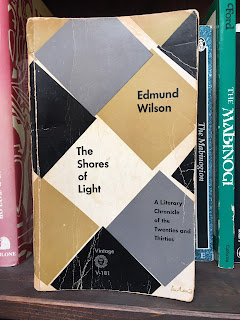
Edmund Wilson's The Shores of Light came out in 1952, but it's largely a collection of his literary journalism in the 20s and 30s.  It's a fascinating history of the American cultural scene of the time. That quote above is from Wilson's review of Burton Rascoe's A Bookman's Daybook, but it could have been about Wilson himself.

Wilson really was in the center of everything. He was the managing editor of Vanity Fair for two years starting in 1920 (he was only 25!) and then later the literary editor at the New Republic for five years. He reviews the first publication of 'The Waste Land'. He's reading André Malraux in French before Malraux has appeared in English. He's involved in the controversy over James Joyce' Ulysses. (Demolishing the criticism of the New Humanist critic Paul Elmer More.) He's praising Hemingway and Dos Passos when those authors are nobodies.

Still, on the whole, I wouldn't go to this book for actual literary criticism, especially in the earlier sections. There's better literary criticism out there. Wilson himself wrote better criticism--I'm reading Axel's Castle at the moment. Think of this as history or chronicle. As I noted earlier, he's not very good on Willa Cather. He writes a series of columns about the state of American poetry that are simply swingeing takedowns and not very insightful: [of Robert Frost, for example] "I find him excessively dull, and he certainly writes very poor verse." 

But the book was assembled in the fifties, and he's aware of his limits. In a footnote to one of those poetry assessments, he notes:
"Maxwell Bodenheim [the Chicago, later New York poet] described me in some such phrase as 'a fatuous policeman, menacingly swinging his club.' In rereading this essay...I have sometimes been reminded of this."
Wilson later told his future biographer Lewis Dabney that he didn't really learn to write until about 1925. This is...kind of true, and represents about a quarter of the book. It's interesting to see him get better in something approaching real time.

The book is at times touching. It's framed by essays written in the 50s, the first, at the death of Christian Gauss, the Princeton professor whom Wilson had studied under; the last, at the death of Edna St. Vincent Millay, which was especially good, remembering life in Greenwich Village in the 20s--Wilson had proposed to Millay at the time, but she turned him down. (I also learned from Dabney's biography that Wilson lost his virginity to Millay, which may have added a little extra poignancy to his recollection.)

Willa Cather aside, Wilson is actually quite good on female authors, praising them, but also treating them seriously. Millay, in particular, who is, of course, a major poet, but also Louise Bogan, Elinor Wylie, Edith Wharton.

The book can be paired with Wilson's The American Earthquake, a similar collection of his journalism covering the 20s and 30s, but on political topics. I read that a couple of years ago. Two 800-page books, representing a mere fragment of what he wrote in the period. The man kept busy.

Also there was this, amusing for bloggers:
"I have recommended lenience toward reviewers who use the books they are supposed to be reviewing as pretexts for expressing themselves; but only in cases where their articles--what happens comparatively rarely--are interesting in themselves. There is no excuse at all for an uninteresting review that tells nothing about the book. The reviewer, at the very least, should be expected to supply information. The retelling of the story of a novel, the summary of an historical or philosophical book, the selection of representative passages and the attempt to communicate the quality of a poet, is the most boring part of the reviewer's business, but it is an absolutely essential part."

And it left me with a bunch of new books I want to read. What more can a book about books do? 

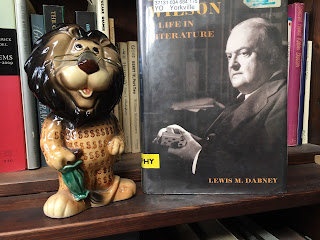
Two literarily-engaged figures with large heads

I got Lewis Dabney's Edmund Wilson: A Life in Literature (2005) from the library to go with this; I've only read it so far through the period in question, but I will finish it. That's where I got the skinny on Wilson and Millay. Dabney also edited the Wilson Library of America volumes. 

The biography is pretty good, but editing, even, it seems, at a prestige publisher like Farrar, Strauss, is a lost art. The phrase 'shores of light' as Wilson tells us, comes from the Latin 'in luminis oras'. Wilson got it from Virgil, (Georgics, Bk II.47) though it appears a few other places as well. In Virgil, it's a comment about the heliotropism of plants; prosaically I might translate the line: "On their own plants grow toward light sources." Wilson romanticizes the line a bit in a poem he wrote (I'm quoting the end of his poem which appears in the essay on Millay):

    My stubborn heart to-night
Divines the fate of souls who have not died,
Buried in sullen shadows underground--
That reach for ever toward the shores of light.
I guess that's his sense of New York artists in the 20s and 30s.

Well and good. But Dabney quotes the tag twice, once as 'ad liminas oras' and once as 'in liminas oras', neither of which are what Virgil wrote and also not what appears in my beat-up Wilson paperback. They're not even good Latin. Argh!

I'm willing, possibly, to let Dabney slide on this: editing and typesetting are no longer processes over which authors have much control. In any case FSG should have done better. But then Dabney calls Robert Service an 'inspirational' poet! I'm not sure I'd even want to meet the folks for whom 'A bunch of the boys were whooping it up in the Malamute saloon' was inspirational. And anybody who found 'The Cremation of Sam McGee' inspirational would be just downright creepy. 😜

The Shores of Light was the first book of the year for me, though it took me a week to write about. A good start! How's your reading year going?