Monday, August 1, 2022
Marc David Baer's The Ottomans
Saturday, June 18, 2022
The Black Sea: A History
A couple of years ago I read Charles King's Midnight at the Pera Palace (looking at 20th-century Turkey though the lens of a luxury hotel/night club in Istanbul) and liked it a lot. More recently I read his Gods of the Upper Air (about American anthropologists, such as Franz Boas and Margaret Mead) and liked it, though a bit less. I didn't manage to blog about either."There is a deep landlubber bias in historical and social research. History and social life, we seem to think, happen on the ground."
Eventually the Ottoman empire grew weaker--and the Cossacks came on the scene. The Cossacks were perfectly happy--and perfectly capable--of conducting piracy on the sea in addition to their raids on horseback. But by themselves they weren't able to dominate the Black Sea. But their piratical successes were one of the things that revealed the increasing weakness of the Ottomans. The Russians took note.
The latter history of the Black Sea is story of the conflict between Russia and Turkey over control of the Black Sea--and the efforts of other players, the British, the French--to keep one party from dominating. The Crimean War, among other conflicts, was the result. Among the results of the Crimean War was an attempt to de-militarize the Black Sea.
The book comes out in 2004 and at that time King was optimistic. There were new environmental initiatives to counteract years of neglect and damage. "[C]onflict among the states of the Black Sea zone is now virtually unthinkable." [p.240] Alas. As Yogi Berra may (or may not) have said: It's tough to make predictions, especially about the future.
Still, it's a pretty fascinating book, even if it needs updating. If you've read his other books you'll know, King likes anecdotes and uses them well. There's some good stories in it and it's pretty readable. And especially now, worth reading.
As King notes in the beginning, six countries currently border the Black Sea; if you counted the countries in the Black Sea drainage area, there are 22 possibilities. Out of all those choices, I guess I won't pick the most obscure... King is a professor in the foreign services school at Georgetown, and at least at the time of this book held the Ion Raţiu chair in Romanian studies. Romania is important in the book, I need to keep up my Romania streak, and so...Romania it is! for the European Reading Challenge.
Friday, April 15, 2022
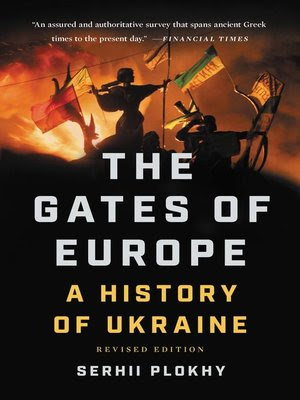
The Gates of Europe: A History of Ukraine
The history begins with Herodotus, which any history that justifiably can ought to do. 😉 The area was not then inhabited by Slavic speakers, but Cimmerians and Scythians, who spoke Iranian languages. Plokhy also makes use of Procopius' history, to discuss the area's relation to Byzantium, but he mostly moves over this period pretty quickly.
Slavic speakers first move to the area as part of the migrations caused by Attila the Hun. (5th or 6th century.) As the power of the Huns wanes, a new state, Kievan Rus' is established covering most of what is now Ukraine, Belorussia, and European Russia. Kyiv is the capitol. The nobles, led by the Rurikid dynasty, are a mix of Vikings and Slavs; the people, mostly Slavs. It reached its political apex under Yaroslav the Wise (978-1054).
It seems the word Rus' (the basis of Russian) comes (via the Finns) from the Swedish word 'ruotsi' used to describe the Vikings as the 'men who row.'
Yaroslav partitioned out the kingdom to his three eldest sons. Plokhy compares this division to that of Charlemagne. Like Charlemagne, Yaroslav did it to prevent inheritance squabbles among his sons, and it succeeded about as well as Charlemagne's attempt did. (That is, not at all.) New successor kingdoms were the result. These fought among themselves and tried to work with their more powerful neighbors (the Khazars, Byzantium). The word Ukraine first appears in the historical record at this time (in the 1180s). Then everything was swept away by the Mongol Horde in 1240. This was the beginning of differences between the various east Slavic states though none of them exactly correspond to three current ones. (Belarus, Ukraine, Russia).
Two east Slavic vassal states are formed in the aftermath of the Mongol invasion. One is Muscovy, with its capital Vladimir (near Moscow) and is the area around Moscow. The other, Galicia-Volhynia, was centred in Kyiv but moved its capitol to Kholm (now Chełm in Poland) and occupied the area of what's now western Ukraine and eastern Poland. The two vassal states received different treatment; the Muscovy state, closer to the Mongol heartland was more oppressed; the Kholm state was allowed a looser rein.
In 1323 the last male heirs (grandsons of the founder) of the Galicia-Volhynia dynasty died. The Mongols were a bit weaker. Galicia was taken over by the Polish kingdom; Volhynia by the Lithuanians. 1386 marks the beginning of the joining of Poland and Lithuania in a commonwealth. But the administration of the two areas remains separate. Plokhy thinks this is the beginning of a separate identity for Belarusians and Ukrainians.
The Cossacks begin as a sort of peasant rebellion in what is now eastern Ukraine, but in 1648 Bohdan Khmelnitsky creates a state (the Hetmanate) out of Polish-Lithuanian lands in what is now eastern Ukraine. Plokhy doesn't play down the pogroms that have left Khmelnitsky as little more than a swear word in Jewish history, but he did create a sort of Ukrainian state. But by 1780 the Hetmanate had been absorbed into Russia. Western Ukraine is split between Austria-Hungary (Lviv) and Russia (Kyiv) during the partitions of Poland.
There's an attempt to set up a new Ukrainian state in the immediate aftermath of World War I, but it doesn't last, doesn't really even get on its feet.
Plokhy discusses the state of education in the Ukrainian language in the various jurisdictions as one of the formative elements of a Ukrainian identity. The ability to use one's native Ukrainian in a public setting comes and goes at the political whim of the various powers. For instance, Austria-Hungary at one point trying to beat back Polish nationalism allows schools to use Ukrainian. Later to placate the Poles, Ukrainian is no longer taught.
Plokhy makes a good case for a Ukrainian identity, which is, of course, like anybody else's, only strengthened by persecution. In the 19th century a number of nationalities were finding their feet; Plokhy does suggest that the Ukrainians were a little late in finding theirs, though they did not really have a state of their own at any point in the 19th century.
I felt like I learned a lot from the book, especially in the time frames that were more obscure to me: the Middle Ages in Slavic lands. Looking at Plokhy's list of publications on Wikipedia, (he's now a professor at Harvard) it's clear one of his real interests is the formation of Ukrainian identity, and I found that the most interesting part.
This is a book for a non-specialist reader. (Like me!) It reads well, but it does cover 2500 years in 360 pages, so there are a few places where it felt a bit thin--World War I, for instance. Still. Full of fascinating and timely and suddenly--unfortunately--much more important things to know. Recommended.
Monday, November 15, 2021
Edmund Wilson's The Scrolls From the Dead Sea (#NovNov)
"At some point rather early in the spring of 1947, a Bedouin boy called Muhammed the Wolf was minding some goats near a cliff on the western shore of the Dead Sea. Climbing up after one that had strayed, he noticed a cave that he had not seen before, and he idly threw a stone into it. There was an unfamiliar sound of breakage...he later came back with another boy, and together they explored the cave...[He] found long manuscripts, inscribed in parallel columns on thin sheets that had been sewn together. Though these manuscripts had faded and crumbled in places, they were in general remarkably clear."
That's the opening of Edmund Wilson's The Scrolls from the Dead Sea.
Those scrolls Muhammed the Wolf discovered were the first of the Dead Sea scrolls, ancient documents that would upend the understanding of the gospels, of Christianity and Judaism both. Though not everyone agreed at first, or even for a long while--likely there are some doubters even now--they were written in the first two centuries preceding the Christian era.
Muhammed the Wolf and his fellow Bedouins were not scholars but they had the sense that they had gotten hold of something that might be of interest. Or at least, of value, and they let it be known they had scrolls for sale. Eventually Mor Samuel, the Metropolitan of the Syriac Orthodox church in Jerusalem purchased the scrolls then available on the market. Even he didn't entirely know what he'd just bought, but he knew they were written in Hebrew, a language he didn't know.
1947 was an 'interesting' time in the old Palestine mandate. The Brits were about to give up and run away, and Jews and Muslims were jockeying--frequently violently--for a better position in what would be the new order. (I am making a great effort to not come down on one side or the other here. 😉) Bedouin goatherders who were accustomed to roaming according to the needs of their goats were now subject to borders and armed checkpoints.
It took a while for the manuscripts to make their way to appropriate scholars and not all of them ended up with Mor Samuel. It was a dramatic and important story and in 1954, Edmund Wilson persuaded the New Yorker to send him to Israel to report on it. He filed a series of articles for the New Yorker starting in May, and later that year a book, composed out of those articles, came out.
He discusses the discovery of the scrolls, the people involved in the discovery, the Essene order (a Jewish monastic order from the time around Christ who were responsible for the preservation of the scrolls), and historical figures, such as the Teacher of Righteousness. Ernest Renan, the 19th century French author of Vie de Jésus appears. Wilson also went to visit the caves at Qumran and writes about his visit.
Edmund Wilson was not a scholar, but he was a literary journalist of a very high order and at this point in his career he'd acquired a little Hebrew. In the 30s he'd been a Marxist, and after he turned against communism, he decided that one of the things Marxism had done for him was to supply a religious feeling he'd been lacking. He didn't ever become a believer, but he was interested in the things believers were interested in, and in any case, the Dead Sea Scrolls were big news.
There are probably better introductions to the subject now and discoveries have been made since--even Edmund Wilson wrote a second edition later, but I was only able to get hold of the first--but this is still a pretty good read, in the way of the New Yorker. And it's a non-fiction book of 121 pages, so it's particularly seasonal...
Sunday, August 15, 2021
Of the Time of Nero (#ccspin)
| Here we have Hubert arbiting some elegances |
My spin book this time was Henryk Sienkiewicz' Quo Vadis, which set off a mini-reading project.
Petronius' The Satyricon
I knew Caius Petronius was a major character in Quo Vadis, and I thought I'd reread The Satyricon in advance. It's mostly accepted (though not universally) that Petronius, author of The Satyricon, is that Caius Petronius mentioned as the Elegantiae Arbiter of Nero's court in Tacitus. (Though maybe not: it's a common enough family name in Rome.)
What we have of The Satyricon is pretty fragmentary; parts, we're told, of Books XV and XVI, amounting to 164 pages in William Arrowsmith's translation. Even the exact meaning of the title is uncertain. For a Roman (as also a bit for us) it probably suggests several things: Satyrs (and thus lechery), satire, but also satura, a Roman word meaning heap or medley. The longest continuous surviving stretch is the dinner at Trimalchio's, who is a freedman working for the Imperial court, with lots of money and little taste and maudlin when drunk. It's amusing to see the sort of thing a rich Roman would have been eating at the time. It makes turducken look like an exercise in restraint.
It's not possible to say much with certainty about the work. If the note attached to the late medieval manuscript is correct about books XV and XVI, it would be a very long work, even if there were only 16 books--and 24 would be a significant number for an ancient author. Encolpius--the (loosely speaking) hero--of the book cons his way through life, cadging free dinners where he can, and sleeping (or trying to) with anything that moves. He hangs out with grammarians, professors of rhetoric, poets, so he seems to be an educated man, but there's something criminal in his background. Also he's managed to offend the god Priapus, with an unwelcome effect on his, umm, priapic appendage, and is on a quest to get back in good with the god, and go on sleeping around. (Probably. The book is fragmentary.) It is a severe judgment of its society. I find it funny in places, but your mileage may vary: some of the jokes are pretty insider-y Roman.
I took an undergraduate class on Petronius. We read a good chunk of the book in Latin, and as well as all of it in Arrowsmith's translation. I must have read the introduction--which is quite good--but I was amused now with how engaged Arrowsmith was with Lolita. (His translation comes out in 1959.) He calls Lolita a failure--twice. I'm sure I hadn't read Lolita at the time. It's not a comparison that would have occurred to me though. The sexual abuse of children is the meeting point, I suppose, but they're not really very much alike. Rather The Satyricon's embedded poetry, commentary thereon, and comically epic plot is more Pale Fire than Lolita. (Though The Satyricon is not either of them, of course.)
Tacitus' Annals
I enjoyed The Satyricon, but in the end I don't think rereading it brought much to Quo Vadis. Sienkiewicz accepts the attribution to Caius Petronius, but it doesn't otherwise feel like it impacts. Much more useful were the Annals, Tacitus' history of Rome from the death of Augustus to the death of Nero. (A.D. 14 - A.D. 68). Moses Hadas, in his introduction, notes that "Sienkiewicz' Quo Vadis... [has] long sections which are but adaptations of Tacitus." True that, Moze.
I thought one of the best things in Quo Vadis was the portrait of Petronius. Sienkiewicz is certainly taking off from Tacitus:
"His [Petronius'] days he passed in sleep, his nights in business and pleasures of life. Indolence had raised him to fame, as energy raises others, and he was reckoned not a debauchee and spendthrift, like most who squander their substance, but a man of refined luxury. And indeed his talk and his doings, the freer they were and the more show of carelessness they exhibited, were the better liked, for their look of natural simplicity...Then falling back into vice or affecting vice, he was chosen by Nero to be on of his few intimate associates, as a critic in matters of taste, while the emperor thought nothing charming or elegant in luxury unless Petronius had expressed to him his approval of it." [Annals 16.18, tr. Church and Broadribb]
Also, the great fire of Rome during Nero's reign. (July, A.D. 64) Tacitus would have been somewhere around six years old at time, but he doesn't use his own memories of the event (assuming he had some); instead he draws on earlier histories. It's a vivid moment in the book. Tacitus doubts Nero was responsible for the fire, but notes the rumors of Nero's guilt spring up almost immediately. The persecution of the Christians after the fire--Tacitus is our earliest source for this--he attributes to Nero's need to find a scapegoat to stifle those rumors.
The other thing that struck me (though irrelevant to Quo Vadis) was how important Armenia was in Roman thinking at the time. It was an ally, practically a client state, stuck on Rome's eastern border, wedged between Rome and the Arsacid-ruled empire of Parthia (corresponding roughly to modern Iran) who were a major rival to Rome at the time. Quite a lot of energy is devoted to keeping a friendly king in Armenia.
Tacitus is a famously difficult author in Latin. The (small) amount of his Latin I read in grad school impressed me; his tricky sentences frequently end with a sharp ironic sting in their tail. He reminded me of George Eliot, though of course the lines of influence run the other way, and I'm quite sure George Eliot knew her Tacitus perfectly well. The Church and Broadribb translation is fine, but it doesn't capture what I remember of the magic of Tacitus' prose.
Henryk Sienkiewicz' Quo Vadis
And on to the main event...
The handsome soldier Marcus Vinicius meets Callina (also called Lygia) and his knees tremble such as they never did in battle; the beautiful Lygia blushes bright pink and scampers off without a word out of Marcus' presence. "Ah, ha!" says the trained literary mind. "What we have here is Romantic Comedy!"
In romantic comedy the Question is what keeps our lovers apart and what it takes to get them together again in the end. Well, in Nero's Rome, there are plenty of things to keep them apart, maybe, just possibly, too many...
Not least is the fact that Lygia is a secret Christian. Years before she had been handed over to the Romans as a hostage and guarantee of a treaty between the Lygii and the Iazyges. The Romans were a neutral party in that conflict. But Lygia's father dies in battle and her mother dies as well, so Lygia, though an official state hostage, is more or less forgotten, raised by a nice Roman couple of the senatorial class.
Lygia is dark-haired with blue eyes and is so good-looking everyone is worried when she's in a room with Nero for a couple of hours he will fall into uncontrollable lust. Ah, but Petronius has a plan for that. (I suspected, and later verified, that the Lygii inhabited what is now Poland. A little Polish boosterism on the part of our author.) What Petronius didn't take into account was that the equally good-looking Marcus would attract the eye of Poppaea, the empress. Complications ensue.
This lightness doesn't last, though. (Well, the subtitle does say it's a narrative of the time of Nero.) The great fire and the persecution of the Christians are yet to come. For the purposes of the novel Sienkiewicz always assumes of the worst of Nero. Every time when Tacitus says some historians say this and some say that, Sienkiewicz always chooses the darker that, even when Tacitus says the milder this is likely true. For instance, the fire is started at the instigation of Nero, and, according to Sienkiewicz, he really does fiddle (or at least play a lyre) while Rome burns.
If it's not already clear, I preferred the earlier, lighter part of the novel. There were even some of those insider-y Roman jokes. When Petronius says of something it involves more fish than even Apicius ate in his life, I laughed. But it helps to know Apicius was the author of a cookbook. Petronius also snarks about Lucan's skill as a poet.
Later I felt it descended a bit into religious tract. The Christians (which include Peter and Paul) are all annoyingly noble, with the partial exception of Crispus, a fire and brimstone type who gets the occasional reprimand. Saint Paul asks Petronius (and we're reminded of it a second time), "If Caesar [Nero] were a Christian, would ye not all feel safer?" I'm afraid I wouldn't, and, alas, I don't think the question was meant ironically. The torture scenes began to feel a little voyeuristic. I was also a bit alarmed by Sienkiewicz' handling of Poppaea's purported Judaism. Josephus, the Jewish historian, is the source for this, and he meant it as a compliment. It doesn't come across that way in the novel.
Still, the later part has more portraits of well-known people and more big events. Not just Peter and Paul and Petronius. Nero and Poppaea do make good villains, even if their villainy is a bit played up. Seneca and Lucan have small roles. The danger and drama do pick up.
And as for our lovers? Well, you'll just have to read it and see... (if you haven't already.)
Antonine Propaganda
There's an exhibit on currently about Nero at the British Museum. I won't get to see it, but I did read the recent New Yorker article... It reminds us it's the winners who get to write the history. Tacitus, the most balanced of the surviving historians covering the period still clearly hates the Julio-Claudian emperors (that sequence of emperors who were descended somehow from Julius Caesar. Nero was the last.) Suetonius makes no pretence of balance. Both Tacitus and Suetonius flourished under the Flavian and then even more under the Antonine emperors, dynasties that were happy to have the previous guys slandered. It's just possible Nero wasn't quite *so* bad. Augustus had Maecenas, his PR guy, and consequently got pretty good press. The rest of the Julio-Claudians not so much. It doesn't necessarily matter for a novel, but it's worth keeping in mind.
Bit of a rainy week at the Internet-Free Zone so lots of reading. But there was a moment of sun when we caught this guy catching some rays...
Sunday, February 10, 2019
Robert Gerwarth's The Vanquished
"On 23 March 1919 we raised the black flag of the fascist revolution, the forerunner of European renewal. Veterans of the trenches and young men gathered around this flag, forming squads that wished to march against the cowardly governments and against fatal Eastern ideologies, in order to free the people from the influence of 1789. Thousands of comrades fell around this flag, fighting like heroes, in the truest meaning of the Roman word, in the streets and squares of Italy, in Africa and in Spain. Their memory is always alive and present in our hearts. Some people may have forgotten the hardships of the post-war years, but the squadristi have not forgotten, they cannot forget."That's from a speech of Benito Mussolini gave in 1939, and quoted in Robert Gerwarth's The Vanquished: Why The First World War Failed To End. It's pretty representative of why Gerwarth thinks his period is important, and I would agree.
The main period he covers in his book runs from the revolutions in Russia in 1917 until the Treaty of Lausanne between Atatürk's new Turkey and the victors of WWI in 1923. It covers pretty much every country that was engaged in that war, plus a few that weren't (Spain, for instance) but brings all the major events together in a way I hadn't seen before.
Some of them are well enough known, even to English readers, particularly the Russian Civil War of the early 1920s and the negotiations of the Versailles Treaty. Maybe less well-known, but not completely obscure, are the revolutions in Germany that led to the founding of the Weimar Republic, and the Greco-Turkish War of 1919 to 1922, but there are lots of other events are described or alluded to: the war of Irish Independence, the coup in Spain that led to the dictatorship of Primo de Rivera in 1923, the March on Fiume and the Regency of Carnaro, the Hungary of Béla Kun, so many others.
The bio on the back flap tells me that Gerwarth is a professor of Modern History at the University College Dublin, but Wikipedia adds that he was born in Germany and mostly educated there. The (extensive) bibliography includes works in English and German, unsurprisingly, but also Italian, French, Greek, Spanish, Russian, Serbian, and Bulgarian. Does he know all these languages? Yikes! Maybe so. It does seem he's ridiculously competent to write this book.
Anyway, it's a period that interests me, and it's well-done. Recommended, if you're at all interested in World War I, its politics and its impact. The book came out in 2016 and I saw it recommended as one of the best history books of that year by Steve Donoghue of Open Letters Monthly. I can't conceivably keep up with Donoghue's level of reading, but I think he was probably right.
With it touching so many European countries, I could use it for practically anywhere in my European Reading Challenge, and so I will use it for one of the more obscure ones, of course... 😉
It was full of information I didn't know about the Finnish Civil War or the Finnish War of Liberation, depending on how you look at it, of 1918. It also covered the short-lived Republic of Armenia of 1920 and 1921. But one of the most interesting bits was the early history of Latvia when it first established independence at the end of World War I, an independence later obliterated in 1939. Freikorps troops--independent German soldiers--fought against Russian revolutionaries at the instigation of the British and French, but then also fought against Latvian nationalists. And I discovered Marguerite Yourcenar wrote a novel in 1939 about that conflict, titled Coup de Grace. Who knew? (Well, I'm sure there are many somebodies who did, but I wasn't one of them.) So I'm going to call this one for Latvia for my European Reading Challenge.
Saturday, December 23, 2017
Barbara Tuchman's The Guns of August
Basically Barbara Tuchman covered the militarily exciting bits and then stopped.
But that first month was exciting and Tuchman does an impressive job with it. It's touch and go whether the Germans would capture Paris and knock out the French in their opening push, and while we know the outcome, both sides were uncertain until the last minute.
Tuchman has clear favorites--she's an Anglophile and clearly likes Generalissimo Joffre of the French--but her irony undercuts and complicates her favoritism, especially in the battle scenes. Of one British officer, she writes: "...with that marvelous incapacity to admit error that was to make him ultimately a Field Marshal." She's good on the fog of war, the incapacity to make happen what you intend, to even understand what is happening. "Arguments can always be found to turn desire into policy," she writes of the German navy, but it could very well serve as a catchphrase of the book.
I do wish my edition had better maps; I'm reading the one that looks like that above, the paperback printing from the sixties. There are maps, but they're grainy and hard to make sense of. I also wish she'd done more with Austria-Hungary, which, after all, is where the war actually started. I'd recommend Christopher Clark's The Sleepwalkers on the opening of the war before battle, who's also very good and more sympathetic to Austria-Hungary's situation.
But very good indeed.