Avenge the patriotic gore,That flecked the streets of Baltimore.
Tuesday, November 22, 2022
Edmund Wilson's Patriotic Gore
Friday, November 4, 2022
The Jena Set
"Listen, this good old Jena really is a den of murderers after all. You have no idea how everyone gossips about everything behind your back, even the people you wouldn't expect."
"Novels arise out of the shortcomings of history."
"...What did they talk about?""Nature-magnetism, galvanism, animal magnetism and freemasonry."
"I see the fault in Fichte's system. There is no place in it for love."
"If a story begins with finding, it must end with searching."
"But I have, I can't deny it, a certain inexpressible sense of immortality."
Monday, August 1, 2022
Marc David Baer's The Ottomans
Saturday, June 18, 2022
The Black Sea: A History
A couple of years ago I read Charles King's Midnight at the Pera Palace (looking at 20th-century Turkey though the lens of a luxury hotel/night club in Istanbul) and liked it a lot. More recently I read his Gods of the Upper Air (about American anthropologists, such as Franz Boas and Margaret Mead) and liked it, though a bit less. I didn't manage to blog about either."There is a deep landlubber bias in historical and social research. History and social life, we seem to think, happen on the ground."
Eventually the Ottoman empire grew weaker--and the Cossacks came on the scene. The Cossacks were perfectly happy--and perfectly capable--of conducting piracy on the sea in addition to their raids on horseback. But by themselves they weren't able to dominate the Black Sea. But their piratical successes were one of the things that revealed the increasing weakness of the Ottomans. The Russians took note.
The latter history of the Black Sea is story of the conflict between Russia and Turkey over control of the Black Sea--and the efforts of other players, the British, the French--to keep one party from dominating. The Crimean War, among other conflicts, was the result. Among the results of the Crimean War was an attempt to de-militarize the Black Sea.
The book comes out in 2004 and at that time King was optimistic. There were new environmental initiatives to counteract years of neglect and damage. "[C]onflict among the states of the Black Sea zone is now virtually unthinkable." [p.240] Alas. As Yogi Berra may (or may not) have said: It's tough to make predictions, especially about the future.
Still, it's a pretty fascinating book, even if it needs updating. If you've read his other books you'll know, King likes anecdotes and uses them well. There's some good stories in it and it's pretty readable. And especially now, worth reading.
As King notes in the beginning, six countries currently border the Black Sea; if you counted the countries in the Black Sea drainage area, there are 22 possibilities. Out of all those choices, I guess I won't pick the most obscure... King is a professor in the foreign services school at Georgetown, and at least at the time of this book held the Ion Raţiu chair in Romanian studies. Romania is important in the book, I need to keep up my Romania streak, and so...Romania it is! for the European Reading Challenge.
Tuesday, May 17, 2022
Memoirs of Mme. Vigée-Le Brun (#ccspin)
Elisabeth Vigée was born in Paris in 1755 to Louis Vigée, a provincial portrait painter who encouraged her love of painting. "I made a picture by lamplight of a man with a beard...When my father saw it he went into transports of joy, exclaiming, 'You will be a painter, child, if ever there was one!""I will begin by speaking of my childhood, which is the symbol, so to say, of my whole life, since my love for painting declared itself in my earliest youth."
![]() |
| Self portrait |
Friday, April 15, 2022
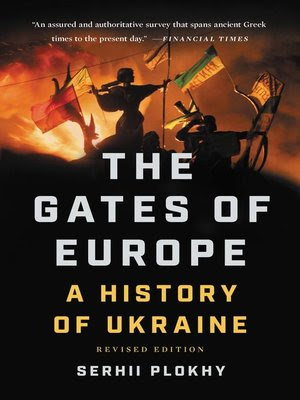
The Gates of Europe: A History of Ukraine
The history begins with Herodotus, which any history that justifiably can ought to do. 😉 The area was not then inhabited by Slavic speakers, but Cimmerians and Scythians, who spoke Iranian languages. Plokhy also makes use of Procopius' history, to discuss the area's relation to Byzantium, but he mostly moves over this period pretty quickly.
Slavic speakers first move to the area as part of the migrations caused by Attila the Hun. (5th or 6th century.) As the power of the Huns wanes, a new state, Kievan Rus' is established covering most of what is now Ukraine, Belorussia, and European Russia. Kyiv is the capitol. The nobles, led by the Rurikid dynasty, are a mix of Vikings and Slavs; the people, mostly Slavs. It reached its political apex under Yaroslav the Wise (978-1054).
It seems the word Rus' (the basis of Russian) comes (via the Finns) from the Swedish word 'ruotsi' used to describe the Vikings as the 'men who row.'
Yaroslav partitioned out the kingdom to his three eldest sons. Plokhy compares this division to that of Charlemagne. Like Charlemagne, Yaroslav did it to prevent inheritance squabbles among his sons, and it succeeded about as well as Charlemagne's attempt did. (That is, not at all.) New successor kingdoms were the result. These fought among themselves and tried to work with their more powerful neighbors (the Khazars, Byzantium). The word Ukraine first appears in the historical record at this time (in the 1180s). Then everything was swept away by the Mongol Horde in 1240. This was the beginning of differences between the various east Slavic states though none of them exactly correspond to three current ones. (Belarus, Ukraine, Russia).
Two east Slavic vassal states are formed in the aftermath of the Mongol invasion. One is Muscovy, with its capital Vladimir (near Moscow) and is the area around Moscow. The other, Galicia-Volhynia, was centred in Kyiv but moved its capitol to Kholm (now Chełm in Poland) and occupied the area of what's now western Ukraine and eastern Poland. The two vassal states received different treatment; the Muscovy state, closer to the Mongol heartland was more oppressed; the Kholm state was allowed a looser rein.
In 1323 the last male heirs (grandsons of the founder) of the Galicia-Volhynia dynasty died. The Mongols were a bit weaker. Galicia was taken over by the Polish kingdom; Volhynia by the Lithuanians. 1386 marks the beginning of the joining of Poland and Lithuania in a commonwealth. But the administration of the two areas remains separate. Plokhy thinks this is the beginning of a separate identity for Belarusians and Ukrainians.
The Cossacks begin as a sort of peasant rebellion in what is now eastern Ukraine, but in 1648 Bohdan Khmelnitsky creates a state (the Hetmanate) out of Polish-Lithuanian lands in what is now eastern Ukraine. Plokhy doesn't play down the pogroms that have left Khmelnitsky as little more than a swear word in Jewish history, but he did create a sort of Ukrainian state. But by 1780 the Hetmanate had been absorbed into Russia. Western Ukraine is split between Austria-Hungary (Lviv) and Russia (Kyiv) during the partitions of Poland.
There's an attempt to set up a new Ukrainian state in the immediate aftermath of World War I, but it doesn't last, doesn't really even get on its feet.
Plokhy discusses the state of education in the Ukrainian language in the various jurisdictions as one of the formative elements of a Ukrainian identity. The ability to use one's native Ukrainian in a public setting comes and goes at the political whim of the various powers. For instance, Austria-Hungary at one point trying to beat back Polish nationalism allows schools to use Ukrainian. Later to placate the Poles, Ukrainian is no longer taught.
Plokhy makes a good case for a Ukrainian identity, which is, of course, like anybody else's, only strengthened by persecution. In the 19th century a number of nationalities were finding their feet; Plokhy does suggest that the Ukrainians were a little late in finding theirs, though they did not really have a state of their own at any point in the 19th century.
I felt like I learned a lot from the book, especially in the time frames that were more obscure to me: the Middle Ages in Slavic lands. Looking at Plokhy's list of publications on Wikipedia, (he's now a professor at Harvard) it's clear one of his real interests is the formation of Ukrainian identity, and I found that the most interesting part.
This is a book for a non-specialist reader. (Like me!) It reads well, but it does cover 2500 years in 360 pages, so there are a few places where it felt a bit thin--World War I, for instance. Still. Full of fascinating and timely and suddenly--unfortunately--much more important things to know. Recommended.
Sunday, April 3, 2022
Kate O'Brien's Farewell Spain
You might guess from the title above that the nationality I've blanked is 'Spaniards', and that the time of its writing in early 1937, and of course it is. But it resonates."...and in any case, say only [blank] were fighting this war it is being fought for an issue which is everyone's immediate concern everywhere. It is a war waged by the forces of militaristic absolutism against democracy."
"But it is no good. The cathedral is on your conscience. You paid good money and took some trouble to get here to see it, and you can sit in a café anywhere. Ah, turismo, what a slave-driver you are!"
O'Brien arrives by boat in the north. She visits Santander, Compostela, Salamanca, Ávila:
"All the rest of the town [Ávila] is lovely. It slithers carelessly about the sides of a golden hill and west and south down to the Adaja. It is placed high, but far away on every side the cold points of mountains fence its landscape in."
O'Brien is quite taken with Saint Teresa of Ávila, and went on to write a book about her. (She had been raised Catholic, but was agnostic as an adult.) She gets to Madrid, by then under attack from the Nationalist forces, though it hasn't yet fallen. Her final stop is Burgos. The edition I have is a Virago reprint from 1985 with illustrations and an introduction by Mary O'Neill, her life partner.
I've never read anything else by Kate O'Brien (have you?) and I quite liked it. She's best known as a novelist, I think. I'm going to have find other of her books.
I read it now because we're going to Spain soon for a little over two weeks. (Yay!) This was the trip we'd planned for two years ago, but then had to cancel at the last minute. We'll mostly be in the south (Córdoba, Granada, the Alhambra) so, in fact, the book didn't do much to prepare me, but that's OK, but it was still pretty good...
It's nice to be able to go somewhere again.
And not only is this a place I want to go visit, it is a place I'm actually going to go visit!
Tuesday, January 25, 2022
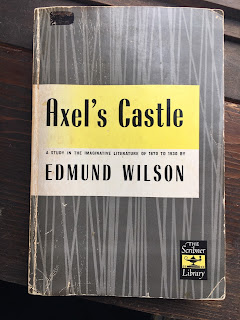
Edmund Wilson's Axel's Castle
The six main writers of Wilson's Axel's Castle are W. B. Yeats, Paul Valéry, T. S. Eliot, Marcel Proust, James Joyce and Gertrude Stein. So, you know, a pretty serious bunch. For Wilson, these are the representative Symbolists and his book is a study of 'imaginative literature of 1870 to 1930'."[These writers] break down the walls of the present and wake us to the hope and exaltation of the untried, unsuspected possibilities of human thought and art."
"...the symbols of the Symbolist school [unlike the cross for Christianity or the Stars and Stripes for the USA] are usually chosen arbitrarily by the poet to stand for for special ideas of his own--they are a sort of disguise for these ideas."
The book is full of sharp and unexpected insights on his subjects; on Proust, for instance:
"These latter scenes, indeed, contain so much broad humor and so much extravagant satire that, appearing in a modern French novel, they amaze us....it seems plain that Proust must have read Dickens and that this sometimes grotesque heightening of character had been partly learned from him."
Not what one thinks of when mentioning Proust, and yet it's true.
But it is 1931. Is this the literature the world needs? Wilson doesn't use the phrase art for art's sake, but maybe art should also be a bit for society's sake? He says Valéry's and Eliot's criticism is engaged in 'an impossible attempt to make aesthetic values independent of all other values.' He finds The Vision--Yeats' attempt to create a universalizing set of symbols--unserious and unhelpful, not to metion Yeats' experiments in automatic writing. He quotes disapprovingly, twice I think, Eliot's declaration from his essay 'For Lancelot Andrewes', that he is "a classicist in literature, an Anglo-Catholic in religion, and a royalist in politics." Wilson is distinctly none of those things.
I also found this on Valéry amusing:
"...one cannot help rebelling against what appears to be Valéry's assumption that it is impossible to be profound and to write as lightly and lucidly as [Anatole] France did."
A goal I suspect dear to Wilson's heart...
After the crash on Wall Street in 1929, Wilson was drawn to Communist ideas, though never becoming an actual Communist. But he did travel to the Soviet Union in the summer of 1935; once there he was put off by the increasingly totalitarian atmosphere, and certainly would have nothing to do with the Soviet Realist idea of art for politics' sake. Wilson doesn't fully construct his middle ground in this, and probably it can't be precisely defined. But technique matters and engagement matters, too. For that the book is applicable now as well, but maybe that's a perennial question. I do find it a very great work of criticism.
And one I tried to read before...at some point in my 20s I started this, but the only authors I'd then read were Yeats (whom I didn't know well) and Eliot (whom I knew only a little better). I thought, well, before I read this, I should read some of these authors. Now, (ahem) a few years later..., it was time to try again. One of Karen's categories this year was 'Classic on your TBR the longest'. Is this absolutely the one? I don't know, but it's been there a long time...
| "What!" says Humpty, "I need to read all those books just to read the one?" Well...maybe not entirely... |
Sunday, January 9, 2022
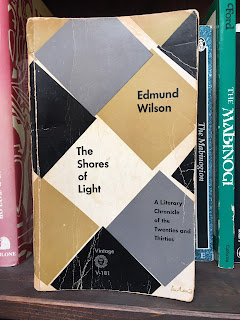
Reading the fatuous policeman: Edmund Wilson's Shores of Light
He arrives full of excitement and high expectations; eagerly he gets to know everybody who is writing, as he already knows everything they have written. He rushes about from one group to another. He attends all the literary teas, the publisher's luncheons, the theatrical openings, the miscellaneous drinking parties. And he brings to it all his shrewdness, his audacity, his humor, his extraordinary memory and his undiscourageable enthusiasm for literature. He makes us feel, as we read this record, that there is something really important in the air, that the work of all these people is interesting, that their opinions deserve attention.
"Maxwell Bodenheim [the Chicago, later New York poet] described me in some such phrase as 'a fatuous policeman, menacingly swinging his club.' In rereading this essay...I have sometimes been reminded of this."
"I have recommended lenience toward reviewers who use the books they are supposed to be reviewing as pretexts for expressing themselves; but only in cases where their articles--what happens comparatively rarely--are interesting in themselves. There is no excuse at all for an uninteresting review that tells nothing about the book. The reviewer, at the very least, should be expected to supply information. The retelling of the story of a novel, the summary of an historical or philosophical book, the selection of representative passages and the attempt to communicate the quality of a poet, is the most boring part of the reviewer's business, but it is an absolutely essential part."
And it left me with a bunch of new books I want to read. What more can a book about books do?
| Two literarily-engaged figures with large heads |
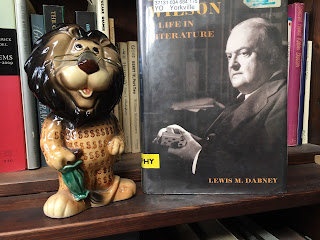
I got Lewis Dabney's Edmund Wilson: A Life in Literature (2005) from the library to go with this; I've only read it so far through the period in question, but I will finish it. That's where I got the skinny on Wilson and Millay. Dabney also edited the Wilson Library of America volumes.
The biography is pretty good, but editing, even, it seems, at a prestige publisher like Farrar, Strauss, is a lost art. The phrase 'shores of light' as Wilson tells us, comes from the Latin 'in luminis oras'. Wilson got it from Virgil, (Georgics, Bk II.47) though it appears a few other places as well. In Virgil, it's a comment about the heliotropism of plants; prosaically I might translate the line: "On their own plants grow toward light sources." Wilson romanticizes the line a bit in a poem he wrote (I'm quoting the end of his poem which appears in the essay on Millay):
My stubborn heart to-night
Divines the fate of souls who have not died,
Buried in sullen shadows underground--That reach for ever toward the shores of light.
The Shores of Light was the first book of the year for me, though it took me a week to write about. A good start! How's your reading year going?