Showing posts with label Ukraine. Show all posts

Tuesday, May 21, 2024

Serhiy Zhadan's The Orphanage (Ukraine)

"People aren't meant to keep so much fear and anger in their memories."

Pasha teaches at a school in the east of Ukraine. It's 2017 and the war in Ukraine is already in full swing in the east by then. But Pasha prefers to pay no attention to politics, speaks both Ukrainian and Russian, doesn't have a side, doesn't watch the news. 

Pasha's nephew is living in a nearby orphanage. The nephew's mother travels for her job, the kid's father's long gone, and with that background and the current situation, the kid was kind of a handful. Against the will of Pasha and the kid's grandfather, the mother had dropped him off at this orphanage. But now it's spring break, and Pasha's father browbeats Pasha into going and picking up his grandchild, Pasha's nephew.

But Pasha also doesn't watch the news. The orphanage is out in the countryside, in theory a short tram ride away. But overnight there'd been a shift in the front line Pasha hadn't heard about. He feels it, though, the moment he gets outside.

There are no trains and there are new checkpoints. Who's manning them? There are Russian-speakers with some Ukrainian; there's Ukrainian-speakers with some Russian; and then there are actual Russians, though in 2017 they're still pretending they aren't Russian, but Pasha hears Russian accents that aren't local.

The novel is structured as a three-day there and back journey. Through Hell? It occurred to me, even if the only soul who gets harrowed is one cantankerous but basically OK nephew. It is quite the hellscape he travels through.

But it's also a journey of discovery for Pasha. There's no my guys, your guys for Pasha at the beginning. (And wouldn't that be nice?) He's had a defective hand from childhood and couldn't be a soldier anyway. (Though somebody tells him at one point they've seen soldiers with worse.) But Pasha's a teacher of Ukrainian, and in the east that's already a political statement. And what he sees gradually changes him. When he gets to the orphanage at the end of the first day, there's only two adults left, the director and the gym teacher. Pasha and the gym teacher bond over their apoliticalness, but then Nina, the director, tells them both off.

Pasha sees worse in the two days it takes him to get back from the orphanage to his flat and his father, but he does make it with his thirteen-year-old nephew in tow. Pasha, who'd been passive as well as apolitical, starts to lead. He's also starting to decide.

The novel came out in 2017 in Ukrainian and was translated (ably, I think) into English in 2021 by Reilly Costigan-Humes and Isaac Stackhouse Wheeler. From the Ukrainian, it says, but I suspect there's quite a lot of subtlety where speakers shift between Russian and Ukrainian that the translators were obliged convey differently. 

A powerful portrait of a grim time and place, but one that ends with family and country and a glimmer (?) of hope. But things have only gotten worse in the Ukraine since then.


Friday, August 25, 2023

Owen Matthews' Overreach

"We used to believe the Russians had the second-best army in the world. Now we know they have the second-best army in the Ukraine."
-Ukrainian soldiers' joke


A bit of bravado, funny, but not entirely wrong either...

Owen Matthews' book on the war in the Ukraine came out late last year. Matthews is a British journalist with deep ties to Russia: he lived there for twenty-five years, speaks the language fluently, was the Moscow bureau chief for Newsweek.

Also his mother, wife, and children are Russian. 

He starts with a quick history of the Ukraine. A lot of his information comes from Serhii Plokhy's The Gates of Europe, but some of it is also family history: his mother was born Lyudmila Bibikov, a Russian-speaker from the Ukraine; his grandfather Bibikov was an ardent communist (Matthews has an Aunt Lenina!) but his grandfather had the temerity to suggest that collectivization was proceeding too fast in the Ukraine; and so he was murdered in the Stalinist purges in the 30s. Matthews' grandmother was exiled to Siberia. Earlier Bibikovs were high-ranking military officers in the Tsarist army. "For two centuries the Bibikovs played a significant role in Russia's imperial rule over Ukraine, first as servants of the tsars and later as loyal lieutenants of the Soviet power." He goes on, "The connection is not a comfortable one."

But the earliest Bibikov in the historical record was born Bibik Beg, a Tatar warlord who swore fealty to the Russian tsar in 1486 and Russified his name to Bibikov.

This was all pretty fascinating and well-done, and I noticed one of Matthews' earlier books is a family memoir, which I'm now curious to find.

Then comes the lead up to the war. Matthews gives a coherent account of the different factions in Russian government. Matthews clearly has good sources in both the Foreign Affairs department under Sergey Lavrov and in the office of Dmitry Peskov, Putin's spokesman. (Neither of his sources he names, for obvious reasons.) Putin was not necessarily the most aggressive (and Sergey Shoigu probably the least) but Putin had become isolated during Covid and no longer quite tethered to reality. (Why was he so isolated? There's apparently a rumour he had thyroid cancer, but nobody knows for sure.) This was interesting, but complicated.

Russia invades on February 24th of last year. Matthews is in Moscow and notes how quickly the mood in Moscow changed. Before the war he was able to talk relatively freely with friends and sources; after it starts he's shunned. At the end of March a friend tells him in strong terms he needs to get his son out: his son is 19 and not in university (he's working with a theatre troupe) and so is subject to call-up. Sanctions have started to bite and flights out of Russia are limited; they get to Istanbul on Turkish Air. Ticket prices have gone through the roof, but Turkish Air is still accepting frequent flyer miles. One advantage of being an international journalist, I guess, is you got lots of those... 😉

Everybody expected the Russian army to roll into Kyiv, not just Putin and Russian generals, but also most of the West. Early on Zelenskyy was prepared to negotiate with Putin, to offer neutrality, to stay of NATO, possibly to give up territory. But Putin believed he could get more. After the discovery of the atrocities at Bucha and Irpin north of Kyiv, Zelenskyy's willingness, but also room, to negotiate shrank.

Of course the Ukraine did fight, and with considerable success. In retrospect, Matthews notes how much military experience there was in the Ukrainian army and even in the general Ukrainian public by then, after eight years of an active war zone in the Donbas: 900,000 Ukrainians had done military service but were not in the army at the start of the war. And they were willing to fight. At the beginning, the Ukraine had more volunteers than weapons, and turned people away.

The Russians less so. It seems nearly a million people left Russia in the first month or so after the war started; possibly another million after the ramp-up in conscription in September of 2022. Putin still remains popular though, and the exodus may have only strengthened his popularity. Matthews discusses such independent polling as is available; it confirms Putin remains relatively popular with the average Russian.

He also notes those Russians who do not like him may be even more nationalistic; much of Putin's opposition is from the nationalistic right-wing. In the end Matthews isn't very optimistic about how all this turns out. The sanctions have hurt Russia, but not hurt enough to be a game changer. Putin probably won't fall, but should he fall, he's more likely to be replaced with somebody worse.

Matthews quotes Andrei Kolesnikov of the Moscow Carnegie Center, "...and so we continue our steady movement down the world's garbage chute."

Matthews closing:
"Not only would Putin leave no lasting ideological legacy, but any legacy of prosperity and stability that he may have created had been destroyed by his own decision ot make war on Ukraine. He had gained a fifth of Ukraine [less now--me] and increased the size of Russia by half a per cent. The price of his illusions was not only thousands of lost lives, but also a lost future for Russia. Most ominously of all, the misbegotten war had opened a Pandora's box of alternative futures for Russia that were much more scary than Putin's regime had ever been."


This could do for either Russia or Ukraine for my reading challenge, but I have another Andrey Kurkov novel out from the library that I should read soon, so that will be Ukraine and this will cover Russia. 

It was a pretty good look at an unfortunate topic.


Saturday, June 18, 2022

The Black Sea: A History

"There is a deep landlubber bias in historical and social research. History and social life, we seem to think, happen on the ground."

A couple of years ago I read Charles King's Midnight at the Pera Palace (looking at 20th-century Turkey though the lens of a luxury hotel/night club in Istanbul) and liked it a lot. More recently I read his Gods of the Upper Air (about American anthropologists, such as Franz Boas and Margaret Mead) and liked it, though a bit less. I didn't manage to blog about either. 

But then, in a moment of idleness, I was looking through Charles King's back catalog and checking what my library had, and there was this volume: The Black Sea: A History. We've all been thinking about the Black Sea far more lately. I thought I should check this out. (Both literally and figuratively.)

The volume begins by discussing why we should consider the Black Sea a unit; it's often not these days; the countries involved are divided under Russian studies or Balkan studies or Near Eastern studies. He makes a good case, but I have to say I wasn't necessarily engaged with that question. Then he discusses the geography and geology of the region, which was pretty fascinating. Good harbors, which products were available for trade, where and when the fishing was good are all hugely important questions to anyone near the sea. 

But that's all pretty quick. Then we're on to the history. As I said once before, any history that can conceivably start with Herodotus ought to do so, and the historical part of this one does, too. One of King's recurring motifs is that the Black Sea is an inland sea for somebody--or it's not. Is it a place of trade or of conflict? For the Greeks, it seems, at least in the early years, it was an inland sea, with a number of Greek colonies trading with their respective hinterlands, but in fairly regular communication with each other and the Greek homeland. Most of the Greek colonies were of Milesian origin. But already by the time we think of as high classical Greek civilization (5th-4th century B.C.) this was falling apart. Alexander's ascendancy didn't last long, and none of the successor kingdoms dominated the sea.

Nor did the Romans. Their inland sea was, of course, the Mediterranean (Mare Nostrum) and the Black Sea was the frontier, where they fought against states they bordered on the east: Pontus, Parthia, Armenia.

It was closer to an inland sea for the Byzantines at their peak, but never quite. Italian city states--Venice, Genoa--pick up a fair amount of the trade and maintained entrepôt of their own. And by the later years of their empire the Byzantines controlled very little of the Black Sea littoral.

But then the Ottomans, after they took Byzantium (1453) again held the sea under one power. Some of the states on the Black Sea were tributaries and not directly part of the empire, but for roughly 300 years after the fall of Byzantium, the Black Sea was an Ottoman lake, and trade was relatively free and easy. 

Eventually the Ottoman empire grew weaker--and the Cossacks came on the scene. The Cossacks were perfectly happy--and perfectly capable--of conducting piracy on the sea in addition to their raids on horseback. But by themselves they weren't able to dominate the Black Sea. But their piratical successes were one of the things that revealed the increasing weakness of the Ottomans. The Russians took note.

The latter history of the Black Sea is story of the conflict between Russia and Turkey over control of the Black Sea--and the efforts of other players, the British, the French--to keep one party from dominating. The Crimean War, among other conflicts, was the result. Among the results of the Crimean War was an attempt to de-militarize the Black Sea.

The book comes out in 2004 and at that time King was optimistic. There were new environmental initiatives to counteract years of neglect and damage. "[C]onflict among the states of the Black Sea zone is now virtually unthinkable." [p.240] Alas. As Yogi Berra may (or may not) have said: It's tough to make predictions, especially about the future.

Still, it's a pretty fascinating book, even if it needs updating. If you've read his other books you'll know, King likes anecdotes and uses them well. There's some good stories in it and it's pretty readable. And especially now, worth reading.


As King notes in the beginning, six countries currently border the Black Sea; if you counted the countries in the Black Sea drainage area, there are 22 possibilities. Out of all those choices, I guess I won't pick the most obscure... King is a professor in the foreign services school at Georgetown, and at least at the time of this book held the Ion Raţiu chair in Romanian studies. Romania is important in the book, I need to keep up my Romania streak, and so...Romania it is! for the European Reading Challenge.

Friday, April 15, 2022

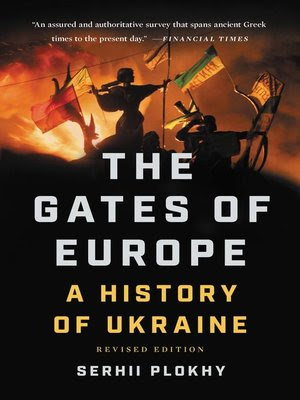
The Gates of Europe: A History of Ukraine

Serhii Plokhy's The Gates of Europe: A History of Ukraine is a history both of the land occupied by the contemporary nation of Ukraine, but even more of the people who are Ukrainians. It covers 2500 years ending with 2020 in the revised edition. (The revised edition came out in 2021.)

Especially now it made for a pretty fascinating read.

The history begins with Herodotus, which any history that justifiably can ought to do. 😉 The area was not then inhabited by Slavic speakers, but Cimmerians and Scythians, who spoke Iranian languages. Plokhy also makes use of Procopius' history, to discuss the area's relation to Byzantium, but he mostly moves over this period pretty quickly.

Slavic speakers first move to the area as part of the migrations caused by Attila the Hun. (5th or 6th century.) As the power of the Huns wanes, a new state, Kievan Rus' is established covering most of what is now Ukraine, Belorussia, and European Russia. Kyiv is the capitol. The nobles, led by the Rurikid dynasty, are a mix of Vikings and Slavs; the people, mostly Slavs. It reached its political apex under Yaroslav the Wise (978-1054).

It seems the word Rus' (the basis of Russian) comes (via the Finns) from the Swedish word 'ruotsi' used to describe the Vikings as the 'men who row.' 

Yaroslav partitioned out the kingdom to his three eldest sons. Plokhy compares this division to that of Charlemagne. Like Charlemagne, Yaroslav did it to prevent inheritance squabbles among his sons, and it succeeded about as well as Charlemagne's attempt did. (That is, not at all.) New successor kingdoms were the result. These fought among themselves and tried to work with their more powerful neighbors (the Khazars, Byzantium). The word Ukraine first appears in the historical record at this time (in the 1180s). Then everything was swept away by the Mongol Horde in 1240. This was the beginning of differences between the various east Slavic states though none of them exactly correspond to three current ones. (Belarus, Ukraine, Russia).

Two east Slavic vassal states are formed in the aftermath of the Mongol invasion. One is Muscovy, with its capital Vladimir (near Moscow) and is the area around Moscow. The other, Galicia-Volhynia, was centred in Kyiv but moved its capitol to Kholm (now CheÅ‚m in Poland) and occupied the area of what's now western Ukraine and eastern Poland. The two vassal states received different treatment; the Muscovy state, closer to the Mongol heartland was more oppressed; the Kholm state was allowed a looser rein. 

In 1323 the last male heirs (grandsons of the founder) of the Galicia-Volhynia dynasty died. The Mongols were a bit weaker. Galicia was taken over by the Polish kingdom; Volhynia by the Lithuanians. 1386 marks the beginning of the joining of Poland and Lithuania in a commonwealth. But the administration of the two areas remains separate. Plokhy thinks this is the beginning of a separate identity for Belarusians and Ukrainians. 

The Cossacks begin as a sort of peasant rebellion in what is now eastern Ukraine, but in 1648 Bohdan Khmelnitsky creates a state (the Hetmanate) out of Polish-Lithuanian lands in what is now eastern Ukraine. Plokhy doesn't play down the pogroms that have left Khmelnitsky as little more than a swear word in Jewish history, but he did create a sort of Ukrainian state. But by 1780 the Hetmanate had been absorbed into Russia. Western Ukraine is split between Austria-Hungary (Lviv) and Russia (Kyiv) during the partitions of Poland.

There's an attempt to set up a new Ukrainian state in the immediate aftermath of World War I, but it doesn't last, doesn't really even get on its feet.

Plokhy discusses the state of education in the Ukrainian language in the various jurisdictions as one of the formative elements of a Ukrainian identity. The ability to use one's native Ukrainian in a public setting comes and goes at the political whim of the various powers. For instance, Austria-Hungary at one point trying to beat back Polish nationalism allows schools to use Ukrainian. Later to placate the Poles, Ukrainian is no longer taught. 

Plokhy makes a good case for a Ukrainian identity, which is, of course, like anybody else's, only strengthened by persecution. In the 19th century a number of nationalities were finding their feet; Plokhy does suggest that the Ukrainians were a little late in finding theirs, though they did not really have a state of their own at any point in the 19th century.

I felt like I learned a lot from the book, especially in the time frames that were more obscure to me: the Middle Ages in Slavic lands. Looking at Plokhy's list of publications on Wikipedia, (he's now a professor at Harvard) it's clear one of his real interests is the formation of Ukrainian identity, and I found that the most interesting part. 

This is a book for a non-specialist reader. (Like me!) It reads well, but it does cover 2500 years in 360 pages, so there are a few places where it felt a bit thin--World War I, for instance. Still. Full of fascinating and timely and suddenly--unfortunately--much more important things to know. Recommended.

Tuesday, March 29, 2022

Two by Andrey Kurkov (#GoUkraine)

"An odd country, an odd life which he had no desire to make sense of. To endure, full stop, that was all he wanted." 

-Andrey Kurkov, Death and the Penguin, p. 34

I've been thinking about the Ukraine lately. Well, who isn't? There's a park near my house where school groups play if the weather is at all tolerable. I went by the other day and a bunch of six-year-olds were chanting, "Go Ukraine, Go Ukraine..."

So I ordered up some Ukraine books from the library.

The two Andrey Kurkov novels I got both date from 1996, both are set in Kiev, and are both translated from the Russian by George Bird. I read Andrey Kurkov's A Matter of Death and Life first, because it was the shorter... ;-)

Tolya has just lost his job and his wife. He contemplates suicide, but doesn't have the nerve to do it himself. He's got friends in dodgy places and decides he'll hire a hit man, ostensibly to kill the wife's new lover, but instead of the lover, he supplies a photo and location details for himself. Suicide by hit man. But then he meets somebody new, gets a job (though a fairly corrupt one). By an accident of timing, he survives the planned attempt on his life, and then decides he'd rather live.

I enjoyed this, and the twist that resolves his dilemma was pretty good, but it is slight. If it was longer than its 110 pages it would have definitely felt overstuffed.

Death and the Penguin is the better-known, and better, novel. I found it very good indeed.

Viktor Zolotaryov is a not very successful writer. He's written stories, unpublished, and dreams of writing a novel, but hasn't got the oomph. He makes (not much of) a living writing occasional journalism. Viktor's one distinction is he has a pet penguin. The impoverished zoo was giving away animals to those who promised to feed them.

Then a newspaper editor sees one of Viktor's stories, likes the style, but doesn't publish fiction. But he asks Viktor, for a handsome salary, to start writing obituaries--for the files. 

Viktor has a talent, or so it seems, but this isn't exactly a way into print because the obits are just kept on file for when they're needed. Initially he gets to pick his own subjects; a Mafia-connected figure comes by and asks Viktor to write an obit for a friend who's ill and offers extra cash for the job. But the friend recovers, and Viktor complains to the Mafia figure that he'd like to appear in print, but none of his subjects has died. The Mafia figure asks which of his obits does Viktor think the best and Viktor tells him.

Then one of his obituaries does appear in print. Somebody's died. Guess who?

"How did he die?" Viktor asked.
"Fell from a sixth-floor window -- was cleaning it for some reason, apparently, though it wasn't his. And at night." [30]
The dam's burst; there's more deaths. Viktor has clearly gotten himself into the middle of something he can't control or even comprehend. Viktor is advised to disappear for a while for safety. His editor disappears for a while -- also for safety. The Mafia acquaintance disappears -- for safety -- and entrusts his daughter Sonya to Viktor -- for safekeeping. Viktor hires Nina, the niece of a friend, to help him watch over Sonya. Viktor and Nina become involved.

What is the nature of a normal life?
"...an ordered, normal life -- for which the essential requisites: wife, child, pet penguin, were present..." [149]

Is that what Viktor has? 

It's the mid-90s and Ukraine is newly independent after the breakup of the Soviet Union. Corruption is around every corner; differences of opinion are solved by violence; maybe a little exaggerated, but not inaccurate, I suspect. Is this violence and corruption normal and expected?
"The pure and the sinless did not exist, or else died unnoticed and with no obituary. The idea seemed persuasive. Those who merited obituaries had usually achieved things, fought for their ideals, and when locked in battle, it wasn't easy to remain entirely honest and upright." [61]

Russia doesn't loom as large in these two novels of the early independent Ukraine as it does now. 

The back of the novel cites Bulgakov; certainly it is a black comedy (and is definitely funny) along the lines of Gogol and Bulgakov, though perhaps not quite as extravagant as those two: nobody's nose runs off to a separate existence, nor does the Devil appear. (Though the penguin's story arc is definitely weird.)

The two novels are actually fairly similar in their structure: the protagonist gets in over his head and requires a twist to get out of the dangerous world of corruption he's fallen into. But the twist in Death and the Penguin is both better setup and more surprising. Highly recommended. 

I need to return these to the library soon; initially I got them pretty quick, but now everybody wants them. But in exchange I get to pick up Serhii Plokhy's The Gates of Europe: A History of Ukraine.

Go Ukraine.

Sunday, September 5, 2021

Sholom Aleichem's In The Storm

"Hearken, O ye nations! Heed, O ye peoples of the world, what my mouth will utter now. Waken from your slumbers, raise your eyes, look about you and see the darkening sky. Black clouds are gathering above, a mighty wind drives them with great speed and they cover the entire sky. Soon, soon, a storm will be breaking. Soon, soon, the thunderclouds will burst and a great storm will pelt down, not of water but of blood." [187]

That's the storm of In The Storm, Sholom Aleichem's novel set in the year 1905. Lippa Bashevitch, an uneducated wood-hauler, has been driven half-mad by events.

But it's not all in such a high register and even Lippa can't sustain that. Immediately afterwards one of the other characters says, "Reb Lippa! Perhaps you would like something to eat?"

1905 is an important year in Russian history. Russia has just--shockingly--lost the Russo-Japanese War. The events of the Russian Bloody Sunday--where peaceful marchers in St. Petersburg are fired on by police--is an important moment in the novel. The Tsar feels compelled to offer the people, temporarily as it turns out, a constitution. "Constitutzia, constitutzia!"

(It's also the time of the movie Battleship Potemkin, though none of those events show up in the book.)

The novel starts in Kiev: "Three different Pesachs were being prepared at No. 13 Vasilchikover Street." These Passover preparations are in the apartments of Itzikl Shostepol, Solomon Safranovitch, and Nehemiah the shoemaker. (Lippa Bashevitch supplies the building with firewood.) Itzikl Shostepol is a well-to-do merchant and religious; Solomon Safranovitch is a middle-class pharmacist and secularizing; Nehemiah is poor and lives in the basement. But all three have children who are engaged with the ideological currents flowing through Russia at the time.

At the start of the novel Tamara Shostepol and Sasha Safranovitch are about to return to Kiev for the holiday from St. Petersburg where they have been studying. They arrive on the same train, and, while as far as their fathers are concerned, they're not supposed to know each other since they're from different economic classes, they do, having grown up in the same building. 

The novel then flashes back to events in St. Petersburg and that Bloody Sunday in January. The second half of the novel returns to Kiev. The tsar revokes the constitution later that year and scapegoats the Jews for Russia's failures. A series of pogroms erupts including one in Kiev. Our characters have to make serious choices.

Sholom Aleichem himself lived through that Kiev pogrom, though he was well-enough off at the time to take his family and hole up anonymously in a hotel. But that was the event that led to Aleichem leaving Russia. "Palestine and America--what a choice!" [219]

Aleichem is often written off at the sentimentalizing chronicler of shtetl life, he of Kasrilevke and Tevye and Fiddler on the Roof. (Great as I find Fiddler on the Roof to be.) I already knew there was more to him than that, but still this novel was a surprise. It's a very urban setting. It also represents the division between a more politicized second generation and their more accommodationist parents, a novel of the sort you see in The Demons (Dostoevsky) and Fathers and Sons (Turgenev). It's also stylistically quite interesting, with various modes: a telegraphic biography of a police spy, e.g., or what seem to be excerpts from police reports. Reading it in translation the interplay between Hebrew and Yiddish will inevitably mostly go past me, but the translation by Aliza Shevrin seems strong and she's able to make some of that apparent.

A few years ago I read Jeremy Dauber's biography of Aleichem and I got it back from the library to see what he said about the novel. The novel was first serialized in the spring of 1906 in the left-wing New York Yiddish paper Varheit, under the title The Deluge. Aleichem rewrote it before it appeared as a novel under the current title. 

At that time Aleichem was new to New York, having fled the Kiev pogrom. His family was still in Europe, his older children at school in Switzerland. He had just had two failures on the New York Yiddish stage, possibly because Aleichem, not knowing New York, had offended the wrong claques. Already a pretty well-known writer, but never, it seems, very astute with money, he needed it badly at the time, and a contract for a serialized novel was a huge boon. (I also have to assume that the Yiddish press was not so well-established at the time that it could pay its authors all that well.)

Highly recommended.
"Come with me, reader, give me your hand, let us proceed--we have a long, long way to go!" [21]

"Why are we standing here? It's time to say goodbye!" [220] 

Not such a long way as all that at 220 pages, but a good one.  

Note: His name is usually transliterated Sholem Aleichem these days, but I spelled it Sholom throughout since that's the way it appears on the cover of my edition of In The Storm.