Showing posts with label NonFic2023. Show all posts

Monday, November 27, 2023

November challenges wrapup (new to the TBR)


The prompt for the last week for both these challenges is the same: What new books did you learn about and add to your TBR? I'm going to be lazy and lump them both in to one post... 😉

Walter Lord/A Night to Remember 
    (Readerbuzz, non-fiction)
François Mauriac/The Kiss of the Leper 
    (NancyLN, novella)
Mike Harris/Mike Nichols: A Life 
    (NancyLN, non-fiction)
Philip Larkin/Letters to Monica 
    (Intrepid Angeleno, non-fiction)
Charles Montgomery/The Happy City: Transforming Our Lives Through Urban Design
    (Adventures in Reading, non-fiction)
Travis Elborough/Atlas of Vanishing Places
    (Volatile Rune, non-fiction)
Louisa May Alcott/Behind a Mask
    (KlasikFanda, novella)
Patrick Modiano/Sundays in August
    (NancyLN, novella)

Now if only my library would start working again...but they say not until January. Yikes!

Fortunately I've got a few Dean Street Press mysteries lined up for next month.

Thanks to all our hosts!

Saturday, November 11, 2023

Rebecca Solnit/Orwell's Roses (#NonficNov)

"In the spring of 1936, a writer planted roses."

That's the opening line of Rebecca Solnit's most recent book Orwell's Roses, and the writer-slash-gardener is George Orwell. Orwell wrote about the roses (and also the fruit trees and gooseberries he planted) in his essay 'A Good Word for the Vicar of Bray' of 1946. Solnit calls it 'a triumph of meandering that begins by describing a yew tree in a Berkshire churchyard.' It takes one to know one: Solnit is a champion of the meandering essay herself.

Back to the Vicar of Bray for a moment. He's not a hero: what he's famous for is the slipperiness of his politics:
And this is law, I will maintain,
Until my Dying Day, sir,
That whatsoever King may reign,
I will be the Vicar of Bray, sir! 

Still, the Vicar planted that yew tree. Orwell:

"An oak or a beech may live for hundreds of years and be a pleasure to thousands or tens of thousands of people before it is finally sawn up into timber. I am not suggesting that one can discharge all all one's obligations towards society by means of a private re-afforestation scheme. Still, it might not be a bad idea, every time you commit an antisocial act, to make a note of it in your diary, and then, at an appropriate season, push an acorn into the ground."

Or roses. 

Solnit was in England for a book tour and was interested to see what was left of Orwell's plantings. Only the roses survived.

"There are many biographies of Orwell, and they've served me well for this book, which is not an addition to that shelf. It is instead a series of forays from one starting point, that gesture whereby one writer planted several roses. As such, it's a book about roses..."

An interesting topic for a meander.

So many fascinating things: Emma Goldman, the photographer Tina Modotti, Stalin and lemon trees. Columbia is the source for 90% of North America's commercial cut roses and is infamous for its terrible labor practices. Solnit manages to visit a rose farm there. It's not a long book, but it's fascinating and I won't even try to tell you all the things in it.

One of her main themes is the frequent puritanism of the left. Orwell is sometimes absorbed into this. Is he a dour political writer who can only tell us the terrible things are going to happen, the terrible things that are happening? Maybe not just. Turns out nature is important in 1984 and is written about well. This leads her to Emma Goldman, the anarchist, and Tina Modotti, the photographer and Communist. 

It is also about what a political essayist can and should do: in Solnit's case in this book, feminism, labor issues, the creeping return of totalitarianism, climate change.

Pretty great stuff. It's the fourth I've read of her twenty-five or so books. (River of Shadows, A Field Guide to Getting Lost, The Faraway Nearby and now this.) Right now it's my favorite, and is likely to stay so at least until I read the next one. 

    "Orwell's signal achievement was to name and describe as no one else had the way that totalitarianism was a threat not just to liberty and human rights but to language and consciousness, and he did it in so compelling a way that his last book casts a shadow--or a beacon's light--into the present. But the achievement is enriched and deepened by the commitment and idealism that fueled it, the things he valued and desired, and his valuation of desire itself, and pleasure and joy, and his recognition that these can be forces of opposition to the authoritarian state and its soul-destroying intrusions.
    The work he did is everyone's job now. It always was."


Monday, October 30, 2023

My Year in Non-Fiction

One of the great November challenges is November Nonfiction:

This week's prompt, My Year in Nonfiction, is hosted by Heather.

Past

Readers, let me tell you, the state of our Non-Fiction reading is sound. 😉 I seem to have hit a fairly high (for me) 20% of my reading this year as non-fiction. Some highlights (in the chronological order I read them):

Brigitta Olubas/Shirley Hazzard

This new biography (2022) of Shirley Hazzard was the first book of the year for me. It was a superb literary biography, but I didn't manage to blog about it. I'm a big fan of Shirley Hazzard's novels (The Transit of Venus especially, of course) and when I saw this came out and was getting glowing reviews I had to read it. If you care at all about Shirley Hazzard you will want to read it. (If you haven't already.)

Michael Hingston/Try to be Strange

A history of the notional Kingdom of Redonda, which is a literary in-joke. It didn't get a full review, but it did get a somewhat substantial mention in a Sunday Salon post here. This led to a bit of a reading project, which also included:

Javier Marias/Dark Back of Time

Pretty great, though I am rather a Marias fan. Another book I didn't manage to blog about. It's Marias writing about the reception of his novel All Souls, his history with John Gawsworth, the king of Redonda somewhat before Marias was, and a bunch of other things... I trust some of it was fictional, but I couldn't quite tell you what. The novel A Heart So White remains Marias' masterpiece, but this is one of his better ones.

Victor Gruen/Shopping Town

An autobiography by the Jewish Austrian emigré architect who designed the first shopping mall (outside Detroit). Pretty fascinating. It got a full review here.

James Baldwin/Notes of a Native Son

His first volume of non-fiction. It came out in 1955, and reprints essays he'd written over the previous ten years or so. Fascinating. Literary criticism, what it meant to be Black in the U.S., life in Paris in the 50s. From my Classics Club list, it deserved (and got) a full review.

Anna Comnena/The Alexiad

Anna Comnena's history of her father's reign in Byzantium from 1081 to 1118. A primary source for the place and period, but also, I was a bit surprised to discover, a pretty great read.

Harvey Sachs/Schoenberg: Why He Matters

Another new release. This one's about the 20th Century composer Arnold Schoenberg. There was a review in the New York Times that made me want to read it. The review suggests it's pretty readable and so it was, no technical knowledge of music required. I'm not especially knowledgeable about serious music--my interest in this was because of Schoenberg's importance to Thomas Mann's novel Doctor Faustus. But I did go off afterwards and listen to a bunch of Schoenberg's pieces on YouTube and actually enjoyed them.

There were others, some quite fascinating, that also got blogged about, listed here.

Future

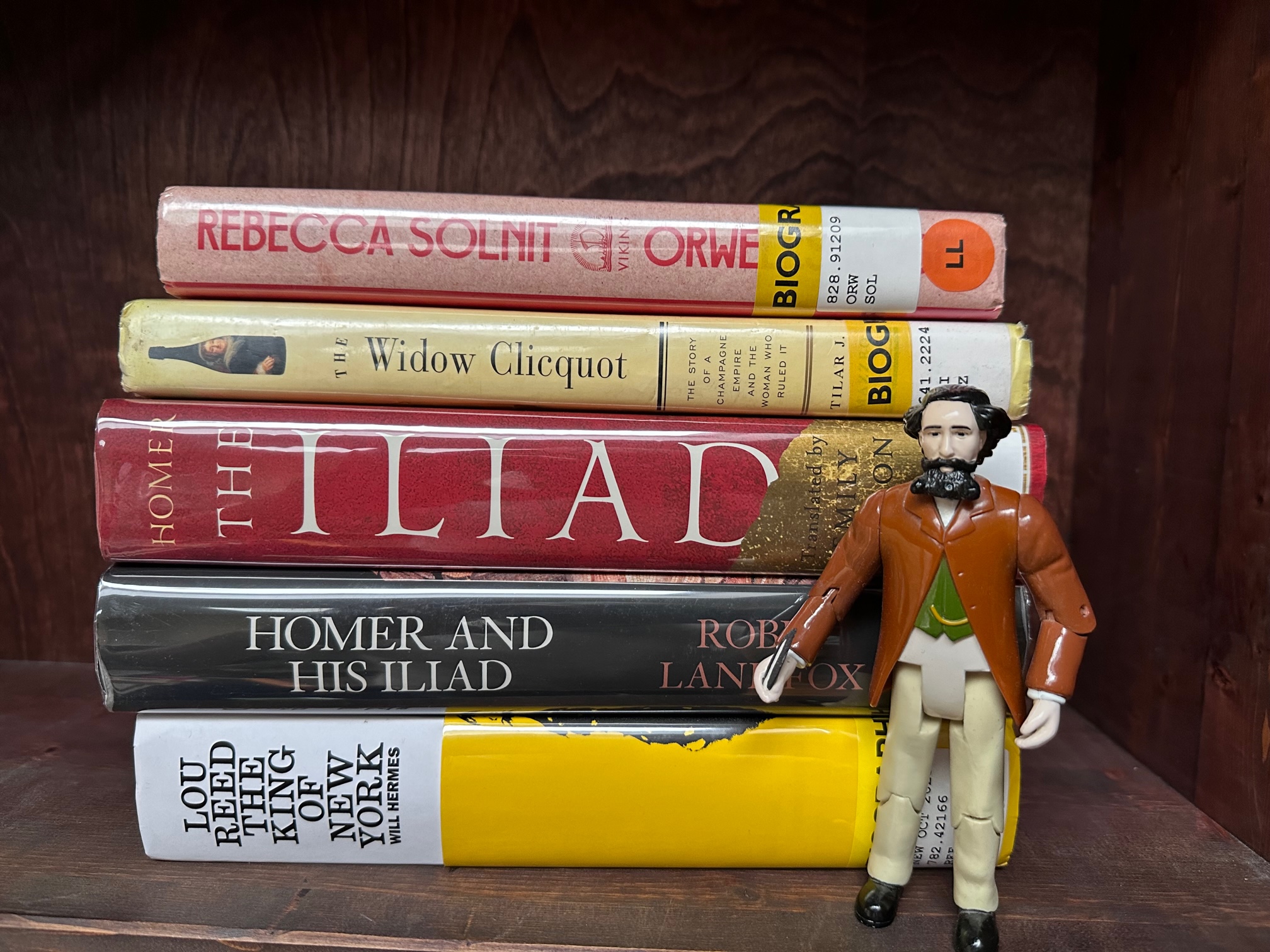
So what's to come for the rest of the year? I couldn't provide a picture of a stack of all those books (because who doesn't want that?) since almost all of those came from the library. But I can provide a picture of the non-fiction books likeliest to get read in the near future (and one ringer...)

Once again it's Chuck and a stack of books!

The library has provided Rebecca Solnit's Orwell's Roses, and I'm a fan of hers. One great essayist engaging with another.

Tilar Mazzeo's The Widow Clicquot. She took over the champagne house after her husband died and now it's named for her. I've been interested since I saw the movie

Will Hermes' new biography Lou Reed: The King of New York. This is the one that will have to be returned the soonest.

Robin Lane Fox' Homer and His Iliad. Lane Fox is a serious classical scholar and an emeritus professor. (At least I think he's emeritus. He's getting up there.) This volume came out earlier this year and is supposed to be for a fairly general audience. I was a classics major, I'm rusty now, but I do try to keep up a bit.

And then the ringer in the pile: Emily Wilson's new translation of The Iliad.  I loved her translation of The Odyssey that came out a few years ago, and I've been looking forward to this one. We'll call it the ringer, because I assume it's basically fiction--though Heinrich Schliemann managed to find the original location of Troy by assuming it was true. But I hope to read both the Fox and the Wilson by the week where the prompt is to pair up a non-fiction book with a fiction book.

There are a few other things from the library around here as well...Plus, well maybe, I could read a book I already own...

Present

I'm currently in the middle of a translation of Georg Christoph Lichtenberg's commentary on Hogarth's series of prints Marriage A-la-Mode. Will I blog about it? Maybe! Lichtenberg was a professor of physics at Göttingen in Germany, roughly contemporaneous with (and friends with) Goethe. Lichtenberg is better-known as an author of epigrams, like La Rouchefoucauld, and that was what I more interested in, but this was what my library could produce on short notice.

Which look good to you? Are you taking part in November Nonfiction?

Wednesday, September 13, 2023

The Alexiad of Anna Comnena

"The date was the first of December in the seventh indiction. [1083] He [Alexius I Comnenus] found the empress in the throes of childbirth, in the room set apart long ago for an empress's confinement. Our ancestors called it the porphyra--hence the world-famous name porphyrogenitus. At dawn (it was a Saturday) a baby girl was born to them, who resembled her father, so they said, in all respects. I was that baby."

Born in a room lined with purple marble, that baby was Anna Comnena, who went on to write a history of her father Alexius' reign as Emperor of Byzantium from 1081-1118. 

The Comneni were a prominent Byzantine family and Alexius' uncle had been emperor from 1057-1059. But to become emperor in 1081 he had to lead a coup. The previous emperor Nicephorus Boutaniates was elderly and had no clear successor. As Anna tells it, Alexius and his brother Isaac became worried at the machinations in the palace, and decided to simply leave Byzantium. Whether that was exactly so or not, they ultimately decided the safest thing for them was simply to seize power.

Alexius and Isaac were both senior figures in the Byzantine military, with Alexius, the younger of the two brothers, holding the more senior office, Great Domestic of the West, which meant he was the supreme commander of military forces in the European half of the Byzantine empire. After some discussion between them it was Alexius who became emperor, though his brother remained a top official. Alexius as a general had been successful in staving off the various threats, but still the state of the empire in 1081 was bad. The Byzantines had lost the disastrous battle of Manzikert in what is now eastern Turkey in 1071, and the lands they had firm control of were little more than the city itself by the time Alexius proclaims himself emperor:
"Alexius knew that the Empire was almost at its last gasp. The east was being horribly ravaged by the Turks; the west was in a bad condition, while Robert [Guiscard] strained every nerve to put on the throne the pseudo-Michael who had taken refuge with him...The Romans [for Anna, what's our Byzantine Empire is still the Roman Empire] had no worthwhile forces; in fact there were no more than 300 soldiers in the capital...In the imperial treasury there were no reserves of money with which he could summon allies..."
The first ten years are pretty much constant warfare. He has to beat back the Seljuk Turks, the Normans under Robert Guiscard, and both Cuman and Pecheneg nomads from north of the Danube. A Seljuk Turk attempts to create a new state centred on Smyrna and leads sea raids up the Turkish coast, taking over Lesbos and Chios. All of that has to be stopped.

As Anna tells it, Alexius has a number of quite competent military assistants and advisers, starting with George Palaeologus. He doesn't often listen to them, though, and hot-headedly charges into battle, leading from the front, and getting beaten, even after Palaeologus suggested maybe that wasn't wise. In particular he loses three times to the Normans before he finally manages to fight them to a standstill. In the end it's mostly the death of Robert Guiscard which slows that source of attack.

It gets easier after ten years, but still not easy. There are a number of internal rebellions and the Pechenegs haven't yet given up, but the empire's boundaries are a bit more stable. Then the First Crusade comes through town. This is both opportunity and threat. The avowed enemy of the crusaders are the Muslims, and in particular the Seljuk Turks, who were also a traditional enemy of Byzantium. But how committed are the crusaders actually to their stated mission? And anyway do the Western Christians actually think the Eastern Christians are legitimately Christian? It's in these years that Alexius' reputation for wiliness gets established--Anna admires wiliness, even in enemies such as Bohemond, Robert Guiscard's son--and Alexius mostly gets the Crusaders to move on towards Jerusalem, and some of their conquests end up in his hands.

Then in 1118, he dies. How old he was is not perfectly clear with a range of dates for his birthday from 1048 to 1057. He's succeeded by his son John.

It's actually a pretty lively read, especially the early battle scenes. Anna says her father didn't like to talk about his military exploits in public, but if it was just the family, he could be persuaded to yarn away at dinner. Palace politics were a little harder to follow, especially as there were far too many people named Nicephorus--her husband, her husband's grandfather, who'd also been an emperor, the previous emperor, at least two rebel leaders. Nicephorus is the Greek for bringer of victory, so it's a well-omened name, but still, what's wrong with a nice George or John? (Not that there aren't a couple of those...)

Anna writes this at the end of her life, after she's been sent to a convent: she led a rebellion against her brother after her father died and that was her punishment. She says she has some old veterans she can talk to and ask questions of; she's got some treaties that she reproduces. She frequently quotes both the Bible and Homer; her Bible quotes tend to be a little fuzzy; her Homer is pretty accurate. Make of that what you will. 

Edward Gibbon, he of The Decline and Fall, complains she's too biased a source to be trusted, but the translator E. R. A. Sewter writes in the introduction that he thinks she's pretty accurate, and that was the standard scholarly opinion of the time (1969).  She clearly likes her father, and acknowledges the possibility of bias:
"I regard him as dear, but truth is dearer still."
In any case Alexius did begin a century of rule by Comneni, which was a late good moment in the history of the empire. 

I've been meaning to read this since I read Sir Walter Scott's Count Robert of Paris. Scott says he uses Anna Comnena as a source, and she's a character in the novel as well; in the novel she's as a bit of a bore who insists on droning on at her literary teas. That felt a bit unfair, even as I was reading Scott, and now I've read the history, it seems quite unfair. She's engaging. One of the conspirators against Alexius is Anna's husband (a Nicephorus, of course), but that's unfair, too; he was loyal to Alexius and died of a fever while on campaign. The husband is also presented a bit of an anti-intellectual bonehead. Not true: he wrote a history of the period just before Anna's book, and Sewter says it's useful, though not as good as Anna's.

Some of Scott does clearly come from Anna, though. There is a crusader knight who hops on the throne in Byzantium and is just a general jerk, but his name is Latinus, according to Anna, and not Count Robert. Still that was the clear source for some of Count Robert's behaviour. Scott says he modelled Robert's wife Brenhilda on Gaita, Robert Guiscard's wife:
"Robert's wife Gaita, who used to accompany him on campaign, like another Pallas, if not a second Athena, seeing the runaways and glaring fiercely at them, shouted in a very loud voice: 'How far will ye run? Halt! Be men!'"
Hmm, maybe. I still say Brenhilda has more to do with some female warrior from Ariosto than any more realistic source.

Anyway, an enjoyable and interesting read. But one I meant to finish a week earlier because then it would have been a Big Book of Summer, one from my 20 Books of Summer list, and a good entry for Women in Translation month. Oh, well... 😉 Still it does count for the European Reading Challenge. It chronicles fighting in what is now Greece, Bulgaria, Albania, but Constantinople and many of the battles make it my trip to Turkey for the year.


Sunday, September 10, 2023

Sunday Salon

A salon-ish bunch of chairs? Well, we were probably looking at the view, but notice the books piled at the side.

Where I Was

We are fortunate enough to own a primitive cabin in Northern Ontario. When we bought the land it was at the edge of Killarney Provincial Park; now it's completely surrounded by the park. You have to paddle in to get to it, and our only neighbours on the lake are two primitive backwoods campsites that folks canoe in to. 

People have cottages, cabins, or camps in Ontario. It's a cottage if you're actually close to Toronto. If you're north of the French River (as we are) it's known as a camp, so that's what we are.

A full view of our splendiferous residence:

The sort of thing we see in the neighbourhood:


Fleet week at the cabin:


That was from August & we had a friend up, so we used all the boats. One last attempt at Artsiness: 😉


Bookish

The camp is way off-grid. There's no cell phone coverage, and the power is supplied by those solar panels hanging off the front. All of which makes it a good place for uninterrupted reading and while we were up there last week, I did read a few books:

Rebecca Makkai/I Have Some Questions For You

Her most recent novel; it came out earlier this year. I have to say I wanted to like this better than I did. It's OK. A prep-school murder mystery, which sounded appealing. Makkai is connected to the Chicago area, important for me, though this story has been transferred to New Hampshire. I thought it skilled enough, but it felt programmatic. She wants to say something about the rush to judgment, Twitter mobs and the facile propensity to convict Black men, but then our protagonist does rush to judgment, and her judgment, about her former music teacher, is a little wrong, but is basically reaffirmed as correct. Hmmph.

James Huneker/Unicorns

Huneker was an American newspaper critic--mainly classical music and literature for the Philadelphia and New York papers--who died in 1922. I've read a bunch of his books and am maybe a bit obsessed. This one is from 1916, and is the last collection of essays that came out during his life. He reviews A Portrait of the Artist as a Young Man when it comes out. (That young James Joyce is a promising author--Dubliners was brilliant--and we expect great things of him in the future. Or so says Mr. Huneker.) Like any collection of incidental writings, it's uneven; there were several fine things, though: a couple of essays on J.-K. Huysmans; Huneker's first trip to Paris, where he went to study piano at the Conservatoire, and may have seen Franz Liszt; a trip up in an airplane.

Anita Brookner/Hotel du Lac

Won the Booker for 1984 and is pretty great. But you probably already knew that.

Anna Comnena/The Alexiad
H. C. Bailey/Call Mr. Fortune

Both of these are going to get their own post soon. The Alexiad is Byzantine history around 1100, and Call Mr. Fortune is six mystery short stories that came out in 1922, the first in the Reggie Fortune series.

R. C. Trevelyan/Thamyris

A short book on the state of poetry that came out in the 20s, though he doesn't cover the war poets (Wilfrid Owen, Sassoon, etc.). Trevelyan was a poet in his own right, and also did translations from Latin and Greek. (Some of which I think I've read in the past? Maybe.) He made me want to read more Robert Bridges.

The Huneker, Bailey, and Trevelyan can all be found on Project Gutenberg.

Movies

It's the Toronto International Film Festival (TIFF) this week; we usually manage to see a few movies and our first one was yesterday: They Shot The Piano Player


Pretty fun, with great music, though sad. It's documentary-ish, but done as stylish animation, and it's about Francisco Tenorio Junior, a Brazilian bossa nova pianist who was disappeared by the Argentine military in 1976, while Tenorio was on tour in Buenos Aires. Documentary-ish, I say, because there's a frame with Jeff Goldblum playing an imaginary New Yorker writer who gets involved in investigating the case. 

We'll see several more films this week during the festival.

Summer Challenges: The Report

I did pretty well on the Big Book of Summer challenge, with three:

Olga Tokarczuk/The Books of Jacob
Eleanor Catton/Birnam Wood

I did about average (for me) on  Twenty Books of Summer challenge. I finished 27 books over the three months. (Yay!) I blogged about 17 books. (Hmm.) And of those 17 books, 11 were on my original list of 20 books. Which is about average for my ability to predict what it is I'm going to read... 😉

Hope you all had a great week!


Friday, August 25, 2023

Owen Matthews' Overreach

"We used to believe the Russians had the second-best army in the world. Now we know they have the second-best army in the Ukraine."
-Ukrainian soldiers' joke


A bit of bravado, funny, but not entirely wrong either...

Owen Matthews' book on the war in the Ukraine came out late last year. Matthews is a British journalist with deep ties to Russia: he lived there for twenty-five years, speaks the language fluently, was the Moscow bureau chief for Newsweek.

Also his mother, wife, and children are Russian. 

He starts with a quick history of the Ukraine. A lot of his information comes from Serhii Plokhy's The Gates of Europe, but some of it is also family history: his mother was born Lyudmila Bibikov, a Russian-speaker from the Ukraine; his grandfather Bibikov was an ardent communist (Matthews has an Aunt Lenina!) but his grandfather had the temerity to suggest that collectivization was proceeding too fast in the Ukraine; and so he was murdered in the Stalinist purges in the 30s. Matthews' grandmother was exiled to Siberia. Earlier Bibikovs were high-ranking military officers in the Tsarist army. "For two centuries the Bibikovs played a significant role in Russia's imperial rule over Ukraine, first as servants of the tsars and later as loyal lieutenants of the Soviet power." He goes on, "The connection is not a comfortable one."

But the earliest Bibikov in the historical record was born Bibik Beg, a Tatar warlord who swore fealty to the Russian tsar in 1486 and Russified his name to Bibikov.

This was all pretty fascinating and well-done, and I noticed one of Matthews' earlier books is a family memoir, which I'm now curious to find.

Then comes the lead up to the war. Matthews gives a coherent account of the different factions in Russian government. Matthews clearly has good sources in both the Foreign Affairs department under Sergey Lavrov and in the office of Dmitry Peskov, Putin's spokesman. (Neither of his sources he names, for obvious reasons.) Putin was not necessarily the most aggressive (and Sergey Shoigu probably the least) but Putin had become isolated during Covid and no longer quite tethered to reality. (Why was he so isolated? There's apparently a rumour he had thyroid cancer, but nobody knows for sure.) This was interesting, but complicated.

Russia invades on February 24th of last year. Matthews is in Moscow and notes how quickly the mood in Moscow changed. Before the war he was able to talk relatively freely with friends and sources; after it starts he's shunned. At the end of March a friend tells him in strong terms he needs to get his son out: his son is 19 and not in university (he's working with a theatre troupe) and so is subject to call-up. Sanctions have started to bite and flights out of Russia are limited; they get to Istanbul on Turkish Air. Ticket prices have gone through the roof, but Turkish Air is still accepting frequent flyer miles. One advantage of being an international journalist, I guess, is you got lots of those... 😉

Everybody expected the Russian army to roll into Kyiv, not just Putin and Russian generals, but also most of the West. Early on Zelenskyy was prepared to negotiate with Putin, to offer neutrality, to stay of NATO, possibly to give up territory. But Putin believed he could get more. After the discovery of the atrocities at Bucha and Irpin north of Kyiv, Zelenskyy's willingness, but also room, to negotiate shrank.

Of course the Ukraine did fight, and with considerable success. In retrospect, Matthews notes how much military experience there was in the Ukrainian army and even in the general Ukrainian public by then, after eight years of an active war zone in the Donbas: 900,000 Ukrainians had done military service but were not in the army at the start of the war. And they were willing to fight. At the beginning, the Ukraine had more volunteers than weapons, and turned people away.

The Russians less so. It seems nearly a million people left Russia in the first month or so after the war started; possibly another million after the ramp-up in conscription in September of 2022. Putin still remains popular though, and the exodus may have only strengthened his popularity. Matthews discusses such independent polling as is available; it confirms Putin remains relatively popular with the average Russian.

He also notes those Russians who do not like him may be even more nationalistic; much of Putin's opposition is from the nationalistic right-wing. In the end Matthews isn't very optimistic about how all this turns out. The sanctions have hurt Russia, but not hurt enough to be a game changer. Putin probably won't fall, but should he fall, he's more likely to be replaced with somebody worse.

Matthews quotes Andrei Kolesnikov of the Moscow Carnegie Center, "...and so we continue our steady movement down the world's garbage chute."

Matthews closing:
"Not only would Putin leave no lasting ideological legacy, but any legacy of prosperity and stability that he may have created had been destroyed by his own decision ot make war on Ukraine. He had gained a fifth of Ukraine [less now--me] and increased the size of Russia by half a per cent. The price of his illusions was not only thousands of lost lives, but also a lost future for Russia. Most ominously of all, the misbegotten war had opened a Pandora's box of alternative futures for Russia that were much more scary than Putin's regime had ever been."


This could do for either Russia or Ukraine for my reading challenge, but I have another Andrey Kurkov novel out from the library that I should read soon, so that will be Ukraine and this will cover Russia. 

It was a pretty good look at an unfortunate topic.


Tuesday, July 4, 2023

James Baldwin's Notes of a Native Son (Classics Club, 20 Books of Summer, Paris in July)

"I want to be an honest man and a good writer." [9] 


James Baldwin's Notes of a Native Son is a collection of previously published essays that comes out in book form late in 1955. The original essays appeared between 1948 and 1955 in magazines such as Harper's, Commentary, and Partisan Review. They were somewhat rewritten for the book.

His first, and at that point only published novel, Go Tell It On The Mountain, had come out in 1953.

Baldwin gives himself a couple of briefs in this. The first is literary criticism, and two of these essays are probably the most famous in the book: 'Everybody's Protest Novel', about Uncle Tom's Cabin, and 'Many Thousands Gone', about Richard Wright's Native Son. He doesn't really like either one.

Native Son (1940) is also discussed in the essay on Uncle Tom's Cabin, and briefly in other essays. Well, the title of Baldwin's book is Notes of Native Son; the book was on his mind, and that of a lot of the rest of America. Baldwin and Wright had been friends, with Baldwin looking up to the older writer; but these two essays lead to their estrangement. Baldwin lumps the two novels together after noting that the characters in Uncle Tom's Cabin are too thin to be believable, and so, even in their avowed political purpose--to stop slavery, to end racism--the novels don't succeed. Worse, the very limitations that Wright portrays in Bigger Thomas, the protagonist of Native Son, reinforce White prejudice, and are internalized, to their detriment, by Blacks:
"Recording his days of anger he [Wright] has also nevertheless recorded, as no Negro before him had ever done, that fantasy Americans hold in their minds when they speak of the Negro...This is the significance of Native Son and also, unhappily, its overwhelming limitation." [26]
"It is not Bigger whom we fear, since his appearance among us [white America] makes our victory certain." [28]

Granted, seeing the world through Bigger Thomas' viewpoint limits a broad perspective on Negro culture of the time, or on American culture. Does it eliminate it entirely? Baldwin rather suggests it does, but I'm not sure I think this entirely fair. I've read Native Son, but it's been years, and I'd have to read it again to decide. (And now I want to.) But I doubt I'd agree. I also think Baldwin isn't quite acknowledging how much Native Son means to him. After all, Giovanni's Room, Baldwin's next novel, features a protagonist with limited options who ends up on Death Row, quite similarly to Native Son.

The one other cultural essay is a review of the movie Carmen Jones, which I haven't seen. The movie has Harry Belafonte and Dorothy Dandridge and is an all-black retelling of the opera Carmen. It's famous because it's the first Academy Award nomination for best actress given to a Black woman, Dandridge. She didn't win. But Baldwin here is in a fierce and funny mode that he does well.

He's also fierce and funny about Henry Wallace's Progressive Party and Wallace's campaign for president in 1948. Baldwin's younger brother David was part of a vocal group that was invited to sing at churches in Georgia to help get out the vote. They were supposed to be paid and fed. But even Progressives in a good Progressive cause can't be bothered to look after a foursome of black teenage boys--in the South!--who aren't paid, and are barely fed. Worse, the organizers get offended when their negligence is pointed out.

There are several other essays on the American scene of the time: life in Harlem, anti-Semitism in the Black community, the death of his father (step-father in actuality, though always referred to as father in this essay). That last one pairs well with Go Tell It On The Mountain and sheds light on the novel. While the fierce Baldwin can also be funny in a way that feels uniquely his, when he starts making sociological categorizations, I'm afraid his prose can turn ponderous.


"For Paris is, according to legend, the city where everyone loses his head, and his morals, lives through at least one histoire d'amour,..." [93]

I hadn't really thought about it when I started, but the book works for Paris in July; a third of it or so are his experiences in Paris after he moves there in November of 1948. He describes the American expat community in Paris at the time; American Blacks' relationship to Blacks from French Colonial Africa. The best of these essays--though in some ways the scariest for Baldwin--was on the eight days he spends in a Paris jail over Christmas of 1949. A friend in a fit of pique steals a sheet from a hotel on his way out; Baldwin uses the sheet in his own cheap hotel, because he can't get hotel management to change his sheets. Baldwin is arrested as a receiver of stolen goods. The case seems a joke, but Baldwin spends eight days in jail--more because of the holidays and bureaucracy than anything else, because when he does appear before a judge it's thrown out. But he's a Black man in jail! He knows France isn't America, but while his French is improving, he's not yet fluent. Just how much exactly is France not like America? After a couple of days he begins to wonder.

A book I actually put on my Twenty Books of Summer list...


...because I'd earlier put it on my Classics Club list...


...and a classic is kind of what it is.

It's also more or less an accident that I'm putting this post up on the Fourth of July, but appropriate, too:
"I love America more than any other country in the world and, exactly for this reason, I insist on the right to criticize her perpetually." [9]

Page numbers from the Library of America edition of Baldwin's Collected Essays

Wednesday, March 29, 2023

Victor Gruen's Shopping Town

"For readers who hope to be entertained by description of adventures, or for those want to be enriched by reports of the success and various detours of a contemporary, I hope my story will suffice. After all, this contemporary was part of the first eight decades of the twentieth century."

-Vienna, March 8, 1979


"...one of the ten best architects of the twentieth century."

-Time Magazine


Victor Gruen (1903-1980), born Viktor Grünbaum in Vienna, is known today, if at all, as the 'father of the shopping mall.' As a title, it's ambiguous, not entirely admirable. He would agree. 

On the way to acquiring that title, there were indeed some adventures. Gruen was born to an upper middle class family in Vienna; his father was a lawyer. They were assimilated Jews, not practicing. (Gruen says he was in synagogue only for the weddings of family friends.) In 1918, at the end of the war, his father died of the Spanish Flu. Austria in general, and the Gruens in particular, were impoverished. 

Gruen had always been interested in architecture, but with no money for education, he apprentices himself as what seems to be basically a bricklayer. At the same time (this is the 1920s) he organizes a left-wing (Socialist) cabaret for which he functions as the MC. He wangles a year at a university architecture department, but the anti-Semitism as well as what he considers the lack of imagination on the part of the teachers keeps him from completing a degree. 

The cabaret is squelched with the rise of Austrofascism (Gruen calls it a 'dictatorship tempered by sloppiness') when Dollfuss becomes Premier in 1932. Still Gruen is managing some more architectural commissions, most notably shop fronts, and has nearly qualified as an official architect by means of experience and exams. But it's now 1938, and when in March Karl Schuschnigg says the Austrian military will not resist should the German army force Anschluss, Gruen realizes he has to be ready to run at a moment's notice.

This is the moment of the 'description of adventures' Gruen promised in the introduction (quoted above). US immigration law required an affidavit from a US resident, with a promise of financial support, to acquire a visa to enter the US at the time. Gruen had an uncle who'd emigrated to the US in 1914, but the uncle, while well-meaning, was still impoverished. But Gruen had made friends with a woman, Ruth Yorke, who'd come to Austria to learn German in the 20s. She became a star on a radio soap opera, and had rich friends; one of them agrees to become Gruen's sponsor. He gets the necessary  exit visa, now a German one, and the required transit visas: his plan is to travel via Switzerland, France, and the UK. (Anna Seghers' Transit covers some of the same visa complications.) But when he's about to go, he learns that the Gestapo has occupied his apartment in his absence, and he's advised not to go home. But everything he needs to leave is still there. 

Earlier a non-Jewish friend had told him that he was joining the Nazi party to keep his job, but that he was still a friend and if Gruen ever needed any help... So Gruen calls up this friend and explains the situation. A few hours later the friend shows up in a Storm Trooper uniform--Gruen is terrified--but he has the luggage and visas and tells him to go, go, go. It's only after the war, when he meets this friend again in Austria, that he learns the story: his friend had stolen a uniform, shown up at the Gruen apartment, and said, These are the belongings of the Jew Viktor Grünbaum and henceforth confiscated, carrying them all away. 

The story even has an amusing (?) denouement: this friend was labeled politically unreliable for this, was immediately drafted into the German army, and sent to various dangerous fronts. Promotions to officer class were refused for him. Still, he survived. At the end of the war, when the Russians occupied Vienna, he was arrested as a Nazi, but was able to prove that, though he had been a Nazi, he was also politically unreliable, and so was let go. 

Anyway, those were the thrills...now we're on to the successes and various detours. 😉

Actually, maybe a moment about the story of the book. Gruen did have an interesting life, wrote some works about architecture and city planning over the course of his professional career, and later in life, various people told him, you should write an autobiography. He wasn't especially interested, he says, made a few half-hearted stabs at it, but then his doctor told him he was near the end, and he took it more seriously. This is the book. It was originally written in German, but this English translation is from 2017. It's pretty finished, but wasn't published during his lifetime, and it's a bit imbalanced. It's clear the thrilling parts engaged him more. He writes about the first several projects that got him established in the US, but he doesn't say much about his professional career after about 1956. Instead he discusses a few failures: a plan to make central core of Fort Worth pedestrian-only, his plan for a residential development on the old Newhall Ranch in Valencia, California, (Suburban L.A.), and a plan to revitalize Teheran that collapsed when the Shah was deposed. (Though it was already going south before that.) The last third of the book discusses his idea of environmentally-oriented city planning: pedestrian-only downtown cores; electric trams and subways; but massive parking garages on a ring road that surrounds that core. After his part finishes, there's a couple of reminiscences by his children, and a rather annoyingly theoretical (Walter Benjamin! Gilles Deleuze!) afterword by the translator, who is an Austrian academic.

He started in the US, with changes to shop fronts to invite browsing:


These were on Fifth Avenue in Manhattan. Lederer, of the store on the right, was also a Jewish emigrant from Vienna. 

He came up with the idea for what would be a shopping mall--a pedestrian shopping center--during World War II, but it couldn't be built then. But he keeps the idea in mind for after the war. His first completed was for the owner of Hudson's, then the major department store in Detroit (and the second largest in the country); they built the Northland Mall in suburban Detroit, completed in 1956. His second, for the Dayton family, owners of the large department store of Minneapolis, was the completely enclosed Southdale Center, the first of its kind. This the maquette for it:


The raised access roads were for buses to get to the center. The interior was meant to be walkable and inviting; while this wasn't his vision, it seems obvious to me in retrospect that the acres of parking around it would inevitably lead to its being isolated from the community. But maybe he can't be blamed for the outcome? In any case he recognized the subsequent negative aspects of what he'd initially designed and had hoped for something different.

His idea of his relationship to his clients:


I was a bit surprised when he quoted from an early article by Jane Jacobs that praised his Detroit mall; I would have thought she would have objected. I wondered if she later changed her mind on Gruen, and I looked him up in the index of The Death and Life of Great American Cities of 1961 (A wonderful book! Read it if you care about US cities.) and he's there, but she's still quite impressed, and discusses his Fort Worth plan at considerable length. If you know the Jacobs, you'll know she's quite capable of doing down city planners she doesn't like. (Robert Moses, Lewis Mumford.)

Anyway, an interesting book about which I've gone on long enough...Though his second wife, Elsie Krummeck, was pretty fascinating in her own right: his business partner until they divorced, a talented designer in her own right, mother of his two children, and I could have devoted more space to her.

A couple of quotes:
[From a description of his Matura thesis]: "I argued that Faust could have saved his soul with a grand vision of liveable homes on land reclaimed from the sea. The idea was a little far-fetched, I now admit."

"They could not believe a Californian would take a train instead of a car." [In regard to the Valencia project--whoever 'they' were, they may have been right.]

"The mass use of individual transport machines [cars] within a collective is an absurdity, a life-endangering breach of all the values of a city. It means that all citizens may also insist on possessing their own wells, septic tanks, rifles." [Though it is the US: all citizens may insist on possessing their own rifles...]

Anyway, born in Vienna, he lived there until he was 35; later in his life when he was a successful architect, he had an international practice with homes in L.A. and New York, but he also had a place once again in Vienna, where he primarily lived after he retired at the age of 65. So I'm calling it the Austria book for my European Reading Challenge:


I first saw the book mentioned here which has more information.

Tuesday, February 21, 2023

Robert Gerwarth's November 1918

"In the early morning hours of 10 November 1918, a small convoy of cars crossed the Belgian-Dutch border near the village of Eijsden, carrying the last German Kaiser and King of Prussia, Wilhelm II, into exile. The previous day, his head of government, Chancellor Max von Baden, had publicly announced, without the Kaiser's authorization, that Wilhelm had abdicated."

And thus ended the German Reich, a revolution of sorts that led to the founding of the new German Republic, centred in Weimar. Robert Gerwarth's book is about that revolution. 

The revolution that led to the Weimar Republic is usually viewed as a failure, but Gerwarth wants to change that, at least a bit. "...commonly referred to in the existing historical literature, political speeches, and journalistic op-ed pieces as a 'failed' or 'half-hearted' revolution, the events of late 1918 have long been viewed as part of Germany's 'special path' towards the abyss of the Third Reich...This book suggests an alternative interpretation of the November Revolution--one that does more justice to the achievements of the events of 1918-19, which constituted both the first and the last revolution in a highly industrialized country worldwide prior to the peaceful revolutions in Eastern and Central Europe in 1989-1990." 

Gerwarth notes that the new German republic was the first large industrial country to give women the right to vote, that three quarters of the electorate voted for parties committed to democracy, and that the initial government was a coalition of centre-left parties. That while homosexuality was still illegal, the atmosphere was considerably liberalized. 

The book covers the years from 1917 to 1923. Gerwarth starts with the revolution in Russia, which was both example and warning. But it also considerably changed the battlefield situation. Lenin took Russia out of the war; the generals Hindenburg and Ludendorff decided to gamble on complete victory--and lost their gamble. Germany went from its strongest position militarily to its weakest quite quickly in early 1918. Hindenburg and Ludendorff had been running the country as well as the army, but after the collapse of their attack in France, Kaiser Wilhelm appointed the liberal aristocrat Max von Baden as Chancellor in an attempt to salvage things.

The war was clearly lost, and the left hoped to negotiate with the allies, particularly with Wilson, on the basis of the Fourteen Points. Gerwarth suggests there was considerable optimism in Germany in the first half of 1919 until it became clear that the Treaty of Versailles would be punitive.  Friedrich Ebert, a moderate socialist, became Chancellor, succeeding von Baden, via some extra-constitutional juggling in November of 1918, but when elections were held in 1919, he was legitimately elected to the office.

There were challenges over the next few years, violence instigated by both the Communist left and by the nationalist right. Gerwarth thinks it was managed adequately, though the use of the Freikorps soldiers of the right to put down the Communists, though maybe necessary, was also problematic in the long run. The book ends with Hitler's Beer Hall Putsch of 1923, which was successfully quashed.

This book came out in 2020. I wanted to read it because I enjoyed his book of 2016 The Vanquished about the years after World War I. While I found this book pretty interesting, I don't think it was quite as fascinating as his earlier one.


Sunday, January 15, 2023

Sunday Salon


Last Week

There were a couple of books, of course: I finished Shirley Hazzard's The Transit of Venus. Post coming soon? We'll see. It is half-written.

Then a slim volume of poetry, The Discarded Life by Adam Kirsch, which came out last year:

Which may be why, in that first eastern winter,
When I looked up to see the silhouettes
Of stripped black branches spidering across
The deeper blackness of a frozen night,...
Our eastern-ish backyard earlier today.
More sunset than frozen night, though...

Kirsch was raised in L.A., but then moved to the east coast, where he writes for The New Yorker. The volume is more or less the story of his move. He writes blank verse well, and yes, that is a bit 'damning with faint praise' in case you were wondering.

Some plays of Plautus, which I'm still thinking about.

Then Try Not To Be Strange by Michael Hingston, a history of the kingdom of Redonda, also out last year, from small Canadian press Biblioasis. Redonda is an actual island in the Caribbean, but the kingdom is a literary in-joke.  M. P. Shiel (born on Montserrat in 1865) was its first king: his father took him to the uninhabited island as a boy and proclaimed him king as a birthday present. Shiel went on to be a popular writer in England; his best known work is the last man sci-fi novel The Purple Cloud. (Pretty good and available from Project Gutenberg.) The kingdom was handed on to the English poet John Gawsworth (friend of Lawrence Durrell and frenemy to Dylan Thomas) before spawning a bunch of claimants to the throne, one of whom was the late Javier Marías.


'Try not to be strange,' is what M. P. Shiel's father told his son as the young Shiel emigrated to the U.K. Not entirely sure the advice was heeded. Pretty entertaining. I preferred the journalistic parts of the book to Hingston's memoir, but your mileage may vary.

Which leads to:

On the Stack


Some of those are the same as last week, but then I added three Redonda-related books to the stack. Am I really going on a Redonda bender? Maybe! The new ones are:

Javier Marías' All Souls
Javier Marías' Between Eternities and other essays
Lawrence Durrell's Spirit of Place: Letters and Essays on Travel

I also downloaded M. P. Shiel's Prince Zaleski from Project Gutenberg, which is supposed to be Shiel's answer to Sherlock Holmes, written after Holmes went over the Reichenbach Falls and everybody still thought the great detective was dead.

Linking up with Readerbuzz' Sunday Salon:


Sit down, stay a while. How was your week?