Showing posts with label James Baldwin. Show all posts

Friday, July 12, 2024

James Baldwin's Giovanni's Room (#ParisInJuly, #ClassicsClub)

"For shame! For shame! That I should be so abruptly, so hideously entangled with a boy."

David is an American expatriate, living in the south of France as the novel starts. "I may be drunk by morning but that will not do any good. I shall take the train to Paris anyway." Why? That next morning Giovanni will die by the guillotine. (The 'knife', as David thinks of it.)

The story is told as flashbacks. That affair with Joey back in the U.S. Cadging money from Jacques, an older homosexual, who indulges him. David denies he's gay, but still hangs around the gay bars in Paris, and Jacques' attitude is a knowing, well, we'll see.

There's Hella, to whom David proposes, but who goes off travelling in Spain for months to decide what she thinks. By the time she decides yes, David is 'entangled 'with Giovanni, both living in Giovanni's tiny room.

Guilliaume, the last of an aristocratic family, runs the gay bar where Giovanni is a bartender, and is where David and Giovanni meet. Guillaume has unrealized designs on his attractive bartender, but in the meanwhile, a good-looking bartender is good for business.

David hooks up with Sue, out of despair, more than love, more even than interest.

It's a pretty great novel.

"'Love him', said Jacques, with vehemence, 'love him and let him love you. Do you think anything else under heaven really matters?'"

But David can't just let himself do that. And Jacques hadn't been able to take his own advice earlier, when he had the chance. Now Jacques 'loans' money to attractive young men. In hopes of something.

The novel comes out in 1956, and represents that time in Paris and the U.S. David has absorbed existing homophobia and applied it to himself, but it's also true that even if hadn't, even if he was perfectly OK with his own attraction to boys, it would be impossible to live the ordinary life he'd like--home, yard, kids--and be with the sort of person he loves.

And the publishing history of the book a bit tells the same story. It was Baldwin's second novel. His first, Go Tell It On The Mountain, had been a success as had his other literary efforts, a play, essays. But Knopf, his publisher, refuses to publish this one. It's for your own good, they say. And while David is white, and from an upper middle-class background, so clearly not Baldwin himself, it is also clear that Baldwin is quite believably familiar with the homosexual milieu in Paris in the 50s. It came out with Dial instead, at that time a bit edgier a press.

I read the novel in 2020 for the 1956 Club, but didn't manage to blog about it then. I'd put it on my Classics Club list as well. It's one you likely enough know, and I'm not sure I'm adding much here, other than to say that while it's tragic, it is also a masterpiece. 


And, well, it's now Paris in July hosted by Emma at Words and Peace:


I hope to get another book read for Paris in July, something a bit less well-known.

Tuesday, July 4, 2023

James Baldwin's Notes of a Native Son (Classics Club, 20 Books of Summer, Paris in July)

"I want to be an honest man and a good writer." [9] 


James Baldwin's Notes of a Native Son is a collection of previously published essays that comes out in book form late in 1955. The original essays appeared between 1948 and 1955 in magazines such as Harper's, Commentary, and Partisan Review. They were somewhat rewritten for the book.

His first, and at that point only published novel, Go Tell It On The Mountain, had come out in 1953.

Baldwin gives himself a couple of briefs in this. The first is literary criticism, and two of these essays are probably the most famous in the book: 'Everybody's Protest Novel', about Uncle Tom's Cabin, and 'Many Thousands Gone', about Richard Wright's Native Son. He doesn't really like either one.

Native Son (1940) is also discussed in the essay on Uncle Tom's Cabin, and briefly in other essays. Well, the title of Baldwin's book is Notes of Native Son; the book was on his mind, and that of a lot of the rest of America. Baldwin and Wright had been friends, with Baldwin looking up to the older writer; but these two essays lead to their estrangement. Baldwin lumps the two novels together after noting that the characters in Uncle Tom's Cabin are too thin to be believable, and so, even in their avowed political purpose--to stop slavery, to end racism--the novels don't succeed. Worse, the very limitations that Wright portrays in Bigger Thomas, the protagonist of Native Son, reinforce White prejudice, and are internalized, to their detriment, by Blacks:
"Recording his days of anger he [Wright] has also nevertheless recorded, as no Negro before him had ever done, that fantasy Americans hold in their minds when they speak of the Negro...This is the significance of Native Son and also, unhappily, its overwhelming limitation." [26]
"It is not Bigger whom we fear, since his appearance among us [white America] makes our victory certain." [28]

Granted, seeing the world through Bigger Thomas' viewpoint limits a broad perspective on Negro culture of the time, or on American culture. Does it eliminate it entirely? Baldwin rather suggests it does, but I'm not sure I think this entirely fair. I've read Native Son, but it's been years, and I'd have to read it again to decide. (And now I want to.) But I doubt I'd agree. I also think Baldwin isn't quite acknowledging how much Native Son means to him. After all, Giovanni's Room, Baldwin's next novel, features a protagonist with limited options who ends up on Death Row, quite similarly to Native Son.

The one other cultural essay is a review of the movie Carmen Jones, which I haven't seen. The movie has Harry Belafonte and Dorothy Dandridge and is an all-black retelling of the opera Carmen. It's famous because it's the first Academy Award nomination for best actress given to a Black woman, Dandridge. She didn't win. But Baldwin here is in a fierce and funny mode that he does well.

He's also fierce and funny about Henry Wallace's Progressive Party and Wallace's campaign for president in 1948. Baldwin's younger brother David was part of a vocal group that was invited to sing at churches in Georgia to help get out the vote. They were supposed to be paid and fed. But even Progressives in a good Progressive cause can't be bothered to look after a foursome of black teenage boys--in the South!--who aren't paid, and are barely fed. Worse, the organizers get offended when their negligence is pointed out.

There are several other essays on the American scene of the time: life in Harlem, anti-Semitism in the Black community, the death of his father (step-father in actuality, though always referred to as father in this essay). That last one pairs well with Go Tell It On The Mountain and sheds light on the novel. While the fierce Baldwin can also be funny in a way that feels uniquely his, when he starts making sociological categorizations, I'm afraid his prose can turn ponderous.


"For Paris is, according to legend, the city where everyone loses his head, and his morals, lives through at least one histoire d'amour,..." [93]

I hadn't really thought about it when I started, but the book works for Paris in July; a third of it or so are his experiences in Paris after he moves there in November of 1948. He describes the American expat community in Paris at the time; American Blacks' relationship to Blacks from French Colonial Africa. The best of these essays--though in some ways the scariest for Baldwin--was on the eight days he spends in a Paris jail over Christmas of 1949. A friend in a fit of pique steals a sheet from a hotel on his way out; Baldwin uses the sheet in his own cheap hotel, because he can't get hotel management to change his sheets. Baldwin is arrested as a receiver of stolen goods. The case seems a joke, but Baldwin spends eight days in jail--more because of the holidays and bureaucracy than anything else, because when he does appear before a judge it's thrown out. But he's a Black man in jail! He knows France isn't America, but while his French is improving, he's not yet fluent. Just how much exactly is France not like America? After a couple of days he begins to wonder.

A book I actually put on my Twenty Books of Summer list...


...because I'd earlier put it on my Classics Club list...


...and a classic is kind of what it is.

It's also more or less an accident that I'm putting this post up on the Fourth of July, but appropriate, too:
"I love America more than any other country in the world and, exactly for this reason, I insist on the right to criticize her perpetually." [9]

Page numbers from the Library of America edition of Baldwin's Collected Essays

Wednesday, December 28, 2022

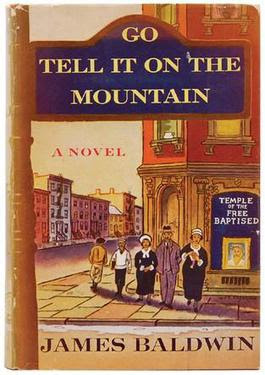
James Baldwin's Go Tell It On The Mountain

"But don't you think that the Lord can change a person's heart?" [174]

That's kind of the question in this, James Baldwin's debut novel of 1953. 

The novel starts on John Grimes' fourteenth birthday, a Saturday in March, 1935, and ends the next day. John is the oldest of four children of Gabriel and Elizabeth Grimes. They're a poor family in Harlem; Gabriel works as a day labourer, but he's a deacon and occasionally preaches at a revivalist church, Temple of the Fire Baptized. 

The novel is divided into three sections: 'The Seventh Day', 'The Prayers of the Saints', and 'The Threshing Floor'. The first ('The Seventh Day') shows us the family as a not very functional unit. John is the good boy, well, pretty good, but Roy, his younger brother, is his father's favourite. This may be because Gabriel is only John's step-father; he was born out of wedlock to Elizabeth and another man, dead by the start of the novel. But it may also be because Gabriel and Roy are similar, angry and intolerant. That same day, John's birthday, that he wanders around with a little money given him by his mother and then into a movie, Roy crosses town with friends to get into a gang fight with white boys and comes home cut with a knife. Florence, Gabriel's older sister, tells Gabriel it's his own fault Roy is who he is; Gabriel somehow casts blame on John for this, and then strikes Elizabeth; Roy curses his father. 

'The Prayers of the Saints': That night John goes to the church, to help clean the building. Neither his father, nor John's older friend Elisha, consider John saved, nor is John himself quite sure what he thinks about religion. After cleaning the church, with a few members arriving for service, he falls to the floor in a frenzy:     

    "'Rise up, rise up, Brother Johnny, and talk about the Lord's deliverance.'
    It was Elisha who had spoken; he stood just above John, smiling; and behind him were the saints...
    He tried to speak, and could not, for the joy that rang in him this morning." [199]

John spends the night on the floor, managing only a few words. The saints are the members of the church in good standing; they stand around John, praying, in honour of this new manifestation of the Lord's power. Three of those saints are his step-father Gabriel, his mother Elizabeth, and his aunt Florence, and we hear each of their prayers. 

None of them are entirely concentrating on prayer, though, and while they're meditating we learn the backstory that brought them to this point. Florence's resentment that Gabriel, the boy, received her mother's love even though Florence was the good one, and Gabriel showed no signs of spirituality as a twenty-year-old, catting and fighting as Roy does in the present. We learn about Gabriel's conversion, which does nothing for his anger and lack of love. We also learn about his own hypocrisy. Last of the praying saints is Elizabeth, still guilt-ridden over the episode that produced John, and how her subsequent hopes in Gabriel's faith were shattered.

We knew from the first chapter, none of them were saints in the usual sense of the word. Does our understanding make any of them more saintly? I don't really think so, but do learn they are more sinned against than sinning. (Though Gabriel is the hardest to forgive.)

In 'The Threshing Floor' we return to the present. On the threshing floor, Jesus separates the saved wheat from the damned chaff. Did John's conversion experience change anything? In some ways clearly not, but I don't think we're meant to have a clear answer. The question I started with up above is asked by Elizabeth, of Gabriel, to her sister-in-law, Florence. Florence's answer:

"I done heard it said often enough, but I got yet to see it." [174]

Though Florence gives that answer before John's conversion experience, and maybe hers is not a reliable voice anyway.

Poking around at what critical commentary I could easily find, it seems that readers are divided as well. The novel is clearly autobiographical (well, it is Baldwin's first) and Baldwin later lost his own faith. But I don't think it's quite fair to read back from Baldwin's subsequent story to divine what this one means, and I do think John's conversion is meant to be read as sincere. To be sure, there are psychological considerations--John wants to win over his step-father; he hadn't known his birth father, who died before he was born--but the language (very biblical) feels sincere to me:

"Then John saw the Lord--for a moment only; and the darkness, for a moment only, was filled with a light he could not bear. Then, in a moment, he was set free;..." [197]

Will that moment last? For the real James Baldwin it didn't, but for John Grimes, at least as long as the novel runs, it's a different story. 

I like the cover I've shown above, but that's the first edition, and alas I don't have that. I read it in James Baldwin's Early Novels and Stories, edited by Toni Morrison, from the Library of America, and the page numbers refer to that edition.

I found it a pretty great novel, it's on that Modern Library list of 20th Century novels, I'd put it on my Classics Club list, and it finishes off the Back to the Classics challenge for me for the year.