Showing posts with label #20booksofsummer23. Show all posts

Thursday, August 31, 2023

Erle Stanley Gardner's Shills Can't Cash Chips

"This is an insurance company. They've had their eye on us for a while. It's the kind of business there's money in, Donald, not this wild-eyed sharpshooting you've been doing."

Lamont Hawley of Consolidated Interinsurance comes into the Cool and Lam detective office for extra help on a suspected insurance fraud case. That's Bertha Cool talking above. She's the older, practical, financially-minded half of the partnership.

Donald Lam is the one given to wild-eyed sharpshooting. He's small--their sometime friend in the L.A. police department calls him 'Pint Size'--no good in a fight, but quick-talking and attractive to the ladies.

And there's Elsie Brand, the office secretary, who's more than half in love with Donald.

But before that initial meeting with Hawley is over, he says:
"I may as well tell you, Lam, we think there's an element of danger involved."
"Personal?"
"Yes."
Well, of course there is.

Carter Holgate was driving too fast and smashed into the rear end of Vivian Deshler's car. She's claiming whiplash and looking for the insurance company to pay up. Holgate admits the accident. But now Vivian has disappeared and various people are--not the insurance company--offering cash for witnesses to the accident. Something is fishy. When did the accident occur? Did it occur?

The body is discovered (it's Holgate's) in the trunk of the Cool and Lam Agency car and Donald is wanted for the murder. He would have needed Bertha to pull it off. 
"'Fry me for an oyster!' Bertha said.
'They just might do that."
As an accomplice to murder. 

"Fry me for an oyster!" is one of Bertha's favorite sayings. "Dice me for a carrot," also shows up in this one.

But of course the person who committed the murder is neither Donald nor Bertha. All in all a pretty entertaining entry to the series.

It's a pretty late entry in the series. Wikipedia tells me it's #22 out of the thirty and it came out in 1961. 


Vintage Mystery, Silver, Brunette: We'll go with that 'vivid brunette, who walked impatiently as though her good-looking legs were trying to push the sidewalk out of the way.'

Saturday, August 19, 2023

Guy Gavriel Kay's The Last Light of Summer (Big Book of Summer)

"I have a tale for you:"

The opening words of Guy Gavriel Kay's The Last Light of the Sun, and so he does. That's a quote from the Liber Hymnorum, a collection of hymns from the Middle Ages.

It's a fantasy novel, but in the common way of Kay's works, it's set in a clear historical period: this is set in Scandinavia and the British Isles; the time period is that of Alfred the Great (the later 800s AD). Danish Vikings are raiding England, and Anglo-Saxon kings are barely holding on. Celtic Wales is still a separate kingdom; they don't necessarily get along with the Anglo-Saxons, but maybe they need to in order to stop the Vikings.

In the novel, the Welsh are renamed the Cyngael; the Anglo-Saxons, the Anglcyn; and the Vikings are the Erlings. There are major characters from each group. Red Thorkell the Erling has been exiled from Erling lands after he committed a second murder in a drunken frenzy; the story starts with his son, who has been sentenced to five years of slavery for his father's crime in addition to the confiscation of the family lands. 

The exiled father has returned to raiding, but his raid into the Cyngael lands fails, and in exchange for mercy, he pledges loyalty to a Cyngael lord Brynn and his wife. (Who just happen to have a beautiful and spirited daughter.) But in the course of the raid, Alun, a Cyngael prince, sees his older brother killed (and that brother's soul stolen by faeries for the Wild Hunt); he's now an avowed enemy of Erlings in any shape.

Meanwhile in the Anglcyn lands, another raid, involving Red Thorkell's son, who has escaped from slavery, is being stopped by Aeldred, the king of the Anglcyn (and our Alfred the Great character). Aeldred, too, has a couple of daughters, the younger of whom can also see the (generally invisible) faeries, just as Alun can.

Anyway, a very fun story. The relations between brothers, between fathers and sons, are important. Various romances are in the offing. I've read maybe half of Kay's books, and this did not become my favorite, which I think remains A Song for Arbonne, but it's a very good entry.

At 545 pages, it's a Big Book of Summer:


And it's actually one of the books I put on my 20 Books of Summer pile!


Saturday, August 5, 2023

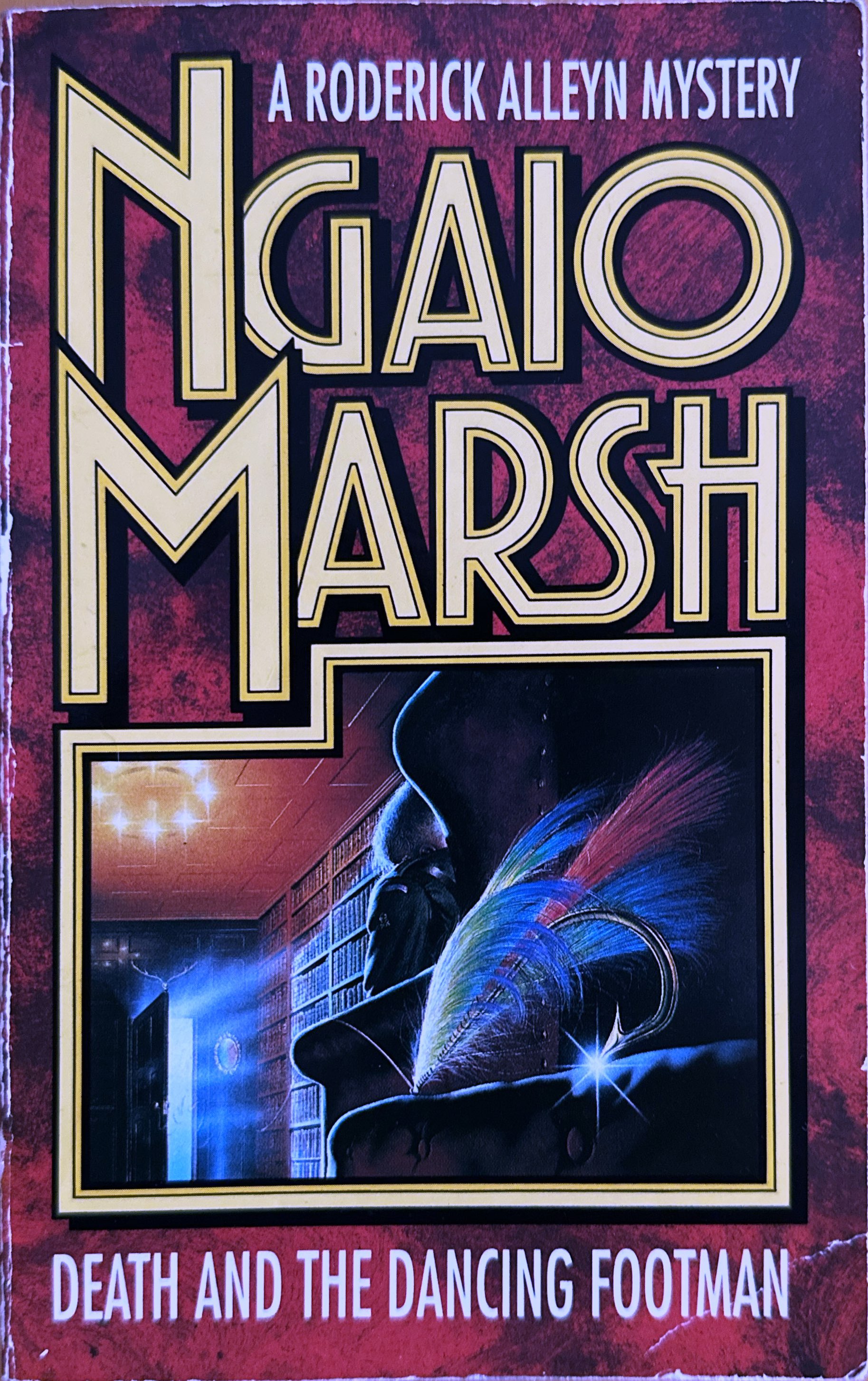
Ngaio Marsh's Death and the Dancing Footman

"'This is most awkward,' said Hart primly."

It's England in 1940, the period of the phoney war before Germany invaded France, and Jonathan Royal has decided to throw a party at his country house Highfold Manor.

Except it's not a fun premise for a party, or fun only for Jonathan Royal, because he invites seven people who don't like each other. There are three Complines, near neighbors, the widowed mother and two sons. William, the elder, would be a momma's boy, but his mother prefers Nicholas, who's a bounder, but attractive to the ladies nevertheless. William's already a soldier, but on leave; Nicholas has scored a desk job in London.

There's Chloris Wynne, formerly affianced to Nicholas, but now engaged to William, after she realized Nicholas would never be true.

There are two rival beauty salons in the neighborhood, Lady Hersey Amblington runs one; she's a distant cousin of Jonathan Royal. Elise Lisse, an Austrian refugee, runs the other. The two are professional rivals, and cordially (?) detest each other. Madame Lisse is also one of those ladies with whom Nicholas was habitually unfaithful to Chloris.

There's a second Austrian refugee, Dr. Francis Hart, a professional (and maybe more?) colleague of Madame Lisse. His specialty is facial plastic surgery, and Madame Lisse recommends him when she can do no more.

Did I mention Mrs. Compline had a disastrous facial surgery twenty years before when that type of surgery was still in its infancy? No? Consider it mentioned...

Jonathan Royal also invites Aubrey Mandrake, an up-and-coming surrealist playwright, mostly so he can show off his cleverness. Mandrake has never met any of the others before.

Several of the characters decide almost immediately to simply leave when they discover the identities of their fellow guests, but conveniently for Jonathan Royal's plans, the house is quickly snowed in. 

Snowed in country house murder. Have you read a few of those before? Me, too.

There are also a few other grounds for hostility that we learn along the way. Quite the motive extravaganza.

Getting us to this place was a bit silly and improbable--Jonathan Royal makes a few noises about reconciling these people, but mostly he's just a mischievous monster--but once we're past the setup, the mystery events move along well. There are two attempted murders before the main event; a couple of duplicate Tyrolean cloaks means not only do we not know who made the attempt, we also don't know who the intended victim was. And when William Compline is finally killed, we're still not sure. Was there yet another mistake?

The obfuscation in this was quite good, I thought. The person I was betting on commits suicide and leaves a note taking responsibility, but it's still fifty pages before the end! That's when I knew I had it wrong... 😉

Mandrake is an acquaintance of our hero Roderick Alleyn of Scotland Yard and he happens to know Alleyn is staying with his wife at Pen Cuckoo (the location of Overture to Death, a couple of mysteries before this one). Sure it's his holiday, but we'll struggle through the snow to bring him back! (Because, of course the phones lines are all down.) And he'll grumble, but he'll come!

Anyway, I don't mind a little farce in my Golden Age mysteries, and there's romance in this one, too. I think of the late 30s and early 40s as Marsh's strongest period, and this was definitely a good entry.

Vintage Mystery, Gold, Fishing Gear. Pay attention to where that fishing lure goes. It's an important clue!


Tuesday, August 1, 2023

Ivo Andrić's Omer Pasha Latas

"After all sorts of hints and rumors, the day finally came when the Ottoman commander in chief, the seraskier Omer Pasha, entered Sarajevo with his army."

That's the opening of Ivo Andrić's Omer Pasha Latas. Omer Pasha spends close to two years (1850-1851) in Bosnia as the agent of the Ottoman sultan; his mission is to implement the sultan's reforms and to get the local feudal aristocracy in line. Whatever it takes is the watchword, and he's led successful missions of this sort before in the Ottoman lands, in Syria, in Kurdistan, in Wallachia.

Omer Pasha Latas is Andrić's last novel, published after his death, maybe not quite complete, though it felt complete to me in this translation by Celia Hawkesworth. 

What is the Bosnia of 1850? 

Of one of the characters, a wandering painter, we're told: 
"Before he left Zagreb, people had given him only negative reports about Bosnia, the terrible roads and uncomfortable inns, the strange people and unusual circumstances,..."

Or:
"Bosnia. Not naturally lush or abundant, a land where few sow and toil, it had been eaten away by both local and foreign idlers, and trodden down by warring armies, so that over the years it had been stripped bare and now resembled stables in which hungry horses gnawed the wood of their mangers."
Those are the thoughts of Idris Effendi, the number two lawyer on Omer Pasha's staff. Or:
"'What is this? What kind of country is this that will devour all? And what kind of scoundrels and criminals have gathered in this residence? All degenerates! Even angels would be corrupted by these idlers and perverts!"
That's the cry of Omer Pasha's wife.

The novel is structured like Andrić's acknowledged masterpiece, The Bridge on the Drina; it's really a collection of stories organized around a central figure. In that novel the central figure is the bridge itself, and the stories take place over four hundred years; in this novel, the central figure is Omer Pasha, and the events take place over that year and a half. But Omer Pasha is not always on the scene.

The back of my copy of the novel gives the backstory to Omer Pasha, but I won't: in the novel itself, it's only gradually revealed over the length of the novel. He was a real historical figure and I linked the Wikipedia article above. But I knew nothing about Omer Pasha Latas before I read this (and I imagine you know nothing, too...😉) and it's likely even to the original audience of the novel he was a bit obscure. So the revelations would and should be revelations and I won't spoil them. But we learn them as we go: Omer Pasha reveals himself to a Montenegran grandée as he's trying to win him over; he meditates on his past while that painter is trying to capture the fire in his eyes; we hear the story of how he met his wife.

At the end of his two years, Omer Pasha and his army march off. Some of the local beys have been killed, some marched in chains to Istanbul. Did the sultan consider the mission a success? We're not really told. But the historical Omer Pasha is still trusted and plays an important role in the Crimean War two years later, though that's outside the frame of the story.

I said the novel is structured like The Bridge on the Drina, and that's true, but it's much darker even than the already quite dark Bridge. Well, a backwater in the later years of the Ottoman empire was probably not a very appealing place. The novel is not quite as good as The Bridge on the Drina, but still awfully good.

Ivo Andrić was born in Sarajevo in 1892, but mostly grew up in Višegrad (also in Bosnia). He got a Ph.D. after WWI in South Slavic history and literature, then served in the diplomatic corps of the Kingdom of Yugoslavia. He won the Nobel Prize for Literature in 1961, and died in 1975.  

Covering Bosnia for the European Reading Challenge.


Monday, July 31, 2023

W. Somerset Maugham's The Razor's Edge (#ParisInJuly-just in time!)

"I'm counting the days until I can get back to Paris. It's the only place in the world for a civilized man to live."

It hurts me to report the speaker was in Chicago when he said it.

W. Somerset Maugham's The Razor's Edge comes out in 1944, but the events end before the Second World War and start in 1919. 

Elliott Templeton (our Paris booster) is in Chicago to visit his sister. The narrator of the novel (a novelist much like Maugham himself) is passing through Chicago and has lunch with Templeton, an old acquaintance. He also meets most of the other figures of the novel: Louisa Bradley, Templeton's sister; his niece, Isabel Bradley; Larry Darrell, Isabel's fiancé, Gray Maturin, who's in love with Isabel, rich, and whom her mother and uncle discreetly would prefer she marry; and Sophie Macdonald, a friend of the younger generation.

It's Larry Darrell's decisions that drive the action of the novel. He had lied about his age and managed to fight as a pilot for the French during WWI. The horrors he saw there, the fact that his life was saved by a friend who died in the process, have left him wondering about the big questions. He still loves Isabel, he says, but he wants to spend two years at least on a quest to discover the meaning of existence. (That's Bill Murray as Larry in something approaching a Hindu seeker's garment on the cover of my beat-up movie tie-in edition.) Larry wants to marry Isabel, but not to give up his search, and suggests that they live on his small inheritance while he continues. In his search, Larry reads philosophy (William James, Spinoza!), makes a retreat at a Benedictine monastery, and eventually travels to India.

But, after Spinoza, and before the monastery, Isabel says unh-unh to that proposal of impoverished seeking; instead she marries Gray Maturin, who was patiently waiting at her side. They have two children and a life of great social and financial success. Until 1929.

I think the novel is usually viewed as a story of spiritual seeking, and it is, of sorts. The Wikipedia article compares it to Hesse in its early (by Western standards) interest in Eastern spirituality. But Larry is not often on the scene, and the novelist character/narrator only meets Larry occasionally over the fifteen or twenty years of the novel. "I can only guess, you know, and I may be quite wrong. I think he's been seeking for a philosophy, or maybe a religion, and a rule of life that'll satisfy both his head and his heart." 

There's one long discussion about philosophy between Larry and the narrator in an all-night Paris café, which might be a little dull. But:

"I feel it right to warn the reader that he can very well skip this chapter without losing the thread of such story as I have to tell, since for the most part it is nothing more than the account of a conversation I had with Larry. I should add, however, that except for this conversation I should perhaps not have thought it worthwhile to write this book."

Hmm. I might still have felt it worthwhile to read it without that chapter, but it is important that Larry not just be an object of fun, but that his quest be taken seriously. And so it is. Still the diffidence and irony of the narrator means that while he takes Larry's quest seriously enough, it's not taken completely seriously, and there are other possibilities.

And in fact Elliott Templeton is present in much more of the novel. He's quite an amusing character who clearly codes as gay, though he's never explicitly described as such. He made his money as an art dealer, though his trading days are so vanishingly far behind him that he won't acknowledge they ever existed; he spends his time cultivating high-status social acquaintances. He's compared to Proust at one point, and not since Recherche has there been quite so much concentration on breaking into the Boulevard St. Germain. I found him the most entertaining character. His pronouncements are sometimes shocking, and maybe we shouldn't like him:
"I have always moved in the best society in Europe and I have no doubt I shall move in the best society in heaven. Our Lord has said: The House of my Father hath many mansions. It would be highly unsuitable to lodge the hoi polloi in a way to which they're entirely unaccustomed."
But at the same time he, too, is treated with real tenderness by the narrator.

Some bad things do happen, and at one point the narrator ends up in a police office in the matter of a dead girl:
    "'We found a number of detective stories in her room and two or three volumes of poetry. There was a Baudelaire and a Rimbaud and an English volume by someone called Eliot. Is he known?'
    'Widely.'"
Our narrator can be amusingly catty himself:
    "Why d'you suppose they do it?" [get divorced]
    "Don't you know? Because American women expect to find in their husbands a perfection that English women only hope to find in their butlers."
"A novel which she knew from the beginning (otherwise she wouldn't have read it) would end happily."
Is that the sort of novel we're reading? Well...
"...to my intense surprise it dawned on me that without in the least intending to I had written nothing more or less than a success story. For all the persons with whom I have been concerned got what they wanted: [Spoilers!] And however superciliously the highbrows carp, we the public in our heart of hearts all like a success story; so perhaps my ending is not so unsatisfactory after all."

Anyway, maybe I'm not one of those highbrows after all, but just another member of the public, and so I thought it was a good read. 😉

One from my Classics Club list.


And squeezing one late-breaking entry in for Paris in July!


Wednesday, July 26, 2023

Olga Tokarczuk's The Books of Jacob

"But does not every religion have some truth in it? All of them, even the most barbaric, have been permeated by the holy sparks."

Chuck is feeling a little triumphant that he's conquered so large a Nobel-prize winning book...

The Jacob of The Books of Jacob is Jacob Frank (1726-1791). He was born Jacob Leibowicz (spellings vary) in Korolivka, now in the Ukraine, but then in the Polish-Lithuanian Commonwealth. His family were Sabbateans, that is, followers of the doctrine of Sabbatai Zevi, the Jewish mystic who converted to Islam in 1666. They were a merchant family, and Frank himself traveled and traded in the Ottoman empire, where he became fluent in Turkish. He met the leaders of the Sabbatean movement at the time, then in Salonika. It was while in Ottoman lands, he took on the name Frank; a frank to the Ottomans was any Western, non-Islamic foreigner.

He also underwent several religious experiences, and eventually proclaimed himself the heir to Sabbatai Zevi, the third in a series of Jewish Messiahs. It might take a fourth to bring about salvation, a female to embody Shekinah, or wisdom. 

Frank considered the Talmud to be outdated--this was also the belief of Sabbateans in general--and it was a virtuous act to violate Mosaic law: eat pork, not fast on holy days, speak the name of the Lord. Expectedly enough this got him in trouble with more orthodox Jewish rabbis, and he was declared a heretic. Political in-fighting ensued, and Frank with his followers converted to Christianity, while still intending to retain something of their separate Jewish identity. (Sabbatai Zevi had converted to Islam, but the Sabbataean community remained largely separate.) This was the ultimate repudiation of Mosaic law. You can imagine this as either evil apostasy or noble ecumenicism, and both points of view were to be found at the time and are present in the novel. 

Converting to Christianity brought Frank protectors, but they weren't strong enough or didn't care enough, and Frank ended up jailed for thirteen years, only released by a Russian general at the first partition of Poland in 1772. Frank and many of his followers left Poland, settling first in Austro-Hungarian lands, before being pushed on to Offenbach-am-Main, now in Germany, where he died.

The novel has a few modes: much of it is in a standard free indirect that follows Jacob Frank, his followers, or other historical figures; there are also sections from the writings of Nahman of Busk, who is the theologian to Frank's mystic. There are letters, particularly those between Fr. Chmielowski, a Jesuit and author of the first Polish encyclopedia, and Elżbieta Drużbacka, a poetess. (Both historical figures, though the letters are imaginary.) Tokarczuk takes the religious experiences seriously, and within the framework of the novel, one is meant to believe they are real. Jewish folk magic also works in the novel, with particular impact on Jacob Frank's grandmother. 

Various historical figures you might know do show up: for example Empress Maria Theresa and Kasimir Pulaski (who also fought in the American Revolution) are perhaps the two most notable. Frank meets both of them.

It's the third Tokarczuk novel I've read; it's easily the biggest, but also the best. (Though I think I'd start with Drive Your Plow Over The Bones of the Dead. Flights was my least favorite of the three, though still impressive.) It's a fascinating and convincing look at a historical place and period that I knew next to nothing about, with multiple generations and characters that change, grow and/or shrink, over the course of forty years. No character is a moral saint, no one is a thorough-going villain. (Though some very bad things do happen.) It does not end with a bang: Frank dies of ill-health at 65 or so, his followers, acquaintances, enemies and supporters do as well, each in their turn.

I thought the translation (by Jennifer Croft) was superb.

At 965 pages, it's definitely a Big Book of Summer, and though I have hopes for at least one more big book this summer, it will certainly be the biggest.


There's also my European Reading Challenge. It's one of those border-crossing books that could fit into practically any slot. Frank spends significant periods in places that are now in the Ukraine, Romania, Bulgaria, Turkey, Greece, Poland, the Czech Republic, Austria, and Germany. Still, Tokarczuk is Polish and writes in Polish; it's in Warsaw that Frank converts, and those thirteen years he's imprisoned it's in Częstochowa in Poland. So Poland it is!


And one I actually put on my 20 Books of Summer list!


-o- 

"If people could read the same books, they would inhabit the same world."

-o- 

    "'Is all this true?' the lovely and talented Maria Szymanowska, née Wołowska, the pianist, asked him many years later,...
    'Madam, it is a novel. It is literature.'"

-o-

"Nonetheless it is written that any person who toils over matters of Messiahs, even failed ones, even just to tell their stories, will be treated just the same as he who studies the eternal mysteries of light." 

Friday, July 14, 2023

Time Shelter

"The point of the experiment was to create a protected past or 'protected time.' A time shelter. We wanted to open up a window into time and let the sick live there, along with their loved ones."

Gaustine, with the assistance of the narrator, 'Georgi Gospodinov', is looking to create a therapeutic safe space for those suffering from Alzheimer's disease. If the sufferer's happy time was in the 1960s, for example, they'll be treated in a wing of the clinic furnished like the 60s, with the furniture, the music, the cigarettes (there's a lot of talk about the cigarettes of different eras) and whatever else will be most effective. Gaustine is the clinical psychologist (though is he?) and 'Gospodinov', a Bulgarian novelist, is the presumed expert in telling the stories of the needed era.

That's the premise of Georgi Gospodinov's novel Time Shelter, which came out earlier this year in English, translated by Angela Rodel, and recently won the Man Booker International. If you've read other Gospodinov, you'll know that Gaustine is a recurring character in his fiction and has a way of moving from time to time at will.

But that's only the first section (of five). Gaustine sets up his clinic, in Switzerland, at least partly under the influence of Mann's The Magic Mountain, and we get the case history of the first two patients, one a dissident in Bulgaria in the 60s, and the second a woman who was a child during World War II. The therapy seems to help, family members are impressed, though of the second one, the 'Gospodinov' character says, "She's remembering, I say, that's why she's crying." Is a doubt creeping in for the reader?

In the second section, the treatment is so successful that even people who do not have Alzheimer's are eager to move to Gaustine-style clinics. (Others than the first in Switzerland are now open.) Whole countries are eager to move to a different point in time. But when? The various E.U. nations decide each will hold a referendum to determine their preferred era. The U.K. wants to join in as well, but the E.U. says, no, you've already left, and anyway, wasn't Brexit a referendum about to moving to an imagined earlier era? Switzerland wants to join in as well, and is allowed, but in the end punts due to their traditional neutrality.

The third section is a case of study of one referendum, that in Bulgaria. (Naturally enough for our Bulgarian author.) None of the countries are seriously considering anything prior to 1900, but what's the best decade in Bulgaria in the 20th century? There are partisans for most decades, but the polls show that it comes to two: the 80s, the stagnant but relatively safe end of the communist era and the 30s, Bulgarian nationalism at its most successful. (In the 20s in Bulgaria there was apparently a military coup, and fighting broke out for a couple of years.) Which will win? The Socs? or the Heroes? Polls show it's close.

The fourth section is a swift overview of the referendum outcomes across Europe. Europe is divided into camps. The 70s are popular, as are the 50s. Only Italy chooses the 60s, la dolce vita, don't you know? Will anybody actually choose the 40s? Things were pretty good then in Sweden for instance.

The E.U. (and Gospodinov the author) take the terms of these referenda seriously: if you've moved to the 80s, do you have to get rid of your cellphones? If to the 30s, do you have also get rid of your televisions? Travel across country lines is forbidden until these questions are sorted. Europe is once again broken into camps, but on different lines.

In the last section, 'Georgi Gospodinov' is losing his memory (or is he?) and in need of treatment. What's his preferred era? Gaustine writes,
"While writing a novel about those who have lost their memory, he himself begins to lose his memory. He rushes to finish it before he forgets what he was writing."
Can I say I think the novel is silly and also still say, I think it's a pretty major novel? Perhaps I should say absurd, a better lit-critty term, but that word comes with a lot of baggage and feels more ponderous than Time Shelter actually is. The whole premise is silly, but it's quite an inspired and suggestive silliness. And, as befits a novel about aging and losing one's memory, there's also a strong streak of melancholy throughout, most pronounced at the end.

[One thing it's not, though, is 'macabre', which was part of the description of the novel when it appeared on the Man Booker International shortlist, and is just absurd. Or silly.]

So: a novel about our relationship to the past, to history, to memory, to Europe. Maybe some other things, too. In a funny, serious package. At this point I haven't read any other of the Man Booker International shortlist novels, but this seems a solid choice.

I've liked Gospodinov in the past. Some other Gospodinov books on the blog.

A few other quotes that didn't quite fit in anywhere else, but I liked: 😉
"For a Bulgarian, complaining is like talking about the weather in England, you can never go wrong."
"I...sink into the cold cave of the library as if into another time, a time shelter."
"The less memory, the more past.
    As long as you remember, you hold at bay the times gone by. Like lighting a fire in the middle of a forest at night. Demons and wolves are crowding all around, the beasts of the past are tightening the circle, but still they don't step into it. The allegory is simple. As long as the flame of memory burns, you are the master."
"The end of a novel is like the end of the world, it's good to put it off."

Covering Bulgaria this year for me for Gilion's European Reading Challenge.


Thursday, July 6, 2023

Ode to American English


Ode to American English

I was missing English one day, American, really,
  with its pill-popping Hungarian goulash of everything
from Anglo-Saxon to Zulu, because British English
  is not the same, if the paperback dictionary
I bought at Brentano's on the Avenue de l'Opera
  is any indication, too cultured by half. Oh, the English
know their delphiniums, but what about doowop, donuts,
  Dick Tracy, Tricky Dick? With their elegant Oxfordian
accents, how could they understand my yearning for the hotrod,
  hotdog, hot flash vocabulary of the U. S. of A.,
the fragmented fandango of Dagwood's everyday flattening
  of Mr. Beasley at the sidewalk, fetuses floating 
on billboards, drive-by monster hip-hop stereos shaking
  the windows of my dining room like a 7.5 earthquake,
Ebonics, Spanglish, "you know" used as comma and period,
  the inability of 90% of the population to get the present perfect,
I have went, I have saw, I have tooken Jesus into my heart,
  the battle cry of the Bible belt, but no one uses
the King James anymore, only plain-speak versions,
  in which Jesus, raising Lazarus from the dead, says,
"Dude, wake up," and the L-man bolts up like a B-movie
  mummy. "Whoa, I was toasted." Yes, ma'am,
I miss the mongrel plenitude of American English, its fall-guy
  rat-terrier, dog-pound neologisms, the bomb of it all,
the rushing River Jordan backwoods mutability of it, the low-rider,
  boom-box cruise of it, from New Joisey to Ha-wah-ya
with its sly dog, malasada-scarfing beach blanket lingo
  to the ubiquitous Valley Girl's like-like stuttering,
shopaholic rant. I miss its quotidian beauty, its querulous
  back-biting righteous indignation, its preening rotgut
flag-waving cowardice. Suffering Succotash, sputters
  Sylvester the cat; sine die, say the pork-bellied legislators
of the swamps and plains. I miss all those guys, their Tweety-bird
  resilience, their Doris Day optimism, the candid unguent
of utter unhappiness on every channel, the midnight televangelist
  euphoric stew, the junk mail, voice mail vernacular.
On every boulevard and rue I miss the Tarzan cry of Johnny
  Weismueller, Johnny Cash, Johnny B. Goode,
and all the smart-talking, gum-snapping hard-girl dialogue,
  finger-popping x-rated street talk, sports babble,
Cheetoes, Cheerios, chili dog diatribes. Yeah, I miss them all,
  sitting here on my sidewalk throne sipping champagne
verses lined up like hearses, metaphors juking, nouns zipping
  in my head like Corvettes on Dexedrine, French verbs
slitting my throat, yearning for James Dean to jump my curb.

-Barbara Hamby

Barbara Hamby is an American (did you guess that?) poet raised in Hawaii and now in the English department at Florida State University in Tallahassee. On the Street of Divine Love is a new and selected volume that came out in 2014; 'Ode to American English' is from her volume Babel of 2004. I don't know when she was in Paris, thinking about American English. 😉

It goes from Anglo-Saxon to Zulu, though C somehow comes later in the alphabet, doesn't it? I'm still looking for that translation of the Bible where the L-man says, "Whoa, I was toasted," but I do want to find it... I was a little surprised to find Johnny Weismuller's name spelled as the young Johann might have, not as Hollywood did to make more it palatable to Americans, but there you go. Pretty fun stuff. This was the poem I first saw of hers that made me want to read more.

That's iced tea next to the book above. It's been hot here!

A book I actually put on my 20 Books of Summer list.


Tuesday, July 4, 2023

James Baldwin's Notes of a Native Son (Classics Club, 20 Books of Summer, Paris in July)

"I want to be an honest man and a good writer." [9] 


James Baldwin's Notes of a Native Son is a collection of previously published essays that comes out in book form late in 1955. The original essays appeared between 1948 and 1955 in magazines such as Harper's, Commentary, and Partisan Review. They were somewhat rewritten for the book.

His first, and at that point only published novel, Go Tell It On The Mountain, had come out in 1953.

Baldwin gives himself a couple of briefs in this. The first is literary criticism, and two of these essays are probably the most famous in the book: 'Everybody's Protest Novel', about Uncle Tom's Cabin, and 'Many Thousands Gone', about Richard Wright's Native Son. He doesn't really like either one.

Native Son (1940) is also discussed in the essay on Uncle Tom's Cabin, and briefly in other essays. Well, the title of Baldwin's book is Notes of Native Son; the book was on his mind, and that of a lot of the rest of America. Baldwin and Wright had been friends, with Baldwin looking up to the older writer; but these two essays lead to their estrangement. Baldwin lumps the two novels together after noting that the characters in Uncle Tom's Cabin are too thin to be believable, and so, even in their avowed political purpose--to stop slavery, to end racism--the novels don't succeed. Worse, the very limitations that Wright portrays in Bigger Thomas, the protagonist of Native Son, reinforce White prejudice, and are internalized, to their detriment, by Blacks:
"Recording his days of anger he [Wright] has also nevertheless recorded, as no Negro before him had ever done, that fantasy Americans hold in their minds when they speak of the Negro...This is the significance of Native Son and also, unhappily, its overwhelming limitation." [26]
"It is not Bigger whom we fear, since his appearance among us [white America] makes our victory certain." [28]

Granted, seeing the world through Bigger Thomas' viewpoint limits a broad perspective on Negro culture of the time, or on American culture. Does it eliminate it entirely? Baldwin rather suggests it does, but I'm not sure I think this entirely fair. I've read Native Son, but it's been years, and I'd have to read it again to decide. (And now I want to.) But I doubt I'd agree. I also think Baldwin isn't quite acknowledging how much Native Son means to him. After all, Giovanni's Room, Baldwin's next novel, features a protagonist with limited options who ends up on Death Row, quite similarly to Native Son.

The one other cultural essay is a review of the movie Carmen Jones, which I haven't seen. The movie has Harry Belafonte and Dorothy Dandridge and is an all-black retelling of the opera Carmen. It's famous because it's the first Academy Award nomination for best actress given to a Black woman, Dandridge. She didn't win. But Baldwin here is in a fierce and funny mode that he does well.

He's also fierce and funny about Henry Wallace's Progressive Party and Wallace's campaign for president in 1948. Baldwin's younger brother David was part of a vocal group that was invited to sing at churches in Georgia to help get out the vote. They were supposed to be paid and fed. But even Progressives in a good Progressive cause can't be bothered to look after a foursome of black teenage boys--in the South!--who aren't paid, and are barely fed. Worse, the organizers get offended when their negligence is pointed out.

There are several other essays on the American scene of the time: life in Harlem, anti-Semitism in the Black community, the death of his father (step-father in actuality, though always referred to as father in this essay). That last one pairs well with Go Tell It On The Mountain and sheds light on the novel. While the fierce Baldwin can also be funny in a way that feels uniquely his, when he starts making sociological categorizations, I'm afraid his prose can turn ponderous.


"For Paris is, according to legend, the city where everyone loses his head, and his morals, lives through at least one histoire d'amour,..." [93]

I hadn't really thought about it when I started, but the book works for Paris in July; a third of it or so are his experiences in Paris after he moves there in November of 1948. He describes the American expat community in Paris at the time; American Blacks' relationship to Blacks from French Colonial Africa. The best of these essays--though in some ways the scariest for Baldwin--was on the eight days he spends in a Paris jail over Christmas of 1949. A friend in a fit of pique steals a sheet from a hotel on his way out; Baldwin uses the sheet in his own cheap hotel, because he can't get hotel management to change his sheets. Baldwin is arrested as a receiver of stolen goods. The case seems a joke, but Baldwin spends eight days in jail--more because of the holidays and bureaucracy than anything else, because when he does appear before a judge it's thrown out. But he's a Black man in jail! He knows France isn't America, but while his French is improving, he's not yet fluent. Just how much exactly is France not like America? After a couple of days he begins to wonder.

A book I actually put on my Twenty Books of Summer list...


...because I'd earlier put it on my Classics Club list...


...and a classic is kind of what it is.

It's also more or less an accident that I'm putting this post up on the Fourth of July, but appropriate, too:
"I love America more than any other country in the world and, exactly for this reason, I insist on the right to criticize her perpetually." [9]

Page numbers from the Library of America edition of Baldwin's Collected Essays

Friday, June 23, 2023

Eleanor Catton's Birnam Wood

"Birnam Wood was defined in carefully apolitical language as a grassroots community initiative that planted sustainable organic gardens in neglected spaces and featured a commitment to help those in need."

But that's not all it is.

Mira Bunting is the founder and main figure of Birnam Wood, a guerrilla gardening collective in New Zealand. Four years ago, the emphasis was on the guerrilla: anti-capitalist, rebellious. Now most of their vegetable plots are planted with the agreement of the owners, and the produce is shared out.

Part of the reason for the practicality is Shelley Noakes. Shelley rather worships Mira, but also is beginning to feel used, and at the very start of the novel she decides to sleep with Tony Gallos, Mira's ex-one-night-stand as a way to assert her independence. Tony's just appeared on the scene after teaching in Mexico for four years, and Shelley knows perfectly well Mira and Tony have unresolved issues.

Meanwhile there's been an earthquake in the Korowai National Park that killed five people and blocked a major road. This means that an old farm at 1606 Korowai Pass Road is now isolated. It's owned by Owen Darvish and his wife Lucy, and he's just been knighted for services to conservation even though he's the owner of a pest control company. (One of the things he kills is invasive species.) Mira thinks here is the grand coup that Birnam Wood needs: guerrilla gardening on the Darvish estate. Birnam Wood will go to Dunsinane. (1606 is likely the year in which Shakespeare's MacBeth was first performed.)

But one other figure has seen possibilities near Korowai National Park; that's Robert Lemoine, an American billionaire. His money is from a drone startup, but he envisions a different sort of financial coup in New Zealand.

That's our major players lined up. The first two-thirds of the novel is getting to know them, individually and in relation to one another; the last third is quite the thriller as their different goals conflict and their unknowing about each other gets resolved. The conflict is political and environmental.

The novel's at times funny. When I saw Eleanor Catton here a couple of months ago, she read from a passage with one of Tony Gallos' rather over-the-top rants. The audience--the book was brand-new at that point, and almost nobody had read it--were first absorbed in Tony's righteous anger, then laughed nervously, then laughed out loud. Catton can pull that sort of thing off. 

Tony's still kind of a hero, even if he only has the vaguest sense of reality, and the book ends with him:

"...so that somebody would see it, so that somebody would notice, so that somebody would care, and as the fire began to blaze and crackle up the ancient trees around him, Tony prayed that somebody would come to put it out."

So a pretty fun novel with some serious themes. I did, however, feel that the American billionaire drifted in from a different sort of novel (or film), likely one involving James Bond. I would also say I still think The Luminaries is the one to read. (Though I haven't read her first, The Rehearsal).

Another book actually from my 20 Books of Summer list!


And, as it turns out, it's my first Big Book of Summer. When I signed up for the challenge, I didn't have a copy of the book in hand and didn't realize, but as it turns out it's 432 pages and so qualifies. I still hope to read a few other monsters. Thanks to Sue and Cathy for hosting!


Friday, June 16, 2023

Catherine Lacey's Biography of X

X is a downtown New York artist (performance, fiction, painting, music, critic--she's amazing; she does it all!) from the 1970s until her death in 1996 when she's only in her early 50s. There's a biography that her widow did not cooperate with and does not like which comes out after X's death; the widow decides to correct the record, and produces her own Biography of X.

And yes, I did say, her widow. We quite rapidly realize we're in an alternative American history, one in which gay marriage was legal already soon after WWII. At least in the northern states; the South has taken advantage of the dislocation of the war to secede and form a theocratic dictatorship. They surround themselves with a wall (like the Berlin Wall) and attempt to keep their own people in, and keep others out. Eventually this fails and by the time of the main events of the novel, the North and the South are reunited, with a Reconstruction-like program going on in the South. 

X had various aliases in her past and previous affairs and marriages, before she settles on X as her alias and C. M. Lucca (the widow and our author, ostensibly). Lucca's attempt to figure out who her wife slept with before they were married is as ill-advised as it sounds--the only case I think of that working out is Scott Pilgrim--but that doesn't mean it's unrealistic or a poor premise for a novel. The novel's getting a lot of buzz and I had hopes.

But I don't think it really worked. Three problems for me: first, the alternative history. I'm OK with that in principal, but Lacey spent too much time building it up. The obvious comparison here is The Handmaid's Tale, and Atwood handles it much better. Atwood spends almost no time on how her theocracy comes to power; Lacey would have been wise to do the same. If you lay out a series of nits, somebody's going to feel the need to pick them. (Could the South have succeeded in a rebellion just because US armies were in Europe? The Irish Easter Rising failed in 1916. Etc., ) She should have just postulated her world.

Second, related. She uses a lot of actual historical figures, but changes their role in history. Emma Goldman is governor of Illinois and in FDR's cabinet. Kathy Boudin blows up buildings in the South, not in the North, Frank O'Hara is run over by a jeep on Fire Island, but survives; Brianna (!) Eno. This is sometimes funny and I think it's meant to be. But it's overdone, especially when she gets to NYC types I had to look up to figure out what the joke was, it began to feel more showoff-y than funny, amusing perhaps to Lacey's artist friends. (Some actual people get their history altered and become major characters, folk singer Connie Converse in particular. That's a bit different.)

All of that would have been OK, though, if I'd cared more about the central figure. X is obviously meant to be a woman of mystery, a real shapeshifter. But there's too many shapes.  She's given a fairly horrific childhood background, but the line between that and her adult life didn't feel worked out through all those shapes. Her genius is demonstrated by what people think of her, of her art, of her books, of her paintings. In a novel about an artist, that's kind of the way it has to go. And because Lacey has allowed herself to use real people, when she wants to demonstrate X's bonafides as a music producer, she can have Tom Waits and David Bowie testify to it, who know something about the subject. But mostly her genius doesn't entirely convince. Here's an example. X is at an art gallery with a famous gallerist, Ginny Green:
"She said--'He didn't put anything in the paintings because he doesn't know how. He doesn't know anything about art, and worse, he doesn't care.' Now, of course I was accustomed to criticism--I even welcomed it on occasion--but no one's opinion ever made me as doubtful as hers." [p.240]
Now, I don't know, your mileage may vary, but that brief, rather platitudinous, ad-hominem attack wouldn't convince me about an artist, and should convince Ginny Green even less, since the artist was someone Green had already selected for exhibition. A lot of X's pronouncements came across like that. We're told they convinced other people. They didn't convince me, in and of themselves. X is meant to be a bit monstrous, and that's OK in a novel; people are fascinated by monsters; but she is meant to be fascinating, the novel kind of depends upon it, and I didn't entirely find her so.

Anyway, it's buzzy, it reads pretty quick, but I was hoping for more.

I've read a few books so far this month, but this is the first one actually from my Books of Summer list!


Thursday, June 15, 2023

17 Dollars


17 Dollars

That's how much the man who owned DuBey's gave me
  for my books that time you insisted
they were taking up space and we needed the money.
  We were poor, sure--you a painter,
me a student--but 17 dollars? I remember looking at it--
  a ten, a five, and two ones--and thinking
how little it was compared to the cardboard box
  you'd lugged into the store that afternoon,
all the days and nights those people--Russian aristocrats,
  English ladies, Southern dingbats, Irish wild men--
taught me how to be human: flawed, yes, but with aspirations
  of divinity. Where were Prince Myshkin,
Dorothea Brooke, Hazel Motes, Stephen Dedalus?
  We could maybe buy groceries for a week
or go to the café down the street for dinner or lunch,
  but how could I get by without my Borges
or Wuthering Heights? When I think back on that day,
  that's when my heart hardened in my chest
like a walnut gone bad, so when another man
  told me he loved me, I looked at him
and didn't ask myself would he love me forever
  but would he love my piles of books.
When they began to grow by the bed, teeter on every table,
  and topple to the floor, would his mouth
become thin and his voice rise like an accountant's 
  with a ledger? I handed you the money
and walked away. You ran to catch up,
 said, "We can take it back," but I felt
like the poor mother who has given her child
  to the rich couple because they can buy her
frilly dresses, give her piano lessons, send her to fancy schools.
  I couldn't take care of my Jane Eyre,
Molly Bloom, Anna Karenina, but maybe some else could.
  Even now I go to the shelves to look for The Trial
or The Day of the Locusts or Thus Spake Zarathustra,
  and when I can't find them, I know
they were in that box. What did we do after? Walk home,
  eat dinner at the cheap Chinese place,
where you picked the shrimp out of the eggrolls and asked,
  "Is that pork? It tastes like pork." Later
a French couple bought the building, ripped out the red silk
  dragons, the lanterns with gold tassels
and turned it into the bistro my new husband and I went to
  most weekends when we were first married,
where I learned to drink wine, eat escargots and bitter greens.
  Now it's the parking lot of the federal courthouse,
and I can't drink red wine without sneezing. Why did I keep
  The Manifestos of Surrealism, which I haven't opened
in thirty years? Where are The Moviegoer, Nightwood,
  Tender Buttons, Wise Blood? Years later,
both married to other people, you said you were sorry
  for making me sell those books. We were standing outside
your studio in Chicago. It was summer and you were holding
  your daughter's hand, and I said it was nothing,
but even that day long ago I knew it was everything and it was.

-Barbara Hamby

This is from Barbara Hamby's new and selected collection, On The Street of Divine Love, which came out in 2014. (It's no longer the newest and there are two volumes since then.) This is from what was then the new section, and the poem first appeared in the literary magazine Agni. She's the writer-in-residence at Florida State University in Tallahassee.

I like her poems a lot and have read a couple of other volumes. They're mostly in this style, and she calls them odes as a rule, though not this one. An alternation of long and short lines, they might also be thought of as elegiacs. (Though that suggests elegy, instead of Propertius, and that's certainly not right.) They're funny, but also with some heft, at their best. (Hazel Motes a dingbat?  Maybe!) 

I put the book on my Books of Summer list, but am making my way through it slowly, and so can't yet count it. But I expect I will soon! (And might have more to say then.)


Friday, May 26, 2023

#20BooksOfSummer + Summer Big Book Challenge


It's 20 Books of Summer time. Cathy hosts a challenge to pick twenty books & read them over the summer months (June, July, August). I'm good at piling up books, and I'm good at reading books. I've not been so good at reading the books I've piled up, however... My best year was the year I picked ten and accepted that any others would be just random. Hope springs eternal, though, and I've pulled 18 books off the shelf and into my backyard for their photo op. Will these be the books I read over the next three months? Hmm, maybe!

That's:

[Left stack, from top]

Andrew Greeley/Happy Are the Clean of Heart (Mystery)
Sara Paretsky/Indemnity Only (Mystery, Chicago)
Abdulrazak Gurnah/Afterlives (Nobel, Current)
Barbara Hamby/On The Street of Divine Love (Poetry)
Peter Hopkirk/The Great Game (Europe, Big Book)
Catherine Lacey/Biography of X (Current, Library)
Olga Tokarczuk/The Books of Jacob (Current, Europe, Big Book, Nobel, Women in Translation)

[In the Middle]

James Baldwin/Notes of a Native Son (Classics Club)

[Right stack, from top]

W. Somerset Maugham/Of Human Bondage (Classics Club)
W. Somerset Maugham/Cakes and Ale (Jazz Age June)
Anna Comnena/The Alexiad (Europe, Women in Translation)
Ngaio Marsh/Death of the Dancing Footman (Mystery)
Ivo Andriç/Omar Pasha Latas (Europe)
Erle Stanley Gardner/The Knife Slipped (Mystery)
Erle Stanley Gardner/Shills Can't Cash Chips (Mystery)
Guy Gavriel Kay/The Last Light of the Sun (Fantasy, Big Book)
Brian Dillon/Affinities (Europe, Current)
Boccaccio/Decameron (Europe, Classics Club)

Two of these would be rereads: I've been thinking about rereading Sara Paretsky's V. I. Warshawsky series, and I've been wanting to reread Peter Hopkirk's The Great Game since I reread Rudyard Kipling's Kim recently.

Classics Club for my ongoing Classics Club challenge; Europe for Gilion's European Reading Challenge; Jazz Age June for Fanda's challenge (is Cakes and Ale really a Jazz Age book? Well, at least chronologically...); Mystery for the challenge at My Reader's Block.

A couple of those are big, so I'm also hereby signing up for the Big Book of Summer challenge.

That leaves two. I have pretty high hopes that the library will produce Georgi Gospodinov's Time Shelter (which just won the Man Booker International) before the end of summer, but I don't have it now. I'm also likely to get Eleanor Catton's Birnam Wood before the end of summer. It wouldn't be surprising if a different or additional mystery--maybe another slender volume of poetry--slipped in. I'm quite sure there will be some substituting...

Which of these should I be sure not to miss?