Showing posts with label Mystery. Show all posts

Monday, June 15, 2026

Leonie Swann's Three Bags Full


George Glenn, an Irish shepherd, has been found dead in his pasturage with a spade driven through his chest. Miss Maple, the cleverest sheep in Glennkill, and possibly the world, says, "I think we ought to find out what kind of human. We owe old George that. If a fierce dog took one of our lambs he always tried to find the culprit. Anyway, he was our shepherd. No one had a right to stick a spade in him. That's wolfish behavior."

Turns out there's a suitable list of suspects: an earlier unsolved murder in the village, the drug trade passing through since Glennkill is on the coast, George had a complicated love life. The elements of a decent mystery story are there.

The gimmick, of course, is the sheep, and when I got the book from the library, I wasn't entirely sure I was going to read it. There are a number of ways it could have veered off into ridiculousness. But it does pretty well. The sheep still feel sheep-like, and the different point of view is fun. In fact, if you were looking for an easy-reading, but pretty perfect example of defamiliarization, this would do nicely. 

The sheep also fill the Watson role in an interesting way. Watson sees and fails to understand; it's important to keep the story hidden; the sheep, who live with humans, see them pretty closely and quite often fail to understand the things humans do. (How can they not smell that!) 

It's my visit to Ireland for the year...


...but the novel orignally came out in German in 2005, and was translated by the late, great Anthea Bell.  I'm not sure now where I saw mention of the book, but there's a movie version just come out titled The Sheep Detectives, so I'm sure it had something to do with that.

Sunday, April 19, 2026

Nicholas Blake's The Worm of Death (#1961Club)


Dr. Piers Loudron is a successful and well-to-do doctor living in Greenwich, the eastern end of London. 

Nigel Strageways (our series detective) and his partner Clare Massinger have just moved to Greenwich. They're invited over to meet their new neighbours the Loudrons. Dr. Piers' wife has passed, but there are also his adult children, three sons (one adopted) and a daughter.

Dr. Piers disappears on a foggy night. The Loudron children approach Strangeways for advice. A week later his body is found floating in the Thames. Both wrists have been slashed.

Suicide? But the wrists are slashed in such a way that suicide is unlikely, and if it was suicide how did the body get into the river? (As the cover suggests, a slashed-wrist suicide often takes place in the bath.) And just in case you were inclined to the suicide theory, Dr. Piers' daughter-in-law is strangled halfway through the book.

All four of the children have plausible motives to murder their father as does as the daughter's boyfriend, whom Dr. Piers didn't approve of. Strangeways hints he knows who did it pretty early (and I kind of did, too) but Blake does a pretty successful job of keeping us on our toes. I've had mixed results with the Strangeways series, but I thought this one a pretty good entry.

It was fun as a 1961 book because it makes good use of the old East End of London, which, of course is all changed now:

     "When he [Strangeways] got home, Clare kissed him, 'My goodness you've been drinking port.'
     'Yes, with an old tart in the Isle of Dogs." 
The Isle of Dogs isn't the sort of place old tarts live anymore I think.
 
My original list of 1961 candidates is here

Nicholas Blake is a pen name for the poet Cecil Day-Lewis, probably better known now as the father of the actor Daniel Day-Lewis. 

Vintage Mystery Scavenger Hunt

Silver Age (1961). Dead body. 

Tuesday, March 10, 2026

Ed McBain's The Con Man

"Meanwhile back at the morgue..."

The first chapter introduces two cases: Arthur Brown and Bert Kling interview a young black woman working as a maid who's been conned out of five dollars by a pretend preacher, and Steve Carella is called in where a dead body of a woman is found floating by the docks.
 
Brown is determined to find the con man; Carella first has to determine if what he's looking at is a crime, but it is. His floater didn't drown, but went into the water already dead from arsenic poisoning. ("Back at the morgue...")
 
Then a second woman is found floating in the harbor, also dead from arsenic poisoning. Both women have tattoos on their hand.
 
This is the fourth of McBain's series of 87th Precinct novels. I enjoyed it, but I don't think it was a particularly strong entry in the series. McBain can occasionally be didactic about police methods--he does famously precede his novels with:
 
"The city in these pages is imaginary.
The people, the places are all fictitious.
Only the police routine is based on established investigatory technique."
In this one, we learned how fingerprints are taken from dead bodies, which was grisly, and maybe interesting? At least relevant to the plot. But there was too much about how con men do their thing, which didn't have much to do with our particular con men. But the final chase was certainly thrilling enough...
 
Vintage Mystery Scavenger Hunt
 
Golden Age (1957). Policeman.
 
I suppose that's Steve Carella on the cover in plainclothes, and Fred di Angelo, the beat cop to whom the body was first reported behind him.
 

Wednesday, March 4, 2026

Peter Dickinson's The Glass-Sided Ants' Nest

     "We've got a lovely little set-up here, all airy-fairy. Just the thing for Pibble, I said, the moment I'd seen the Kus."
    "Coos?"
    "Every single member of the household, my dear, is called Ku. They're a tribe from New Guinea, somewhere. Deceased's a Ku, suspects all Kus, witnesses all Kus. Except there aren't any."
 
This was totally bats. But I really mean that in the best possible way...
 
During World War II, the Ku tribe sheltered a downed Australian airman. The Japanese found out and killed everyone they could lay their hands on, and this included the British anthropologist studying the tribe. The anthropologist's daughter Elizabeth has brought the remains of the tribe to London, where they live in a house, attempting to keep up their tribal customs in an alien environment. They all take the last name Ku.
 
Then the chief of the tribe, Aaron Ku, is bashed over the head by a lefty at the top of the stairs.
 
Elizabeth has gotten her own Ph.D. in anthropology after the war, and this arrangement will enable her to keep up her father's work more comfortably, with the tribe arranged for viewing like ants tunnelling in a kid's glass terrarium. And one of the things she tells Pibble is that, while the Kus don't approve of murder, of course, if they were to murder someone, they would naturally use the left hand, because that's the hand of evil deeds.
 
Most of the clues kind of go like that. This is the first case (out of six) with Chief Inspector Jimmy Pibble by Dickinson, but in his world he's already got a reputation. We're told he's the one who gets these kind of cases. He interviews an old lag at one point:
    "Hope you don't mind me asking, but are you Pibble?"
    "Yes," said Pibble. "But how did you know?"
    "Kinky little case like vis. Vey wouldn't send one of the ver big boys out on it--too much to lose, nuffing to gain. Good luck, ven."

There is a lot of slang and dialect. Pibble himself uses "Crippen" as an oath amusingly enough, but a fair amount of it might be easier for a Brit...

A second murder is in progress when it's thwarted by Pibble discovering the culprit.

Pretty entertaining. I'd read another from the series. Do you know it? Is this representative? 

Vintage Mystery Scavenger Hunt

Silver Age (1968). Staircase. 


Tuesday, February 24, 2026

Jan Hilliard's Morgan's Castle (#readindies)

 "What a lot of ways there are to murder someone, she thought..."

Oh, what fun this one was! 

The sixteen-year-old Laura Dean had thought she might work at the local five-and-dime for the summer; there were supposed to be some college boys in town with summer jobs of their own. But her Aunt Amy has other plans, any local boy is bound to be heedless, and Laura's father Sidney is not to be trusted.

Aunt Amy's school friend Charlotte Morgan is writing a book about the Morgan family wine business and needs a secretary, she says; her daughter-in-law has recently died in a tragic accident and maybe she needs a new daughter-in-law, too. 

In fact there have been quite a few tragic accidents in recent memory at Morgan's Castle. And just how heroically well poor Charlotte Morgan has held up in the midst of all these *accidents*...it's no wonder everybody admires her so...

There's not a lot of mystery in this crime story--even if you managed to miss the word 'murderess' in the blurb on the cover--but there is a lot of humour. It's quite darkly funny, a bit Arsenic and Old Lace, though with more real suspense than that. You suspect somebody will be murdered during the book (and somebody is) but who will it be, and how will our murderess be stopped? That's assuming she is, of course.

There's also a fine romance budding, just not the one Aunt Amy and Charlotte Morgan have in mind. 

Jan Hilliard is a pseudonym for Hilda Kay Grant (1910-1996). She was born in Nova Scotia, but lived most of her adult life around Toronto. Morgan's Castle came out in 1964 and is set in the Niagara area. Her first novel won the Stephen Leacock Award for best humorous book of the year, and this one ought to have been in the running, too. The book was reissued last month by the Montreal-based independent Véhicule Press, as part of its Ricochet line of Canadian Noir reprints, edited by Brian Busby

Brian kindly supplied me with a copy of the book, and I am very glad he did.

February is #readindies month, hosted by Kaggsy at Bookish Ramblings


It also fits the My Reader's Block challenge

Vintage Mystery Scavenger Hunt

Silver Age (1964). Damsel in Distress.
 

Wednesday, November 12, 2025

Patricia Moyes' Death on the Agenda

"Chief Inspector Henry Tibbett of Scotland Yard, to give him his full title. A deceptively insignificant man in early middle age, with sandy hair and a mild manner, with a flair for intuitive deduction which he described, with some embarrassment, as 'my nose.'"

Henry is in Geneva at the Palais des Nations for a conference of police officers of different countries dealing with international drug smuggling. His wife Emmy has come along for a bit of vacation. It looks like a simple junket at first, but then the American delegate tells Henry there's a leak from their committee, and what are they going to do? It has to come from one of the committee members or staff.

Then John Trapp, one of the simultaneous translators, is killed in the committee rooms. Because the work of the committee is about secret countermeasures to the drug trade, there's a door warden who takes names and notes the time when everyone comes in. The only possible suspects are the six police officers on the committee, the two other simultaneous translators, and the verbatim reporter. And, of course, one of those possible suspects is Henry Tibbett himself, for quite a while the primary suspect. The murder weapon, a knife, comes from the Geneva home of a rich American.

Was Trapp the leaker? Or did he know who the leaker was? Or was he killed for some entirely different reason? (His romantic life is pretty complicated.) All three possibilities are given a reasonable airing.

Of course, Henry figures it out in the end, less as a result of his nose then from sensible insights. (How many words a minute can a good typist manage?) I thought it was a good enough entry in the Henry Tibbett series, but not my favorite. Henry behaves in a way that might be OK in a different kind of mystery series, but seemed inappropriate here.

Tuesday, October 21, 2025

Earl Derr Biggers' The House Without A Key (#1925Club)

"Amos!" cried Miss Minerva, "That man--why he--"
"Charlie Chan," Amos explained. "I'm glad they brought him. He's the best detective on the force."
 
1925 saw the first of the six Charlie Chan mystery novels. (And I don't know how many movies, etc...)

John Quincy Winterslip has left Boston to come to Honolulu to see what his Aunt Minerva is still doing there. Proper Bostonians don't go gallivanting off to the tropics and even though she's there to see her  cousins Dan and Amos Winterslip, it's time she come home.

But when John Quincy gets off the ship he learns Dan was murdered the night before. He also discovers that while Dan has been living an upright life for a while, he was a black sheep back in the 1880s, and there's still more than one person who would be happy to see him dead.

John Quincy's initial instinct is to pack up his Aunt Minerva and head back to Boston at once, but the Winterslip honour is at stake.

And anyway there's a girl, actually two girls, his distant cousin and Dan's daughter Barbara Winterslip, but more importantly Carlota Maria Egan, beautiful and also the daughter of a suspect.

It's a fun one in the Golden Age mystery tradition, more American than British, not an amateur detective, a few more chase scenes and a bit more violence. (A fist fight! An abduction with an escape!) John Quincy hangs out with Charlie Chan and comes to the correct solution, just a bit later than Chan and Chan has to rescue him. The romance is completely satisfactory.

In fact, really the only downside is that, though I last read it twenty-five years ago, I remembered the murderer and the solution. But I'm quite sure I didn't guess it the first time.

Biggers, already a professional writer, created Charlie Chan because he was impressed by an actual detective of Chinese ancestry on the Honolulu police force Chang Apana and disliked the whole idea of the Yellow Peril.


It's the 1925 Club week! Thanks to Kaggsy and Simon for hosting.
 
I see Fanda also read the novel and enjoyed it this week. 


Monday, July 28, 2025

van de Wetering's Tumbleweed

"Have you noticed that nothing ever happens in Amsterdam?"

Doesn't that just tell you something's about to happen?

The beautiful Maria van Buren is found murdered on her houseboat when a neighbour becomes worried about her cat, who doesn't seem to be getting food at home.

It's Grijpstra and de Gier, Amsterdam detectives, hanging around, bored at the office, who catch the case when the request comes to check up on von Braun. That's Grijpstra complaining above.

But they'd already been keeping an eye on the von Braun houseboat since the Dutch Secret Service had asked them to. So they arrive with a warrant, break a window, and discover the dead woman with a British commando knife that has been thrown, not plunged, into Maria von Braun's back. 

Maria von Braun had her luxurious houseboat because she was sleeping with three well-to-do men, a senior American Army officer, a Belgian diplomat, and a Dutch industrialist. That combination was why the Secret Service was interested. She was estranged from her family in Dutch Curaçao who disapproved of her lifestyle. And she was engaged in sorcery.

All that provides a decently satisfying list of suspects. Who wanted to do it? Who has an alibi? Who had access to a commando knife and knew how to throw it?

Grijpstra and de Gier are protagonists of a series of fourteen novels, plus a volume of short stories, by Janwillem van de Wetering. De Gier is the bachelor who likes motorcycles and has a cat of his own; Grijpstra is the married one, a bit more sensible, though now running to fat. They make a good team. The Commisaris (which, I assume, is Dutch for commissioner) who is their boss, has a significant part in this one. He's never given a name, but he's a likeable character. This is the second in the series and dates from 1976. It was a strong entry, I thought, and may be the best of the ones I've read. I'd say the series is more about mood than particularly tricky or thrilling plots, though this had both some trickiness and thrills.

I haven't been reviewing many books lately (though reading lots) and need to knock off a few for my European Reading Challenge:


Hadn't been to the Netherlands yet this year, but now I have!


Friday, December 8, 2023

Patricia Wentworth's Who Pays the Piper? (Mystery, DeanStreetDecember)

"I always get what I want," said Lucas Dale.

That's the opening line of Who Pays the Piper? and it's Lucas Dale who ends up dead. He didn't get what he wanted that time! (And ever is such hubris rewarded?)

Lucas Dale is a Brit who went to the U.S. and made a pile of money, in likely dodgy ways, and returned to England. He's just bought King's Bourne, an old country manor from the nearly bankrupt estate of James Bourne. Bourne is survived by one of his twin sisters, Millicent O'Hara, Mrs. O'Hara's daughter Catherine and Catherine's cousin Susan Lenox. 

Dale falls in love with Susan Lenox--she's one of the things he wants--but she's already in love with Bill Carrick, the son of the local doctor, who's still got his way to make (as an architect).

Dale also comes with a private secretary, an ex-wife who's on the stage, and an American business partner with a grievance. Plenty of suspects, especially after Dale starts using strong-arm tactics to get Susan to marry him.

Some pearls appear to be stolen, then reappear where they're not supposed to be, and then Lucas Dale is found dead, shot in the back of his head. Scotland Yard is called in, in the person of Chief Inspector Lamb, who brings along his dashing sergeant, Frank Abbott.

Now if you know anything about Patricia Wentworth, you'll know the evidence will look bad for Susan and Bill at first, but that it won't be either of them who committed the murder. And it's not.

This is the second (1940) of the Ernest Lamb series, and he's fine form here, curmudgeonly, sexist, and tender:
"He had three daughters of his own, and was sometimes put to it to conceal a most obstinate softness of heart where girls were concerned."
but at the same time quite observant. Later, after Lamb and Abbott are absorbed into Wentworth's most famous detective series, that of Miss Silver, his curmudgeonly is played up, and his observational skills are less used, and he's mostly that useful thing for a PI, a friend on the force, but in this one he and Abbott are on top of all the needed clues. A completely enjoyable entry, though the witness who has the one crucial clue keeps silent until the very end for reasons that seem a little improbable. (Other than the needs of a mystery novel...)

The first Ernest Lamb novel on the blog is here. I've also got the third and final one, Pursuit of a Parcel, as an eBook, and hope to read it this month. 

It's Dean Street December, and Liz is hosting an event.


Also, though I'm already a bit over the top on this challenge, it also fits My Reader's Block Vintage Mystery Scavenger Hunt:


Vintage Mystery, Gold, Hat. Those are some stylish hats, even if I'm not quite sure who the people under them are. Bill and Susan, I guess, though Susan is supposed to be blonde.


Saturday, September 16, 2023

Call Mr. Fortune by H. C. Bailey

"You look very young."
"I try to be."
It's Reggie Fortune delivers that snappy (?) comeback.

This is the first book in the series and our hero starts as something of a lazy dilettante. "At Oxford, at his hospital, he did what was necessary to take respectable degrees, but no more than he could help." Now out of school, the first story 'The Archduke's Tea' starts with his father, Dr. Fortune, delivering young Reggie a lecture. Reggie will be taking care of his father's medical practice while the father goes on vacation. And he'd better do it right. His first call is to a Continental archduchess living in the neighbourhood.
"She was a serene Highness of the house of Erbach-Wittelsbach, which traces its descent to Odin, and had an independent realm of nearly two square miles,..."
On the way there Reggie and his father's driver Gorton come across the body of a man killed in a hit and run accident. He looks a lot like the Archduke, but isn't. Is somebody trying to kill the Archduke? Of course they are. So who? The Archduchess? The brother-in-law? The two of them working in cahoots? And will the police actually be able to solve the case, or will the solution be squelched due to political pressure?

The second case 'The Sleeping Companion' has a similar setup: Reggie gets called in on a case in place of his father. A woman is having bad dreams. Why?

By the end of those two cases, though, Reggie is a dilettante no longer and knows this is what he wants to do. He hangs out his shingle in London as a consulting detective, and in the remaining four cases in this book, he's a professional. His medical background comes in handy. In the third case 'The Nice Girl', he's called in by Scotland Yard to investigate the death of Sir Albert Lunt, a businessman with lots of enemies.

Three more cases round out the book. One of the stories I thought weaker, but mostly they're pretty entertaining. As the Wikipedia article on H. C. Bailey suggests, Reggie's education and general demeanour--and maybe the name, too--put him in a class with Lord Peter Wimsey, but I found him less exasperating than Lord Peter. Wikipedia also says the stories are darker and more political, but that really only shows up in the last one of these, which does turn on government corruption. This is the only book of Bailey's I've read, but now I do plan to read more, and the second in the series, Mr. Fortune's Practice, also a collection of stories, is available from Project Gutenberg (as was this one) and is already downloaded to my Kobo.


Call Mr. Fortune came out in 1922, with the stories appearing individually in the year before that. So...

Vintage Mystery, Gold, Piece of Furniture: The picture on the cover above will represent the second story, 'The Sleeping Companion.' That's the murderer's hand creeping in at the side, while Miss Weston has been drugged and is sleeping in the chair.

Thursday, August 31, 2023

Erle Stanley Gardner's Shills Can't Cash Chips

"This is an insurance company. They've had their eye on us for a while. It's the kind of business there's money in, Donald, not this wild-eyed sharpshooting you've been doing."

Lamont Hawley of Consolidated Interinsurance comes into the Cool and Lam detective office for extra help on a suspected insurance fraud case. That's Bertha Cool talking above. She's the older, practical, financially-minded half of the partnership.

Donald Lam is the one given to wild-eyed sharpshooting. He's small--their sometime friend in the L.A. police department calls him 'Pint Size'--no good in a fight, but quick-talking and attractive to the ladies.

And there's Elsie Brand, the office secretary, who's more than half in love with Donald.

But before that initial meeting with Hawley is over, he says:
"I may as well tell you, Lam, we think there's an element of danger involved."
"Personal?"
"Yes."
Well, of course there is.

Carter Holgate was driving too fast and smashed into the rear end of Vivian Deshler's car. She's claiming whiplash and looking for the insurance company to pay up. Holgate admits the accident. But now Vivian has disappeared and various people are--not the insurance company--offering cash for witnesses to the accident. Something is fishy. When did the accident occur? Did it occur?

The body is discovered (it's Holgate's) in the trunk of the Cool and Lam Agency car and Donald is wanted for the murder. He would have needed Bertha to pull it off. 
"'Fry me for an oyster!' Bertha said.
'They just might do that."
As an accomplice to murder. 

"Fry me for an oyster!" is one of Bertha's favorite sayings. "Dice me for a carrot," also shows up in this one.

But of course the person who committed the murder is neither Donald nor Bertha. All in all a pretty entertaining entry to the series.

It's a pretty late entry in the series. Wikipedia tells me it's #22 out of the thirty and it came out in 1961. 


Vintage Mystery, Silver, Brunette: We'll go with that 'vivid brunette, who walked impatiently as though her good-looking legs were trying to push the sidewalk out of the way.'

Saturday, August 5, 2023

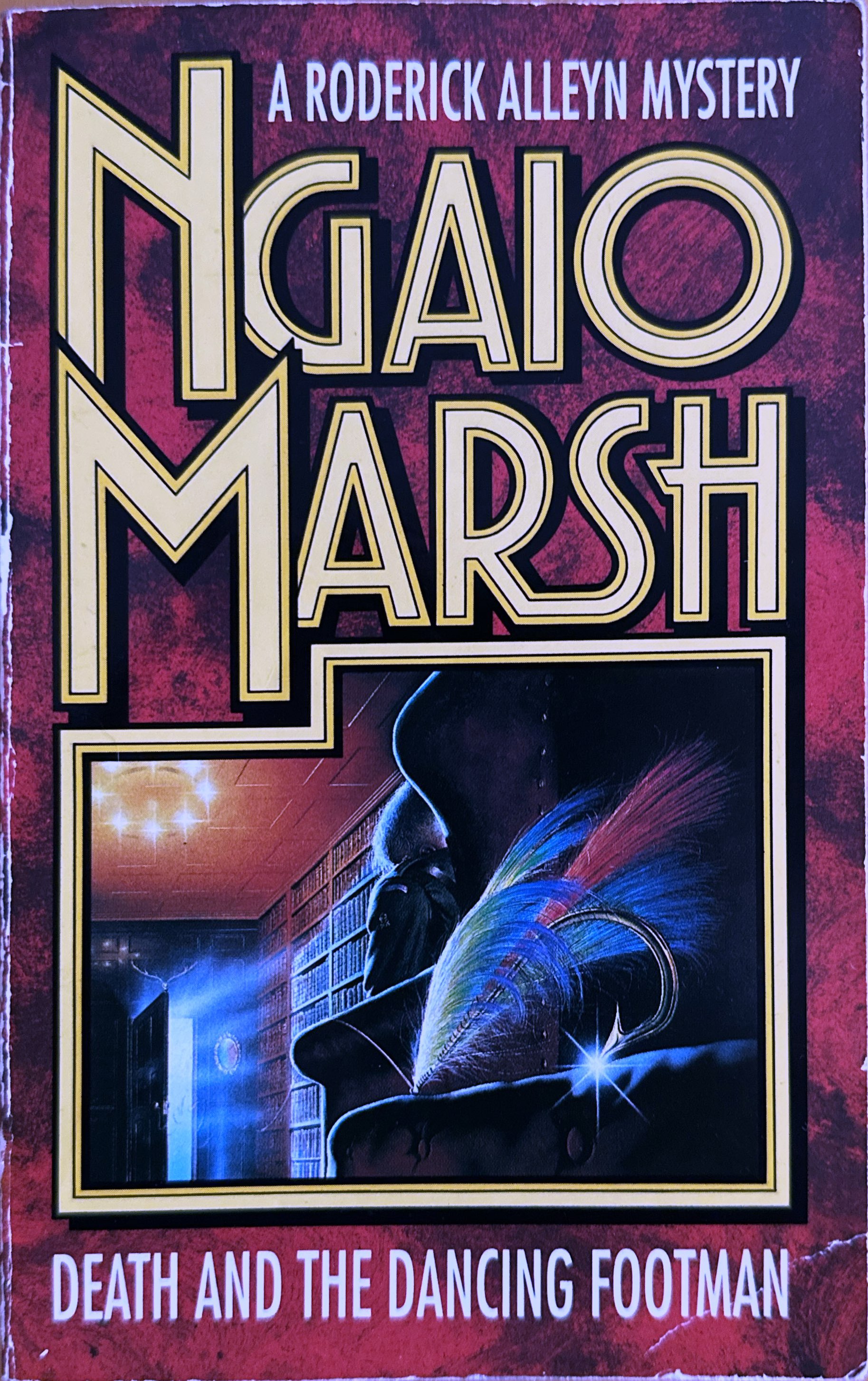
Ngaio Marsh's Death and the Dancing Footman

"'This is most awkward,' said Hart primly."

It's England in 1940, the period of the phoney war before Germany invaded France, and Jonathan Royal has decided to throw a party at his country house Highfold Manor.

Except it's not a fun premise for a party, or fun only for Jonathan Royal, because he invites seven people who don't like each other. There are three Complines, near neighbors, the widowed mother and two sons. William, the elder, would be a momma's boy, but his mother prefers Nicholas, who's a bounder, but attractive to the ladies nevertheless. William's already a soldier, but on leave; Nicholas has scored a desk job in London.

There's Chloris Wynne, formerly affianced to Nicholas, but now engaged to William, after she realized Nicholas would never be true.

There are two rival beauty salons in the neighborhood, Lady Hersey Amblington runs one; she's a distant cousin of Jonathan Royal. Elise Lisse, an Austrian refugee, runs the other. The two are professional rivals, and cordially (?) detest each other. Madame Lisse is also one of those ladies with whom Nicholas was habitually unfaithful to Chloris.

There's a second Austrian refugee, Dr. Francis Hart, a professional (and maybe more?) colleague of Madame Lisse. His specialty is facial plastic surgery, and Madame Lisse recommends him when she can do no more.

Did I mention Mrs. Compline had a disastrous facial surgery twenty years before when that type of surgery was still in its infancy? No? Consider it mentioned...

Jonathan Royal also invites Aubrey Mandrake, an up-and-coming surrealist playwright, mostly so he can show off his cleverness. Mandrake has never met any of the others before.

Several of the characters decide almost immediately to simply leave when they discover the identities of their fellow guests, but conveniently for Jonathan Royal's plans, the house is quickly snowed in. 

Snowed in country house murder. Have you read a few of those before? Me, too.

There are also a few other grounds for hostility that we learn along the way. Quite the motive extravaganza.

Getting us to this place was a bit silly and improbable--Jonathan Royal makes a few noises about reconciling these people, but mostly he's just a mischievous monster--but once we're past the setup, the mystery events move along well. There are two attempted murders before the main event; a couple of duplicate Tyrolean cloaks means not only do we not know who made the attempt, we also don't know who the intended victim was. And when William Compline is finally killed, we're still not sure. Was there yet another mistake?

The obfuscation in this was quite good, I thought. The person I was betting on commits suicide and leaves a note taking responsibility, but it's still fifty pages before the end! That's when I knew I had it wrong... 😉

Mandrake is an acquaintance of our hero Roderick Alleyn of Scotland Yard and he happens to know Alleyn is staying with his wife at Pen Cuckoo (the location of Overture to Death, a couple of mysteries before this one). Sure it's his holiday, but we'll struggle through the snow to bring him back! (Because, of course the phones lines are all down.) And he'll grumble, but he'll come!

Anyway, I don't mind a little farce in my Golden Age mysteries, and there's romance in this one, too. I think of the late 30s and early 40s as Marsh's strongest period, and this was definitely a good entry.

Vintage Mystery, Gold, Fishing Gear. Pay attention to where that fishing lure goes. It's an important clue!


Friday, June 30, 2023

Andrew Greeley's Happy Are The Clean Of Heart

Lisa Malone is an Irish Catholic girl from the Chicago. She could sing; she was good-looking; so she went to Hollywood and she succeeded. Now it's 1984 and she's nearly 40 and when she comes back to the old neighborhood, they're happy and envious in about equal measure. Make that measure unequal: more envious.

And on her first night back, somebody beats her to within an inch of her life in a hotel. Now she's in a coma.

Her estranged husband is found standing over the body, the cosh in his hand. He 'says' he interrupted somebody. But he's not the only suspect. There's her agent, who felt like he's the one that made her, her understudy for an upcoming Christmas special, her co-star on that special, a woman from the neighborhood, writing a biography with Lisa's approval,  a Mobbed-up bank vice president who administers Lisa's charitable foundation, her jealous older brother, and a nun who knew Lisa as a girl and whose organization is also the recipient of Lisa's charity.

And, well, Fr. John Blackwood "Blackie" Ryan had opportunity, too, and everybody knew he was in love with her when they were in high school. 

Then there's a second and a third attempt on her life in the hospital.

Blackie Ryan is the hero of a mystery series by Andrew Greeley, himself a priest as well as a professor at the University of Chicago. This is the second in the series, though there is an earlier non-mystery novel with Blackie Ryan as a major character. It takes until that third attempt for Blackie to figure out the villain. "Indeed," as Blackie himself might say.

There's some fun things in it for a Chicagoan. Roger Ebert and Richie Daley make appearances. (That's Richard M. Daley, former mayor of Chicago to you.) Richie is Cook County state's attorney that year. The events take place on the near north side, Chicago's Water Tower, the John Hancock building, Holy Name Cathedral, the Drake Hotel, the Playboy Building (as Blackie can barely bring himself to say, not the Playboy any longer). Lisa Malone's daughter plans on St. Ignatius for her high school, my alma mater.

I've read a bunch of the Blackie Ryan mysteries. My dad liked them, and I read them after he did, frequently because I gave him the new one for Christmas or his birthday. I can't say that this was one of the better ones. I find the early ones a bit overwritten, and Greeley's not the psychologist he wants to be. He pared them down later, and they were better for it. Oh, well...

The novel comes out in 1986 and the movie Amadeus has clearly influenced the plotting.

But it was one of the books I put on my Twenty Books of Summer list!


And it counts for Bev's Vintage Mystery Challenge:


Vintage Mystery, Silver, Knife: a knife is used in the third attempt.

Tuesday, June 20, 2023

Josephine Tey's The Daughter of Time

"Truth is the daughter of time."
-Old proverb

Inspector Alan Grant is stuck in hospital after he fell through a trap door in pursuit of a criminal. For now, he can do nothing but lie on his back and look at the ceiling. Nurses, friends, acquaintances bring him flowers, sweets, books to pass the time. None of them particularly engage.

One friend, more astute than the rest, brings him portraits of historical criminals. These portraits include King Richard III, famous for supposedly murdering his nephews, the 'Princes in the Tower.' Grant thinks, that doesn't look like a murderer's face, and becomes interested in the evidence for King Richard's guilt. He gets his friends to bring him a bunch of history books, and eventually Brent Carradine, a researcher. Grant applies his Scotland Yard techniques to working out a solution, while Carradine gathers the evidence.

Now all I know about the case comes from Shakespeare's Richard III: there Richard's a thorough-going villain, and the ghosts of all of the people he'd unjustly killed gather round his bed the night before Bosworth Field and chant, "Tomorrow in the battle think on me." I was prepared to believe he didn't kill his nephews. It turns out Shakespeare got his information from Sir Thomas More, still a child at the time of the supposed murders, and later a partisan of the Tudors, at least until he wasn't. If you've read Hilary Mantel, you'll have no problem imagining More as untrustworthy, but in Tey he's the 'sainted' Thomas More, and Grant has some convincing to do.

Would it be a spoiler to reveal Grant's solution? Well, I won't. Tey, in the person of Grant, makes a pretty good case, but not perfectly convincing. Her evidence amounts to cui bono, who benefits--that was the best part for me--but also she makes considerable use of the absence of evidence. (If X happened, Y should have happened, but there's no record of Y. But the events were in the 1400s. There may just be no record any more.) Still very enjoyable. It would have helped if I'd known more about the period.

It's a celebrated novel--and justly so. Though the British Crime Writer's Association voted it the best mystery of all time in 1990 and that seems a little excessive. (Not The Maltese Falcon, The Murder on the Orient Express, The Hound of the Baskervilles!?!) But it is certainly a classic mystery...


For the challenge I'll go with:

Vintage Mystery, Gold, Castle or Ruin. The Tower of London is about as classic a castle as you can find.

Thursday, April 13, 2023

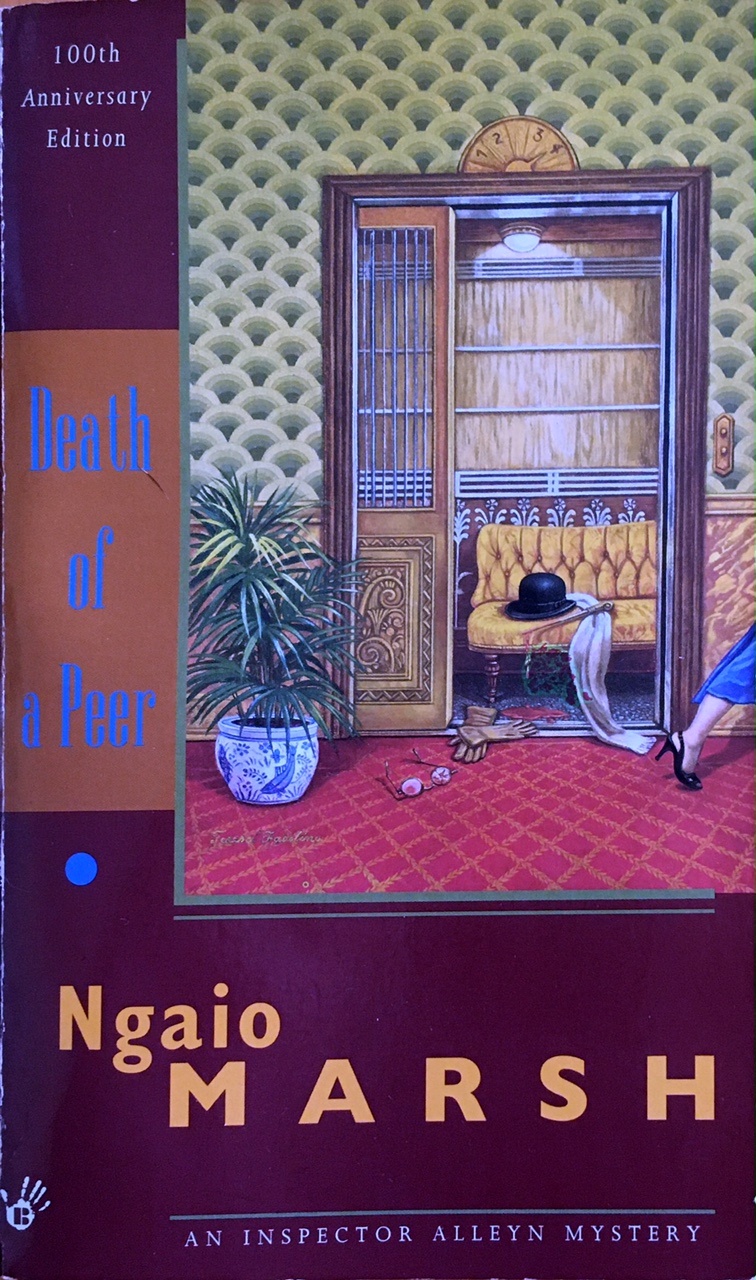
Ngaio Marsh's Death of a Peer (AKA A Surfeit of Lampreys) #1940Club

"It was some good-for-nothing out in the street. One of these Nazzys. The police will soon have him locked up."

[Spoiler alert! 😉] It wasn't one of those Nazis.

There are one or two quick allusions to events of the era, but mostly this feels like a interwar book. "The whole thing's lousy with lords and ladies," says Inspector Fox.

There have been ennobled Lampreys ever since one did 'some fishy bit of hanky-panky for Good Queen Anne or one of her ministers.' Lord Charles Lamprey is the second son, improvident, and head of a large family. It's his older brother that's murdered, in the lift at Lord Charles' London apartment. Since Lord Charles was hoping to get cash from his older brother and had not, he's clearly a prime suspect.

The novel starts in New Zealand, though, where Roberta (Robin) Grey becomes friends with the family. In New Zealand Robin's already half in love with Henry, Lord Charles' oldest son and when her parents die and she's sent off to live with an aunt in England, she's not entirely sad. We get a few amusing pages of a provincial's first arrival in London before the main event (together with Superintendant Roderick Alleyn and Inspector Fox and the whole crew) arrives.

The puzzle in this one is pretty successful, and I got to the end without realizing who had done it. Still the best thing in the novel has to be the Micawber-ish Lampreys; they're charming, witty, hapless, and (unlike the Micawbers) compulsively given to fudging the truth. You'd think that last quality might detract from the charm, but they do it to save each other, and it *is* useful in a mystery novel. Not that Alleyn or Fox is ever be-fudged.

A strong entry in the Marsh canon, I thought, though I preferred her other 1940 book, Death at the Bar, that I read earlier this year.


Good for My Reader's Block Vintage Mystery challenge.

Vintage Mystery, Gold, Glove. The gloves are a crucial clue.

And it's the week of the 1940 Club!

Marsh dated the book December, 1939 in New Zealand, at the end. My copy is copyrighted 1940. The Internets are a bit uncertain: some calling it a 1940 book and some a 1941. Publishing was becoming restricted by then and it may very well have different release dates in different countries. But I'm just going to stick my fingers in my ears, and unlike Roderick Alleyn, ignore any facts that contradict what I want to believe. La, la, la. It's a 1940 book!


Monday, April 10, 2023

Leslie Charteris' The Saint in Miami (#1940Club)

"The name is Simon Templar--usually known as the Saint."

A friend of the Saint's girlfriend writes and says there's trouble brewing, and so the Saint heads for Miami.

But when they get to the Gilbecks' house, they're gone. The servants let them in, but are clearly puzzled why these foreigners have come to stay when the owners of the house just sailed away.

That same day a U.S. freighter is blown up off the Florida coast; the Saint spots a submarine; and a body washes up by the Gilbecks' house, a body half-dressed in a British Navy uniform. 

Are these things all connected? Of course they are!

It makes a pretty good 1940 novel (though see Below...) Who exactly would be attempting to drive a wedge between the Americans and the British in 1940? It's not giving much away to say that's exactly who villains are. But just who it is that's the big boss Nazi in Miami and what the Saint is going to do about it are still pretty good questions for a novel.

The Saint's first action is to hide that body, because he (rightly) suspects the British Navy has nothing to do with it.

Leslie Charteris' series is pretty well established by this point. The first Saint novel, Meet the Tiger, came out in 1928 and his crew are present: the Saint's sometime girlfriend, Patricia Holm, doesn't do much in this one except provide the tie-in to the Gilbecks; Peter Quentin does some of the early legwork, but is mostly there to be captured; however, the Saint's Brooklyn-born muscle-man, Hoppy Uniatz, is in fine form: "Welcome him with liquor, and he'll drink out of your hand," Saint tells the Greek, and it's true.

The Saint's a key figure in the long line of guys on the wrong side of the law who still fight for the good: Robin Hood to contemporaries like Andrew Vachss' Burke and Jack Reacher. The Saint hits a sweet spot for me. I find his successors too dark, and their stories too grisly for my taste. He kills one of the 'ungodly', his term for the bad guys, in this, but it isn't dwelt on, and even then it's unusual; mostly the Saint arranges for the ungodly to do themselves in, and that's the way this one ends.

The Saint was once better known than he is now: not only are there the novels, but also stage plays, radio plays, television shows, and movies.

He's also a precursor for James Bond, and Roger Moore played the Saint on TV in the 60s before Moore became (a rather wooden) James Bond. The Saint knows his champagnes and his cars; his suits are good; the ladies (inevitably stunning) are inexplicably drawn to him.

But he does have his troubles with the law; less in this than some others, but there's an FBI agent, a British secret service agent, and an amusing local sheriff. He doesn't want to fight them, but he isn't going to co-operate either: "They had provided the one vital clue, but they still couldn't have his adventures."

Pretty fun stuff. 

[Below] It was such a good 1940 novel, but then, as they're about to slog their way through the Everglades to the ungodly's hideaway, the Greek says, "The quickest way is overland through the swamps. But the only guy who could walk on that stuff died nineteen hundred and forty years ago." Ouch, you'd think a Greek would know better...I believe that gentleman had been *born* nineteen hundred and forty years earlier.

A couple of other Charteris' Saint books on the blog: The Last Hero and Enter the Saint.

Good for the 1940 Club, hosted by Kaggsy and Simon. Thanks to them!


And good for My Reader's Block Vintage Mystery Scavenger Hunt. 1940 makes it Golden Age, and we'll go with:

Vintage Mystery, Gold, Hand Holding Gun. Just whose side is the redhead on? (Because the girl in the bikini has to be the redhead...)


Monday, April 3, 2023

Kerry Greenwood's Cocaine Blues (Phryne Fisher #1)

"A young man in one's bedroom is capable of being explained, but a corpse is always a hindrance."

Phryne Fisher has just moved from London to Melbourne. It's the 1920s and though she's good at it, she's bored with fast life in Europe. (Dinner parties, but also tangoing with gigolos in Paris and exposing crooked cricketeers.) She could afford that fast life because, after the convenient deaths of a few intervening heirs, she came into possession of a fortune in England, but she'd grown up poor in Australia. So she had both street smarts and resources.

The perfect combination for an amateur detective.

As a bit of added incentive, some English acquaintances ask her to look in on their daughter, because they're worried about how she's doing with her husband. 

Now I have to say, as a mystery, this is only so-so. The title rather gives away the motivation for the plot, and I'm afraid I saw the solution to the quest for the cocaine pingpin (to quote a former president) pretty early on. Doesn't matter. Fisher's a character one wants to read about: her affairs, her clothes, her accomplices. It makes a story both witty and engaging.

I don't know the series well, but several of the ongoing characters (though not all) make their first appearance here: her maid Dot, her two wheel/muscle men, Cec and Bert, her friend on the force, always convenient for an amateur detective. A wonderful start to the series.

And what I hadn't realized until I did a little math, it came out in 1989, and so it just squeezes in for the Silver Age Vintage Mystery Scavenger Hunt.  We'll go with that extravagant strand of pearls.

Vintage Mystery, Silver, Jewelry


Saturday, February 11, 2023

The Man Who Was Thursday: A Nightmare

There's going to be some spoilerish things in this, so be advised.

Gabriel Syme wanders into the London suburb of Saffron Park, a 'place not only pleasant, but perfect.' 'It had to be considered not so much as a workshop for artists, but as a frail but finished work of art.' Syme is himself a poet, 'a poet of law, a poet of order; nay, he said he was a poet of respectability.' He gets into a verbal squabble with red-headed Lucian Gregory, the established poet of Saffron Park, who is none of those things, but rather the opposite. (While at the same time, Syme admires Gregory's sister Rosamond, equally red-headed.)

Syme is also a detective, working for Scotland Yard. He was approved at joining by a mysterious man in a dark room.

Gregory proclaims himself a radical anarchist, but Syme accuses him of being a wannabe. Gregory refutes this charge by introducing Syme to a secret society, the leaders of which are named after the days of the week; at the very next meeting, to which Gregory takes Syme, Gregory expects to be elected the new Thursday. Sunday is the leader of this anarchist society.

Syme launches into a speech that results in his being elected the new Thursday. Aha, thinks Syme! I will now be Scotland Yard's man on the inside. But he has confessed his status as a policeman to Gregory, and sworn not to denounce him, so he has to figure out how to use his new insider-dom without breaking his vow.

At the very first meeting of the seven weekday leaders, Sunday announces one of them is a policeman. Yikes, thinks Syme, I've been found out already. But no, it turns out Gogol is also a policeman in disguise, and while Syme is mostly relieved he hasn't been detected, he's also a little ashamed he didn't do more. Gogol is escorted by thugs off the premises to some unspeakable fate.

On leaving that first meeting, Syme is pursued by another anarchist principal, the Professor de Worms. Does the Professor know Syme's a policeman? Syme tries to escape, but is eventually cornered by the Professor, who...reveals he's also a policeman. That makes three out of the seven. If only they'd organized!

I was perfectly ready to generalize after this, and yes, it quickly turns out six of the seven anarchist leaders are policeman in disguise. Is Sunday as well? 

Of course he is. (I have to say I saw that a mile away, or at least 90 pages away out of the 160.) But Chesterton handles it amusingly and suspensefully enough, and, in fact, Sunday is exactly that unseen policeman who first approved Syme's joining the force (and the other five policeman/anarchist leaders, as well.) The six pursue Sunday (or maybe Sunday is pursuing them) until a final recognition and no crime is actually committed, no dynamite thrown, the Czar not assassinated, even Gogol turns out to be alive after all.

It is Chesterton, and the name Sunday might be a clue. This is fairly early in Chesterton's career (1908), Father Brown is in the future, and Chesterton has not yet converted to Catholicism. Wikipedia tells me he was suffering a crisis of faith as he was writing this. Sunday is a deus absconditus. He tells his policemen, "You heard the voice in the dark, and you never heard it again. The sun in heaven denied it, the earth and sky denied it, all human wisdom denied it. And when I met you in daylight I denied it myself." Sunday goes on to explain why he allowed this, and so the book is a kind of theodicy, a justification of God, and an explication of why there is evil in the world. Like all theodicies, I didn't find it very convincing myself...

But until it got there it was a pretty amusing thriller.

There are the usual Chestertonian provocations. Only someone who's meat-eating and beer-drinking can be a proper Englishman, and not a lowly anarchist. Well in fact, I eat meat and drink beer, and have no desire to be a proper Englishman, so this should slide right past me, but I admit to being bothered by it, a little. But it is Chesterton, so one has to either not read him, or not be bothered by that sort of thing.

Do I dare call it a crime book? Well, in the end, it is a bit more Piers Plowman than Bulldog Drummond, but it does start with a Scotland Yard man trying to prevent a murder, so...


Vintage Mystery, Gold, Two People.

I actually read it in a copy from Project Gutenberg, but found online the cover shown above which fits the book pretty well.

Tuesday, January 17, 2023

Ngaio Marsh's Death at the Bar

"If thurr's not a corpse on the premises afore long, I'll be greatly astonished."

Don't you worry...

Abel Pomeroy is the proprietor at The Plume of Feathers and he's got a rat problem. He goes off to buy rat poison, but the ordinary stuff is not in stock; the pharmacist has only got the extra strong. But that's not a problem for Pomeroy: he's got a plan. Locked cabinet, gloves, whatever it takes to keep it safe.

Well, you know how that goes. By the time the lawyer Luke Watchman is dead, we've got a good half-dozen suspects lined up: two beneficiaries under his will, a girl who previously had an affair with Watchman, young Will Pomeroy who's in love with the girl, the cousin of a man whom Watchman sent to prison, and the mysterious Legge, whom Watchman knows from somewhere, but nobody's saying where. 

The murder takes place on the coast of Devon, and the local police officials are good, but not good enough. Abel Pomeroy wants this solved, it's ruining his business. So Roderick Alleyn and his trusty assistant Br'er Fox are sent to have a look:

"Yes, look at the colour of the sea, you old devil. Smell that jetty-tar-and-iodine smell, blast your eyes. Fox, murder or no murder, I'm glad we came."

Me, too, Mr. Alleyn. 

It's the ninth in the series and dates from 1940. It's a pretty good entry, though I preferred the opening drollery about the poison; the unwinding of events I think could have been clearer. But in just now looking at the date, I realized this was the one I meant to save for the 1940 Club in April. Oh, well...

Vintage Mystery, Gold, Bottle of Poison. Yup, there's definitely a bottle of poison in this one...

Wednesday, December 21, 2022

Patricia Wentworth's The Blind Side (#DeanStreetDecember)

"Oh, I wish Ross was dead!" - Chapter 2

"I won't let Ross so much as cross the threshold. If he tries...There'll be murder done." - Chapter 3

"Mr. Ross, he'll go too far one of these days." - Chapter 4

"Shooting's too good for him--that's what I say!" - Chapter 5

Guess who ends up dead? Shot, in fact?

Ross Craddock has just inherited a block of London flats as well as some other property, so he's well-to-do. He inhabits one of those flats; Lucy, a maiden aunt another. A second maiden aunt recently dead inhabited a third flat. There are a dozen altogether, some unoccupied at the time of Ross Craddock's murder.

Ross is just about to evict Lucy; has just tried to seduce Mavis, a distant cousin; has feuded with Rush, the concierge, accusing him of blackmail. (Rush is important in determining just who can have gotten in and out of this locked-building mystery.) 

Chapter 1 gives a family history, which is important, but so complicated as to be incomprehensible; fortunately Wentworth gives us a table later on. Should you like a romance in your Golden Age mystery (as I do!) there's one on between Lee Stratton and Peter Renshaw (also distant cousins).

Whew!

The mystery came out in 1939. World War I is important, but it's before World War II and no sign of it yet. The economy has begun to recover after the depression.

This is the first of the Chief Inspect Ernest Lamb mysteries; Frank Abbott is his public-school-educated assistant. Wentworth wrote three mysteries with Lamb as the main detective before he was absorbed into her most famous series, which has Miss Silver, former governess, as a professional detective. Two Miss Silver mysteries had appeared before this, but without Lamb or Abbott. I find the Miss Silver series pretty wonderful.

Lamb is much the same as he is in the Miss Silver stories, curmudgeonly, and a bit sexist: "Difficult to stop girls doing it nowadays, but if he found one of his [own daughters] with her mouth made up to look like an orange peel..." Dum, dum, de dum. Abbott is more modern, amenable to women in roles they didn't use to have and admires Miss Silver as a P.I. But Lamb isn't a fool in this or in other books; he recognizes Miss Silver gets results when they're paired together; and he finds the murderer in this one, mostly on his own. (Though with a little help.) Very entertaining.

And that romance? Well, if you've read any Patricia Wentworth, you'll know what happens.

All the non-Miss Silver mysteries were reissued be Dean Street Press a few years ago. And since Liz is hosting a Dean Street Press event at the moment...