Showing posts with label Erle Stanley Gardner. Show all posts

Thursday, August 31, 2023

Erle Stanley Gardner's Shills Can't Cash Chips

"This is an insurance company. They've had their eye on us for a while. It's the kind of business there's money in, Donald, not this wild-eyed sharpshooting you've been doing."

Lamont Hawley of Consolidated Interinsurance comes into the Cool and Lam detective office for extra help on a suspected insurance fraud case. That's Bertha Cool talking above. She's the older, practical, financially-minded half of the partnership.

Donald Lam is the one given to wild-eyed sharpshooting. He's small--their sometime friend in the L.A. police department calls him 'Pint Size'--no good in a fight, but quick-talking and attractive to the ladies.

And there's Elsie Brand, the office secretary, who's more than half in love with Donald.

But before that initial meeting with Hawley is over, he says:
"I may as well tell you, Lam, we think there's an element of danger involved."
"Personal?"
"Yes."
Well, of course there is.

Carter Holgate was driving too fast and smashed into the rear end of Vivian Deshler's car. She's claiming whiplash and looking for the insurance company to pay up. Holgate admits the accident. But now Vivian has disappeared and various people are--not the insurance company--offering cash for witnesses to the accident. Something is fishy. When did the accident occur? Did it occur?

The body is discovered (it's Holgate's) in the trunk of the Cool and Lam Agency car and Donald is wanted for the murder. He would have needed Bertha to pull it off. 
"'Fry me for an oyster!' Bertha said.
'They just might do that."
As an accomplice to murder. 

"Fry me for an oyster!" is one of Bertha's favorite sayings. "Dice me for a carrot," also shows up in this one.

But of course the person who committed the murder is neither Donald nor Bertha. All in all a pretty entertaining entry to the series.

It's a pretty late entry in the series. Wikipedia tells me it's #22 out of the thirty and it came out in 1961. 


Vintage Mystery, Silver, Brunette: We'll go with that 'vivid brunette, who walked impatiently as though her good-looking legs were trying to push the sidewalk out of the way.'

Friday, September 7, 2018

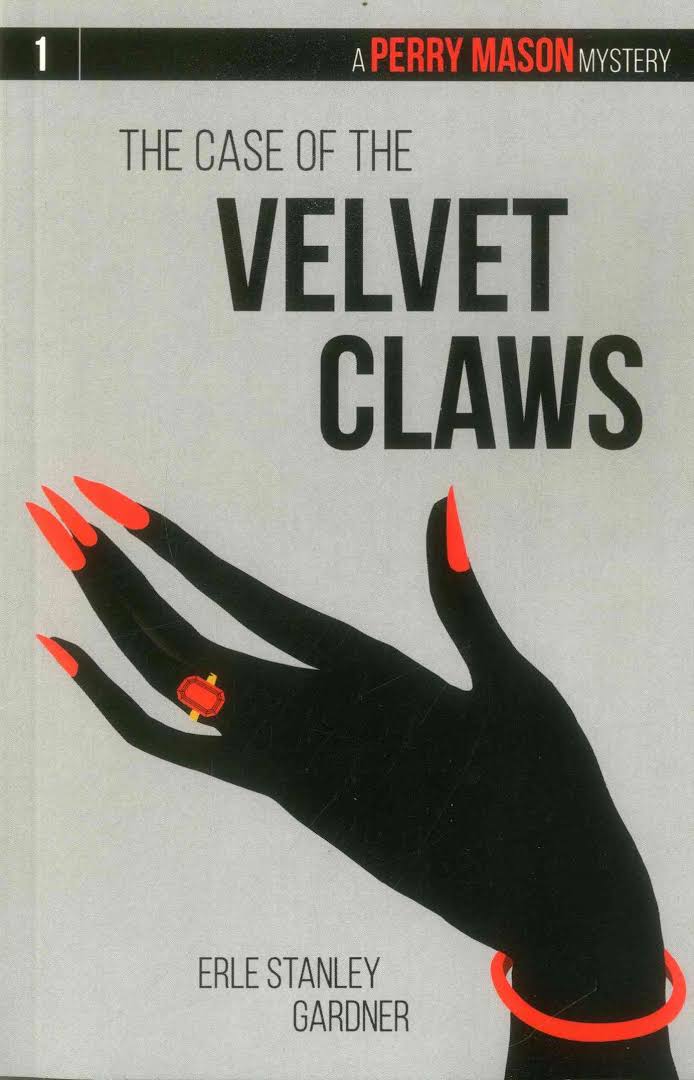
Erle Stanley Gardner's The Case of the Velvet Claws

"I told you what she was--all velvet and claws!"
That's Della talking about Eva, Perry Mason's very first client (as far as we know) in the first Perry Mason mystery ever from 1933. Della's got the hate on for the client:

"I hate everything she stands for! I've had to work for everything I got. I never got a thing in life that I didn't work for. And lots of times I've worked for things and have had nothing in return. That woman is the type that has never worked for anything in her life!"

Who knew Della Street had so many class resentments?

And that's not the only way in which the mystery is different from others in the series. Perry tells the client at one point, "I'll protect you, just as long as you pay cash." Would a later Perry Mason ever say that to a client? Now sure he was a more successful lawyer as he went on, but I seem to remember him taking a one dollar retainer on more than one occasion.

And there's no courtroom scene! And Perry slugs someone not once, but twice!

Still it's identifiably a Perry Mason novel. Sure, it's a little more noirish than later novels, but there was always a bit of noir to Perry Mason, and it's not just the TV show music. In addition to Perry and Della, Paul Drake, the private eye, is there; Perry bends the rules on behalf of his client to the point where he's potentially at risk himself. The client is innocent, though the misdirection on that point is very good in this novel. So most of the usual elements are there.

The basic setup is this: Eva (at first under a false last name) is caught with a man who's an aspiring politician when a holdup in a bar goes wrong. The local scandal sheet knows they were there. Can Perry manage to keep their names out of it? Then the owner of the scandal sheet is murdered. Well, it's a scandal sheet: there are plenty of suspects, and not just the client.

This usually shows up in lists of best Perry Mason novels and I would have to agree!

Vintage Mystery Challenge. Golden Age. How. Death by shooting.


Saturday, July 28, 2018

Erle Stanley Gardner's The Case Of The Spurious Spinster

The Case Of The Spurious Spinster (1961) finds Perry Mason in good form. It's Sue Fisher, the well-dressed brunette of the cover, who goes to Perry Mason. She's an executive secretary, working on a Saturday and the son of her manager and the boy's governess come to the office. The son hands her a shoebox of hundred-dollar bills, supposedly from his father. She puts the money in the safe, goes to the airport to pick up the company's owner, and then goes straight to Perry Mason. Which turns out to be very astute of her. I would have thought, odd as it was, with the money in the safe everything would be fine. Well, of course, it wasn't.

Amelia Corning, the owner of Corning Mining, Smelting and Investment, lives in South America and is confined to a wheelchair; it's her who arrives at the airport. She then disappears that evening. Then a second, different Amelia Corning arrives the next day, and then she disappears, too. One of them was spurious, but which?

Ken Lowry, the manager of one of the Corning mines, is found murdered, by Perry, of course; shortly after that, Sue Fisher is arrested for the crime. It's clear that there's some sort of fraud going on, but who's behind it? The manager is the likeliest candidate, but it could be Sue Fisher, and she's arrested for the murder.

The formula requires a good-looking young woman who goes to Perry Mason for something else (check) and is promptly accused of murder (check). It has to be Perry who discovers the body (check). It also requires Perry finding some key bit of evidence, then obfuscating his trail in a way that brushes with legality. That part of the formula was very successfully done in this, and I thought the best part. No spoilers! Then Hamilton Burger has to blow his top, and that was very well done, too.

It will be no surprise that the murderer was not Sue Fisher, but the final resolution was cleverly tricky and was revealed in court (check).

All in all, a good, if not brilliant, Perry Mason story.

Vintage Mystery Challenge. Silver. TBR List.

Tuesday, July 3, 2018

Erle Stanley Gardner's The Case Of The Haunted Husband

"There's nothing the matter with you that four good cocktails won't cure."
That's Della's advice to Paul Drake. It might be a bit much for me, though. I probably wouldn't get past the second.

Until the very end I thought Haunted Husband was one of the best Perry Mason outings. It's from 1941, in the middle of a good period for Gardner's Perry Mason novels, and was free of the sloppiness he's capable of. The blonde client ends up in Mason's office at first for vehicular manslaughter; she was supposedly drunk and behind the wheel in a four car pile up outside Bakersfield. But she's innocent of that, of course.

The blonde has an uncle and a fiancée of sorts--she's hitchhiking to get away from him--and they're both quite amusing; the fiancée a wimp and the uncle a busybody. There's an amusing satire of a Hollywood artiste as he writes the script for his next blockbuster. And it includes Perry's usual shenanigans in finding a body.

Up until the very end, though, as I said. I read the last twenty pages three times and I still can't tell you exactly what happened. Perry explains it to Lt. Tragg but that's because he wants Tragg to act in one way and when Della asks Perry if his explanation to Tragg was accurate, he says mostly, but then changes a few things. Who was married to whom and who wanted to be married to whom is still up in the air for me. It may be OK to wonder who it was that really shot the chauffeur if you're Raymond Chandler; I expect Gardner to be a little less impressionistic.

Oh, well. Still a strong entry.
"'But,' Tragg pointed out, 'he's done more to solve murders than any man on the force...but...well, damn him!'"
Vintage Mystery Challenge. Gold. What. Alliterative title.

Sunday, December 31, 2017

Erle Stanley Gardner's The Case of the Rolling Bones

The Case Of The Rolling Bones is a Perry Mason mystery of 1939. I use 'a' deliberately. Though I didn't actually check, I doubt it was the only one. Are Gardner's books the only ones that also give the month as well as the year of publication? He may be one of the few authors that needs it. For what it's worth, this was Gardner's book of September, 1939. (An otherwise ominous month.) It was *probably* the only one that month...

On the whole it was a medium good entry. Alden Leeds is an elderly man with a somewhat mysterious past who struck it rich in an Alaska gold rush in 1906. He's unmarried and the rest of his family likes it that way. Then he takes it into his head to marry a girl he knew from a dance hall back in Alaska--she's younger than he is, but not young--and the family decides, conveniently, he must be crazy. It's this that brings Perry into the case.

Leeds is also being blackmailed over that mysterious past and it's the blackmailer who gets killed. And Leeds is the prime suspect, and it's up to Perry to get him off.

There was some reasonably well-done fair-play cluing in this one, which is not a thing I usually associate with Gardner's mysteries. And the old coot quotient was high in this and they were amusing. It's Gardner and I could hunt up examples of slapdash construction, but if you know the Perry Mason series at all you wouldn't be surprised. Enjoyable.

That's very definitely the 1969 version not the 1939 model on my cover, but either way she's a:

Brunette. Golden Age. My Reader's Block Vintage Mystery Scavenger Hunt

Tuesday, November 28, 2017

Erle Stanley Gardner's The Case Of The Lonely Heiress

"There are times when a lawyer throws the rule book away, when he has to go by hunches." Oh, really? You don't say, Mr. Mason? Are  there actually any other times in your law practice, Mr. Mason? In any case, this isn't one of those other times. But you wouldn't want to read about those other times anyway.

The copyright in my reprint of Erle Stanley Gardner's The Case Of The Lonely Heiress says it first came out in February of 1948. Maybe it was Gardner's first novel of that year. I doubt it was his last.

The setup is pretty good in this one. Robert Caddo is the publisher of a somewhat sleazy lonely hearts magazine. Women post ads in his magazine. The back of the magazine has a mailing coupon to contact these lonely women c/o Robert Caddo's magazine office, which he then forwards on to an anonymous box for the woman posting a particular ad. That's all fine and mildly lucrative. Then a woman posts an ad saying she's a young, good-looking heiress (not someone middle-aged whose parent has just died) and it's a hit. Caddo's magazine is flying off the shelves. But it's a little too much of a hit for the local vice squad who thinks Caddo has just gotten that much closer to pimping.

Caddo goes to Mason to prove that this advertisement is legit since he's created a structure whereby he doesn't actually know the women involved. Perry, with Paul Drake's help, identifies the lonely heiress of the title advertising in Caddo's magazine. She really is looking for a man, though for what purpose isn't quite clear at the start.

Caddo is a bit of a sleaze bucket. This is before internet dating, though the process is kind of analogous, and it was inevitable I suppose that he had to be. Della says:
You can take a look at Bob Caddo and see what he is. One of those old wolves that run around pawing girls and trying to cut corners.
Timely!

After the setup, though, it deteriorates a bit. As you knew (unless you've never read a Perry Mason novel and you've never seen the television show) the lonely heiress, blonde and fur-coated on the cover of my copy, will go to Perry, engage him as her lawyer, and then promptly be suspected of murder. That's the convention, and conventions are useful. The real question is, who is the person who really did it, and how will Perry make a fool of Hamilton Burger?

Well. Hamilton Burger doesn't even show up in this one. The D.A. is James Hanover and he's not particularly confounded or interesting. The revelation of the actual murderer isn't especially surprising. And, while this is a short novel, it even feels a little padded. Remember how your fifth grade teacher taught you in writing an essay to first say what you were going to say, then say it, then remind your reader what it was you said? Yeah, me too. That may be good advice for making your essay clear and comprehensible, and it may also be good advice for padding out your word count. It's less good advice if you're writing a novel, but it's advice Gardner had in his head, I'm afraid. He may have needed the word count. Perry and Della decide what they're going to do when they break into a witness's apartment, then they do almost exactly that, and then the information shows up in the courtroom. Okay, we get it.

On the subject of rom com subplots, though, this one was a winner. I don't think of this as a usual item in my Perry Mason universe: there's merely the eternal question of when will Perry realize that Della is unspokenly pining for him. Here he takes her out for Chinese and dancing as a variant instead of a steak. But this one has another, more realized flirtation. The lonely heiress ends up with one of Paul Drake's detectives. Romance!

Summation: not the best, but if you like Perry Mason and are looking for a bit of fluff, you'll like this.

Golden Age. Blonde (and in a fur coat!) My Reader's Block Vintage Mystery Cover Scavenger Hunt.


Saturday, January 28, 2017

Erle Stanley Gardner's The Case Of The Deadly Toy

The Case Of The Deadly Toy came out in 1959 as the first of three Perry Mason novels that year. The television series had already started. My general feeling, based on reading a bunch, but not all--how many people have really read all the Perry Mason novels? and it must be asked, why would you?--is that the later ones are hastier and less strong than the early ones.

But I thought this one was pretty good.

The initial exposition is blunt but brutally effective and takes up sixteen pages in my edition. Norda Allison (her interesting name seems to have been simplified to Claire for the TV episode) discovers her fiancee Mervin Selkirk is a bit of a thug when he slaps his son from a previous marriage for little cause. She breaks it off; her new boyfriend has his jaw broken by her ex-fiancee, and she's lured from San Francisco to LA for a scheme by Selkirk's ex-wife to wrest custody of the son from Selkirk. She's sympathetic but almost immediately she recognizes there's something screwy going on, and goes to Perry Mason.

At that point, of course, you know she'll be accused of murder and that's she's innocent.

There are signs of sloppiness: Della Street sees Norda Allison and gives 'the visitor the benefit of a swift and professional appraisal.' A few pages later, Paul Drake sees Norda Allison for the second time, and flashes 'Norda Allison a keen glance of professional appraisal.' Everyone in Perry's office is clearly capable of professional appraisals, especially of good-looking women.

Even worse from the very first page, I knew who the murderer was. The Perry Mason novels typically give a cast of characters at the very beginning. From that two line description it was obvious who was the murderer, I'm afraid, and I wasn't wrong.

But none of that matters. One comes to Perry Mason mainly for the wit in the dialog, but also for the completely ridiculous, probably illegal, turns that Perry pulls to confound Hamilton Burger. Both were successful in this case, and Perry's shenanigans did double duty in that they irritated the rich and obnoxious father of the victim as well as Hamilton Burger.

And speaking of double duty, this novel works for me both as an item in my scavenger hunt, and as clearing out my TBR list. Even though there's not supposed to be any blood on the toy printing kit pictured on the cover, there clearly is, so we'll count it for that:

Golden Age. Bloodstains. My Reader's Block Mystery Scavenger Hunt.

Both of the books I've read so far the TBR challenge came into my library in 2016. That hardly feels like backlog, but by the rules of the game it counts, so this is also for My Reader's Block Mount TBR Challenge. But the next one might have to be been hanging around for a bit longer. And that's only two out of thirty-six, and January is nearly over. I may need to pick up the pace...