Showing posts with label Mystery2023. Show all posts

Friday, December 8, 2023

Patricia Wentworth's Who Pays the Piper? (Mystery, DeanStreetDecember)

"I always get what I want," said Lucas Dale.

That's the opening line of Who Pays the Piper? and it's Lucas Dale who ends up dead. He didn't get what he wanted that time! (And ever is such hubris rewarded?)

Lucas Dale is a Brit who went to the U.S. and made a pile of money, in likely dodgy ways, and returned to England. He's just bought King's Bourne, an old country manor from the nearly bankrupt estate of James Bourne. Bourne is survived by one of his twin sisters, Millicent O'Hara, Mrs. O'Hara's daughter Catherine and Catherine's cousin Susan Lenox. 

Dale falls in love with Susan Lenox--she's one of the things he wants--but she's already in love with Bill Carrick, the son of the local doctor, who's still got his way to make (as an architect).

Dale also comes with a private secretary, an ex-wife who's on the stage, and an American business partner with a grievance. Plenty of suspects, especially after Dale starts using strong-arm tactics to get Susan to marry him.

Some pearls appear to be stolen, then reappear where they're not supposed to be, and then Lucas Dale is found dead, shot in the back of his head. Scotland Yard is called in, in the person of Chief Inspector Lamb, who brings along his dashing sergeant, Frank Abbott.

Now if you know anything about Patricia Wentworth, you'll know the evidence will look bad for Susan and Bill at first, but that it won't be either of them who committed the murder. And it's not.

This is the second (1940) of the Ernest Lamb series, and he's fine form here, curmudgeonly, sexist, and tender:
"He had three daughters of his own, and was sometimes put to it to conceal a most obstinate softness of heart where girls were concerned."
but at the same time quite observant. Later, after Lamb and Abbott are absorbed into Wentworth's most famous detective series, that of Miss Silver, his curmudgeonly is played up, and his observational skills are less used, and he's mostly that useful thing for a PI, a friend on the force, but in this one he and Abbott are on top of all the needed clues. A completely enjoyable entry, though the witness who has the one crucial clue keeps silent until the very end for reasons that seem a little improbable. (Other than the needs of a mystery novel...)

The first Ernest Lamb novel on the blog is here. I've also got the third and final one, Pursuit of a Parcel, as an eBook, and hope to read it this month. 

It's Dean Street December, and Liz is hosting an event.


Also, though I'm already a bit over the top on this challenge, it also fits My Reader's Block Vintage Mystery Scavenger Hunt:


Vintage Mystery, Gold, Hat. Those are some stylish hats, even if I'm not quite sure who the people under them are. Bill and Susan, I guess, though Susan is supposed to be blonde.

Tuesday, November 21, 2023

Tony Hillerman's The Blessing Way (#Mystery)

"I asked around some in re your inquiry about witchcraft cases and it looks only moderately promising."


But if you're looking for a mystery, it's very promising.

Luis Horeseman is a young Navajo who has just injured a man in a drunken knife fight. But he's worried he's killed his opponent, and so is living rough in an uninhabited canyon. Or so he thinks.

Joe Leaphorn is a detective with the Navajo police and he's pretty sure he knows where Horseman is, but rather than go hunting him, he drops hints among Horseman's relatives that young Luis won't be guilty of murder after all and should just turn himself in.

Bergen McKee is a professor of anthropology at the University of New Mexico and he's interested in Navajo witch stories. He's also an old college chum of Joe Leaphorn, and that's from Leaphorn's letter to McKee above. Even though Leaphorn's not very encouraging about the research, he still would like McKee to come visit, and anyway there just happens to be one report of a witch, otherwise unexplained.

Then Horseman is found dead, far from where Leaphorn expected him to be hiding out. At first glance the death looks accidental, but Leaphorn sees through that right away.

There are three more deaths before it's done and a good thriller scene in backcountry Arizona.

It's the first entry (1970) in Hillerman's series of mysteries set in Navajo lands, and the series started well, I thought. I've read most of them (and maybe this one before? But it felt new.) As it's the first neither Jim Chee or Bernadette Manuelito are on the scene and it's all up to the (not yet) Legendary Joe Leaphorn.


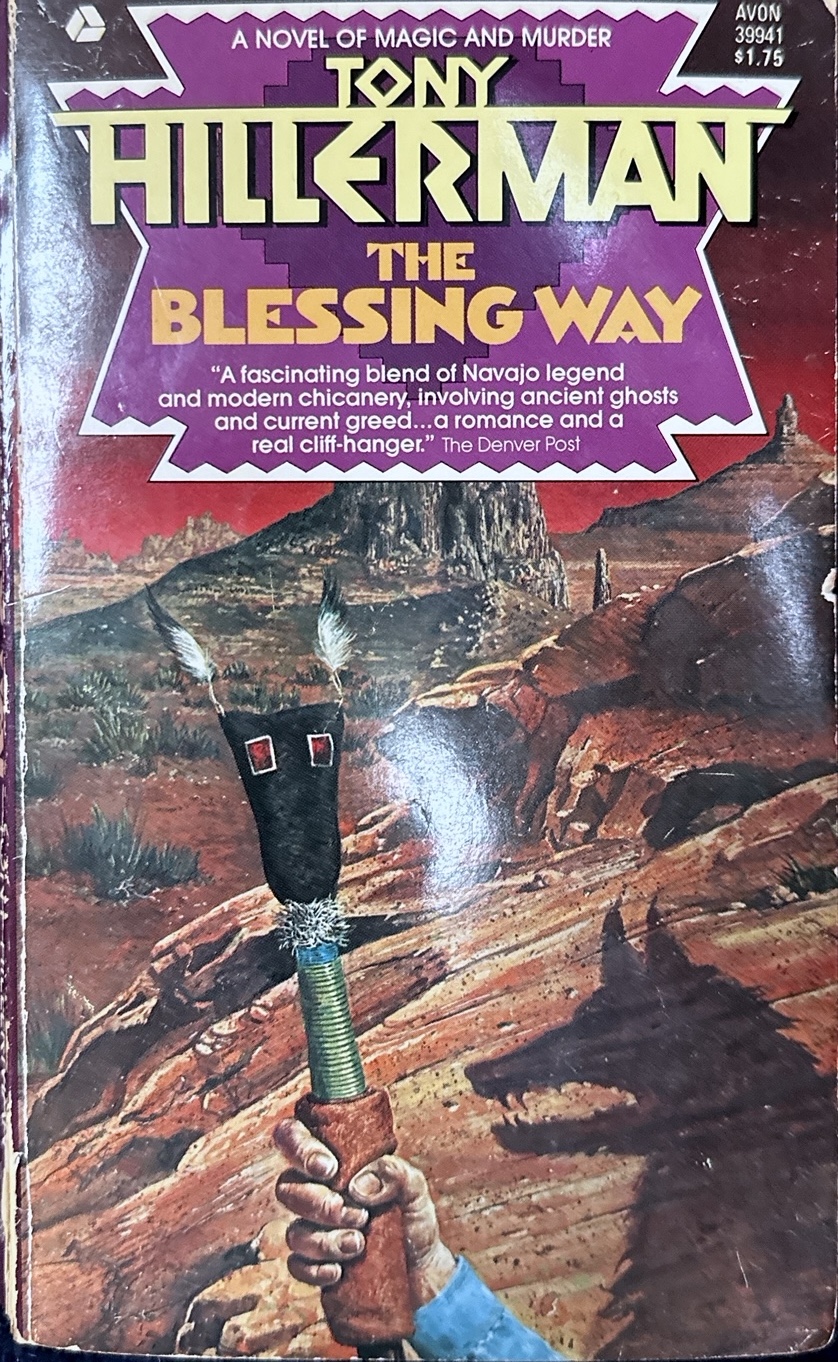
Vintage Mystery, Silver, Any Other Animal: That's a wolf shadow on the cover. Unless it's a witch (Navajo witches are either gender and take the shape of animals, most commonly wolves). Or, just possibly, a murderer in a wolf mask...

That completes Silver Age Vintage Mystery challenge for me, though who knows? I could very well read another mystery or two yet this year written between 1960 and 1989...

Sunday, October 29, 2023

Janwillem van de Wetering's Outsider in Amsterdam (#mystery)

"Killers are very scarce in Amsterdam so why should we suddenly run into a whole bunch of them?"

Piet Verbloom is found hanged in the Hindist Society building. Suicide? Could be, but then why was he banged on the head before he died?

This is the first Grijpstra and de Gier case; they're detectives on the Amsterdam force; the fat Henk Grijpstra is married with kids, and is the senior of the pair; Rinus de Gier is a sergeant, single and living with his cat Oliver. They're called in. They argue back and forth: is it suicide? But they both know that bump on the head means they will have to investigate. 

The Hindist Society is interested in a mishmash of Eastern religions--the book comes out in 1975--and their building houses a bar, a meditation center, a shop, and a commune. Verbloom sees himself as the chief priest. He's married, but should any other females appear on the premises, he feels authorized to pester them.

An early seventies society interested in Eastern religions? There's drugs, of course, hash at the very least. Are there more serious drugs? Maybe.

If it is a murder, the suspects are Piet's estranged wife, his pregnant lover, his accountant, a couple of drug dealers who frequented the bar, and the various people living in the commune, the bartender, a Papuan immigrant looking for cheap rooms. 

I've read one van de Wetering before, The Mind-Murders of 1981, the eighth in the series. I think I preferred this one. I started the series because I read somewhere it compared well with Edmund Crispin, one of my favorite mystery writers, and I continue to fail to see the comparison. It is a bit funny, but it has none of Crispin's inspired zaniness. I felt this one started well, and ended well, but I was less certain about the middle. It can't quite make up its mind whether it's a police procedural--other cases our detectives are involved with intrude--or a fair-play-cluing mystery. But if it was meant to be the latter, the red herrings weren't very red and I knew who the murderer was almost from the beginning, though the motive remained a bit mysterious until the end.

Read for the Vintage Mystery Challenge:


Vintage Mystery, Silver, Noose. That's our opening scene portrayed on the cover. With a very 70s shirt.

And for the European Reading Challenge:

It is pretty fascinating as a Netherlands book. Amsterdam was famous for its drug culture not so long afterwards. But as of 1975 (or presumably the novel represents the events of a little earlier) the city wasn't quite so ready for all that implied.

Van de Wetering was Dutch, though he lived in the U.S. later on for quite a while. It seems he wrote his novels first in Dutch, but then did his own translating.

Wednesday, October 18, 2023

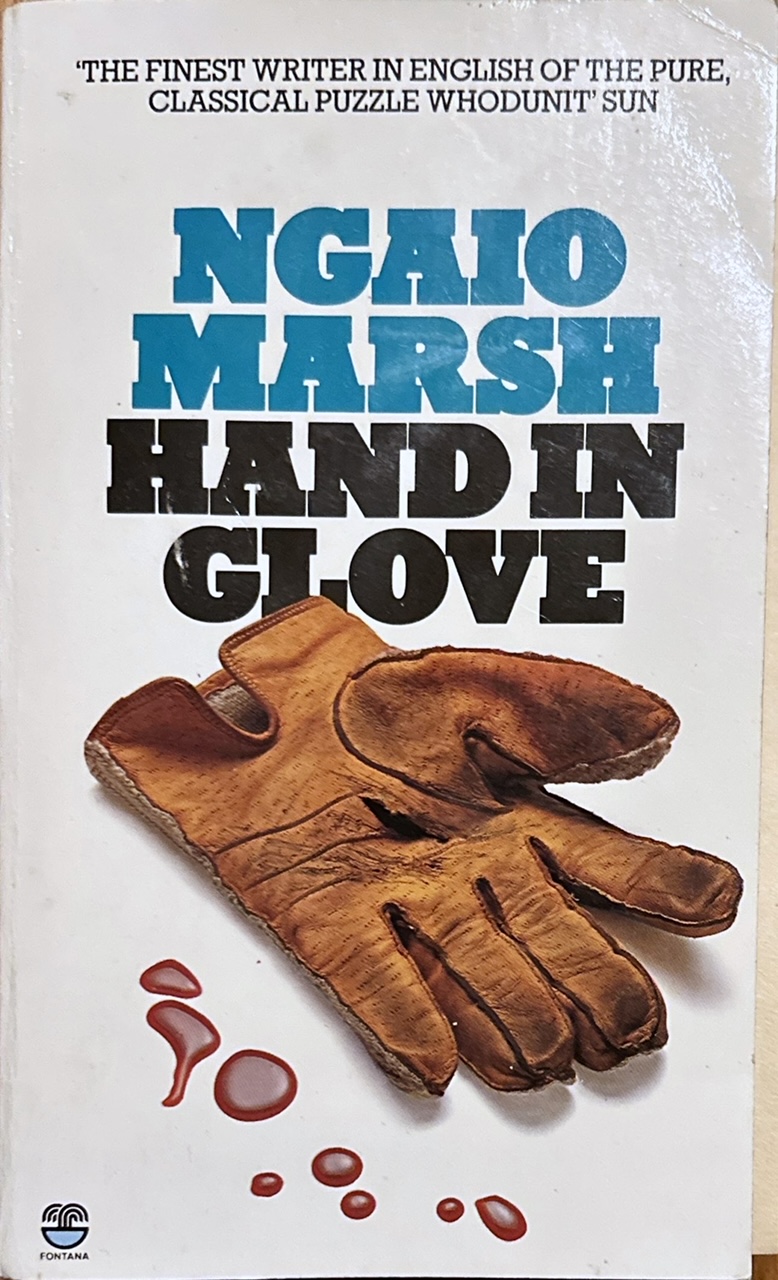
Ngaio Marsh's Hand in Glove (#1962Club)

"Here, Nicola, encountered the group of persons with whom, on one hand disastrously and on the other to her greatest joy, she was about to become inextricably involved."

Nicola Maitland-Mayne has just taken a job for P. Pyke Period as a typist. The elderly (and fussy) Mr. Period has been invited to write a book of etiquette, but all his notes are handwritten, and he needs somebody to type and organize them. While she's there working, Period invites her to an impromptu luncheon. 

It's Harold Cattrell who's at that luncheon and is murdered. Who did it? On hand are Cattrell's sister, his sister's ward, called Moppet, and Moppet's dodgy boyfriend, Cattrell's ex-wife with her new husband, the ex-wife's son Andrew by her first (of three) marriages, Nicola, and Period himself. Whew. Got that? The book does provide a chart. Period's servants get a passing consideration because they don't like Cattrell, but we all know it can't be the servants, right?

On the night of an outdoor summer party, Cattrell is lured into a dig for sewer repair, and then a sewer pipe is tipped over on him, crushing him into the mud. Threads from a pair of work gloves are found on the sewer pipe, but now the gloves can't be found.

Somebody hurls a bookend at Period in a second attempt at murder.

Pretty much everybody on that list has some motive to have killed Cattrell--he was an irritable man, it seems--but of course Alleyn, with his crew, discovers the murderer.

Though not her best, still a pretty strong entry in the series, I thought. I find her later ones a bit weaker as a rule, but this was amusing, and the obfuscation worked on me--I'd picked the wrong person for the murderer. I'm not sure it felt like 1962, with servants still around and country houses and books of etiquette and heirs not having access to their money until they turn twenty-five, but there was a nod to the new popular music at least, awful as we're told it is. 😉But it was its 1962-ness that got me to read it now.

Also:

Vintage Mystery, Silver, Glove. Who had the gloves? Is it the dodgy boyfriend? They belonged to him. Is it the third husband? He carried the jacket with them in the pocket for a while. Who, who, who!

And as for that 'greatest joy'? Well, I don't think you'll need much help to guess who among that list of suspects Nicola will be marrying soon...Much easier to figure out than the murderer!

Wednesday, October 11, 2023

Mr. Fortune's Practice (#Mystery)

"How do you do these things, Fortune? You look only human, not to say childlike. Yet you have us all beat."

That's the Hon. Sidney Lomas, chief of the Criminal Investigation Department at Scotland Yard. And friend to our hero, Reggie Fortune.

This is the second volume in the Reggie Fortune, detective consultant, series, and in this one he's a practically a regular at Scotland Yard. In the second (of seven) stories in this, he and Lomas are on a salmon-fishing vacation in Norway. 

In the first, 'The Ascot Tragedy', someone is murdered at the races, and it's clear the poison was administered in the royal pavilion. Fortunately the king wasn't there yet, but what a scandal!

In the second, 'The President of San Jacinto', while our hero is on that fishing vacation, Lord Carwell is murdered, and Carwell's cousin convicted. But when he gets back the beautiful actress Joan Amber asks him to take a look. Fortune had already had doubts about the case from what he read in the paper.

In 'The Young Doctor', we've got a second conviction and once again Fortune doesn't quite believe the evidence says what the prosecutor says it does. Did Dr. Horace Wilton actually steal those diamonds? 

'The Magic Stone' sees a talisman from Borneo stolen out of the British Museum. Then Lord Tetherdown, a famous collector of East Asian artifacts disappears. Connected? Of course.

Reggie Fortune goes to a country house party. Uh, oh! But not to worry: there's no sudden snowfall, the phone lines aren't cut, and nobody's even murdered. But it does seem some jewelry is stolen.

In 'The Leading Lady', Lomas and Fortune are again taking it easy, punting along a river in the countryside. They spot a lady's bag floating in the water; it belongs to well-known actress who they discover has disappeared. Do they need to drag the river?

Sir Humphrey Bigod falls to his death. The coroner's journey declares for 'death by misadventure,' but nobody's sure what happened. Then Dr. Emily Hall, medical officer at an orphanage, is murdered during a Christmas party fundraiser. 'Not a nice murder,' says Fortune. Then Fortune is summoned, in his role as an M.D., to look at a child with a bad stomach upset. It's not the flu, but arsenic. The story is 'The Unknown Murderer', but the murderer doesn't remain unknown...

Fortune is given to non sequiturs that prove to mean something after all: he reminds of Lord Peter Wimsey or Albert Campion; if you like that sort of detective, you'll like Fortune. I find him more tolerable than Wimsey, and not quite as off-the-wall as the early Campion. It works for me.

They're funny, but they can be a bit dark about the function of the law. There's those two mistaken convictions in this, and twice Fortune takes the provision of justice into his own hands because he fears the law won't provide it.

And that beautiful Joan Amber from the second case? In the last story:

"Mr. Fortune was much occupied in being happy, for after long endeavour he had engaged Joan Amber to marry him. The lady has said the endeavour was hers,..."

Pretty entertaining. I got this, together with the previous one, from Project Gutenberg. This came out in 1923, and I guess I've got a couple of years before Project Gutenberg can legally do the next one in the series. From here on to read more of them gets tricky...but I'm sure I'll try.

For the Vintage Mystery challenge:


Vintage Mystery, Gold, Man in Trench Coat: That picture on the cover will be from the last case, 'The Unknown Murderer' and that's Reggie Fortune himself in the trench coat.


Tuesday, October 10, 2023

Obelists at Sea (#Mystery)

 "An obelist is one who harbours suspicions."

Or so says C. Daly King. It's a word of his own invention.

In 1932 the S. S. Meganaut is on the run between New York and France. In the evening in the ship's smoking room, the lights fail for a moment, there's the sound of a shot, and when the lights come back up Mr. Smith, American millionaire, is dead, shot, and Mr. de Brasto, shady lawyer, is holding a smoking gun. Open and shut case, right?

Ha!

And that's despite the fact that Smith had just been persecuting de Brasto over an innocent shipboard game. The Meganaut (think the Queen Mary, which carried 2100 passengers and 1100 crew) has two detectives aboard, but they were prepared for the occasional brawl or sneak thief, not for an actually mysterious murder. 

But there's also four psychologists aboard on their way to a European conference, and the captain quickly turns to them for assistance. They each produce a suspect in accordance with their psychological theories: a behaviourist, a Freudian of sorts, an early proponent of a lie detector device, etc. All their suspects prove to be red herrings. 

So who does solve it? (Because it does get solved.) Well, that's part of the mystery, too...

It's a pretty good Golden Age mystery, it moves along well, and prides itself on its fair-play cluing; the last section is 'The Clue Finder'--"Do not open until you have finished the story." I have to admit to not seeing enough of those clues to know who the killer was.

C. Daly King was an American psychologist, who wrote a text book with the Marstons (they of Wonder Woman fame). His attitude towards the four psychologists is curious: he allows them space to be serious, but still is a bit mocking of their various theories. And he gives them silly names: the behaviourist is Frank B. Hayvier, for example. The last psychologist is perhaps the most respected; he considers all the theories useful, but none of them complete. His name is Professor Knott Coe Mittle. (Ha, ha.) But even he fails to produce the killer. I will admit to finding the names a bit of a distraction.

This is the first of the Obelist series, and King went on to write several more, plus he started another series later. They've been out of print for years, until Otto Penzler Classics brought this one out again earlier this year, with an introduction by Martin Edwards. Michael Dirda's review in The Washington Post (where I first saw it mentioned) suggests one of the later Obelist ones is even better, so hopefully they don't stop with just the first.

For the Vintage Mystery challenge.


Vintage Mystery, Gold, Boat: I'd call that a ship myself, but shhh. I was once told you can put a boat on a ship, but you can't put a ship on a boat, and that was the difference, but we'll just ignore that for now...

Thursday, September 28, 2023

Josef Škvorecky's Sins for Father Knox

     "...the blonde turned to the detective. 'It's clear now, isn't it?'
     'What is?'
     'Everything. Don't you see?'
     Neils C. Kölln didn't see, but rather than making him humble, this annoyed him.
     'No,' he snapped. 'I'm not clairvoyant!'
     'Neither am I," said the blonde modestly. 'But when I'm bored, I read mysteries.'"

The 'blonde' is Eve Adam, a Czech lounge singer on a world-wide tour for Pragokonzert, who has to fight off (at least some of the time; at other times she doesn't fight) various men's groping hands. And all the while she's solving mysteries.

But not before she gets out of jail in Prague. Where she herself had been convicted for murder. Lieutenant Boruvka, the Czechoslovakian detective who was the protagonist of the first book in this series by Škvorecky, was responsible assembling the evidence and arresting Eve Adam, but in the first case in this book, he begins to have doubts, and with Eve's help, gets her cleared from that murder charge. Still Eve decides it's best to leave the country for a while and takes an offer of a tour to get out of Czechoslovakia.

There are ten stories in the book, and as the title might suggest, they follow a conceit: Fr. Ronald Knox, first Anglican, then Catholic priest, uncle to Penelope Fitzgerald, writer of mysteries, member in good standing of the Detection Club, composed in 1928 a list of ten commandments for the writing of Golden Age, fair-play mysteries. Each of the stories in Škvorecky's book violates one of Fr. Knox's rules. Those rules (fairly tongue-in-cheek) include things like, no more than one secret passage in a house or no previously unknown twin can suddenly show up.

At one point each story presents a challenge to the reader, like an old Ellery Queen mystery:
It's a pretty amusing collection of stories. 

But I will say I didn't think it as good as that first collection of mystery stories by Škvorecky. Mostly that's because there wasn't enough Lt. Boruvka. Now probably it's to Škvorecky's credit that he writes less well about a loose-living lounge singer than he does about a mournful but happily married man who still looks at girls but then doesn't act on those longing looks. Lt. Boruvka is just both more amusing and more convincing than Eve Adam, and I wanted more of the Lieutenant in this book. Still this was fun.

Škvorecky is an interesting figure in his own right. Born in 1924 in Czechoslovakia, he was a jazz musician as a young man, and wrote several novels in the Communist years, either unpublished or squelched after publication. He was a supporter of the liberalization in Czechoslovakia in 1968, and after the country was invaded by the Russians, he and his wife got out, to Canada, where he established a press, 68 Publishers, in Toronto, that specialized in banned Czech and Slovak literature--the press brings out the first Czech language edition of Milan Kundera's The Unbearable Lightness of Being. He died in 2012.

This book comes out in 1973, when Škvorecky is in Canada, and the stories are set in a variety of places--New York, Stockholm, Paris--where Eve Adam tours, but the stories set in Prague are still clearly a communist Czechoslovakia. The book was translated into English by Kaca Polackova Henley.

And though the stories are set in several locations, it will be my visit to the Czech Republc for this year's European Reading Challenge.


And while that's the shadowiest of shadowy figures on the cover of that book, I've already used an Eric Ambler novel for the Shadowy Figure category in this year's Vintage Mystery Scavenger Hunt...


...so we'll have to go with the hat.

Vintage Mystery, Silver, Hat: the fifth story is 'Why So Many Shamuses?' and that guy with the hat on the cover looks pretty shamus-like to me...

Tuesday, September 19, 2023

Israel Zangwill's The Big Bow Mystery

'[an] editor...asked me to provide him with a more original piece of fiction. I might have refused, but there was murder in my soul, and here was an opportunity."

Israel Zangwill's The Big Bow Mystery of 1892 is one of the earliest locked-room mysteries. In his introduction, quoted above, he claims it's the earliest, but then his detective discusses the solution to 'The Murders in the Rue Morgue', a clear predecessor. Let's just say it's early... 😉

Arthur Constant, an up and coming lefty politician, moves to the East End of London to get to know his potential constituents, is found murdered in his bedroom, locked from the inside, windows unbroken and locked from the inside, chimney too narrow for anyone to go down--you know the drill. How was it done?

And who'd want to do it anyway? (Because of course it wasn't suicide.) Arthur Constant was such a nice man, helpful to his neighbours, loved by his friends, etc. The only possible motive is that of a fellow labour leader Mortlake who may have thought Constant was after his girl, and the police soon fix on him as the murderer. 

There are two detectives on the case: Grodman, a former police detective, now retired, and writing his memoirs. He lives in the neighbourhood and is called to break the door when Constant's landlady gets worried. And Wimp, the detective who replaced him on the force, whom Grodman disdains as incompetent. (And Grodman may be right.)

I find it a bit astonishing how influential this is. Various possible solutions to unlocking the room are discussed, only to be dismissed; I swear I've seen all of those answers used in subsequent locked-room mysteries. And the type of the actual surprise murderer shows up in a few subsequent mysteries, too, but it would be spoilerish to say which. The book is on the Howard Haycraft/Ellery Queen list of the Cornerstones of Mystery, and deservedly so.

It's a pretty good read, too, though I did find it a little slow in the middle. It's also often funny. One of the suspects is a poet, Denzil Cantercot, forever talking about the Beautiful: "Life was very serious to him. He never wrote comic verse intentionally."


I got it from Project Gutenberg, but for a cover I used what seems to be the eBook Amazon sells. 

Vintage Mystery, Gold. A Town Scene: Stalking a murderer on the streets of East London.

That's eight! Completing the challenge, though it's likely I won't stop there.

Saturday, September 16, 2023

Call Mr. Fortune by H. C. Bailey

"You look very young."
"I try to be."
It's Reggie Fortune delivers that snappy (?) comeback.

This is the first book in the series and our hero starts as something of a lazy dilettante. "At Oxford, at his hospital, he did what was necessary to take respectable degrees, but no more than he could help." Now out of school, the first story 'The Archduke's Tea' starts with his father, Dr. Fortune, delivering young Reggie a lecture. Reggie will be taking care of his father's medical practice while the father goes on vacation. And he'd better do it right. His first call is to a Continental archduchess living in the neighbourhood.
"She was a serene Highness of the house of Erbach-Wittelsbach, which traces its descent to Odin, and had an independent realm of nearly two square miles,..."
On the way there Reggie and his father's driver Gorton come across the body of a man killed in a hit and run accident. He looks a lot like the Archduke, but isn't. Is somebody trying to kill the Archduke? Of course they are. So who? The Archduchess? The brother-in-law? The two of them working in cahoots? And will the police actually be able to solve the case, or will the solution be squelched due to political pressure?

The second case 'The Sleeping Companion' has a similar setup: Reggie gets called in on a case in place of his father. A woman is having bad dreams. Why?

By the end of those two cases, though, Reggie is a dilettante no longer and knows this is what he wants to do. He hangs out his shingle in London as a consulting detective, and in the remaining four cases in this book, he's a professional. His medical background comes in handy. In the third case 'The Nice Girl', he's called in by Scotland Yard to investigate the death of Sir Albert Lunt, a businessman with lots of enemies.

Three more cases round out the book. One of the stories I thought weaker, but mostly they're pretty entertaining. As the Wikipedia article on H. C. Bailey suggests, Reggie's education and general demeanour--and maybe the name, too--put him in a class with Lord Peter Wimsey, but I found him less exasperating than Lord Peter. Wikipedia also says the stories are darker and more political, but that really only shows up in the last one of these, which does turn on government corruption. This is the only book of Bailey's I've read, but now I do plan to read more, and the second in the series, Mr. Fortune's Practice, also a collection of stories, is available from Project Gutenberg (as was this one) and is already downloaded to my Kobo.


Call Mr. Fortune came out in 1922, with the stories appearing individually in the year before that. So...

Vintage Mystery, Gold, Piece of Furniture: The picture on the cover above will represent the second story, 'The Sleeping Companion.' That's the murderer's hand creeping in at the side, while Miss Weston has been drugged and is sleeping in the chair.

Thursday, August 31, 2023

Erle Stanley Gardner's Shills Can't Cash Chips

"This is an insurance company. They've had their eye on us for a while. It's the kind of business there's money in, Donald, not this wild-eyed sharpshooting you've been doing."

Lamont Hawley of Consolidated Interinsurance comes into the Cool and Lam detective office for extra help on a suspected insurance fraud case. That's Bertha Cool talking above. She's the older, practical, financially-minded half of the partnership.

Donald Lam is the one given to wild-eyed sharpshooting. He's small--their sometime friend in the L.A. police department calls him 'Pint Size'--no good in a fight, but quick-talking and attractive to the ladies.

And there's Elsie Brand, the office secretary, who's more than half in love with Donald.

But before that initial meeting with Hawley is over, he says:
"I may as well tell you, Lam, we think there's an element of danger involved."
"Personal?"
"Yes."
Well, of course there is.

Carter Holgate was driving too fast and smashed into the rear end of Vivian Deshler's car. She's claiming whiplash and looking for the insurance company to pay up. Holgate admits the accident. But now Vivian has disappeared and various people are--not the insurance company--offering cash for witnesses to the accident. Something is fishy. When did the accident occur? Did it occur?

The body is discovered (it's Holgate's) in the trunk of the Cool and Lam Agency car and Donald is wanted for the murder. He would have needed Bertha to pull it off. 
"'Fry me for an oyster!' Bertha said.
'They just might do that."
As an accomplice to murder. 

"Fry me for an oyster!" is one of Bertha's favorite sayings. "Dice me for a carrot," also shows up in this one.

But of course the person who committed the murder is neither Donald nor Bertha. All in all a pretty entertaining entry to the series.

It's a pretty late entry in the series. Wikipedia tells me it's #22 out of the thirty and it came out in 1961. 


Vintage Mystery, Silver, Brunette: We'll go with that 'vivid brunette, who walked impatiently as though her good-looking legs were trying to push the sidewalk out of the way.'

Saturday, August 5, 2023

Ngaio Marsh's Death and the Dancing Footman

"'This is most awkward,' said Hart primly."

It's England in 1940, the period of the phoney war before Germany invaded France, and Jonathan Royal has decided to throw a party at his country house Highfold Manor.

Except it's not a fun premise for a party, or fun only for Jonathan Royal, because he invites seven people who don't like each other. There are three Complines, near neighbors, the widowed mother and two sons. William, the elder, would be a momma's boy, but his mother prefers Nicholas, who's a bounder, but attractive to the ladies nevertheless. William's already a soldier, but on leave; Nicholas has scored a desk job in London.

There's Chloris Wynne, formerly affianced to Nicholas, but now engaged to William, after she realized Nicholas would never be true.

There are two rival beauty salons in the neighborhood, Lady Hersey Amblington runs one; she's a distant cousin of Jonathan Royal. Elise Lisse, an Austrian refugee, runs the other. The two are professional rivals, and cordially (?) detest each other. Madame Lisse is also one of those ladies with whom Nicholas was habitually unfaithful to Chloris.

There's a second Austrian refugee, Dr. Francis Hart, a professional (and maybe more?) colleague of Madame Lisse. His specialty is facial plastic surgery, and Madame Lisse recommends him when she can do no more.

Did I mention Mrs. Compline had a disastrous facial surgery twenty years before when that type of surgery was still in its infancy? No? Consider it mentioned...

Jonathan Royal also invites Aubrey Mandrake, an up-and-coming surrealist playwright, mostly so he can show off his cleverness. Mandrake has never met any of the others before.

Several of the characters decide almost immediately to simply leave when they discover the identities of their fellow guests, but conveniently for Jonathan Royal's plans, the house is quickly snowed in. 

Snowed in country house murder. Have you read a few of those before? Me, too.

There are also a few other grounds for hostility that we learn along the way. Quite the motive extravaganza.

Getting us to this place was a bit silly and improbable--Jonathan Royal makes a few noises about reconciling these people, but mostly he's just a mischievous monster--but once we're past the setup, the mystery events move along well. There are two attempted murders before the main event; a couple of duplicate Tyrolean cloaks means not only do we not know who made the attempt, we also don't know who the intended victim was. And when William Compline is finally killed, we're still not sure. Was there yet another mistake?

The obfuscation in this was quite good, I thought. The person I was betting on commits suicide and leaves a note taking responsibility, but it's still fifty pages before the end! That's when I knew I had it wrong... 😉

Mandrake is an acquaintance of our hero Roderick Alleyn of Scotland Yard and he happens to know Alleyn is staying with his wife at Pen Cuckoo (the location of Overture to Death, a couple of mysteries before this one). Sure it's his holiday, but we'll struggle through the snow to bring him back! (Because, of course the phones lines are all down.) And he'll grumble, but he'll come!

Anyway, I don't mind a little farce in my Golden Age mysteries, and there's romance in this one, too. I think of the late 30s and early 40s as Marsh's strongest period, and this was definitely a good entry.

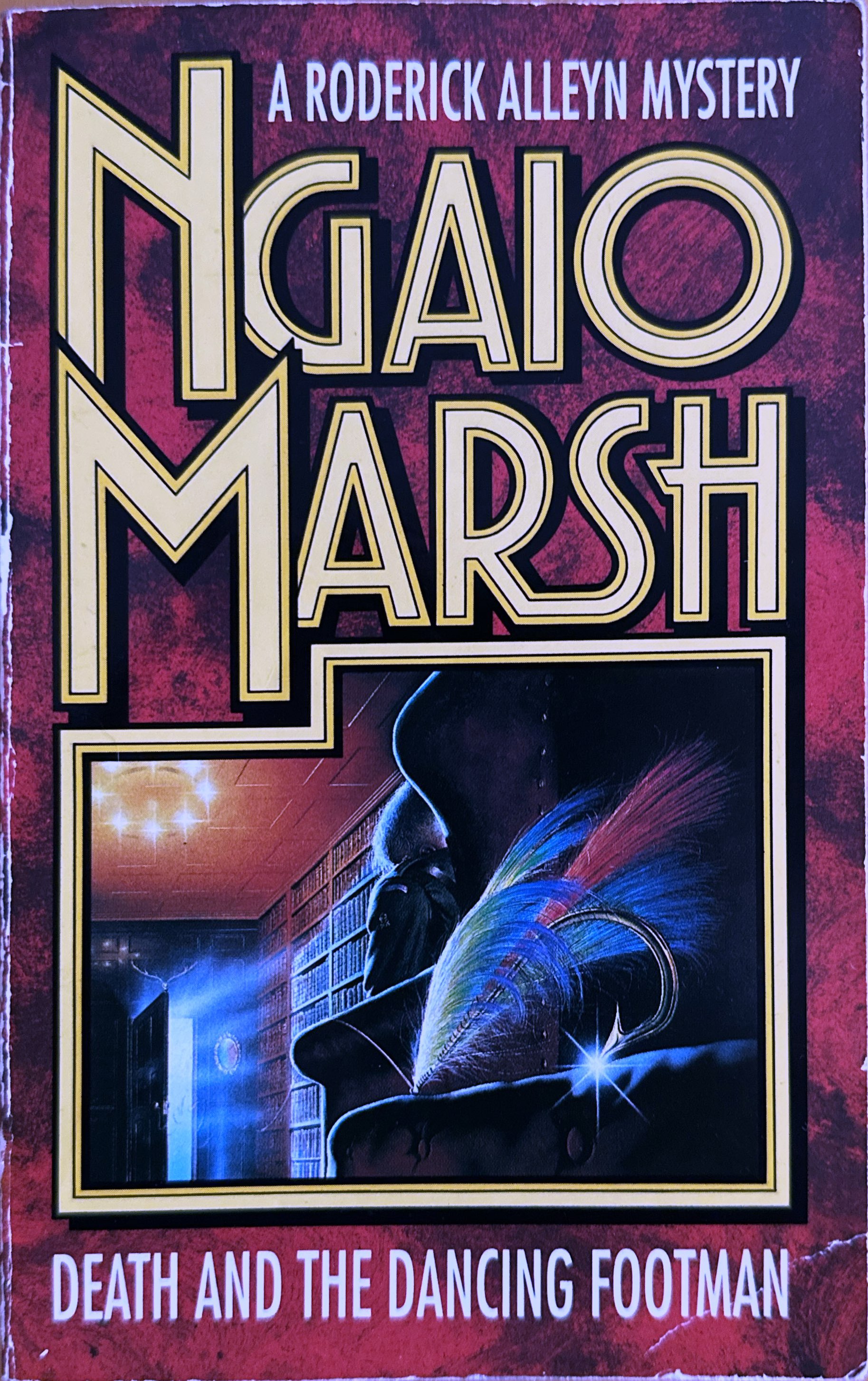
Vintage Mystery, Gold, Fishing Gear. Pay attention to where that fishing lure goes. It's an important clue!


Friday, June 30, 2023

Andrew Greeley's Happy Are The Clean Of Heart

Lisa Malone is an Irish Catholic girl from the Chicago. She could sing; she was good-looking; so she went to Hollywood and she succeeded. Now it's 1984 and she's nearly 40 and when she comes back to the old neighborhood, they're happy and envious in about equal measure. Make that measure unequal: more envious.

And on her first night back, somebody beats her to within an inch of her life in a hotel. Now she's in a coma.

Her estranged husband is found standing over the body, the cosh in his hand. He 'says' he interrupted somebody. But he's not the only suspect. There's her agent, who felt like he's the one that made her, her understudy for an upcoming Christmas special, her co-star on that special, a woman from the neighborhood, writing a biography with Lisa's approval,  a Mobbed-up bank vice president who administers Lisa's charitable foundation, her jealous older brother, and a nun who knew Lisa as a girl and whose organization is also the recipient of Lisa's charity.

And, well, Fr. John Blackwood "Blackie" Ryan had opportunity, too, and everybody knew he was in love with her when they were in high school. 

Then there's a second and a third attempt on her life in the hospital.

Blackie Ryan is the hero of a mystery series by Andrew Greeley, himself a priest as well as a professor at the University of Chicago. This is the second in the series, though there is an earlier non-mystery novel with Blackie Ryan as a major character. It takes until that third attempt for Blackie to figure out the villain. "Indeed," as Blackie himself might say.

There's some fun things in it for a Chicagoan. Roger Ebert and Richie Daley make appearances. (That's Richard M. Daley, former mayor of Chicago to you.) Richie is Cook County state's attorney that year. The events take place on the near north side, Chicago's Water Tower, the John Hancock building, Holy Name Cathedral, the Drake Hotel, the Playboy Building (as Blackie can barely bring himself to say, not the Playboy any longer). Lisa Malone's daughter plans on St. Ignatius for her high school, my alma mater.

I've read a bunch of the Blackie Ryan mysteries. My dad liked them, and I read them after he did, frequently because I gave him the new one for Christmas or his birthday. I can't say that this was one of the better ones. I find the early ones a bit overwritten, and Greeley's not the psychologist he wants to be. He pared them down later, and they were better for it. Oh, well...

The novel comes out in 1986 and the movie Amadeus has clearly influenced the plotting.

But it was one of the books I put on my Twenty Books of Summer list!


And it counts for Bev's Vintage Mystery Challenge:


Vintage Mystery, Silver, Knife: a knife is used in the third attempt.

Tuesday, June 20, 2023

Josephine Tey's The Daughter of Time

"Truth is the daughter of time."
-Old proverb

Inspector Alan Grant is stuck in hospital after he fell through a trap door in pursuit of a criminal. For now, he can do nothing but lie on his back and look at the ceiling. Nurses, friends, acquaintances bring him flowers, sweets, books to pass the time. None of them particularly engage.

One friend, more astute than the rest, brings him portraits of historical criminals. These portraits include King Richard III, famous for supposedly murdering his nephews, the 'Princes in the Tower.' Grant thinks, that doesn't look like a murderer's face, and becomes interested in the evidence for King Richard's guilt. He gets his friends to bring him a bunch of history books, and eventually Brent Carradine, a researcher. Grant applies his Scotland Yard techniques to working out a solution, while Carradine gathers the evidence.

Now all I know about the case comes from Shakespeare's Richard III: there Richard's a thorough-going villain, and the ghosts of all of the people he'd unjustly killed gather round his bed the night before Bosworth Field and chant, "Tomorrow in the battle think on me." I was prepared to believe he didn't kill his nephews. It turns out Shakespeare got his information from Sir Thomas More, still a child at the time of the supposed murders, and later a partisan of the Tudors, at least until he wasn't. If you've read Hilary Mantel, you'll have no problem imagining More as untrustworthy, but in Tey he's the 'sainted' Thomas More, and Grant has some convincing to do.

Would it be a spoiler to reveal Grant's solution? Well, I won't. Tey, in the person of Grant, makes a pretty good case, but not perfectly convincing. Her evidence amounts to cui bono, who benefits--that was the best part for me--but also she makes considerable use of the absence of evidence. (If X happened, Y should have happened, but there's no record of Y. But the events were in the 1400s. There may just be no record any more.) Still very enjoyable. It would have helped if I'd known more about the period.

It's a celebrated novel--and justly so. Though the British Crime Writer's Association voted it the best mystery of all time in 1990 and that seems a little excessive. (Not The Maltese Falcon, The Murder on the Orient Express, The Hound of the Baskervilles!?!) But it is certainly a classic mystery...


For the challenge I'll go with:

Vintage Mystery, Gold, Castle or Ruin. The Tower of London is about as classic a castle as you can find.

Thursday, April 13, 2023

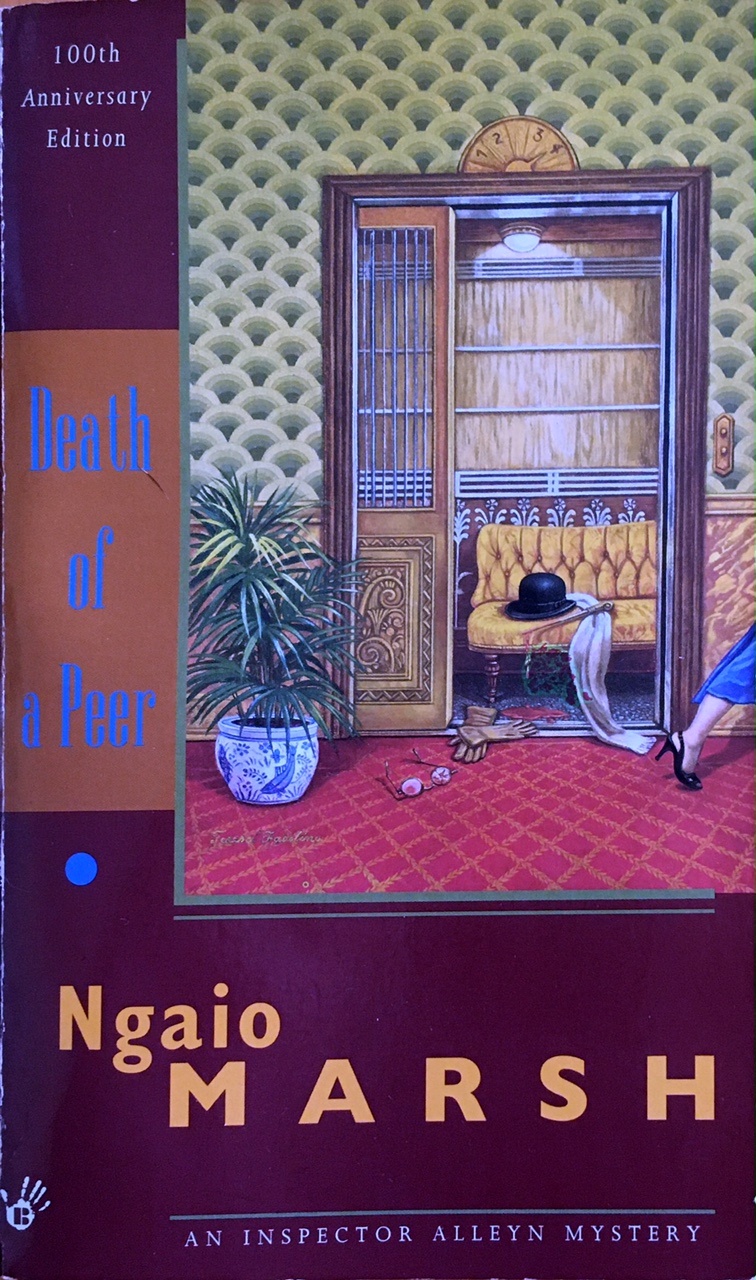
Ngaio Marsh's Death of a Peer (AKA A Surfeit of Lampreys) #1940Club

"It was some good-for-nothing out in the street. One of these Nazzys. The police will soon have him locked up."

[Spoiler alert! 😉] It wasn't one of those Nazis.

There are one or two quick allusions to events of the era, but mostly this feels like a interwar book. "The whole thing's lousy with lords and ladies," says Inspector Fox.

There have been ennobled Lampreys ever since one did 'some fishy bit of hanky-panky for Good Queen Anne or one of her ministers.' Lord Charles Lamprey is the second son, improvident, and head of a large family. It's his older brother that's murdered, in the lift at Lord Charles' London apartment. Since Lord Charles was hoping to get cash from his older brother and had not, he's clearly a prime suspect.

The novel starts in New Zealand, though, where Roberta (Robin) Grey becomes friends with the family. In New Zealand Robin's already half in love with Henry, Lord Charles' oldest son and when her parents die and she's sent off to live with an aunt in England, she's not entirely sad. We get a few amusing pages of a provincial's first arrival in London before the main event (together with Superintendant Roderick Alleyn and Inspector Fox and the whole crew) arrives.

The puzzle in this one is pretty successful, and I got to the end without realizing who had done it. Still the best thing in the novel has to be the Micawber-ish Lampreys; they're charming, witty, hapless, and (unlike the Micawbers) compulsively given to fudging the truth. You'd think that last quality might detract from the charm, but they do it to save each other, and it *is* useful in a mystery novel. Not that Alleyn or Fox is ever be-fudged.

A strong entry in the Marsh canon, I thought, though I preferred her other 1940 book, Death at the Bar, that I read earlier this year.


Good for My Reader's Block Vintage Mystery challenge.

Vintage Mystery, Gold, Glove. The gloves are a crucial clue.

And it's the week of the 1940 Club!

Marsh dated the book December, 1939 in New Zealand, at the end. My copy is copyrighted 1940. The Internets are a bit uncertain: some calling it a 1940 book and some a 1941. Publishing was becoming restricted by then and it may very well have different release dates in different countries. But I'm just going to stick my fingers in my ears, and unlike Roderick Alleyn, ignore any facts that contradict what I want to believe. La, la, la. It's a 1940 book!


Monday, April 10, 2023

Leslie Charteris' The Saint in Miami (#1940Club)

"The name is Simon Templar--usually known as the Saint."

A friend of the Saint's girlfriend writes and says there's trouble brewing, and so the Saint heads for Miami.

But when they get to the Gilbecks' house, they're gone. The servants let them in, but are clearly puzzled why these foreigners have come to stay when the owners of the house just sailed away.

That same day a U.S. freighter is blown up off the Florida coast; the Saint spots a submarine; and a body washes up by the Gilbecks' house, a body half-dressed in a British Navy uniform. 

Are these things all connected? Of course they are!

It makes a pretty good 1940 novel (though see Below...) Who exactly would be attempting to drive a wedge between the Americans and the British in 1940? It's not giving much away to say that's exactly who villains are. But just who it is that's the big boss Nazi in Miami and what the Saint is going to do about it are still pretty good questions for a novel.

The Saint's first action is to hide that body, because he (rightly) suspects the British Navy has nothing to do with it.

Leslie Charteris' series is pretty well established by this point. The first Saint novel, Meet the Tiger, came out in 1928 and his crew are present: the Saint's sometime girlfriend, Patricia Holm, doesn't do much in this one except provide the tie-in to the Gilbecks; Peter Quentin does some of the early legwork, but is mostly there to be captured; however, the Saint's Brooklyn-born muscle-man, Hoppy Uniatz, is in fine form: "Welcome him with liquor, and he'll drink out of your hand," Saint tells the Greek, and it's true.

The Saint's a key figure in the long line of guys on the wrong side of the law who still fight for the good: Robin Hood to contemporaries like Andrew Vachss' Burke and Jack Reacher. The Saint hits a sweet spot for me. I find his successors too dark, and their stories too grisly for my taste. He kills one of the 'ungodly', his term for the bad guys, in this, but it isn't dwelt on, and even then it's unusual; mostly the Saint arranges for the ungodly to do themselves in, and that's the way this one ends.

The Saint was once better known than he is now: not only are there the novels, but also stage plays, radio plays, television shows, and movies.

He's also a precursor for James Bond, and Roger Moore played the Saint on TV in the 60s before Moore became (a rather wooden) James Bond. The Saint knows his champagnes and his cars; his suits are good; the ladies (inevitably stunning) are inexplicably drawn to him.

But he does have his troubles with the law; less in this than some others, but there's an FBI agent, a British secret service agent, and an amusing local sheriff. He doesn't want to fight them, but he isn't going to co-operate either: "They had provided the one vital clue, but they still couldn't have his adventures."

Pretty fun stuff. 

[Below] It was such a good 1940 novel, but then, as they're about to slog their way through the Everglades to the ungodly's hideaway, the Greek says, "The quickest way is overland through the swamps. But the only guy who could walk on that stuff died nineteen hundred and forty years ago." Ouch, you'd think a Greek would know better...I believe that gentleman had been *born* nineteen hundred and forty years earlier.

A couple of other Charteris' Saint books on the blog: The Last Hero and Enter the Saint.

Good for the 1940 Club, hosted by Kaggsy and Simon. Thanks to them!


And good for My Reader's Block Vintage Mystery Scavenger Hunt. 1940 makes it Golden Age, and we'll go with:

Vintage Mystery, Gold, Hand Holding Gun. Just whose side is the redhead on? (Because the girl in the bikini has to be the redhead...)


Monday, April 3, 2023

Kerry Greenwood's Cocaine Blues (Phryne Fisher #1)

"A young man in one's bedroom is capable of being explained, but a corpse is always a hindrance."

Phryne Fisher has just moved from London to Melbourne. It's the 1920s and though she's good at it, she's bored with fast life in Europe. (Dinner parties, but also tangoing with gigolos in Paris and exposing crooked cricketeers.) She could afford that fast life because, after the convenient deaths of a few intervening heirs, she came into possession of a fortune in England, but she'd grown up poor in Australia. So she had both street smarts and resources.

The perfect combination for an amateur detective.

As a bit of added incentive, some English acquaintances ask her to look in on their daughter, because they're worried about how she's doing with her husband. 

Now I have to say, as a mystery, this is only so-so. The title rather gives away the motivation for the plot, and I'm afraid I saw the solution to the quest for the cocaine pingpin (to quote a former president) pretty early on. Doesn't matter. Fisher's a character one wants to read about: her affairs, her clothes, her accomplices. It makes a story both witty and engaging.

I don't know the series well, but several of the ongoing characters (though not all) make their first appearance here: her maid Dot, her two wheel/muscle men, Cec and Bert, her friend on the force, always convenient for an amateur detective. A wonderful start to the series.

And what I hadn't realized until I did a little math, it came out in 1989, and so it just squeezes in for the Silver Age Vintage Mystery Scavenger Hunt.  We'll go with that extravagant strand of pearls.

Vintage Mystery, Silver, Jewelry


Tuesday, February 28, 2023

Eric Ambler's The Levanter

"My name, Michael Howell, may look and sound Anglo-Saxon, but, with a Lebanese Armenian grandmother and a Cypriot mother, I am no more than fractionally English."

Michael Howell is the Levanter. He's the son in a third generation running Agence Howell, a successful trading business in the eastern Mediterranean. It's around 1970, and Syria, where a good deal of his business takes place, has gotten much more difficult to work in. He struggles to keep on the good side of Syria's various government factions.

One faction is supporting the Palestinian Action Force, a group splintered off from the PLO, led by Salah Ghaled. Without quite realizing what he's doing, Howell gets lured into assisting Ghaled. One of Howell's initiatives in Syria is the manufacture of ceramic batteries, but his wife notes there have been some purchases by the factory that don't quite jibe with what they're supposed to be making. What's up?

The novel comes out in 1972, written before the attack at the Munich Olympics. So you can probably guess the sort of thing that's going to happen.

The novel won Ambler's second Gold Dagger from the Crime Writers Association in the UK, and I saw Alan Furst said it was one of the spy novels he most admired when setting out to write his series. But for me, while I enjoyed it, I wouldn't say I thought it one of Ambler's best: his later novels start with fifty pages of exposition (the union of Egypt and Syria in 1958, anyone? industrial engineering?--a subject Ambler knows about, but still...) that don't feel entirely useful. Once the story does get going, though, it's a good one, but you do have to plow through a bit at the beginning.

Good for a couple of challenges:


Vintage Mystery, Silver, Shadowy Figure. I'm going to call that Arab in a keffiyeh a shadowy figure. I'm not entirely sure what's supposed to be in those bottles, but they could just be the raw ingredients for batteries.

And...


Most of the novel takes place in Syria or Lebanon and the grand finale at sea, but a couple of key scenes do take place on Cyprus.

Saturday, February 11, 2023

The Man Who Was Thursday: A Nightmare

There's going to be some spoilerish things in this, so be advised.

Gabriel Syme wanders into the London suburb of Saffron Park, a 'place not only pleasant, but perfect.' 'It had to be considered not so much as a workshop for artists, but as a frail but finished work of art.' Syme is himself a poet, 'a poet of law, a poet of order; nay, he said he was a poet of respectability.' He gets into a verbal squabble with red-headed Lucian Gregory, the established poet of Saffron Park, who is none of those things, but rather the opposite. (While at the same time, Syme admires Gregory's sister Rosamond, equally red-headed.)

Syme is also a detective, working for Scotland Yard. He was approved at joining by a mysterious man in a dark room.

Gregory proclaims himself a radical anarchist, but Syme accuses him of being a wannabe. Gregory refutes this charge by introducing Syme to a secret society, the leaders of which are named after the days of the week; at the very next meeting, to which Gregory takes Syme, Gregory expects to be elected the new Thursday. Sunday is the leader of this anarchist society.

Syme launches into a speech that results in his being elected the new Thursday. Aha, thinks Syme! I will now be Scotland Yard's man on the inside. But he has confessed his status as a policeman to Gregory, and sworn not to denounce him, so he has to figure out how to use his new insider-dom without breaking his vow.

At the very first meeting of the seven weekday leaders, Sunday announces one of them is a policeman. Yikes, thinks Syme, I've been found out already. But no, it turns out Gogol is also a policeman in disguise, and while Syme is mostly relieved he hasn't been detected, he's also a little ashamed he didn't do more. Gogol is escorted by thugs off the premises to some unspeakable fate.

On leaving that first meeting, Syme is pursued by another anarchist principal, the Professor de Worms. Does the Professor know Syme's a policeman? Syme tries to escape, but is eventually cornered by the Professor, who...reveals he's also a policeman. That makes three out of the seven. If only they'd organized!

I was perfectly ready to generalize after this, and yes, it quickly turns out six of the seven anarchist leaders are policeman in disguise. Is Sunday as well? 

Of course he is. (I have to say I saw that a mile away, or at least 90 pages away out of the 160.) But Chesterton handles it amusingly and suspensefully enough, and, in fact, Sunday is exactly that unseen policeman who first approved Syme's joining the force (and the other five policeman/anarchist leaders, as well.) The six pursue Sunday (or maybe Sunday is pursuing them) until a final recognition and no crime is actually committed, no dynamite thrown, the Czar not assassinated, even Gogol turns out to be alive after all.

It is Chesterton, and the name Sunday might be a clue. This is fairly early in Chesterton's career (1908), Father Brown is in the future, and Chesterton has not yet converted to Catholicism. Wikipedia tells me he was suffering a crisis of faith as he was writing this. Sunday is a deus absconditus. He tells his policemen, "You heard the voice in the dark, and you never heard it again. The sun in heaven denied it, the earth and sky denied it, all human wisdom denied it. And when I met you in daylight I denied it myself." Sunday goes on to explain why he allowed this, and so the book is a kind of theodicy, a justification of God, and an explication of why there is evil in the world. Like all theodicies, I didn't find it very convincing myself...

But until it got there it was a pretty amusing thriller.

There are the usual Chestertonian provocations. Only someone who's meat-eating and beer-drinking can be a proper Englishman, and not a lowly anarchist. Well in fact, I eat meat and drink beer, and have no desire to be a proper Englishman, so this should slide right past me, but I admit to being bothered by it, a little. But it is Chesterton, so one has to either not read him, or not be bothered by that sort of thing.

Do I dare call it a crime book? Well, in the end, it is a bit more Piers Plowman than Bulldog Drummond, but it does start with a Scotland Yard man trying to prevent a murder, so...


Vintage Mystery, Gold, Two People.

I actually read it in a copy from Project Gutenberg, but found online the cover shown above which fits the book pretty well.

Tuesday, January 17, 2023

Ngaio Marsh's Death at the Bar

"If thurr's not a corpse on the premises afore long, I'll be greatly astonished."

Don't you worry...

Abel Pomeroy is the proprietor at The Plume of Feathers and he's got a rat problem. He goes off to buy rat poison, but the ordinary stuff is not in stock; the pharmacist has only got the extra strong. But that's not a problem for Pomeroy: he's got a plan. Locked cabinet, gloves, whatever it takes to keep it safe.

Well, you know how that goes. By the time the lawyer Luke Watchman is dead, we've got a good half-dozen suspects lined up: two beneficiaries under his will, a girl who previously had an affair with Watchman, young Will Pomeroy who's in love with the girl, the cousin of a man whom Watchman sent to prison, and the mysterious Legge, whom Watchman knows from somewhere, but nobody's saying where. 

The murder takes place on the coast of Devon, and the local police officials are good, but not good enough. Abel Pomeroy wants this solved, it's ruining his business. So Roderick Alleyn and his trusty assistant Br'er Fox are sent to have a look:

"Yes, look at the colour of the sea, you old devil. Smell that jetty-tar-and-iodine smell, blast your eyes. Fox, murder or no murder, I'm glad we came."

Me, too, Mr. Alleyn. 

It's the ninth in the series and dates from 1940. It's a pretty good entry, though I preferred the opening drollery about the poison; the unwinding of events I think could have been clearer. But in just now looking at the date, I realized this was the one I meant to save for the 1940 Club in April. Oh, well...

Vintage Mystery, Gold, Bottle of Poison. Yup, there's definitely a bottle of poison in this one...