Showing posts with label #1962Club. Show all posts

Thursday, October 19, 2023

J. F. Powers' Morte d'Urban (#ThrowbackThursday,#1962Club)

"It had been a lucky day for the Order of St. Clement the day Mr. Billy Cosgrove entered the sacristy of a suburban church after Mass and shook the hand of Father Urban."

That's the opening line. Billy Connolly will prove to be a rich donor.

What makes a good man and a good priest? That may be the question Powers is asking here--though I'm not certain. But it's the question I was left with when I finished the novel.


If that's what the novel is asking, it's not so strongly put as something like Graham Greene's The Power And The Glory (good priest) or Dostoevsky's The Idiot (good man). Instead J. F. Powers has written a funny novel, sometimes very funny, that leaves you, the reader, to decide if you're interested in the deeper question. But you don't have to care and you can still enjoy the book. The blurbs on my edition talk a lot about the satire--crisp, bitter, and sharp, it tells me--but I think that takes a limited, though not entirely wrong, view of the book.

The novel came out in 1962 and won the National Book Award (U.S.) in the following year.

The story is this: Fr. Urban Roche is a popular preacher of the (imaginary) Clementine order. He's based in Chicago and is in demand to do revivals at various Catholic churches around the midwest. It's 1960 or thereabouts; John XXIII is pope and Senator Joe McCarthy is dead. Near the beginning of the story Father Urban is transferred from Chicago to a Clementine retreat in central Minnesota. Urban sees it as a demotion and a place where his real skills will not be used. He aspires to be the Father Provincial, the head of the local Clementine district, based in Chicago. But most of the novel takes place in small-town Minnesota.

One of the other characters calls Father Urban an 'operator' and it's true. It's the vita activa and not the vita contemplativa for Father Urban. Not that such high-falutin' terms ever appear. He pursues wealthy donors, tries to get a new church built for a crowded local parish, wangles a nine-hole golf course for the retreat so they can attract more (and a higher class of) retreatants.

He also tries--and mostly fails--to do good in smaller ways: to get Father Jack to write brochures that are more up-to-date, more relevant to parishioners, to help Katie, an Irish maid, who's lost her wages in gambling with her employer and is homesick, to moderate the vindictiveness of Billy Cosgrove, that rich man who's their major donor.

The satire comes from the hapless ineffectiveness of the church in most things, stumbling over small motives and petty politics. But isn't that always the way of the world? Maybe Father Urban is still a good man. From trying to do good and avoid evil, Father Urban has to twice (!) swim home across a cold Minnesota lake. But those two times are both successes for him, of a sort.

Father Urban had preached a great many thrilling sermons on saints who had really asked for the martyr's crown, but he believed that there were others from whose lives we might learn more that would serve us better in the daily round. What of those who remained on the scene and got on with the job? The work of the Church, after all, had to be done for the most part by the living. There was too much emphasis on dying for the faith. How about living for the faith?

Despite the title Father Urban is alive at the end of the novel, and has been elected the Father Provincial, though by then his health is so poor he's unable to be much of a force for change. Things muddle on. Father Jack is doing a Catholic children's edition of King Arthur and his knights, and the title is more an allusion to Malory's Morte D'Arthur than a plot summary. Like Malory, there's a distinct sadness at the end of the book, and you wonder just when was that moment of high glory? First there was scrabbling to get established, and then the brotherhood broke up to go questing, and then it was over. Yet the glory must have been in there somewhere.

Funny, sad, and thought-provoking.

I've posted this for Throwback Thursday and the #1962 Club. The post originally appeared on my blog on April 26th, 2018 and has been lightly edited. It's far too great a book not to be better known. 


It has been reissued by New York Review Books, so you don't have to hunt up some poor-quality paperback edition for a dollar. 😉

Three other 1962 books that made it on to my blog, all highly recommended:

Edmund Wilson/Patriotic Gore

Wilson's history about the effect of the Civil War on American literary prose.

Barbara Tuchman/The Guns of August

Tuchman's history of the opening of World War I.

Eric Ambler/The Light of Day

One of Ambler's best spy novels. The post also covers a second, considerably lesser Ambler, plus his autobiography.

Several people have mentioned how rich a year 1962 was, and have listed books and it's true. I could repeat all of those, but I won't. But I will pimp for three I've read and haven't seen mentioned and would highly recommend:

W. H. Auden/The Dyer's Hand

A collection of literary studies, quirky and brilliant. I've read it at least twice.

Edward Albee/Who's Afraid of Virginia Woolf

And then there's Richard Burton and Elizabeth Taylor version.

Thomas Kuhn/The Structure of Scientific Revolution

It was my favorite Latin teacher in college who told me I had to read this and she was right. A sociology of the way science changes. Hugely influential and you *can* actually read it!

Thanks to Simon and Kaggsy for hosting!


Wednesday, October 18, 2023

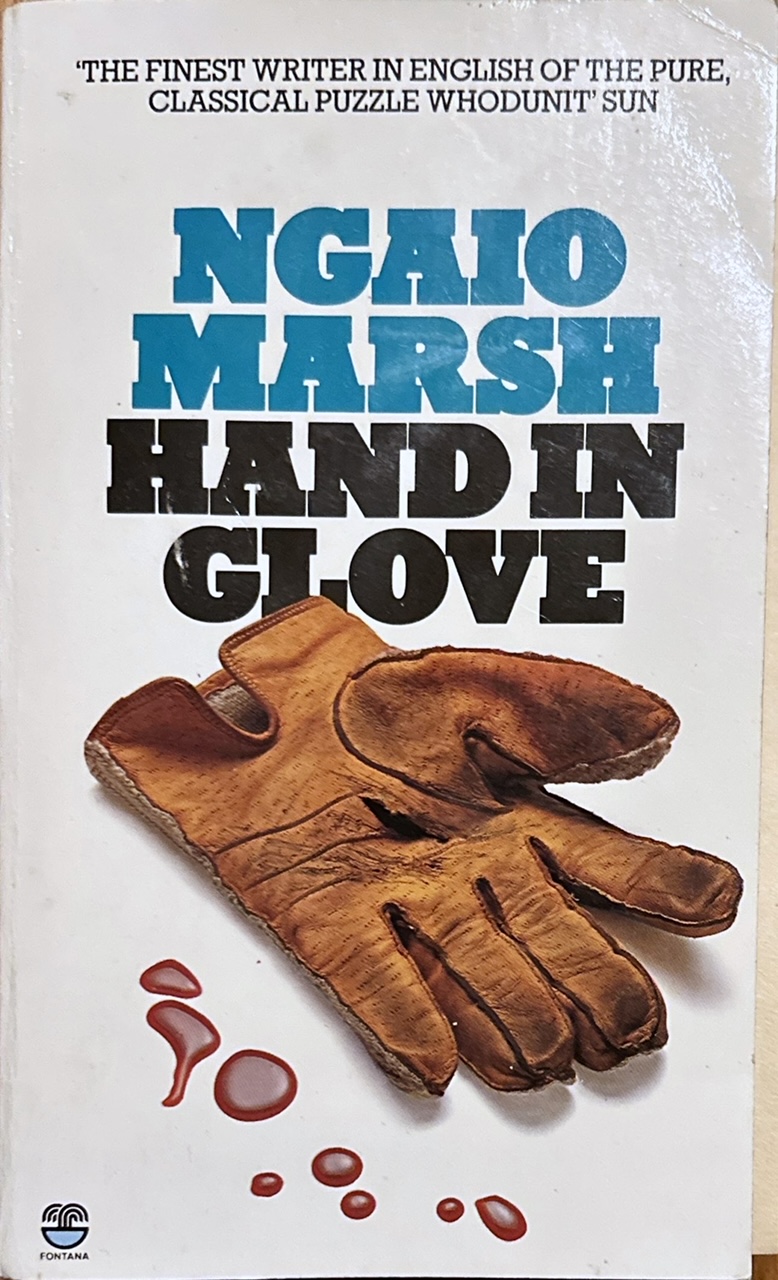
Ngaio Marsh's Hand in Glove (#1962Club)

"Here, Nicola, encountered the group of persons with whom, on one hand disastrously and on the other to her greatest joy, she was about to become inextricably involved."

Nicola Maitland-Mayne has just taken a job for P. Pyke Period as a typist. The elderly (and fussy) Mr. Period has been invited to write a book of etiquette, but all his notes are handwritten, and he needs somebody to type and organize them. While she's there working, Period invites her to an impromptu luncheon. 

It's Harold Cattrell who's at that luncheon and is murdered. Who did it? On hand are Cattrell's sister, his sister's ward, called Moppet, and Moppet's dodgy boyfriend, Cattrell's ex-wife with her new husband, the ex-wife's son Andrew by her first (of three) marriages, Nicola, and Period himself. Whew. Got that? The book does provide a chart. Period's servants get a passing consideration because they don't like Cattrell, but we all know it can't be the servants, right?

On the night of an outdoor summer party, Cattrell is lured into a dig for sewer repair, and then a sewer pipe is tipped over on him, crushing him into the mud. Threads from a pair of work gloves are found on the sewer pipe, but now the gloves can't be found.

Somebody hurls a bookend at Period in a second attempt at murder.

Pretty much everybody on that list has some motive to have killed Cattrell--he was an irritable man, it seems--but of course Alleyn, with his crew, discovers the murderer.

Though not her best, still a pretty strong entry in the series, I thought. I find her later ones a bit weaker as a rule, but this was amusing, and the obfuscation worked on me--I'd picked the wrong person for the murderer. I'm not sure it felt like 1962, with servants still around and country houses and books of etiquette and heirs not having access to their money until they turn twenty-five, but there was a nod to the new popular music at least, awful as we're told it is. 😉But it was its 1962-ness that got me to read it now.

Also:

Vintage Mystery, Silver, Glove. Who had the gloves? Is it the dodgy boyfriend? They belonged to him. Is it the third husband? He carried the jacket with them in the pocket for a while. Who, who, who!

And as for that 'greatest joy'? Well, I don't think you'll need much help to guess who among that list of suspects Nicola will be marrying soon...Much easier to figure out than the murderer!

Tuesday, October 17, 2023

Isaac Bashevis Singer's The Slave (#1962Club)

'a slavery that would last as long as he lived'

We first meet Jacob as a literal slave in the Polish hill country near Krakow. His wife and children had been killed in the Cossack Khmelnytsky massacres (1648-1657) in southeastern Poland; Jacob himself had been sold into slavery, technically illegal in Poland at the time, but who was going to say no? He couldn't run away, and didn't know where to run to anyway. He's a learned man, in his late 20s, but now he's a cowherd.

And he falls in love with Wanda, his owner's daughter. She herself is a widow at twenty-five, and she's equally in love with him. But what can they do? He won't convert, and she can't, legally. Jacob's a pious man as well, in his way, and he doesn't know that his wife is dead, though he suspects. After some resistance on his part, they do sleep together, and well, the sex is good. But he feels bad about it.

Then well-to-do Jews recovering in his hometown of Josefov learn of his plight and ransom him. He becomes a teacher, learns his wife actually is dead, and eventually, dreaming that Wanda is about to bear his child, goes to find her and carries her away. Still, where can they live? No Jewish community would accept Wanda; a Christian married to a Jew could bring down new pogroms. 

But Wanda does convert, becomes Sarah, and they are married under Jewish law. They move to a city where they're both unknown. Though Wanda's learned Yiddish, she's speaks with an accent, and she decides to pretend to be a mute so that they don't hear her Yiddish. Their new town assumes she's deaf as well. This, as you can imagine, is a formula for disaster.

The gentiles are terrible, but the Jews little better:
'They wanted to be kind to God and not to man; but what did God need of man and his favors?'

Why do these things happen? 1962 isn't so long after the fall of Nazi Germany. 

'The question that recurred more often than any other was why did the good suffer and the evil prosper?'

And what does a Jew, a good man but not necessarily a saint, do in terrible times? Various possibilities that were in the air occur in the novel: Jacob considers taking up arms, but doesn't; how much should he resist:

'Nowhere is it written that a man must consent to his own destruction.'

He's drawn to Sabbatai Zevi, the purported Jewish Messiah, of the time; he even goes to the Holy Land. Does Sabbataeanism have the answer? The novel covers some of the same ground as Olga Tokarczuk's The Books of Jacob. Another book of Jacob.

The novel follows Jacob and Wanda to their deaths. The novel ends by quoting their epitaph:

'Lovely and pleasant in their lives, and in their death they were not divided.'

Anyway, a pretty interesting read, a romance with big themes, though I don't think anybody now would consider this one of Singer's major works. Still, it did get its own Wikipedia article, though the article has several errors in the plot summary. But via that, I did read this article in Forward, in which Dylan says he prefers Singer to Kerouac (well, I would, too) and of this novel, "Now Isaac Singer, he wrote a story called 'The Slave.' It must have stayed in my head months afterward." One Nobel Laureate on another. 😉

I've always liked Singer, and went through a serious Singer phase in the 80s, and I've had this in mind since reading Scholem's Sabbatai Sevi, Olga Tokarczuk's The Books of Jacob, and Singer's own Satan in Goray relatively recently. But I read it now since it came out in 1962, and this is the week of Simon and Kaggsy's 1962 Club.

But how about that cover? Isn't it delightfully lurid? Wouldn't you just want to read it for that?

Translated from the Yiddish by the author and Cecil Hemley.