Showing posts with label New York Review Books. Show all posts

Monday, October 14, 2024

J. G. Farrell's Troubles (#1970Club)

"In those days the Majestic was still standing in Kilnalough at the very end of a slim peninsula covered with dead pines leaning here and there at odd angles." [5]

The opening of J. G. Farrell's Troubles. Those days are 1919, and the Majestic is a grand old hotel in Ireland, by then fairly dilapidated. The hotel was bought by the Protestant widower Edward Spencer some years before; the vendor told him the hotel attracted a regular clientele, but what he didn't tell Edward was that very few of that clientele had money to pay their bills.

Edward has four children, the oldest Angela, a son Ripon, and teenage twin terrors, Faith and Charity. Angela has her Major, who arrives in Kilnalough at the start of the novel.

"In the summer of 1919, not long before the great Victory Parade marched up Whitehall, the Major left hostpital and went to Ireland to claim his bride, Angela Spencer. At least he fancied that the claiming of a bride might come into it. But nothing definite had been settled." [7]

Major Brendan Archer had met Angela in Brighton when on health leave in 1916. They'd kissed once, he'd returned to the trenches, and ever after he was receiving letters from "your loving fiancée, Angela."

Brendan is particularly hapless at the business of romance:

"Until now, incredible though it may seem, the Major had never considered that love, like war, is best conducted with experience of tactics." [253]

When the Major gets to Kilnalough, Angela avoids him. She was tubercular the whole time. ("I thought you knew.") 

There was another prospect, but the Major hadn't even realized: she writes that he hoped he didn't mind, but after waiting, she eventually married someone else. "She oppressed him, though, by the intensity of her feeling for him, and that was the principal thing he now remembered about her. She had had a tendency to hug him violently, squeezing the air out of his lungs--it's distressing to be squeezed very hard if you are not trying to squeeze the other person back. One feels trapped." [255]

And there's a third girl he's attracted to: Sarah, but she's Catholic. After Angela dies he allows himself to fall completely in love, but just like with Angela, the Major barely talks to Sarah. After a year of aimless loitering, he bumbles out a proposal: 

    "Look here, I want you to be my wife."  He could say no more. He could not move. He stood there waiting like a pillar of salt. He could see, though, that it was no go...
    She said crossly, "Oh, I know you do, Brendan." [349]

Hapless!

All the while Brendan Archer is loitering in Ireland, and not getting married, the Majestic continues to fall down or is pulled down by desperate or angry Catholics; its owner, Edward Spencer is going mad in his attempt to hold up some sort of Protestant Irish standard. Major Archer, Edward Spencer, the Majestic hotel--almost a character in itself--are all of a piece: decaying, under attack, committed to vanishing and misguided standards, Anglo-Irish, ineffectual. If you're a symbol-spotting kind of person, the Majestic hotel is definitely a stand-in for the last years of the Protestant Irish Ascendancy.

The book ends with the arrival of the Irish Free State in 1922; the Protestants flee and the Majestic burns to the ground.

The book has a blurb on the back from The Guardian: "Sad, tragic, also very funny." Sad and very funny both are abundantly true; the tragic, though, is a bit more of question: it depends on whether you think they're so hapless, they deserve what's coming to them. And they might! 😉

J. G. Farrell wrote three novels in the 70s--this was the first--called the Empire trilogy, The remaining two are The Siege of Krishnapur (1973) and The Singapore Grip (1978). Troubles won the Lost Booker for those novels that came out in 1970 and due to a rules change weren't eligible for any Booker Prize. The Siege of Krishnapur won the Booker for its year as well. All three are great. All three focus entirely on representative members of the Empire; the subject populations--Irish, Indian, Malay or Chinese, respectively--are anonymous, nearly invisible. Did Farrell not want to appropriate the stories of the oppressed? Did he simply not know those people as well? (Farrell was born in Liverpool, but came from a Protestant Irish family of colonial administrators.) Or did the stories of hapless English in colonial settings just seem funnier? I suspect the last myself.

John Banville in a well-done introduction calls this Farrell's masterpiece. Could be, though I'd plump for The Siege of Krishnapur myself. Funny as this is, Siege is even funnier. It's also shorter and would make a better introduction if you haven't read any of them. But they're all three great and I suspect I'm going on to reread the other two as well.


It's the week of the 1970 Club, hosted by Simon & Kaggsy! Isn't that a cool logo?

My organizing post for this fall's club is here, with links to a few books from 1970 already on the blog. (Tony Hillerman, Brian Moore, Shirley Hazzard.)

Also:

"...how incrediby Irish it all is..." [24]

This is my trip to Ireland for this year's European Reading Challenge.


Page numbers are from the New York Review of Books edition shown above.

I'm hoping to get a couple more in this week. Are you reading something for the 1970 Club? Any favorites from that year?


Wednesday, September 18, 2024

Anna Seghers' The Seventh Cross (#ccspin)

"The National Socialist state relentlessly prosecutes anyone who commits an offense against the national community; it protects that which is worth protecting; it punishes those who deserve punishment; it destroys that which should be destroyed."

Or so says Commandant Fahrenberg of the Westhofen concentration camp. But he's just had a breakout of seven prisoners from his camp, and it's a big black eye to his leadership. Will he recapture them all? Is the National Socialist state that powerful?

No. We already know from the prologue that one (but only one) will make it to freedom. It's a novel with thrills and narrative drive. But not just that.

We spend most of our time with George Heisler, the one who makes it safely to Holland, but we see all seven as they attempt to escape the Nazis. One is killed just outside the camp boundaries, another is betrayed, a third despairs and turns himself in, the next to last to be found can think of nothing but revenge against the fellow politician who framed him.

But it's not only the escapees who feature in the novel: it's also the people who help him and hinder him, family, friends, strangers. Also the SS and the SA troopers who pursue him. He escapes one checkpoint because he's so beaten down by his years in the concentration camp he no longer matches the picture that's distributed. George steals a gardener's prized jacket to cover up his prison clothes; the gardener  at first wants George caught, but then starts to think of George as 'his' escapee and lies about the jacket when it's found, sending the searchers astray. In a letter of 1938, cited in the afterword, Seghers writes of her novel that it's 'a tale, then, that makes it possible to get to know the many layers of fascist Germany through the fortunes of a single man.'

That one man escaped gives the resistance, both inside the prison and out of it, hope. It only seems that that the state is all-powerful whatever Fahrenberg may say in that opening quote. It's not true. A childhood friend Paul Roeder, one of the key figures in helping George to escape says, "But they are not the slightest bit all-knowing. They only know what you tell them." And you don't have to tell them anything.

Anna Seghers herself was arrested in 1933 after Hitler came to power. She'd married a Hungarian Communist and was involved in Communist organizations. Once the Nazis felt solidified in their power, she was released, but she was of Jewish extraction and felt it safer to leave the country, first for France and then later for Mexico. Her mother was killed in a concentration camp in 1942.

This novel was written in 1938-9, and is set in 1937 or early '38. [Heisler while on the run picks up a discarded newspaper which discusses the battle of Teruel in the Spanish Civil War.] The novel came out with a German emigrĂ© press in Mexico in 1942, but was quickly translated into English and became a Book-of-the-Month Club main selection. In 1944 it was made into a movie with Spencer Tracy as George, and Hume Cronyn earned a Best Supporting Oscar nod for his role as that friend. 

A couple of years ago I read Seghers' subsequent novel Transit and thought it also was very good. Both novels turn around a suspenseful plot of escape from the Nazis, but both novels also have ambitions larger than simple suspense.

Seghers was nominated several times for the Nobel Prize, though she didn't win, and based on the now two novels I've read of hers, I'd have to say she would have been a good choice. After World War II, she returned to Germany, eventually pitching up in East Germany, where she died in 1983.

It was my spin book, and while I thought I might read it last month for Women in Translation month, I didn't get around to it. But it was pretty great whenever I read it. Did you join in the Classics Club spin this time? Did you have a good read?


Monday, July 1, 2024

June Wrapup

All of my reading in June in one swell foop...

The Mystery Department

Harini Nagendra/Murder Under a Red Moon

Kaveri Murthy's second case. Set in Bangalore, India in the 1920s, I liked the first last summer. Kaveri enjoyed her successful detectivizing in that case; she was a bored housewife, but now she's going to have an agency. Her husband's OK with it, her mother-in-law less sure. But she's got a friend on the police force, some Bangalore Street Irregulars, and friends and acquaintances know she's good at it. This starts as embezzlement, but ends in murder. Perhaps not too mysterious, but charming and enjoyable. 

The third and most recent is on order at my library. 

Craig Johnson/The Cold Dish

A couple of years ago four boys gang-raped an indigenous girl; they were convicted, but their sentences were shockingly light. Then the leader of the boys is shot dead. Wyoming Sheriff Longmire takes into account it could be just a hunting accident, but suspects somebody's out for revenge. When a second boy is shot, he knows.

I know Lark likes the series and somewhere else I saw it compared to Tony Hillerman's, strong recommendations, so I tried it. This is the first. The interactions between the characters were fun, and while I was worried the plot would be a little too grisly for my taste, it was OK on that front. However, it was 400 pages and I did keep feeling it could be a hundred pages shorter and better for it. (Dame Agatha can do it in 250, if not 200.) Still I enjoyed this one & I'll carry on.

The Poetry Department

Matthew Arnold/Selected Poems

I didn't know Matthew Arnold's poetry very well--really only 'Dover Beach', I guess--and I thought maybe I didn't like it very well. But after rereading a bunch of Anthony Hecht last month (and his response to 'Dover Beach') I thought I'd try some Arnold. He's better than I thought... 😉 Except that his poems are mostly too long, I might even put some on a poetry post. Anyway, I'll be reading him more closely.

Richard Howard/Inner Voices

Him, I knew I liked. Inner Voices is a selection of his poetry from 1963-2003, so covering most of his career, but not all: he died in 2022. Howard was gay; in an era when confessional poetry was king, his early poetry was pleasantly out-of-step, voicing Edith Wharton or John Ruskin. His book Untitled Subjects won the Pulitzer for poetry in 1969; it's a series of monologues by Victorian-era commoners, funny and touching.

By the late 70s though he's mined that vein and I felt there was a falling off. Then come the 80s and it's become both possible, but also maybe required, to acknowledge one's homosexuality. There are AIDS poems; it was a tough period. But it added a new weight to his poetry, without taking away his humour.

Two books by Ana Blandiana

Ana Blandiana (a pseudonym) is a Romanian poet born in 1942. She won this year's Princess of Asturias Prize in Literature. I quoted from a couple of her books with some more thoughts here.

Big Ole Literary Novels

Thackeray/Henry Esmond

Henry Esmond is born abroad under dodgy circumstances to parents who may be dead. He's shuffled home to be raised a bit neglectfully by an aunt and uncle and falls in love with their daughter, his flirty first cousin. Eventually he goes off to fight in the wars of his time.

Henry's home country is England. The war of his time is the War of Spanish Succession. (Marlborough, Malplaquet, all that. 1701-1714.) Also going on is the question of English succession. Will it be the Catholic Stuarts or some other Protestant dynasty that inherits the English throne? Henry is involved in both struggles.

Virginia Woolf says in A Room of One's Own, that 'the critics often say that Esmond is Thackeray's most perfect novel.' I doubt the critics would say that now, and Woolf had her doubts--this is when she tries to get into a specialist library and is turned away because she's a woman. Still the Thackeray is a pretty good read, even if the flirty Beatrix Esmond is a bit Becky Sharp (of Vanity Fair) in less vibrant colours.

I read it now because last month I finished Ippolito Nievo's Confessions of an Italian. Change Henry Esmond to Carlo Altoviti in the first paragraph and you've got the plot of Confessions. Carlo's cousin is called Pisana, and his wars are Napoleon in Italy and then the early wars of the Risorgimento. (Garibaldi, the defense of the Roman Republic. 1793-1848 or so.) Henry Esmond came out in 1852, just a couple of years before Nievo was writing, and he thought, now there's a plot I can plunder. (Nievo also stole manfully from Ugo Foscolo's Last Letters of Jacopo Ortis, mostly for his thinking about the nature of Italian patriotism.) It also was a pretty good read, even if it was twice the length of the already longish Henry Esmond. La Pisana was a more psychologically believable flirt than Beatrix Esmond, I thought. The final twist is our young soldier-hero's obsessive romance was maybe less weird in Nievo. (Though pretty weird in both.) 

I did have to keep Wikipedia open for both novels for explanations of historical background. The first full translation into English of the Nievo, by Lucy Riall, came out in 2014.

And how about that dapper Italian on the cover? He's neither Nievo, nor supposed to be Carlo Altoviti. But who cares?

Jean d'Ormesson/The Glory of the Empire

This was a delightfully odd one. D'Ormesson's novel came out in 1971. It was his sixth, and the earlier ones apparently hadn't done much. This won prizes and got d'Ormesson elected to the Academie Française in short order. It was translated into English in 1974--superbly--by Barbara Bray. I read it in a New York Review Books reissue.

The Empire grows from two feuding cities who finally unite and conquer the known world. There are three famous emperors--Arsaphes, Basil, Alexis--though with periods of chaos between them; the third creates a golden age of culture and eventually peace that will not last. So far it could be any of various world-building fantasy novels, and, in fact, Tolkien gets a nod--we're told at one point he's the author of a history of a minor war on the Empire's eastern edge.

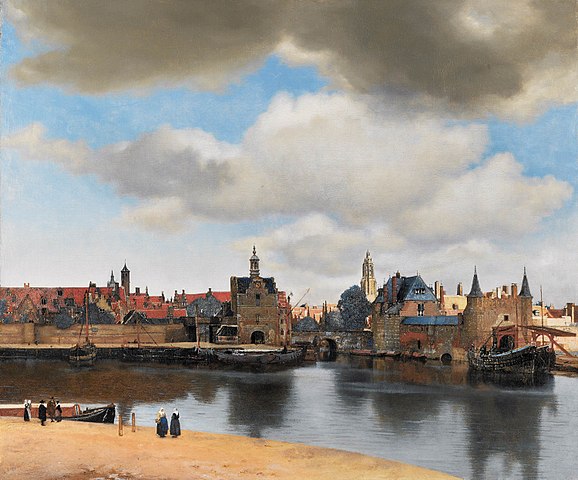
And that's a small example. The founding cities code as Sparta and Athens (one militaristic, one cultural) but are set geographically (if they're anywhere) on the west coast of Turkey. The Empire exists in our world and it impacts our world's poets, novelists, historians, and that's where d'Ormesson really goes to town. Corneille's last play, a failure, was the story of Arsaphes and his love; d'Ormesson quotes (creates) lines from the play, writing them in the alexandrines of the 1600s. (Bray amusingly translates them into heroic couplets, purportedly by Dryden, and does it well.) When Bergotte dies in Proust, it's not that Vermeer:


he's remembering; it's a Piero della Francesca painting of Alexis and his mother. D'Ormesson 'quotes' the passage in Proust. (I.e., makes it up.) Historians from Burckhardt to Bloch discuss episodes in the Empire. Sexual theorists from Freud to Foucault consider the consequences. Edmund Gibbon's The Rise of the Empire features in the bibliography. Renan doesn't write a Vie de Jesus, but a Vie de Alexis. No word on whether that book, too, is sometimes considered a precursor to Nazi thought. We're told Alexis is the only pagan who has ever been decreed a saint; we're given--in Italian!--the lines from Dante's Paradiso where he appears. The last source mentioned in that bibliography is Marguerite Yourcenar's Memoirs of Hadrian, but the only Hadrian in The Glory of the Empire is Pope Hadrian VIIth. Is that then an allusion to the Baron Corvo novel? Maybe!

One long collection of egghead-y easter eggs mixed in with a couple of doomed love affairs and some battle scenes might just drive you nuts, and I certainly didn't read this in one sitting. As you might guess, Borges is a clear precursor (and shows up several times). But if you're the sort of person who thought the only thing wrong with 'Tlön, Uqbar, Orbis Tertius' was that it wasn't long enough, you'll love this.

A few sensible-sounding (?) quotes:

'History is never about anything but the folly of men.' [p.152]

'People are not interested in the past any more. And yet it was the past that made us.' [p.200]

'History fabricates its own sources.' [Supposedly this is Georg Christoph Lichtenberg. Maybe it even is.] [p.257]

'...novelists given to the lamentable genre of historical fiction bear a heavy responsibility...' [p.273]

Obviously all deeply ironic coming from such a book.

When Marguerite Yourcenar became the first woman elected to the French Academy in 1980, there was considerable opposition. Jean d'Ormesson was her primary advocate.

Cooking

When I get cookbooks or food-related books from the library I often just skim them. These two got read cover to cover.

Hazebroek & Elenbaas/Hot Coals

I got a fancy kamado-style grill for my birthday a while back, which I am still learning how to use. (My old Weber kettle was rusting away...) This was heavy on history, theory, and practice, which is great as far as I'm concerned and why it got read cover-to-cover, unlike the other two kamado cookbooks, which are being browsed.

Dolinsky/The Ultimate Chicago Pizza Guide

A mix of recipes and descriptions of Chicago pizza places as of the end of the pandemic. The list of pizza places was a trip down memory lane; the recipes made me want to mix up my pizza-making game. (I do both flat and deep dish pretty often.)

He can be a bit repetitive, but he's got a punchy way with metaphors that suggests he was reading sportswriters from the 30s: 'a nice even browning, like a retiree in Boca'  or 'the top layer is as thin as the Trib's business section' that keeps one reading.

He introduces the concept PIGUE (pizza I grew up eating), suggesting that people in general become uncritical about their childhood favourite. He says a lot of people feel this way about Barnaby's in the northern suburbs of Chicago--a pizza I'd totally forgotten about until reading this book. (And apparently I ate at a satellite branch, not the mother ship.)  But my PIGUE is My Pi pizza, a deep dish pizza, but not especially deep. And I am certainly unable to think about it critically. I had thought the last of its two branches had closed in the late 80s, but it turns the son of the former owner has refounded it, and Dolinsky thinks it's good. That next trip to Chicago...

And speaking of Chicago:

David Mamet in Chicago

I read/reread three plays by David Mamet set in Chicago. Sexual Perversity in Chicago has two guys and two girls. One guy and one girl are cynical about love; the cynical guy, Bernie, in particular is an obnoxious fabulist. The non-cynical pair fall in love--for a while. The play premiered in Chicago in 1974. I'm not sure about this play: on the page at least the love story didn't feel very convincing. It was the basis for the movie About Last Night, which I haven't seen but now want to. I expect it to be watered down, though.

Then I read Duck Variations. Fourteen short scenes where two old guys meet on a park bench and talk about ducks. No plot, but it was great. Mamet says in the stage notes it could be any park bench looking out at a lake, but no, it's Chicago: they discuss the pump houses at one point. Toronto doesn't have pump houses out in the lake where they get water, and I imagine most other lakeside cities just have hoses under the lake that you can't see. First there was Thirteen Ways of Looking at a Blackbird, then there was Fourteen Ways of Talking about Ducks. Take that, Wallace Stevens.

Then I finished by rereading American Buffalo, my favorite of Mamet's plays that I know. (I've seen Glengarry Glen Ross twice--the movie once and on stage once. Maybe it could be done differently, but there was too much scenery-chewing in both. Death of a Fuckin' Salesman, indeed. That's often considered his best, but not for me.) In this a junk shop owner has a buffalo head nickel and sells it to a collector. But maybe he sold it for too little? He decides he's going to steal it back. How that goes. This takes place on the north side of Chicago--somehow I think of it as in my neighborhood, though it's probably south of where I grew up. We're told the collector lives on Lake Shore Drive--which would make him rich. A pretty great play, I think.

The books still around the house:


I've been reading plenty, but not blogging much. Oh, well. My blogging mojo has gone missing. (Department of Missing Mojo? Hello? Have you seen...) Maybe this omnibus post will get me over the hump.

Next month? It's Paris in July. Maybe when I reread Giovanni's Room this time, I'll actually blog about it? We'll see. I'm also thinking more Chicago books, particularly covering the late 70s and early 80s. Sara Paretsky, Michelle Obama, maybe something I haven't read before, though I'm not sure what just now. [Suggestions welcome!] What are your plans?

Happy Canada Day! To Canadians and those thinking about moving to Canada depending on election outcomes in your jurisdiction. The fireworks are starting as I'm finishing this.

Saturday, November 25, 2023

Two by Patrick Modiano (#NovNov)

So You Don't Get Lost in the Neighborhood

Jean Daragane is an elderly man living on his own, suspicious and irritable. Then a stranger Gilles Ottolini calls up to say that he's found Daragane's address book: could he bring it by? (Daragane had written his phone number and address in the book in the space supplied after 'If found please return to...'). Daragane doesn't want this stranger to come to his house, but they arrange to meet at a café the next day.

Daragane is a well-known writer, famous for his book Le Noir de l'EtĂ© about the Paris demimonde. He has genuinely lost his address book and, despite his suspicions, supposes he should get it back. Ottolini shows up the next day with a 'friend', Chantal Grippay, and it's clear Ottolini knows quite a bit about Daragane. Ottolini has read through the address book and he's interested in a name from it, Guy Torstel, which was also a name that Daragane had used in that famous novel. Who is Torstel? Daragane claims he can barely remember the actual Torstel, and that he remembers nothing about the novel he wrote so many years ago. But he agrees to try to remember something and to meet again with Ottolini when Ottolini's back in town. 

But before that Chantal Grippay comes by and warns him not to trust Ottolini. Daragane tries to work out the connections between Torstel and his mother and the woman (not his mother) who raised him and the other figures from that novel. And what do they have to do with Ottolini and Grippay? And just what has he got himself into? 

Interesting and evocative, but in retrospect not the one to have started with. In the real world, Modiano's first novel was La Place de l'Etoile.

155p. And with rather wide spacing and margins. Translated by Euan Cameron.

In the Café of Lost Youth

Louki is an habituée of the café Condé. The place is a little downmarket even for students, with a somewhat rough clientele of youths, with a few dodgy elders mixed in. Louki seems just a bit more glamorous than the rest of the crowd. But Louki is just a nickname. Who is she?

The novella is structured as four different narrators telling us what they know (or what they want to tell us) about Louki. The first is an actual student: he studies at the École SupĂ©rieure des Mines; because he's a student, though one perhaps not entirely committed to his studies, he feels isolated from the core crowd at the cafĂ©. Still he observes Louki without ever knowing her real name.

The second figure is a private detective who's looking for Louki on behalf of her abandoned husband; he learns Louki is actually Jacqueline Choureau née Delanque, that she'd been in minor trouble with the law as a teenager, that her mother was a dancer at the Moulin Rouge. He has to decide what exactly to report to the abandoned husband.

The third chapter is from the point of view of Louki herself; the last chapter is that of a writer from years later who had hung out with this crowd at the time. We learn Louki's fate.

Wikipedia says the novel is loosely about the circle around the Situationist Guy Debord, philosopher, Marxist, provocateur. In any case, the novella begins with an epigraph from Debord:
"At the halfway point of the journey making up real life, we were surrounded by a gloomy melancholy, one expressed by so very many derisive and sorrowful words in the café of lost youth."
Also evocative, and less dependent on a familiarity with the Modiano oeuvre. Pretty good, I thought and it would have been a better start. (Though as you can see I didn't stop after the first that I did read.)

118p. Translated by Chris Clarke.

Modiano won the Nobel Prize in Literature in 2014, and I've been meaning to try him out since then. That's all the Modiano I've read, but I liked them both and it made me curious to read more. I'll probably go next to the beginning and read La Place de l'Etoile. (Same title in English.) It's the first in a trilogy, it seems. Do you know Modiano? Is that a good plan? Any others to be sure not to miss?

November is Novellas month!


Thursday, October 19, 2023

J. F. Powers' Morte d'Urban (#ThrowbackThursday,#1962Club)

"It had been a lucky day for the Order of St. Clement the day Mr. Billy Cosgrove entered the sacristy of a suburban church after Mass and shook the hand of Father Urban."

That's the opening line. Billy Connolly will prove to be a rich donor.

What makes a good man and a good priest? That may be the question Powers is asking here--though I'm not certain. But it's the question I was left with when I finished the novel.


If that's what the novel is asking, it's not so strongly put as something like Graham Greene's The Power And The Glory (good priest) or Dostoevsky's The Idiot (good man). Instead J. F. Powers has written a funny novel, sometimes very funny, that leaves you, the reader, to decide if you're interested in the deeper question. But you don't have to care and you can still enjoy the book. The blurbs on my edition talk a lot about the satire--crisp, bitter, and sharp, it tells me--but I think that takes a limited, though not entirely wrong, view of the book.

The novel came out in 1962 and won the National Book Award (U.S.) in the following year.

The story is this: Fr. Urban Roche is a popular preacher of the (imaginary) Clementine order. He's based in Chicago and is in demand to do revivals at various Catholic churches around the midwest. It's 1960 or thereabouts; John XXIII is pope and Senator Joe McCarthy is dead. Near the beginning of the story Father Urban is transferred from Chicago to a Clementine retreat in central Minnesota. Urban sees it as a demotion and a place where his real skills will not be used. He aspires to be the Father Provincial, the head of the local Clementine district, based in Chicago. But most of the novel takes place in small-town Minnesota.

One of the other characters calls Father Urban an 'operator' and it's true. It's the vita activa and not the vita contemplativa for Father Urban. Not that such high-falutin' terms ever appear. He pursues wealthy donors, tries to get a new church built for a crowded local parish, wangles a nine-hole golf course for the retreat so they can attract more (and a higher class of) retreatants.

He also tries--and mostly fails--to do good in smaller ways: to get Father Jack to write brochures that are more up-to-date, more relevant to parishioners, to help Katie, an Irish maid, who's lost her wages in gambling with her employer and is homesick, to moderate the vindictiveness of Billy Cosgrove, that rich man who's their major donor.

The satire comes from the hapless ineffectiveness of the church in most things, stumbling over small motives and petty politics. But isn't that always the way of the world? Maybe Father Urban is still a good man. From trying to do good and avoid evil, Father Urban has to twice (!) swim home across a cold Minnesota lake. But those two times are both successes for him, of a sort.

Father Urban had preached a great many thrilling sermons on saints who had really asked for the martyr's crown, but he believed that there were others from whose lives we might learn more that would serve us better in the daily round. What of those who remained on the scene and got on with the job? The work of the Church, after all, had to be done for the most part by the living. There was too much emphasis on dying for the faith. How about living for the faith?

Despite the title Father Urban is alive at the end of the novel, and has been elected the Father Provincial, though by then his health is so poor he's unable to be much of a force for change. Things muddle on. Father Jack is doing a Catholic children's edition of King Arthur and his knights, and the title is more an allusion to Malory's Morte D'Arthur than a plot summary. Like Malory, there's a distinct sadness at the end of the book, and you wonder just when was that moment of high glory? First there was scrabbling to get established, and then the brotherhood broke up to go questing, and then it was over. Yet the glory must have been in there somewhere.

Funny, sad, and thought-provoking.

I've posted this for Throwback Thursday and the #1962 Club. The post originally appeared on my blog on April 26th, 2018 and has been lightly edited. It's far too great a book not to be better known. 


It has been reissued by New York Review Books, so you don't have to hunt up some poor-quality paperback edition for a dollar. 😉

Three other 1962 books that made it on to my blog, all highly recommended:

Edmund Wilson/Patriotic Gore

Wilson's history about the effect of the Civil War on American literary prose.

Barbara Tuchman/The Guns of August

Tuchman's history of the opening of World War I.

Eric Ambler/The Light of Day

One of Ambler's best spy novels. The post also covers a second, considerably lesser Ambler, plus his autobiography.

Several people have mentioned how rich a year 1962 was, and have listed books and it's true. I could repeat all of those, but I won't. But I will pimp for three I've read and haven't seen mentioned and would highly recommend:

W. H. Auden/The Dyer's Hand

A collection of literary studies, quirky and brilliant. I've read it at least twice.

Edward Albee/Who's Afraid of Virginia Woolf

And then there's Richard Burton and Elizabeth Taylor version.

Thomas Kuhn/The Structure of Scientific Revolution

It was my favorite Latin teacher in college who told me I had to read this and she was right. A sociology of the way science changes. Hugely influential and you *can* actually read it!

Thanks to Simon and Kaggsy for hosting!


Tuesday, August 1, 2023

Ivo Andrić's Omer Pasha Latas

"After all sorts of hints and rumors, the day finally came when the Ottoman commander in chief, the seraskier Omer Pasha, entered Sarajevo with his army."

That's the opening of Ivo Andrić's Omer Pasha Latas. Omer Pasha spends close to two years (1850-1851) in Bosnia as the agent of the Ottoman sultan; his mission is to implement the sultan's reforms and to get the local feudal aristocracy in line. Whatever it takes is the watchword, and he's led successful missions of this sort before in the Ottoman lands, in Syria, in Kurdistan, in Wallachia.

Omer Pasha Latas is Andrić's last novel, published after his death, maybe not quite complete, though it felt complete to me in this translation by Celia Hawkesworth. 

What is the Bosnia of 1850? 

Of one of the characters, a wandering painter, we're told: 
"Before he left Zagreb, people had given him only negative reports about Bosnia, the terrible roads and uncomfortable inns, the strange people and unusual circumstances,..."

Or:
"Bosnia. Not naturally lush or abundant, a land where few sow and toil, it had been eaten away by both local and foreign idlers, and trodden down by warring armies, so that over the years it had been stripped bare and now resembled stables in which hungry horses gnawed the wood of their mangers."
Those are the thoughts of Idris Effendi, the number two lawyer on Omer Pasha's staff. Or:
"'What is this? What kind of country is this that will devour all? And what kind of scoundrels and criminals have gathered in this residence? All degenerates! Even angels would be corrupted by these idlers and perverts!"
That's the cry of Omer Pasha's wife.

The novel is structured like Andrić's acknowledged masterpiece, The Bridge on the Drina; it's really a collection of stories organized around a central figure. In that novel the central figure is the bridge itself, and the stories take place over four hundred years; in this novel, the central figure is Omer Pasha, and the events take place over that year and a half. But Omer Pasha is not always on the scene.

The back of my copy of the novel gives the backstory to Omer Pasha, but I won't: in the novel itself, it's only gradually revealed over the length of the novel. He was a real historical figure and I linked the Wikipedia article above. But I knew nothing about Omer Pasha Latas before I read this (and I imagine you know nothing, too...😉) and it's likely even to the original audience of the novel he was a bit obscure. So the revelations would and should be revelations and I won't spoil them. But we learn them as we go: Omer Pasha reveals himself to a Montenegran grandĂ©e as he's trying to win him over; he meditates on his past while that painter is trying to capture the fire in his eyes; we hear the story of how he met his wife.

At the end of his two years, Omer Pasha and his army march off. Some of the local beys have been killed, some marched in chains to Istanbul. Did the sultan consider the mission a success? We're not really told. But the historical Omer Pasha is still trusted and plays an important role in the Crimean War two years later, though that's outside the frame of the story.

I said the novel is structured like The Bridge on the Drina, and that's true, but it's much darker even than the already quite dark Bridge. Well, a backwater in the later years of the Ottoman empire was probably not a very appealing place. The novel is not quite as good as The Bridge on the Drina, but still awfully good.

Ivo Andrić was born in Sarajevo in 1892, but mostly grew up in ViĆĄegrad (also in Bosnia). He got a Ph.D. after WWI in South Slavic history and literature, then served in the diplomatic corps of the Kingdom of Yugoslavia. He won the Nobel Prize for Literature in 1961, and died in 1975.  

Covering Bosnia for the European Reading Challenge.


Thursday, October 27, 2022

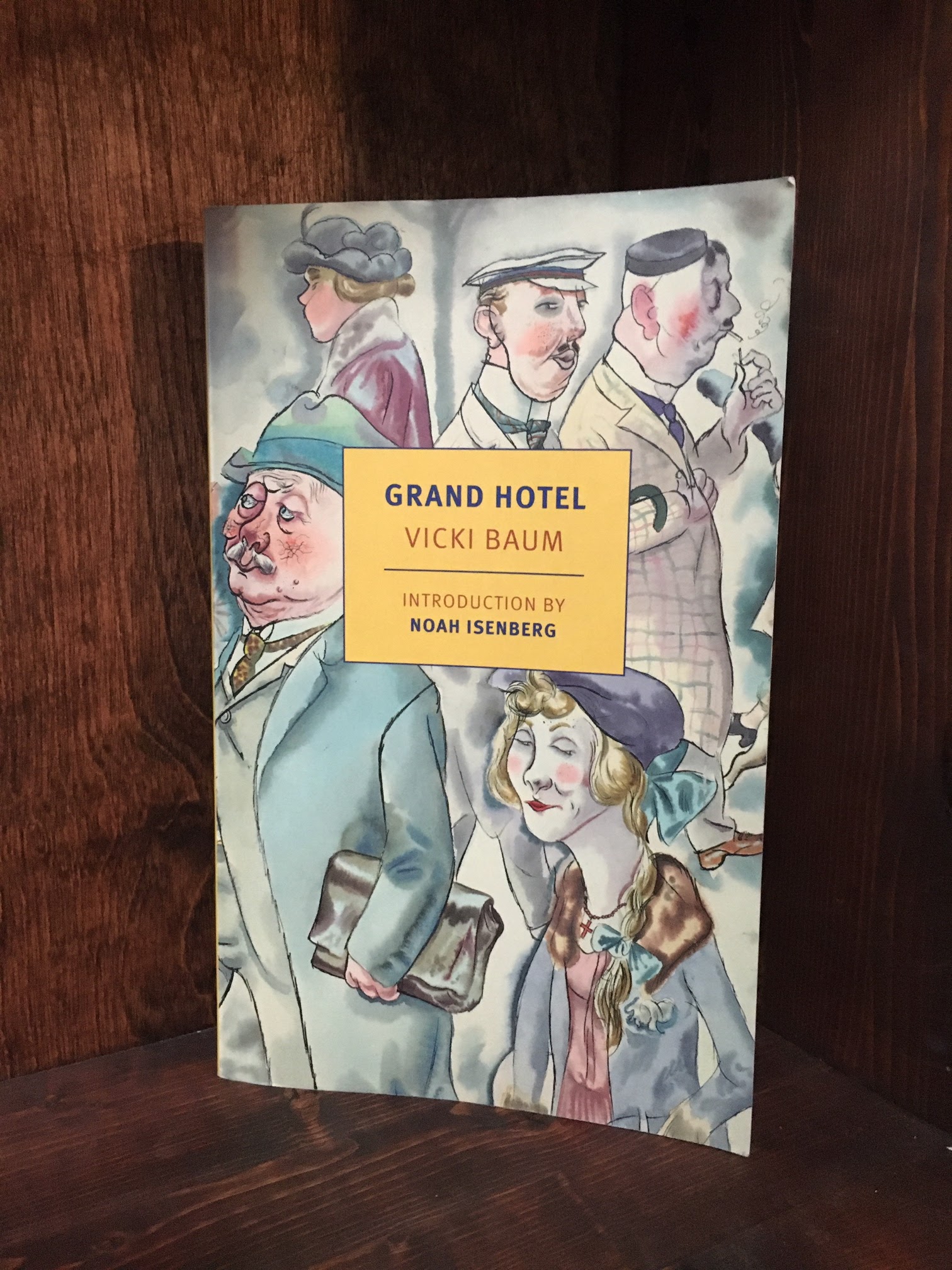
Vicki Baum's Grand Hotel (#1929Club)

"...that indefinable smell of Berlin in March..."

An aging Russian ballerina, an unimaginative company director, a stenographer who also does nude photos, an impoverished baron doubling as a thief, a bookkeeper with a fatal cancer diagnosis, a morphine-addicted doctor whose face was destroyed in World War I--they're all staying in a grand Berlin hotel.

That sounds like a series of character sketches, which is, according to the introduction, the way Vicki Baum first began to think about the novel, but she's worked out a plot that brings them all together. There's love, there's death, there's fortunes won and lost--or are they? The meeting of Grusinskaya, the ballerina, and Baron Gaigern (Greta Garbo and John Barrymore in the movie!) is both delightful and amusing. 

The novel--or the characters at least--affect a certain cynicism about love: the stenographer FlÀmmchen (what a name! Joan Crawford in the movie) tells Baron Gaigern, "True love? There's no such thing," and says of the sexual act, "It was like having a tooth filled by a singularly incompetent dentist." Gaigern himself is quite calculating about love, until, maybe, he isn't. The novel itself is less certain about that cynicism, but still a little cynical. Do unexpected characters fall in love? "No," says the third-person narrator. "Life is very far from producing such delightful surprises." Yet, even so, some hearts might be warmed.

Closer to the feeling of the novel is a concern for money. Kriegelein, the bookkeeper, says at one point, "Only with money can you begin to be a decent human being." Which room you're in, what clothes you wear, career choices and life choices. All the characters think about money, and a possible corporate merger is one of the main plot threads. 

It ends--but no spoilers!--with a big scene that involves all the major characters, even if one has already left town. Very enjoyable.

It's the week of the 1929 Club, hosted by Kaggsy and Simon, and this is very much a 1929 book...


Over the years, I've posted a couple of other 1929 volumes on the blog:


and Mateiu Caragiale's The Rakes of the Old Court in the Sean Cotter translation.


Brona's post about her 1929 book reminds me that the A Room of One's Own is actually a 1929 book as well, though the lectures were given in 1928. My thoughts about it here.


Thanks to Simon and Kaggsy for hosting!

Tuesday, September 20, 2022

Short Reviews: von Doderer, Faulkner, Scholem

Three complicated chunksters all of which I started long posts for. Those posts didn't get finished. (Oh, well.) Time to clear the decks.


Heimito von Doderer's The Strudlhof Steps (850 pages)

This is a fairly new release from New York Review Books, and Vincent Kling won the most recent Wolff Prize for translation from the German for it. The novel came out in 1951 in German, and hasn't previously appeared in an English translation.

The main events take place just before and just after World War I in Vienna. I'm a sucker for the place and time. And, hey, it's shorter than The Man Without Qualities; as a bonus, von Doderer finished it, too. Four sections, each coming to a dramatic climax--who gets married, who gets dumped, who gets a leg cut off by a tram--generally on or near the Strudlhof Steps:


Lt. Melzer features in the subtitle. He likes to drink Turkish coffee on the skin of a bear he shot in Bosnia in 1912; watched his commanding officer (whom he likes) die on the Italian front in World War I; seems almost unmarriageable, but is he?

René von Stengeler is born into a wealthy Protestant family, captured by the Russians in 1916, only making it back to Vienna after the war is over. Does he marry Grete, back from Oslo where she escaped the misery of post-war Vienna by teaching piano? And why does René's sister commit suicide? Because we know she did from the first few pages.

The novel requires tolerance, but pays back. It moves back and forth in time, at first seemingly arbitrarily. You have to accept its terms, and give it space to get started. Characters have last names or first names but not necessarily both, and sometimes merely initials. For example, we never learn Lt. Melzer's (a major character) first name: on page 823, "Sorry, but we don't know Melzer's first name." The narrative voice has a curious diffidence.

Von Doderer's politics were not particularly admirable. He joined the Nazis in the mid-30s, when the party was illegal in Austria. The afterword, by Daniel Kehlmann, says he was quite anti-Semitic at that time. He later turned against the party, but never publicly, and as a WWI veteran, he was drafted into the Wehrmacht, serving in garrison duty, first in Norway, later in France, where he started writing this novel. The publication of the novel was delayed while von Doderer was de-Nazified. René von Stengeler is clearly a self-portrait, and deliberately not a flattering one. What did he think by 1950? I don't know. There are minor Jewish characters in this, and they're treated with real sympathy.

Anyway, I thought it was very good.

William Faulkner's Light in August (480 pages)

I had heard that Light in August was a murder story, the story of Joe Christmas, and, well, it is. Christmas (named for the day his infant form was dropped off at the orphanage) murders his lover. Christmas may have black blood--he doesn't know and we don't know either, but he thinks he does, and though he could pass for white, once he's accused of having a drop of black blood (by his own grandfather, no less) he assumes he does.

But Christmas' story is not the whole of the novel by any means. It's the portrait of a town called Jefferson, and not just the evils of racism, but also the ways racism distorts the life of the town. Nowadays we don't really have any problem contemplating that Jefferson the man may have been a bit racist, but the novel came out in 1932. There's a daring irony to that. Was Faulkner in his heart of hearts free of racism? Certainly not, and I doubt he would say he was. But he knew that problem for a problem, and that counts for something. Percy Grimm, the white captain of the National Guard, is a particularly (dare I say it?) grim portrait of a racist.

And am I the only one who doubted Christmas committed the murder? No, because the Wikipedia article says it's unclear who did it. I don't think that's actually sustainable, and that Christmas really did do it, but I did wonder during the middle of the novel. But maybe that's attributable to too many years of reading mysteries: the obvious suspect is never the culprit.

The town's a mess, and there's nothing to do but escape, but almost nobody does; the only ones who do are Lena Grove and Byron Bunch, running off in a folie Ă  deux: she's looking for the man who got her pregnant and who will never marry her, and Byron's hoping she'll settle for him instead, and meanwhile he'll be there when she (which she won't) changes her mind.

One other thing to be said about this is that, of the great Faulkner novels, I thought this was the easiest read. And that's definitely something... 😉 It's easier than The Sound and the Fury, As I Lay Dying, and Absalom, Absalom. No chapters from the POV of dead people or madmen. Not the greatest of that quartet, I'd say, which for my money is Absalom, Absalom, but a better starting point. (Though if you include Sanctuary in your list of top Faulkner, I would say that one's a pretty straightforward read.)

Yeah, a classic.

Gershom Scholem's Sabbatai Sevi (929 pages, plus bibliography, notes and index)

Sabbatai Sevi (1626? - 1676) declared himself the Jewish messiah in 1665. (He may have intimated it as early as 1648 but only in limited circles.) Gershom Scholem, Jewish historian and friend of Walter Benjamin, made Sevi the subject of a major book.

Sevi (there should be a dot under the S which I can't figure out how to type, but think Tsevi or Zevi) was born in Smyrna to a middle-class merchant family, studied the Kabbala in Jerusalem, traveled on religious business to the Jewish community in Egypt and later to Constantinople. All lands under the control of the Ottomans at the time. When he began his mission in earnest, Nathan of Gaza was his prophet and explicated the theology of the new movement. Scholem, as a historian of Jewish mysticism, is rather more taken with Nathan than Sevi.

But the stories of Sevi and Nathan are just a small part of this fascinating book. What's surprising is the Europe-wide discussion of these figures, and not just in the Jewish community. Italy, Amsterdam, Morocco, Poland, Hamburg, Egypt are all discussing this new Messiah. English chiliastic Protestants write books about Sevi, who, they think, will lead 10000 Jews from the Lost Tribes across the River Sambatyon, armed with bows and arrows but still invincible. (The River Sambatyon doesn't actually exist, which is why you haven't heard of it.) Samuel Pepys writes about Sevi in his diary! Along with all the women he was shagging. He features in Venetian ambassador's reports and Jesuit Relations. One can imagine Blaise Pascal, roughly contemporary, being discussed across Europe, but it turns out not all Europe-wide discussions were so scientific.

Sevi himself always advocated a peaceful movement. Faith and the perfection of the self would lead to the kingdom of God. There were no armies in his vision.

In fact, I found the reception of Sabbatai Sevi to be more interesting than the biography of Sevi himself. Scholem is inclined to attribute Sevi's messianic proclamations to mental illness, labeling him a manic-depressive. Maybe. But diagnosing mental illness in the present is difficult enough--DSM-III, DSM-IV, DSM-V have different labels, and so will DSM-XCIII--diagnosing it in figures in the past in inherently suspect.

Why could a Messianic movement take root then? Scholem finds the main factor to be the diffusion of Kabbalistic thinking going back to Isaac Luria (1534-1572). But also the Jewish massacres by Khmelnitsky in Poland and the Ukraine take place in 1648. As for the interest in Christian circles, there was a feeling that 1666 should be an important year: the number of the beast plus 1000.

Once in Constantinople, Sevi was arrested by the Ottomans. They were relatively tolerant of Judaism, but weren't prepared to tolerate a figure who was going to lead an army of invincible Jews and put the crown of the world on his head. (If, in fact, Sevi intended these things. Probably not.) He seems to have impressed the vizier and then later the sultan, but still in September of 1666, he was told to convert to Islam or die. Sevi converted. 

Surprisingly this wasn't the end of the movement. A number of Sevi's followers also converted over the years. Sevi was ordered to leave Constantinople, first to Edirne, which was at times the Ottoman capital, then later to Albania. Sevi led his converts, the Dönmeh, also referred to as the Ma'min, or the Faithful, in a new syncretistic religious community influenced both by Judaism and Islam, particularly that of the mystical Sufi orders. Scholem's book ends in 1676, when Sevi dies, but the community survived, centred in Salonica until the Greek-Turkish population transfers of 1922. The Dönmeh were often thought to be hidden Jews, but they were Muslim enough for the time, so they had to go. The story of the Dönmeh would be fascinating, and Scholem had intended to write a book, but didn't live to do so. They do feature in Mark Mazower's book (recommended!) on Salonica, though.

I read the second edition of the book, which came out in 1973, translated by R. J. Zwi Werblowsky. Scholem says in the introduction that he had access to more material by then, and that it superseded the earlier edition.

And why did I read this book now? Well. Did I really need to read one nine-hundred page book about a failed Jewish messiah in order to prepare for another nine-hundred page book about a failed Jewish messiah? Oh, probably not, but that's what I did:


These were all August reads for me, and it's been a while now. Still I wanted to review these because they knock off a couple of challenge items. Light in August was on my original Classics Club list and works for this year's Back to the Classics challenge.


And the other two count for this year's European Reading Challenge:


The Strudlhof Steps is clearly an Austrian book, though it does have scenes in Norway and Switzerland. Sabbatai Sevi spent most of his life in what is now Turkey, but I've already done Turkey this year. Sabbatai Sevi the book ranges across Europe. Still we'll stick Sevi himself, who spent the last eight years of his life in Ulcinje, which was in the Ottoman province of Albania at the time, but is now in Montenegro.

Short reviews, did I say? Well, short-ish...


Thursday, October 21, 2021

Osip Mandelstam


All I want to do is
escape the madness here.
To rise into the light
where I can disappear.

Where you can be like light--
and happiness is mine!--
and learn from every star
what it means to shine.

All I want to say is,
the whispering you hear--
that's the sound of light
I whisper in your ear.

The thing that makes us light
the thing that makes us shine
is that I whisper words
and that this voice is mine.

-Osip Mandelstam (tr. Paul Schmidt)

I've been reading Mandelstam in W. S. Merwin's translation and I'm afraid that has sent me back to reading those few poems of Mandelstam's that are in Paul Schmidt's collection of 20th century Russian poetry The Stray Dog Cabaret. I don't know, but for me, the best thing that can be said about the W. S. Merwin translations are that there are more of them. (And, yes, that is damning with faint praise.) What was (is?) it about American (and Canadian) poets of a certain era that they were so very afraid of rhyme? Whether it's appropriate or not for one's own poetry, it feels false to translate somebody like Mandelstam without it.

This poem dates from March 23, 1937. Mandelstam had been arrested in 1934 after the Stalin Epigram came to light. He had assumed its discovery would mean a death sentence, but after interrogation and torture he got off lightly (?) with internal exile to the Ural mountains, only to be rearrested in 1938. He died later that year.

Saturday, September 18, 2021

August wrapup (and summer reading)

My August reading (and looking at that #20booksofsummer list, ha, ha...)

Like most blogger memes, monthly summaries turns out to be another I'm pretty sporadic about doing.

The Mystery Department

Which was Philo Vance by S. S. Van Dine this month. I recently discovered that the whole series is available at Project Gutenberg Australia. Are they legal in Canada? I dunno. But I downloaded the ones I hadn't read and then read three of them.

Philo Vance may be an idle aesthete, but he's effective in tracking down murderers.

"If you will refer to the municipal statistics of the City of New York, you will find that the number of unsolved major crimes during the four years that John F.-X. Markham was district attorney, was far smaller than under any of his predecessors' administrations." [Benson Murder Case, Introductory]

Philo Vance was the reason why. 

The Benson Murder Case (#1 in the series, 1926)

Alvin Benson was a Wall Street broker and man about town; he was shot one night at home in the forehead. Harassed actresses and jealous boyfriends make up a good collection of suspects, but as the police go through one suspect after another, Vance keeps insisting the psychology is wrong. Until it isn't.

The Scarab Murder Case (#5 in the series, 1930)

Benjamin Kyle is a philanthropist financing an expedition to excavate in Egypt. Early one morning his head is crushed by the statue of an Egyptian god and the dead hand is clutching an ancient scarab. The curse of the old gods for looting pyramids? Or a more terrestrial murderer? Howard Carter & King Tut's tomb weren't so far in the past at this point. Vance is once again mostly tasked with keeping the police from arresting the wrong person, but in this case the actual murderer is doing his best to frame somebody else, anybody else. 

The Dragon Murder Case (#7 in the series, 1933)

In an old estate on the north end of Manhattan, there's a swimming pool formed from a river. (Think Tryon Hall, now Fort Tryon Park.) Sanford Montague dives into the pool and never comes up. A few days later his body is found a couple of miles away. Murder? Or accident with a clumsy attempt to hide the outcome? Or is it the dragon of Lenape legend? 

The solution depends on the latest in technology in 1933, which was also true of 1927's The Canary Murder Case, probably my favorite in the series and an excellent locked-room murder.

However. "Philo Vance/needs a kick in the pants," wrote Ogden Nash, and it's kind of true. I enjoy the series and it's historically important, but. Willard Wright, for whom S. S. Van Dine was a pseudonym, was also an art critic while under one of his other hats, and there's far more art history than any of the mysteries require. There may be some use to discussions of Egypt's 17th dynasty in The Scarab Murder Case, but mostly you have to just like the long digressions for their own sake. I don't entirely mind them myself. But what's pretty continuously hard to take is Wright's inability to write dialog that sounds like anything an actual human being might speak.

I knew early Ellery Queen was quite influenced by Philo Vance, but what struck me in these was how much Rex Stout was paying attention, too. And it's not just that there's a butler who cooks!

In the Time of Nero

My Classics Club spin book was Henryk Sienkiewicz' Quo Vadis. That sent me off to Petronius' Satyricon and Tacitus' Annals. Thoughts were written up here.

The Poetry Department

Richard Crashaw/Selected Poems

Crashaw (1613-1649) was the son of a Puritan sympathizer, but he became a high-church Anglican and eventually a Catholic. Not a politically astute move for an Englishman in those years, Crashaw fled to France and then died in the Papal States. 

Crashaw considered George Herbert his poetic master, which shows good taste as far as I'm concerned. Very much a metaphysical, with elaborate conceits: one poem voices the tears that Mary Magdalene cried. A couple of impressive long poems devoted to Teresa of Avila.

The edition I read was selected by Michael Cayley for Fyfield Books (Carcanet Press) in 1972. He wrote a useful introduction.

H. D./Sea Garden
H. D./Hymen

These early volumes of H. D. (Hilda Doolittle, 1886-1961) are available at Project Gutenberg. I've got a couple other volumes of hers in hand. I like her handling of classical allusions, but I'm not going to say much at the moment.

G. K. Chesterton/Wine, Women, and Song

Ahem. Not very politically correct, and not just in the ways suggested by the title. (The en passant anti-Semitism was pretty hard to swallow.) Still, he's a skilled versifier and there was some amusing stuff in it:

You will find me drinking rum
Like a sailor in a slum
You will find me drinking beer like a Bavarian
You will find me drinking gin
In the lowest kind of inn
Because I am a rigid Vegetarian.

Available from Project Gutenberg. 

Richard Howard/RH đŸ–€   HJ

New York Review Poets volume. It draws from Howard's career as a poet of fifty years. (He's also a translator, of E. M. Cioran among others.) HJ is Henry James, and a number of the poems selected concern James in some way. I find Richard Howard very good, but I'm not sure this is the selection of his poems I would have made. Quoted from it here.

Women in Translation Month

Two by Amélie Nothomb (Thirst, Tokyo Fiancée). Thoughts here.

Dorthe Nors/Mirror, Shoulder, Signal

It's possible I'll still say more about this, but I haven't yet.

Sonja Hansen lives in Copenhagen and is the translator of (imaginary) Swedish thriller writer Gösta Svensson. She's 40 or so and wants to get a driver's license so she's a little freer to go where she wants, but she suffers from positional vertigo--if she swings her head too fast, she gets dizzy and disoriented. She thinks about doing yoga, gets massages, feels like a country mouse (she's from rural Jutland) in the big city of Copenhagen. Not much happens, but that's kind of the point.

The novel was shortlisted for the Booker International in 2017, but lost to David Grossman's A Horse Walks Into a Bar. That was also the year of Mathias Énard's Compass.

Some Other International Fiction

Jose Maria Eça de Queiroz/The Yellow Sofa

A novella by the 19th Century Portuguese realist. The merchant Godofredo da Conceiçao Alves discovers the younger partner in his firm is having an affair with his wife. What to do? A duel is just one of several possibilities. 

I thought this was very good. It's the first of his I've read, but I've now got several more from the library.

Stanislaw Lem/Fiasco

An expedition from Earth to a distant star system sets out with the idea of making contact with an alien civilization. No humans have ever been in contact with any aliens before--this is a story of first contact. The title gives away the outcome, but how it fails and why are the questions of the novel.

It would be Lem's hundredth birthday this year, leading to overviews. Lem is almost always a science-fiction writer, but he ranges from scientifically hard to fabular, from serious to uproariously funny. I liked this, though I didn't think it was his best--it took a little while to really get going. It's on the serious, more technologically-minded end of his spectrum.

Sholem Aleichem/In The Storm

Quite good, I thought. More here.

So that's a month's worth of reading for me. As for that 20 Books of Summer, as you might guess from this one month's reading, I read twenty books. But as for that list, umm...eleven, plus two I had suggested I might read. Ah, well...

The August books that are still around the house


Senhor Dorsey decided I wasn't using his service properly--probably by not using it enough--so there's a new Twitter account follow button...

Thursday, August 19, 2021

Richard Howard (#poem)


from Decades 

(for Hart Crane)


II

Laukhuff's Bookstore. I am fourteen, I live
on the Diet of Words, shoving a ladder around
high shelves while the German ex-organ-maker
smokes with a distant nightmare in his eyes
("You have heard of Essen," he murmurs, "you never
will again": it is nineteen forty-three),
his body on hinges, his elbows hovering wide
over the Jugendstil bindings (Werfel, Kraus...)
like a not-quite-open penknife. "Hart Crane?

He came here to marry the world...You understand?
Maritare mundum: it is the work of magic,
Mirandola says it somewhere, to marry the world...
And not much time to do it in, he had
to read all the books, to marry, then to burn,,,
It is one kind of greatness to grow old--
to be able to grow old, like Goethe;
it was Hart's kind to refuse. You understand?"
Laukhuff is asking me, laughing through smoke

his postponing, renouncing laugh. No, I don't--
that much I do. I climb down, clutching The Bridge
and hand it over. "Will I understand this,
Mr Laukhuff? Should I buy it?" "Cross it first.
You won't, but there is a certain value, there is
poetic justice in the sense of having missed
the full meaning of things. Sure, buy it. Spend
all you have, your mother will give you more."
The German penknife closes with a click.

Marriage, Hart. The endless war. The words.
Cleveland was our mother-in-lieu. We left.

-Richard Howard

I've been reading a lot of Richard Howard lately.

'Decades' is about Howard's lifelong engagement with Hart Crane, author of The Bridge. Both Richard Howard and Hart Crane grew up in Cleveland. The poem consists of five sections--this is the second--set at ten year intervals. Each section is three nine-line stanzas of accentual pentameter, plus the final couplet, generally unrhymed. 'Decades' was first collected in Fellow Feelings, 1976, though I have it in the New York Review Books selection.

Howard's poems are often long (and so hard to quote). Many are dramatic monologues or duologues (think Robert Browning) with some spoken by famous figures, such as Walt Whitman, Henry Irving, or Edith Wharton. This passage is a little funny (I think) but he's often laugh-out-loud funny.

And Laukhuff's Bookstore! It closed before I was even born in a city I've never been to and now I miss it.


Saturday, January 9, 2021

Italy books: his and hers

His: Poets In A Landscape

In the mid-50s Gilbert Highet, then a professor in Classics at Columbia, took a trip through Italy. He seeks out places associated with the famous Roman poets: Catullus, Vergil, Propertius, Horace, Tibullus, Ovid, and Juvenal. The organizing principle is geographical, starting in the north: Catullus' birthplace is Sirmione, on the Lago di Garda; Juvenal is likely from Aquinum, the modern Aquino, southeast of Rome, also the origin of St. Thomas Aquinas. Highet and his traveling companion visit places from north to south. Some of the identifications are tenuous. Is the Villa d'Orazio Horace's actual villa? Who knows? But it doesn't really matter. Highet is a good travel writer. Italy, especially in the countryside, was still quite poor in the mid-50s, but Highet enjoys meeting people, his descriptions of the landscape are evocative, the things he sees are fun.

A second aspect of the book is the poetry. Highet gives his own translations from the poets. I think he's a sensitive and strong translator, with a real feel for the metrics. He's also an enormously civilized individual, quoting Eliot or Pound or Tennyson appropriately. For instance he cites Tennyson's witty 'Hendecasyllabics' in discussing Catullus. Highet isn't known as a translator, but based on this he could have been.

The weak link in the book is the criticism of the poetry. It's not exactly wrong, but it's terribly flat-footed. It wouldn't have been out of place in the Victorian era, but Highet was born in 1906. It's possible to read his criticism for amusement, but that's about all. Highet has the grace to quote Yeats' poem 'The Scholars' but doesn't manage to escape its mockery of 'bald heads forgetful of their sins' reading Catullus.

It would be a wonderful book to take with (or read in advance) should you be able to take a trip to Italy. ***Heavy sigh***

Highet dedicated his book to his 'Travelling Companion'. Turns out she was writing a book, too.

Hers: North From Rome

The introduction to Highet's book says if he's remembered at all, he's remembered for this, that, and the other. He was a famous enough man in his day, a great teacher, author of various books, judge at Book of the Month Club, editor at Cyril Connolly's Horizon, radio personality (you can hear him on YouTube). Still. Balderdash. If Gilbert Highet is remembered at all these days, he's remembered as Mr. Helen MacInnes.

I probably read North From Rome when I was teenager, but if so I didn't remember it, and it felt blissfully new. 

The American Bill Lammiter has written one hit play. He's there for rewrites in New York during the production; he goes to Hollywood to consult because they're going to make it into a movie. His fiancée Eleanor Halley has broken it off with him because of his unavailability and has subsequently announced she's going to marry an Italian count.

The novel starts with Bill living in a Roman hotel on the Via Vittorio Veneto, near the Pincian Gate. He's been there four months, making no progress either on his next play or in winning Eleanor back, and he's thinking about chucking it all and heading back to the U.S. 

Late that very night, smoking on his balcony, he sees a man jump out of a car and attack a pretty Italian girl. He yells, they run off, and our story is off, too. Pretty great.

It was amusing to read them together. At one point Bill visits a professor staying at the American Academy in Rome. Well, Highet in his acknowledgements gives thanks to the American Academy in Rome. I imagine Gilbert looking for signs of Propertius' farm in the countryside near Perugia, while Helen was there pacing off a possible shoot-out between Bill Lammiter and some Communist goons. 

Her dedication also reads, "To my travelling companion."

Good times.


Starting off this year's tour of Europe on a high note!