Showing posts with label RIchard Howard. Show all posts

Monday, July 1, 2024

June Wrapup

All of my reading in June in one swell foop...

The Mystery Department

Harini Nagendra/Murder Under a Red Moon

Kaveri Murthy's second case. Set in Bangalore, India in the 1920s, I liked the first last summer. Kaveri enjoyed her successful detectivizing in that case; she was a bored housewife, but now she's going to have an agency. Her husband's OK with it, her mother-in-law less sure. But she's got a friend on the police force, some Bangalore Street Irregulars, and friends and acquaintances know she's good at it. This starts as embezzlement, but ends in murder. Perhaps not too mysterious, but charming and enjoyable. 

The third and most recent is on order at my library. 

Craig Johnson/The Cold Dish

A couple of years ago four boys gang-raped an indigenous girl; they were convicted, but their sentences were shockingly light. Then the leader of the boys is shot dead. Wyoming Sheriff Longmire takes into account it could be just a hunting accident, but suspects somebody's out for revenge. When a second boy is shot, he knows.

I know Lark likes the series and somewhere else I saw it compared to Tony Hillerman's, strong recommendations, so I tried it. This is the first. The interactions between the characters were fun, and while I was worried the plot would be a little too grisly for my taste, it was OK on that front. However, it was 400 pages and I did keep feeling it could be a hundred pages shorter and better for it. (Dame Agatha can do it in 250, if not 200.) Still I enjoyed this one & I'll carry on.

The Poetry Department

Matthew Arnold/Selected Poems

I didn't know Matthew Arnold's poetry very well--really only 'Dover Beach', I guess--and I thought maybe I didn't like it very well. But after rereading a bunch of Anthony Hecht last month (and his response to 'Dover Beach') I thought I'd try some Arnold. He's better than I thought... 😉 Except that his poems are mostly too long, I might even put some on a poetry post. Anyway, I'll be reading him more closely.

Richard Howard/Inner Voices

Him, I knew I liked. Inner Voices is a selection of his poetry from 1963-2003, so covering most of his career, but not all: he died in 2022. Howard was gay; in an era when confessional poetry was king, his early poetry was pleasantly out-of-step, voicing Edith Wharton or John Ruskin. His book Untitled Subjects won the Pulitzer for poetry in 1969; it's a series of monologues by Victorian-era commoners, funny and touching.

By the late 70s though he's mined that vein and I felt there was a falling off. Then come the 80s and it's become both possible, but also maybe required, to acknowledge one's homosexuality. There are AIDS poems; it was a tough period. But it added a new weight to his poetry, without taking away his humour.

Two books by Ana Blandiana

Ana Blandiana (a pseudonym) is a Romanian poet born in 1942. She won this year's Princess of Asturias Prize in Literature. I quoted from a couple of her books with some more thoughts here.

Big Ole Literary Novels

Thackeray/Henry Esmond

Henry Esmond is born abroad under dodgy circumstances to parents who may be dead. He's shuffled home to be raised a bit neglectfully by an aunt and uncle and falls in love with their daughter, his flirty first cousin. Eventually he goes off to fight in the wars of his time.

Henry's home country is England. The war of his time is the War of Spanish Succession. (Marlborough, Malplaquet, all that. 1701-1714.) Also going on is the question of English succession. Will it be the Catholic Stuarts or some other Protestant dynasty that inherits the English throne? Henry is involved in both struggles.

Virginia Woolf says in A Room of One's Own, that 'the critics often say that Esmond is Thackeray's most perfect novel.' I doubt the critics would say that now, and Woolf had her doubts--this is when she tries to get into a specialist library and is turned away because she's a woman. Still the Thackeray is a pretty good read, even if the flirty Beatrix Esmond is a bit Becky Sharp (of Vanity Fair) in less vibrant colours.

I read it now because last month I finished Ippolito Nievo's Confessions of an Italian. Change Henry Esmond to Carlo Altoviti in the first paragraph and you've got the plot of Confessions. Carlo's cousin is called Pisana, and his wars are Napoleon in Italy and then the early wars of the Risorgimento. (Garibaldi, the defense of the Roman Republic. 1793-1848 or so.) Henry Esmond came out in 1852, just a couple of years before Nievo was writing, and he thought, now there's a plot I can plunder. (Nievo also stole manfully from Ugo Foscolo's Last Letters of Jacopo Ortis, mostly for his thinking about the nature of Italian patriotism.) It also was a pretty good read, even if it was twice the length of the already longish Henry Esmond. La Pisana was a more psychologically believable flirt than Beatrix Esmond, I thought. The final twist is our young soldier-hero's obsessive romance was maybe less weird in Nievo. (Though pretty weird in both.) 

I did have to keep Wikipedia open for both novels for explanations of historical background. The first full translation into English of the Nievo, by Lucy Riall, came out in 2014.

And how about that dapper Italian on the cover? He's neither Nievo, nor supposed to be Carlo Altoviti. But who cares?

Jean d'Ormesson/The Glory of the Empire

This was a delightfully odd one. D'Ormesson's novel came out in 1971. It was his sixth, and the earlier ones apparently hadn't done much. This won prizes and got d'Ormesson elected to the Academie Française in short order. It was translated into English in 1974--superbly--by Barbara Bray. I read it in a New York Review Books reissue.

The Empire grows from two feuding cities who finally unite and conquer the known world. There are three famous emperors--Arsaphes, Basil, Alexis--though with periods of chaos between them; the third creates a golden age of culture and eventually peace that will not last. So far it could be any of various world-building fantasy novels, and, in fact, Tolkien gets a nod--we're told at one point he's the author of a history of a minor war on the Empire's eastern edge.

And that's a small example. The founding cities code as Sparta and Athens (one militaristic, one cultural) but are set geographically (if they're anywhere) on the west coast of Turkey. The Empire exists in our world and it impacts our world's poets, novelists, historians, and that's where d'Ormesson really goes to town. Corneille's last play, a failure, was the story of Arsaphes and his love; d'Ormesson quotes (creates) lines from the play, writing them in the alexandrines of the 1600s. (Bray amusingly translates them into heroic couplets, purportedly by Dryden, and does it well.) When Bergotte dies in Proust, it's not that Vermeer:
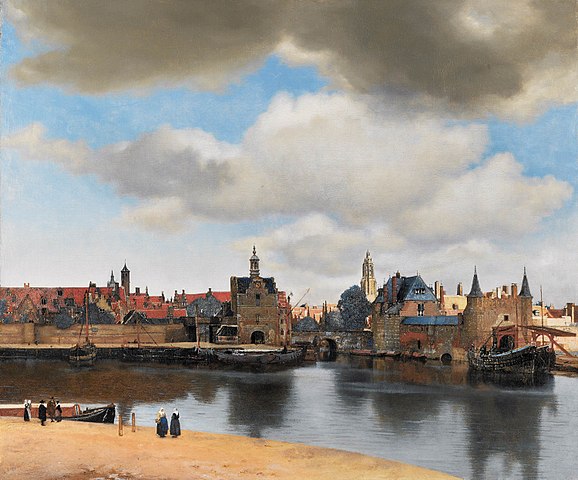


he's remembering; it's a Piero della Francesca painting of Alexis and his mother. D'Ormesson 'quotes' the passage in Proust. (I.e., makes it up.) Historians from Burckhardt to Bloch discuss episodes in the Empire. Sexual theorists from Freud to Foucault consider the consequences. Edmund Gibbon's The Rise of the Empire features in the bibliography. Renan doesn't write a Vie de Jesus, but a Vie de Alexis. No word on whether that book, too, is sometimes considered a precursor to Nazi thought. We're told Alexis is the only pagan who has ever been decreed a saint; we're given--in Italian!--the lines from Dante's Paradiso where he appears. The last source mentioned in that bibliography is Marguerite Yourcenar's Memoirs of Hadrian, but the only Hadrian in The Glory of the Empire is Pope Hadrian VIIth. Is that then an allusion to the Baron Corvo novel? Maybe!

One long collection of egghead-y easter eggs mixed in with a couple of doomed love affairs and some battle scenes might just drive you nuts, and I certainly didn't read this in one sitting. As you might guess, Borges is a clear precursor (and shows up several times). But if you're the sort of person who thought the only thing wrong with 'Tlön, Uqbar, Orbis Tertius' was that it wasn't long enough, you'll love this.

A few sensible-sounding (?) quotes:

'History is never about anything but the folly of men.' [p.152]

'People are not interested in the past any more. And yet it was the past that made us.' [p.200]

'History fabricates its own sources.' [Supposedly this is Georg Christoph Lichtenberg. Maybe it even is.] [p.257]

'...novelists given to the lamentable genre of historical fiction bear a heavy responsibility...' [p.273]

Obviously all deeply ironic coming from such a book.

When Marguerite Yourcenar became the first woman elected to the French Academy in 1980, there was considerable opposition. Jean d'Ormesson was her primary advocate.

Cooking

When I get cookbooks or food-related books from the library I often just skim them. These two got read cover to cover.

Hazebroek & Elenbaas/Hot Coals

I got a fancy kamado-style grill for my birthday a while back, which I am still learning how to use. (My old Weber kettle was rusting away...) This was heavy on history, theory, and practice, which is great as far as I'm concerned and why it got read cover-to-cover, unlike the other two kamado cookbooks, which are being browsed.

Dolinsky/The Ultimate Chicago Pizza Guide

A mix of recipes and descriptions of Chicago pizza places as of the end of the pandemic. The list of pizza places was a trip down memory lane; the recipes made me want to mix up my pizza-making game. (I do both flat and deep dish pretty often.)

He can be a bit repetitive, but he's got a punchy way with metaphors that suggests he was reading sportswriters from the 30s: 'a nice even browning, like a retiree in Boca'  or 'the top layer is as thin as the Trib's business section' that keeps one reading.

He introduces the concept PIGUE (pizza I grew up eating), suggesting that people in general become uncritical about their childhood favourite. He says a lot of people feel this way about Barnaby's in the northern suburbs of Chicago--a pizza I'd totally forgotten about until reading this book. (And apparently I ate at a satellite branch, not the mother ship.)  But my PIGUE is My Pi pizza, a deep dish pizza, but not especially deep. And I am certainly unable to think about it critically. I had thought the last of its two branches had closed in the late 80s, but it turns the son of the former owner has refounded it, and Dolinsky thinks it's good. That next trip to Chicago...

And speaking of Chicago:

David Mamet in Chicago

I read/reread three plays by David Mamet set in Chicago. Sexual Perversity in Chicago has two guys and two girls. One guy and one girl are cynical about love; the cynical guy, Bernie, in particular is an obnoxious fabulist. The non-cynical pair fall in love--for a while. The play premiered in Chicago in 1974. I'm not sure about this play: on the page at least the love story didn't feel very convincing. It was the basis for the movie About Last Night, which I haven't seen but now want to. I expect it to be watered down, though.

Then I read Duck Variations. Fourteen short scenes where two old guys meet on a park bench and talk about ducks. No plot, but it was great. Mamet says in the stage notes it could be any park bench looking out at a lake, but no, it's Chicago: they discuss the pump houses at one point. Toronto doesn't have pump houses out in the lake where they get water, and I imagine most other lakeside cities just have hoses under the lake that you can't see. First there was Thirteen Ways of Looking at a Blackbird, then there was Fourteen Ways of Talking about Ducks. Take that, Wallace Stevens.

Then I finished by rereading American Buffalo, my favorite of Mamet's plays that I know. (I've seen Glengarry Glen Ross twice--the movie once and on stage once. Maybe it could be done differently, but there was too much scenery-chewing in both. Death of a Fuckin' Salesman, indeed. That's often considered his best, but not for me.) In this a junk shop owner has a buffalo head nickel and sells it to a collector. But maybe he sold it for too little? He decides he's going to steal it back. How that goes. This takes place on the north side of Chicago--somehow I think of it as in my neighborhood, though it's probably south of where I grew up. We're told the collector lives on Lake Shore Drive--which would make him rich. A pretty great play, I think.

The books still around the house:


I've been reading plenty, but not blogging much. Oh, well. My blogging mojo has gone missing. (Department of Missing Mojo? Hello? Have you seen...) Maybe this omnibus post will get me over the hump.

Next month? It's Paris in July. Maybe when I reread Giovanni's Room this time, I'll actually blog about it? We'll see. I'm also thinking more Chicago books, particularly covering the late 70s and early 80s. Sara Paretsky, Michelle Obama, maybe something I haven't read before, though I'm not sure what just now. [Suggestions welcome!] What are your plans?

Happy Canada Day! To Canadians and those thinking about moving to Canada depending on election outcomes in your jurisdiction. The fireworks are starting as I'm finishing this.

Thursday, April 7, 2022

Richard Howard's At Sixty-Five (#poem)


At Sixty-Five

The tragedy, Colette said, is that one
does not age. Everyone else does, of course
(as Marcel was so shocked to discover),
and upon one’s mask odd disfigurements
are imposed; but that garrulous presence
we sometimes call the self, sometimes deny
it exists at all despite its carping
monologue, is the same as when we stole
the pears, spied on mother in the bath, ran
away from home. What has altered is what
Kant called Categories: the shapes of time
change altogether! Days, weeks, months,
and especially years are reassigned.
Famous for her timing, a Broadway wit
told me her “method”: asked to do something,
anything, she would acquiesce next year—
“I’ll commit suicide, provided it’s
next year.” But after sixty-five, next year
is now. Hours? there are none, only a few
reckless postponements before it is time . . .
When was it you “last” saw Jimmy—last spring?
last winter? That scribbled arbiter
your calendar reveals—betrays—the date:
over a year ago. Come again? No
time like the present, endlessly deferred.
Which makes a difference: once upon a time
there was only time (. . . as the day is long)
between the wanting self and what it wants.
Wanting still, you have no dimension where
fulfillment or frustration can occur.
Of course you have, but you must cease waiting
upon it: simply turn around and look
back. Like Orpheus, like Mrs. Lot, you
will be petrified—astonished—to learn
memory is endless, life very long,
and you—you are immortal after all.

-Richard Howard


Richard Howard (1929-2022) passed away last week, a favorite as a poet and an important translator from the French.

As a consequence there have been links: the NY Times obituary, an article, emphasizing his Jewishness in the Forward, a conversation at a Pen event between him and Susan Sontag. That last, from which I lifted the poem, also has an amusing anecdote involving Hermann Broch: it seems Broch, assisted in his emigration from Europe by Howard's adoptive mother, flirted with her, bringing on young Howard's jealousy. To no avail. (The romance didn't come off anyway.)

I also learned that Howard's husband insisted that one book leave their New York apartment every time a new one came in. The horror! There was generally large stack of books by the door to be schlepped down to the Strand and sold.

The poem uses a syllable-counting pattern. Ten syllables in each line, though it's not five accents, and so it's not blank verse.

For Howard, at sixty-five, next year wasn't yet now. He went on well past that. But 'you are immortal after all.'

Thursday, October 28, 2021

The Past Is The Present (Marianne Moore)


The Past is the Present

If external action is effete
  and rhyme is outmoded,
    I shall revert to you,
  Habakkuk, as on a recent occasion I was goaded
      into doing, by XY, who was speaking of unrhymed verse.

This man said--I think that I repeat
  his identical words:
    "Hebrew poetry is
  prose with a sort of heightened consciousness. 'Ecstasy affords
      the occasion and expediency determines the form.'"

-Marianne Moore

I've been looking into Marianne Moore (1887-1972) again after reading Richard Howard. Though in most ways they're pretty different, both use a syllable-counting scheme in their poetics. (Moore, pretty much always; Howard, frequently.) For example, the first line of each stanza in this has nine syllables. There is a rhyme scheme, though it's not very intrusive: effete/repeat, outmoded/goaded, words/affords, with the last one being only a sight rhyme.

XY is the Rev. Edwin Henry Kellogg, Moore tells us in a note.

Moore was an inveterate rewriter of her poems; this is the first version, published in 1915 and first collected in her book Observations of 1924. There is another version. Her most famous poem, 'Poetry', the one that begins 'I, too, dislike it...' goes from thirty lines in the earliest version to three in the final.

Saturday, September 18, 2021

August wrapup (and summer reading)

My August reading (and looking at that #20booksofsummer list, ha, ha...)

Like most blogger memes, monthly summaries turns out to be another I'm pretty sporadic about doing.

The Mystery Department

Which was Philo Vance by S. S. Van Dine this month. I recently discovered that the whole series is available at Project Gutenberg Australia. Are they legal in Canada? I dunno. But I downloaded the ones I hadn't read and then read three of them.

Philo Vance may be an idle aesthete, but he's effective in tracking down murderers.

"If you will refer to the municipal statistics of the City of New York, you will find that the number of unsolved major crimes during the four years that John F.-X. Markham was district attorney, was far smaller than under any of his predecessors' administrations." [Benson Murder Case, Introductory]

Philo Vance was the reason why. 

The Benson Murder Case (#1 in the series, 1926)

Alvin Benson was a Wall Street broker and man about town; he was shot one night at home in the forehead. Harassed actresses and jealous boyfriends make up a good collection of suspects, but as the police go through one suspect after another, Vance keeps insisting the psychology is wrong. Until it isn't.

The Scarab Murder Case (#5 in the series, 1930)

Benjamin Kyle is a philanthropist financing an expedition to excavate in Egypt. Early one morning his head is crushed by the statue of an Egyptian god and the dead hand is clutching an ancient scarab. The curse of the old gods for looting pyramids? Or a more terrestrial murderer? Howard Carter & King Tut's tomb weren't so far in the past at this point. Vance is once again mostly tasked with keeping the police from arresting the wrong person, but in this case the actual murderer is doing his best to frame somebody else, anybody else. 

The Dragon Murder Case (#7 in the series, 1933)

In an old estate on the north end of Manhattan, there's a swimming pool formed from a river. (Think Tryon Hall, now Fort Tryon Park.) Sanford Montague dives into the pool and never comes up. A few days later his body is found a couple of miles away. Murder? Or accident with a clumsy attempt to hide the outcome? Or is it the dragon of Lenape legend? 

The solution depends on the latest in technology in 1933, which was also true of 1927's The Canary Murder Case, probably my favorite in the series and an excellent locked-room murder.

However. "Philo Vance/needs a kick in the pants," wrote Ogden Nash, and it's kind of true. I enjoy the series and it's historically important, but. Willard Wright, for whom S. S. Van Dine was a pseudonym, was also an art critic while under one of his other hats, and there's far more art history than any of the mysteries require. There may be some use to discussions of Egypt's 17th dynasty in The Scarab Murder Case, but mostly you have to just like the long digressions for their own sake. I don't entirely mind them myself. But what's pretty continuously hard to take is Wright's inability to write dialog that sounds like anything an actual human being might speak.

I knew early Ellery Queen was quite influenced by Philo Vance, but what struck me in these was how much Rex Stout was paying attention, too. And it's not just that there's a butler who cooks!

In the Time of Nero

My Classics Club spin book was Henryk Sienkiewicz' Quo Vadis. That sent me off to Petronius' Satyricon and Tacitus' Annals. Thoughts were written up here.

The Poetry Department

Richard Crashaw/Selected Poems

Crashaw (1613-1649) was the son of a Puritan sympathizer, but he became a high-church Anglican and eventually a Catholic. Not a politically astute move for an Englishman in those years, Crashaw fled to France and then died in the Papal States. 

Crashaw considered George Herbert his poetic master, which shows good taste as far as I'm concerned. Very much a metaphysical, with elaborate conceits: one poem voices the tears that Mary Magdalene cried. A couple of impressive long poems devoted to Teresa of Avila.

The edition I read was selected by Michael Cayley for Fyfield Books (Carcanet Press) in 1972. He wrote a useful introduction.

H. D./Sea Garden
H. D./Hymen

These early volumes of H. D. (Hilda Doolittle, 1886-1961) are available at Project Gutenberg. I've got a couple other volumes of hers in hand. I like her handling of classical allusions, but I'm not going to say much at the moment.

G. K. Chesterton/Wine, Women, and Song

Ahem. Not very politically correct, and not just in the ways suggested by the title. (The en passant anti-Semitism was pretty hard to swallow.) Still, he's a skilled versifier and there was some amusing stuff in it:

You will find me drinking rum
Like a sailor in a slum
You will find me drinking beer like a Bavarian
You will find me drinking gin
In the lowest kind of inn
Because I am a rigid Vegetarian.

Available from Project Gutenberg. 

Richard Howard/RH 🖤   HJ

New York Review Poets volume. It draws from Howard's career as a poet of fifty years. (He's also a translator, of E. M. Cioran among others.) HJ is Henry James, and a number of the poems selected concern James in some way. I find Richard Howard very good, but I'm not sure this is the selection of his poems I would have made. Quoted from it here.

Women in Translation Month

Two by Amélie Nothomb (Thirst, Tokyo Fiancée). Thoughts here.

Dorthe Nors/Mirror, Shoulder, Signal

It's possible I'll still say more about this, but I haven't yet.

Sonja Hansen lives in Copenhagen and is the translator of (imaginary) Swedish thriller writer Gösta Svensson. She's 40 or so and wants to get a driver's license so she's a little freer to go where she wants, but she suffers from positional vertigo--if she swings her head too fast, she gets dizzy and disoriented. She thinks about doing yoga, gets massages, feels like a country mouse (she's from rural Jutland) in the big city of Copenhagen. Not much happens, but that's kind of the point.

The novel was shortlisted for the Booker International in 2017, but lost to David Grossman's A Horse Walks Into a Bar. That was also the year of Mathias Énard's Compass.

Some Other International Fiction

Jose Maria Eça de Queiroz/The Yellow Sofa

A novella by the 19th Century Portuguese realist. The merchant Godofredo da Conceiçao Alves discovers the younger partner in his firm is having an affair with his wife. What to do? A duel is just one of several possibilities. 

I thought this was very good. It's the first of his I've read, but I've now got several more from the library.

Stanislaw Lem/Fiasco

An expedition from Earth to a distant star system sets out with the idea of making contact with an alien civilization. No humans have ever been in contact with any aliens before--this is a story of first contact. The title gives away the outcome, but how it fails and why are the questions of the novel.

It would be Lem's hundredth birthday this year, leading to overviews. Lem is almost always a science-fiction writer, but he ranges from scientifically hard to fabular, from serious to uproariously funny. I liked this, though I didn't think it was his best--it took a little while to really get going. It's on the serious, more technologically-minded end of his spectrum.

Sholem Aleichem/In The Storm

Quite good, I thought. More here.

So that's a month's worth of reading for me. As for that 20 Books of Summer, as you might guess from this one month's reading, I read twenty books. But as for that list, umm...eleven, plus two I had suggested I might read. Ah, well...

The August books that are still around the house


Senhor Dorsey decided I wasn't using his service properly--probably by not using it enough--so there's a new Twitter account follow button...

Thursday, August 19, 2021

Richard Howard (#poem)


from Decades 

(for Hart Crane)


II

Laukhuff's Bookstore. I am fourteen, I live
on the Diet of Words, shoving a ladder around
high shelves while the German ex-organ-maker
smokes with a distant nightmare in his eyes
("You have heard of Essen," he murmurs, "you never
will again": it is nineteen forty-three),
his body on hinges, his elbows hovering wide
over the Jugendstil bindings (Werfel, Kraus...)
like a not-quite-open penknife. "Hart Crane?

He came here to marry the world...You understand?
Maritare mundum: it is the work of magic,
Mirandola says it somewhere, to marry the world...
And not much time to do it in, he had
to read all the books, to marry, then to burn,,,
It is one kind of greatness to grow old--
to be able to grow old, like Goethe;
it was Hart's kind to refuse. You understand?"
Laukhuff is asking me, laughing through smoke

his postponing, renouncing laugh. No, I don't--
that much I do. I climb down, clutching The Bridge
and hand it over. "Will I understand this,
Mr Laukhuff? Should I buy it?" "Cross it first.
You won't, but there is a certain value, there is
poetic justice in the sense of having missed
the full meaning of things. Sure, buy it. Spend
all you have, your mother will give you more."
The German penknife closes with a click.

Marriage, Hart. The endless war. The words.
Cleveland was our mother-in-lieu. We left.

-Richard Howard

I've been reading a lot of Richard Howard lately.

'Decades' is about Howard's lifelong engagement with Hart Crane, author of The Bridge. Both Richard Howard and Hart Crane grew up in Cleveland. The poem consists of five sections--this is the second--set at ten year intervals. Each section is three nine-line stanzas of accentual pentameter, plus the final couplet, generally unrhymed. 'Decades' was first collected in Fellow Feelings, 1976, though I have it in the New York Review Books selection.

Howard's poems are often long (and so hard to quote). Many are dramatic monologues or duologues (think Robert Browning) with some spoken by famous figures, such as Walt Whitman, Henry Irving, or Edith Wharton. This passage is a little funny (I think) but he's often laugh-out-loud funny.

And Laukhuff's Bookstore! It closed before I was even born in a city I've never been to and now I miss it.