Showing posts with label Eca de Queiros. Show all posts

Saturday, October 9, 2021

Eça de Queirós' The City and The Mountains

 "So this is Portugal, eh? Hm, it smells good."

Jacinto is born and raised in Paris, the only son of an only son of a wealthy family and Jacinto is fantastically rich. His grandfather, an ardent royalist, left Portugal when Miguel I was exiled in 1834. It's the 1890s when the novel starts and Zé Fernandes is in Paris for his studies. The two become friends, and it's Zé Fernandes who narrates Jacinto's story. "It's for this reason we named him 'the prince of Great Good Fortune.'"

In Paris, Jacinto lives alone but for his servants at No. 202, Avenue des Champs-Élysées. This appears to be an imaginary address, but if it existed, Jacinto would live right next to the Arc de Triomphe. Did I mention wealthy?

Zé Fernandes goes back to Portugal for family duties; when seven years later he returns to Paris, he renews his acquaintance with Jacinto. In the interim Jacinto has used his great wealth to acquire and enjoy all the technological marvels available in Paris in the 1890s.

Or, maybe, not enjoy them.

The Paris part of the novel, the first third or so of its nearly 300 pages, is a wonderful satire of the state of technology in the 1890s. If there's a gadget, Jacinto has to have it. There are those I could name now. This goes well beyond electric light and the telephone. Jacinto has a teletype news service in his home. There's the Théâtrophone, a dedicated phone line that connects the user to the opera or theater. But these gadgets inevitably fail, the electricity just before an entertainment Jacinto had planned. The hot water system breaks, scalds and then floods the household. A prize fish course is stuck between floors when the dumbwaiter fails. And can you imagine listening to even a comic opera singer over a telephone line of the 1890s? ("Nothing but squeaks and buzzes!")

Then even the library,...

"My friend brushed his finger lightly against the wall and a circle of electric lights, which glowed against the carved wooden ceiling, lit up the monumental ebony shelves. These were filled by over thirty thousand books--bound in white, scarlet and red, with just a few touches of gold--as stiff and erect in their pomp and authority as an assembly of learned doctors."

...fails to delight after a while. (Nooooooo!)

When the gadgets fail, Jacinto goes on to obsess over various philosophical fads: Nietzsche, Ruskin, finally pitching on Schopenhauer and pessimism. (Yes, yes, I did just reduce Nietzsche & Ruskin to fads, but that is their function in the novel.)

Something must be missing from Jacinto's life. Just what could it be? 😉

Eventually Jacinto is obliged to go to Portugal, a country he's never been to, but the source of his wealth. He will be present for the rededication of the chapel in his ancestral family home. He owns several other estates, but this one is in the remote northern mountains of Portugal in a town called Tormes. The region is primitive and poor even by the standards of Portugal of the time. 

Jacinto attempts to import all his gadgets to Tormes and when he discovers the real state of the countryside decides to improve the lot of the locals: new housing, modern farming techniques, new industries. (A cheese dairy!) His estate manager Silvério and Zé Fernandes attempt to instil a little realism in him, but...

It's not giving much away to say it's marriage that removes the megrims from Jacinto's life--halfway through I was describing the plot as I'd read it thus far, and the Other Reader said, well, Jacinto is going to get married and that will solve everything. 

And so it was.

I'm not one to necessarily object to predictability, especially in a marriage plot, but the second half of the novel, while still fun, is not the equal of the first. The girl has little character other than her great beauty, and there's no real tension to keep them apart. But happily ever after isn't a bad ending, and suitable enough for our 'prince of Great Good Fortune.'

Though the 'happily ever after' doesn't extend to Zé Fernandes, whose romantic interest moves to Brazil and who makes a last unhappy trip to Paris.

José Maria de Eça de Queirós was the Portuguese consul in Paris when he was writing the novel, though he traveled to Portugal more often than Jacinto. It was his last novel, almost, but not quite, completed, with most of it in proofs, at his death in 1900; the last page or so was written by a friend after his death based on notes.

I read his novella The Yellow Sofa a couple of weeks ago and that seems to have sent me on an Eça de Queirós binge. The library assisted:
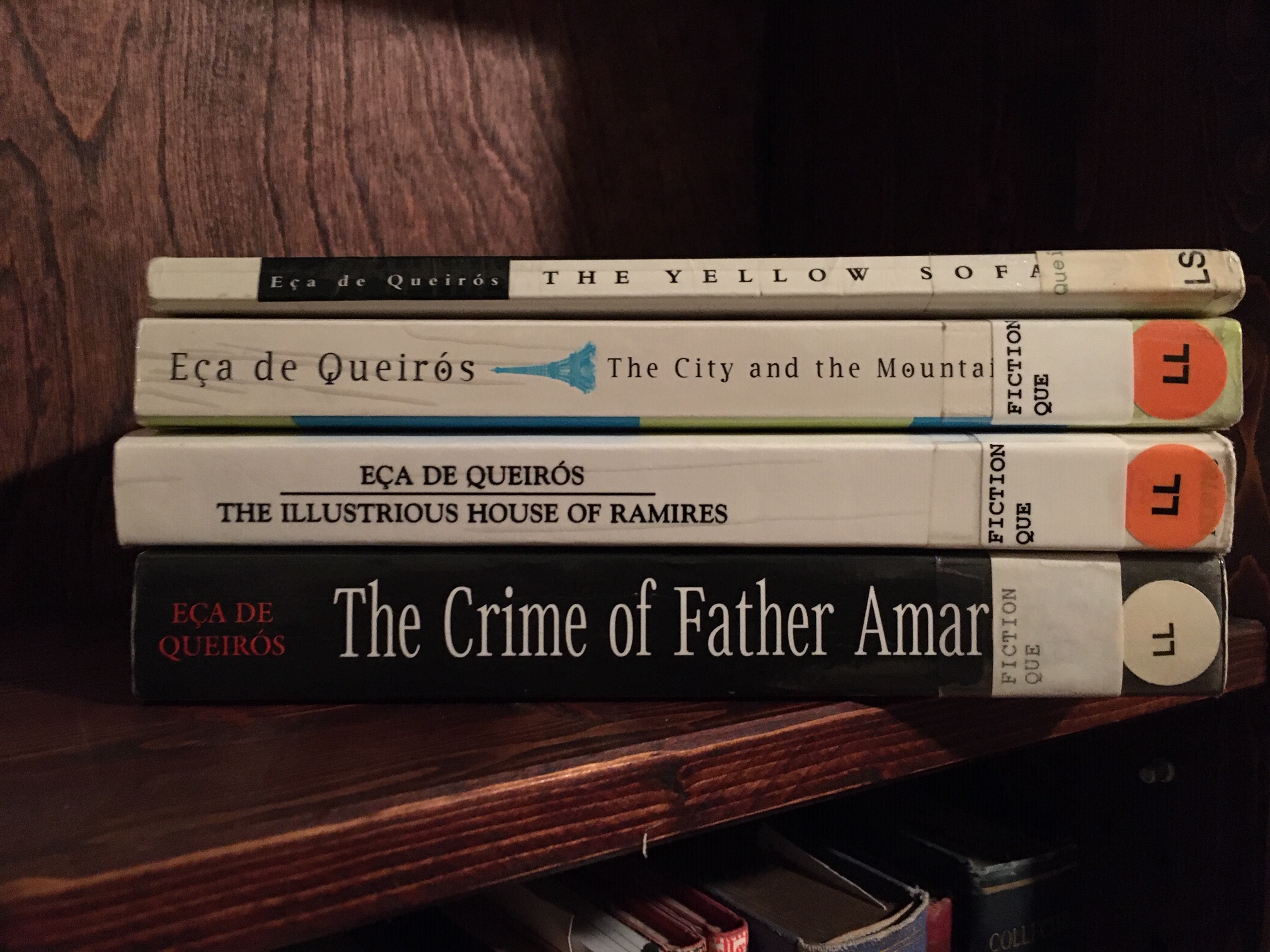

with The Maias also on the way. 

Comparisons to Flaubert seem to be de rigeur--three of the six blurbs on the back of The City and The Mountains cite Flaubert and apparently this trend goes back a while: Wikipedia tells me Zola compared Eça de Queirós with Flaubert to Flaubert's disadvantage. I have the suspicion the two I've read so far are unrepresentative, but this seems weird to me. Eça de Queirós is far funnier and much more genial than Flaubert. But if it is true, then this is his Bouvard et Pecuchet: it was unfinished at his death (though much closer to finished than Flaubert's novel) and is built around an encyclopedia of absurdities. I can't imagine Flaubert would have solved Bouvard or Pecuchet's mania by marriage, though...

If you know Eça de Queirós, which should I read next? Which should I have already read?

Saturday, September 18, 2021

August wrapup (and summer reading)

My August reading (and looking at that #20booksofsummer list, ha, ha...)

Like most blogger memes, monthly summaries turns out to be another I'm pretty sporadic about doing.

The Mystery Department

Which was Philo Vance by S. S. Van Dine this month. I recently discovered that the whole series is available at Project Gutenberg Australia. Are they legal in Canada? I dunno. But I downloaded the ones I hadn't read and then read three of them.

Philo Vance may be an idle aesthete, but he's effective in tracking down murderers.

"If you will refer to the municipal statistics of the City of New York, you will find that the number of unsolved major crimes during the four years that John F.-X. Markham was district attorney, was far smaller than under any of his predecessors' administrations." [Benson Murder Case, Introductory]

Philo Vance was the reason why. 

The Benson Murder Case (#1 in the series, 1926)

Alvin Benson was a Wall Street broker and man about town; he was shot one night at home in the forehead. Harassed actresses and jealous boyfriends make up a good collection of suspects, but as the police go through one suspect after another, Vance keeps insisting the psychology is wrong. Until it isn't.

The Scarab Murder Case (#5 in the series, 1930)

Benjamin Kyle is a philanthropist financing an expedition to excavate in Egypt. Early one morning his head is crushed by the statue of an Egyptian god and the dead hand is clutching an ancient scarab. The curse of the old gods for looting pyramids? Or a more terrestrial murderer? Howard Carter & King Tut's tomb weren't so far in the past at this point. Vance is once again mostly tasked with keeping the police from arresting the wrong person, but in this case the actual murderer is doing his best to frame somebody else, anybody else. 

The Dragon Murder Case (#7 in the series, 1933)

In an old estate on the north end of Manhattan, there's a swimming pool formed from a river. (Think Tryon Hall, now Fort Tryon Park.) Sanford Montague dives into the pool and never comes up. A few days later his body is found a couple of miles away. Murder? Or accident with a clumsy attempt to hide the outcome? Or is it the dragon of Lenape legend? 

The solution depends on the latest in technology in 1933, which was also true of 1927's The Canary Murder Case, probably my favorite in the series and an excellent locked-room murder.

However. "Philo Vance/needs a kick in the pants," wrote Ogden Nash, and it's kind of true. I enjoy the series and it's historically important, but. Willard Wright, for whom S. S. Van Dine was a pseudonym, was also an art critic while under one of his other hats, and there's far more art history than any of the mysteries require. There may be some use to discussions of Egypt's 17th dynasty in The Scarab Murder Case, but mostly you have to just like the long digressions for their own sake. I don't entirely mind them myself. But what's pretty continuously hard to take is Wright's inability to write dialog that sounds like anything an actual human being might speak.

I knew early Ellery Queen was quite influenced by Philo Vance, but what struck me in these was how much Rex Stout was paying attention, too. And it's not just that there's a butler who cooks!

In the Time of Nero

My Classics Club spin book was Henryk Sienkiewicz' Quo Vadis. That sent me off to Petronius' Satyricon and Tacitus' Annals. Thoughts were written up here.

The Poetry Department

Richard Crashaw/Selected Poems

Crashaw (1613-1649) was the son of a Puritan sympathizer, but he became a high-church Anglican and eventually a Catholic. Not a politically astute move for an Englishman in those years, Crashaw fled to France and then died in the Papal States. 

Crashaw considered George Herbert his poetic master, which shows good taste as far as I'm concerned. Very much a metaphysical, with elaborate conceits: one poem voices the tears that Mary Magdalene cried. A couple of impressive long poems devoted to Teresa of Avila.

The edition I read was selected by Michael Cayley for Fyfield Books (Carcanet Press) in 1972. He wrote a useful introduction.

H. D./Sea Garden
H. D./Hymen

These early volumes of H. D. (Hilda Doolittle, 1886-1961) are available at Project Gutenberg. I've got a couple other volumes of hers in hand. I like her handling of classical allusions, but I'm not going to say much at the moment.

G. K. Chesterton/Wine, Women, and Song

Ahem. Not very politically correct, and not just in the ways suggested by the title. (The en passant anti-Semitism was pretty hard to swallow.) Still, he's a skilled versifier and there was some amusing stuff in it:

You will find me drinking rum
Like a sailor in a slum
You will find me drinking beer like a Bavarian
You will find me drinking gin
In the lowest kind of inn
Because I am a rigid Vegetarian.

Available from Project Gutenberg. 

Richard Howard/RH 🖤   HJ

New York Review Poets volume. It draws from Howard's career as a poet of fifty years. (He's also a translator, of E. M. Cioran among others.) HJ is Henry James, and a number of the poems selected concern James in some way. I find Richard Howard very good, but I'm not sure this is the selection of his poems I would have made. Quoted from it here.

Women in Translation Month

Two by Amélie Nothomb (Thirst, Tokyo Fiancée). Thoughts here.

Dorthe Nors/Mirror, Shoulder, Signal

It's possible I'll still say more about this, but I haven't yet.

Sonja Hansen lives in Copenhagen and is the translator of (imaginary) Swedish thriller writer Gösta Svensson. She's 40 or so and wants to get a driver's license so she's a little freer to go where she wants, but she suffers from positional vertigo--if she swings her head too fast, she gets dizzy and disoriented. She thinks about doing yoga, gets massages, feels like a country mouse (she's from rural Jutland) in the big city of Copenhagen. Not much happens, but that's kind of the point.

The novel was shortlisted for the Booker International in 2017, but lost to David Grossman's A Horse Walks Into a Bar. That was also the year of Mathias Énard's Compass.

Some Other International Fiction

Jose Maria Eça de Queiroz/The Yellow Sofa

A novella by the 19th Century Portuguese realist. The merchant Godofredo da Conceiçao Alves discovers the younger partner in his firm is having an affair with his wife. What to do? A duel is just one of several possibilities. 

I thought this was very good. It's the first of his I've read, but I've now got several more from the library.

Stanislaw Lem/Fiasco

An expedition from Earth to a distant star system sets out with the idea of making contact with an alien civilization. No humans have ever been in contact with any aliens before--this is a story of first contact. The title gives away the outcome, but how it fails and why are the questions of the novel.

It would be Lem's hundredth birthday this year, leading to overviews. Lem is almost always a science-fiction writer, but he ranges from scientifically hard to fabular, from serious to uproariously funny. I liked this, though I didn't think it was his best--it took a little while to really get going. It's on the serious, more technologically-minded end of his spectrum.

Sholem Aleichem/In The Storm

Quite good, I thought. More here.

So that's a month's worth of reading for me. As for that 20 Books of Summer, as you might guess from this one month's reading, I read twenty books. But as for that list, umm...eleven, plus two I had suggested I might read. Ah, well...

The August books that are still around the house


Senhor Dorsey decided I wasn't using his service properly--probably by not using it enough--so there's a new Twitter account follow button...