Well, another year is done and that means I'm done going over the top on another European Reading Challenge. It turned out to be a very good year for traveling...by book. Here's my final list:
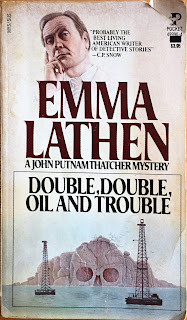
John Putnam Thatcher is a high-powered executive at Sloan Guaranty Bank on Wall Street. He's in Switzerland for other business reasons when he's called in to make a ransom payoff; Davidson Wylie, a key employee at Macklin Drilling, one of Sloan's clients, was kidnapped in Turkey by 'Black Tuesday.' Macklin will be paying, and Thatcher is asked to hand over the money to a numbered Swiss bank account.
But Wylie isn't released. What went wrong? And who is Black Tuesday? Palestinians? Eco-terrorists? (It is an oil company under attack.)
It's an important moment for Macklin: they're in the process of bidding for a North Sea oil site off the coast of Scotland; a German company is their main rival. Wylie was crucial to the bid.
Three weeks later, after some half-hearted negotiations, Wylie is released. By then the bid has been decided, and Macklin won even without Wylie's presence. Wylie is terrified and refuses to help police track down his kidnappers. He flies off to Houston (Macklin's headquarters) for some R&R, but is murdered a few days later.
There's another body--this one in London--before Thatcher solves this one. Pretty fun.
This comes out in 1978 when North Sea oil and OPEC are important issues. (That's assuming they aren't always.) But Emma Lathen isn't a writer of political thrillers, or not exactly, instead owing more to Golden Age mystery conventions, and we've met all the possible suspects by about page 40. (Emma Lathen also isn't Emma Lathen. It's a pseudonym for two high-powered professional women: one a New York lawyer; the other an economics professor.) This is the seventeenth in the series. There were seven more to come.
As it is the world of high finance and oil exploration, it moves around: Switzerland, Istanbul, Greece, Houston, New York, London, Scotland facing the North Sea. It was amusing to see Houston in the 70s, where I was for my undergraduate years. (Though this would be a little before my time.)
And all that traveling means I get to count it for:
Though the chat between the Istanbul cops was pretty entertaining, I think we'll go with that opening scene in the world of Swiss bankers...
Lives end pretty frequently for the female protagonist in Jenny Erpenbeck's The End of Days, people die around her, but those deaths also include her own. Four times she dies and we see what that death does to the people around her; four times, through the magic of fiction, she avoids her death and carries on; only the fifth, at the age of ninety does she die for good--or ill."The end of a day on which a life has ended is still far from being the end of days."
"Three prisoners are sitting in a cell and they get to talking.Why are you in prison?I was for Bukharin.What about you?I was against Bukharin.And you?I am Bukharin."
"Love is a god, my children; he is young, beautiful, and winged; and so he enjoys youth, pursues beauty, and makes souls take wing. Zeus has not so much power as he has; he rules the elements; he rules the stars; he rules his fellow gods--"
François Gérard's Daphnis and Chloe
And Eros looks out for his favorites, and that includes Daphnis and Chloe.
Daphnis and Chloe are probably better known through painting these days than through Longus' original novella, which is kind of a shame. (Though the paintings can be a lot of fun!) I found the above painting with a bunch of other Daphnis and Chloe paintings here. A nice selection, and by no means complete--it's easy to find more, including a series by Marc Chagall.
But Longus is the originator of the story. Nothing is known about him, though it's assumed he lived on Lesbos, where the story happens. He probably wrote it around 200 A.D. It's a work of great charm.
At the very beginning the narrator sees a painting:
"I saw the most beautiful sight I have ever seen, in a grove that was sacred to the Nymphs: a painting that told a story of love."
The narrator asks around, learns the story in the painting, and decides to write it down as an offering to the gods.
You can see why this appealed to painters.
We know from the start that Daphnis and Chloe are special: the slave goatherd Lamon finds Daphnis when his goat keeps running off to a thicket. Lamon investigates and discovers his goat suckling the infant Daphnis; next to Daphnis are tokens that indicate he was well-born: a purple cloak and a tiny sword. Lamon and his wife Myrtale decide to adopt the boy, but hide the signs of noble parentage. The name they give him, Daphnis, indicates a rustic origin. (And hopefully hides his true parentage.)
Two years later something very similar happens with an infant girl, except that the nurturing animal is a ewe. Her tokens are golden sandals and anklets. She's raised by Dryas and Nape (pronounced with two syllables) who give her the equally rustic name Chloe.
Flash forward to when Daphnis is fifteen and Chloe thirteen. Both adoptive fathers have a dream (which they don't communicate to each other) that their wards are meant to be out of doors herding where they will each be touched by the arrow of Eros. And so Daphnis and Chloe are trained in the arts of their respective herding specialties. And so the two of them are out in the fields with their sheep and their goats--and each other. And so...they fall in love. It's Chloe who falls first; Daphnis stumbles into a pit-trap dug for a wolf, he's fine, but muddy, and with Chloe nearby takes off his clothes to wash up in a spring.
"And that thought was the beginning of love. She didn't know what was happening to her: she was a young girl brought up in the country and hadn't even heard of anyone speak of love... 'Now I feel ill, but I don't know what my illness is; I feel pain, although I've not been injured; I feel sad, although I've lost none of my sheep; I feel hot, although I'm sitting in deep shade. How many times I've been scratched by brambles and I've not wept! How many times I've been stung by bees, and I've not cried out!'"
She's lost none of her sheep! And still!
Don't worry: Daphnis' turn comes soon enough.
Oh, there's threats to their love: Dorcon, the cowherd, falls for Chloe, tries to win her over, then win over her adoptive father, and then finally resorts to more violent means. Pirates raid the coast, stealing the livestock, but see Daphnis and decide he would be the better prize. Daphnis inadvertently starts a war between Mytilene and Methymna, the two main cities on Lesbos, and Chloe is captured and carried off. Gnathon, the hanger-on of the estate's owner, falls in lust with Daphnis and persuades that owner to give him Daphnis as his personal slave.
All resolved most satisfactorily. But you never really doubted that, did you? And that's what you wanted all along, wasn't it? 😉
Even the villains, so long as they're named--Dorcon and Gnathon and one or two others--are redeemed, in their way, in the end. Though some anonymous pirates do die.
Anyway, like I said, ridiculously charming.
There's some lit-crittery things I could possibly say, about ecphrasis, or how each of its four chapters corresponds to a season, suitable enough for an agricultural poem, or how it derives from the twin fountainheads of Theocritus and Greek new comedy (Menander, later echoed in Plautus and Terence, and then Shakespeare's Comedy of Errors), but nah...
Oh, and while I'm not perfectly sure I should admit this: but, without leaving the house. I could come up with five different translations, and only one of them I found online. I've been quoting from Christopher Gill's, which appears in Collected Ancient Greek Novels, edited by B. P. Reardon. I'd previously read the story (I'm pretty sure) in a translation by Moses Hadas in Three Greek Romances (1953). It's not bad:
"A god is Eros, my children, young and handsome and winged. Therefore does he take pleasure in youth, and he pursues beauty and he endows souls with wings. He possesses greater power than Zeus himself. He rules the elements; he rules the stars; he rules his fellow deities;..."
W. D. Lowe renders in 1908. (I have it in an Ayer reprint):
"Love, my children, is a god, youthful, handsome, winged; and so his pleasure is in youth, his chase is beauty, his task to wing man's soul. None has such power, not Zeus himself. He rules the elements, rules the stars and rules his fellow-gods..."
I rather like this, especially 'to wing man's soul'.
My older Loeb edition, with translation by Stephen Gaselee in 1916, gives:
"Love, my children, is a God, a young youth and very fair, and winged to fly. And therefore he delights in youth, follows beauty, and gives our fantasy her wings. His power's so vast that that of Jove is not so great. He governs in the elements, rules in the stars, and domineers even o'er the Gods that are his peers."
That old Loeb not only has 'young youth'--argh!--but also changes the name of Dorcon (bad enough, but accurate) to Dorco, which I'm afraid just makes me laugh. (Hey you, Dorko!) It's not completely crazy: a Roman would likely enough translate the original Greek of Dorcon to Dorco in Latin, but it *is* just a wee bit unfortunate in English...
All these would appear to be out of print, though the Loeb series has a new version of Daphnis and Chloe with a translation by Jeffrey Henderson I haven't seen.
The novella is also available at Project Gutenberg, which is probably the easiest one to come by, in a translation by Rev. Rowland Smith:
"My young friends, he is a god, young, beautiful, and ever on the wing. He rejoices, therefore, in the company of youth, he is ever in search of beauty, and adds wings to the souls of those he favours. He has power far beyond that of Jove himself. He commands the elements, and he rules the stars, and even the gods themselves, who are otherwise his equals;..."
Whew...that's a lot of Love. 😉
Looking at my Greek text (I have one of those, too...) I see I was supposed to have read about a quarter of it in Greek for a class once upon a time. Based on some penciled-in vocabulary notes, it's possible I even did my homework...
Anyway, it's 50-70 pages depending on the edition, making it too short really to be a novel, but a little long for a short story, and so...
Jacinto is born and raised in Paris, the only son of an only son of a wealthy family and Jacinto is fantastically rich. His grandfather, an ardent royalist, left Portugal when Miguel I was exiled in 1834. It's the 1890s when the novel starts and Zé Fernandes is in Paris for his studies. The two become friends, and it's Zé Fernandes who narrates Jacinto's story. "It's for this reason we named him 'the prince of Great Good Fortune.'""So this is Portugal, eh? Hm, it smells good."
In Paris, Jacinto lives alone but for his servants at No. 202, Avenue des Champs-Élysées. This appears to be an imaginary address, but if it existed, Jacinto would live right next to the Arc de Triomphe. Did I mention wealthy?
Zé Fernandes goes back to Portugal for family duties; when seven years later he returns to Paris, he renews his acquaintance with Jacinto. In the interim Jacinto has used his great wealth to acquire and enjoy all the technological marvels available in Paris in the 1890s.
Or, maybe, not enjoy them.
The Paris part of the novel, the first third or so of its nearly 300 pages, is a wonderful satire of the state of technology in the 1890s. If there's a gadget, Jacinto has to have it. There are those I could name now. This goes well beyond electric light and the telephone. Jacinto has a teletype news service in his home. There's the Théâtrophone, a dedicated phone line that connects the user to the opera or theater. But these gadgets inevitably fail, the electricity just before an entertainment Jacinto had planned. The hot water system breaks, scalds and then floods the household. A prize fish course is stuck between floors when the dumbwaiter fails. And can you imagine listening to even a comic opera singer over a telephone line of the 1890s? ("Nothing but squeaks and buzzes!")
Then even the library,...
"My friend brushed his finger lightly against the wall and a circle of electric lights, which glowed against the carved wooden ceiling, lit up the monumental ebony shelves. These were filled by over thirty thousand books--bound in white, scarlet and red, with just a few touches of gold--as stiff and erect in their pomp and authority as an assembly of learned doctors."
...fails to delight after a while. (Nooooooo!)
When the gadgets fail, Jacinto goes on to obsess over various philosophical fads: Nietzsche, Ruskin, finally pitching on Schopenhauer and pessimism. (Yes, yes, I did just reduce Nietzsche & Ruskin to fads, but that is their function in the novel.)
Something must be missing from Jacinto's life. Just what could it be? 😉
Eventually Jacinto is obliged to go to Portugal, a country he's never been to, but the source of his wealth. He will be present for the rededication of the chapel in his ancestral family home. He owns several other estates, but this one is in the remote northern mountains of Portugal in a town called Tormes. The region is primitive and poor even by the standards of Portugal of the time.
Jacinto attempts to import all his gadgets to Tormes and when he discovers the real state of the countryside decides to improve the lot of the locals: new housing, modern farming techniques, new industries. (A cheese dairy!) His estate manager Silvério and Zé Fernandes attempt to instil a little realism in him, but...
It's not giving much away to say it's marriage that removes the megrims from Jacinto's life--halfway through I was describing the plot as I'd read it thus far, and the Other Reader said, well, Jacinto is going to get married and that will solve everything.
And so it was.
I'm not one to necessarily object to predictability, especially in a marriage plot, but the second half of the novel, while still fun, is not the equal of the first. The girl has little character other than her great beauty, and there's no real tension to keep them apart. But happily ever after isn't a bad ending, and suitable enough for our 'prince of Great Good Fortune.'
Though the 'happily ever after' doesn't extend to Zé Fernandes, whose romantic interest moves to Brazil and who makes a last unhappy trip to Paris.
José Maria de Eça de Queirós was the Portuguese consul in Paris when he was writing the novel, though he traveled to Portugal more often than Jacinto. It was his last novel, almost, but not quite, completed, with most of it in proofs, at his death in 1900; the last page or so was written by a friend after his death based on notes.
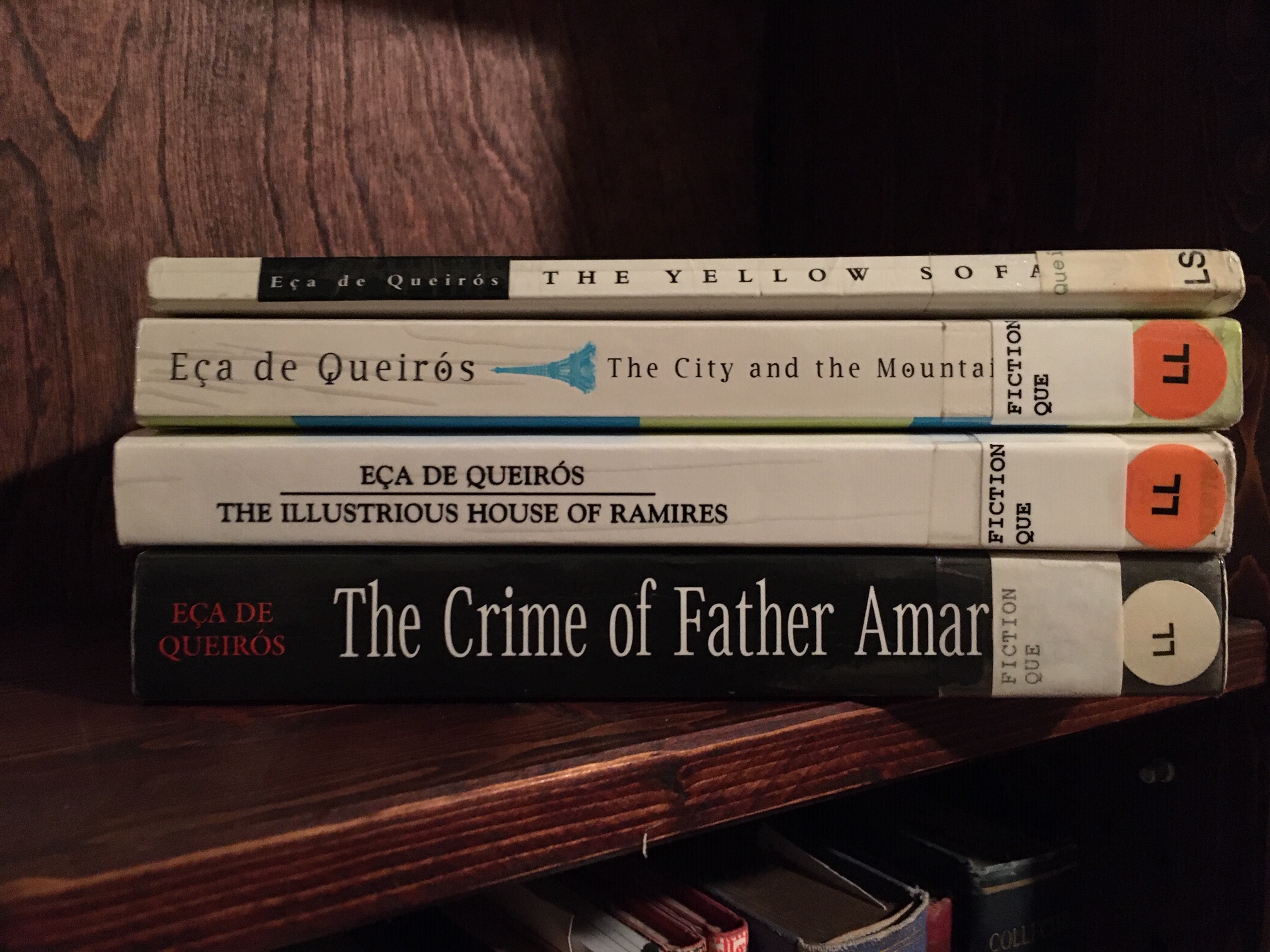
I read his novella The Yellow Sofa a couple of weeks ago and that seems to have sent me on an Eça de Queirós binge. The library assisted:
That's Pirgu talking to the narrator of Rakes of the Old Court. There are four main characters in the novel: Paşadia, Pirgu, Pantazi, and the narrator."They were talking about you today, before you came, they said you were working on a novel of manners, set in Bucharest, and I could barely keep from laughing...maybe if you wrote about Paşa, me, Panta--with anyone else you won't know what you're doing..." [70]
"I would have started conversation, if the musicians had not begun precisely that waltz for which Pantazi had a weakness, a slow, dragging waltz, voluptuous and sad, almost funereal. In its mollitious oscillation, it traced a nostalgic and endlessly somber passion,..." [5]
"Nene, when are you going to give this stuff up? When? You'll turn your brains to mush with all this bookwork." [69]
That's Pirgu to the narrator. But since it's Pirgu maybe us bookish types can treat him condescendingly as well...
Which means Lieutenant Boruvka has solved another case..."An expression of extreme sadness appeared on the lieutenant's face."
Lieutenant Boruvka is a homicide detective in Prague; the twelve stories in this volume date from the mid-60s--it's still communist Czechoslovakia. Lt. Boruvka is saddened every time a death turns out to be a homicide--it's not always clear at first--and then is further saddened when he finds the crucial clue that tells him who the killer was.
The stories themselves are quite funny.
The stories nod to golden age detective fiction (and earlier). Holmes, C. Auguste Dupin, Dr. Thorndyke are all referenced. In one of the cases, Lt. Boruvka gets the needed clue from reading Ellery Queen's The Roman Hat Mystery. (Or maybe Skvorecky got the plot element he needed from Queen?) At one point Lt. Boruvka remarks about possible suspects with the murdered man's servant:
"He and Farina are the only two men in the whole house who can be taken into account because it certainly wasn't me."The major-domo coughed. He seemed to be offended."You don't regard me as a man, sir?""But of course I do," the lieutenant hurriedly covered up. "But in any decent murder case the murderer is never one of the servants. That simply isn't done."
Paging Mr. Van Dine! (See number 11.)
There are a few recurring characters. In the office there's Sergeant Malik, officious and a bit blood-thirsty and prone to miss the obvious; there's Constable Sintak, to whom "Lieutenant Boruvka was a wizard." And the beautiful policewoman Eva with her chignon. Lt. Boruvka's wife, and especially his daughter Zuzana, are important. A vacation promised to Zuzana means that two of the cases are set in Italy, where Lt. Boruvka stumbles into a couple of murders (and Zuzana is crucial to finding the solutions.)
There's a plot arc through most of the stories in which Lt. Boruvka is attracted to Eva; in one he's arranged to meet her at the Tomcat (!) Club for dinner and drinks and who knows what, when a couple of accidents drag him into a case in which he manages to prevent a murder only by standing up Eva. Saint Sidonius features in the case in a couple of ways, giving Lt. Boruvka, who's perfectly happy with the official state atheism of Czechoslovakia at the time, a moment of wonder. And keeping him from doing something he shouldn't...
A lot of fun.
Covering the Czech Republic for this years European Reading Challenge.
That's the storm of In The Storm, Sholom Aleichem's novel set in the year 1905. Lippa Bashevitch, an uneducated wood-hauler, has been driven half-mad by events."Hearken, O ye nations! Heed, O ye peoples of the world, what my mouth will utter now. Waken from your slumbers, raise your eyes, look about you and see the darkening sky. Black clouds are gathering above, a mighty wind drives them with great speed and they cover the entire sky. Soon, soon, a storm will be breaking. Soon, soon, the thunderclouds will burst and a great storm will pelt down, not of water but of blood." [187]
"Come with me, reader, give me your hand, let us proceed--we have a long, long way to go!" [21]
"Why are we standing here? It's time to say goodbye!" [220]
Not such a long way as all that at 220 pages, but a good one.
Note: His name is usually transliterated Sholem Aleichem these days, but I spelled it Sholom throughout since that's the way it appears on the cover of my edition of In The Storm.
It's Women in Translation month! I had one unread Amélie Nothomb novel on the shelf, and I got another one from the library.
Thirst
I read the library book first. Thirst is her most recent novel in English; it came out earlier this year. The French dates from 2019, but it isn't her most recent novel in French. (Well, she keeps busy.)
Christ tells his own story, from his condemnation by Pontius Pilate until after his resurrection. He's wry and jokey about it until the pain doesn't allow that any more:
"The jailer said to me:'Try to get some sleep. You need to be in good shape tomorrow.'On seeing my ironic expression, he added:'Don't laugh. It takes good health to die. Don't say I didn't warn you.'" [17]
"As to calling her Mary, [Mary Magdalene] that's out of the question. It's never a good idea to confuse your sweetheart with your mother." [27]
He discusses, wonders almost, about the nature of religious inspiration, of mysticism:
"It's no coincidence that I chose this part of the world...I needed a land of great thirst. No other sensation more eloquently evokes what I seek to inspire than thirst. That is surely why no one has experienced it as I have.Truth to tell: what you feel when you are dying of thirst is something you must cultivate. Therein lies the mystical urge. It is not its metaphor. When you are no longer hungry, that is called satiety. When you are no longer tired, that is called rest. When you cease to suffer, that is called comfort. When you are no longer thirsty, there is no word for it....There are people who do not consider themselves mystics. They are wrong. It takes only a moment of extreme thirst to attain such a state. And the ineffable state when the parched man raises a glass of water to his lips: that is God." [34-5]
"To experience thirst, you must be alive. I lived so intensely that I died thirsting.Perhaps that is what is meant by eternal life." [90]
It's a thoughtful and interesting volume and not what I expected. (Which is generally a good thing.)
But. There was some classical Greek in the book which was wrong. Christ distinguishes between why and how in Greek and then misspells how. I'm not sure what to make of that. (I looked and saw it was also wrong in the French.) Additionally Christ says, "Christ means gentle."[40] Maybe the actual Christ is gentle, though he claims not in the context. (Rather, it's mother who is gentle.) But the word doesn't mean that. It means the anointed one.
On the other hand, while his Greek may be poor, he can quote Latin. (A language the historical Christ was less likely to know.) "Homo sum. Humani a me nihil alienum puto." "I am a man. I think nothing human is alien to me," is from Terence's Heautontimorumenos, and Christ paraphrases it twice.
Tokyo Fiancée
My first experience of any sort with Amélie Nothomb was the movie version of Tokyo Fiancée. Before that she was just a name to me, but when the movie showed up for the film festival here in Toronto in 2014, I thought, oh, I'm curious about her, let's see that one. I usually try to read the novel before seeing the movie, but I didn't and just read it now. The novel came out in French in 2007, in English in 2009.
'Amélie,' the character, lived in Japan until she was five years old. Now twenty or so, she decides to go back to Japan to get in touch with her roots, learn the language. She's going to teach French to pay her way.
"As always in my life I was the only Belgian." [25]
| Here we have Hubert arbiting some elegances |
My spin book this time was Henryk Sienkiewicz' Quo Vadis, which set off a mini-reading project.
Petronius' The Satyricon
I knew Caius Petronius was a major character in Quo Vadis, and I thought I'd reread The Satyricon in advance. It's mostly accepted (though not universally) that Petronius, author of The Satyricon, is that Caius Petronius mentioned as the Elegantiae Arbiter of Nero's court in Tacitus. (Though maybe not: it's a common enough family name in Rome.)
What we have of The Satyricon is pretty fragmentary; parts, we're told, of Books XV and XVI, amounting to 164 pages in William Arrowsmith's translation. Even the exact meaning of the title is uncertain. For a Roman (as also a bit for us) it probably suggests several things: Satyrs (and thus lechery), satire, but also satura, a Roman word meaning heap or medley. The longest continuous surviving stretch is the dinner at Trimalchio's, who is a freedman working for the Imperial court, with lots of money and little taste and maudlin when drunk. It's amusing to see the sort of thing a rich Roman would have been eating at the time. It makes turducken look like an exercise in restraint.
It's not possible to say much with certainty about the work. If the note attached to the late medieval manuscript is correct about books XV and XVI, it would be a very long work, even if there were only 16 books--and 24 would be a significant number for an ancient author. Encolpius--the (loosely speaking) hero--of the book cons his way through life, cadging free dinners where he can, and sleeping (or trying to) with anything that moves. He hangs out with grammarians, professors of rhetoric, poets, so he seems to be an educated man, but there's something criminal in his background. Also he's managed to offend the god Priapus, with an unwelcome effect on his, umm, priapic appendage, and is on a quest to get back in good with the god, and go on sleeping around. (Probably. The book is fragmentary.) It is a severe judgment of its society. I find it funny in places, but your mileage may vary: some of the jokes are pretty insider-y Roman.
I took an undergraduate class on Petronius. We read a good chunk of the book in Latin, and as well as all of it in Arrowsmith's translation. I must have read the introduction--which is quite good--but I was amused now with how engaged Arrowsmith was with Lolita. (His translation comes out in 1959.) He calls Lolita a failure--twice. I'm sure I hadn't read Lolita at the time. It's not a comparison that would have occurred to me though. The sexual abuse of children is the meeting point, I suppose, but they're not really very much alike. Rather The Satyricon's embedded poetry, commentary thereon, and comically epic plot is more Pale Fire than Lolita. (Though The Satyricon is not either of them, of course.)
Tacitus' Annals
I enjoyed The Satyricon, but in the end I don't think rereading it brought much to Quo Vadis. Sienkiewicz accepts the attribution to Caius Petronius, but it doesn't otherwise feel like it impacts. Much more useful were the Annals, Tacitus' history of Rome from the death of Augustus to the death of Nero. (A.D. 14 - A.D. 68). Moses Hadas, in his introduction, notes that "Sienkiewicz' Quo Vadis... [has] long sections which are but adaptations of Tacitus." True that, Moze.
I thought one of the best things in Quo Vadis was the portrait of Petronius. Sienkiewicz is certainly taking off from Tacitus:
"His [Petronius'] days he passed in sleep, his nights in business and pleasures of life. Indolence had raised him to fame, as energy raises others, and he was reckoned not a debauchee and spendthrift, like most who squander their substance, but a man of refined luxury. And indeed his talk and his doings, the freer they were and the more show of carelessness they exhibited, were the better liked, for their look of natural simplicity...Then falling back into vice or affecting vice, he was chosen by Nero to be on of his few intimate associates, as a critic in matters of taste, while the emperor thought nothing charming or elegant in luxury unless Petronius had expressed to him his approval of it." [Annals 16.18, tr. Church and Broadribb]
Also, the great fire of Rome during Nero's reign. (July, A.D. 64) Tacitus would have been somewhere around six years old at time, but he doesn't use his own memories of the event (assuming he had some); instead he draws on earlier histories. It's a vivid moment in the book. Tacitus doubts Nero was responsible for the fire, but notes the rumors of Nero's guilt spring up almost immediately. The persecution of the Christians after the fire--Tacitus is our earliest source for this--he attributes to Nero's need to find a scapegoat to stifle those rumors.
The other thing that struck me (though irrelevant to Quo Vadis) was how important Armenia was in Roman thinking at the time. It was an ally, practically a client state, stuck on Rome's eastern border, wedged between Rome and the Arsacid-ruled empire of Parthia (corresponding roughly to modern Iran) who were a major rival to Rome at the time. Quite a lot of energy is devoted to keeping a friendly king in Armenia.
Tacitus is a famously difficult author in Latin. The (small) amount of his Latin I read in grad school impressed me; his tricky sentences frequently end with a sharp ironic sting in their tail. He reminded me of George Eliot, though of course the lines of influence run the other way, and I'm quite sure George Eliot knew her Tacitus perfectly well. The Church and Broadribb translation is fine, but it doesn't capture what I remember of the magic of Tacitus' prose.
Henryk Sienkiewicz' Quo Vadis
And on to the main event...
The handsome soldier Marcus Vinicius meets Callina (also called Lygia) and his knees tremble such as they never did in battle; the beautiful Lygia blushes bright pink and scampers off without a word out of Marcus' presence. "Ah, ha!" says the trained literary mind. "What we have here is Romantic Comedy!"
In romantic comedy the Question is what keeps our lovers apart and what it takes to get them together again in the end. Well, in Nero's Rome, there are plenty of things to keep them apart, maybe, just possibly, too many...
Not least is the fact that Lygia is a secret Christian. Years before she had been handed over to the Romans as a hostage and guarantee of a treaty between the Lygii and the Iazyges. The Romans were a neutral party in that conflict. But Lygia's father dies in battle and her mother dies as well, so Lygia, though an official state hostage, is more or less forgotten, raised by a nice Roman couple of the senatorial class.
Lygia is dark-haired with blue eyes and is so good-looking everyone is worried when she's in a room with Nero for a couple of hours he will fall into uncontrollable lust. Ah, but Petronius has a plan for that. (I suspected, and later verified, that the Lygii inhabited what is now Poland. A little Polish boosterism on the part of our author.) What Petronius didn't take into account was that the equally good-looking Marcus would attract the eye of Poppaea, the empress. Complications ensue.
This lightness doesn't last, though. (Well, the subtitle does say it's a narrative of the time of Nero.) The great fire and the persecution of the Christians are yet to come. For the purposes of the novel Sienkiewicz always assumes of the worst of Nero. Every time when Tacitus says some historians say this and some say that, Sienkiewicz always chooses the darker that, even when Tacitus says the milder this is likely true. For instance, the fire is started at the instigation of Nero, and, according to Sienkiewicz, he really does fiddle (or at least play a lyre) while Rome burns.
If it's not already clear, I preferred the earlier, lighter part of the novel. There were even some of those insider-y Roman jokes. When Petronius says of something it involves more fish than even Apicius ate in his life, I laughed. But it helps to know Apicius was the author of a cookbook. Petronius also snarks about Lucan's skill as a poet.
Later I felt it descended a bit into religious tract. The Christians (which include Peter and Paul) are all annoyingly noble, with the partial exception of Crispus, a fire and brimstone type who gets the occasional reprimand. Saint Paul asks Petronius (and we're reminded of it a second time), "If Caesar [Nero] were a Christian, would ye not all feel safer?" I'm afraid I wouldn't, and, alas, I don't think the question was meant ironically. The torture scenes began to feel a little voyeuristic. I was also a bit alarmed by Sienkiewicz' handling of Poppaea's purported Judaism. Josephus, the Jewish historian, is the source for this, and he meant it as a compliment. It doesn't come across that way in the novel.
Still, the later part has more portraits of well-known people and more big events. Not just Peter and Paul and Petronius. Nero and Poppaea do make good villains, even if their villainy is a bit played up. Seneca and Lucan have small roles. The danger and drama do pick up.
And as for our lovers? Well, you'll just have to read it and see... (if you haven't already.)
Antonine Propaganda
There's an exhibit on currently about Nero at the British Museum. I won't get to see it, but I did read the recent New Yorker article... It reminds us it's the winners who get to write the history. Tacitus, the most balanced of the surviving historians covering the period still clearly hates the Julio-Claudian emperors (that sequence of emperors who were descended somehow from Julius Caesar. Nero was the last.) Suetonius makes no pretence of balance. Both Tacitus and Suetonius flourished under the Flavian and then even more under the Antonine emperors, dynasties that were happy to have the previous guys slandered. It's just possible Nero wasn't quite *so* bad. Augustus had Maecenas, his PR guy, and consequently got pretty good press. The rest of the Julio-Claudians not so much. It doesn't necessarily matter for a novel, but it's worth keeping in mind.
Bit of a rainy week at the Internet-Free Zone so lots of reading. But there was a moment of sun when we caught this guy catching some rays...
That's Bjartur of Summerhouses speaking, the protagonist of Halldór Laxness' Independent People, and the most independent of the lot. After eighteen years of indentured servitude, he owns his own croft and flock of sheep."The chief point and the point to which I have always directed my course, is independence. And a man is independent if the hut he lives in is his own." [65]
But it also connects to a more mythic era in Iceland's history. Bjartur composes poetry in the old style; I think it's supposed to be pretty good in Icelandic. People do actually believe in elves and trolls. The land Bjartur's house is on is supposedly cursed by Saint Columba (Columcille in Irish) who has been re-branded by the locals as the demon Kolumkilli. Bjartur sneers at this as mere superstition, but isn't entirely able himself to disbelieve.
The Fell King (a neighbor, always referred to as the Fell King, and at this time Bjartur's father-in-law) goes on after Bjartur makes his declaration:
"The love of freedom and independence has always been a characteristic of the Icelandic people. Iceland was originally colonized by freeborn chieftains who would rather live and die in isolation than serve a foreign king. They were the same sort of men as Bjartur."
Ah, Bjartur, the iconic Icelander. But then the Fell King goes on to ask his daughter Rosa, Bjartur's wife, how she likes life in the croft.
"'Oh, it's very free, of course,' she replied, and sniffed." [66]
So, the book is grim, mythic, and often laugh-out loud funny.
Rosa dies in childbirth, but the daughter survives. Bjartur names her Asta Sollilja, ('beloved sun lily') a rather exotic name. She's the beginning of a considerable amount of flower imagery.
Some years pass, and Bjartur has remarried. Now in addition to Asta Sollilja, he has three sons who have survived their infant years, Helgi, Gvendur, and Nonni. His second wife's mother also lives with them. There's some comic business with a cow--Bjartur is very much a sheep man--whom the local grandee tries to give to Bjartur. Bjartur insists on paying for the cow, though he can't really afford it. (There's also backstory here between Bjartur and the grandee.) Briefly life looks up with the cow, but then an especially bad winter comes that nearly wipes out Bjartur (and does wipe out some of the family.)
The co-op movement comes to Iceland; Bjartur remains loyal to the merchant from whom he buys goods and to whom he sells sheep. The co-op movement is much celebrated in Denmark; it's a bit more ambiguous in the novel. Eventually World War I comes and in Iceland, which remained neutral, it's suddenly boom times.
Bjartur: "Oh, let them squabble, damn them. I only hope they keep it up as long as they can. They aren't half so particular about what they eat now that they're face to face with the realities of life. They'll eat anything now. They'll buy anything from you. Prices are soaring everywhere. Soon they'll be buying muck from your middens." [374]
Not the usual view on the first World War, but not necessarily wrong for that...
Bjartur is stubborn and sure of himself. How good a man is he? He does real damage. Both his wives die young, and while the poverty is so great that high mortality is unsurprising, Bjartur bears some responsibility. "You've always been a cross-grained swine," someone tells him at some point, and it's true.
He meets with triumph and disaster, and mostly treats those two impostors just the same, but not entirely. His opinions get him and others into trouble, but if he'd stuck to his opinions (especially on debt) just a little more, he might have been better off. But it's also the case that forces outside of his control, that are too big for an independent person, dominate his life. Well, the novel did come out in two parts in the 30s. Maybe it was important to gang together to deal with tough times. The fates of Bjartur's three sons suggest the possibilities of rural Icelandic crofters at the time.
The reprint edition has an introduction by Brad Leithauser, which is interesting and informative. Leithauser met the author late in Laxness' life--Laxness was already starting to suffer from the Alzheimer's that would eventually do him in:
"When I spoke of my admiration for Bjartur, a look of perplexity gave way to one of alarm. 'Oh, but he's so stupid!' he [Laxness] objected.
'Oh, but he's so wonderfully stupid!" I replied, and the old man peered at me and pondered darkly a moment; then his features cleared and he abruptly laughed with pleasure."
That does give a good sense. But on the whole the introduction gives away too much. It's not especially a plot-driven novel, but there is one half-hidden mystery that is gradually revealed over the first third of the novel, and it's not until near the end that we fully understand what Bjartur knows. Leithauser spills the beans. Save the introduction for an afterword.
We had some friends over last night for drinks and snacks--and mosquitoes. A couple of them were knitters. I couldn't contribute much to that part of the conversation except to say that, in the last two mysteries I read, the murder weapon was a knitting needle...
Patricia Moyes/Night Ferry To Death (1985)
Chief Inspector Henry Tibbett of Scotland Yard and his wife Emmy are able to slip away for a quick vacation to the Netherlands. They see the tulips, visit friends, have a nice dinner out. The last day of their vacation, there's a robbery at one of the major diamond dealers in Amsterdam.
But that's not Henry's concern, right?
Ha. On the ferry back one of the passengers is stabbed in a sleeping cabin with a knitting needle. The body is only discovered as the ship is docking in Harwich. The sleeping cabin requires a special ticket to enter and the purser said no one went in or out all night. So there's a limited number of suspects, though that includes Henry and Emmy.
But where is the knitting needle? And where are the diamonds? (Because of course they're involved.)
There's a few more bodies along the way before Henry solves this one, and it includes another trip to the Netherlands to meet with the diamond merchant.
Pretty fun. But if I was Emmy Tibbett, I'd be terrified to go on vacation. A bunch of Patricia Moyes' mysteries begin when Henry and Emmy are traveling.
Ngaio Marsh/Swing, Brother, Swing (1949)
This one starts with an amusing epistolary section to give us the exposition: Félicité has fallen in love with Carlos, an Argentine accordion player in a swing band. Her mother disapproves. Her stepfather, the eccentric Lord Pastern and Baggott is indifferent to the potential marriage; he just wants to sit in with the band. So Félicité's cousin Carlisle is summoned in an attempt to talk some sense into her. Another cousin Edward Manx, plus various swing band members are on the scene as well. Various romance possibilities are in the offing.
Lord P&B's musical debut occurs in a club. They've planned some stage business where our lordship will shoot Carlos in the middle of his hot solo. The gun is supposed to be loaded with blanks...but you know how that goes.
Or maybe you don't, because instead of an actual bullet replacing one of the blanks, the murderer has rigged up a projectile involving a knitting needle. Lord P&B duly kills Carlos, but did he mean to? Or did some other murderer tamper with the gun?
And, as it turned out, Chief Inspector Roderick Alleyn of Scotland Yard and his wife Troy had hoped to slip away for a simple night out at a jazz club...
Alleyn, after the usual banter with Br'er Fox, his assistant, solves this. Of course. Still not sure why the gun was stuffed with a knitting needle rather than just putting a bullet back into it.
Marsh is knowledgeable about and sympathetic toward performers, and is again here, though her life was more involved with theater than music. But her attitude toward the upper classes sometimes brings out the Marxist in me, and halfway through I was half-hoping one of the aristos had done it. But you can't always get what you want...
"...this is not a building like any other, but one of those erected by God's will and for God's love; a certain time and certain men built it, and another time and other men will destroy it." [208]
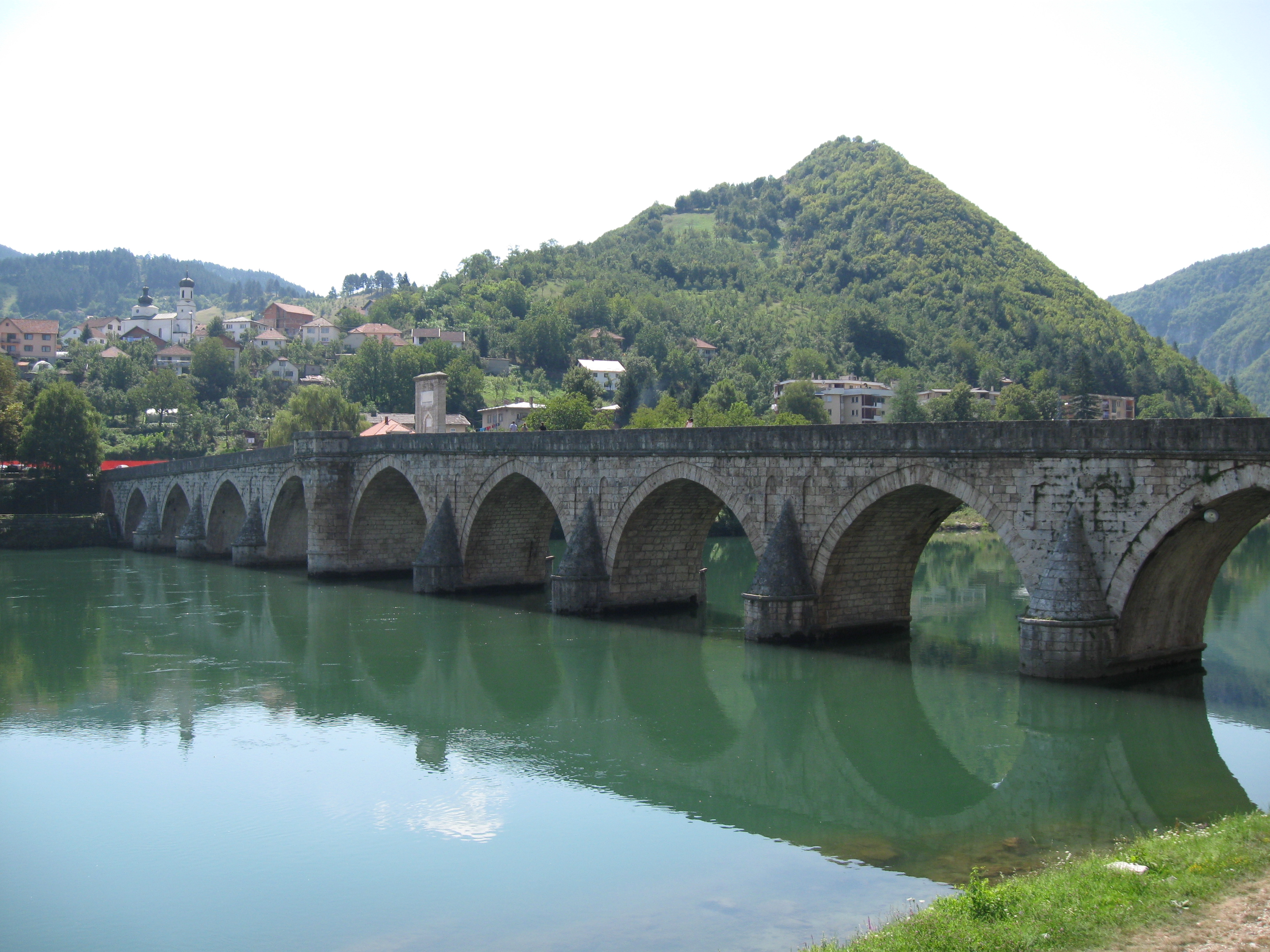
The Bridge on the Drina is a novel about the Mehmed Pasha Sokolović bridge in Višegrad, Bosnia. The novel begins with the bridge's construction, starting in 1571, and relates its history from then until 1914, at the start of the first World War. The introduction, by William H. McNeill, says that there are over 200 characters in the novel (in just over 300 pages) but suggests, and I agree, that the real protagonist of the novel is the bridge itself.
Mehmed Pasha Sokolovič, who funded the bridge, was born in the area, but was abducted as a child and forcibly converted to Islam for service under Ottoman Sultans. But he was good at it, eventually rising to become the Grand Vizier of the empire. He remembered his homeland, funded the building of the bridge, and left estates to pay for its upkeep. In the middle of the bridge there's a wide place, the kapia, with an engraved dedication, which you can sort of make out in the picture.
It's the novel that, more or less, won Andrić the Nobel Prize of 1961; they declared it an epic, but Andrić himself demurred; he said it was instead a chronicle, which is a pretty good description. But not one line per year as in the Anglo-Saxon chronicle, but one with stories. Families and roles recur: the local Orthodox priest, the town rabbi, the administrator of the bridge's trust fund.
Bosnia is of course a country with a dark and troubled history, and Andrić doesn't let you forget that, but he does allow for the possibility of good, and the bridge is its symbol:
"Even the least of the townsmen felt as if his powers were suddenly multiplied, as if some wonderful, superhuman exploit was brought within the measure of his powers and with the limits of everyday life, as if besides the well-known elements of earth, water, and sky, one more were open to him, as if by some beneficent effort each one of them could suddenly realize one of his dearest desires, that ancient dream of man--to go over the water and to be master of space." [66]
This is at the completion of the bridge, in 1577. But even to get there, a symbolic three lives were lost: Radisav, a Serbian Orthodox, tries to sabotage the construction, is caught, tortured and executed. The master mason's assistant, an Arab, dies in an industrial accident. And an unnamed gypsy child dies from eating too much halva at the party for the opening of the bridge.
The life of the town centers around the bridge and in particular, that kapia, where hawkers sell food, where the townsfolk gather to talk, where boys meet girls. One of the best stories is of Fata Avdagina:
"It has always been the case with us that at least one girl in every generation passes into legend and song because of her beauty, her qualities and her nobility." [104]
The story is alluded to in the summary on the back, though I don't think the summarist got it quite right. 😉 But according to the back cover she died from an unhappy marriage.
"For some time the townspeople talked about the incident and then began to forget it. All that remained was a song about a girl whose beauty and wisdom shone above the world as if it were immortal." [112]
The song of Fata Avdagina is sung on later occasions in the book.
Wars and floods challenge the bridge. The bridge laughs off the floods, despite the occasional dire prediction. The town doesn't always."It is now 1914, the last year in the chronicle of the bridge on the Drina." [265]
Serb artillery is able to shell the town, and the bridge is partly blown up to prevent Serb armies from advancing. Another time and other men destroyed it. The bridge was restored after World War I (and after the novel ends), but was damaged even more in World War II, only to be restored again.
Ivo Andrić himself was an interesting figure. A Catholic, which to current thinking would make him a Croat, he saw himself as a Yugoslav and, at least in his later years, disliked the divisions between the various ethnic strands in Yugoslavia and refused to identify as a Croat. Certainly the happiest moments in the novel are when the various ethnic and religious groups in the city are able to live together in peace:
"'They are as close as the priest and the hodja'; and this saying became a proverb with them." [129]
And the priest and the hodja (a Muslim cleric) were especially close at that time. I was also amused when the town rabbi was given the title Hajji (one who has performed the haj or the pilgrimage to Mecca) as a title of respect.
Ivo Andrić was born in 1892 in Sarajevo. His father died when he was two; his mother was impoverished and felt unable to raise him by herself, so he was given over to his mother's sister and her husband in Višegrad. Andrić felt these were his happiest years. He returned to Sarajevo when he got a scholarship for his studies. He was a friend of Gavrilo Princip, Franz Ferdinand's assassin, and a member of the same secret society as Princip; he seems to have known nothing about the assassination in advance, nevertheless he was arrested by the Austro-Hungarians, imprisoned first in a prison and then later house arrest before being granted clemency in 1917. After the war he earned a Ph.D. (at Graz) and joined the new kingdom of Yugoslavia's diplomatic service, serving in various posts before ending up as the ambassador to Nazi Germany just as Yugoslavia was invaded by Germany. In occupied Yugoslavia he lived in retirement, wrote three novels (including this one) which were only published at the end of the war. He held a few ceremonial posts in Tito's Yugoslavia, but mostly wrote.
And in 1961 he won the Nobel prize.
Very highly recommended. Maybe he was one of those who actually deserved the Nobel prize...
Since I was just reading about guslars recently in Kanigel's biography of Milman Parry, I was amused to see this:
"From the deep pocket of his cloak the Montenegrin drew out a gusle, a tiny primitive fiddle, clumsy and small as the palm of a man's hand, and a short bow." [33]
A second guslar shows up later as well.
I was intending a different Andrić novel for my twenty books of summer list, but this one crept in first. I might still read Omar Pasha Latas, though. It also covers Bosnia for my European reading tour this year.
That field work upended Homeric studies and indeed the study of pretty much all traditional epic poetry: The Song of Roland, The Nibelungenlied, Beowulf, etc. I'd earlier read Robert Kanigel's biography of the Indian mathematician Ramanujan, The Man Who Knew Infinity, and quite enjoyed it, and when I saw his new biography was of Milman Parry, I knew I would want to read it."In 1934 and 1935, [Milman] Parry spent fifteen months in Yugoslavia, driving his black Ford sedan from town to town with his young assistant Albert Lord. They stopped at village coffeehouses, spread word they were looking for local singers, recorded the songs they sang while strumming their rude, raspy one-string gusles."
| Hubert groovin' to some tunes |