"...this is not a building like any other, but one of those erected by God's will and for God's love; a certain time and certain men built it, and another time and other men will destroy it." [208]
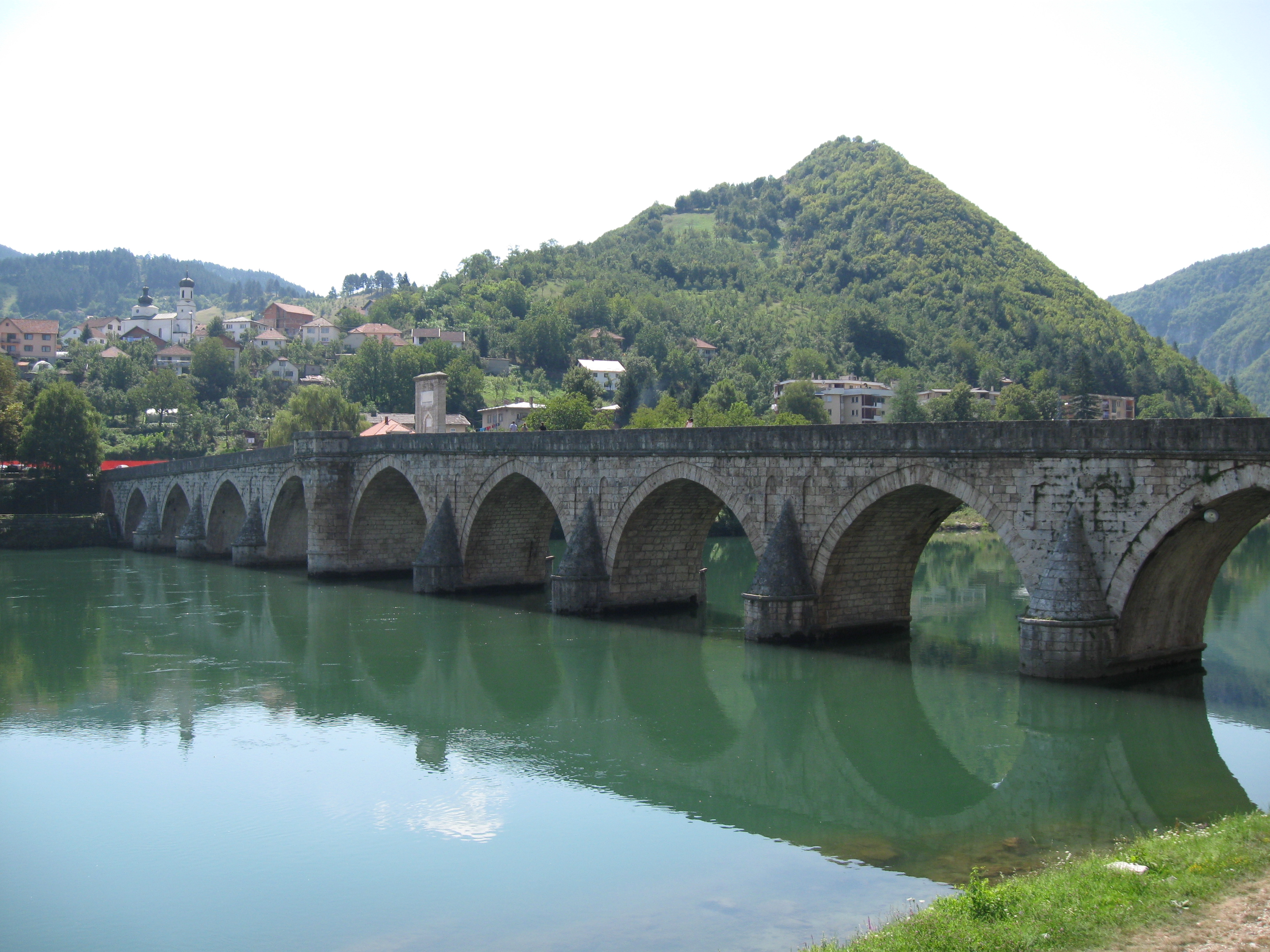
The Bridge on the Drina is a novel about the Mehmed Pasha Sokolović bridge in Višegrad, Bosnia. The novel begins with the bridge's construction, starting in 1571, and relates its history from then until 1914, at the start of the first World War. The introduction, by William H. McNeill, says that there are over 200 characters in the novel (in just over 300 pages) but suggests, and I agree, that the real protagonist of the novel is the bridge itself.
Mehmed Pasha Sokolovič, who funded the bridge, was born in the area, but was abducted as a child and forcibly converted to Islam for service under Ottoman Sultans. But he was good at it, eventually rising to become the Grand Vizier of the empire. He remembered his homeland, funded the building of the bridge, and left estates to pay for its upkeep. In the middle of the bridge there's a wide place, the kapia, with an engraved dedication, which you can sort of make out in the picture.
It's the novel that, more or less, won Andrić the Nobel Prize of 1961; they declared it an epic, but Andrić himself demurred; he said it was instead a chronicle, which is a pretty good description. But not one line per year as in the Anglo-Saxon chronicle, but one with stories. Families and roles recur: the local Orthodox priest, the town rabbi, the administrator of the bridge's trust fund.
Bosnia is of course a country with a dark and troubled history, and Andrić doesn't let you forget that, but he does allow for the possibility of good, and the bridge is its symbol:
"Even the least of the townsmen felt as if his powers were suddenly multiplied, as if some wonderful, superhuman exploit was brought within the measure of his powers and with the limits of everyday life, as if besides the well-known elements of earth, water, and sky, one more were open to him, as if by some beneficent effort each one of them could suddenly realize one of his dearest desires, that ancient dream of man--to go over the water and to be master of space." [66]
This is at the completion of the bridge, in 1577. But even to get there, a symbolic three lives were lost: Radisav, a Serbian Orthodox, tries to sabotage the construction, is caught, tortured and executed. The master mason's assistant, an Arab, dies in an industrial accident. And an unnamed gypsy child dies from eating too much halva at the party for the opening of the bridge.
The life of the town centers around the bridge and in particular, that kapia, where hawkers sell food, where the townsfolk gather to talk, where boys meet girls. One of the best stories is of Fata Avdagina:
"It has always been the case with us that at least one girl in every generation passes into legend and song because of her beauty, her qualities and her nobility." [104]
The story is alluded to in the summary on the back, though I don't think the summarist got it quite right. 😉 But according to the back cover she died from an unhappy marriage.
"For some time the townspeople talked about the incident and then began to forget it. All that remained was a song about a girl whose beauty and wisdom shone above the world as if it were immortal." [112]
The song of Fata Avdagina is sung on later occasions in the book.
Wars and floods challenge the bridge. The bridge laughs off the floods, despite the occasional dire prediction. The town doesn't always.
Wars are more problematic. The estates whose income funded the bridge maintenance were in Hungary, and when the Ottomans are forced to retreat from Hungary, that money dries up. The bridge was built with an associated caravanserai; with no money to maintain it, the caravanserai falls apart.
Višegrad is near the Serbian border, and the various rebellions and wars that led to Serbian independence in 1878 trouble Višegrad as well and the bridge, a chokepoint, is used for the control of people's movement. The kapia is converted into a bunkhouse or a customs check.
That same Treaty of Berlin that formalized Serbian independence resulted in the transfer of Bosnia to the Austro-Hungarians. Financially this marks a major step up for Višegrad, and immigrants from elsewhere in Austria-Hungary start to arrive, Ashkenazi Jews (the town's Jews before were Sephardic), Croats, Italians. New businesses are established, though this includes a whorehouse.
But the frontier with Serbia remains just as troubled. The renowned Serbian rebel Jakov crosses the bridge while Fedun, an Austro-Hungarian soldier from the Ukraine is on duty. He's detained pending his court martial, but Fedun commits suicide before that happens. "Thus the young man who had made his mistake on the kapia remained for ever in the town." [169]
The years leading up to World War I are particularly poignant and interesting. These are times of Andrić's own youth, and he captures well the discussions that must have been taking place at the time.
"It is now 1914, the last year in the chronicle of the bridge on the Drina." [265]
Serb artillery is able to shell the town, and the bridge is partly blown up to prevent Serb armies from advancing. Another time and other men destroyed it. The bridge was restored after World War I (and after the novel ends), but was damaged even more in World War II, only to be restored again.
Ivo Andrić himself was an interesting figure. A Catholic, which to current thinking would make him a Croat, he saw himself as a Yugoslav and, at least in his later years, disliked the divisions between the various ethnic strands in Yugoslavia and refused to identify as a Croat. Certainly the happiest moments in the novel are when the various ethnic and religious groups in the city are able to live together in peace:
"'They are as close as the priest and the hodja'; and this saying became a proverb with them." [129]
And the priest and the hodja (a Muslim cleric) were especially close at that time. I was also amused when the town rabbi was given the title Hajji (one who has performed the haj or the pilgrimage to Mecca) as a title of respect.
Ivo Andrić was born in 1892 in Sarajevo. His father died when he was two; his mother was impoverished and felt unable to raise him by herself, so he was given over to his mother's sister and her husband in Višegrad. Andrić felt these were his happiest years. He returned to Sarajevo when he got a scholarship for his studies. He was a friend of Gavrilo Princip, Franz Ferdinand's assassin, and a member of the same secret society as Princip; he seems to have known nothing about the assassination in advance, nevertheless he was arrested by the Austro-Hungarians, imprisoned first in a prison and then later house arrest before being granted clemency in 1917. After the war he earned a Ph.D. (at Graz) and joined the new kingdom of Yugoslavia's diplomatic service, serving in various posts before ending up as the ambassador to Nazi Germany just as Yugoslavia was invaded by Germany. In occupied Yugoslavia he lived in retirement, wrote three novels (including this one) which were only published at the end of the war. He held a few ceremonial posts in Tito's Yugoslavia, but mostly wrote.
And in 1961 he won the Nobel prize.
Very highly recommended. Maybe he was one of those who actually deserved the Nobel prize...
Since I was just reading about guslars recently in Kanigel's biography of Milman Parry, I was amused to see this:
"From the deep pocket of his cloak the Montenegrin drew out a gusle, a tiny primitive fiddle, clumsy and small as the palm of a man's hand, and a short bow." [33]
A second guslar shows up later as well.
I was intending a different Andrić novel for my twenty books of summer list, but this one crept in first. I might still read Omar Pasha Latas, though. It also covers Bosnia for my European reading tour this year.