Showing posts with label ModernLibrary100. Show all posts

Wednesday, March 15, 2023

Samuel Butler's The Way of All Flesh

"Embryo minds, like embryo bodies, pass through a number of strange metamorphoses before they adopt their final shape."

That's said of our hero, Ernest Pontifex. He's got some growing up to do.

Samuel Butler's The Way of All Flesh came out in 1903 after Butler's death; he felt the book was too critical of family and organized religion to appear during his lifetime. But it was written in the 1870s and 1880s, being finished and then set aside in 1885.

That's Samuel Butler at the side there--or is it Ernest Pontifex? They're about the same age and both grow up to be iconoclastic writers. 

The story is narrated by Edward Overton, Ernest's godfather. As you see above Overton is capable of being ironic about his godson.
"I may very likely be condemning myself, all the time I am writing this book, for I know that whether I like it or no I am portraying myself more surely than I am portraying any of the characters whom I set before the reader."
The novel is set up as a history of the Pontifex family, though, and begins with Ernest's great-grandfather John, whom Overton knew as a boy. In the next generation it's George, who becomes a publisher of religious books and makes good money doing so. George has five children, one of whom, Theobald, is Ernest's father; another is Alethea, whom Overton is in love with, but who dies young-ish, and they don't marry. Theobald becomes a minister in the Anglican church, but only because he's pressured into it by his father. Theobald reacts to this by becoming especially rigorous and self-righteous in his religious practices.

But as far as I'm concerned the novel doesn't really take off until the arrival of Ernest, about a fifth of the way in.

Ernest first appears on the scene for his baptism, which is...funny? His grandfather:

   "'Gelstrap,' he said solemnly, 'I want to go down into the cellar.'
   Then Gelstrap preceded him with a candle, and he went into the inner vault where he kept his choicest vintages.
   He passed many bins: there was 1803 Port, 1792 Imperial Tokay, 1800 Claret, 1812 Sherry, these and many others were passed...[then] a single pint bottle. This was the object of Mr. Pontifex's search.
   Gelstrap had often pondered over this bottle. It had been placed there by Mr. Pontifex about a dozen years previously...the last chance of securing even a sip of the contents was about to be removed for ever..."
But grandfather George stumbles and the bottle is smashed. George Pontifex prepares to fire his butler Gelstrap for his own clumsiness. Turns out the bottle held water from the river Jordan, saved for the baptism of the first Pontifex grandchild. The quick-witted Gelstrap sponges up the water from the cellar floor, squeezes it out into a new bottle, and this is the water with which Ernest is baptized. "Eventually it was found that half a pint was saved, and this was held to be sufficient."

Ernest gets an education: a good prep school and then Cambridge, but doesn't seem to learn much for a while. Ernest's father Theobald shoves him toward a religious career, just as George had done to Theobald. At first Ernest resists, but then gets religion. Ernest veers between Methodism, a high-church Anglicanism approaching Catholicism, but also scientific atheism. (This is the late 1850s. Wesleyanism is still an active force. But also the high-church Oxford Movement: Newman had converted to Catholicism in 1845. On yet another hand, The Origin of Species comes out in 1859.) Ernest's Aunt Alethea and Overton see other possibilities in him; Alethea moves to Cambridge to keep an eye out, but dies of a fever. But not before she wills her money in trust to Ernest, Overton administering the trust and not saying anything to Ernest, with nothing to be done until Ernest turns twenty-eight.
"...Ernest could not be expected to know this; embryos never do."
Up to this point, Butler's life isn't so different from Ernest's, but Ernest's adventures in his early twenties are melodramatic, and surprising, and I think I won't say anything else. (Spoilers!) Butler himself emigrated to New Zealand and became a sheep rancher, doing quite well at it, before returning to England. Ernest's path is a little rockier...
"He had, in fact, to burn his house down to get his roast suckling pig."
Anyway, Ernest does come round.

Did I mention Butler felt the novel couldn't be published in his lifetime, because of its disregard for Victorian pieties? I did. 😉 In case you didn't believe...

Church? 
"They would have been equally horrified at seeing the Christian religion doubted, as at seeing it practiced."
"Christianity was true in so far as it had favoured beauty."
Hmm. Not very orthodox that last one.

Family?
"Ernest could never stand being spoken to in this way by his mother, for he still believed that she loved him."
"A man first quarrels with his father about three quarters of a year before he was born."

Butler is particularly hard on familial relations, and at times I was irritated by how much he stacked the deck against Ernest's parents. Theobald and Cristina are self-righteous hypocrites. Still Butler over-generalizes a bit. I dunno: there are bad families out there. But I rather liked my parents...

Still:

"It was the system rather than the people that were at fault."

I was amused to discover via Wikipedia that the Dr. Skinner of Ernest's prep school (Roughborough in the novel; Shrewsbury School in real life) was the Dr. Benjamin Hall Kennedy of Kennedy's Latin Primer. Still at least sometimes in use, and that's my copy I've taken a photo of. The Dr. Skinner of the novel is portrayed as not very loveable...

All in all, though, a pretty great novel, I thought, even if slow to start. Overton's ironic and knowing telling keeps it moving along pretty well. "It happens that a faithful rendering of contemporary life is the very quality which gives its most permanent interest to any work of fiction,..." Sure. But a little irony doesn't hurt either.

One of the novels on that Modern Library list of the greatest English language novels of the 20th Century, and one off my Classics Club list...

Wednesday, February 1, 2023

Henry James' The Wings of the Dove (#ccspin)

"We shall never be again as we were!"

Four young people and their watchful elders, first in London, briefly in Switzerland, and for most of the last third of the book, in Venice, where there's a death.

Kate Croy, the 'handsome girl', starts us off. She's maybe 25, has £200 a year from her late mother's estate, though she gives half of that to help her widowed (and impoverished and ungrateful) elder sister with four kids. Our first scene shows her hunting up her scoundrelly father and proposing to move in with him. Her father's a bankrupt and has done something (?) that makes him unpresentable in society. Still, she prefers him to her controlling aunt. But he refuses her, because if she can squeeze money out of the rich aunt maybe some of it will drift on to Pops. Why does she not want to live with Aunt Maud? Is it because Kate's in love with somebody inappropriate? Well, yes, she is.

Merton Densher, a 'bland Hermes' according to Henry James himself in The Art of the Novel, seems like a nice enough guy. He has a respectable job as a journalist, but does not come from money, does not have money, and, then as now, as a journalist, does not have much prospect of acquiring money. But he's definitely in love with Kate, and though the coy Croy generally hides it, she's in love with him. £200 a year, even £100 a year, plus the income of a steady job, oughtn't be so difficult, but Kate wants more, and then Aunt Maud does have money. But will Aunt Maud fork over or does she have other plans? Ah, she has other plans.

Meet Lord Mark. ("...he was, oh, yes, adequately human.") Mark's a pretty minor lord, and doesn't have any money himself, but he is a Lord, and Aunt Maud has more than enough money, and Maud's determined to propel Kate (and presumably herself, by connection) into aristocratic circles. If Kate wants to live with adult protection, and not in her sister's Chelsea hovel. she's going to have to entertain and encourage any overtures Lord Mark might make.

(I've been to Chelsea. Not hovels no more.) It is amusing that Chelsea means hovels to the Londoner Kate, but for our next character, the American, it means Carlyle. (Well, I'm an American, of sorts, too.)

Introduce into this circle Milly Theale, in her early 20s, an American orphan from New York, rich beyond any European's furthest imaginings. She's traveling about Europe (Switzerland at first) with her older companion, Susan Stringham, a writer from Burlington, Vermont, 'which she boldly upheld as the real heart of New England, Boston being "too far south"'. We learn almost right away that Milly had been sick in the States before she started traveling, and it's not giving too much away--it's the one thing I was sure of before I read the novel--that it's her death (in Venice) that provides the climax.

(Boston is not too far south to be the heart of New England.)

Milly decides to go to London where Susan's old school friend Maud lives.

In Lord Mark's family estates there's a Bronzino portrait of a young woman, whom everyone says looks exactly like Milly Theale. And maybe the woman looks rather ill? Anyway, Milly has a fainting fit when she sees the portrait. The internets agree the portrait James intends is that of Lucrezia Panciatichi, so you can imagine that's our American heroine above on the left. 

Sir Luke Strett, a noted London doctor and surgeon, shows up to look after Milly, though everyone pretends he's just a great friend.

You can see the outlines of a plot taking shape and I don't want to give away too much; as I said, I didn't know how it would go exactly myself--I have not (yet) seen any movie version--and while this is one of those novels much discussed--it's a major example in Sontag's Illness as Metaphor--it may be possible to come to it naively, as original readers did. And as I mostly did. There is suspense, surprising perhaps... 😉 in late James, and I'll leave it there. Though I can say, as a good friend of mine frequently does, it's all about the money. Well, almost all.

It is late James, and I have occasionally snarked about that prose style before. Here's an example from around halfway through the novel. Merton Densher is back in London; he's been away in New York, working, where he had met Milly. (From Book VI, Chapter 5, near the beginning)
"She [Milly] had been interesting enough without them [Kate and Aunt Maud]--that appeared to-day to come back to him; and, admirable and beautiful as was the charitable zeal of the two ladies, it might easily have nipped in the bud the germs of a friendship inevitably limited but still perfectly open to him."
This is Merton thinking, but yet it isn't Merton. We'll set aside that nobody thinks in such rounded phrases because everybody does that in James. One of those 'two ladies' is Kate, with whom Merton is more or less secretly engaged. Would he think of her as just one of 'two ladies'? And 'admirable and beautiful' and 'full of charitable zeal', Aunt Maud is not, and Merton knows it perfectly well, since she's the reason he and Kate are keeping their engagement secret. As well as the fact that Aunt Maud's zeal is about pimping Milly on the social circuit for societal advantage. (We'll come to have our doubts about Kate, too.) As for that 'friendship inevitably limited but still perfectly open', well, it's limited by that secret engagement, but Milly's already half in love with Merton (though it's not clear how well Merton understands that at this point) and 'friendship' and 'perfectly open' mean very different things to Milly and to Merton. 

So James is ironically complicating our relationship with the characters in ways we have to work out to get there, while at the same time sounding like 'Everything is Awesome.' (Cue that Lego movie song here...)

It must be said that James knows:
"'Then what,' he demanded, frankly mystified now, "are we talking about?"
That's Merton Densher. 

I don't know if Thom Gunn was thinking of The Wings of the Dove when he wrote this couplet/quip, but he very well could have been. (Though it would apply to other late books as well.)

Jamesian

Their relationship consisted
In discussing if it existed.

It also struck me how close in theme this was to The Ambassadors, James' novel of the next year (1903). It's Lambert Strether from that novel who advises, "Live all you can, it's a mistake not to," a statement also deeply ironic. It could have fit into this one. Sir Luke Strett to Milly:

"My dear young lady, isn't 'to live' exactly what I'm trying to persuade you to do?"

I reread Susan Sontag's Illness as Metaphor now that I've read The Wings of the Dove, (well, the Sontag at least is short) and I do think she's a little hard on James, whose irony complicates everything, but, of course, Sontag's basic point is correct: a will to live might help Milly, but what she really needs is antibiotics, and putting too much emphasis on her will feels like blaming the victim. (Way oversimplifying Sontag here.)


I'll leave you with a picture of the Palazzo Barbaro in Venice, which becomes the Palazzo Leporelli in the novel, rented by Milly as her (modest) domicile when she was there. I understand it's used as the set for scenes in the movie version with Helena Bonham Carter. James used a writing desk still there to compose The Aspern Papers.

It was my spin book. (I somehow had it in my head the spin ran to the 31st. Oh, well.) It is late James, with all the noodliness that implies, but I quite liked it, after having dreaded it a bit, and I think it's replaced The Ambassadors as my favorite of that period. 

If you've read it, what did you think? Are our couple actually redeemed? What, in fact, do you think was their final decision? (Because, of course, it ends without entirely telling you, as I, too, am now doing...)

Wednesday, December 28, 2022

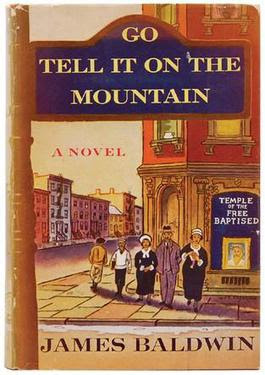
James Baldwin's Go Tell It On The Mountain

"But don't you think that the Lord can change a person's heart?" [174]

That's kind of the question in this, James Baldwin's debut novel of 1953. 

The novel starts on John Grimes' fourteenth birthday, a Saturday in March, 1935, and ends the next day. John is the oldest of four children of Gabriel and Elizabeth Grimes. They're a poor family in Harlem; Gabriel works as a day labourer, but he's a deacon and occasionally preaches at a revivalist church, Temple of the Fire Baptized. 

The novel is divided into three sections: 'The Seventh Day', 'The Prayers of the Saints', and 'The Threshing Floor'. The first ('The Seventh Day') shows us the family as a not very functional unit. John is the good boy, well, pretty good, but Roy, his younger brother, is his father's favourite. This may be because Gabriel is only John's step-father; he was born out of wedlock to Elizabeth and another man, dead by the start of the novel. But it may also be because Gabriel and Roy are similar, angry and intolerant. That same day, John's birthday, that he wanders around with a little money given him by his mother and then into a movie, Roy crosses town with friends to get into a gang fight with white boys and comes home cut with a knife. Florence, Gabriel's older sister, tells Gabriel it's his own fault Roy is who he is; Gabriel somehow casts blame on John for this, and then strikes Elizabeth; Roy curses his father. 

'The Prayers of the Saints': That night John goes to the church, to help clean the building. Neither his father, nor John's older friend Elisha, consider John saved, nor is John himself quite sure what he thinks about religion. After cleaning the church, with a few members arriving for service, he falls to the floor in a frenzy:     

    "'Rise up, rise up, Brother Johnny, and talk about the Lord's deliverance.'
    It was Elisha who had spoken; he stood just above John, smiling; and behind him were the saints...
    He tried to speak, and could not, for the joy that rang in him this morning." [199]

John spends the night on the floor, managing only a few words. The saints are the members of the church in good standing; they stand around John, praying, in honour of this new manifestation of the Lord's power. Three of those saints are his step-father Gabriel, his mother Elizabeth, and his aunt Florence, and we hear each of their prayers. 

None of them are entirely concentrating on prayer, though, and while they're meditating we learn the backstory that brought them to this point. Florence's resentment that Gabriel, the boy, received her mother's love even though Florence was the good one, and Gabriel showed no signs of spirituality as a twenty-year-old, catting and fighting as Roy does in the present. We learn about Gabriel's conversion, which does nothing for his anger and lack of love. We also learn about his own hypocrisy. Last of the praying saints is Elizabeth, still guilt-ridden over the episode that produced John, and how her subsequent hopes in Gabriel's faith were shattered.

We knew from the first chapter, none of them were saints in the usual sense of the word. Does our understanding make any of them more saintly? I don't really think so, but do learn they are more sinned against than sinning. (Though Gabriel is the hardest to forgive.)

In 'The Threshing Floor' we return to the present. On the threshing floor, Jesus separates the saved wheat from the damned chaff. Did John's conversion experience change anything? In some ways clearly not, but I don't think we're meant to have a clear answer. The question I started with up above is asked by Elizabeth, of Gabriel, to her sister-in-law, Florence. Florence's answer:

"I done heard it said often enough, but I got yet to see it." [174]

Though Florence gives that answer before John's conversion experience, and maybe hers is not a reliable voice anyway.

Poking around at what critical commentary I could easily find, it seems that readers are divided as well. The novel is clearly autobiographical (well, it is Baldwin's first) and Baldwin later lost his own faith. But I don't think it's quite fair to read back from Baldwin's subsequent story to divine what this one means, and I do think John's conversion is meant to be read as sincere. To be sure, there are psychological considerations--John wants to win over his step-father; he hadn't known his birth father, who died before he was born--but the language (very biblical) feels sincere to me:

"Then John saw the Lord--for a moment only; and the darkness, for a moment only, was filled with a light he could not bear. Then, in a moment, he was set free;..." [197]

Will that moment last? For the real James Baldwin it didn't, but for John Grimes, at least as long as the novel runs, it's a different story. 

I like the cover I've shown above, but that's the first edition, and alas I don't have that. I read it in James Baldwin's Early Novels and Stories, edited by Toni Morrison, from the Library of America, and the page numbers refer to that edition.

I found it a pretty great novel, it's on that Modern Library list of 20th Century novels, I'd put it on my Classics Club list, and it finishes off the Back to the Classics challenge for me for the year.


Tuesday, September 20, 2022

Short Reviews: von Doderer, Faulkner, Scholem

Three complicated chunksters all of which I started long posts for. Those posts didn't get finished. (Oh, well.) Time to clear the decks.


Heimito von Doderer's The Strudlhof Steps (850 pages)

This is a fairly new release from New York Review Books, and Vincent Kling won the most recent Wolff Prize for translation from the German for it. The novel came out in 1951 in German, and hasn't previously appeared in an English translation.

The main events take place just before and just after World War I in Vienna. I'm a sucker for the place and time. And, hey, it's shorter than The Man Without Qualities; as a bonus, von Doderer finished it, too. Four sections, each coming to a dramatic climax--who gets married, who gets dumped, who gets a leg cut off by a tram--generally on or near the Strudlhof Steps:


Lt. Melzer features in the subtitle. He likes to drink Turkish coffee on the skin of a bear he shot in Bosnia in 1912; watched his commanding officer (whom he likes) die on the Italian front in World War I; seems almost unmarriageable, but is he?

René von Stengeler is born into a wealthy Protestant family, captured by the Russians in 1916, only making it back to Vienna after the war is over. Does he marry Grete, back from Oslo where she escaped the misery of post-war Vienna by teaching piano? And why does René's sister commit suicide? Because we know she did from the first few pages.

The novel requires tolerance, but pays back. It moves back and forth in time, at first seemingly arbitrarily. You have to accept its terms, and give it space to get started. Characters have last names or first names but not necessarily both, and sometimes merely initials. For example, we never learn Lt. Melzer's (a major character) first name: on page 823, "Sorry, but we don't know Melzer's first name." The narrative voice has a curious diffidence.

Von Doderer's politics were not particularly admirable. He joined the Nazis in the mid-30s, when the party was illegal in Austria. The afterword, by Daniel Kehlmann, says he was quite anti-Semitic at that time. He later turned against the party, but never publicly, and as a WWI veteran, he was drafted into the Wehrmacht, serving in garrison duty, first in Norway, later in France, where he started writing this novel. The publication of the novel was delayed while von Doderer was de-Nazified. René von Stengeler is clearly a self-portrait, and deliberately not a flattering one. What did he think by 1950? I don't know. There are minor Jewish characters in this, and they're treated with real sympathy.

Anyway, I thought it was very good.

William Faulkner's Light in August (480 pages)

I had heard that Light in August was a murder story, the story of Joe Christmas, and, well, it is. Christmas (named for the day his infant form was dropped off at the orphanage) murders his lover. Christmas may have black blood--he doesn't know and we don't know either, but he thinks he does, and though he could pass for white, once he's accused of having a drop of black blood (by his own grandfather, no less) he assumes he does.

But Christmas' story is not the whole of the novel by any means. It's the portrait of a town called Jefferson, and not just the evils of racism, but also the ways racism distorts the life of the town. Nowadays we don't really have any problem contemplating that Jefferson the man may have been a bit racist, but the novel came out in 1932. There's a daring irony to that. Was Faulkner in his heart of hearts free of racism? Certainly not, and I doubt he would say he was. But he knew that problem for a problem, and that counts for something. Percy Grimm, the white captain of the National Guard, is a particularly (dare I say it?) grim portrait of a racist.

And am I the only one who doubted Christmas committed the murder? No, because the Wikipedia article says it's unclear who did it. I don't think that's actually sustainable, and that Christmas really did do it, but I did wonder during the middle of the novel. But maybe that's attributable to too many years of reading mysteries: the obvious suspect is never the culprit.

The town's a mess, and there's nothing to do but escape, but almost nobody does; the only ones who do are Lena Grove and Byron Bunch, running off in a folie à deux: she's looking for the man who got her pregnant and who will never marry her, and Byron's hoping she'll settle for him instead, and meanwhile he'll be there when she (which she won't) changes her mind.

One other thing to be said about this is that, of the great Faulkner novels, I thought this was the easiest read. And that's definitely something... 😉 It's easier than The Sound and the Fury, As I Lay Dying, and Absalom, Absalom. No chapters from the POV of dead people or madmen. Not the greatest of that quartet, I'd say, which for my money is Absalom, Absalom, but a better starting point. (Though if you include Sanctuary in your list of top Faulkner, I would say that one's a pretty straightforward read.)

Yeah, a classic.

Gershom Scholem's Sabbatai Sevi (929 pages, plus bibliography, notes and index)

Sabbatai Sevi (1626? - 1676) declared himself the Jewish messiah in 1665. (He may have intimated it as early as 1648 but only in limited circles.) Gershom Scholem, Jewish historian and friend of Walter Benjamin, made Sevi the subject of a major book.

Sevi (there should be a dot under the S which I can't figure out how to type, but think Tsevi or Zevi) was born in Smyrna to a middle-class merchant family, studied the Kabbala in Jerusalem, traveled on religious business to the Jewish community in Egypt and later to Constantinople. All lands under the control of the Ottomans at the time. When he began his mission in earnest, Nathan of Gaza was his prophet and explicated the theology of the new movement. Scholem, as a historian of Jewish mysticism, is rather more taken with Nathan than Sevi.

But the stories of Sevi and Nathan are just a small part of this fascinating book. What's surprising is the Europe-wide discussion of these figures, and not just in the Jewish community. Italy, Amsterdam, Morocco, Poland, Hamburg, Egypt are all discussing this new Messiah. English chiliastic Protestants write books about Sevi, who, they think, will lead 10000 Jews from the Lost Tribes across the River Sambatyon, armed with bows and arrows but still invincible. (The River Sambatyon doesn't actually exist, which is why you haven't heard of it.) Samuel Pepys writes about Sevi in his diary! Along with all the women he was shagging. He features in Venetian ambassador's reports and Jesuit Relations. One can imagine Blaise Pascal, roughly contemporary, being discussed across Europe, but it turns out not all Europe-wide discussions were so scientific.

Sevi himself always advocated a peaceful movement. Faith and the perfection of the self would lead to the kingdom of God. There were no armies in his vision.

In fact, I found the reception of Sabbatai Sevi to be more interesting than the biography of Sevi himself. Scholem is inclined to attribute Sevi's messianic proclamations to mental illness, labeling him a manic-depressive. Maybe. But diagnosing mental illness in the present is difficult enough--DSM-III, DSM-IV, DSM-V have different labels, and so will DSM-XCIII--diagnosing it in figures in the past in inherently suspect.

Why could a Messianic movement take root then? Scholem finds the main factor to be the diffusion of Kabbalistic thinking going back to Isaac Luria (1534-1572). But also the Jewish massacres by Khmelnitsky in Poland and the Ukraine take place in 1648. As for the interest in Christian circles, there was a feeling that 1666 should be an important year: the number of the beast plus 1000.

Once in Constantinople, Sevi was arrested by the Ottomans. They were relatively tolerant of Judaism, but weren't prepared to tolerate a figure who was going to lead an army of invincible Jews and put the crown of the world on his head. (If, in fact, Sevi intended these things. Probably not.) He seems to have impressed the vizier and then later the sultan, but still in September of 1666, he was told to convert to Islam or die. Sevi converted. 

Surprisingly this wasn't the end of the movement. A number of Sevi's followers also converted over the years. Sevi was ordered to leave Constantinople, first to Edirne, which was at times the Ottoman capital, then later to Albania. Sevi led his converts, the Dönmeh, also referred to as the Ma'min, or the Faithful, in a new syncretistic religious community influenced both by Judaism and Islam, particularly that of the mystical Sufi orders. Scholem's book ends in 1676, when Sevi dies, but the community survived, centred in Salonica until the Greek-Turkish population transfers of 1922. The Dönmeh were often thought to be hidden Jews, but they were Muslim enough for the time, so they had to go. The story of the Dönmeh would be fascinating, and Scholem had intended to write a book, but didn't live to do so. They do feature in Mark Mazower's book (recommended!) on Salonica, though.

I read the second edition of the book, which came out in 1973, translated by R. J. Zwi Werblowsky. Scholem says in the introduction that he had access to more material by then, and that it superseded the earlier edition.

And why did I read this book now? Well. Did I really need to read one nine-hundred page book about a failed Jewish messiah in order to prepare for another nine-hundred page book about a failed Jewish messiah? Oh, probably not, but that's what I did:


These were all August reads for me, and it's been a while now. Still I wanted to review these because they knock off a couple of challenge items. Light in August was on my original Classics Club list and works for this year's Back to the Classics challenge.


And the other two count for this year's European Reading Challenge:


The Strudlhof Steps is clearly an Austrian book, though it does have scenes in Norway and Switzerland. Sabbatai Sevi spent most of his life in what is now Turkey, but I've already done Turkey this year. Sabbatai Sevi the book ranges across Europe. Still we'll stick Sevi himself, who spent the last eight years of his life in Ulcinje, which was in the Ottoman province of Albania at the time, but is now in Montenegro.

Short reviews, did I say? Well, short-ish...


Sunday, September 27, 2020

John O'Hara's Appointment in Samarra


Somebody's due for a great fall, and Humpty is just glad it isn't him...


In the epigraph to his debut novel Appointment in Samarra, John O'Hara quotes Somerset Maugham's version of an old story involving Death. Death runs into a servant in the morning market at Baghdad; the servant recognizes Death, and begs assistance of his master to flee as far he can, and his master gives him money and a horse. When Death is asked that afternoon, Why did you frighten the servant if you didn't mean to take him? Death answers, I didn't intend to frighten him. I was just surprised to see him in Baghdad, since he and I have an appointment in Samarra tonight. (127 km according to Google Maps.)

An appointment in Samarra. So you suspect from the start it's not going to end well for somebody, and it doesn't. 

Based on the epigraph, this is not very, but a bit, spoilerish...

That somebody is Julian English. 

The story takes place in Gibbsville, Pennsylvania, a stand-in for John O'Hara's hometown of Pottsville. (Anthracite coal country northwest of Philadelphia.) Julian is the son of the local society doctor, and ought to be well enough off, but his car dealership's sales are a little soft. It's Christmas, Hoover's the president, and the Great Depression has started. He's married to Caroline, whom he's known since they were children, and it seems a good marriage; certainly she's in love with him, though she can see his flaws.

What are those flaws? The root of them is the excess consumption of alcohol. 

Too much alcohol--or is it something more fundamental?--leads Julian to do three bad things during the course of the novel. He throws a drink in Harry Reilly's face; he has a sexual rendezvous with Helene Holman; he gets into a fistfight with Froggy Ogden. He owes Reilly money and is worried Reilly may sleeping with his wife; Holman, a local torch singer, is the mistress of the town's gangster/bootlegger; Ogden is a vet who lost one arm in the Great War and can hardly fight back. In the end? Julian has that appointment in Samarra.

The novel was famous for its scandalousness when it came out. Husbands and wives have sex, and sometimes enjoy it, even the wives. Well, that may have been news in fiction in 1934, but less so now.

There's a self-destructive streak in Julian that's not explained. Is Julian's alcoholism cause or result of that self-destructive streak? I'm not certain, and not certain that we're meant to know. But while Julian is the main focus, the novel doesn't limit itself to him; it's a short novel (225 pages in my edition) and yet it presents a substantial cross-section of Gibbsville society. Which is both impressive and also good: I found Julian's company a bit of a cross to bear.

So I'm not entirely sure what I thought. Self-destructive alcoholics are hard to take, in fiction as in life. Comparing this to Malcolm Lowry's Under The Volcano, I'd say Geoffrey Firmin is the more convincing drunk. Firmin is further along the road to dissolution than Julian; Firmin's state of confused mind is presented in more convincing detail; everything Julian does seems contingent, it seems like he could as easily have done something else, so why did he have to die? We see occasional hints of engagement with the world in Geoffrey Firmin, of the man he once was, but his thoughts in the present mostly revolve around how to find that next drink. Firmin's story had the inevitability of tragedy; Julian's was more like an accident.

The other curious comparison is to Updike. The edition I got from the library has an introduction by Charles McGrath, who is at pains to tell us that Updike valued O'Hara very highly. In an introduction this is supposed to make you more enthused to read the coming book than you were before, but I'm afraid the fact that Updike (the 'penis with a thesaurus'*) liked it had the opposite effect on me. I still liked the O'Hara, though, despite that... 😉  and not just because the prose was un-Updikean. But it's clear that Updike had read this novel: at one point Julian thinks about escaping his situation, hops in a car and drives off only to return to town. Was that Julian English or Rabbit Angstrom? Rabbit, too, is a unsuccessful salesman, living in a smallish Pennsylvania town, who decides he can't take it any more and drives off only to return. Rabbit drives further than Julian, but otherwise... 

The novel is on that hundred-best list of Modern Library 20th century novels, problematic as that list was. I'm glad to have read it, even if I'm not entirely convinced by Julian English at the center of it. DolceBelezza and WutheringExpectations were or are also currently reading it. 


*David Foster Wallace is responsible for labeling Updike the 'penis with a thesaurus.' It comes from his review of one of Updike's lesser novels Towards the End of Time, and he attributes the comment to an unnamed female reader of literary fiction under the age of 40. If she exists, she's become very famous, anonymously. Perhaps it's not entirely deserved, but I know I'm not the only one who can't now think of Updike without thinking of that characterization.

Sunday, July 28, 2019

Under the Volcano

Under The Volcano is--famously--a novel about a drunk. It's often taken as a simple roman á clef about Malcolm Lowry's life, and Lowry was a drunk, and so...maybe it's little more than autobiography, a sort of addiction memoir, of the sort we see all the time.

I've set up that straw man to push back at it: not to push back against Lowry being a drunk; I don't know, but the evidence seems strong; but rather against it being simple, against it being a roman á clef, against it being unmediated portrait of the day-to-day existence of Malcolm Lowry.

The story goes something like this: Geoffrey Firmin, the (ex-)British consul in the Mexican town of Quauhnahuac, is drinking himself to death. The majority of the novel takes place on the Day of the Dead, November 2nd, 1938, though the first chapter takes place a year later and in it, we learn that Firmin is dead. In the second chapter, Firmin wakes up hungover after a party the night before, and he's in search of (and in need of) the hair of (some, many) dogs. His half-brother Hugh is due back that same day; Geoffrey Firmin's ex-wife Yvonne, estranged because of his excessive drinking, also arrives, unexpectedly, with the idea that maybe things can still be patched up. How he gets through that day (and then doesn't) is the story.

Yvonne seems serious in her wish to patch up things with Geoffrey, but she's also clearly attracted to Geoffrey's younger half-brother. She and Hugh may have had an affair in the past. She's certainly had an affair with Laruelle, Geoffrey's best friend, a French filmmaker, but that occurs only after she's given up on Geoffrey because of his drinking.

Not a lot happens that day. Hugh and Yvonne go horseback riding. The main trio run into Laruelle. Early that evening Geoffrey, Hugh, and Yvonne go to a bull-riding event that's a bust because the bull doesn't buck enough. And then Geoffrey's final end. That's pretty much it. Most of the pages of the novel are devoted to unwinding how we got here.

One thing that's not resolved is why Geoffrey's a drunk. It's sometimes implied that Geoffrey's a drunk because Yvonne has had an affair, maybe more than one, but we learn Geoffrey was a drunk before that; maybe he's a drunk because of the trauma he went through as a naval officer in World War I, but we know he was drinking earlier; maybe it's due to the complications of his Anglo-Indian childhood and orphanhood? But he had opportunities after that; he developed a close relationship with his foster father. Geoffrey writes, and is working on a book--contributing to that feeling of a roman á clef--and could it be the stress of a creative career that sends him to the bottle? Well, in the end, we're not told, and it sort of doesn't matter: by the time of main events, Geoffrey Firmin is already a lost person.

It's the unwinding, the revelation of the backstory, I found fairly sophisticated and interesting. It's where the drama in the book is. The chapters are generally from the point of view of one character, largely rotating among those main three: Geoffrey, Hugh, and Yvonne. At some point in each chapter, the character enters into fugue state, half remembrance, half fantasy. So, during the boring part of the bull-riding, Yvonne's mind drifts off and we learn about her acting career, a successful enough star of second-tier Westerns as a teenager, a withdrawal from Hollywood, then ending with a hope and dream of returning that doesn't pan out. Elsewhere she also dreams of leaving Mexico with Geoffrey and going to Canada with him sober and working on his book.

In other chapters we learn about Hugh's career as a reporter, and his dream of being the hero of the saved Spanish Republic, just as (in 1938) Franco's forces are about to win conclusively.

But it's Geoffrey's memories and fantasies that are the most problematic, the most confused. And this, very subtly, is how we learn that Geoffrey really is lost. In person, people like him: Yvonne wants to reconcile; he has friends still, despite his compulsive drinking, who care about him; they think him capable of reform. But in his fantasy life, his thoughts are substantially past-directed; few of his thoughts touch upon that work he might write, and those confused; a few upon the renewed life he might build with Yvonne; but mostly they revolve around where that next drink is coming from. Hopes and fantasies may be unrealistic, but without them you're dead.

It's a bleak novel to be sure. But there's hope in it, too, just not much for Geoffrey Firmin.

The good news is Malcolm Lowry was at least partly Hugh, and not entirely Geoffrey: he was Hugh's age, not Geoffrey's; he did escape to Canada with the woman he loved; he doesn't seem to have ever escaped his alcohol problem, but he did write a novel that shows up on the Modern Library list of great 20th Century novels as well as other lists of great novels.

The edition I read is shown above and has an introduction by Stephen Spender. I thought Spender's essay was pretty good--he compares and contrasts Under the Volcano with works of high modernism like Ulysses or The Waste Land, which this book both is and isn't--but it should have been an afterword. He gives too much away. We know from almost the start that Geoffrey Firmin dies, but there's a bit of a mystery about the details, and those should have been left mysterious. If you read this edition, save his introduction until after.

Anyway, this one does multiple duty for me: it's on my Classics Club list, my #20BooksOfSummer list, my Back to the Classics list, and counts for my Canadian Book Challenge. Whew!


Thursday, July 5, 2018

Lawrence Durrell's Clea

"What is the writer's struggle except a struggle to use a medium as precisely as possible, but knowing fully its basic imprecision? A hopeless task but none the less rewarding for being hopeless."
So says one of the many writers in Durrell's Alexandria Quartet. A message for us all, bloggers included? Or just more writerly talk, undercut by the situational irony of the series? The speaker (John Keats, well not that John Keats) is unloved in the earlier volumes; Darley, the most obvious stand-in for Durrell, is trying desperately to get him to not write a tell-all biography about Pursewarden, another writer; and now, Keats tells us this, as he prepares to write his masterpiece, only to die with it entirely unwritten and even unstarted, fighting the Afrika Korps in the Egyptian desert.

Ah, well, whatever it is: a message of wisdom or the ironic imitation thereof. You can decide. I've been struggling to write this post, as precisely as possible, but it has seemed hopeless. I'm just going to have to deal with the imprecision of my thoughts and get it done.

A few things have occurred to me, though, in rereading the series, and at the same time reading MacNiven's biography of Lawrence Durrell:

1.) The important one. Durrell's name is to be pronounced as if it rhymes with squirrel. Who knew? Also he was Larry to everyone who knew him, and MacNiven's biography constantly refers to him as Larry. Larry Durl is definitely not the same person as Lawrence DurRELL. But now you know: he's a Larry.

2.) The series was often read as a roman à clef; it seems Larry resisted that. After the biography, I can both see why, and see why he resisted. Larry, who was--ahem!--a bit of a horndog, lost one wife in Alexandria when she left him, met a second one there whom he was losing as he started the quartet, and then acquired a third who saw him through the quartet. That third wife also had connections to Alexandria: her father was French, but her mother was from a wealthy Alexandrian banking family. In the novels, Darley starts with Melissa, a not very good cabaret dancer, moves on to Justine, an Alexandrian Jew with a complicated sexual history; and ends up with Clea, an artist in her own right. Eve Cohen, the second wife, was an Alexandrian Jew with a possibly complicated sexual history, and Claude-Marie Vincendon, the third wife, was a novelist in her own right. (Nancy Durrell, née Myers, the first wife, was, from the photograph in the MacNiven biography, an attractive, though perhaps prim, Englishwoman. She apparently had painterly aspirations. Her transmutation into a Greek exotic dancer seems the biggest stretch.)

3.) That explains a bit why it was thought of as a roman à clef; here's why it was not: Larry was in Alexandria only during World War II. He escaped to there when the Nazis took Greece; the main events of the quartet take place in the thirties, and only Clea, the last novel, takes place during the war. But the whole psychology of the novel is not wartime, nor is it really Alexandria. It exists in a world where people spend all of their time talking about art; it also exists in a world of sexual license. MacNiven the biographer suggests that the sexual license reflects the war years, when Larry was actually in Alexandria, rather than the 30s, when he sets the novels; rather I would suggest the novels suggest the 30s, when Larry and his wife, Nancy Durrell, were in Paris, hanging out with Henry Miller and Anais Nin and no doubt drinking heavily and talking about art and Freud and D. H. Lawrence. With that crowd, there was probably some sexual license, too. It's only the trappings that are Alexandrian.

4.) But that does a disservice to those trappings; they're half the charm of the quartet; Larry was also a very good travel writer, and the description of place is a good part of why we turn to the Alexandria Quartet. According to MacNiven, Larry thought about setting his quartet idea in Athens before deciding to set it in Alexandria. But it could only be in Alexandria, or a place like Alexandria, steeped in history, and with a meeting of cultures and religions. Larry was born in India, and lived there the first fifteen years of his life. His family, for Anglo-Indians, were apparently unusually comfortable in associating with Indians. I think there was something in India, its multi-ethnic, multi-religious society that stuck with Larry, that seemed to him to simply right. It's like that in his Alexandria: main characters are heterosexual, homosexual, and bisexual; they're Christian, Protestant and Coptic, Muslim, Jewish (many with a persistent interest in Gnosticism); they're Arab, Greek, English, French, probably some others I'm not thinking about at the moment. Alexandria isn't like that anymore, even if it was, really, then. That doesn't matter. Larry needed a place like that, and wanted a place like that, created a place like that, and I at least think it's admirable he did.

I had some other quotes I'd copied out, but this post is probably long enough. There are things to dislike about the quartet: the prose, you either like it or you don't, and if you don't,  I can't really defend it; his attitude towards women and sexuality: Justine had been raped as a child, it's a major plot point, and at one point Pursewarden tells her to get over it, and she does. I wish I could say I thought Larry meant that ironically, but I doubt he did.

But mostly, I think, there are things to like about the quartet. This is my second time through it, and I liked it as much the second time as the first.

Monday, June 25, 2018

Lawrence Durrell's Mountolive

And it's on to Mountolive, the conventional one.

This, the third novel of Lawrence Durrell's Alexandria Quartet, came out in 1958, and was the second of the quartet to come out that year. According to Ian MacNiven's biography of Durrell, he'd been meditating the subject of the quartet for almost two decades when he began to write it in earnest. It was going to be set in Athens for a while rather than Alexandria, though that's hard to imagine--it seems so tied to its place. But when he started to write in earnest, he didn't slack off: he wrote four volumes, totalling a bit over 1100 pages in my edition, in something like two years. Zoom, zoom.

Mountolive is the conventional one in two senses: it is written in a more staid (as staid as Durrell ever gets I suspect) third person which mostly moves forward in time instead of bopping around. But also because David Mountolive, later Sir David, is a conventional man, especially by the standards of the Alexandria Quartet circle. He's a professional diplomat who eventually becomes the British ambassador to Egypt. He has his love affair, too--love is the avowed theme of the quartet--with the mother of the rich Coptic banker Nessim Hosnani, but in the end turns away from it. And, as fits a story about a diplomat, this novel reveals a political dimensions to events of the first two novels--the death of Capodistria, the flight of Justine, the death of Narouz Hosnani--that first seemed motivated by amorous passions. It adds another layer of complexity to the characters and to the story, something all to the good.

But while Durrell in his real life worked in minor diplomatic roles, he's not at heart a diplomat. He hangs out with demimonde artists and prostitutes, the lost and the damned. Staid conventionality doesn't come naturally to him. Agents and spies in minor European capitols or colonial outposts suggest Eric Ambler or Alan Furst and Durrell just doesn't do it as well. There were moments in this one when I wasn't really convinced.

Of Sir David:
He could not even feel happy without feeling guilty.
Now Durrell was not a stupid man, and to simplify is to falsify, but that's the problem as he sees it in a nutshell: one should be in love, be honest about sex, and be happy without letting guilt get in the way. But I think Brave New World is more like the world today: we feel guilty when we're unhappy, not when we're happy. Here: why don't you just have some soma?

Ah, well, I wasn't reading it for the philosophy, but for the talk and the scenery and the prose.

I've finished Clea, with more thoughts to go. I need to get posting!

Sunday, June 17, 2018

Lawrence Durrell's Balthazar

"I love the French edition with its uncut pages. I would not want a reader too lazy to use a knife on me."

A bit of bravado on Lawrence Durrell's part? It's ostensibly an obiter dicta of Pursewarden, but Pursewarden is one of two novelist characters in the series, both of whom are, in different ways, stand-ins for Durrell.

In any case, I'm not inclined to take up the challenge; I like the series and it's more commented upon (both good and bad) than read I'm sure; and no doubt more neglected than either of those choices. So, no knife.

Balthazar (1958) is the second of the novels of the Lawrence Durrell's Alexandria Quartet and it operates as a corrective to the first; without the corrective it would be all too easy to take Justine as just the romantic blatherskite of some not very successful decadent writer. It's not, but it does impersonate such a thing pretty well.

Darley, the other novelist character in the series, with the same initials as Lawrence G. Durrell, has written a first volume Justine and sent it off to friends for comment. Mostly they neglect it, but one, Balthazar, a homosexual Greek doctor of their circle in Alexandria, drops in on him with the text marked up as the "Great Interlinear," and Darley learns a lot of what he wrote in the first volume was untrue. So he writes a new book covering the same period of time with this new information.

The most important corrective is that Darley, who was in love with Justine in the first volume, assumed Justine was in turn in love with him. But Balthazar says she loved Pursewarden and Darley himself was just a decoy or a substitute. He needs to rethink everything that happened.

Durrell writes in a brief headnote:
The characters and situations in this novel, the second of a group--a sibling, not a sequel to Justine--are entirely imaginary, as is the personality of the narrator. Nor could the city be less unreal. 
Modern literature offers us no Unities, so I have turned to science and am trying to complete a four-decker novel whose form is based on the relativity proposition. 
Three sides of space and one of time constitute the soup-mix of a continuum. The four novels follow this pattern. 
The three first parts, however, are to be deployed spatially (hence the use of "sibling" not "sequel") and are not linked in a serial form. They interlap, interweave, in a purely spatial relation. Time is stayed. The fourth part alone will represent time and be a true sequel.
That makes it sound more precious than it is; perhaps the use of 'soup-mix' will give us the right sense of Durrell's attitude to his plan. In any case there's a quote (Auden, I think?) about an author's theory of his own work: that it is merely so much scaffolding towards the construction, and it should be kicked away at the end to allow the building to be appreciated on its own.

The Other Reader asked if this going-over made it dull and my answer was no. (I am unable to say how anyone might react to Durrell's hothouse prose style, though; it is an exotic taste.) Durrell likes big events; the first novel ends with a hunt scene in which Darley is worried an accident is being arranged for him--Justine's husband suspects. And in fact another character is killed (or murdered or something) during the hunt. Balthazar also ends with a grand set piece, at Carnival, and again one of the characters is murdered, with a subsequent investigation. Though the two novels cover the same period of time there is more than enough difference in the events to keep it interesting; Durrell manages his structure quite well. The third, Mountolive, begins a little before the events of the first two but then covers the same time period; it, too, has a big set piece and it, too, gives a number of picturesque travel details about Alexandria and Egypt. So, yes, it's a pretty good read.

Another of Pursewarden's so-called Obiter Dicta:
"I have always believed in letting my reader sink or skim."
Go ahead and read it fast, perhaps, but there's no need to skim.


Wednesday, June 13, 2018

Lawrence Durrell's Justine

Justine is the first volume of Lawrence Durrell's Alexandria Quartet. It came out in 1957 and was the beginning of a boomlet to give Lawrence Durrell the Nobel Prize in Literature.

Durrell was one of those writers for whom the world would be saved by honest talk about sex. With that attitude, of course he was influenced by Freud. D. H. Lawrence, I'd say, stands at the head of this tradition in English, and Henry Miller, a great friend of Durrell's, is of the camp. Mostly men, but you could possibly add Durrell and Miller's friend Anais Nin. Justine's name is taken from the novel by de Sade, and each of the four books in the series begins with a quote from de Sade's Justine, though Durrell picks quotes more philosophical than prurient. (Knowing de Sade only by reputation, I'm not sure how difficult that is.) Thinking honestly about sex will save the world is an attitude that's hard to accept any more, though there may remain some truth in it for sexually marginalized communities. But if Durrell's outlook is now passé, can the novel series still work? Let's look into it!

The novel is told (mostly) in the first person voice of Darley, a writer still unsuccessful as of the time of the story. He falls in love with Justine, the Jewish-born wife of Nessim, a wealthy Copt banker. This is the main love triangle. Other characters include Clea, a painter, who previously had a love affair with Justine and is still pining for her; Pursewarden, a much more successful novelist; Pombal, a French diplomat and Darley's roommate, who passes on recommended prostitutes to Darley; Balthazar, an aging Greek homosexual doctor; Melissa, an exotic dancer dying of tuberculosis; and Scobie, a cross-dressing policeman. Quite a cross-section of ethnic and sexual types.

There are also extensive quotations from Jacob Arnauti, another novelist, a French-Albanian, who was previously married to Justine and wrote a roman à clef about her called Moeurs, though he himself has left the scene. With quotes from Moeurs and from Justine's diary and reports of Nessim's dreams set in a historical time, Durrell as Darley allows himself to jump around in time and POVs. But it all occurs in a rather elaborate hothouse prose:
We turn a corner and the world becomes a pattern of arteries, splashed with silver and deckle-edged with shadow. At this end of Kom El Dick not a soul abroad save an occasional obsessive policeman, lurking like a guilty wish in the city's mind...Pursewarden is speaking of the book which he has always wanted to write, and of the difficulty which besets a city-man when he faces a work of art.
Chosen relatively at random, but that's not unrepresentative.

Durrell was also a travel writer and writes well about places. I read his Bitter Lemons about Cyprus a while ago and liked it. I don't know Alexandria, but this felt exotic and he convinces.

Though this is basically not a funny book, but a melodrama, the diplomatic corps does provide some humor. The Other Reader and I both read Durrell's Antrobus stories and laughed at the Woosterish absurdity of British diplomats in Serbia and other places. That also shows up here in parts.

Despite the sometime elaborateness of the prose, and the tendency of multiple characters to speak in epigrams, I think it's a book best read quickly. It's also probably a book best read when you're young, which I'm certainly not now, and wasn't really when I first read the book twenty years ago. If you were young, you could read it for the talk about sex and literature. Nowadays I already have opinions about D. H. Lawrence and Joris-Karl Huysmans. But when you're young and don't know anything, and you come from the provinces, (well, lower-middle-class Chicago, north side near the lake, but not on the lake) you want to know about these things, you want to hear people talking about them, because nobody you know does.

Durrell doesn't really do irony in micro, but he does in macro, and this short novel, 250 pages in my edition, if read by itself, could feel like it fits the dismissive description of the Nobel Prize committee notes: 'monomaniacal preoccupations with erotic complications.' But reading it quick and moving on to the second (and third and fourth) of the series while the first in your head successfully complicates what might otherwise be taken as a rather simplistic novel. I read the quartet the first time in eleven days, on a road trip to Cape Cod, where the other guests at my father-in-law's getaway, a couple older than us, said, "Oh, yes, we read that. We liked it," rather dismissively. That felt very cosmopolitan, very Durrellian. I'll probably take longer than eleven days this time because who has the concentration? There are blog posts to write, Tracey Breaks The News episodes to watch, news items to get outraged over. Still I've finished the second already as I write this (Balthazar) and have started the third (Mountolive). They do successfully complicate the characters begun in the first novel. They are meant to be read as a series. The Other Reader asked me, which is the best? And I hawed and hemmed for a bit, but I couldn't say: in fact, any one by itself has merits, but the series has to be read as a whole for maximum impact. It's only a thousand pages. (Said with a smile.)

There are a number of reasons why I reread this series now, but one of them is I just finished Ian MacNiven's biography of Durrell from the Toronto Public Library. They only had one copy and I was worried they were about to decommission it; I've had that happen before. But also, via Kat's Mirabile Dictu blog, I read this. Which made me want to reread the Alexandria Quartet and maybe also pull some of the unread Durrell off my shelf.

So do I recommend it? Well, yes, I do.