Showing posts with label 1000_books. Show all posts

Saturday, April 4, 2026

George Gissing's New Grub Street (#CCSpin)

"Best or worst, novels are all the same. Nothing but love, love, love. What silly nonsense it is."

Gissing's novel of 1891 New Grub Street isn't that kind of novel. Or not exactly.

It's not that there isn't talk about love: that's Amy Reardon above and she has just been discussing with her friend Edith why it is divorce is so difficult in England at the time. She had loved her husband Edwin at one point, but that point is probably past, beaten down by the couple's unbearable poverty.

So what it is, is a novel of money, or more, the lack of it. Balzac is referenced several times as a novelist writing on the right kind of subject.

Edwin Reardon is a novelist, maybe aspiring to be what we would now call midlist. And as in Balzac, we learn about the finances; in this case what it takes--and what you can make--as a novelist. Reardon's biggest success brought him £100, an amount that is the barest minimum for a respectable existence in London for a year. That was for a so-called triple-decker, a novel of 200,000 words or 600-800 pages. Think Middlemarch in size. He needs to write one of those a year, and with no guarantee he'll meet the demands of the moment. He can't. Book reviewing? Articles for the magazines? These pay, but not well. Reardon writes a shorter novel with a sensationalist plot; he hopes to get £75 for it, but nobody is willing to buy.

Reardon is not the only writer; the novel is set among a circle of writers. There's Whelpdale: 

"And what's more, he made six guineas in the first fortnight; so he says, at all events. Now that's one of the finest jokes I ever heard. A man who can't get anyone to publish his own books makes a living by telling other people how to write!"

There's the nearly heroic Biffen, who lives in utter poverty in a garret, has (almost) no hope of marrying, toiling away on his novel: Mr. Bailey, Grocer. Nobody expects it to be read when he does finish it. Biffen himself says of it, "The result will be something unutterably tedious...If it were anything but tedious, it would be untrue." A nod to the naturalism still mostly in the future in English?

Amy Reardon's uncle Alfred Yule writes for the magazines with the aid of his talented daughter Marian. Someday he hopes to edit his own magazine. But until then:

"Seeing him in the title-lists of a periodical most people knew what to expect, but not a few forbore cutting open the pages he occupied." 

Dora and Maud Milvain (and mostly it's Dora) write religious stories for magazines; once their mother dies, and her annuity with her, that's what they will have to live on. Dora finds the work beneath her, but she is good at it. Her brother Jasper tells her: "Oh, if you can be a George Eliot, begin at the earliest opportunity."

The other main character is Jasper Milvain. He can't write 'stories' he says, but he sees making his way in the writing trade, via magazine articles, then an editorship:

"First of all, my qualities are not of the kind which demand the recognition of posterity. My writing is for to-day, most distinctly hodiernal. It has no value except in reference to to-day."

And he knows how to go about it: 

"Art must be practiced as a trade, at all events in our time. This is the age of trade."

Milvain is a goer, and it's he who largely makes the plot go. At the beginning of the novel Milvain and Reardon are friends, with the impractical, somewhat older Reardon, having had some success.  Milvain tries to get him to capitalize on it, but to no avail, with little effect other than increasing Amy Reardon's dissatisfaction. They don't become enemies, but their differing trajectories pull them apart.

Milvain meets Marian Yule (Amy Reardon's cousin) and falls in love with her. He certainly can't afford to marry when he first sees her, but if one or the other of them should ever come into enough money? But until then Milvain cannot acknowledge his love to anyone, scarcely even to himself. And maybe he could marry an heiress?

"You have to become famous before you can secure the attention which would give fame."

How to get around that conundrum? That's Milvain's problem and he intends to solve it. There's an inheritance to be sorted out, and there are marriages--though are any of them for love? (I'd say maybe one. If you've read it, what did you think?) Milvain's a bit of a monster, but not entirely. Milvain's advice to Reardon is sound, if unhelpful. When Mr. Bailey, Grocer finally does appear in print, Milvain does what he can to puff it.


The book was my Classics Club spin book, and I finished it last month, but I've only now gotten around to the post. (We went on vacation--though since I'm mostly retired, what exactly was I vacationing from? Blog posting, perhaps.) The novel is dark, but funny, complex, and engaging. It portrays a believable segment of society in interesting detail, different from today, but maybe not so different: even today midlist authors today scramble to publish articles, get grants, teach writing, all in order to achieve a bare middle-class existence, if that.

It's one of those novels I've known of for a long time, more read about than actually read, and I pulled off the shelf a couple of things I'd previously read to remind myself what they had to say.


Woolf's essay from the second volume of The Common Reader is a little harsh on Gissing, I thought, even though she remains positive. Her complaint is Gissing is a novelist who can only write about himself, unable to create other characters. Despite the current fashion for auto-fiction, I would agree if this were true it would be a valid complaint. Give me Middlemarch over Leaving the Atocha Station. But I don't feel it applies to New Grub Street. Edwin Reardon is no doubt a roughly accurate self-portrait of Gissing. But Jasper Milvain, Amy Reardon, Marian Yule, Dora Milvain are also rounded characters. Even a comic type like Whelpdale has some substance to him. (Woolf's may be a more fair charge for something like Gissing's The Private Papers of Henry Ryecroft.)

But she also writes, "Gissing is one of the extremely rare novelists who believes in the power of the mind, who makes his people think," and this is quite true. He's not Dostoevsky, but his characters do think, do have ideas, those ideas come into conflict, and nobody is tendentiously given the right answer ahead of time. Milvain is perhaps shallow, but Reardon is unable to function.

As for Orwell, I feel Gissing is all over him, and the index of my four-volume Collected Essays, Letters, and Journalism backs me up. Well, one would expect the author of Down and Out in Paris and London and The Road to Wigan Pier to be deeply interested in a novelist of poverty. But in 1948 Orwell was requested to write an essay on Gissing for the magazine Politics and Letters on the occasion of the reissuing of two lesser-known Gissing novels. The magazine went bankrupt before the article appeared, and Orwell had difficulty recouping his manuscript from the empty offices. The article only appeared in 1960, so it was Orwell's heirs who got paid, an ironic outcome Gissing would have darkly appreciated, I'm sure.

Orwell separates out what Gissing does from picaresque novels and other earlier types of narrative. 

"A true novel...will also contain at least two characters, probably more, who are described from the inside and on the same level of probability..."

The very criteria for which Woolf faulted Gissing. But Orwell writes:

"But merely on the strength of New Grub Street, Demos, and The Odd Women I am ready to maintain England has produced very few better novelists."

I think Orwell has the better of this argument.

From the last page of New Grub Street

"'Ha! Isn't the world a glorious place?'
'For rich people.'
'Yes, for rich people. How I pity the poor devils.'"
Maybe the world hasn't changed so much?  

Sunday, December 21, 2025

Dawn Powell's A Time To Be Born (#CCSpin)

"What's good about it?, Vicky thought. He's in love with you and you're in love with somebody who's in love with somebody else--oh, splendid. Perfectly ducky, in fact."

It's that sort of comedy where one generally expects all of those mismatched loves to be resolved in the end. Is that true of this one? Hmm, maybe. The novel a bit leaves us hanging. If you've read it, did you think things were going to work out?

Ethel Carey, Amanda Keeler, and Vicky Havens were three friends at a private girls' school in Ohio. Vicky was the youngest and the pet of the older two. Now Vicky's heart has been broken when her fiancé runs off with her business partner in their small real-estate firm. Can Vicky bear to continue working with the actual Mrs. Turner when she'd hoped to be Mrs. Turner? Everybody in Lakeville is sniggering behind Vicky's back.

So Ethel, born the wealthiest of the three, goes off to New York City to see her friend Amanda, who's made good. Can Amanda do something for Vicky? 

Since school, Amanda wrote a novel, which got boosted into success when she married Julius Evans, a very wealthy New York publisher. Now she's working on the sequel, writing for Julius' magazines, and since the year is 1941, helping with refugees. Amanda's run far away from Ohio; she'd prefer to forget it. But if Amanda sets up Vicky with a studio apartment, she can use it during the day as a love-nest. She's bored with her husband and thinking about her used-to-be.

Will the US get into the war? Seems likely. It's a serious time.

But the novel is funny: 

"But Lakeville was not hometown to Amanda, it was childhood, and childhood was something to be forgotten, like a long sentence in prison."

"She was so accustomed to only go to those places she was known that this anonymity was a new experience for her. She didn't like it."

[After a family squabble.] "Yet their public manners were charming, even to each other, and probably kept in all the finer condition by not being wasted in private."

[Vicky has been crying.] "...she blew her nose so many times you would have thought she had test the instrument thoroughly before permitting it to leave the factory."

Powell says in her diary she started the novel in January of 1941; on May 18th of 1942, she writes:

"Finished novel at 4:30--p. 402."

She sends it off the next day. But a couple of weeks before on April 25th, she wrote:

"I grow dissatisfied with novel--which is not like me. But it is the longest, most expansive book I've ever attempted and I'm afraid I'll not have the actual capacity for handling this big a theme. I still like it and feel cheated that I can't linger more over it and make it richer, which is what it needs. The title ought to be changed to a more provocative one--'Almond Tree Shall Blossom'--not so bad."

I suspect all writers go through such a phase with whatever they're working on and it doesn't necessarily mean much. It doesn't in this case. It's the third Powell novel I've read, and while I liked the other two well enough, this one amazed me.


Wikipedia tells me Amanda is loosely based on Claire Boothe Luce (Luce-ly?) which would make Julius Evans a stand in for Henry Luce, publisher of Time and Life.

My Classics Club spin novel this time, and a rousing success.


Sunday, November 30, 2025

Pavese and Machado de Assis (#NovNov)

Cesare Pavese's The Moon and the Bonfires

The 'Eel'--we never learn his actual name--left Italy's Piedmont early in the Fascist era for America. He was an orphan, raised by a poor family for few lire the state handed over and the free labor he could provide. He didn't have much to hope for at home. He lives rough in the US, working as a milkman, in a diner, but eventually makes good running some sort of agricultural supply company in California. Twenty years later, 1950 or so, he returns to his native ground. Has he come to stay?

The locals certainly hope so: he could marry! He could buy a farm! But really he just wants to look at the old places and see some old acquaintances. Maybe the person he most wants to see is Nuto, and he does; Nuto came from a better set-up family, and is now, by the standards of rural post-war Italy, well-off. The 'Eel' looked up to the older Nuto before he left. Nuto worked with the Communist resistance during the war, and retains his Communist sympathies; that doesn't earn him any friends in rural Piedmont in 1950. 

The novella is rather slow-burning--surprising in a novella?--and it takes a while before we get to the dramatic plot elements, which happened during the war and are reported by Nuto. But it's mostly an atmospheric work, I thought. I was most touched by the Eel's relationship to young Cinto, a near orphan, whom the Eel sees in himself at that age.

The moon and the bonfires are representative of local superstition:

"What is this valley for a family that comes from the sea, who nothing about the moon and the bonfires?"

I was amused that the Eel lived near El Cerrito in the East Bay ("the Cerrito road") when he was in California, where I also lived in the first half of the 90s.

Pavese never went to America, and instead was in internal exile during the Fascist era, but was known for his translations from American literature (Moby-Dick, Gertrude Stein). He committed suicide shortly after this novella came out in 1950.

152p, plus an introduction by Mark Rudman, translated by R. W. Flint

Machado de Assis' The Alienist

"Dr. Simão Bacamarte, a son of the gentry, and the greatest doctor in Brazil, Portugal, and the Spains,has returned to Brazil. "'Science,' he said to His Majesty, 'is my sole employment; Itaguaí is my universe.'" There's no keeping him in Lisbon.

The story is serialized in a Rio de Janeiro newspaper from October of 1881 to March of 1882. But the events, we're told, took place 'long ago.'  

Bacamarte is interested in a scientific study of insanity. (Alienist is a nineteenth century term what we would call a psychologist.) He convinces the town to allow him to set up an insane asylum. Well-to-do patients will be paid for by their families; the indigent will be treated at a low cost borne by the city. Bacamarte can make discoveries. Such a great and dignified scientist! The city is thrilled at first.

But Bacamarte starts finding a lot of insanity. A lot. He is accused of doing it for the money; he repudiates the payments and does his work pro bono. A rebellion is started by a barber, which gets a groundswell of support, but not quite enough, and rebellion is a form of insanity, isn't it?

But Bacamarte is sincere in his studies, and he eventually realizes that if everybody's insane, then nobody is. What to do? He veers in different directions, finally coming to what might have been the only sensible solution all along. (Think Chekhov's 'Ward No. 6'). But while Chekhov can be funny, there's a real zaniness in Machado de Assis not present in Chekhov. (And anyway this story is a decade earlier than Chekhov's.) 

Is this a political allegory? I dunno. Probably. One chapter in my translation is called 'The Terror'. Funny and thought-provoking.

90p. in my Pushkin Press edition, with other stories. Translated in 2022 by Daniel Hahn. Marcie at Buried in Print also read it this month but in a different translation

I finished both of these a week or two ago, but I suddenly realized I'd better get going if I was going to squeeze them in for Novellas in November this year. Thanks to our hosts!


Thursday, November 13, 2025

A Displaced Person's Song


Chuck says, I just love the names in this: Pointsman, Slothrop, Borgesius

If you see a train this evening,
Far away against the sky,
Lay down in your wooden blanket, (*)
Sleep, and let the train go by.
 
Trains have called us, every midnight,
From a thousand miles away,
Trains that pass through empty cities,
Trains that have no place to stay.
 
No one drives the locomotive,
No one tends the staring light,
Trains have never needed riders,
Trains belong to bitter night.
 
Railway stations stand deserted,
Rights-of-way lie clear and cold,
What we left them, trains inherit,
Trains go on, and we grow old.
 
Let them cry like cheated lovers,
Let their cries find only wind.
Trains are meant for night and ruin
We are meant for song, and sin.
 
-Thomas Pynchon
 
Another song from Gravity's Rainbow. In the novel, it's the time after V-E Day, but before the zones decided on at the Potsdam Conference (17 July - 2 August) have been implemented, and there's just one Zone. (Though for Tyrone Slothrop there's really only ever just one Zone.) People are trying to get home--either their old home, or whatever the new one they might be forced to will be.
"It is a Displaced Person's song, and Slothrop will hear it often around the Zone, in the encampments, out on the road, in a dozen variations." (p. 283)
I finished my rereading a couple of days ago. I won't actually try to say anything about the novel, I guess, but I did think about the poetry in the book a bit more this time.
 
(*) My edition, the second printing of the original paperback edition, really does say wooden, but woolen seems more likely...though maybe it's wood from the sides of the boxcars? But the observer is presumably not in a boxcar. A 'wooden blanket' also suggests a coffin, but maybe that's just me?
 

Thursday, November 6, 2025

One of the those sad little Parisian-sounding tunes


Love never goes away,
Never completely dies,
Always some souvenir
Takes us by sad surprise.
 
You went away from me,
One rose was left behind--
Pressed in my Book of Hours,
That is the rose I find....
 
Though it's another year,
Though it's another me,
Under the rose is a drying tear,
Under my linden tree....
 
Love never goes away,
Not if it's really true,
It can return, by night, by day,
Tender and green and new
As the leaves from the linden tree, love,
  That I left with you.
 
-Thomas Pynchon
 
Pynchon is famous for the songs he embeds in his novels. Like a stage musical, people break into song at all times, sometimes motivated, but not always. Here apprentice witch Geli Tripping is accompanying herself on a balalaika when our hero (?) Tyrone Slothrop first meets her. (p.289 in my edition.) A lot of the poems/songs are contextual--whenever Major Marvy's Mothers, an American military detachment chasing Slothrop appears, they approach singing obscene limericks--but this one felt like it could stand on its own. It reminds me a bit of Heine.
 
Pynchon's a bit in the air these days and I'm rereading Gravity's Rainbow. I saw One Battle After Another, the new film by Paul Thomas Anderson, last night--quite good, I thought--based on Pynchon's novel Vineland. And the old wizard has a new novel out this fall, Shadow Ticket, but I haven't read it yet. How much of the old Pynchon am I going to reread before I get that? I'm not sure, but clearly some.
 
The post title comes from the introduction of the poem: "...Slothrop heard a girl singing. Accompanying herself on a balalaika. One of those sad little Parisian-sounding tunes in 3/4..." 

Monday, October 20, 2025

Ford Madox Ford's Parade's End (#1925Club)

"And Christopher was as obstinate as a hog. For that Mark did not blame him. It was a Tietjens job to be obstinate as a hog." [800]

The protagonist of Parade's End is Christopher Tietjens and indeed he's pretty obstinate. That's Mark, his older brother, musing above, and maybe it takes one to know one, both as a Tietjens and as an obstinate hog... 

Parade's End is a series of four novels that takes place from 1912 until some point after the end of World War I. Christopher Tietjens comes from a wealthy family from the North of England--he's one of the Tietjens of Groby--and in 1912 he's a highly valued analyst in a department of statistics. But he's married Sylvia Tietjens (neé Satterthwaite) and she's a bad 'un.

She'd set her cap at him because she thought she might be pregnant by Colonel Drake and needed a father; she's beautiful; Tietjens falls; he's never quite sure the son she bears is his. (Nor is anyone else: Sylvia herself, various other Tietjens, the reader.) At the beginning of the first novel Some Do Not Sylvia is on the continent, and has just left a subsequent lover Perowne, and intends to ask Tietjens to take her back, which he does.

In the meantime, though, Tietjens, in a meet-cute episode, has discovered Valentine Wannop, a suffragette. He's golfing; she's disrupting the golf course as a protest, and Tietjens rescues her from arrest. He ends up driving her home in the middle of the night and they start to fall in love. Nothing happens at that time.

And nothing happens for quite a while. Tietjens gets himself into the army; we next see Tietjens in 1917 and he's back in England; a shell had exploded near him in France and he'd woken up in hospital not even knowing his name. He meets Valentine again in London, but nevertheless he's determined to get back to France.

"The gods to each describe a different lot:
Some enter at the portal. Some do not!" [24]
This couplet is first quoted in the context of the landed Tietjens' relation to his poor Scottish friend MacMaster. But just before Tietjens' return to France, which both he and Valentine assume is a death sentence, he asks her to sleep with him, and she thinks, that while she's not that sort of girl, "Some do!"
 
But, in fact, they do not. 
 
The second novel No More Parades is set in France. Tietjens is a very capable officer in Transport. New levies appear and need to be moved to the front; there's a grimly comic bit about trying to move Canadian troops into position to go over the top, presumably largely to be killed. Tietjens' position isn't on the very front, but it's dangerous enough; his messenger Morgan dies in his arms, killed by a German shell. 
 
At the same time Sylvia (and aspirants to Sylvia's favours) are out to drag down Tietjens. It's widely believed that Valentine is Tietjens' mistress, and Sylvia contributes to the rumours which get back to, and are believed, by Tietjens' commanding officer General Campion, his older brother Mark, even by his father, so much so that his father commits suicide. (Or does he?) One of those aspirants, working for a bank, delays deposits to his account and hastens check processing so Tietjens' checks bounce, a court-martialable offence at the time.
 
What makes Sylvia so miserable to her husband? She perceives that Tietjens has fallen out of love with her, though he's too honourable to ask for a divorce, or even to sleep with the girl he loves (at least for a long while), and she's still half in love with him. She also just craves excitement:
"And then there is the boredom. I know it; one is bored...bored...bored!" [41]
A sentiment she repeats several times.  She gets to the battle lines in France, where she's not suppose to be and gets Tietjens to spend the night with her in a hotel, but leaves the door open so Perowne can come in.
"If what's distressing you is having to tell me that you believe Major Perowne came with my wife's permission I know it's true. It's also true my wife expected me to be there. She wanted some fun; not adultery." [498]

Not my idea of fun, but that's who Sylvia is. Tietjens not unreasonably attacks this intruder, but it's Tietjens who gets in trouble for it.

Tietjens, on the other hand, is often irritating in a priggish way:

"His private ambition had always been for saintliness...a saint of the Anglican variety..." [200] 

Tietjens' reputation is so compromised by the end of the second novel that Campion can do nothing but promote him into a position that actually is the front lines.

The third novel A Man Could Stand Up-- starts with Valentine on Armistice Day 1918. Noisy celebrations are starting; Valentine, who's teaching at a girls' school, can't control her students, when she learns (along with a lot of misinformation) that Tietjens has survived the war and is in London. She goes to see him, but does he want to see her? 

In fact he does, and once again they think about sleeping together, but rescuing Valentine's drunk brother gets in the way. 

The novel then moves back in time to early 1918 on the Western front; the British army is close to collapse and nobody quite recognizes that the German army is equally close to collapse. (The Russians have collapsed, which just might give a second wind to the Germans.) 

Tietjens on the front is more concerned with his personal issues: what to do about his family? His son (if the son is his)? Valentine? His brother Mark and his father were too ready to believe the slanders about Tietjens and he can't forgive them (see the quote at the top) and Tietjens who would inherit the family estate because Mark has no children decides to refuse it and make his own way.

The fourth novel The Last Post resolves most of the issues but I won't tell you how they're resolved... When Graham Greene caused the series to be reprinted as one volume in 1963, he said The Last Post was a 'disaster' and simply left it out. That's a little strong, but I did think it was the weakest.

The novel is often quite funny, despite the darkness of its themes, both political and personal. It's also stylistically interesting, with a lot of it in stream of consciousness, an early, though hardly the first, example of the technique. There was a BBC adaptation with Benedict Cumberbatch as Tietjens, which I haven't seen but now want to. Cumberbatch could do a good Tietjens, I think, both pompous and appealing; after all he was Sherlock Holmes.

It's the 1925 Club! 


Actually only the second novel No More Parades is from 1925; the whole was issued from 1924-1928. Thanks to Kaggsy and Simon for hosting!


Sunday, August 11, 2024

Ali and Nino (#europe, #WITMonth)

"...and Nino Kipriani was still the most beautiful girl in the world."

Ali and Nino are in their late teens and finishing their schooling in Baku just before World War I. Baku (now in Azerbaijan) was then part of the Russian Empire. Ali attends an elite Russian-run school for non-Russians; he's good at languages, bad at most other subjects, but good enough at math that he can help Nino with her homework.

"Ali Khan, a train goes from the town X to the town Y, doing 50 miles an hour..."

Ali is a Shiite Muslim, and Nino is Georgian Orthodox and they're in love.

His relatives are all in Persia; hers in Georgia, but family differences are the least of the impediments to their love. His father is happy with the marriage; hers only insists that she finish school first. 

Ali doesn't drink--until he goes off to Tiflis to meet Nino's cousins. Oh, my head! Accommodating their own  different world views is the greater challenge.

The first half of the novel is light and charming and funny. It doesn't get to stay that way: world events intervene. A servant reports the news:

"Nothing special, little master. The neighbour's women have quarrelled, a donkey bolted, it ran into the well, and there it still is. The czar has deigned to declare war on several European monarchs."

It may have all seemed very far off at first, but Baku saw the armies of Tsarist Russia, the Sunni Ottoman Empire, the English, the soldiers of the briefly independent Azerbaijan, and finally the return of Russian soldiers, now Soviet.

Highly recommended.

The novel crisscrosses the Caucasus with scenes set in Georgia, Dagestan, and Iran, but is mainly in Baku: "This wonderful town, the gate of Europe." 


I learned about the novel from Major Yammerton's blog who also read it for this year's European Reading Challenge. His thoughts are here.

The novel first came out in German, in Austria, in 1937. A difficult time and it didn't have much opportunity to make an impact at first. Kurban Said is a pseudonym, and now nobody is quite sure who he or she was. Likely enough, it was more than one person working together. The candidates: Yusif Vazir Chamanziminli was an Azerbaijani statesman and author killed by Stalin's minions in 1943. Lev Nussimbaum was born a Jew in Kiev, but lived much of his younger years in Baku and converted to Islam, writing sometimes as Essad Bey. And then there's Baroness Elfriede Ehrenfels, in whose name the copyright was registered. Nussimbaum and Ehrenfels were known to be friends. There are other, less probable candidates as well.

And if one of the people hiding behind the pseudonym Kurban Said is Ehrenfels, this also counts for:

The novel was translated into English by Jenia Gramm in 1970.


Monday, November 13, 2023

Two Novellas (Elizabeth Smart, Boris Pasternak) #NovNov

Elizabeth Smart's By Grand Central Station I Sat Down and Wept

The narrator has fallen in love with the poet on the basis of his poems. She invites the poet and his wife to Monterey, California, where she's living, to meet him. She's just as enthralled by the poet in person as she was when she only knew him through his poetry. But can she do this to his wife?

Oh, yes she can.

The narrator is Elizabeth Smart and the poet is George Barker; his wife is Jessica Barker, and the events more or less follow actual events. So, auto-fiction, avant la lettre?

Yes, but. The prose definitely makes this. You see the Psalms there in the title: is that Grand Central Station or the rivers of Babylon? The Song of Solomon is all over the book. So are the Latin and Greek classics, slyly grandiose: "Jupiter has been with Leda, and now nothing can avert the Trojan Wars."

There's also interesting things happening with metaphors from the natural world. The main events take place in the late 30s, but Smart is writing the book during World War II in England. Comparisons to natural features from North America--the Mississippi, Niagara Falls--are inundating, but positive as a rule; those of Europe--the pools in Epping Forest, e.g.--smaller, withdrawn. All mostly involve water, or its absence: the Mojave Desert makes a metaphorical appearance.

But the occasional funny pinprick from outside the bubble lets us see another side. A policeman (and yes, the police do get involved): "'What a cad,' he said, 'And the girl's a religious maniac.'" Why, now you mention it, quite possibly yes... "Are all Americans chaste? All, by law." "Like Macbeth, I keep remembering that I am their host."

The book was first published in England in 1945. Smart came from a well-to-do Ottawa family, and her mother, appalled Elizabeth was publishing her shame (as she saw it) bought up as many copies of the book as she could get her hands on. It was also the end of the war, so, between those things, not much happened with the book at the time. But when it was reissued in the 60s, its reputation took off. Smart continued her bohemian life, bearing four children to Barker, but never marrying him. (Barker continued his caddishness.) She wrote other works (which I haven't read) but this is considered her masterpiece. She died in 1986.

Weird and wonderful. "Girls in love, be harlots, it hurts less."

112p. including an introduction by Brigid Brophy.

Boris Pasternak's The Last Summer

Serezha has just finished his exams, and takes a job as tutor to the eleven-year-old Harry Fresteln. The Fresteln estate is in the Ural Mountains, well away from Moscow or Saint Petersburg. Serezha finds his duties light, writes and gallivants at night.

Mrs. Anna Tjornskold is the widow of a Danish pastor who died young. Suddenly near destitution she takes a job as paid companion to Mrs. Fresteln, but once she's stuck in the remote Ural Mountain region, she discovers her role is more maid than companion. She feels denigrated and trapped and unhappy.

There's a frame set in 1916, but the main events take place in the summer of 1914, the last summer before everything goes to pieces.

Then Serezha proposes to Anna.

It's a promising enough premise for a story, but I can't recommend it, at least in this form. (Penguin, 1960, reprinted many times.) There's an introduction by Pasternak's younger sister Lydia, interesting, though it doesn't tell you what you want or need to know. 

But the main problem is the translation. I guess I'll credit the translator (George Reavey) with trying to reproduce things he found in the original, but it just doesn't read well in English. There's undigested bits of Russian: izvoschik (a cabman, it seems), mahorka (a coarse tobacco), calatch (still not perfectly sure about this one. Kolach? Maybe.) I don't know how you would have sorted those before the Internet. There's awkward bits of English: 'a tent of tremblingly-moist, sultry-laurel birch trees.' And extravagant words, even if they are English. Canicularly? Know that one? Canicular: having to do with the dog days of summer. -ly, adverb. In retrospect, you can probably see the can- of canine in it, but it's certainly a long ways from Basic English. Is the Russian word in Pasternak equally obscure?

Anyway, it needs notes or a new translation or likely both. I don't know if those things exist.

92p, including Lydia Pasternak Slater's introduction.

Wednesday, May 24, 2023

Adventures in Central Asia (The Great Game)

"I traveled for two years in Tibet, therefore, and amused myself by visiting Lhassa, and spending some days with the head lama. You may have read of the remarkable explorations of a Norwegian named Sigerson, but I am sure that it never occurred to you that you were receiving news of your friend."

Sherlock Holmes to Dr. Watson, The Adventure of the Empty House


I recently came across mention of Jamyang Norbu's The Mandala of Sherlock Holmes: The Missing Years. (Somebody's blog, I'm sure. Was it yours?) It sounded fun, and my library had it. It's the story of those two years Sherlock Holmes spent in Tibet. I had just started it when I realized that Rudyard Kipling's Kim was equally a precursor to The Mandala of Sherlock Holmes as were the original Holmes stories. I pulled that book off the shelf. Was I going to reread Kim? Well, yes, as it turned out, I was...

Kim

"I am Kim, I am Kim. And what is Kim?"

Kimball O'Hara is the son of an Irish soldier in India. His mother dies when he's a babe, and soon after his father runs off the rails with drink and opium, and also dies. Kim is looked after by an opium-addicted aunt, but he's a wild child, more fluent in Hindi than in English, street smart, but constitutionally allergic to school. His sign is War, and, though he doesn't know why, his emblem is a Red Bull on a Green Field.

"Sooner or later, if he chose, he could escape into the great, grey, formless India, beyond tents and padres and colonels."

At the beginning of the novel, Kim is maybe thirteen, and he meets a Tibetan lama, who's on a quest of his own to find the River of the Arrow, whose water washes away all sin and frees one from the wheel of life. (Sin is Kipling's term, and perhaps not quite doctrinal Buddhism.) Kim is impressed--we are, too--with the holy man's holiness, and decides to follow him as his disciple, his chela

Teshoo Lama (we only learn the lama's name after a while) and Kim travel south in India on their respective quests. One of the traditional roles of a chela is to beg for his master, and Kim is particularly good at this; eventually they accompany an amusing old woman traveling to visit her daughter in the south; she's a member of a minor Northern royal family. Kim also finds the Red Bull in a Green Field: it's the flag of his father's regiment, and the two chaplains of the regiment are agreed the son of a Sahib, of their regiment, even an Irish one, can't be allowed to go gallivanting around India as a beggar. (That's when Kim thinks he can always disappear into 'great, grey, formless India'.) But somebody in the British spy network realizes Kim could be useful, and with the help of Teshoo Lama arranges for an education Kim can stomach.

Kipling's politics are not ours. And though I do think Kipling's politics became more problematic as he aged, he does not doubt Britain's right to rule India, and that Kim is being prepped to perpetuate this rule is not a problem within the novel. But Kipling also clearly loves India and that helps. He loves the people, the customs, the food:

"Kim yearned for the caress of soft mud squishing up between the toes, as his mouth watered for mutton, stewed with butter and cabbages, for rice speckled with strong-scented cardamoms, for the saffron-tinted rice, garlic and onions, and the forbidden greasy sweatmeats of the bazars."

(Kim is a teenage boy, so perhaps all food is good food, but still, how sensual--and how un-English--is that description of food.)

"'And who are thy people, Friend of all of the World?" 
"This great and beautiful land," said Kim.
The novel is a bit of a Bildungsroman, and 'What is Kim?' is the question. What should he be, and how is he educated to become what he should be? Does Kim follow his lama, who, though with the occasional charming bit of backsliding, is attempting to detach himself from the world, to get off the 'Wheel of Life.' But no, 
"This was seeing the world in real truth; this was life as he would have it--bustling and shouting, the buckling of belts, and beating of bullocks and creaking of wheels, lighting of fires and cooking of food, and new sights at every turn of the approving eye."
Though I was charmed with the lama and was half-hoping he would win over Kim's soul, maybe a Kim with that attitude really does need to be an agent of the secret service. (I also have to say I just love that sentence--the rhythm, the alliteration.) Anyway, Kim comes into adulthood, and goes 'far and far into the North, playing the Great Game.'

It's a great novel, I think, even (after thirty years?) on rereading. It may also help us swallow Kipling's politics--at least these days--that the clear villain is an agent of Russian imperialism.

And so, once I'd finished Kim, it was back to:

The Mandala of Sherlock Holmes

I didn't say much about the secret service agents in the description of Kim, but they mostly reappear here. It's Colonel Creighton who recognizes Kim's potential as an agent and who's been informed it's Sherlock Holmes coming to India. It's Lurgan Sahib who trains Kim in disguises and who has a long conversation with Holmes on that subject among others. Kim himself even briefly shows up (I think) under his alias K.21. But the main carryover is Hurree Chunder Mookerjee, a Bengali in the secret service. He's Kim's immediate superior once Kim has become a fully-fledged agent, and it's Hurree who accompanies Holmes to Lhassa, as his knowledgeable local guide and protector. (Though Holmes does more to protect Hurree than vice-versa.) Hurree is also the narrator of the story: since Watson was not available, he is our Watson.

An attempt is made to assassinate Holmes almost immediately on his arrival in India. Holmes quickly recognizes it as the work of Moriarty's henchman Colonel Sebastian Moran (the villain in 'The Adventure of the Empty House') but is unable to pin it decisively on Moran, who's a member in good-standing in Indian society. ('Formerly 1st Bangalore Pioneers. Author of Heavy Game of the Western Himalayas.') Anyway, Holmes can't put away Moran in India, because Moran has to reappear in London for 'Empty House.' Was this 'the repulsive story of the red leech' that Watson mentions in 'The Adventure of the Golden Pince-Nez'? Maybe!

Holmes is still determined to travel to Lhassa, and maybe it's for the best: he can get out of Moran's reach. But of course he doesn't, and further attempts are made on Holmes' life. Also on the way to Tibet, where supposedly Westerners are not at that time allowed, Holmes and Hurree discover that the Grand Lama in fact wants Holmes to come to Lhassa because he's worried about the current Dalai Lama (at that time only thirteen years old.) 

Holmes gets to Lhassa and foils that plot. (Well, he is Sherlock Holmes. Did you doubt?) The clear villain in this is an agent of Chinese imperialism. (Though there is also a surprise villain, whom I won't mention.)

Jamyang Norbu was born in Tibet, in 1949, but left at a very young age, before the Chinese takeover. He mostly grew up in Dharamshala in a community of Tibetan exiles, and according to the author bio on the back flap was living there in 1999 when this book came out. (Wikipedia now has him living in the U.S.) He's been involved with the Tibetan government-in-exile and this would seem to be his only novel; his other books are about the current situation in Tibet. That the villain was an agent of Chinese imperialism is perhaps unsurprising.

If a fan-fiction mashup of Kipling's Kim and the Sherlock Holmes stories, with maybe just a pinch of the fantastic from H. Rider Haggard, appeals to you (as it did to me) you will definitely not be disappointed. 

And Carrying On...

I reread the relevant stories from the Sherlock Holmes canon (primarily 'The Final Problem' and 'The Adventure of the Empty Room', as well as parts of Peter Hopkirk's wonderful history The Great Game: The Struggle for Empire in Central Asia.) Does that mean I'm about to reread those books? It might!


Wednesday, March 15, 2023

Samuel Butler's The Way of All Flesh

"Embryo minds, like embryo bodies, pass through a number of strange metamorphoses before they adopt their final shape."

That's said of our hero, Ernest Pontifex. He's got some growing up to do.

Samuel Butler's The Way of All Flesh came out in 1903 after Butler's death; he felt the book was too critical of family and organized religion to appear during his lifetime. But it was written in the 1870s and 1880s, being finished and then set aside in 1885.

That's Samuel Butler at the side there--or is it Ernest Pontifex? They're about the same age and both grow up to be iconoclastic writers. 

The story is narrated by Edward Overton, Ernest's godfather. As you see above Overton is capable of being ironic about his godson.
"I may very likely be condemning myself, all the time I am writing this book, for I know that whether I like it or no I am portraying myself more surely than I am portraying any of the characters whom I set before the reader."
The novel is set up as a history of the Pontifex family, though, and begins with Ernest's great-grandfather John, whom Overton knew as a boy. In the next generation it's George, who becomes a publisher of religious books and makes good money doing so. George has five children, one of whom, Theobald, is Ernest's father; another is Alethea, whom Overton is in love with, but who dies young-ish, and they don't marry. Theobald becomes a minister in the Anglican church, but only because he's pressured into it by his father. Theobald reacts to this by becoming especially rigorous and self-righteous in his religious practices.

But as far as I'm concerned the novel doesn't really take off until the arrival of Ernest, about a fifth of the way in.

Ernest first appears on the scene for his baptism, which is...funny? His grandfather:

   "'Gelstrap,' he said solemnly, 'I want to go down into the cellar.'
   Then Gelstrap preceded him with a candle, and he went into the inner vault where he kept his choicest vintages.
   He passed many bins: there was 1803 Port, 1792 Imperial Tokay, 1800 Claret, 1812 Sherry, these and many others were passed...[then] a single pint bottle. This was the object of Mr. Pontifex's search.
   Gelstrap had often pondered over this bottle. It had been placed there by Mr. Pontifex about a dozen years previously...the last chance of securing even a sip of the contents was about to be removed for ever..."
But grandfather George stumbles and the bottle is smashed. George Pontifex prepares to fire his butler Gelstrap for his own clumsiness. Turns out the bottle held water from the river Jordan, saved for the baptism of the first Pontifex grandchild. The quick-witted Gelstrap sponges up the water from the cellar floor, squeezes it out into a new bottle, and this is the water with which Ernest is baptized. "Eventually it was found that half a pint was saved, and this was held to be sufficient."

Ernest gets an education: a good prep school and then Cambridge, but doesn't seem to learn much for a while. Ernest's father Theobald shoves him toward a religious career, just as George had done to Theobald. At first Ernest resists, but then gets religion. Ernest veers between Methodism, a high-church Anglicanism approaching Catholicism, but also scientific atheism. (This is the late 1850s. Wesleyanism is still an active force. But also the high-church Oxford Movement: Newman had converted to Catholicism in 1845. On yet another hand, The Origin of Species comes out in 1859.) Ernest's Aunt Alethea and Overton see other possibilities in him; Alethea moves to Cambridge to keep an eye out, but dies of a fever. But not before she wills her money in trust to Ernest, Overton administering the trust and not saying anything to Ernest, with nothing to be done until Ernest turns twenty-eight.
"...Ernest could not be expected to know this; embryos never do."
Up to this point, Butler's life isn't so different from Ernest's, but Ernest's adventures in his early twenties are melodramatic, and surprising, and I think I won't say anything else. (Spoilers!) Butler himself emigrated to New Zealand and became a sheep rancher, doing quite well at it, before returning to England. Ernest's path is a little rockier...
"He had, in fact, to burn his house down to get his roast suckling pig."
Anyway, Ernest does come round.

Did I mention Butler felt the novel couldn't be published in his lifetime, because of its disregard for Victorian pieties? I did. 😉 In case you didn't believe...

Church? 
"They would have been equally horrified at seeing the Christian religion doubted, as at seeing it practiced."
"Christianity was true in so far as it had favoured beauty."
Hmm. Not very orthodox that last one.

Family?
"Ernest could never stand being spoken to in this way by his mother, for he still believed that she loved him."
"A man first quarrels with his father about three quarters of a year before he was born."

Butler is particularly hard on familial relations, and at times I was irritated by how much he stacked the deck against Ernest's parents. Theobald and Cristina are self-righteous hypocrites. Still Butler over-generalizes a bit. I dunno: there are bad families out there. But I rather liked my parents...

Still:

"It was the system rather than the people that were at fault."

I was amused to discover via Wikipedia that the Dr. Skinner of Ernest's prep school (Roughborough in the novel; Shrewsbury School in real life) was the Dr. Benjamin Hall Kennedy of Kennedy's Latin Primer. Still at least sometimes in use, and that's my copy I've taken a photo of. The Dr. Skinner of the novel is portrayed as not very loveable...

All in all, though, a pretty great novel, I thought, even if slow to start. Overton's ironic and knowing telling keeps it moving along pretty well. "It happens that a faithful rendering of contemporary life is the very quality which gives its most permanent interest to any work of fiction,..." Sure. But a little irony doesn't hurt either.

One of the novels on that Modern Library list of the greatest English language novels of the 20th Century, and one off my Classics Club list...

Saturday, February 11, 2023

The Man Who Was Thursday: A Nightmare

There's going to be some spoilerish things in this, so be advised.

Gabriel Syme wanders into the London suburb of Saffron Park, a 'place not only pleasant, but perfect.' 'It had to be considered not so much as a workshop for artists, but as a frail but finished work of art.' Syme is himself a poet, 'a poet of law, a poet of order; nay, he said he was a poet of respectability.' He gets into a verbal squabble with red-headed Lucian Gregory, the established poet of Saffron Park, who is none of those things, but rather the opposite. (While at the same time, Syme admires Gregory's sister Rosamond, equally red-headed.)

Syme is also a detective, working for Scotland Yard. He was approved at joining by a mysterious man in a dark room.

Gregory proclaims himself a radical anarchist, but Syme accuses him of being a wannabe. Gregory refutes this charge by introducing Syme to a secret society, the leaders of which are named after the days of the week; at the very next meeting, to which Gregory takes Syme, Gregory expects to be elected the new Thursday. Sunday is the leader of this anarchist society.

Syme launches into a speech that results in his being elected the new Thursday. Aha, thinks Syme! I will now be Scotland Yard's man on the inside. But he has confessed his status as a policeman to Gregory, and sworn not to denounce him, so he has to figure out how to use his new insider-dom without breaking his vow.

At the very first meeting of the seven weekday leaders, Sunday announces one of them is a policeman. Yikes, thinks Syme, I've been found out already. But no, it turns out Gogol is also a policeman in disguise, and while Syme is mostly relieved he hasn't been detected, he's also a little ashamed he didn't do more. Gogol is escorted by thugs off the premises to some unspeakable fate.

On leaving that first meeting, Syme is pursued by another anarchist principal, the Professor de Worms. Does the Professor know Syme's a policeman? Syme tries to escape, but is eventually cornered by the Professor, who...reveals he's also a policeman. That makes three out of the seven. If only they'd organized!

I was perfectly ready to generalize after this, and yes, it quickly turns out six of the seven anarchist leaders are policeman in disguise. Is Sunday as well? 

Of course he is. (I have to say I saw that a mile away, or at least 90 pages away out of the 160.) But Chesterton handles it amusingly and suspensefully enough, and, in fact, Sunday is exactly that unseen policeman who first approved Syme's joining the force (and the other five policeman/anarchist leaders, as well.) The six pursue Sunday (or maybe Sunday is pursuing them) until a final recognition and no crime is actually committed, no dynamite thrown, the Czar not assassinated, even Gogol turns out to be alive after all.

It is Chesterton, and the name Sunday might be a clue. This is fairly early in Chesterton's career (1908), Father Brown is in the future, and Chesterton has not yet converted to Catholicism. Wikipedia tells me he was suffering a crisis of faith as he was writing this. Sunday is a deus absconditus. He tells his policemen, "You heard the voice in the dark, and you never heard it again. The sun in heaven denied it, the earth and sky denied it, all human wisdom denied it. And when I met you in daylight I denied it myself." Sunday goes on to explain why he allowed this, and so the book is a kind of theodicy, a justification of God, and an explication of why there is evil in the world. Like all theodicies, I didn't find it very convincing myself...

But until it got there it was a pretty amusing thriller.

There are the usual Chestertonian provocations. Only someone who's meat-eating and beer-drinking can be a proper Englishman, and not a lowly anarchist. Well in fact, I eat meat and drink beer, and have no desire to be a proper Englishman, so this should slide right past me, but I admit to being bothered by it, a little. But it is Chesterton, so one has to either not read him, or not be bothered by that sort of thing.

Do I dare call it a crime book? Well, in the end, it is a bit more Piers Plowman than Bulldog Drummond, but it does start with a Scotland Yard man trying to prevent a murder, so...


Vintage Mystery, Gold, Two People.

I actually read it in a copy from Project Gutenberg, but found online the cover shown above which fits the book pretty well.

Wednesday, February 1, 2023

Henry James' The Wings of the Dove (#ccspin)

"We shall never be again as we were!"

Four young people and their watchful elders, first in London, briefly in Switzerland, and for most of the last third of the book, in Venice, where there's a death.

Kate Croy, the 'handsome girl', starts us off. She's maybe 25, has £200 a year from her late mother's estate, though she gives half of that to help her widowed (and impoverished and ungrateful) elder sister with four kids. Our first scene shows her hunting up her scoundrelly father and proposing to move in with him. Her father's a bankrupt and has done something (?) that makes him unpresentable in society. Still, she prefers him to her controlling aunt. But he refuses her, because if she can squeeze money out of the rich aunt maybe some of it will drift on to Pops. Why does she not want to live with Aunt Maud? Is it because Kate's in love with somebody inappropriate? Well, yes, she is.

Merton Densher, a 'bland Hermes' according to Henry James himself in The Art of the Novel, seems like a nice enough guy. He has a respectable job as a journalist, but does not come from money, does not have money, and, then as now, as a journalist, does not have much prospect of acquiring money. But he's definitely in love with Kate, and though the coy Croy generally hides it, she's in love with him. £200 a year, even £100 a year, plus the income of a steady job, oughtn't be so difficult, but Kate wants more, and then Aunt Maud does have money. But will Aunt Maud fork over or does she have other plans? Ah, she has other plans.

Meet Lord Mark. ("...he was, oh, yes, adequately human.") Mark's a pretty minor lord, and doesn't have any money himself, but he is a Lord, and Aunt Maud has more than enough money, and Maud's determined to propel Kate (and presumably herself, by connection) into aristocratic circles. If Kate wants to live with adult protection, and not in her sister's Chelsea hovel. she's going to have to entertain and encourage any overtures Lord Mark might make.

(I've been to Chelsea. Not hovels no more.) It is amusing that Chelsea means hovels to the Londoner Kate, but for our next character, the American, it means Carlyle. (Well, I'm an American, of sorts, too.)

Introduce into this circle Milly Theale, in her early 20s, an American orphan from New York, rich beyond any European's furthest imaginings. She's traveling about Europe (Switzerland at first) with her older companion, Susan Stringham, a writer from Burlington, Vermont, 'which she boldly upheld as the real heart of New England, Boston being "too far south"'. We learn almost right away that Milly had been sick in the States before she started traveling, and it's not giving too much away--it's the one thing I was sure of before I read the novel--that it's her death (in Venice) that provides the climax.

(Boston is not too far south to be the heart of New England.)

Milly decides to go to London where Susan's old school friend Maud lives.

In Lord Mark's family estates there's a Bronzino portrait of a young woman, whom everyone says looks exactly like Milly Theale. And maybe the woman looks rather ill? Anyway, Milly has a fainting fit when she sees the portrait. The internets agree the portrait James intends is that of Lucrezia Panciatichi, so you can imagine that's our American heroine above on the left. 

Sir Luke Strett, a noted London doctor and surgeon, shows up to look after Milly, though everyone pretends he's just a great friend.

You can see the outlines of a plot taking shape and I don't want to give away too much; as I said, I didn't know how it would go exactly myself--I have not (yet) seen any movie version--and while this is one of those novels much discussed--it's a major example in Sontag's Illness as Metaphor--it may be possible to come to it naively, as original readers did. And as I mostly did. There is suspense, surprising perhaps... 😉 in late James, and I'll leave it there. Though I can say, as a good friend of mine frequently does, it's all about the money. Well, almost all.

It is late James, and I have occasionally snarked about that prose style before. Here's an example from around halfway through the novel. Merton Densher is back in London; he's been away in New York, working, where he had met Milly. (From Book VI, Chapter 5, near the beginning)
"She [Milly] had been interesting enough without them [Kate and Aunt Maud]--that appeared to-day to come back to him; and, admirable and beautiful as was the charitable zeal of the two ladies, it might easily have nipped in the bud the germs of a friendship inevitably limited but still perfectly open to him."
This is Merton thinking, but yet it isn't Merton. We'll set aside that nobody thinks in such rounded phrases because everybody does that in James. One of those 'two ladies' is Kate, with whom Merton is more or less secretly engaged. Would he think of her as just one of 'two ladies'? And 'admirable and beautiful' and 'full of charitable zeal', Aunt Maud is not, and Merton knows it perfectly well, since she's the reason he and Kate are keeping their engagement secret. As well as the fact that Aunt Maud's zeal is about pimping Milly on the social circuit for societal advantage. (We'll come to have our doubts about Kate, too.) As for that 'friendship inevitably limited but still perfectly open', well, it's limited by that secret engagement, but Milly's already half in love with Merton (though it's not clear how well Merton understands that at this point) and 'friendship' and 'perfectly open' mean very different things to Milly and to Merton. 

So James is ironically complicating our relationship with the characters in ways we have to work out to get there, while at the same time sounding like 'Everything is Awesome.' (Cue that Lego movie song here...)

It must be said that James knows:
"'Then what,' he demanded, frankly mystified now, "are we talking about?"
That's Merton Densher. 

I don't know if Thom Gunn was thinking of The Wings of the Dove when he wrote this couplet/quip, but he very well could have been. (Though it would apply to other late books as well.)

Jamesian

Their relationship consisted
In discussing if it existed.

It also struck me how close in theme this was to The Ambassadors, James' novel of the next year (1903). It's Lambert Strether from that novel who advises, "Live all you can, it's a mistake not to," a statement also deeply ironic. It could have fit into this one. Sir Luke Strett to Milly:

"My dear young lady, isn't 'to live' exactly what I'm trying to persuade you to do?"

I reread Susan Sontag's Illness as Metaphor now that I've read The Wings of the Dove, (well, the Sontag at least is short) and I do think she's a little hard on James, whose irony complicates everything, but, of course, Sontag's basic point is correct: a will to live might help Milly, but what she really needs is antibiotics, and putting too much emphasis on her will feels like blaming the victim. (Way oversimplifying Sontag here.)


I'll leave you with a picture of the Palazzo Barbaro in Venice, which becomes the Palazzo Leporelli in the novel, rented by Milly as her (modest) domicile when she was there. I understand it's used as the set for scenes in the movie version with Helena Bonham Carter. James used a writing desk still there to compose The Aspern Papers.

It was my spin book. (I somehow had it in my head the spin ran to the 31st. Oh, well.) It is late James, with all the noodliness that implies, but I quite liked it, after having dreaded it a bit, and I think it's replaced The Ambassadors as my favorite of that period. 

If you've read it, what did you think? Are our couple actually redeemed? What, in fact, do you think was their final decision? (Because, of course, it ends without entirely telling you, as I, too, am now doing...)

Wednesday, December 28, 2022

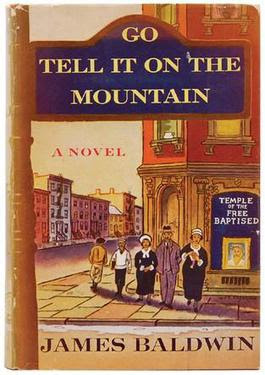
James Baldwin's Go Tell It On The Mountain

"But don't you think that the Lord can change a person's heart?" [174]

That's kind of the question in this, James Baldwin's debut novel of 1953. 

The novel starts on John Grimes' fourteenth birthday, a Saturday in March, 1935, and ends the next day. John is the oldest of four children of Gabriel and Elizabeth Grimes. They're a poor family in Harlem; Gabriel works as a day labourer, but he's a deacon and occasionally preaches at a revivalist church, Temple of the Fire Baptized. 

The novel is divided into three sections: 'The Seventh Day', 'The Prayers of the Saints', and 'The Threshing Floor'. The first ('The Seventh Day') shows us the family as a not very functional unit. John is the good boy, well, pretty good, but Roy, his younger brother, is his father's favourite. This may be because Gabriel is only John's step-father; he was born out of wedlock to Elizabeth and another man, dead by the start of the novel. But it may also be because Gabriel and Roy are similar, angry and intolerant. That same day, John's birthday, that he wanders around with a little money given him by his mother and then into a movie, Roy crosses town with friends to get into a gang fight with white boys and comes home cut with a knife. Florence, Gabriel's older sister, tells Gabriel it's his own fault Roy is who he is; Gabriel somehow casts blame on John for this, and then strikes Elizabeth; Roy curses his father. 

'The Prayers of the Saints': That night John goes to the church, to help clean the building. Neither his father, nor John's older friend Elisha, consider John saved, nor is John himself quite sure what he thinks about religion. After cleaning the church, with a few members arriving for service, he falls to the floor in a frenzy:     

    "'Rise up, rise up, Brother Johnny, and talk about the Lord's deliverance.'
    It was Elisha who had spoken; he stood just above John, smiling; and behind him were the saints...
    He tried to speak, and could not, for the joy that rang in him this morning." [199]

John spends the night on the floor, managing only a few words. The saints are the members of the church in good standing; they stand around John, praying, in honour of this new manifestation of the Lord's power. Three of those saints are his step-father Gabriel, his mother Elizabeth, and his aunt Florence, and we hear each of their prayers. 

None of them are entirely concentrating on prayer, though, and while they're meditating we learn the backstory that brought them to this point. Florence's resentment that Gabriel, the boy, received her mother's love even though Florence was the good one, and Gabriel showed no signs of spirituality as a twenty-year-old, catting and fighting as Roy does in the present. We learn about Gabriel's conversion, which does nothing for his anger and lack of love. We also learn about his own hypocrisy. Last of the praying saints is Elizabeth, still guilt-ridden over the episode that produced John, and how her subsequent hopes in Gabriel's faith were shattered.

We knew from the first chapter, none of them were saints in the usual sense of the word. Does our understanding make any of them more saintly? I don't really think so, but do learn they are more sinned against than sinning. (Though Gabriel is the hardest to forgive.)

In 'The Threshing Floor' we return to the present. On the threshing floor, Jesus separates the saved wheat from the damned chaff. Did John's conversion experience change anything? In some ways clearly not, but I don't think we're meant to have a clear answer. The question I started with up above is asked by Elizabeth, of Gabriel, to her sister-in-law, Florence. Florence's answer:

"I done heard it said often enough, but I got yet to see it." [174]

Though Florence gives that answer before John's conversion experience, and maybe hers is not a reliable voice anyway.

Poking around at what critical commentary I could easily find, it seems that readers are divided as well. The novel is clearly autobiographical (well, it is Baldwin's first) and Baldwin later lost his own faith. But I don't think it's quite fair to read back from Baldwin's subsequent story to divine what this one means, and I do think John's conversion is meant to be read as sincere. To be sure, there are psychological considerations--John wants to win over his step-father; he hadn't known his birth father, who died before he was born--but the language (very biblical) feels sincere to me:

"Then John saw the Lord--for a moment only; and the darkness, for a moment only, was filled with a light he could not bear. Then, in a moment, he was set free;..." [197]

Will that moment last? For the real James Baldwin it didn't, but for John Grimes, at least as long as the novel runs, it's a different story. 

I like the cover I've shown above, but that's the first edition, and alas I don't have that. I read it in James Baldwin's Early Novels and Stories, edited by Toni Morrison, from the Library of America, and the page numbers refer to that edition.

I found it a pretty great novel, it's on that Modern Library list of 20th Century novels, I'd put it on my Classics Club list, and it finishes off the Back to the Classics challenge for me for the year.