Showing posts with label Europe2022. Show all posts

Monday, December 19, 2022

Shirley Hazzard in Italy


Humpty and Shirley and Italy

I read a couple of Shirley Hazzard books I got from the library recently. I started with:

Greene on Capri

This is a memoir of her and her husband's (Francis Steegmuller) friendship with Graham Greene which came out in 2000. She met Greene on Capri in the late 60s. If you've read any Shirley Hazzard, you will be unsurprised by how she met him.  She and Graham Greene were sitting at nearby tables in a café on Capri. She knew who Greene was by sight, but didn't introduce herself. Greene was discussing a poem of Robert Browning's with a friend, but neither Greene nor his friend could remember the last line, until she supplied it as she was walking out the door. Later that evening she and her husband were dining at the same restaurant as Graham Greene--Capri is a small place--and Greene introduced himself.  It was the beginning of a twenty-years' friendship that lasted until Greene died.

They mostly met on Capri--Greene had a house on the island and shortly afterwards the Steegmullers rented a place (for $70 a month! I learned here. Not anymore, I'm afraid.) where they spent six months of the year.

The memoir is a delight. It doesn't whitewash Greene, who could, it seems, be difficult, and whose best writing was mostly behind him by that point. She was pleased, she writes, that she could genuinely tell Greene she liked The Honorary Counsel, (which is one of the better late Greene books) and is sensible on the strengths and weaknesses in Greene's writing. Greene was helpful in getting one of Steegmuller's Flaubert translations published by The Bodley Head.

The memoir is also a reminiscence of the Capri of that era. Capri has long been a bit glamorous, popular with foreigners, but not yet what it was to become. One amusing story, though, involves Steegmuller trading Russian phrases with an aged woman whom Lenin had tried to teach Russian when she was a girl; her father had been the gardener at the villa where Lenin stayed with Gorky in 1908. The Steegmullers, Greene, and Greene's partner at the time, Yvonne Cloetta, walk up to the Villa Jovis, the fortress from which Tiberius ruled the Roman empire in his later years. (I've been there!)

Both Greene himself and her husband Francis Steegmuller are dead by the time she writes this. It has a melancholic tinge. But she remembers those times fondly and well.

And it ends, as it began, with that missing bit of Robert Browning: 'Or so very little longer.' (from The Lost Mistress.)

The Bay of Noon

Then I read her short novel of 1970. The main events take place a few years after the end of World War II. Jenny, running away from her family, takes a job as a secretary for a commission studying the NATO base in Naples. (Primarily, then as now, the home of the US Sixth Fleet.) She knows no one there, but comes with a letter of recommendation to Gioconda. Gioconda is the author of a novel Del Tempo Felice, that was made into an Italian neo-realist movie. (It gets compared to Open City and The Bicycle Thieves.) Gioconda's lover is Gianni, the director of Del Tempo Felice. Various people around the office feature, her boss, the Colonel, but most particularly Justin Tulloch, a Scottish marine biologist to whom she's detailed for a while. She and Justin trade lines from Sir Walter Scott's Lochinvar at one point.

The novel mostly takes place in Naples, though, of course, they do make it to Capri. It's very good on place:
"An open-air nightclub, wedged into the tufa near my building, lay in wait for its season; and a bedraggled restaurant or two commanded, from scruffy terraces, the incomparable, lake-like prospect of the bay."

I won't say much about the plot. There is a twist, although I have to say I felt like I saw it coming. Still, a good read, even if it's not The Transit of Venus

And are my trip to Italy this year for the Rose City Reader European Reading Challenge.

There would have been several good reasons to have read these books last month, but I didn't... I'm reading them now because I just got my copy of the new Shirley Hazzard biography from the library on Friday.


I knew I would want to read it in any case, but I was pleased to see that Steve Donoghue listed it as his best biography of the year. His are really the only end-of-year lists I read, funny, cantankerous, and with (for me at least) more hits than misses.


Friday, November 4, 2022

The Jena Set

"Listen, this good old Jena really is a den of murderers after all. You have no idea how everyone gossips about everything behind your back, even the people you wouldn't expect."
-Letter from Caroline Schlegel to her husband August Wilhelm Schlegel, 5 May 1801

That's a little strong but there is a lot of gossip in Andrea Wulf's new book Magnificent Rebels about the figures of what she labels the Jena set. At the time (1795-1806) Jena was an important German university town near Weimar. The gossip includes: Who's sleeping with whom. Who's feuding with whom. Who's pro-Napoleon and who's not. Who's dying and who pulls through.

But they're people worth gossiping about, with Goethe the best known. He's the old man of the group, 46 at the start, respectable, though not entirely, since he's living with, and not yet married to, Christiane Vulpius. There's a boatload of Friedrichs, and Wulf conveniently provides a Dramatis Personae, because among those Friedrichs are Schiller, Schlegel, and Schelling, plus one (Friedrich von Hardenberg) whose name fortunately doesn't start with 'Sch', and better known as Novalis anyway. Poets, translators, philosophers. Kant is an early booster, and Hegel a late addition to the group. 

At first there's harmony. They start magazines, philosophize together, read each other's poetry. Goethe and Schiller edit each other's work. Goethe arranges for Johann Fichte a job as professor at Jena; his lectures become enormously popular. Later Goethe is equally instrumental in getting Friedrich Schelling an appointment as a professor of philosophy. It's Friedrich Schlegel who popularizes the word Romantic in its modern sense, from the French word 'roman', meaning a novel.

Wulf is most interested in Caroline Schlegel. (Her name through most of the book. At the start she's the widow Böhmer; near the end, after a long affair with him, she marries Schelling.) August Wilhelm Schlegel is her second husband, and the two of them are responsible for what Wulf says are still the standard translations of Shakespeare in German. But the affairs, the literary feuds, the short tempers, begin to tell. Fichte is fired from his professorship for atheism. The Schlegels and Schiller end up in a bitter feud over editing and won't talk to each other, though Goethe attempts to mediate. By 1806, the year of the Battle of Jena, where Napoleon decimates the army of Prussia and its allies, most of the principals have already left town. The town itself is battered. But their legacy lives on, propagated by figures who write books about them, such as Madame de Staël and Samuel Taylor Coleridge.

A pretty fascinating crowd in its own right, but especially fascinating if you're a fan of Penelope Fitzgerald's delightful The Blue Flower.


And of course I then had to reread it. It centers around the poet and novelist Novalis, but ends in 1797, when Novalis' fiancée dies of tuberculosis. Most of the same figures appear, though. 
"Novels arise out of the shortcomings of history."
  "...What did they talk about?"
"Nature-magnetism, galvanism, animal magnetism and freemasonry."
"I see the fault in Fichte's system. There is no place in it for love."
"If a story begins with finding, it must end with searching."
"But I have, I can't deny it, a certain inexpressible sense of immortality."

All sayings of Novalis in the novel and I suspect based on his writings, though only the first (which serves as the epigraph) is given a citation. It's funny and touching. A great novel.

Novalis himself dies in 1801, at the age of 28, also of tuberculosis.

Thursday, October 27, 2022

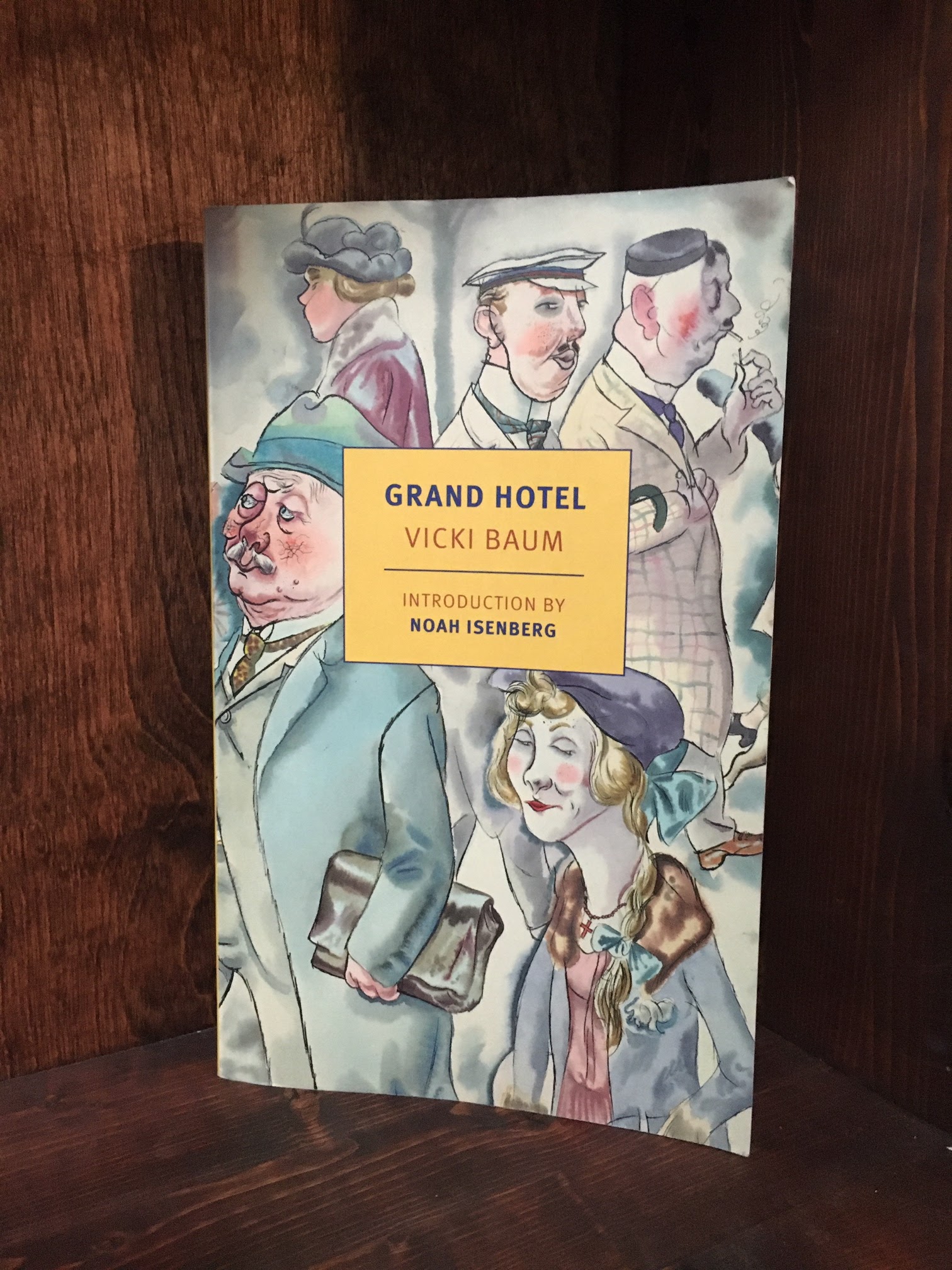
Vicki Baum's Grand Hotel (#1929Club)

"...that indefinable smell of Berlin in March..."

An aging Russian ballerina, an unimaginative company director, a stenographer who also does nude photos, an impoverished baron doubling as a thief, a bookkeeper with a fatal cancer diagnosis, a morphine-addicted doctor whose face was destroyed in World War I--they're all staying in a grand Berlin hotel.

That sounds like a series of character sketches, which is, according to the introduction, the way Vicki Baum first began to think about the novel, but she's worked out a plot that brings them all together. There's love, there's death, there's fortunes won and lost--or are they? The meeting of Grusinskaya, the ballerina, and Baron Gaigern (Greta Garbo and John Barrymore in the movie!) is both delightful and amusing. 

The novel--or the characters at least--affect a certain cynicism about love: the stenographer Flämmchen (what a name! Joan Crawford in the movie) tells Baron Gaigern, "True love? There's no such thing," and says of the sexual act, "It was like having a tooth filled by a singularly incompetent dentist." Gaigern himself is quite calculating about love, until, maybe, he isn't. The novel itself is less certain about that cynicism, but still a little cynical. Do unexpected characters fall in love? "No," says the third-person narrator. "Life is very far from producing such delightful surprises." Yet, even so, some hearts might be warmed.

Closer to the feeling of the novel is a concern for money. Kriegelein, the bookkeeper, says at one point, "Only with money can you begin to be a decent human being." Which room you're in, what clothes you wear, career choices and life choices. All the characters think about money, and a possible corporate merger is one of the main plot threads. 

It ends--but no spoilers!--with a big scene that involves all the major characters, even if one has already left town. Very enjoyable.

It's the week of the 1929 Club, hosted by Kaggsy and Simon, and this is very much a 1929 book...


Over the years, I've posted a couple of other 1929 volumes on the blog:


and Mateiu Caragiale's The Rakes of the Old Court in the Sean Cotter translation.


Brona's post about her 1929 book reminds me that the A Room of One's Own is actually a 1929 book as well, though the lectures were given in 1928. My thoughts about it here.


Thanks to Simon and Kaggsy for hosting!

Tuesday, September 20, 2022

Short Reviews: von Doderer, Faulkner, Scholem

Three complicated chunksters all of which I started long posts for. Those posts didn't get finished. (Oh, well.) Time to clear the decks.


Heimito von Doderer's The Strudlhof Steps (850 pages)

This is a fairly new release from New York Review Books, and Vincent Kling won the most recent Wolff Prize for translation from the German for it. The novel came out in 1951 in German, and hasn't previously appeared in an English translation.

The main events take place just before and just after World War I in Vienna. I'm a sucker for the place and time. And, hey, it's shorter than The Man Without Qualities; as a bonus, von Doderer finished it, too. Four sections, each coming to a dramatic climax--who gets married, who gets dumped, who gets a leg cut off by a tram--generally on or near the Strudlhof Steps:


Lt. Melzer features in the subtitle. He likes to drink Turkish coffee on the skin of a bear he shot in Bosnia in 1912; watched his commanding officer (whom he likes) die on the Italian front in World War I; seems almost unmarriageable, but is he?

René von Stengeler is born into a wealthy Protestant family, captured by the Russians in 1916, only making it back to Vienna after the war is over. Does he marry Grete, back from Oslo where she escaped the misery of post-war Vienna by teaching piano? And why does René's sister commit suicide? Because we know she did from the first few pages.

The novel requires tolerance, but pays back. It moves back and forth in time, at first seemingly arbitrarily. You have to accept its terms, and give it space to get started. Characters have last names or first names but not necessarily both, and sometimes merely initials. For example, we never learn Lt. Melzer's (a major character) first name: on page 823, "Sorry, but we don't know Melzer's first name." The narrative voice has a curious diffidence.

Von Doderer's politics were not particularly admirable. He joined the Nazis in the mid-30s, when the party was illegal in Austria. The afterword, by Daniel Kehlmann, says he was quite anti-Semitic at that time. He later turned against the party, but never publicly, and as a WWI veteran, he was drafted into the Wehrmacht, serving in garrison duty, first in Norway, later in France, where he started writing this novel. The publication of the novel was delayed while von Doderer was de-Nazified. René von Stengeler is clearly a self-portrait, and deliberately not a flattering one. What did he think by 1950? I don't know. There are minor Jewish characters in this, and they're treated with real sympathy.

Anyway, I thought it was very good.

William Faulkner's Light in August (480 pages)

I had heard that Light in August was a murder story, the story of Joe Christmas, and, well, it is. Christmas (named for the day his infant form was dropped off at the orphanage) murders his lover. Christmas may have black blood--he doesn't know and we don't know either, but he thinks he does, and though he could pass for white, once he's accused of having a drop of black blood (by his own grandfather, no less) he assumes he does.

But Christmas' story is not the whole of the novel by any means. It's the portrait of a town called Jefferson, and not just the evils of racism, but also the ways racism distorts the life of the town. Nowadays we don't really have any problem contemplating that Jefferson the man may have been a bit racist, but the novel came out in 1932. There's a daring irony to that. Was Faulkner in his heart of hearts free of racism? Certainly not, and I doubt he would say he was. But he knew that problem for a problem, and that counts for something. Percy Grimm, the white captain of the National Guard, is a particularly (dare I say it?) grim portrait of a racist.

And am I the only one who doubted Christmas committed the murder? No, because the Wikipedia article says it's unclear who did it. I don't think that's actually sustainable, and that Christmas really did do it, but I did wonder during the middle of the novel. But maybe that's attributable to too many years of reading mysteries: the obvious suspect is never the culprit.

The town's a mess, and there's nothing to do but escape, but almost nobody does; the only ones who do are Lena Grove and Byron Bunch, running off in a folie à deux: she's looking for the man who got her pregnant and who will never marry her, and Byron's hoping she'll settle for him instead, and meanwhile he'll be there when she (which she won't) changes her mind.

One other thing to be said about this is that, of the great Faulkner novels, I thought this was the easiest read. And that's definitely something... 😉 It's easier than The Sound and the Fury, As I Lay Dying, and Absalom, Absalom. No chapters from the POV of dead people or madmen. Not the greatest of that quartet, I'd say, which for my money is Absalom, Absalom, but a better starting point. (Though if you include Sanctuary in your list of top Faulkner, I would say that one's a pretty straightforward read.)

Yeah, a classic.

Gershom Scholem's Sabbatai Sevi (929 pages, plus bibliography, notes and index)

Sabbatai Sevi (1626? - 1676) declared himself the Jewish messiah in 1665. (He may have intimated it as early as 1648 but only in limited circles.) Gershom Scholem, Jewish historian and friend of Walter Benjamin, made Sevi the subject of a major book.

Sevi (there should be a dot under the S which I can't figure out how to type, but think Tsevi or Zevi) was born in Smyrna to a middle-class merchant family, studied the Kabbala in Jerusalem, traveled on religious business to the Jewish community in Egypt and later to Constantinople. All lands under the control of the Ottomans at the time. When he began his mission in earnest, Nathan of Gaza was his prophet and explicated the theology of the new movement. Scholem, as a historian of Jewish mysticism, is rather more taken with Nathan than Sevi.

But the stories of Sevi and Nathan are just a small part of this fascinating book. What's surprising is the Europe-wide discussion of these figures, and not just in the Jewish community. Italy, Amsterdam, Morocco, Poland, Hamburg, Egypt are all discussing this new Messiah. English chiliastic Protestants write books about Sevi, who, they think, will lead 10000 Jews from the Lost Tribes across the River Sambatyon, armed with bows and arrows but still invincible. (The River Sambatyon doesn't actually exist, which is why you haven't heard of it.) Samuel Pepys writes about Sevi in his diary! Along with all the women he was shagging. He features in Venetian ambassador's reports and Jesuit Relations. One can imagine Blaise Pascal, roughly contemporary, being discussed across Europe, but it turns out not all Europe-wide discussions were so scientific.

Sevi himself always advocated a peaceful movement. Faith and the perfection of the self would lead to the kingdom of God. There were no armies in his vision.

In fact, I found the reception of Sabbatai Sevi to be more interesting than the biography of Sevi himself. Scholem is inclined to attribute Sevi's messianic proclamations to mental illness, labeling him a manic-depressive. Maybe. But diagnosing mental illness in the present is difficult enough--DSM-III, DSM-IV, DSM-V have different labels, and so will DSM-XCIII--diagnosing it in figures in the past in inherently suspect.

Why could a Messianic movement take root then? Scholem finds the main factor to be the diffusion of Kabbalistic thinking going back to Isaac Luria (1534-1572). But also the Jewish massacres by Khmelnitsky in Poland and the Ukraine take place in 1648. As for the interest in Christian circles, there was a feeling that 1666 should be an important year: the number of the beast plus 1000.

Once in Constantinople, Sevi was arrested by the Ottomans. They were relatively tolerant of Judaism, but weren't prepared to tolerate a figure who was going to lead an army of invincible Jews and put the crown of the world on his head. (If, in fact, Sevi intended these things. Probably not.) He seems to have impressed the vizier and then later the sultan, but still in September of 1666, he was told to convert to Islam or die. Sevi converted. 

Surprisingly this wasn't the end of the movement. A number of Sevi's followers also converted over the years. Sevi was ordered to leave Constantinople, first to Edirne, which was at times the Ottoman capital, then later to Albania. Sevi led his converts, the Dönmeh, also referred to as the Ma'min, or the Faithful, in a new syncretistic religious community influenced both by Judaism and Islam, particularly that of the mystical Sufi orders. Scholem's book ends in 1676, when Sevi dies, but the community survived, centred in Salonica until the Greek-Turkish population transfers of 1922. The Dönmeh were often thought to be hidden Jews, but they were Muslim enough for the time, so they had to go. The story of the Dönmeh would be fascinating, and Scholem had intended to write a book, but didn't live to do so. They do feature in Mark Mazower's book (recommended!) on Salonica, though.

I read the second edition of the book, which came out in 1973, translated by R. J. Zwi Werblowsky. Scholem says in the introduction that he had access to more material by then, and that it superseded the earlier edition.

And why did I read this book now? Well. Did I really need to read one nine-hundred page book about a failed Jewish messiah in order to prepare for another nine-hundred page book about a failed Jewish messiah? Oh, probably not, but that's what I did:


These were all August reads for me, and it's been a while now. Still I wanted to review these because they knock off a couple of challenge items. Light in August was on my original Classics Club list and works for this year's Back to the Classics challenge.


And the other two count for this year's European Reading Challenge:


The Strudlhof Steps is clearly an Austrian book, though it does have scenes in Norway and Switzerland. Sabbatai Sevi spent most of his life in what is now Turkey, but I've already done Turkey this year. Sabbatai Sevi the book ranges across Europe. Still we'll stick Sevi himself, who spent the last eight years of his life in Ulcinje, which was in the Ottoman province of Albania at the time, but is now in Montenegro.

Short reviews, did I say? Well, short-ish...


Thursday, September 1, 2022

Charles King's The Ghost of Freedom: A History of the Caucasus

 "The mountains are full of free and ungoverned people..."

-Gen. Alexei Petrovich Ermolov

But there were various attempts to clamp down on that, including by a certain Russian General Ermolov in the early 1800s...

Continuing my reading of Charles King's back catalog and my voyage this year round the Black Sea, I got his book of 2008 from the library. It's another fascinating study.

It's a meeting place of continents and languages. In Arabic it's referred to as djabal al-alsun, the mountain of languages, and it's home to a half-dozen (or more, depending how you count) language families, of which Indo-Europenan is only one. Turkic and Semitic languages are widely spoken. And there are three language families indigenous to the area as well: Kartvelian (the best known of which is Georgian); Caspian (including the Chechen language) and Northwest Caucasian.

It's also the meeting ground of empires. The frontiers of Persia, of the Ottomans, and of Russian collide in the Caucasus. King's book really only starts in the 1700s, as Peter the Great tries to expand Russia into the area. By then the Persians and even the Ottomans are weakening, and it's mostly a story of Russian expansion. But 'imperialists are congenital optimists' as King says, and it wasn't an easy progress as the locals attempted to remain a 'free and ungoverned people', at least ungoverned by outsiders.

One of the themes King emphasizes is how the region functioned in Russian identity. Before Siberia it was their wild west, and is important in their writing to Pushkin (his The Captive of the Caucasus provides King his title), to Lermontov (A Hero of Our Time), and to Tolstoy (Hadji Murad, among other works). Pushkin's view remains fairly romanticized, according to King; Lermontov and Tolstoy are more realistic.

It's not just the Russians who have fanciful images of the Caucasus. The Russian tsar sends German scholars into the Caucasus; one of the questions he wants to know are the Circassian women as beautiful as they're reported to be. But so does Woodrow Wilson (!) want to know that. In the 19th century Circassian beauties were a regular feature of P. T. Barnum's (and others') expositions. (Though King says they were generally Irish girls with their hair frizzed.)

King tells the story of Jan Saremba, a Pole who fought against the Russians in his homeland. After the fall of Warsaw, he was drafted into the Russian army and sent to fight in the Caucasus. He and a group of Poles decided to cross over into the Ottoman lines, and join up to fight Russians instead of serving them, but the Ottomans sell them into slavery instead. Saremba eventually escapes, takes refuge with the French consul in Trebizond, marries a Greek woman, and later leads tours of the Caucasus, and it's through that he becomes known. But on other occasions Russians complain the forces ranged against them shout their battle cries in Polish. 

In the aftermath of the Bolshevik revolution and World War I, the Caucasus is united into TransCaucasian State, but it breaks down pretty quickly into three countries Georgia, Armenia, and Azerbaijan. All three of those countries are gone by 1922, reabsorbed into the Soviet Union, only to reemerge after the collapse of the USSR. King ends with the wars that follow; the Second Chechen War still going on as he was writing the book, though by then winding down.

All in all, a pretty fascinating read and a good introduction to the area.


There are four countries from Gilion's list that occupy the Caucasus today: Russia, Georgia, Armenia, and Azerbaijan. (There are some other places that claim to be countries, but aren't widely recognized.) Azerbaijan seems to me the one I'm least likely to read another book from, and it's a country I've never covered in my years of doing the European Reading Challenge. So today's visit is to Azerbaijan!

I read the book in a place I couldn't obsess over the news:


If I was sitting in that chair and looking out...


Thursday, August 4, 2022

The Donkey's Ears


from The Donkey's Ears, part 5, § XIX, opening

What's this I do? A diary or a poem?
Or letters to you? Will you keep them by you
As a memento of my love, my blue
Seafaring days, and when you're old, read them

All over again, in your favourite chair
By the window? By then much might have changed
And how might Russia be rearranged
Forty years on?...
In 1904, the Russian Baltic fleet set sail from Kronstadt, St. Petersburg, to join the Russian Pacific fleet during the Russo-Japanese war. The fleet was under the command of Admiral Rozhestvensky, but the Flag Engineer E. S. Politovsky wrote a series of letters home to his wife during the voyage. (A flag engineer is the person in charge of maintenance and repair across an entire fleet.) The letters made it home and survived and are now considered a major historical source for the expedition. Douglas Dunn, a Scottish poet (b. 1942), used them as the basis for his book length poem. 

Dunn says in an afterword he'd started the poem in 1983 for an exhibit on the Dogger Bank incident where the Russian fleet, mistaking a few British fishing boats in the North Sea for the Japanese navy, opened fire. One trawler was sunk, but the Russian navy didn't come out too well either:
Aurora's holed below her waterline--
Imaginary, midnight Japanese!
Our guns were real, but not our enemies...
An empire, at its zenith, in decline!

-Part 1, § VIII, l. 1-4

Those Russians; paranoid much, eh?

Dunn set the poem aside for a while, though, only finishing it in 2000. The poem follows the fleet as it sails around Africa, holes up off Madagascar, still a French colony, then sets sail across the Indian Ocean.

Who can postpone or stop this merciless
Near-circumnavigation, this witless sprint
Over the oceans to the Orient,
To destiny?
     Madame, I crave your kiss!
-Part 4, §VII, end

Destiny was the Battle of Tsushima in May of 1905. It was a disaster for the Russians, with very nearly the entire fleet wiped out, and it led swiftly to the end of the Russo-Japanese War. The Tsushima Straits are the body of water between Japan and Korea; Tsushima is an island in those straits with a rock outcrop that resembles donkey's ears, and Tsushima means donkey's ears in Japanese. You can decide if you think the idea of donkeys has any other application to our story... 

Admiral Rozhestvensky survived the disaster, but Flag Engineer Politovsky did not. His last appearance:

I'll have to hurry. Our unarmed transports
Will leave us soon for Shanghai, and with mail
If I can finish this before they sail
To booze and safety and the sexual sports

For which the city's famous. Not for me!
My uniform's been pressed, so if I die
I'll be well dressed, gold cufflinks, black bow-tie,
Wing collar, dressed to meet the horrid sea.
-Part 9, § V, end


I thought the whole thing very good.

Politovsky seems a good man, his sense of honour, his love for his wife, his engineer's practicality, his ability to see through official balderdash. Dunn said he came to like Politovsky and it shows, and considered contriving a last letter from the battle or a death scene, but then thought better of it. Such is war, anonymizing and deadly.

And why have I picked as my Russia book this year the story of a disastrous end to Russian imperial hubris and military adventurism? Well, you can hope, can't you?


Monday, August 1, 2022

Marc David Baer's The Ottomans

Continuing this year's voyage around the Black Sea...

Marc David Baer's The Ottomans, is a history of the Ottoman empire from its founding by Osman I (dates slightly approximate, but he died close to 1324) until its demise at the end of World War I. They aren't always represented as some of history's good guys, but Baer, a professor at the London School of Economics, is pretty sympathetic. The book was short-listed for this year's Wolfson Prize, but didn't win in the end. But that wasn't revealed before I put it on my library's hold list.

Osman I (though his story seems to be at least partly mythical) led his band of Turkish herders from central Asia to a spot on the Anatolian plateau southeast of Istanbul. They elbowed out whoever was there and created a small state, but initially did not conquer a city, nor found one. They pastured their herds on the uplands in summer and in the valleys in winter.  They had already converted to Islam, but retained some of the ways of their animistic ancestors. (Relative equality between the sexes, for example.)

They had the virtues of where they came from: good horsemanship and good bowmanship. But they were too small a band and too powerless to have much impact at first. At least according to Baer, though, they were fortunate in their choice of location. The Mongols were retrenching a bit; Byzantium was weakening; the Seljuk sultanate of Rum, the main power on the Anatolian plateau, collapsed in the early 1300s. The Black Death came, and because the Ottomans had not yet founded cities, they weathered it much more readily than their city-inhabiting neighbors. 

This set them up for their period of expansion: the Balkans, the conquest of Constantinople in 1453, Mecca and Medina in 1517, the first siege of Vienna in 1529. Baer observes that at this time, the Ottomans are technological leaders: they're early adopters of gunpowder, muskets, and more famously, siege cannons. 

Baer is also impressed with their governance structures. He emphasizes their tolerance, though he's careful to distinguish this from true egalitarianism, which existed exactly nowhere at the time. (And we won't talk about now either.) You could be Jewish or Christian and advance; top positions were reserved for Muslims, but if you converted you could be from anywhere, not necessarily a Turk, and it didn't matter. When the Jews were kicked out of Spain and Portugal (1492) they were welcomed into the Ottoman empire for their skills. The grand vizier was often a Christian convert, sometimes one taken as a child and educated (though also enslaved) by the Ottoman state. This created a class loyal to the state, that advanced by merit, both in the military (the Janissaries) and in civil governance. Local aristocracies could complain, but couldn't wangle their incompetent children into positions of power.

This lasted pretty well through the reign of Suleiman I, who was in charge 1520-1566. While the maximum geographical extent of the empire came later, religious zealotry and nationalism began to cut into a system that had worked well. The other powers around them also caught up with the Ottoman expertise with gunpowder.

One of the interesting motifs for me was how much the Ottomans saw themselves as the true inheritor of the Roman empire. This is not as odd as it might seem. The Byzantines considered themselves the successor of the Roman state, called themselves not Byzantines, but Romaioi. The Ottomans now held the Byzantine capitol. Suleiman I, roughly contemporaneous with Charles V, the Holy Roman Emperor, felt equally the inheritor of Rome. (And as we know, the Holy Roman Empire "wasn't holy, wasn't Roman, and wasn't an empire"--Voltaire.) The area called Rome, or Rum, or Rumelia moves around. One interesting bit of trivia I realized is the poet Rumi, born in what is now Afghanistan, and who died in what is now Turkey, and who wrote mostly in Persian, is actually, according to his name, the 'Roman.'

Succession had always been a problem among the Ottomans. One son, generally the eldest, rushed back from the provinces where he'd been stationed to the capitol upon the death of his father, got the reins of government in his hands, and had all his male siblings killed. The army, in the form of the Janissaries, was involved, and once they'd gotten a taste for king-making, couldn't be easily dislodged. This was an unfortunate 'Roman' trait: the Praetorian Guard also didn't do the Roman empire any good in its latter days either.

Baer also feels the Ottomans failed in not making the transition from a warrior state to a peaceful trading state. They stood athwart major trade routes and could have done so. A strong faction continued to feel the true Ottoman was the warrior Ottoman. (Their term was gazi.) But the empire had gotten about as big as it could. The first siege of Vienna failed in 1529 because the supply lines were too long, but they had learned nothing from that at the time of the second (in 1683) which was a considerable disaster for the Ottomans. From here on in they're also butting up against the expanding Russian empire.

Various attempts at reform were tried and failed: concentrate on commerce not war, reduce the sultan to figurehead and let bureaucrats run things, religious zealotry, benevolent autocracy (a la the later Hapsburgs). It's Tsar Nicholas II, just before the Crimean War, who first calls the Ottoman state the 'sick man of Europe.'

The last attempted reform movement is a Turkish nationalism. The Young Turks (none of whose founders interestingly was a Turk: two Kurds, an Albanian, a Circassian) reduce the sultan to a figurehead and are more or less in charge during World War I. Baer is distinctly not sympathetic to them, but then their goal is to reduce what had been, at least at times, a successfully multi-ethnic polity to a state defined by one's race. His discussion of the Armenian genocide makes for very painful reading.

It also means Baer's not especially positive about Atatürk, though he's mostly outside the scope of the book. Atatürk (born in Thessalonica, but of Turkish parents) isn't directly implicated in the Armenian genocide, because he's busily organizing the defence at Gallipoli, but the Young Turks are his natural allies, and Atatürk, given the opportunity, refused to condemn the genocide after the war.

Anyway, a pretty fascinating history. Baer knows his stuff, provides an interesting perspective--emphasizing how European they were, especially appropriate for the European Reading Challenge 😉--and wants us to think differently about their history. (Based on the footnotes, I think there may have been a little war going on with the late Bernard Lewis.) I have to say, though, the writing was no better than adequate. There's the occasional misuse of words, but more notably a tendency to repeat. It was indeed interesting that no sultan completed the Hajj in all the years of the empire, or that it wasn't until 1520 and the conquests of Selim I that the empire was Muslim majority, but he tells us both those facts three times in different locations and in more or less the same words. Baer himself has to take the primary blame (that is, bear responsibility...?) for any sloppiness, but the book is from Basic Books, supposedly an imprint for quality books for the general reader. They ought to provide better editing. Maxwell Perkins, where did you go?

Monday, July 25, 2022

Pynchon's V.

"Stencil has stayed off Malta."

Ever since I've been signing up for the European Reading Challenge, there's been these two big historical/encyclopedic novels that turn around Malta I've been thinking about rereading. It turns out this is the year for one, V., Pynchon's debut novel. (The other is Anthony Burgess' Earthly Powers.)

Part of the resistance was I'm not sure I'm capable of saying anything about either one.

But let's see. First, the story: the novel has two interlocking plot lines. One in 1956, (the present, roughly; the novel comes out in 1963) and the other in a series of discrete moments from 1898 to 1943. The protagonist of the present is Benny Profane, in his early 20s, child of a religiously mixed marriage (Jewish/Italian Catholic), born in New York City, recently having served a hitch in the US Navy, but now at odds and ends. (Which things, I think, are basically Pynchon himself, except Pynchon's mix is Episcopal/Catholic, and he grew up further out on Long Island, not in the city itself.) The other timeline is the result of an investigation by Herbert Stencil into a woman V., possibly Veronica Wren, who was, as a teenager, caught up in the assassination of a British spy in Cairo in 1898. Herbert's father is Sydney Stencil, a British Foreign Service agent/spy. V. may (or may not) be Herbert's mother. 

Benny is a schlemiel, and is constantly at war with objects: alarm clocks don't wake him; flashlight batteries fail; at one point he tries to rappel down the side of a building and is left hanging upside down. Benny has (imaginary?) late night conversations with a crash-test dummy: they're soul-brothers of a sort, individuals whom the powerful mechanisms of the modern world are out to damage, possibly destroy.

But une guerre contre les objets is the honourable position; the alternative is V., gradually turning herself into an object, glass eye, false teeth, artificial leg. This conflict is Pynchon's theme.

"'I detect allegory in all this,' she said.
'No,' said Slab. 'That is on the same intellectual level as doing the Times crossword puzzle on Sunday. Phony. Unworthy of you.'"
There are moments when it feels like a schematic message novel--Pynchon's message would definitely be humanist, anti-machine, admirable--but the novel escapes allegorical reductionism by a deliberate fudging. V. is not just symbol of the dehumanization of people into objects in the 20th century. (Appropriate as that might be, with the ultimate dehumanization being nuclear annihilation. 1956 is the year of the Suez crisis, important to the novel, and of Hungary. War seemed closer.) But V. is also the woman Veronica Wren, maybe somebody's mother, who's capable of falling in love. (Though not with Sydney Stencil.)

The novel's also funny, or at least I think so:
"Mountebank is a dying profession; all the good ones have moved into politics."
Pynchon is also famous for his zany song lyrics, which can be found in V., although I think he gets better at this as he goes along.

Pynchon also gets better at female characters--though never great--and the women are thinly realized in this, with Benny Profane's sometime girlfriend Rachel Owlglass being the best-drawn of the lot. From Pynchon's (wonderful) introduction to his collection of short stories Slow Learner (1984):
"Modern readers will be, at least, put off by an unacceptable level of racist, sexist, and proto-Fascist talk throughout this story. I wish I could say that this is only Pig Bodine's voice, but, sad to say, it was also my own at the time. The best I can say for it now is that, for its time, it is probably authentic enough."
Pynchon is writing of one of his stories in Slow Learner, but Pig Bodine is a character that also shows up in V., and it's also kind of true of the novel.

Still, I find it a pretty great novel. And it reaches its climax on Malta. Stencil had stayed off Malta; I had, too; but no longer.


You could even call it a classic...


which I've read a few times:


I guess I can treat myself to a new copy. 😉


Saturday, June 18, 2022

The Black Sea: A History

"There is a deep landlubber bias in historical and social research. History and social life, we seem to think, happen on the ground."

A couple of years ago I read Charles King's Midnight at the Pera Palace (looking at 20th-century Turkey though the lens of a luxury hotel/night club in Istanbul) and liked it a lot. More recently I read his Gods of the Upper Air (about American anthropologists, such as Franz Boas and Margaret Mead) and liked it, though a bit less. I didn't manage to blog about either. 

But then, in a moment of idleness, I was looking through Charles King's back catalog and checking what my library had, and there was this volume: The Black Sea: A History. We've all been thinking about the Black Sea far more lately. I thought I should check this out. (Both literally and figuratively.)

The volume begins by discussing why we should consider the Black Sea a unit; it's often not these days; the countries involved are divided under Russian studies or Balkan studies or Near Eastern studies. He makes a good case, but I have to say I wasn't necessarily engaged with that question. Then he discusses the geography and geology of the region, which was pretty fascinating. Good harbors, which products were available for trade, where and when the fishing was good are all hugely important questions to anyone near the sea. 

But that's all pretty quick. Then we're on to the history. As I said once before, any history that can conceivably start with Herodotus ought to do so, and the historical part of this one does, too. One of King's recurring motifs is that the Black Sea is an inland sea for somebody--or it's not. Is it a place of trade or of conflict? For the Greeks, it seems, at least in the early years, it was an inland sea, with a number of Greek colonies trading with their respective hinterlands, but in fairly regular communication with each other and the Greek homeland. Most of the Greek colonies were of Milesian origin. But already by the time we think of as high classical Greek civilization (5th-4th century B.C.) this was falling apart. Alexander's ascendancy didn't last long, and none of the successor kingdoms dominated the sea.

Nor did the Romans. Their inland sea was, of course, the Mediterranean (Mare Nostrum) and the Black Sea was the frontier, where they fought against states they bordered on the east: Pontus, Parthia, Armenia.

It was closer to an inland sea for the Byzantines at their peak, but never quite. Italian city states--Venice, Genoa--pick up a fair amount of the trade and maintained entrepôt of their own. And by the later years of their empire the Byzantines controlled very little of the Black Sea littoral.

But then the Ottomans, after they took Byzantium (1453) again held the sea under one power. Some of the states on the Black Sea were tributaries and not directly part of the empire, but for roughly 300 years after the fall of Byzantium, the Black Sea was an Ottoman lake, and trade was relatively free and easy. 

Eventually the Ottoman empire grew weaker--and the Cossacks came on the scene. The Cossacks were perfectly happy--and perfectly capable--of conducting piracy on the sea in addition to their raids on horseback. But by themselves they weren't able to dominate the Black Sea. But their piratical successes were one of the things that revealed the increasing weakness of the Ottomans. The Russians took note.

The latter history of the Black Sea is story of the conflict between Russia and Turkey over control of the Black Sea--and the efforts of other players, the British, the French--to keep one party from dominating. The Crimean War, among other conflicts, was the result. Among the results of the Crimean War was an attempt to de-militarize the Black Sea.

The book comes out in 2004 and at that time King was optimistic. There were new environmental initiatives to counteract years of neglect and damage. "[C]onflict among the states of the Black Sea zone is now virtually unthinkable." [p.240] Alas. As Yogi Berra may (or may not) have said: It's tough to make predictions, especially about the future.

Still, it's a pretty fascinating book, even if it needs updating. If you've read his other books you'll know, King likes anecdotes and uses them well. There's some good stories in it and it's pretty readable. And especially now, worth reading.


As King notes in the beginning, six countries currently border the Black Sea; if you counted the countries in the Black Sea drainage area, there are 22 possibilities. Out of all those choices, I guess I won't pick the most obscure... King is a professor in the foreign services school at Georgetown, and at least at the time of this book held the Ion Raţiu chair in Romanian studies. Romania is important in the book, I need to keep up my Romania streak, and so...Romania it is! for the European Reading Challenge.

Tuesday, May 17, 2022

Memoirs of Mme. Vigée-Le Brun (#ccspin)

"I will begin by speaking of my childhood, which is the symbol, so to say, of my whole life, since my love for painting declared itself in my earliest youth."

Elisabeth Vigée was born in Paris in 1755 to Louis Vigée, a provincial portrait painter who encouraged her love of painting. "I made a picture by lamplight of a man with a beard...When my father saw it he went into transports of joy, exclaiming, 'You will be a painter, child, if ever there was one!" 

Unfortunately he died when she was twelve, and her mother remarried a jeweller, who did not encourage her, but did take any money she made as a painter. "I detested the man."

To get out of her hated stepfather's house, she married the art dealer, Jean-Baptiste-Pierre Le Brun, in 1776. Le Brun encouraged her painting, but now her husband took all of her money instead of her stepfather. He was a successful enough dealer--later he was instrumental in making the Louvre into a public museum--but he was also a compulsive gambler, and no amount of money could do much to keep him afloat.

She was, however, starting to succeed in a big way. She painted Marie Antoinette, and the queen liked the portrait, so there were several more, also the king, with or without the children. 

In a few years though, being Marie Antoinette's preferred portrait painter was not particularly a recommendation with the public. She threw a toga party, and there was a rumor going round that it had been financed by the state to the tune of twenty-thousand francs. (She claims she spent fifteen and used a few old bedsheets. Since my idea of a toga party is more Animal House than Trianon, I guess I believe her...)

Self portrait
As the Revolution began to get hot, she decided to leave France. In 1789, the royal family was arrested, and she fled with her daughter (but not her husband) to Italy. It was the beginning of thirteen years of exile. She was abroad ostensibly to study the great masters of painting--and she did--but it was also safer. After Italy, she went to Vienna, to Saint Petersburg, to Moscow, to Berlin. She was commissioned to paint Catherine the Great (and did paint her granddaughters) but Catherine herself died before the portrait was begun. Only in 1802 was she able to safely return to France. She made later trips to England (which she didn't much like) and to Switzerland.

She wrote these memoirs in the later 1830s, when she was in her early 80s, her husband and daughter both dead by then. They're pretty fascinating, though it's true (and occasionally exasperating) that she never met an aristocrat she didn't like. I've seen her paintings in various museums.

The memoir is available on Project Gutenberg, translated by Lionel Strachey, the brother of Lytton. I first learned of its existence from Mudpuddlesoup

Sunday, April 3, 2022

Kate O'Brien's Farewell Spain

 "...and in any case, say only [blank] were fighting this war it is being fought for an issue which is everyone's immediate concern everywhere. It is a war waged by the forces of militaristic absolutism against democracy."

You might guess from the title above that the nationality I've blanked is 'Spaniards', and that the time of its writing in early 1937, and of course it is. But it resonates.

Kate O'Brien (1897-1974) was an Irish-born novelist. She worked as an au pair in Bilbao, Spain, in the early 20s, and fell in love with the country. She had come back as a tourist in 1936 and this book, half travelogue, half angry lament that the republic is under attack is the result. As she's writing it, late in 1936 and early 1937, it's not clear who will win, but, of course, in the end it was Franco and the nationalists, and O'Brien was denied entry to Spain until 1957 because of this book.

But half the book--probably more, actually--is travelogue, and witty and amusing travelogue at that:
"But it is no good. The cathedral is on your conscience. You paid good money and took some trouble to get here to see it, and you can sit in a café anywhere. Ah, turismo, what a slave-driver you are!"

O'Brien arrives by boat in the north. She visits Santander, Compostela, Salamanca, Ávila:

"All the rest of the town [Ávila] is lovely. It slithers carelessly about the sides of a golden hill and west and south down to the Adaja. It is placed high, but far away on every side the cold points of mountains fence its landscape in."

O'Brien is quite taken with Saint Teresa of Ávila, and went on to write a book about her. (She had been raised Catholic, but was agnostic as an adult.) She gets to Madrid, by then under attack from the Nationalist forces, though it hasn't yet fallen. Her final stop is Burgos. The edition I have is a Virago reprint from 1985 with illustrations and an introduction by Mary O'Neill, her life partner.

I've never read anything else by Kate O'Brien (have you?) and I quite liked it. She's best known as a novelist, I think. I'm going to have find other of her books.

I read it now because we're going to Spain soon for a little over two weeks. (Yay!) This was the trip we'd planned for two years ago, but then had to cancel at the last minute. We'll mostly be in the south (Córdoba, Granada, the Alhambra) so, in fact, the book didn't do much to prepare me, but that's OK, but it was still pretty good...

It's nice to be able to go somewhere again.

And not only is this a place I want to go visit, it is a place I'm actually going to go visit!


Tuesday, March 29, 2022

Two by Andrey Kurkov (#GoUkraine)

"An odd country, an odd life which he had no desire to make sense of. To endure, full stop, that was all he wanted." 

-Andrey Kurkov, Death and the Penguin, p. 34

I've been thinking about the Ukraine lately. Well, who isn't? There's a park near my house where school groups play if the weather is at all tolerable. I went by the other day and a bunch of six-year-olds were chanting, "Go Ukraine, Go Ukraine..."

So I ordered up some Ukraine books from the library.

The two Andrey Kurkov novels I got both date from 1996, both are set in Kiev, and are both translated from the Russian by George Bird. I read Andrey Kurkov's A Matter of Death and Life first, because it was the shorter... ;-)

Tolya has just lost his job and his wife. He contemplates suicide, but doesn't have the nerve to do it himself. He's got friends in dodgy places and decides he'll hire a hit man, ostensibly to kill the wife's new lover, but instead of the lover, he supplies a photo and location details for himself. Suicide by hit man. But then he meets somebody new, gets a job (though a fairly corrupt one). By an accident of timing, he survives the planned attempt on his life, and then decides he'd rather live.

I enjoyed this, and the twist that resolves his dilemma was pretty good, but it is slight. If it was longer than its 110 pages it would have definitely felt overstuffed.

Death and the Penguin is the better-known, and better, novel. I found it very good indeed.

Viktor Zolotaryov is a not very successful writer. He's written stories, unpublished, and dreams of writing a novel, but hasn't got the oomph. He makes (not much of) a living writing occasional journalism. Viktor's one distinction is he has a pet penguin. The impoverished zoo was giving away animals to those who promised to feed them.

Then a newspaper editor sees one of Viktor's stories, likes the style, but doesn't publish fiction. But he asks Viktor, for a handsome salary, to start writing obituaries--for the files. 

Viktor has a talent, or so it seems, but this isn't exactly a way into print because the obits are just kept on file for when they're needed. Initially he gets to pick his own subjects; a Mafia-connected figure comes by and asks Viktor to write an obit for a friend who's ill and offers extra cash for the job. But the friend recovers, and Viktor complains to the Mafia figure that he'd like to appear in print, but none of his subjects has died. The Mafia figure asks which of his obits does Viktor think the best and Viktor tells him.

Then one of his obituaries does appear in print. Somebody's died. Guess who?

"How did he die?" Viktor asked.
"Fell from a sixth-floor window -- was cleaning it for some reason, apparently, though it wasn't his. And at night." [30]
The dam's burst; there's more deaths. Viktor has clearly gotten himself into the middle of something he can't control or even comprehend. Viktor is advised to disappear for a while for safety. His editor disappears for a while -- also for safety. The Mafia acquaintance disappears -- for safety -- and entrusts his daughter Sonya to Viktor -- for safekeeping. Viktor hires Nina, the niece of a friend, to help him watch over Sonya. Viktor and Nina become involved.

What is the nature of a normal life?
"...an ordered, normal life -- for which the essential requisites: wife, child, pet penguin, were present..." [149]

Is that what Viktor has? 

It's the mid-90s and Ukraine is newly independent after the breakup of the Soviet Union. Corruption is around every corner; differences of opinion are solved by violence; maybe a little exaggerated, but not inaccurate, I suspect. Is this violence and corruption normal and expected?
"The pure and the sinless did not exist, or else died unnoticed and with no obituary. The idea seemed persuasive. Those who merited obituaries had usually achieved things, fought for their ideals, and when locked in battle, it wasn't easy to remain entirely honest and upright." [61]

Russia doesn't loom as large in these two novels of the early independent Ukraine as it does now. 

The back of the novel cites Bulgakov; certainly it is a black comedy (and is definitely funny) along the lines of Gogol and Bulgakov, though perhaps not quite as extravagant as those two: nobody's nose runs off to a separate existence, nor does the Devil appear. (Though the penguin's story arc is definitely weird.)

The two novels are actually fairly similar in their structure: the protagonist gets in over his head and requires a twist to get out of the dangerous world of corruption he's fallen into. But the twist in Death and the Penguin is both better setup and more surprising. Highly recommended. 

I need to return these to the library soon; initially I got them pretty quick, but now everybody wants them. But in exchange I get to pick up Serhii Plokhy's The Gates of Europe: A History of Ukraine.

Go Ukraine.

Tuesday, January 4, 2022

European Reading Challenge 2022 Signup


As far as I'm concerned one of the best challenges going is Gilion's European Reading Challenge and she's hosting again in 2022--it's now the 10th year. The idea is to visit Europe by reading books set there; for full details see her signup post here. I'll pledge for the Jetsetter level (5 books) but I suspect I'll go over the top again, as I have every year I've done this one. 

I never know what books I will read this for one, so I won't even speculate...

It's a fun one: join in!