Showing posts with label Graham Greene. Show all posts

Monday, December 19, 2022

Shirley Hazzard in Italy


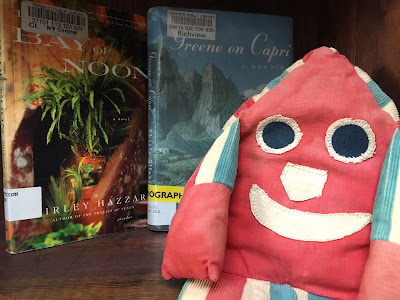
Humpty and Shirley and Italy

I read a couple of Shirley Hazzard books I got from the library recently. I started with:

Greene on Capri

This is a memoir of her and her husband's (Francis Steegmuller) friendship with Graham Greene which came out in 2000. She met Greene on Capri in the late 60s. If you've read any Shirley Hazzard, you will be unsurprised by how she met him.  She and Graham Greene were sitting at nearby tables in a café on Capri. She knew who Greene was by sight, but didn't introduce herself. Greene was discussing a poem of Robert Browning's with a friend, but neither Greene nor his friend could remember the last line, until she supplied it as she was walking out the door. Later that evening she and her husband were dining at the same restaurant as Graham Greene--Capri is a small place--and Greene introduced himself.  It was the beginning of a twenty-years' friendship that lasted until Greene died.

They mostly met on Capri--Greene had a house on the island and shortly afterwards the Steegmullers rented a place (for $70 a month! I learned here. Not anymore, I'm afraid.) where they spent six months of the year.

The memoir is a delight. It doesn't whitewash Greene, who could, it seems, be difficult, and whose best writing was mostly behind him by that point. She was pleased, she writes, that she could genuinely tell Greene she liked The Honorary Counsel, (which is one of the better late Greene books) and is sensible on the strengths and weaknesses in Greene's writing. Greene was helpful in getting one of Steegmuller's Flaubert translations published by The Bodley Head.

The memoir is also a reminiscence of the Capri of that era. Capri has long been a bit glamorous, popular with foreigners, but not yet what it was to become. One amusing story, though, involves Steegmuller trading Russian phrases with an aged woman whom Lenin had tried to teach Russian when she was a girl; her father had been the gardener at the villa where Lenin stayed with Gorky in 1908. The Steegmullers, Greene, and Greene's partner at the time, Yvonne Cloetta, walk up to the Villa Jovis, the fortress from which Tiberius ruled the Roman empire in his later years. (I've been there!)

Both Greene himself and her husband Francis Steegmuller are dead by the time she writes this. It has a melancholic tinge. But she remembers those times fondly and well.

And it ends, as it began, with that missing bit of Robert Browning: 'Or so very little longer.' (from The Lost Mistress.)

The Bay of Noon

Then I read her short novel of 1970. The main events take place a few years after the end of World War II. Jenny, running away from her family, takes a job as a secretary for a commission studying the NATO base in Naples. (Primarily, then as now, the home of the US Sixth Fleet.) She knows no one there, but comes with a letter of recommendation to Gioconda. Gioconda is the author of a novel Del Tempo Felice, that was made into an Italian neo-realist movie. (It gets compared to Open City and The Bicycle Thieves.) Gioconda's lover is Gianni, the director of Del Tempo Felice. Various people around the office feature, her boss, the Colonel, but most particularly Justin Tulloch, a Scottish marine biologist to whom she's detailed for a while. She and Justin trade lines from Sir Walter Scott's Lochinvar at one point.

The novel mostly takes place in Naples, though, of course, they do make it to Capri. It's very good on place:
"An open-air nightclub, wedged into the tufa near my building, lay in wait for its season; and a bedraggled restaurant or two commanded, from scruffy terraces, the incomparable, lake-like prospect of the bay."

I won't say much about the plot. There is a twist, although I have to say I felt like I saw it coming. Still, a good read, even if it's not The Transit of Venus. 

And are my trip to Italy this year for the Rose City Reader European Reading Challenge.

There would have been several good reasons to have read these books last month, but I didn't... I'm reading them now because I just got my copy of the new Shirley Hazzard biography from the library on Friday.


I knew I would want to read it in any case, but I was pleased to see that Steve Donoghue listed it as his best biography of the year. His are really the only end-of-year lists I read, funny, cantankerous, and with (for me at least) more hits than misses.


Wednesday, December 26, 2018

Graham Greene's Doctor Fischer of Geneva or The Bomb Party


Well, nobody would call this Graham Greene's greatest novel, I imagine, or even particularly recommend it as a place to start. But I'm running out of Greene novels I haven't read and this one finally floated to the top of the stack.

But Greene can certainly be great and I liked this one. Doctor Fischer is a toothpaste gazillionaire and a powerful man in Geneva. He's widowed and has a daughter that he's mostly estranged from. He also has a circle of Toads, that is toadies who put up with his cruel practical jokes in exchange for his (valuable) gifts. It sounds a bit like it might be The Magic Christian, but it's much darker (and less funny) than that.

The narrator is Alfred Jones, also a widower, who lost his hand in the London Blitz, and now ekes out a small living from his disability pension and work as a commercial translator. Jones and the daughter Anne-Luise fall in love and marry.

The novel is told in retrospect by Jones and we know that something bad has happened; he refers to both Fischer and Anne-Luise in the past tense. It's not particularly a mystery, but I also don't feel I should spoil it; there's a carefully constructed atmosphere of dread and discovering the nature of the dread provides the drive of the story. Doctor Fischer is a monster, but why and how, and is he justified? Well, those are the questions of the novel.

I think of Greene as a writer concerned with faith and religion and that colored my impression of Doctor Fischer: an all-powerful man with a circle of figures dependent on his every whim. Is that a possible interpretation of the novel? Hmm. Maybe.

Now having read a bunch of Greene novels, I think I'd like to read his biography. Does anybody have a sense of good one? Any particular favorite books by or about Greene?

That completes my list for the My Reader's Block Mount TBR challenge. Probably get one more book in this year, and then I'll need to write a wrapup post.

Tuesday, August 29, 2017

Graham Greene's A Gun For Sale

Graham Greene's A Gun For Sale first came out in England in 1936. It was called This Gun For Hire when it came out that same year in the U.S., and that was the title used for the Alan Ladd/Victoria Lake noir film of 1942.

The first scene takes place in a nameless European country. James Raven, a young man with a harelip, goes to assassinate a minister of the unnamed country, the Minister of War as it happens. But before we're told he's the Minister of War, we're told that he's a socialist, that he's an old man who lives modestly, that he's considerate with his employees, that he's 'said to love humanity.'

All the more to establish Raven as a villain and a monster. The first lines of the book are: "Murder didn't mean much to Raven. It was just a job." After he shoots the minister, he exceeds his brief and shoots the secretary, an older woman who pleads for her life in a language he doesn't understand.

So. He's a villain. Get it?

Naturally things have to be complicated a bit. Raven returns to England where he's paid off by a fat man who loves sweets. But the notes are marked; and Raven, who has little money otherwise, after spending the first realizes he can spend no more of them. From the moment he spends the first one, he's a hunted man. He's naturally pissed about this, and vows revenge on the fat man, and, as he comes to learn, the power behind the fat man, a rich financier.

Raven spends the rest of the novel avoiding the police, and determining and then tracking down his employer. He also comes to understand the point behind the seemingly pointless crime he committed. There's a girl. She begins to see Raven as a more rounded figure just as we do.

The plot is well-done, tautly paced, and makes good use of the international situation in 1936. The movie, which comes out after the war is started, not long after Pearl Harbor, feels forced to update the plot, but it's not improved: the subtlety is lost in comparison to the novel.

Greene calls this one one of his 'entertainments,' implying he thought it one of his lesser efforts, but mostly it doesn't show it, and Greene later decided he was unhappy with the division of his fictional works into entertainments and novels. Raven can easily run with such existentialist killers as Meursault of Camus's The Stranger or Pinkie of Greene's own Brighton Rock.

However, that it's ostensibly a lesser work is not an adequate excuse for the fact that Greene makes that evil rich financier a Jew. Even in 1936. My politics are such that I don't mind rich financiers as evil villains, but not like this. Maybe Albanian Catholic is the answer.

The cover actually suggests the cover artist read the book: that must be Raven on the front, with a handkerchief to cover his harelip, and the building in the back looks like a commercial property, perhaps Midland Steel, where the finale takes place.

Golden Age. Building. My Reader's Block Vintage Mystery Scavenger Hunt.