"The mountains are full of free and ungoverned people..."
-Gen. Alexei Petrovich Ermolov
But there were various attempts to clamp down on that, including by a certain Russian General Ermolov in the early 1800s..."The mountains are full of free and ungoverned people..."
-Gen. Alexei Petrovich Ermolov
But there were various attempts to clamp down on that, including by a certain Russian General Ermolov in the early 1800s...from The Donkey's Ears, part 5, § XIX, opening
What's this I do? A diary or a poem?Or letters to you? Will you keep them by youAs a memento of my love, my blueSeafaring days, and when you're old, read themAll over again, in your favourite chairBy the window? By then much might have changedAnd how might Russia be rearrangedForty years on?...
Aurora's holed below her waterline--Imaginary, midnight Japanese!Our guns were real, but not our enemies...An empire, at its zenith, in decline!
-Part 1, § VIII, l. 1-4
Those Russians; paranoid much, eh?
Dunn set the poem aside for a while, though, only finishing it in 2000. The poem follows the fleet as it sails around Africa, holes up off Madagascar, still a French colony, then sets sail across the Indian Ocean.
Who can postpone or stop this mercilessNear-circumnavigation, this witless sprintOver the oceans to the Orient,To destiny?Madame, I crave your kiss!
Admiral Rozhestvensky survived the disaster, but Flag Engineer Politovsky did not. His last appearance:
I'll have to hurry. Our unarmed transportsWill leave us soon for Shanghai, and with mailIf I can finish this before they sailTo booze and safety and the sexual sportsFor which the city's famous. Not for me!My uniform's been pressed, so if I dieI'll be well dressed, gold cufflinks, black bow-tie,Wing collar, dressed to meet the horrid sea.
A couple of years ago I read Charles King's Midnight at the Pera Palace (looking at 20th-century Turkey though the lens of a luxury hotel/night club in Istanbul) and liked it a lot. More recently I read his Gods of the Upper Air (about American anthropologists, such as Franz Boas and Margaret Mead) and liked it, though a bit less. I didn't manage to blog about either."There is a deep landlubber bias in historical and social research. History and social life, we seem to think, happen on the ground."
Eventually the Ottoman empire grew weaker--and the Cossacks came on the scene. The Cossacks were perfectly happy--and perfectly capable--of conducting piracy on the sea in addition to their raids on horseback. But by themselves they weren't able to dominate the Black Sea. But their piratical successes were one of the things that revealed the increasing weakness of the Ottomans. The Russians took note.
The latter history of the Black Sea is story of the conflict between Russia and Turkey over control of the Black Sea--and the efforts of other players, the British, the French--to keep one party from dominating. The Crimean War, among other conflicts, was the result. Among the results of the Crimean War was an attempt to de-militarize the Black Sea.
The book comes out in 2004 and at that time King was optimistic. There were new environmental initiatives to counteract years of neglect and damage. "[C]onflict among the states of the Black Sea zone is now virtually unthinkable." [p.240] Alas. As Yogi Berra may (or may not) have said: It's tough to make predictions, especially about the future.
Still, it's a pretty fascinating book, even if it needs updating. If you've read his other books you'll know, King likes anecdotes and uses them well. There's some good stories in it and it's pretty readable. And especially now, worth reading.
As King notes in the beginning, six countries currently border the Black Sea; if you counted the countries in the Black Sea drainage area, there are 22 possibilities. Out of all those choices, I guess I won't pick the most obscure... King is a professor in the foreign services school at Georgetown, and at least at the time of this book held the Ion Raţiu chair in Romanian studies. Romania is important in the book, I need to keep up my Romania streak, and so...Romania it is! for the European Reading Challenge.
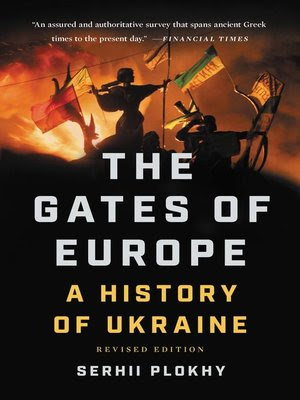
The history begins with Herodotus, which any history that justifiably can ought to do. 😉 The area was not then inhabited by Slavic speakers, but Cimmerians and Scythians, who spoke Iranian languages. Plokhy also makes use of Procopius' history, to discuss the area's relation to Byzantium, but he mostly moves over this period pretty quickly.
Slavic speakers first move to the area as part of the migrations caused by Attila the Hun. (5th or 6th century.) As the power of the Huns wanes, a new state, Kievan Rus' is established covering most of what is now Ukraine, Belorussia, and European Russia. Kyiv is the capitol. The nobles, led by the Rurikid dynasty, are a mix of Vikings and Slavs; the people, mostly Slavs. It reached its political apex under Yaroslav the Wise (978-1054).
It seems the word Rus' (the basis of Russian) comes (via the Finns) from the Swedish word 'ruotsi' used to describe the Vikings as the 'men who row.'
Yaroslav partitioned out the kingdom to his three eldest sons. Plokhy compares this division to that of Charlemagne. Like Charlemagne, Yaroslav did it to prevent inheritance squabbles among his sons, and it succeeded about as well as Charlemagne's attempt did. (That is, not at all.) New successor kingdoms were the result. These fought among themselves and tried to work with their more powerful neighbors (the Khazars, Byzantium). The word Ukraine first appears in the historical record at this time (in the 1180s). Then everything was swept away by the Mongol Horde in 1240. This was the beginning of differences between the various east Slavic states though none of them exactly correspond to three current ones. (Belarus, Ukraine, Russia).
Two east Slavic vassal states are formed in the aftermath of the Mongol invasion. One is Muscovy, with its capital Vladimir (near Moscow) and is the area around Moscow. The other, Galicia-Volhynia, was centred in Kyiv but moved its capitol to Kholm (now Chełm in Poland) and occupied the area of what's now western Ukraine and eastern Poland. The two vassal states received different treatment; the Muscovy state, closer to the Mongol heartland was more oppressed; the Kholm state was allowed a looser rein.
In 1323 the last male heirs (grandsons of the founder) of the Galicia-Volhynia dynasty died. The Mongols were a bit weaker. Galicia was taken over by the Polish kingdom; Volhynia by the Lithuanians. 1386 marks the beginning of the joining of Poland and Lithuania in a commonwealth. But the administration of the two areas remains separate. Plokhy thinks this is the beginning of a separate identity for Belarusians and Ukrainians.
The Cossacks begin as a sort of peasant rebellion in what is now eastern Ukraine, but in 1648 Bohdan Khmelnitsky creates a state (the Hetmanate) out of Polish-Lithuanian lands in what is now eastern Ukraine. Plokhy doesn't play down the pogroms that have left Khmelnitsky as little more than a swear word in Jewish history, but he did create a sort of Ukrainian state. But by 1780 the Hetmanate had been absorbed into Russia. Western Ukraine is split between Austria-Hungary (Lviv) and Russia (Kyiv) during the partitions of Poland.
There's an attempt to set up a new Ukrainian state in the immediate aftermath of World War I, but it doesn't last, doesn't really even get on its feet.
Plokhy discusses the state of education in the Ukrainian language in the various jurisdictions as one of the formative elements of a Ukrainian identity. The ability to use one's native Ukrainian in a public setting comes and goes at the political whim of the various powers. For instance, Austria-Hungary at one point trying to beat back Polish nationalism allows schools to use Ukrainian. Later to placate the Poles, Ukrainian is no longer taught.
Plokhy makes a good case for a Ukrainian identity, which is, of course, like anybody else's, only strengthened by persecution. In the 19th century a number of nationalities were finding their feet; Plokhy does suggest that the Ukrainians were a little late in finding theirs, though they did not really have a state of their own at any point in the 19th century.
I felt like I learned a lot from the book, especially in the time frames that were more obscure to me: the Middle Ages in Slavic lands. Looking at Plokhy's list of publications on Wikipedia, (he's now a professor at Harvard) it's clear one of his real interests is the formation of Ukrainian identity, and I found that the most interesting part.
This is a book for a non-specialist reader. (Like me!) It reads well, but it does cover 2500 years in 360 pages, so there are a few places where it felt a bit thin--World War I, for instance. Still. Full of fascinating and timely and suddenly--unfortunately--much more important things to know. Recommended.