One of the great November challenges is November Nonfiction:
This week's prompt, My Year in Nonfiction, is hosted by Heather.
Past
Readers, let me tell you, the state of our Non-Fiction reading is sound. 😉 I seem to have hit a fairly high (for me) 20% of my reading this year as non-fiction. Some highlights (in the chronological order I read them):
Brigitta Olubas/Shirley Hazzard
This new biography (2022) of Shirley Hazzard was the first book of the year for me. It was a superb literary biography, but I didn't manage to blog about it. I'm a big fan of Shirley Hazzard's novels (The Transit of Venus especially, of course) and when I saw this came out and was getting glowing reviews I had to read it. If you care at all about Shirley Hazzard you will want to read it. (If you haven't already.)
Michael Hingston/Try to be Strange
A history of the notional Kingdom of Redonda, which is a literary in-joke. It didn't get a full review, but it did get a somewhat substantial mention in a Sunday Salon post here. This led to a bit of a reading project, which also included:
Javier Marias/Dark Back of Time
Pretty great, though I am rather a Marias fan. Another book I didn't manage to blog about. It's Marias writing about the reception of his novel All Souls, his history with John Gawsworth, the king of Redonda somewhat before Marias was, and a bunch of other things... I trust some of it was fictional, but I couldn't quite tell you what. The novel A Heart So White remains Marias' masterpiece, but this is one of his better ones.
Victor Gruen/Shopping Town
An autobiography by the Jewish Austrian emigré architect who designed the first shopping mall (outside Detroit). Pretty fascinating. It got a full review here.
James Baldwin/Notes of a Native Son
His first volume of non-fiction. It came out in 1955, and reprints essays he'd written over the previous ten years or so. Fascinating. Literary criticism, what it meant to be Black in the U.S., life in Paris in the 50s. From my Classics Club list, it deserved (and got) a full review.
Anna Comnena/The Alexiad
Anna Comnena's history of her father's reign in Byzantium from 1081 to 1118. A primary source for the place and period, but also, I was a bit surprised to discover, a pretty great read.
Harvey Sachs/Schoenberg: Why He Matters
Another new release. This one's about the 20th Century composer Arnold Schoenberg. There was a review in the New York Times that made me want to read it. The review suggests it's pretty readable and so it was, no technical knowledge of music required. I'm not especially knowledgeable about serious music--my interest in this was because of Schoenberg's importance to Thomas Mann's novel Doctor Faustus. But I did go off afterwards and listen to a bunch of Schoenberg's pieces on YouTube and actually enjoyed them.
There were others, some quite fascinating, that also got blogged about, listed here.
Future
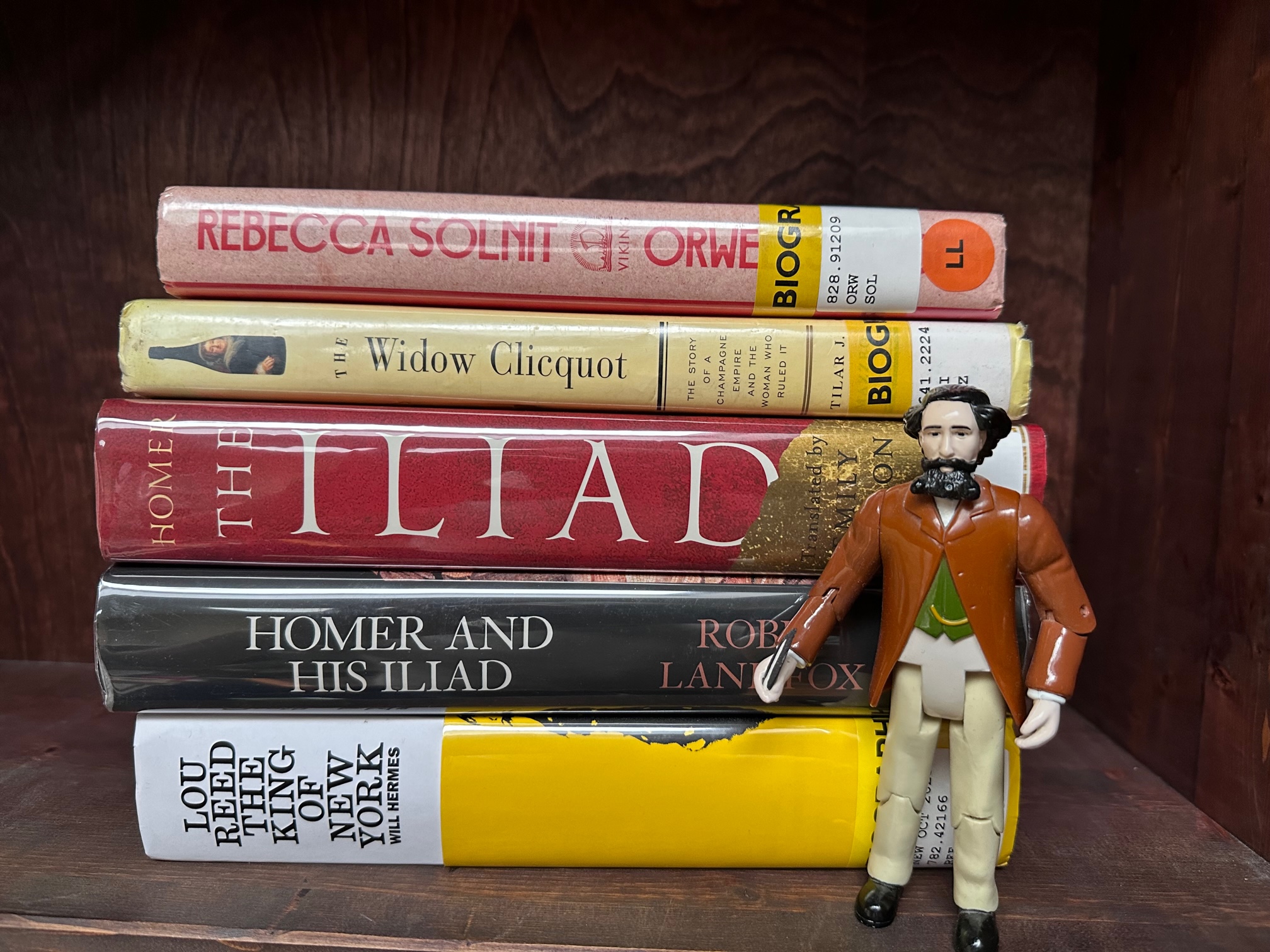
So what's to come for the rest of the year? I couldn't provide a picture of a stack of all those books (because who doesn't want that?) since almost all of those came from the library. But I can provide a picture of the non-fiction books likeliest to get read in the near future (and one ringer...)
 |
| Once again it's Chuck and a stack of books! |
The library has provided Rebecca Solnit's Orwell's Roses, and I'm a fan of hers. One great essayist engaging with another.
Tilar Mazzeo's The Widow Clicquot. She took over the champagne house after her husband died and now it's named for her. I've been interested since I saw the movie.
Will Hermes' new biography Lou Reed: The King of New York. This is the one that will have to be returned the soonest.
Robin Lane Fox' Homer and His Iliad. Lane Fox is a serious classical scholar and an emeritus professor. (At least I think he's emeritus. He's getting up there.) This volume came out earlier this year and is supposed to be for a fairly general audience. I was a classics major, I'm rusty now, but I do try to keep up a bit.
And then the ringer in the pile: Emily Wilson's new translation of The Iliad. I loved her translation of The Odyssey that came out a few years ago, and I've been looking forward to this one. We'll call it the ringer, because I assume it's basically fiction--though Heinrich Schliemann managed to find the original location of Troy by assuming it was true. But I hope to read both the Fox and the Wilson by the week where the prompt is to pair up a non-fiction book with a fiction book.
There are a few other things from the library around here as well...Plus, well maybe, I could read a book I already own...
Present
I'm currently in the middle of a translation of Georg Christoph Lichtenberg's commentary on Hogarth's series of prints Marriage A-la-Mode. Will I blog about it? Maybe! Lichtenberg was a professor of physics at Göttingen in Germany, roughly contemporaneous with (and friends with) Goethe. Lichtenberg is better-known as an author of epigrams, like La Rouchefoucauld, and that was what I more interested in, but this was what my library could produce on short notice.
Which look good to you? Are you taking part in November Nonfiction?