Men in Dark Times is a collection of Hannah Arendt's occasional articles that came out in 1968. The pieces were from the previous fifteen years and cover figures such Karl Jaspers, Pope John XXIII, Walter Benjamin, Hermann Broch, Bertolt Brecht. Despite the title two women are included: Rosa Luxembourg and Isak Dinesen.
Arendt is probably best known for her great book Eichmann in Jerusalem, her controversial report on the trial in 1961 of Adolf Eichmann for his part in the Holocaust. It's the source of the phrase, 'the banality of evil.' She was also a political philosopher and a scholar of totalitarianism.
I pulled this off the shelf to read her essay on Hermann Broch because I was still thinking about The Death of Virgil, but that was actually the least interesting essay in the book: it's the introduction a volume out of the collected essays of Broch, and it was simply too specialized for me.
Some of the other essays are slender: she has some interesting ideas about Dinesen, for instance, but the context was a biography of Dinesen she was reviewing that she didn't think was very good, and that distracted her from the more interesting parts, I thought. Half the essays are translated from German.
But the essays on Benjamin, and particularly on Brecht, were very good. That on Benjamin was from a foreword to the collection of Benjamin essays titled Illuminations, but I thought it would serve as a pretty good introduction to Benjamin, even if you didn't go on to read that particular book. And her essay on Brecht was even better: it was a piece from the New Yorker ten years after Brecht died, and was looking at the state of his reputation at that time, the relationship between his poetry and his politics. Brecht died in a somewhat bad odor; he had been chased out of the United States after World War II for his (never very doctrinaire) communism, and further chased out of West Germany, ending up in East Germany. He was unhappy and unproductive there and most likely afraid in those last years of Stalin. Arendt, the great scholar and opponent of all totalitarianism, sensitively considers the relationship of the work to the political morality of the artist. I wondered to what extent this also reflected her thoughts on Heidegger, who had been her teacher--and lover--in between the world wars, but was later a Nazi supporter.
Recommended particularly for the essay on Brecht.
Showing posts with label NonFic2019. Show all posts
Wednesday, October 2, 2019
Wednesday, September 25, 2019
Why Read Moby-Dick? (#MobyDickReadalong) by Nathaniel Philbrick
Why? Well, because Brona's hosting a readalong, of course!
Actually, I found out about this 2011 book from Brona who read it at the very beginning of the readalong. So I didn't need his answer to the question: I was already committed. But our library had copies and, while Brona's review of the book was not unmixed, I thought I'd take a look. It's definitely worth reading, though not least because it's short. 😉
It's not a full biography, but it does contain useful information about the relationship between Hawthorne and Melville at the time of the writing. He did make me want to read Melville's letters to Hawthorne. I did not know, but there was an earlier draft of Moby-Dick in which there was no Captain Ahab! Melville started on his new larger plan for Moby-Dick only after meeting Hawthorne in 1850.
And Hawthorne started writing The House of Seven Gables when he met Melville. Should I reread that? It would be also be a good #RIPXIV book, but that way madness lies, I fear...
Philbrick is quite interested in tying Moby-Dick to the issue of slavery, though, and I have some doubts about that. Now it is a big question in the nation already in 1850. And I agree that race issues do interest Melville: the opening comic misunderstanding which becomes friendship between Ishmael and Queequeg; or the story of Pip, the cook's boy. And while I have no doubt that whale ships were typically a motley collection of sailors from wherever, the Pequod seems to be particularly international, and that's no doubt deliberate, to represent the world in miniature. So race, yes, but I'm less certain about slavery in particular as a theme. But now I will pay attention to the idea.
And Fedallah as Iago, and Pip as Lear's Fool? Maybe so!
Philbrick has also got some interesting things in his bibliography, though that's another direction in which an Ahab-ian obsessive madness lies...but I did order Delbanco's biography of Melville from the library, so we'll see. I also noticed Philbrick has Charles Olson's Call Me Ishmael: A Study of Melville in his bibliography, which I've been thinking about rereading, but probably not until I finish the novel. I remember the Olson pretty well, though it's been thirty years since I read it (and I hadn't read Moby-Dick at the time.) I thought the Olson didn't seem to have much impact on Philbrick, but then near the very end he writes, (about Moby-Dick's afterlife) "What Moby-Dick needed, it turned out, was space."
Well, after the prologue, Olson begins his study,
"I take SPACE to be the central fact to man born in America,..."I noticed Biblioklept highlighted an earlier post about Olson for Melville's birthday at the start of the readalong, which I enjoyed. So, you know, if you can't wait for my profound thoughts...
Anyway, on with the Pequod!
Wednesday, August 14, 2019
War and the Iliad (#WITMonth)
"It is hopeless to look in the Iliad for a condemnation of war as such. People make war, they put up with it, they curse it, they even praise it in songs and verses, but it is not to be judged any more than destiny is."
-Rachel Bespaloff
![]() |
| A very serious Humpty engaged in some late night lucubrations. |
War and the Iliad, a New York Review Books reissue, contains two essays--by Simone Weil and Rachel Bespaloff--about Homer's Iliad, written in the early years of World War II.
Weil's essay is the first out and the first in this volume; it's published in Vichy France in the winter of 1940/41. The title is 'The Iliad, or The Poem of Force,' and it begins: "The true hero, the true subject, the center of the Iliad is force. Force employed by man, force that enslaves man, force before which man's flesh shrinks away..."
Rachel Bespaloff was already working on her own essay 'On the Iliad' at this time, though she seems to have read Weil's before finishing her own; hers came out in French in 1943.
Both essays are more about the times than the Iliad, though I would say this was particularly true of Weil's. I don't know that I felt Weil was that insightful about Homer's text, but it was powerful and moving about war. It's often considered an anti-war or pacifist document, and while it is certainly anti-war, it's too despairing to be pacifist, I'd say; to argue for pacifism implies a measure of hope that something can be done.
The quote from Bespaloff above is I think partly in response to Weil, but I also think it's closer to the spirit of the author of the Iliad. Homer is not under any illusions as to what war is really like; he does not romanticize it; but it is material for stories; it is possible to behave well in wartime, though so very often men do not.
Both were translated into English by Mary McCarthy with idea that they would be published in one volume, but rights for Weil's essay were unavailable in 1947 so Bespaloff's essay with an afterword by Hermann Broch came out in an edition with Bollingen press. New York Review Books was able to put together the two essays with Broch's afterword and added an introduction by Christopher Benfey in 2005.
I had assembled a lovely pile of novels I thought I could read for #WITMonth, but I'm still thinking about Hermann Broch and I knew this had that final essay by him so that's what came of the top of the stack. I'm still hopeful that at least one of those novels gets read this month, but I also pulled Hannah Arendt's Men In Dark Times off the shelf because it has an essay on Hermann Broch. Half the Arendt volume's essays were originally in English, but half were translated from the German, including the essay on Broch, making it another possible #WITMonth book. I've already read the Broch essay.
And Weil and Bespaloff made me want to reread the Iliad. I was going to wait for the Emily Wilson translation, since I so much enjoyed her Odyssey, but now I may not be willing to wait.
Wednesday, July 24, 2019
C. S. Lewis' The Four Loves
Cleo at Classical Carousel organized a readalong of C. S. Lewis' The Four Loves, which, even though I knew my June was going to be a bit discombobulated, I was excited to join. Cleo has written a series of lovely, thoughtful, and informative posts that were a great help.
And, though I suspect this comes a little late, and I only found it three-quarters through my reading, I found these annotations (by searching for the quote that turned out to be Masefield) to be helpful.
So, having just given you those far more useful and informative posts, I have nothing left to say, right? Actually, kind of...You're better off with those posts than me. But I'll squeeze in a few words around the margins anyway...because a blogger can hardly be usefully silent...
I was dimly aware--I was a Classics major--about the distinction in the Greek language between types of love (storgé, philia, eros, agapé) that we, in English, lump together under the one word Love. Lewis is quite lucid about this, and in particular, I found Lewis' distinction between Need-love and Gift-Love (not concepts that necessarily occurred to the Greeks) insightful. Need-love is that form of Love where we expect something--a child needs nourishment from its mother, and the child loves mother for it; Gift-love is that more purely beneficent form of love that just gives--a mother nourishing that child. (Though more on that later.)
Now Lewis, a Christian, sees a sort of progression in the four types of love: Storgé (Affection) is a more mechanical form than its successor, Philia (Friendship). In turn, Philia isn't as strong a force as Eros (Erotic love,) and the summit is Agapé, sometimes translated as Charity (Caritas in Latin,) though I'd say a bit more complicated than that. (And Lewis would agree.) Lewis didn't express himself this way, but I rather wonder if his un-Greek, but useful terms Need-love and Gift-love could helpfully express the progression. The more advanced forms of love have a smaller portion of Need-Love and more Gift-love. In fact, I might say that any type of love expressed by actual humans has an admixture of Need-love and Gift-love; only divine love is purely Gift-love. Lewis doesn't say that, but I think he'd agree. Human loves, even the largely Gift-love forms of human love, such as charity or the love of a parent for a child, have some Need-love in them: my name will be glorified if I donate the money that leads to a cure for cancer; if I look after Junior now, Junior will help me when I am old and decrepit. Lewis by no means condemns those, but neither are those purely divine forms of love.
Now that I've speculated about what Lewis might have said (but didn't)...😉...I thought I'd also make an observation about the sort of thing he did say. Because he does see that all of his forms of love have both good and bad forms, he tries to distinguish what's good and what's bad. Mostly I would agree with his distinctions. For example one of his early forms of love (Love for the Sub-Human he categorizes it as) is patriotism. Now patriotism these days is a thing I'm particularly suspicious of--too often it seems to be "the last refuge of a scoundrel" and all that. Now Lewis is perfectly well aware there are bad manifestations of patriotism, and he identifies them pretty much as I would identify them, though I do think memorializing Waterloo may be a bit more ambiguous than Lewis seems to think. But where I do wonder is how can we tell the good forms apart from the bad forms? Now Lewis, as I said, mostly distinguishes them as I would, and (*naturally*) that marks him as sensible person. But if somebody should insist the proper form of patriotism involves liking only people of my ethnicity, how do I demonstrate that isn't a proper of patriotism? Unclear.
Later he discusses what are sometimes characterized as 'neurotic' forms of love, though he doesn't like that terminology. Fair enough. I'm not very fond of Freud myself. Freud was more highly rated in 1960, the year Lewis' book came out, than today, though, and it's quite easy now to see Freud as less helpful. Lewis says he might sort through some of the more difficult issues with his spiritual adviser, but that also strikes me as a not very satisfactory answer; spiritual advisers come in all stripes, and he doesn't seem to me to give any guidelines as to how to distinguish the good from the bad in spiritual advisers as well as in manifestations of love.
Well, Lewis doesn't have to answer all the questions--it is a short book--and I certainly don't have the answers myself; only to note that there are still some questions, and, in any case, this post has taken me quite long enough (!) to write.
Thanks to Cleo for prodding me to read this fascinating book!
Sunday, June 23, 2019
The story of Arthur Abdel Simpson, or that lying Eric Ambler
| How about those book covers? No serious books here! |
Dirty Story
I picked up Eric Ambler's Dirty Story (1967) at a charity sale last fall. It's one of the few of Ambler's spy novels I haven't read, and I was happy to find it. It starts in Athens where Arthur Abdel Simpson is a chauffeur, tour guide, and small-time crook. He's got passport trouble, with neither a valid Egyptian passport (his mother's country) nor an English passport (his father's.) The clerk at the English embassy is perfectly well aware of Simpson's criminal record in various countries, and simply refuses to renew his now out of date English passport, claiming his parents were never married. Simpson is left with no choice but to try to buy a fake passport on the docks at Piraeus. For which he doesn't have the money.
His attempt to scheme his way out of this results in various complications that lead to his taking a job as a mercenary in a war between small (fake) African countries over mineral rights.
The exposition was amusing, but took up too much of the novel; the adventure part was compelling and fun, but came a little late in the book, only the last 60 pages.
But it was early in the exposition I realized this was the same protagonist/narrator as in Ambler's The Light of Day, so I pulled that off the shelf.
The Light of Day
The Light of Day (1962) is the much better novel; here Simpson breaks into the hotel room of his client Harper after dropping Harper off at a house of prostitution, and sets himself up to be blackmailed into assisting in some illegal scheme. What is it? Simpson figures it's drugs; the Turkish policeman, Colonel Haki, who detects it almost right away, assumes it's political. The alternate title of the book, Topkapi (also the title of the movie, with Peter Ustinov as Simpson) half gives it away, but I won't say more. Much more thriller, less exposition, with Ambler's signature humor.
I'd read The Light of Day before, a while ago now, and so I didn't realize until I reread it, that Simpson's explanation of his checkered career is almost the same in Dirty Story as it is in The Light of Day. Pretty slack on Ambler's part. It's amusing, but reading them one right after the other is a bit disappointing, but it's the second novel that's the lazy one, of course, not this one.
Here Lies
I've long loved the title of Ambler's autobiography, and when I saw I could get it from the library, I thought, well, now's the time. It dates from 1985, when Ambler was 76, and comes after all of his novels, though he lived on for another thirteen years. It's pretty entertaining.
His parents were puppeteers and performers of musical theater, before his father decided he needed a more stable job during the Depression years. It covers his school years (decent public school education,) his first jobs (manufacturing of electrical equipment--this was full of technical information and often incomprehensible--,) and his war years (mostly with a film unit, writing for Carol Reed or John Huston.) It stops about 1950, but then author biographies often get dull once they're solidly established so maybe that's just as well.
Now I want to see the movie again.
Can't get much more fluffy/summer-y in one's reading than that!
and while I have an unread Orhan Pamuk novel around here, The Light of Day is definitely a Turkey book, so...
Labels:
#20booksofsummer,
Eric Ambler,
Europe2019,
NonFic2019,
Reread,
TBR
Friday, June 21, 2019
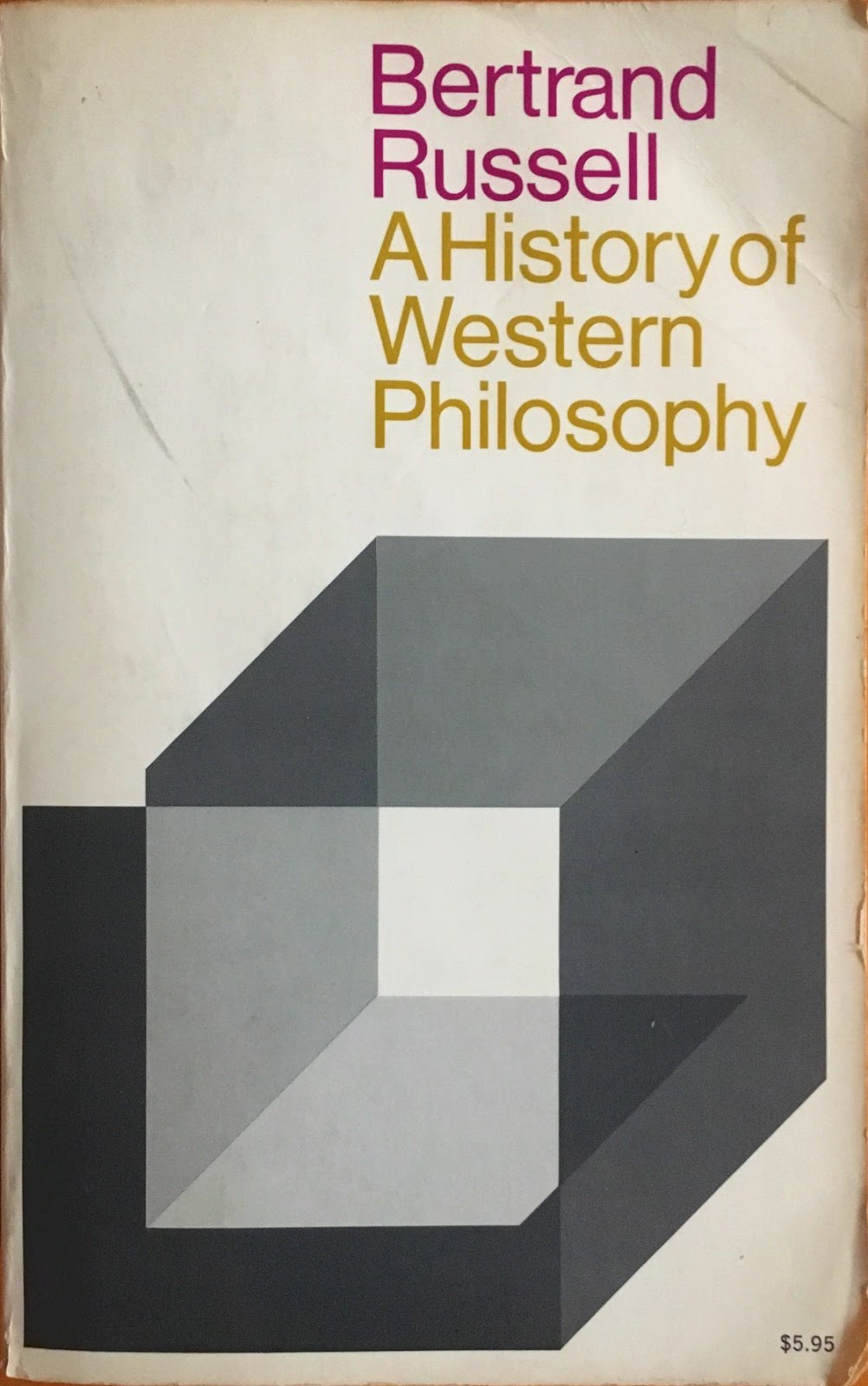
Russell's A History of Western Philosophy
"Many histories of philosophy exist, and it has not been my purpose merely to add one more to their number. My purpose is to exhibit philosophy as an integral part of social and political life: not as the isolated speculations of remarkable individuals, but as both an effect and a cause of the character of the various communities in which different systems flourished. This purpose demands more account of general history than is usually given by historians of philosophy."-from the Preface
"Philosophy, as I shall understand the word, is something intermediate between theology and science. Like theology, it consists of speculations on matters as to which definite knowledge has, so far, been unascertainable; but like science, it appeals to human reason rather than to authority, whether that of that of tradition or that of revelation. All definite knowledge--so I should contend--belongs to science;..."-from the Introductory [Yes, that's what he calls it.]
Some years ago I was beginning to collect the individual volumes of A History of Philosophy by Frederick Copleston, S. J., and a friend remarked, "Why would you read that? Aren't you worried about bias?" and suggested Russell's A History of Philosophy. I sputtered an incoherent argument, but the basis of it was meant to be there's always bias, and we'll need to read critically, though I doubt I actually managed that very well in conversation...But I did get a copy of Russell, too, when I saw it in some used bookstore, though for a long time it lingered unread or just browsed in, as have for that matter most of the volumes of Copleston. But no longer!
As for the bias of Frederick Copleston, S.J., I'm partly educated by the Jesuits, so I am presumed able to see through their wiles, or have experience of them at any rate, or, possibly, am so compromised by them, it's hopeless anyway. You can decide.
So: I've had this longstanding, but at best occasional, desire to have a working overview of philosophy in my head, and have even been known sometimes to do something about it. Russell's book turns out to have been a good addition.
A History of Philosophy is based on lectures Russell gave at the Barnes Foundation in Philadelphia in 1942 and 1943. The book first came out in 1945, and is cited as one of the books that led to his winning the Nobel Prize in Literature of 1950.
A recent review I read of Witcraft by Jonathan Rée said of that book: "Rather than whisking us from one prominent philosophical peak to another, it spends a lot of time wandering the fertile valleys in between them." Russell's is very definitely a work of the peaks. There are a number of philosophers whose names I know (a sign they must have some importance, right?) who don't get mentioned at all.
On those he does mention, he's generally quite lucid, and often witty. For instance, what he says about Kant was intelligible to me, which feels like a major accomplishment. I doubt it's a full picture of Kant, but that he can say something, anything, about das Ding-an-sich, and have it make sense to me, is a very good start, and likewise about a number of other quite esoteric authors, such as Hobbes, Spinoza, Plotinus, Locke. However, I'm not going to summarize Russell's summaries; you'll just have to take my word for it, or try it yourself. Which I do recommend.
There are flaws. Some of these are due to its date, 1945. He says at one point, we can't know that Mycenae and Tiryns were actually Greek; well, yes we can. But he sent me off to Wikipedia to remind myself that Michael Ventris didn't actually solve Linear B until the 1950s, so it is true that Russell could not know that Mycenae was actually Greek. I'm a lapsed classicist, so I'm more attuned to this period, but even in the field of classical studies we do learn things yet. Russell's instincts were relatively sound, I thought. While he couldn't have known about E. R. Dodd's book The Greeks and the Irrational, he would not have been shocked to discover that the Greeks were not paragons of reason, as so often thought.
A bit more problematic is his attitude toward German philosophers. Well, he was writing in the first half of the 1940s, with all that implies. He doesn't entirely accept Kant, but he likes Kant. On Hegel, he's much more condemnatory. I have never managed even a page of Hegel, but was Hegel personally responsible for Naziism? Hmm, I have my doubts. As for Nietzsche, Russell is still under the influence of the idea of Nietzsche of the first half of the 1900s. Whatever one might make of Nietzsche, he is not the same person as his avowedly Nazi sister.
Russell also tries to be fair to the great Catholic philosophers, such as Augustine and Aquinas, but, I'm afraid, can't quite manage it.
And, while I definitely appreciate his intention to place the philosophers into their historical and social context, it does lead to some rather potted recounting of history. His treatment of the dark ages and early middle ages is particularly unsubtle.
Existentialism, which was underway when Russell was writing this, though perhaps not yet in full flower, is completely ignored by him. No Kierkegaard, no Heidegger, no Sartre.
But that's now over-emphasizing the negative. What really struck me about this was how readable it was, and that's why I would particularly suggest it if you're interested in a history of philosophy. Sure, there are flaws. That's inevitable in any work with such a large remit. But this is the book you might actually finish, and, in a history of philosophy, there's a whole lot to be said for that.
Some things that amused me and got copied to my commonplace book:
"The typical romantic removes the bars and enjoys the magnificent leaps when the tiger annihilates the sheep. He exhorts men to imagine themselves tigers, and when he succeeds the results are not wholly pleasant."
"There has been a tendency to think that everything Xenophon says must be true, because he had not the wits to think of anything untrue. This a very invalid line of argument."
"Aristotle's metaphysics, roughly speaking, may be described as Plato diluted by common sense. He is difficult because Plato and common sense do not mix easily."
"There is, in fact, an element of sour grapes in Stoicism. We can't be happy, but we can be good; therefore let us pretend that, so long as we are good, it doesn't matter being unhappy. This doctrine is heroic, and in a bad world, useful, but it is neither quite true, nor, in a fundamental sense, quite sincere."
"Part II [of Hobbes' Leviathan] ends with the hope that some sovereign will read the book and make himself absolute--a less chimerical hope than Plato's, that some king would turn philosopher."
"No one has yet succeeded in inventing a philosophy at once credible and self-consistent. Locke aimed at credibility, and achieved it at the expense of self-consistency. Most of the great philosophers have done the opposite. A philosophy which is not self-consistent cannot be wholly true, but a philosophy which is self-consistent can very well be wholly false."
"The necessity of believing without knowledge, nay, often upon very slight grounds, in this fleeting state of action and blindness we are in, should make us more busy and careful to inform ourselves than to restrain others."Highly recommended, if it's a thing you're looking for.
And there goes one of the larger books on my Classics Club list.
Labels:
#20booksofsummer,
Bertrand Russell,
Chunkster,
ClassicsClub,
NobelLaureate,
NonFic2019,
TBR
Wednesday, April 17, 2019
Valeria Luiselli's Sidewalks
"When the trip was over and I reread my notes, I swore I'd never write anything about Venice, simply because there's nothing more vulgar and futile than encouraging the production of even one more page about the city,...Writing about Venice is like emptying a glass of water into the sea."
In the opening essay, Luiselli visits Brodsky's grave in the cemetery of San Michele in Venice. After some searching, she finds it, giving her the opportunity to ponder dead Venetians and encounter living ones.
Most of the essays are at least partly concerned with place. I don't really know her biography, but from this she was born in Mexico City, lived for a while in Central America as a young girl, and in India as a teenager, and now in Manhattan. In one of the best essays she bicycles around a neighborhood in Mexico City while pondering the meaning of the Portuguese word saudade. (Meaning roughly melancholy? Or maybe not.)
They touch on longing and loss, though are also often funny. Why is it the young are so given to, and often so good at, melancholy? They can still afford it, I guess. I spent much of my late teens moping myself, listening to Townes van Zandt.
Authors mentioned by Luiselli: Joseph Brodsky, W. H. Auden, Cyril Connolly, Fernando Pessoa, Roland Barthes, Gilles Deleuze, Robert Walser, Walter Benjamin, W. G. Sebald, Wittgenstein, Lichtenberg, Borges, Cervantes. If that list of authors sounds good to you, you're going to like this. It does for me and I did.
It was published by Coffee House Press in 2014. It seems ably translated by Christina MacSweeney.
I'd heard of her before, no longer sure where, but I decided to read this now because she was coming to Toronto for an #AppelSalon event. In the end the event was cancelled. Now I'm regretting that. Her novel Faces in the Crowd is on its way to my local library.
Sunday, February 10, 2019
Robert Gerwarth's The Vanquished
"On 23 March 1919 we raised the black flag of the fascist revolution, the forerunner of European renewal. Veterans of the trenches and young men gathered around this flag, forming squads that wished to march against the cowardly governments and against fatal Eastern ideologies, in order to free the people from the influence of 1789. Thousands of comrades fell around this flag, fighting like heroes, in the truest meaning of the Roman word, in the streets and squares of Italy, in Africa and in Spain. Their memory is always alive and present in our hearts. Some people may have forgotten the hardships of the post-war years, but the squadristi have not forgotten, they cannot forget."That's from a speech of Benito Mussolini gave in 1939, and quoted in Robert Gerwarth's The Vanquished: Why The First World War Failed To End. It's pretty representative of why Gerwarth thinks his period is important, and I would agree.
The main period he covers in his book runs from the revolutions in Russia in 1917 until the Treaty of Lausanne between Atatürk's new Turkey and the victors of WWI in 1923. It covers pretty much every country that was engaged in that war, plus a few that weren't (Spain, for instance) but brings all the major events together in a way I hadn't seen before.
Some of them are well enough known, even to English readers, particularly the Russian Civil War of the early 1920s and the negotiations of the Versailles Treaty. Maybe less well-known, but not completely obscure, are the revolutions in Germany that led to the founding of the Weimar Republic, and the Greco-Turkish War of 1919 to 1922, but there are lots of other events are described or alluded to: the war of Irish Independence, the coup in Spain that led to the dictatorship of Primo de Rivera in 1923, the March on Fiume and the Regency of Carnaro, the Hungary of Béla Kun, so many others.
The bio on the back flap tells me that Gerwarth is a professor of Modern History at the University College Dublin, but Wikipedia adds that he was born in Germany and mostly educated there. The (extensive) bibliography includes works in English and German, unsurprisingly, but also Italian, French, Greek, Spanish, Russian, Serbian, and Bulgarian. Does he know all these languages? Yikes! Maybe so. It does seem he's ridiculously competent to write this book.
Anyway, it's a period that interests me, and it's well-done. Recommended, if you're at all interested in World War I, its politics and its impact. The book came out in 2016 and I saw it recommended as one of the best history books of that year by Steve Donoghue of Open Letters Monthly. I can't conceivably keep up with Donoghue's level of reading, but I think he was probably right.
With it touching so many European countries, I could use it for practically anywhere in my European Reading Challenge, and so I will use it for one of the more obscure ones, of course... 😉
It was full of information I didn't know about the Finnish Civil War or the Finnish War of Liberation, depending on how you look at it, of 1918. It also covered the short-lived Republic of Armenia of 1920 and 1921. But one of the most interesting bits was the early history of Latvia when it first established independence at the end of World War I, an independence later obliterated in 1939. Freikorps troops--independent German soldiers--fought against Russian revolutionaries at the instigation of the British and French, but then also fought against Latvian nationalists. And I discovered Marguerite Yourcenar wrote a novel in 1939 about that conflict, titled Coup de Grace. Who knew? (Well, I'm sure there are many somebodies who did, but I wasn't one of them.) So I'm going to call this one for Latvia for my European Reading Challenge.
Labels:
Europe2019,
History,
NonFic2019,
Robert Gerwarth,
TorontoPublicLibrary
Wednesday, January 16, 2019
Stefan Zweig's The World of Yesterday
I have never attached so much importance to my own person that I would have been tempted to tell others the story of my life.
Stefan Zweig was a well-known author when he penned that opening line to his autobiography and he acts on it. It's the least personally revealing autobiography I can think of. His first wife shows up only as an element in the occasional 'we'. If you didn't know she was there, you might think he was being royal. His second wife features in an anecdote about his life as a refugee from Hitler, but she herself is little more present than his first.
We get a little more information about his Jewish parents: his father made money in textiles; he made the transition from shtetl to industrialist. His mother's family was an old banking family. Thus Zweig himself was the second son of a haute bourgeois family. (Though we don't learn anything about that older brother.)
None of that much matters, though; that's not what he's interested in. He's a young man interested in the arts:
"I had not read La Bohéme for nothing, without wishing at twenty, to live a similar life."I find it interesting he says 'read.' The opera I see dates from 1896 and would have pretty brand new when he was twenty; the book is 1851.
Zweig emphasizes his interest as a collector: he searches out manuscripts of Goethe, Beethoven, and Mozart, and particularly those that show the moment of creation, and that's what interests him in his personal life, too. There are various reasons I was interested in this book, but one of them is Zweig's interest in Romain Rolland; Zweig wrote a biography of Rolland in 1921 which I read last fall. He also wrote biographies of Emile Verhaeren, Paul Verlaine, and Sigmund Freud, among people of his own time, as well as various historical figures. He meets James Joyce and offers to translate Portrait of an Artist into German; André Gide visits him at his flat in Paris, and tells him only a foreigner could find so lovely a spot; Zweig helps save Rilke's library, stranded in Paris during World War I; Richard Strauss uses Zweig as his librettist and has to defend the resulting opera against the Nazis; Zweig visits Freud in London and introduces him to Salvador Dalí. Zweig happily puts himself in the middle of the cultural world.
Zweig is endearingly modest about his role; though he knows he's a success, he's not impressed with that part, and what he wants you to think about, and hope for, and work for, is the cultural unity of Europe.
All peoples feel only that a strange shadow hangs broad and heavy over their lives. But we, who once knew a world of individual freedom, know and can give testimony that Europe once, without a care, enjoyed the kaleidoscopic play of color. And we shudder when we think how overcast, overshadowed, enslaved and enchained our world has become because of our suicidal fury.Sadly all too relevant today. He quotes, with approval, a letter from Rolland, written during the first world war:
Je ne quitterai jamais mes amis.and one feels that would be true of Zweig.
But let us hope, especially today, with the chaos of the English vote and the assassination of the Europhile mayor of Danzig, that his nearly final words won't apply:
...my most cherished aim to which I had devoted all the power of my conviction for forty years, the peaceful union of Europe, had been defiled. What I had now feared more than my own death, the war of all against all, now had become unleashed for the second time.I read it in the seemingly anonymous, first English translation of 1943, reprinted in the 70s with a useful introduction by the translator and scholar Harry Zohn. That's what the Toronto Public Library has, but it has been retranslated by the late, great Anthea Bell, which I assume should be preferred.
The other reason this crossed my radar was that Wes Anderson said it was an influence for The Grand Budapest Hotel; who knows what enables Wes Anderson to do the (amazing, IMHO) things he does, but the connection between the two seems a bit tenuous frankly.
Zweig is the great pan-Europeanist so the book could qualify for a number of different countries, but since he was born in Austria, and came later he says to feel a certain Austrian patriotism, I'll count it for Austria for this year's European Reading Challenge:
And at 454 pages, plus a separately numbered preface, it qualifies, although just, as large enough for my Chunkster Reading Challenge:
Labels:
Chunkster,
Europe2019,
NonFic2019,
Rolland,
Stefan Zweig,
TorontoPublicLibrary
Subscribe to:
Posts (Atom)