Showing posts with label Michael Innes. Show all posts

Tuesday, April 20, 2021

March Wrapup

My reading month in March:

Koren Shadmi's Graphical Biographies

The Twilight Man: Rod Serling and the Birth of Television

I saw this reviewed in the New York Review of Books--yes, yes, I'm running behind--and ordered it from the library. I was never particularly a fan of The Twilight Zone--too black and white for me at the age I would have watched the show in reruns--but I liked the graphical style of the clips in the review and the book looked interesting. It was. In fact, really quite good--it got me interested and I might try to see some Twilight Zone episodes. It recapitulates Serling's life story in a narrative frame you might find in a Twilight Zone plot.


Gary Gygax and the Creation of D&D (text by David Kushner)

Looking up Shadmi in my library's catalog, I also came across this. I was a fan of Dungeons and Dragons and so I got this one, too. Though it's Gary Gygax in the title, don't worry: Dave Arneson gets equal time. It was enjoyable, and even though it spoke to me more, I do think it was a less successful work than The Twilight Zone volume. The text is written as if by a dungeon master, or even more, as if it were from that early computer game Colossal Cave/Adventure. (That game's author Will Crowther gets a couple of pages.) "You are in a maze of twisty passages all alike." "You are likely to be eaten by a grue."


The Mystery Department

Michael Innes' Hare Sitting Up

An Inspector Appleby story from 1959. Take identical twin brothers, one a schoolmaster, the other a biowarfare scientist, add a rural lord half(?)-crazed with bird-watching, throw in a blackmailer and a pretty girl with a Ph.D., and you've got a story. It's mostly Innes in his silly mode, which I actually prefer, though Innes does want to say one or two serious things about the morality of WMDs. Not his best by any means, but fun.

Julie Campbell's The Gatehouse Mystery

Trixie and Honey find a diamond in the old gate house on the Wheeler property. Are they going to turn it into the proper authorities? Of course not!

This book has the first appearance of Trixie's older brothers, Brian--and Mart, the snarky one with a propensity toward Brobdingnagian vocables. Always my favorite character. I'm sure I don't know why.

The next in the series is waiting at the library for me to pick it up.

Chester Himes' Blind Man With A Pistol

The last of the Coffin Ed Johnson and Grave Digger Jones mysteries Himes completed, from 1969. This is a very ambitious book, bursting the bounds of Himes' already capacious sense of what a mystery can be. All in 191 pages. Several plots; several time frames. Pretty great & at some risk of sending me down a Himes rabbit hole--I've ordered up the recent biography of Himes from the library. But if you're interested in Himes as a mystery writer, you should probably start with something earlier in the series.

"'There ain't going to be any facts,' Grave Digger informed Anderson."

#BrianMooreAt100

Cathy at 746Books has organized a year long read of Brian Moore's books in honor of what would have been his hundredth birthday. 

Brian Moore's The Color of Blood

Political tensions in an unnamed East European country just before the fall of the Iron Curtain. I thought it was very good. More here.

Brian Moore's Fergus

That I enjoyed The Color of Blood so much led me on to read Fergus. Not as good, I said, though still good.

This month's Brian Moore is the great, but grim, The Lonely Passion of Judith Hearne. Will I reread it? Maybe, but I haven't yet.


The Poetry Section

George Bradley's Of the Knowledge of Good and Evil

This collection came out with Knopf in 1991. A living American poet (b. 1953). The first volume of his I've read--though a couple of these poems appeared in The New Republic in the 80s, so it's possible I read those before. I thought it was very good. Expect something to appear in a poem post in the future. Bradley's poem 'The Lives of the Chinese Poets' begins 'About suffering they were reticent,...' O my Auden

Georgi Gospodinov

Natural Novel, And Other Stories, The Physics of Sorrow

Contemporary Bulgarian novelist, poet, story writer. That's most of what of his is available in English. I think he's pretty good. More thoughts here, mostly on The Physics of Sorrow.

Hilary Mantel's Cromwell

Wolf Hall

I reread this for Brona's readalong, but I'm *still* organizing my thoughts on this one. Not very organized thoughts, eh? I should have finished rereading Bring Up The Bodies to be on schedule, but I haven't...

Shakespeare's Henry VIII

That sent me off to this. Not necessarily one of the better plays, but there are some great speeches--Buckingham's (Act II, Sc 1) on his sentence of death:

The law I bear no malice for my death
'T has done upon the premises but justice
But those that sought it I could wish more Christians

or Wolsey's farewell to greatness.

Andre Alexis

Contemporary Canadian writer. He's four books into a series of five he's termed a quincunx. I read the first, Pastoral (2014). I thought it was very good. A newly minted priest takes up a parish in a small town near Sarnia, Ontario. The second one in the series--Fifteen Dogs--is the celebrated one; it won the Giller, one of Canada's two major novel prizes, as well as various other prizes. I might have more to say when I finish the sequence, at least as it stands now. I have the others on hand.

Euripides

Rex Warner (no relation?--though that first name could so easily slip into...) translated three Euripidean plays with strong female characters in the 40s & 50s: Medea, Hippolytus, Helen. I was interested in the Helen, but then I carried on. Medea, Phaedra, & Helen are all women who do bad or tricksy things and suffer at the hands of men. These are quite often read now as feminist or proto-feminist; would an Athenian of the time have thought so? Mmm. Certainly as Aristophanes presents it (Women at the Thesmophoria) Euripides wasn't popular with the ladies...but then, that's Aristophanes.

No longer the standard translations, but I thought they were quite good. I especially liked Warner's handling of the choruses. He's an interesting novelist (The Aerodrome) and poet, but best known now, I'm guessing, as the translator of Thucydides.

The books that were still around the house (at least when I took the picture):
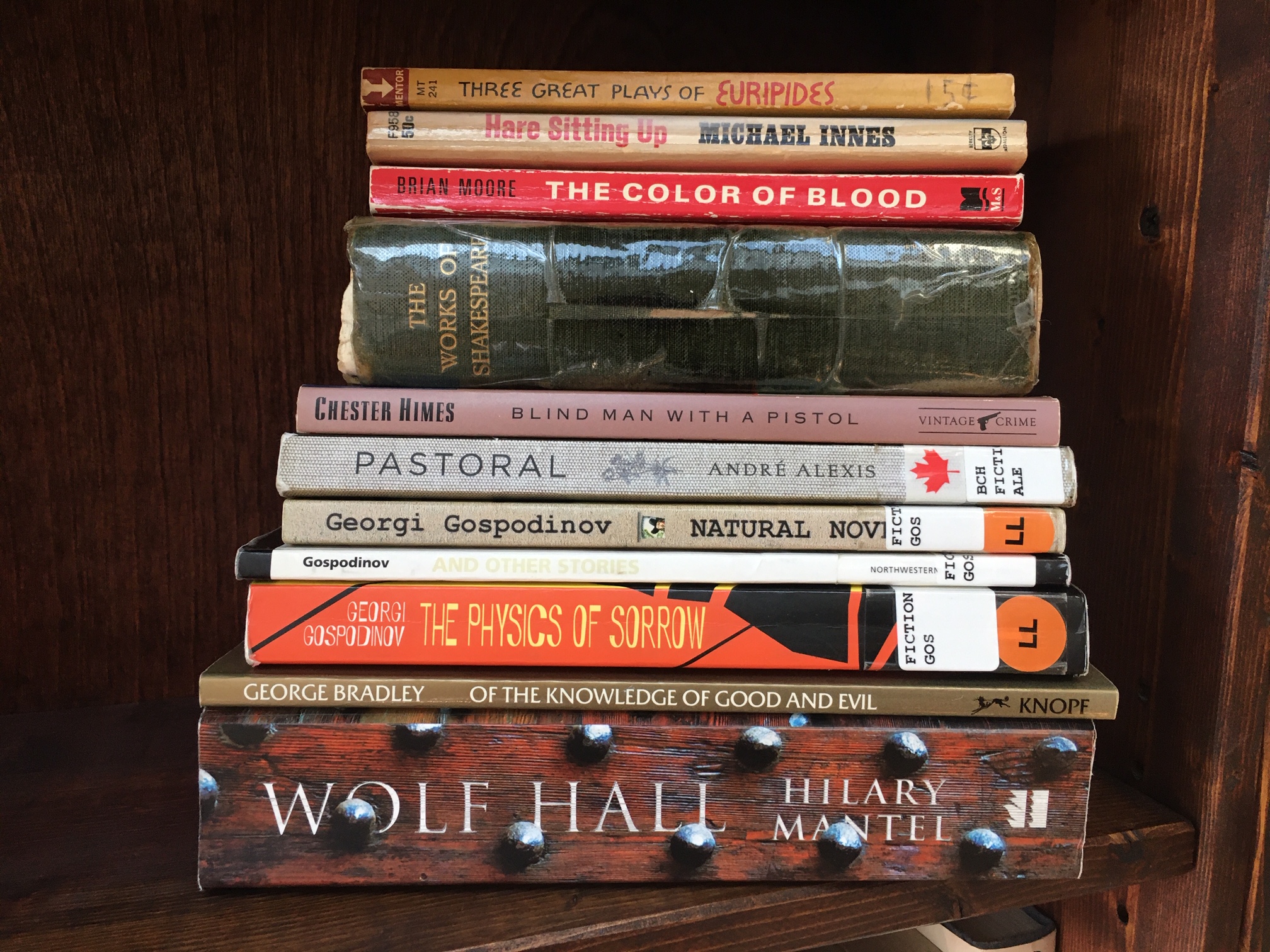
I wrote most of this post a while ago. It was long past time to either delete it or publish it. Yet another month of much, but muddled, reading--I sometimes get embarrassed by the desultoriness of my reading. Oh, well. Any of these strike thoughts in you?


Sunday, August 5, 2018

Michael Innes' The New Sonia Wayward

Oh, what a tangled web we weave
When first we practice to deceive.
Michael Innes' The New Sonia Wayward (1960) could be read as demonstrating that old saw as being completely true.

Colonel Ffoliot Petticate (what a handle!) is sailing off the coast of England with his wife who is generally not known as Mrs. Ffoliot Petticate. No, she's Sonia Wayward, author of intellectually unsatisfying (at least to Petticate) but lucrative romances. And then she dies.

Her death is innocent enough. Colonel Petticate is an ex-Army doctor, and while he's no longer practicing, he's quite sure she's dead. An aneurysm or an embolism, he doesn't have the instruments and he's not sure about the cause. Oh, well. Their marriage was no longer anything more than friendly, and he hadn't really forgiven her for referring to him as 'quaint' when talking to one of her girlfriends.

But for reasons that are not particularly justified, he tips her body into the ocean and proceeds to try to appear as if his wife has just gone away. It will be convenient: he can write the next Sonia Wayward novel (the 'new Sonia Wayward') and keep cashing the checks.

Umm. Complications ensue...

Did his wife abandon him? (Embarrassing.) Did he kill his wife? (Criminal.) Who wrote the new Sonia Wayward? (Fraudulent.) There are some funny bits and Innes can be a successful farceur.

However, I just don't like it when, in a novel, suspense is generated because an otherwise smart person does something stupid, and this one is full of it. We're meant to like Petticate and think him of above average intelligence. Except he keeps failing to show it.

This one is helped along at the end with a couple of amusing, if improbable, coincidences, but the final solution was visible a mile away, I'm afraid. So, for me at least, not one of the better Michael Innes mysteries.

Vintage Mystery Challenge. Silver. Who. In/Retired From The Armed Services.

Which completes the Silver Age part of my challenge. I've got a couple to go on the Gold Age card.

The old saw, which I thought of when I'd barely started the novel, is actually Sir Walter Scott. I didn't know that...

Monday, May 7, 2018

Michael Innes' The Secret Vanguard

The Secret Vanguard is a John Appleby mystery by Michael Innes from 1940 (Not yet Sir John Appleby.)
"Ploss," said John Appleby, deliberately. "Philip Ploss, the Cow-and-Gate poet. Who would want, now, to shoot a quiet fellow like that?"
But that (on page 8) is just about the last mystery-ish moment in this one. It's not giving away much to say he was killed by Nazi spies. It very quickly becomes a thrilling chase for a eccentric scientist with a formula through the Scottish highlands. Speedboats and airplanes--probably to get into the spirit of the thing I should say aeroplane--shootouts and slingshots, crofter's huts and lonely railway stations. A castle and a loch. If, as I said when I reviewed an Innes last week, he's an author that likes to have a model, the model for this one is John Buchan. Think The Thirty-Nine Steps. If it was filmed--and it could be!--it should be Alfred Hitchcock.

It's a very good chase, too, with not only John Appleby, our resourceful man from Scotland Yard, but also a plucky lass and two unworldly academics who come up to the mark when the pressure's on.

However. The plot is thrown into action when two people recognize a misquotation from Algernon Swinburne. Not just one, but two. Alright, Ploss is a poet and he may have an excuse for knowing Swinburne, but the plucky lass recognizes a Swinburne misquote, too. This strikes me as just a wee bit improbable, even in England, even in 1939. (How much Swinburne can you quote? Yeah, me, too.)

Ah, well, Michael Innes is really J. I. M. Stewart, English professor, and (at this point future) Oxford don. I guess he had some Swinburne by heart, and certainly he was able to write a few lines of misquotation that sounded like they could pass to me. Very enjoyable.

Vintage Mystery Challenge. Golden Age. What. Pseudonymous Author. Since he's been outed as an Oxford don.

Monday, April 30, 2018

Michael Innes' Lament For A Maker

Lament For A Maker is the third of Innes' Appleby novels and came out in 1938. Appleby is at a fairly junior point in his career, a detective-inspector; he comes into this one late, and as he says, "It was in no sense--it never in any sense became--my case." His job is simply to round up the initial suspects. Of course he solves it. Or does he? One of the other characters says, "John Appleby, that clever London man, would have it the Guthrie case defeated him." In any case, by the end we know what happened.

J. I. M. Stewart, the man behind the pseudonym Michael Innes, was a professor of English and ended up an Oxford don. Especially in the earlier novels in the series, he tries different styles, borrowing at will from earlier literary works. Appleby's End, one of my favorites, is a pastiche of Stella Gibbons' Cold Comfort Farm, except I prefer it to the original. This one is Innes' take on a Wilkie Collins novel such as The Woman In White or, even more so, The Moonstone.

Both of those are great novels. The Moonstone is high on my pile for rereading at the moment, though it has been a month or two. And both are constructed as documents written by the various players in the book, each in their own style. And there's the rub.

The first document in this is a seventy page narrative written by Ewan Bell, a provincial Scottish shoemaker, and it's written in a nearly (to me, at least) impenetrable Scots dialect. Douce, gleg, stammagasted, dreich, meikle, (alright, I kind of knew that one) quean. I just wasn't prepared for a book where I'd need a dictionary at my side. After that we get narrations from a London swell, a pedantic lawyer, an Australian surgeon, and John Appleby himself. All those were easier but already I was off my stride.

As a consequence the absurdity of the plot struck me more negatively than it might. Evil near twin, amnesia, potential incest, ghosts, mad laird, creepy tower--it had it all and not necessarily in a good way. There were amusing bits, though, and while I saw my way through most of the solution, the final reversal remained a surprise.

So OK, but not my favorite Appleby. (I'd probably plump for Appleby's End.) If you do read it, I found this Scots dictionary to be practically a necessity.

Vintage Mystery Challenge. Golden Age. When. Set During A Recognized Holiday. The first death occurs on Christmas Eve.


Friday, April 27, 2018

Book Beginning: Michael Innes' Lament For A Maker


It will appear in full plain in this narrative that Mr. Wedderburn, the writer from Edinburgh, is as guileful as he's douce - and that he has need of all the guile that Eve passed on from the Serpent may be supposed, him with his living to make among the lawyers. Gleg he is. 

...is the beginning of Michael Innes' Lament For A Maker.

Lament For A Maker is a Detective Appleby novel from 1936, fairly early in the series.

I pulled this one off a pile of unread mysteries earlier in the week, because I needed a book that fit in my pocket for a subway ride. It wasn't too beat up yet, and it was the right size. I didn't realize the first seventy pages were written in Scots dialect and I'd need a dictionary handy. Douce and gleg! Innes has constructed this like The Woman In White or The Moonstone--it's made up of parts by different narrators and our first narrator is a provincial Scottish shoemaker. I'm nearly on to the next section, which looks easier.

I am sometimes a sucker for an unknown word or two, but I wasn't expecting it this time. Would this put you off or interest you?

Book Beginnings on Fridays is a bookish meme hosted by Gilion at Rose City Reader. To play, quote the beginning of the book you're currently reading, give the author and title, and any thoughts if you like. What a gleg old soul I am to figure these words out, but they did leave me fair stammagasted for a bit.