My reading month in March:
Koren Shadmi's Graphical Biographies
The Twilight Man: Rod Serling and the Birth of Television
I saw this reviewed in the New York Review of Books--yes, yes, I'm running behind--and ordered it from the library. I was never particularly a fan of The Twilight Zone--too black and white for me at the age I would have watched the show in reruns--but I liked the graphical style of the clips in the review and the book looked interesting. It was. In fact, really quite good--it got me interested and I might try to see some Twilight Zone episodes. It recapitulates Serling's life story in a narrative frame you might find in a Twilight Zone plot.

Gary Gygax and the Creation of D&D (text by David Kushner)
Looking up Shadmi in my library's catalog, I also came across this. I was a fan of Dungeons and Dragons and so I got this one, too. Though it's Gary Gygax in the title, don't worry: Dave Arneson gets equal time. It was enjoyable, and even though it spoke to me more, I do think it was a less successful work than The Twilight Zone volume. The text is written as if by a dungeon master, or even more, as if it were from that early computer game Colossal Cave/Adventure. (That game's author Will Crowther gets a couple of pages.) "You are in a maze of twisty passages all alike." "You are likely to be eaten by a grue."

The Mystery Department
Michael Innes' Hare Sitting Up
An Inspector Appleby story from 1959. Take identical twin brothers, one a schoolmaster, the other a biowarfare scientist, add a rural lord half(?)-crazed with bird-watching, throw in a blackmailer and a pretty girl with a Ph.D., and you've got a story. It's mostly Innes in his silly mode, which I actually prefer, though Innes does want to say one or two serious things about the morality of WMDs. Not his best by any means, but fun.
Julie Campbell's The Gatehouse Mystery
Trixie and Honey find a diamond in the old gate house on the Wheeler property. Are they going to turn it into the proper authorities? Of course not!
This book has the first appearance of Trixie's older brothers, Brian--and Mart, the snarky one with a propensity toward Brobdingnagian vocables. Always my favorite character. I'm sure I don't know why.
The next in the series is waiting at the library for me to pick it up.
Chester Himes' Blind Man With A Pistol
The last of the Coffin Ed Johnson and Grave Digger Jones mysteries Himes completed, from 1969. This is a very ambitious book, bursting the bounds of Himes' already capacious sense of what a mystery can be. All in 191 pages. Several plots; several time frames. Pretty great & at some risk of sending me down a Himes rabbit hole--I've ordered up the recent biography of Himes from the library. But if you're interested in Himes as a mystery writer, you should probably start with something earlier in the series.
"'There ain't going to be any facts,' Grave Digger informed Anderson."
#BrianMooreAt100

Brian Moore's The Color of Blood
Political tensions in an unnamed East European country just before the fall of the Iron Curtain. I thought it was very good. More here.
Brian Moore's Fergus
That I enjoyed The Color of Blood so much led me on to read Fergus. Not as good, I said, though still good.
This month's Brian Moore is the great, but grim, The Lonely Passion of Judith Hearne. Will I reread it? Maybe, but I haven't yet.
This collection came out with Knopf in 1991. A living American poet (b. 1953). The first volume of his I've read--though a couple of these poems appeared in The New Republic in the 80s, so it's possible I read those before. I thought it was very good. Expect something to appear in a poem post in the future. Bradley's poem 'The Lives of the Chinese Poets' begins 'About suffering they were reticent,...' O my Auden!
Georgi Gospodinov
Natural Novel, And Other Stories, The Physics of Sorrow
Contemporary Bulgarian novelist, poet, story writer. That's most of what of his is available in English. I think he's pretty good. More thoughts here, mostly on The Physics of Sorrow.
Hilary Mantel's Cromwell
Wolf Hall
I reread this for Brona's readalong, but I'm *still* organizing my thoughts on this one. Not very organized thoughts, eh? I should have finished rereading Bring Up The Bodies to be on schedule, but I haven't...
Shakespeare's Henry VIII
That sent me off to this. Not necessarily one of the better plays, but there are some great speeches--Buckingham's (Act II, Sc 1) on his sentence of death:
The law I bear no malice for my death
'T has done upon the premises but justice
But those that sought it I could wish more Christians
or Wolsey's farewell to greatness.
Andre Alexis
Contemporary Canadian writer. He's four books into a series of five he's termed a quincunx. I read the first, Pastoral (2014). I thought it was very good. A newly minted priest takes up a parish in a small town near Sarnia, Ontario. The second one in the series--Fifteen Dogs--is the celebrated one; it won the Giller, one of Canada's two major novel prizes, as well as various other prizes. I might have more to say when I finish the sequence, at least as it stands now. I have the others on hand.
Euripides
Rex Warner (no relation?--though that first name could so easily slip into...) translated three Euripidean plays with strong female characters in the 40s & 50s: Medea, Hippolytus, Helen. I was interested in the Helen, but then I carried on. Medea, Phaedra, & Helen are all women who do bad or tricksy things and suffer at the hands of men. These are quite often read now as feminist or proto-feminist; would an Athenian of the time have thought so? Mmm. Certainly as Aristophanes presents it (Women at the Thesmophoria) Euripides wasn't popular with the ladies...but then, that's Aristophanes.
No longer the standard translations, but I thought they were quite good. I especially liked Warner's handling of the choruses. He's an interesting novelist (The Aerodrome) and poet, but best known now, I'm guessing, as the translator of Thucydides.
The books that were still around the house (at least when I took the picture):
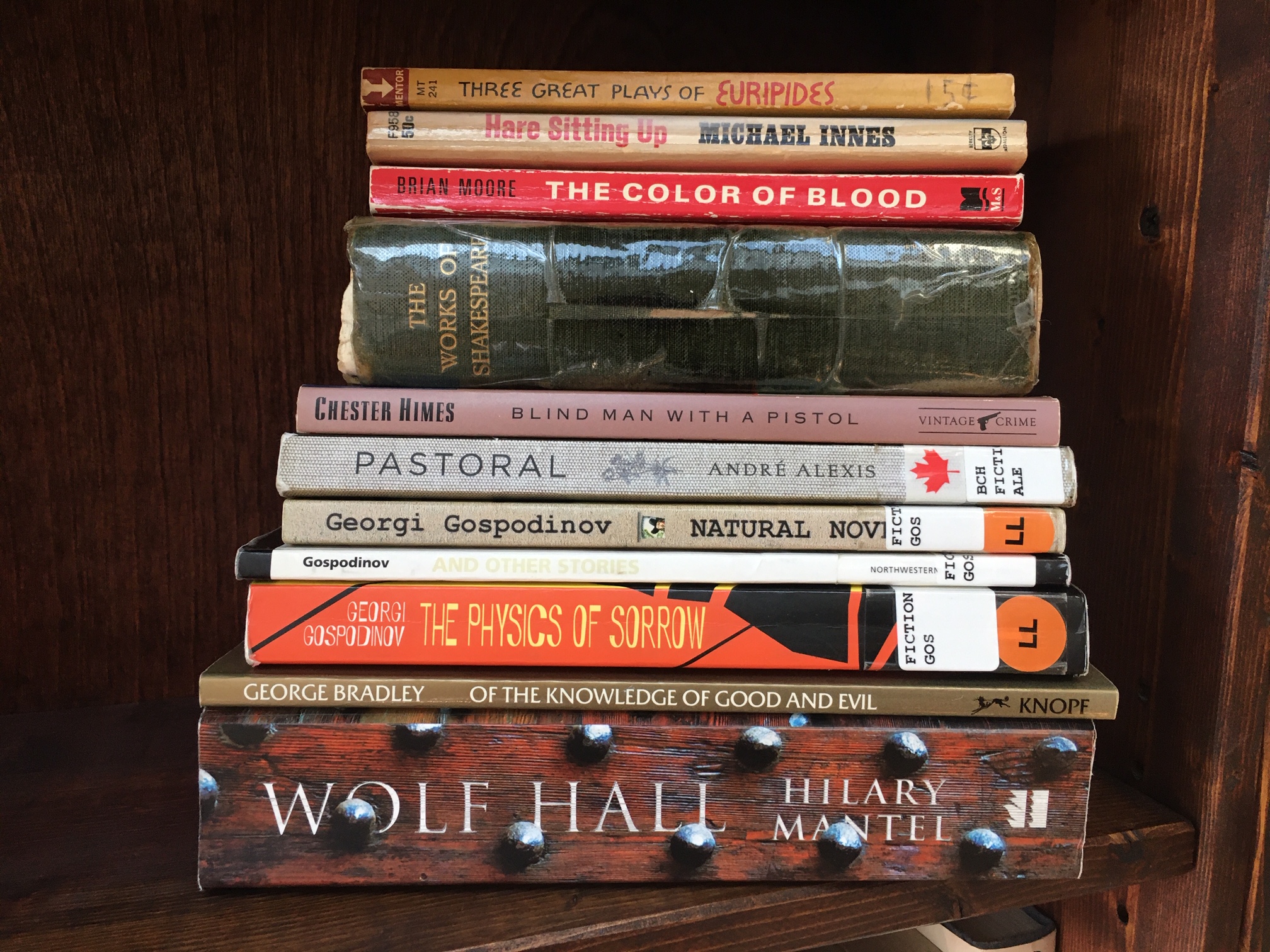
I wrote most of this post a while ago. It was long past time to either delete it or publish it. Yet another month of much, but muddled, reading--I sometimes get embarrassed by the desultoriness of my reading. Oh, well. Any of these strike thoughts in you?

