Showing posts with label Aphorisms. Show all posts

Tuesday, April 6, 2021

Sexta Aprilis: Day Fatality, or Some Observations of Days Lucky and Unlucky

From John Aubrey's Miscellanies Upon Various Subjects

"Upon the sixth of April, Alexander the Great was born. Upon the same day he conquered Darius, won a great victory at sea, and died the same day.

Neither was this day less fortunate to his father Philip; for on the same day he took Potidea; Parmenio, his general, gave a great overthrow to the Illyrians; and his horse was victor at the Olympic games. Therefore, his prophets foretold to him, 'Filium cujus natalis,' &c. That a son whose birthday was accompanied with three victories, should prove invincible.

At the hour of prime, April 6, 1327, Petrarch first saw his mistress Laura in the church of Saint Clara in Avignon. In the same city, same month, same hour, 1348, she died."


Friday, March 5, 2021

February Wrapup

Hmm. Am I going to be a person who now writes monthly wrapup posts? I doubt it, but I'm trying it on for size.

Drugs

Michael Pollan's How To Change Your Mind

About recent research into, and experimentation with, psychedelics. A friend's been recommending this for a while. (Who has acted on it.) It was also, through the weird channels in which my brain works, related to a project I was reading on. When I got it from the library, I wasn't actually sure I would read it, but then the first chapter was full of people I knew, and so I was hooked. I worked, as a computer programmer, for the pharmacology department at the University of Chicago in the mid to late 80s. All those people were no longer researching psychedelics by then, for reasons expounded by Pollan, but they had been.

Pollan strikes me as a pretty good writer of non-fiction, and while LSD and mushrooms aren't really my thing, I'm now inclined to read The Omnivore's Dilemma. Eating meat, while maybe feeling you shouldn't, is my thing, and now I'm curious to see what Pollan has to say.

Aldous Huxley's The Doors of Perception and Heaven and Hell

Unsurprisingly this is an important book in Pollan. It didn't do much for me when I first read it thirty years ago, and it still didn't. I have loved Brave New World on each of several readings, and I keep thinking that some other Huxley book will mean as much. None has yet. I was surprised how much art criticism was in this; that probably all went over my head the first time.

Venice

Cees Nooteboom's Venice

Visiting Venice. Important living Dutch writer and this was really very good. More here.

Donna Leon's Death at La Fenice

That sent me off to Donna Leon. The first Commissario Brunetti story. The mystery was so-so, but the characters and setting are fun. I might also read/reread some Michael Dibdins at some point.

Interlude

Megha Majdumar's A Burning

I really ought to have written about this one at length, but it arrived from the library after a long wait and I wasn't going to be able to renew it. Molotov cocktails are thrown into a commuter train in India, and what happens to various characters peripherally associated with this terror attack. Her debut novel, there's been some buzz, and I definitely enjoyed it. I read somewhere that it has done better in North America than in India. That makes sense to me. Her politics are well-intentioned, but I wouldn't be surprised to learn that an Indian found them shallow while a North American thought them insightful. It's the voice that interested me. It's possible the same criticism could be made (felt shallow there, but impressive here) but I was impressed. I'd read another of hers.

Susanna M. Smith (#ReadIndies)

Susanna M. Smith's How The Blessed Live

It was #ReadIndies month hosted by Kaggsy and I really should have blogged about these on time. I already had the idea of digging into a couple of small Canadian publishers and had these when I saw her announcement. How The Blessed Live is about two fraternal twins and their father. The daughter goes to Vancouver and hangs out with artists; the son goes to Montreal to university. The mother died at their birth, and the father lives in lamentation on an island in Lake Ontario. Isis and Osiris are mentioned. There may have been brother/sister incest.

I mention that mostly because I tend to dislike it in a novel and still I liked this novel. Brother/sister incest goes back to Egypt, to Greece; anything after about Malory starts to feel derivative. I was willing to forgive it here, so that means it must have been pretty well done. A fairly poetic style. This came out with Coach House books in 2002. If I'd written that Coach House books post (this one came from the public library, but I have several other of their books here already) I would also have mentioned how I love, love, love the paper stock they use.

Susanna M. Smith's The Fairy Tale Museum

This book (her second and only other book I believe) came out with Invisible Publishing in 2018, the press I was more interested in (and knew less about) when I ordered them up from the library. A collection of stories on similar somewhat magical themes: a fairy tale museum. (Truth in advertising.) I liked this even better. She retells various fairy tales with a twist and in different contexts. Think, I suppose, Angela Carter.

More stuff related only in my own mind to Propertius

Shakespeare's Henry V

I started it looking for that speech about tennis balls and mockery--and found I had misremembered the line I was looking for. That speech is in Act I and I could have stopped there, but it is Henry V. The second act is weird, but otherwise such a great play. I carried on. We few, we happy few. We are the makers of manners.

Robert Herrick's Poems

Herrick has a more obvious connection to Propertius, maybe not just in my mind. ("Come, I will drink a tun/To my Propertius.") My edition is not complete, a compact thing from Blackie and Son that I probably bought in the U.K. years ago. But it does have a good couple hundred of his (mostly short) poems. Reading it this time, though I was supposed to be thinking about Propertius, the pandemic kept coming to mind:

Stay then at home, and do not go,
Or fly abroad, and seek for woe.

I ask you: could I help it? And, Ted Cruz, were you listening?

Tabucchi

Antonio Tabucchi's Indian Nocturne

Another book I should have blogged about. Novella length. Pretty great. A character much like Tabucchi himself travels to India, both for academic reasons, but also to hunt up an old friend who may be in trouble. We learn about the back story with the friend; we learn about the writing of books. Does he find the friend? Well. Tabucchi was a professor of Portuguese and the story ends in Goa. It's not the equal of his Sostiene Pereira, but then, so very few things are.

Trixie Belden

Julie Campbell's The Secret of the Mansion

I found this in a Little Free Library a few months ago, and thought, wow, I could recapture my childhood. It hung around my reading chair for those few months and then, one night, when nothing else was working, I reread it. I was surprised how well it held up.

I had not yet read Little Women when I read these as a child--I only read that as an adult--and I was surprised at how much this owes to Little Women. Julie Campbell likes the poor little rich kid next door motif so much she uses it twice. It's Honey Wheeler in this one; Diana Lynch is only mentioned in the second book and joins the gang still later. Oh, the chores! And is that Moms? Or Marmee?

Just who is it living in the old Frayne mansion next door? And is there treasure hidden in there? Sleepyside-on-Hudson...not so sleepy any more!

Julie Campbell's The Red Trailer Mystery

I enjoyed that one so much, I ordered up the next several from the library. The Red Trailer Mystery is practically one novel with the The Secret of the Mansion. Jim Frayne disappears at the end of the first; Trixie and Honey and the ever-competent Miss Trask hunt him down--in order to tell him he's inherited a million bucks--in the second. And find some trailer thieves. And help a poor family, who aren't yet dying of tuberculosis, but could be.

More of these to come!

Hazzard

Shirley Hazzard's The Transit of Venus

Let us continue the I-should-have-blogged-about theme. Maybe I even did so, though pretty danged obliquely.

Two Australian orphan sisters, Grace and Caroline, move to England. Their lives. Grace, the sweeter and blonder one, marries the son of an astronomer. Caro leads a life with more detours. This is a novel one needs to read several times before saying anything, but it is a novel one wants to read several times, so maybe that's OK.

Gloom

E. M. Cioran's On The Heights of Despair

Cioran's first book, (1934, tr. Ilinca Zarifopol-Johnston, 1992) originally written in Romanian.

Ha. My heading is probably not entirely fair. Oh, wait, of course it is. I mean, look at the title. "On the heights of despair," the introduction suggests, was a stock phrase from Romanian suicide notices of the time. 

Cioran is an essayist/aphorist in the Nietzschean/Schopenhauerian pessimist tradition.

By no means his best. It felt a little windy. While it's his themes, his later writing in French forced him to pare down. (I suppose. Or maybe he just learned to.) This is also more clearly derivative. Nietzsche is never very far from Cioran, but this reeks of it. Though, correspondingly, there is more appreciation of the Dionysiac in this, it's not all gloom and doom, more than in later Cioran. Nevertheless Cioran strikes me as standing more on his own feet afterwards. It wasn't bad--if you like Cioran--but The Trouble With Being Born remains my favorite. If favorite is quite the right word to use...

That's a month's worth of reading. Actually, for me, probably more than a month's worth under normal circumstances, but what else can you do these days? I'm also in the middle of rereading Wolf Hall and The Adventures of Nicholas Nickleby. Well, when I say middle, that's appropriate enough to Wolf Hall, somewhat less so to Nickleby.

The books that are still around the house

How was your February reading?

Sunday, December 6, 2020

The Life and Opinions of Zacharias Lichter

"One way or another, all philosophical insight derives from an awareness of the mendacious nature of language. In fact, in language, truth is always relative, partial, circumscribed--a fragment of a fragment, an echo of an echo, a mere shadow." [p.126]


That's not an unrepresentative sample from Matei Calinescu's The Life and Opinions of Zacharias Lichter. (1969, tr. Andrea Calinescu and Breon Mitchell, 2018.) It is labeled a novel, but...you were warned.

I tend to be OK with that sort of thing. And while the talk may be philosophical, and the plot near to non-existent, it does have characters. The 'Biographer' who is telling us about Lichter, Lichter himself, and several figures in Lichter's circle: the drunk and silent philosopher Leopold Nacht,  Adrian Leonescu, a specialist in English phonetics, and Doctor S., a psychotherapist, the villain of the piece, if that's not too exalted a term. (He keeps wanting to explain Lichter, to explain Lichter to himself.) A few others. Zacharias Lichter is culturally Jewish, but not practicing.

The book is divided into short chapters, many of which are philosophical treatises in miniature. The quote above, for example, comes from a chapter 'On Lying.' Others include 'Regarding the Devil,' 'Responsibility and Freedom,' and 'On Mathematical Language.' At points it suggested Wittgenstein, if you leave out the math.

Lichter is also a poet, and we see his poems, though Lichter treats his own poetry dismissively. One poem presented in the text, the 'Biographer' tells us he had to rescue from the trash. They're typically held together with a sort of Biblical anaphora. Here's the opening to 'Mouth Full of Flowers': [p.56]

Beggars, lunatics, old friends,
It's been raining so long we have no shelter,
It rains of winter, of spring, and of other seasons,
It rains of thought and death, and without a purpose, it rains
Of fright and of cold words, of words, words.

But mostly, in addition to being a philosopher and a poet, Lichter is a sort of secular saint. He takes up an almost Buddhist begging rather than accumulate possessions. He's kind to the downtrodden and concerned with the aetherial. Lichter, himself, though denies this, saying that the silent (stille? und so heilige? 'Tis the season...) Nacht is the embodiment of love in the world. 

Norman Manea in the introduction says that 1969 was a period of relative liberalization in Romania; the book came out then. Also maybe the censors were too stupid to see. The novel takes place in a no-time, possibly the 1930s, but not very explicitly so, so how could Calinescu be complaining about Ceausescu? Nevertheless Calinescu was not allowed to publish afterwards, and got out of Romania, ultimately taking a position at Indiana University. He died in 2009. 

Life and Opinions suggests to English readers Tristram Sterne's The Life and Opinions of Tristram Shandy, and apparently it does to a Romanian, too. Cioran said of the novel, it's the story of the Baal Shem Tov as told by Sterne. It's not a bad comparison. Lichter is more analytic and less purely genial than the Baal Shem Tov, at least as the latter is presented in Buber and I. B. Singer. But like the Baal Shem Tov, and Socrates for that matter, Lichter doesn't write much:

"The fiery truth can only be transmitted orally." [p.80]

When he does write, he considers it shameful. (Hence, the poem in the trashcan.) 

While it's as plotless as Tristram Shandy, it is plotless in a different way and its prose is quite different. It reminded me of George Gissing's The Private Papers of Henry Ryecroft, though I wonder if Calinescu could even have seen that work. But Gissing's short book has a biographer, G. G. as character, and a series of texts on philosophical or spiritual issues. Ryecroft is more of a nature writer than the urban Lichter. Anyway, Zacharias Lichter is its own thing, and I liked that thing. But it may have been wise on Calinescu's part to keep it short... (145 pages in translation).

"And now, may I ask what moved you to write my biography? Don't you see that my 'biography' is the last thing that could possibly be written? If I knew, at least that you meant to write a fictional life of Zacharias Lichter, so be it!...I predict that the biography you write will be serious and boring, cold, perhaps awkwardly ironic; something fitting only for yourself." [p.144]

Maybe, maybe not...

Nearing the end of the year, but one more for Gillion's European Reading Challenge!


Sunday, October 6, 2019

Sunday Salon


#CCSpin

My Classics Club spin choice was Edith Wharton's The Custom of the Country. It's very good: post coming soon. But Indiana Frusk, Mabel Blitch, and Undine Spragg! I am very glad I don't come from Apex City if I was going to be saddled with a name like that.

Nobel Prize Watch

This is the week. The Swedish Academy were really trying for a while there to destroy the mystique of the Nobel Prize in Literature, but I still get excited for the Thursday announcement. When I was an undergraduate a friend told me I should try to read a living author before winning the Nobel prize. I think that was when I had a stack of Elias Canetti under my arm. But in my defense I was a classics major...

The Italians have a word -- papabile -- for somebody who could plausibly be elected pope. And I do now sometimes read those who could be considered nobelabile, instead of just laureates. The betting shops put Anne Carson on the inside track this year, who would be a very good choice, but I just read the newest (in translation) by one of my favorites, Claudio Magris.


It's a collection of very short essays or observations, from his travels or from around Trieste, and often poignant or funny or both.

Currently Reading

I piled up a stack of books for #1930club earlier this week and started one of the two long ones: Holbrook Jackson's The Anatomy of Bibliomania.

I'm also reading Erich Fromm's The Art of Loving along with Cleo.

Where I Was

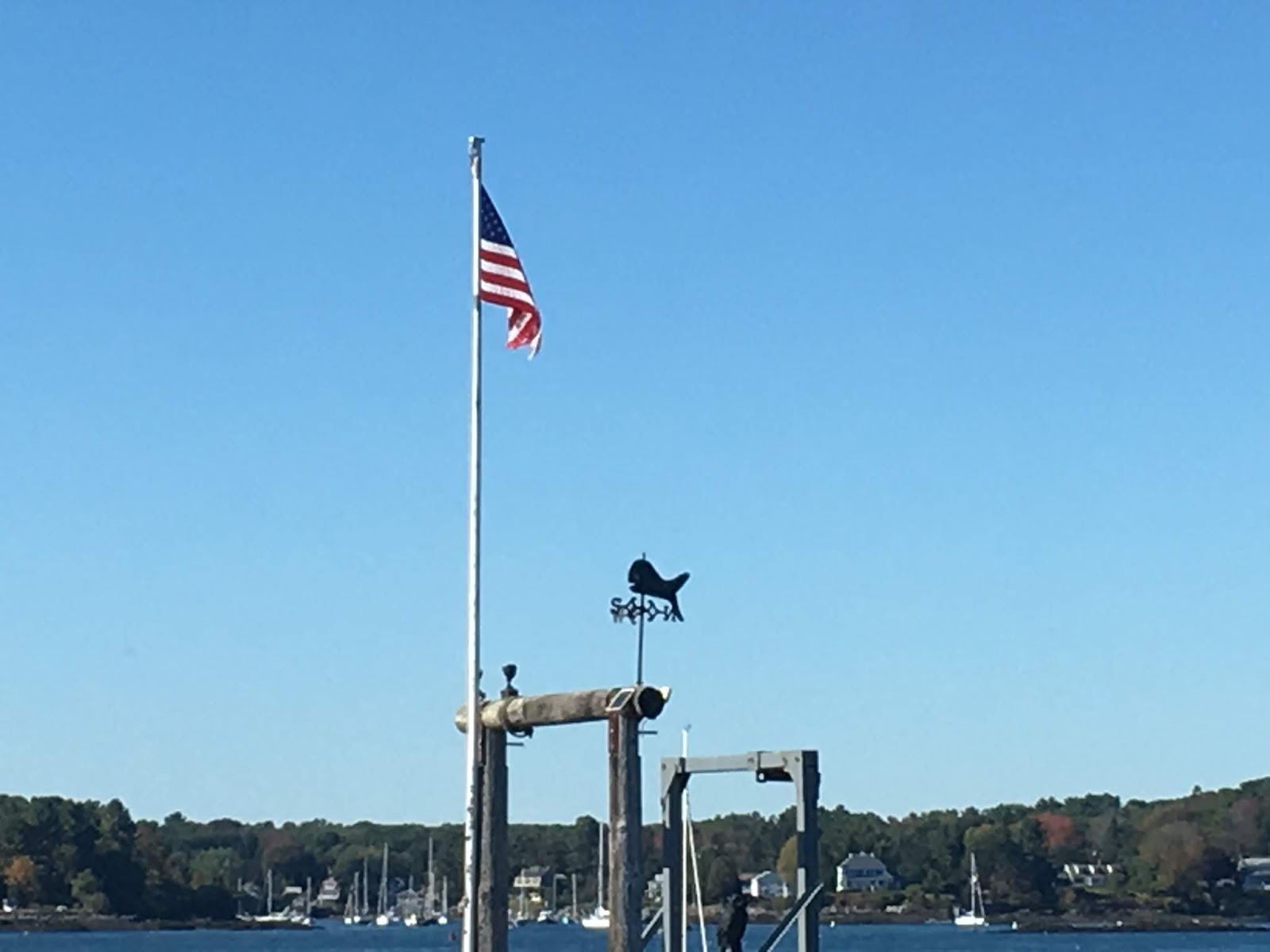
We went to New Hampshire to visit my sister-in-law and brother-in-law. The other thing I'm reading these days is Moby Dick for Brona's readalong, and while Portsmouth, NH, may not quite be the fons et origo of New England whaling, it ain't so far neither. I hadn't paid any attention to it before, but we were greeted by a whale welcome mat, and that wasn't the only opportunity for a #mobydickinthewild picture:


Hope all's well with you!


Thanks to DebNance at Readersbuzz for hosting the Sunday Salon.

Thursday, November 1, 2018

#RIPXIII: Oscar Wilde's The Portrait of Dorian Gray

Hubert contemplates having his portrait painted
I last read this in high school. Mr. Wall, junior year for what we would have called English literature, even though Wilde was an Anglo-Irish. I don't recall if we read anything Scottish (other than the Scottish play, which we did read) but we would have called that English, too.

Well, we were in high school. We probably thought it actually meant something that this was 'Oscar Wilde's most famous novel' as it proclaims on the cover of the edition we used. Yes... As the Other Reader wondered, is it even grammatical to use the superlative when there's only one object?

The scribblings in my high school edition tell me that Mr. Wall pushed hard on the psychosexual interpretation of Dorian Gray. That doesn't surprise me, even now. Later in the year, we read Peter Shaffer's Equus, which may be good on stage, but even in high school I recognized Equus as the most unimaginatively unsubtle portrayal of mother-fixation imaginable. Oh, hey, Dr. Freud! And my marginal notes in this suggest that Dorian Gray was interested in Sibyl Vane because his mother married beneath her. Thank you, Mr. Wall, for your (rather expected) opinion.

One of the reasons I reread this now, after years, was Adam's fascinating series of posts at Roof Beam Reader covering five different theoretical approaches to Dorian Gray. And, of course, the psychosexual isn't all wrong. But there are definitely others and Adam gives a great overview.

However, what struck me most was how many of the great Wilde lines come from this. Wilde is famous for cynical, paradoxical, witty epigrams. They float free of context and could appear almost anywhere. I somehow had it in my head that all these came from the plays, but they're spoken by Lord Henry Wotton in Dorian Gray:
"When her third husband died, her hair turned quite gold from grief."
"To get back my youth I would do anything in the world, except take exercise, get up early, or be respectable."
"...for there is only one thing in the world worse than being talked about, and that is not being talked about."
"...and as for believing things, I can believe anything, provided that it is quite unbelievable."
I had also decided to reread this now for Readers Imbibing Peril; it is, at heart, a gothic novel, with murder, disposal of the body, opium-taking, a Romantic view of the past, and above all, a bargain with the devil, the exchange of one's soul for eternal youth and beauty. But a laugh-out-loud gothic novel filled with one-liners? Only Oscar Wilde.

It is now just after midnight my time, so I'm a little late for RIPXIII. I'm blaming it on the Batmans and Luna Lovegoods and Fairy Godmothers that kept coming to my door earlier tonight...


Thursday, April 12, 2018

La Rochefoucauld's Maxims

Maxims, epigrams, aphorisms, call them what you like: little polished bits of prose that stand by themselves. I've been thinking about them lately.

So what do I think? 1.) That in a collection they can reveal character, 2.) that aphoristic writers tend to repeat themselves over a collection; you might not have said what you had to say perfectly the first time so try again, 3.) that the character type best revealed by aphorisms have changed over the years, 4.) that Nietzsche represents a major point of inflection, 5.) that the attempt to present an argument in fragments, rather than written-through, feels very modern.

Last year I read a collection of aphorisms by the French/Romanian pessimist E. M. Cioran. When you feel that life is going to hell in a hand-basket, the inability to write anything longer than a paragraph feels like the right form: "If disgust for the world conferred sanctity in itself, I fail to see how I could avoid canonization."

I read somewhere that Sarah Manguso's 300 Arguments was an attempt to present a character by the use of aphorisms, so I read that. Though it was not quite what I was looking for, it was very good. "The word fragment is often misused to describe anything smaller than a breadbox, but an eight-hundred page book is no more complete than a ten-line poem. That's confusing size with integrity. An ant is not a fragment of an elephant, except orthographically."

The Portugese poet Fernando Pessoa's The Book of Disquiet was one of the best things I read last year. Pessoa may not have intended it to be a book of fragmentary aphorisms, but that's the way it is for us. "I'm astounded whenever I finish something. Astounded and distressed. My perfectionist instinct should inhibit me from finishing; it should inhibit me from even beginning."

In Christopher Miller's Sudden Noises From Inanimate Objects, a very amusing novel, the narrator plans to write a book of aphorisms. None of the aphorisms from his putative book show up, but he does write this: "Life is a gift, and like most gifts it isn't what you would have picked out for yourself, but you have to act pleased with it."

As for the Duc de la Rochefoucauld. His Maxims (1665) is not very modern, but he was writing during the reign of Louis XIV of France, the Sun-King. One wouldn't expect him to be. But he stands at or very near the head of the aphoristic writing tradition. It's easy to imagine him delivering his witty and cynical bon mots in the company of other men dressed like the dapper gentleman on the cover of my edition. Like, for example, maxim #93: "Old men love to give good advice to console themselves for not being able to set bad examples."

I could say more, but then, I shouldn't go on and on, should I?

Thursday, September 21, 2017

Fernando Pessoa's The Book of Disquiet


Pessoa's The Book of Disquiet is a book I just want to copy out passages from:
It's human to desire what we need, and it's human to desire what we don't need but find desirable. Sickness occurs when we desire what we need and what's desirable with equal intensity, suffering our lack of perfection as if it were a lack of bread. The Romantic malady is to want the moon as if it could actually be obtained.
I left my room with a great goal in mind, which was simply to get to the office on time. But on this particular day the compulsion to live participated in that other good compulsion which makes the sun come up at the times shown in the almanac, according to the latitude and longitude of each place on earth. I felt happy because I couldn't feel unhappy.
Perhaps my destiny is to remain forever a bookkeeper, with poetry or literature as a butterfly that alights on my head, making me look ridiculous to the extent that it looks beautiful. 
We may know that the work we continue to put off doing will be bad. Worse, however, is the work we never do. A work that's finished is at least finished. It may be poor, but it exists, like the miserable plant in the flowerpot of my neighbour who's crippled. The plant is her happiness, and sometimes it's even mine. What I write, bad as it is, may provide some hurt or sad soul a few moments of distraction from something worse. That's enough for me, or it isn't enough, but it serves some purpose, and so it is with all of life.
These are my Confessions, and if in them I say nothing, it's because I have nothing to say.
I could have copied out an entirely different set of passages, and in fact the passages selected changed from the ones I noted in the back of my book as I went to look them up for this post and began rereading at random. I expect -- I would hope -- the next time I read the book, I would be struck by an entirely different set of passages.

Fernando Pessoa was a Portuguese writer who died in 1935. He wasn't entirely unknown during his life, but he was primarily known then as a poet; at his death he left a trunk full of other poems plus prose pieces. One group of the prose was marked for inclusion in a project called The Book of Disquiet. This book was never completed, but there was enough that looked like it should belong to produce the 450 page volume that I read.

Pessoa often composed his poems and prose in the voices of imagined characters. He called them heteronyms. These heteronyms were generally given their own biography, more or less developed. The Book of Disquiet was to have been written by Bernardo Soares, an assistant bookkeeper, who wrote not very successful short stories, and there are places where the entries reflect that biography.

The edition I read was the Penguin, translated by Richard Zenith in 2001. There's a new translation by Margaret Jull Costa as well that came out just this year. One interesting distinction is that Zenith chose to arrange the sections thematically; the new translation arranges them by date of composition. Either arrangement involves guesswork: the thematic choices are obviously Zenith's, but not all the pieces are dated. Jull Costa seems to me a wonderful translator (she translates Javier Marias among others) and her edition has the advantage of being able to use the most recent Portuguese edition and scholarship. I do think I'd like the thematic arrangement better. But still  I now want to read her translation as well.

My Reader's Block Mount TBR Challenge