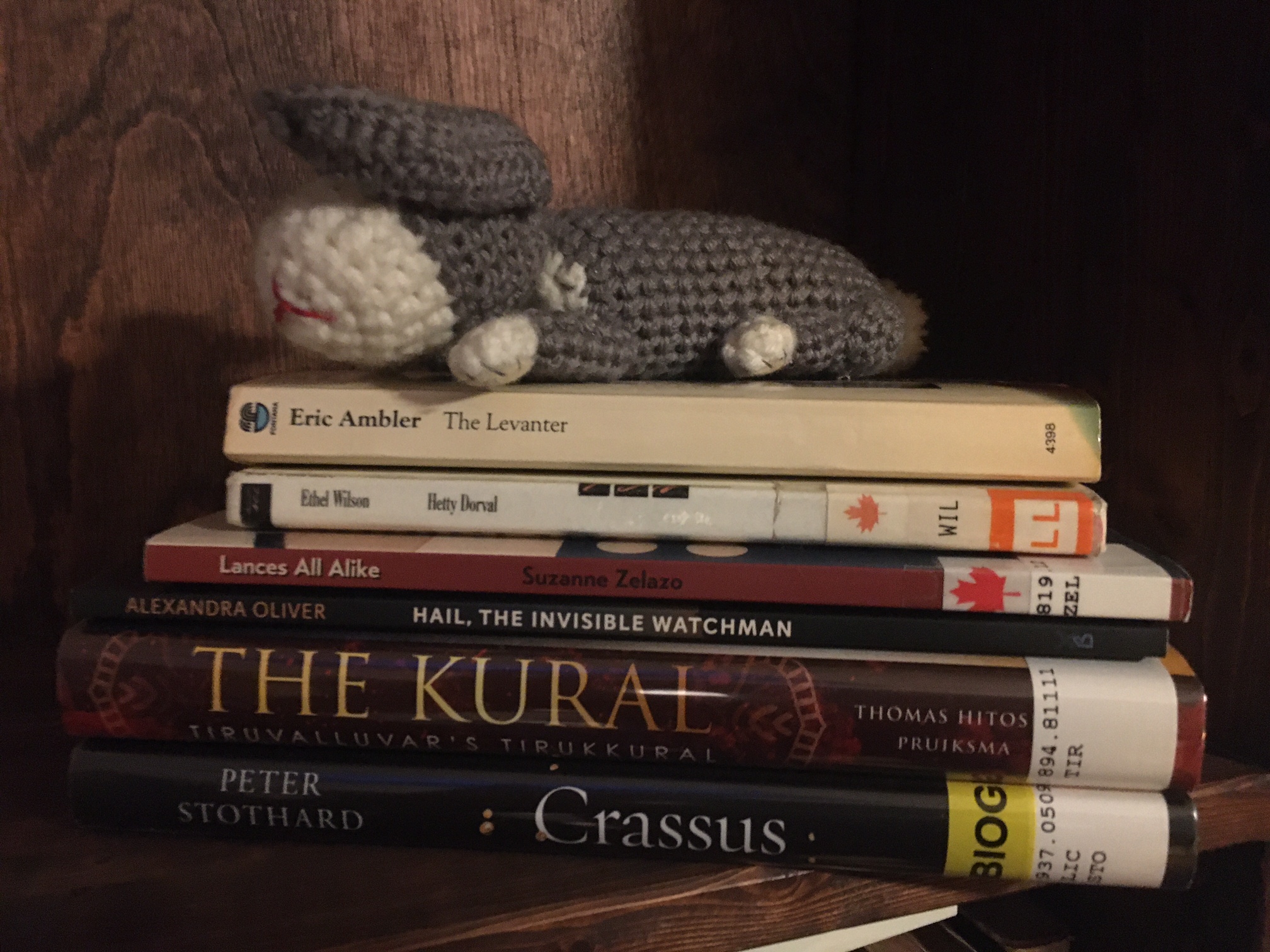
Another of the great November challenges is Novellas in November. The first prompt is an overview of novella-reading from the last year. So, on with a few highlights!
The Man Who Was Thursday is G. K. Chesterton's mystery-ish novella of 1908, well before his Father Brown stories. Gabriel Syme, a Scotland Yard agent, becomes Thursday in a circle of anarchists; the mysterious Sunday is the leader. Syme is out to expose Sunday and does so in the end, but what does that signify? Was there really ever a plot? It's both thriller, but also a bit of an allegorical Piers-Plowman style of story. Entertaining and very Chestertonian. I gave it a fuller review here.Ethel Wilson's Hetty Dorval of 1947 is Wilson's first book, and a CanLit classic. The teenaged girl Frankie Burnaby is fascinated by the mysterious Mrs. Dorval after she moves to their small town in British Columbia. Mrs. Dorval seems sophisticated--maybe she's too sophisticated? (She is given the first name Hetty/Hester; think The Scarlet Letter or Adam Bede.) I'd sort of long known of the book, but read it this spring for the first time, because Alexandra Oliver's most recent volume of poetry, Hail, The Invisible Watchmen, includes a sonnet sequence based on Hetty Dorval. The novella is pretty great. (And well worth a sonnet sequence.)
Maggie Millner's Couplets: A Love Story is a verse novella that came out earlier this year. Our (female) artsy NYC heroine has a steady boyfriend, but then falls in love with an older woman. I don't know that I thought the story was astonishing, but it was entertaining enough, and I quite enjoyed the poetry, which is written in a series of (Heroic? Un?) couplets, appropriately enough. I quoted a stanza and discussed it at more length here.
Lots of Golden Age mysteries are probably effectively novellas; certainly Israel Zangwill's The Big Bow Mystery is. I read the text from Project Gutenberg, and just now copied it and subjected it to a word count. Approximately 43000 words. It came out in 1892 and is a very early locked-room mystery, one of the classics of the genre. It got its own post here.
But, hey! how about a couple of short non-fiction works, too?
I've read it a few times, but once more didn't seem to hurt. And it is short. Susan Sontag's Illness as Metaphor is about tuberculosis and cancer (she wrote a sequel about AIDS) and the way we make metaphors out of diseases--things that are really not metaphors--but bacteria, or viruses, or cellular malfunctions. It's also a very hidden autobiography--she wrote this after being diagnosed with the breast cancer that went on to kill her some years later, but doesn't mention it at all in the book. One of her main examples of illness as metaphor is Henry James' The Wings of the Dove, whose Milly Theale dies of tuberculosis. I reread Sontag after reading the James, and discussed both (and a few other odds and ends) here.But what's past is prologue (as the master says...) What novellas might I read this month? We have a picture for that, of course!
![]() |
| Mr. Dickens says, But these books are all so short! |
Elizabeth Smart/By Grand Central Station I Sat Down and Wept
Another classic CanLit novella. About her long-term affair with the British poet George Barker. (I believe.)
Cesare Pavese/The Moon and the Bonfires
Our hero leaves Italy for the U. S. early in the Fascist era and returns only after the war is over. What's changed?
Boris Pasternak/The Last Summer
Don't know much. 😉 The back of the book says, "Set in the winter of 1916, The Last Summer has an autobiographical basis." That, and it's shorter than Doctor Zhivago.
Patrick Modiano/So You Don't Get Lost in the Neighborhood
That makes two Nobel prize winners on this list. Hmm...
Which look good to you? Are you taking part in Novellas in November?