Showing posts with label #TBR2019RBR. Show all posts

Monday, August 26, 2019

Ngaio Marsh' Overture To Death (#20BooksOfSummer)

Overture to Death (1939) is a classic village mystery from the golden age: there's Jernigham, the master of the local manor house; his son; Copeland, a rather high Anglican rector; his daughter; the village doctor; the husbandless Mrs. Ross; and two absolutely impossible (but amusing!) spinsters.

You know what happens to the son and daughter, of course...

It's one of the spinsters who gets murdered, though there's a question if the other one was the target. The event takes place an amateur theatrical performance for the benefit of the local church. Miss Campanula sits down to play the piano for the overture, and well, consider the title.

I found this one very amusing; the two spinsters and their rivalry was very deftly handled, very amusing. The lovers were believably plagued. Marsh knows her theatre and her writing on casting and rehearsals was hilarious and altogether believable. The list of possible suspects was small and it was pretty clear who had done it, but the cluing was very well done.

Marsh wrote thirty-three mysteries involving her detective Roderick Alleyn and I've read ten or so; this jumped to the top of the list of those I've read, and the interwebs (at least in the form of the late mystery blogger Noah Stewart) seem to agree. Recommended!

An entry in the Just The Facts mystery challenge hosted by Bev at My Readers' Block.

Golden Age. When. During a performance of any sort.


Tuesday, August 6, 2019

The Last Manly Man (#20booksofsummer)

"For weeks after my reported death, I made light of it with friends, asking them, 'Where were you when you heard I died?'"
Well, it is a Book of Summer
Robin Hudson is a reporter and unit leader for ANN, a cable news agency. She's doing a series on the Man of the Future, in which she talks to an anthropologist, the founder of a multi-level marketing company, a specialist in great apes, and a feminist predicting the demise of men. Except she gets distracted into a murder investigation. The subjects of her story are also the suspects in her murder investigation. Such are the rules of mystery novels...

Since that's the opening sentence of the novel I give above, we know she's reported dead for a while, but isn't. By the end of the novel, the murderer is revealed, although this is less by her Holmesian cleverness than by her reportorial persistence.

The story involves bonobo chimps, atavistic males, and Manhattan, as the cover kind of gives away.

This is the fourth of Sparkle Hayter's comic mystery novels starring reporter Robin Hudson, and it came out in 1998. I read the first three more or less when they came out, but then somehow lost track of them. There was only one more written (which I haven't read) but when I saw this at a charity sale last year I reminded myself of the series. It won't change your life (at least I think I hope it won't...) but it is fun.

One thing that did surprise me was how much of a period piece it now feels. ANN is a stand-in for CNN where Hayter worked, and its business was growing at the time; now not so much. In the novel everybody uses beepers. Pheromones, the attitude toward AIDS, the distinction between separatist and sex-positive feminists. All these things haven't gone away, but they just don't seem as much in the news. I've reached an age where twenty years doesn't seem like it should be that long a time, but I guess the world has changed...

This is the eleventh book from my list for #20booksofsummer, though I've read another six not on that list. I knew I wasn't going to be very good at keeping to a list!

Wednesday, July 10, 2019

The Luminaries

Eleanor Catton's The Luminaries won the 2013 Booker prize. So, you know, you probably don't need me to say nice things about it. But I will anyway... 😉

It's set in 1866, the time of the gold rush in Hokitika, New Zealand, with some flashbacks to a year or so earlier. A dozen men, mostly white, but with one Maori and two Chinese, discover events that seem to implicate them in crimes or diminish their public reputation; it looks like a malign conspiracy, but could any conspiracy be so far-reaching? They decide to meet quietly to discuss, pool their knowledge, and see if they can determine what happened. A thirteenth man, Walter Moody, a young lawyer, happens upon their assembly by accident, and then leads the investigation.

The prose is extravagant, but the pacing is still superb: it's clear to me that Catton is a devoted reader of mysteries: twelve men determining the actions of a villain (if there is one) suggests a jury as well as a certain Agatha Christie novel you may have heard of...; at one point Walter Moody suggests what better place to hide a body than in a coffin (paging Ellery Queen!); and a mention of one red herring (Oh, Ms. Sayers!) made me check to see if that was an anachronism in 1866. (It's not.)

But at the same time Catton writes with the personable omniscient voice of a Victorian like Thackeray:
"Let the man speak for himself!" Nilssen snapped. "What's going on?" 
We shall omit Mannering's answer to this question, which was both inaccurate and inflammatory; we shall omit, also, the ensuing discussion, during which Mannering and Nilssen discovered that their purpose in journeying to Chinatown was one and the same, and Frost, who could intuit quite plainly that the commission merchant was holding him in some suspicion over the sale of the Wells estate, maintained a rather sullen silence. The clarifications took some time,...
I found it an engaging voice and a compelling read, and funny as well. But it also has real darkness to it, too: Catton does not soft-pedal the casual sexism and especially racism that would have been all too common at that time; nor, unlike say in Dickens, does she particularly fix things up at the end. Racist acts in particular have no repercussions, alas, a thing all too true to the time and place, I'm sure.

It begins with an astrological chart, and the plot, according to Catton's afterword, is actually partly determined by the horoscopes she cast. Now that part is very un-Victorian, and rather pomo-ish, something like Calvino's The Castle of Crossed Destinies. I'm afraid all that went over my head, though I didn't really mind. I read most of it while off the grid, with no internet access. I'm an Aries, and that's about the extent of my astrological knowledge.

I did find the second half, the unwinding and explaining of what the 'conspiracy' was a bit slower than the first half; there weren't quite enough revelations there, but it didn't matter: I was already completely hooked...

One of my #20booksofsummer, and here's the summer-y location where I was when I read it...


Saturday, April 6, 2019

Young Man With A Horn (#TBR2019RBR)

"Sensitive students of music go one of two ways when they hear a really great performance; young violinists, specifically, come away from a Yehudi concert feeling either that they'd better take up tennis or else get more time somehow to practice. Rick was with the last class..."
Young Man With A Horn (1938) is Dorothy Baker's debut novel about Rick Martin, a budding jazz trumpeter in the 1920s. The novel starts with him as a young orphan in L.A., raised with no oversight by an aunt and uncle. Rick stumbles on a piano in a Salvation Army hall and teaches himself to play, until the Army realizes he has no real business there. At the age of fifteen or so, working as a pin-setter in a bowling alley, he meets Smoke Jordan, a black drummer five years his senior, doing the janitorial work:
"When he pushed a broom nothing much came of it; he had developed a style of sweeping that was good to listen to from start to finish. It had its drawbacks, however, from a utilitarian standpoint; it raised an awful dust and it didn't get anywhere."
It's Smoke who's his entrance into a more committed world of jazz. Rick learns piano from Jeff Williams, a young black leader of a small combo; Smoke eventually takes over the drums for Williams' combo when the first drummer dies of appendicitis. Rick, though, decides he wants to play trumpet, mostly for its portability, and he studies under Art Hazard, the combo's trumpeter. He gets good. After the Jeff Williams combo moves to New York, Rick plays with a couple of other groups, moving his way up the food chain. Eventually, with a white band, he gets to New York himself.

Baker says, in a headnote, her novel about Rick Martin is based on the 'music, but not the life' of the jazz cornetist Bix Beiderbecke, but it does follow the life of Bix in one important detail: it ends all too soon.

I think Baker writes well about the interaction between blacks and whites. Rick is raised to be casually racist; it wouldn't have been uncommon then, of course, leaving aside just how common it is now. But it didn't sink deep in Rick, and when he meets actual black people, who are nice and know things he values and wants to know, he's a bit puzzled by his reactions, but with some struggle is able to overcome them. It's pretty clear to me Baker had been reading Huck Finn.

The narrator is a person in the story, unnamed, and taking no part in the action, but still close to it. The narrator opens:
"What I'm going to do is write off the story of Rick Martin's life, now that it's all over, now that Rick is washed up and gone, as they say, to his rest."
Baker also writes well about jazz, informed without being didactic. Early on, the distinction between New Orleans-style and Memphis-style is a point, made clearly in the narrator's voice; musicians discuss technical points in a style authentic, but still lucid.

Rick's final words:
"This is sad; but so is everything, and in the end there is another thing to say about it. The good thing, finally, is to lead a devoted life, even if it swings around and strikes you in the face."
Anyhoo, another successful reissue from New York Review Books. Very good. Reading back over, my description fails to note it can be quite funny so I'm squeezing that in, too. Really my only complaint is the naming of the characters. Rick Martin? Jeff Williams? Might as well have been John Smith. I'm not really convinced by the aggressive Everyman-ish quality of the names. The ability to name characters interestingly is a useful skill and one Baker either didn't have or decided to forgo.

There was a movie made in 1950 with Kirk Douglas as Rick Martin, Dorothy Day as a singer, and Lauren Bacall as Rick's sometime love interest. I haven't seen it, though I'd now like to. The movie gets whitewashed, unsurprisingly I guess; none of the major characters in the movie are black, though they certainly are in the book. There's a hint, though little more than that, that the Lauren Bacall character in the book is bisexual. Apparently that does survive into the movie, though well within the framework of the Hays Code.

Another entry for the TBR challenge hosted by Roof Beam Reader.


Saturday, March 30, 2019

I'm a good girl, I am

"I wish to boast that Pygmalion has been an extremely successful play, both on stage and screen, all over Europe and North America as well as at home. It is so intensely and deliberately didactic, and its subject is esteemed so dry, that I delight in throwing it at the heads of the wiseacres who repeat the parrot cry that art should never be didactic. It goes to prove my contention that great art can never be anything else."
What with the movie versions (especially My Fair Lady)Pygmalion is too well known in one form or another to need any summary from me. You know what happens: Liza learns "English."

What I will say is how good a read I found it. (Not so dry a subject as all that.) I'm usually a little doubtful about reading plays--all dialog and no description make them harder for me to sink into--but I didn't find that a problem with Pygmalion at all. Of course, Shaw's stage directions are so very extensive, it is practically a novel, albeit a bit dialog-heavy by most novel standards. I've never seen a stage version, but the set descriptions, with the amount of the furniture specified for numerous sets, would seem to make it rather a challenge to put on, at least adhering to Shaw's intentions. It may be more like what he wanted as a movie anyway. (Though he's supposed to have hated Hollywood, and disdained the Oscar he got for his screenplay.)

I will also say, Shaw clearly has some opinions about apostrophes, but I couldn't figure out what they were. "Dont," "havnt," "lets," but "he'd" and "I'm." I could not figure out what his rule is. I almost accused my version of being badly proofread, but it's probably not true. I'm sure the information is available somewhere, but it wasn't evident to me.

Some quotes:
"Nonsense! Time enough to think of the future when you havnt any future to think of."
"Oh, if only I'd known what a dreadful thing it is to be clean I'd never have come..."
and for you #Dewithon19 readers:
"Sentimental rhetoric! That's the Welsh strain in him. It also accounts for his mendacity and dishonesty."
I'd also say, Oh, George. Never explain. The afterword tells us who Liza Doolittle marries and everything that happens afterwards. But the play proper ends with the question of who Liza marries (if anyone) up in the air. (As does My Fair Lady, though as for that, does anyone really doubt Audrey Hepburn's about to marry Rex Harrison as Henry Higgins?) Shaw's afterword (from 1942) was mostly a disappointment.

But, on the whole, what an incredible hoot.

This is so very London a play with the opening scene in Covent Garden and much discussion of the Cockney accent, but Shaw was born in Dublin, so it will be my contribution to #ReadingIrelandMonth2019. I had higher hopes for doing a bit more Irish this month, but it didn't happen. It's also a book off my Classics Club list:


Wednesday, March 20, 2019

Marisha Pessl's Special Topics In Calamity Physics

We first see Blue van Meer, the narrator and heroine of Special Topics in Calamity Physics (2006) as a Harvard undergraduate. Her opening sentence is "Dad always said a person must have a magnificent reason for writing his or her Life Story and expecting anyone to read it." But Blue has cause now.

I told the Other Reader the narrator was a Harvard undergraduate, and the Other Reader said, "So, it's a tragedy, is it?"

(The Other Reader is a Yalie.)

It's not a tragedy exactly, and it's a funny one if it is, but definitely some tragic things happen. Blue sets out to tell us about finding the body of her (private prep) high school teacher, but flashes back first to tell us about the death of her mother. For six years or so after her mother's death, Blue and her father bounce around from one school to another; her father accepts any four-month appointment as a visiting professor he can find; Blue wonders if this is because he couldn't face up to the death of his wife.

But then she decides that wasn't the full explanation.

They pitch up in the fictional Stockton, NC, where she will attend the St. Gallway School for the entirety of her senior year. She's drawn into a circle of students around the film teacher Hannah Schneider, a circle she doesn't entirely seem to belong in because Blue is an egghead-y reader type and the other students in the circle are not. It's Hannah Schneider's body Blue stumbles across on a camping trip.

Was Schneider murdered or did she commit suicide? And in any case why? We learn something about the why by the end, but the basic question of what exactly happened is left somewhat uncertain. But the real relationship in the story is that of Blue and her father. The ending is definitely a surprise and has a real payoff, though, for my money, it took a little long to get there and then skimmed a bit what should be the emotional heart of the story.

But the reason to read the book is the prose. Blue is a voracious reader with a professor father who seems to half imagine he's raising a second J. S. Mill. Blue structures her story around a reading list and she can scarcely get through a sentence without citing a book, some of which are real and some of which are, well, not:
In that instant, the dining room became nail-bitingly unbearable (see Midday Face-Off at Sioux Falls: A Mohave Dan Western, Lone Star Publishers, Bendley, 1992).
or:
There was, too, the supremely itchy feeling I'd seen her somewhere before, when she had a similar eggshell haircut--a feeling so persistent, the next day, sunny and freezing, when Leulah dropped me off at home, I found myself weeding through some of the contemporary biographies in Dad's library, Fuzzy Man: The Life and Times of Andy Warhol (Benson, 1990), Margaret Thatcher: The Woman, The Myth (Scott, 1999), Mikhail Gorbachev: The Lost Prince of Moscow (Vadivarich, 1999), flipping to the centers and inspecting the photographs.  
It strikes me as a suitable enough style for who the narrator is--a hyper-literate undergraduate--but your mileage may vary, and the jokiness of the titles is uneven. (The idea of Andy Warhol as Fuzzy Man works for me, but not all of them do.)

She also uses a lot of similes in her style, mostly successfully, I'd say: "The question hung in the air like a national flag with no wind." Or, of a sometime boyfriend: "...the kid who was like a cafeteria, so rectangular and brightly lit there wasn't a millimeter of exciting murk..."

Anyway, fun and with substance, too. Another book I could and should have read a while ago, but better late than never..., prompted by Adam's #TBR2019RBR challenge:


Thursday, February 7, 2019

Eileen Chang's Love In A Fallen City

Shanghai's clocks were set an hour ahead so the city could "save daylight," but the Bai family said, "We go by the old clock." Ten o'clock to them was eleven to everyone else. Their singing was behind the beat; they couldn't keep up with the huqin of life.
That's the opening paragraph of the title story in this collection of Eileen Chang stories Love In A Fallen City. It gives a good sense: these six stories are about families, mostly stuck in tradition. People refer to others by their place in the family hierarchy: Second Master, Fourth Mistress, Third Sister. The men are incompetently in charge; the women, trying to scrape up a little power by whatever means. The young of both sexes are trying to get out from under. For the girls, prostitution is an available option. Money is tight, but opium is readily available. Generally nobody gets what they want.

The stories take place in either Shanghai or Hong Kong, or both, in the years leading up to and then including the Japanese occupation; the stories were written (in Chinese) during the occupation and slipped past the censors. They're apolitical and generally don't mention the Japanese. They give a sense of how much and how fast China was changing in those years, though mostly without the cooperation of the characters.

My favorite was the title story. Bai Liusu has divorced her husband and returned home because he beat her. The Bai family take her back in, but they grumble about it, and when her ex-husband dies, they suggest Liusu return to her husband's family and take the role of widow. She refuses.

A family friend, Mrs. Xu, takes Liusu to Hong Kong; maybe there she can meet a male protector. But what will be her role? Will she be his wife, his legal concubine, his whore? Liusu doesn't really trust Mrs. Xu to do the right thing for her, and Liusu's position is delicate. She meets Fan Liuyuan, who's interested in her; he's kind enough and rich enough. Liusu is willing to accept legal concubinage, she figures she's twenty-eight, divorced and widowed, but wishes for more. First Hong Kong falls to the Japanese, then Shanghai. Everything is in chaos, the couple are reduced to living in poverty in an occupied city--and it's still the happiest story in the collection.

Grim, but I thought they were very good. New York Review Books have reissued at least two of her novels as well. I'm now likely to read them.

Tuesday, January 22, 2019

Xiaolu Guo's A Concise Chinese-English Dictionary for Lovers (#TBR2019RBR)

"Immigration officer holding my passport behind his accounter, my heart hanging on high sky. Finally he stamping on my visa. My heart touching down like air plane. Ah. Wo. Ho. Ha. Picking up my luggage, now I a legal foreigner."
Yes, that is Winter in the background.
Guo's A Concise Chinese-English Dictionary for Lovers came out in 2007 and was shortlisted for what that year was called the Orange Broadband Prize for Women's Fiction. The narrator, Zhuang or 'Z' after she decides to make it easier on Westerners, is the only child, a daughter, of a couple who has just made the leap from peasant to small factory owners. She comes to London for a year to learn English.

Zhuang's story is a girl meets boy, girl falls in love with boy, something happens (Spoilers!) kind of story. Let me assure you that one of the outcomes you have already thought of is what happens.

It's also the story of a naive girl from the provinces who learns by traveling.

Those are good story types, but it's the language that makes this interesting. Most of the book is in Zhuang's voice, given above. The growth of her ability in English is nicely graded over the year she spends in Europe, but as you might expect she's not yet fluent at the end of her year-long course. Not to go all Russian Formalist on you, but Guo makes good use of her narrator's language and naiveté to defamiliarize us from things we are used to seeing and make us see them anew. She is also able, at least for me, to get both humor and poetry out of that brokenness.

Still, it's very nearly an entire novel of that kind of pidgin English. Would you read it? It was just as well it wasn't any longer than it was, and even at just 280 pages with lots of white space, I was occasionally annoyed. But mostly amused and impressed.

I no longer recall what got me to pick it up in the bookstore; maybe I saw it mentioned in some article on the Orange Prize. It's just as likely it was the title; I'm a bit of a sucker for a pomo-ish structure. Dictionary of the Khazars, anyone?

One down! And not (quite) the shortest. Roof Beam Reader TBR challenge.


Thursday, December 27, 2018

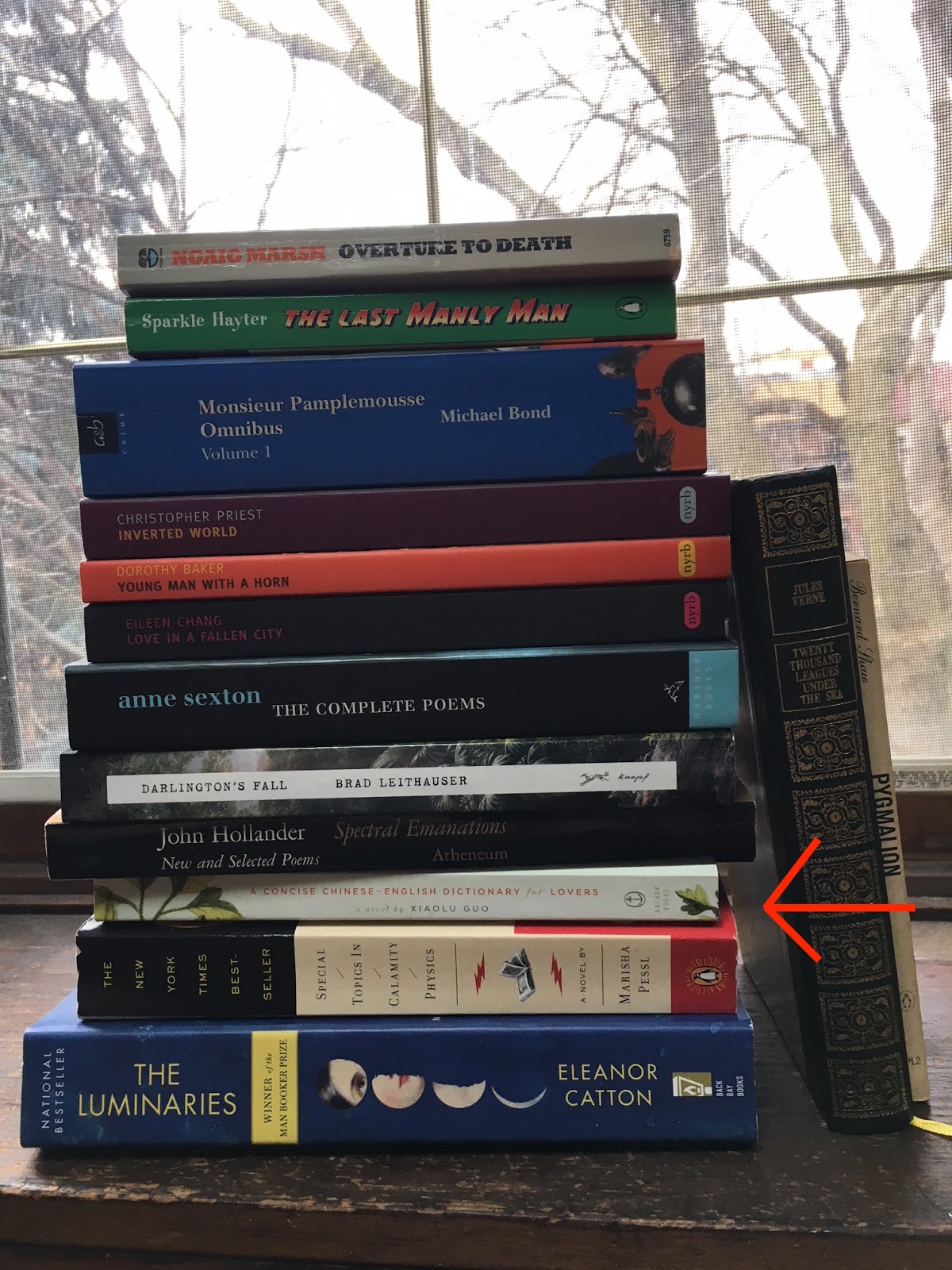
Roof Beam Reader 2019 TBR Challenge Signup


Adam at Roof Beam Reader hosts a TBR challenge. I'm signing up this year for the first time. It's a dozen books (plus two alternates) and requires you to specify in advance the books you're going to read. Tricky! At least for me. My reading habits usually amount to "Ooh...shiny!" and off I go in some new direction. Head off to his announcement post for full details.

There are lots of books around here to choose from; it's the choosing that's hard. To help out I decided on some categories before I even started. Here's the list:

Contemporary fiction. I see a review of something and think that sounds fun! Now is the time to find out if I was right:

1.) Eleanor Catton/The Luminaries
2.) Marisha Pessl/Special Topics in Calamity Physics
3.) Xialou Guo/A Concise Chinese-English Dictionary for Lovers

Poetry. Poetry volumes are often slim and those get read right away. But if they aren't and they don't...

4.) John Hollander/Spectral Emanations: New and Selected Poems
5.) Brad Leithauser/Darlington's Fall
6.) Anne Sexton/The Complete Poems

New York Review Book reissues. I've had such ridiculous good luck with their reissues, I can't resist something new and unknown when it shows up at my remaindered book store. But sometimes they slip into the pile. Time to catch up on those!

7.) Eileen Chang/Love In A Fallen City
8.) Dorothy Baker/Young Man With A Horn
9.) Christopher Priest/Inverted World

Detective Stories. How is it I even have crime novels aged for over a year on my TBR pile? I'm not sure, but not for much longer...

10.) Michael Bond/Monsieur Pamplemousse Omnibus, Vol. 1
11.) Sparkle Hayter/The Last Manly Man
12.) Ngaio Marsh/Overture to Death

And for my two alternates. Two readable choices from my Classics Club list.

1.) George Bernard Shaw/Pygmalion
2.) Jules Verne/Twenty Thousand Leagues Under The Sea

Thanks to Adam for hosting!